2019 Scarecrow Psychotronic Challenge Day 8: Roller Blade (1985)

DAY 8. AFTER THE DISASTER: Will we rebuild, adapt or move on?

If there’s one thing this site has been about as of late, it’s been post-apocalyptic films. Just take a look at this Letterboxd list that keeps track of all of them — if a movie has been made about the end of the world, we’ve watched it, written about it and told way too many people about it.

So after watching more than a hundred post-End of All Things movies, where else do we have to go?

1985’s Roller Blade was directed by Donald Jackson, who was no stranger to end of the world movies. You’d probably know him best for the movie where Roddy Piper plays a male stud who knocks up fertile women and battles amphibians, Hell Comes to Frogtown.

He was also no stranger to post-nuke films that feature people on skates, for some reason. This very narrow genre of films is actually much wider than you think it is, thanks to movies like Solarbabies, Prayer of the Rollerboys and the many, many films that Jackson created, such as Roller Blade Warriors: Taken by Force, The Roller Blade Seven, The Legend of the Rollerblade Seven and Return of the Roller Blade Seven. He was also responsible for the 1996’s Rollergator, in which a purple jive-talking alligator escapes from Joe Estevez’s carnival and does battle with a skateboarding ninja.

Look — it’s 4 AM and I’m not certain that any of this is real. I’m just going to write what I know and hope that this record proves that I was here, alive on Planet Earth and trying to contribute something worthwhile before I become dust.

In the City of Lost Angels, Sister Speed leads a holy order of rollerskating nuns called the Bod Sisters that try to protect humanity from the fascist regime that seems to be holding sway over things. All of the nuns wear strange cult-like robes with iron crosses on them when they’re not nude and Sister Speed rolls around in a wheelchair, yet she still has her skates on, just in case her legs decide to start working again.

Perhaps the most telling thing I can say about this movie is that everyone is on old four-wheeled skates and not inline Rollerblades, so it’s basically lying to you with every single moment of screen time.

Then again, this is also a movie where switchblades are used to heal people.

The sisters also have this magic crystal that the bad guys want and they’ve possessed a young girl to infiltrate the skating nuns. Those bad guys are led by Dr. Santicoy, who has a leather dom mask and a hand puppet made from a silver-painted baby doll that he talks to. Also, for some reason, one of the head nuns is a dog named the Holy Hound Gideon. Yes, they put a dog in a colorful nun outfit that kind of makes that canine look like it joined some weird Satanic cult.

Nearly every single person in this movie has been dubbed, which makes it seem like you’re watching an episode of Power Rangers, but it’s an episode where everyone has naked rollerskate fights and has sapphic interludes in a hot tub.

There’s also a group of skating law enforcement officers led by Marshall Goodman, whose son Little Chris (played by Fred Olen Ray’s young son) runs away without his skates. Yes, he disobeyed the biggest rule in this wasteland. He took his skates off.

Unlike nearly every great end of the world movie, no effort has been made to explain how the world got this way. Who has time when there’s so much skating to do?

It also shouldn’t surprise you that a majority of the Bod Sisters — like Shaun Michelle, Melanie Scott, Crystal Breeze and Michelle Bauer (who was also in Dr. Alien and Sorority Babes in the Slimeball Bowl-O-Rama — are well-known adult actresses. The quality of a mid-1980’s VCA adult effort is completely apparent here, but just when you expect the performers to start getting down, they start skate fighting instead.

I’m not sure who this movie was made for, why it existed or how it found it’s way into my Plex stream at 4:49 AM, but it’s moments like these that make me realize that God doesn’t play dice and that there’s some kind of grand plan. Because otherwise, watching a cinema opus like Roller Blade would find me screaming into the void.

The Quiet Earth (1985)

This one is for the Lords of the Rings trilogy fans.

This New Zealand-produced entry is an end-of-the-world dramatic-mystery thriller and not some Down Under, post-apoc frolic in the vein of Mad Max, Battletruck, Dead End Drive-In, or Turkey Shoot. Unlike most low-budget “futures” that have no choice but to create simplified futures utilizing clothing, technology, vehicles, and architecture that resemble our present—there’s nothing “simplified” about The Quiet Earth. This introspective story ranks with the class and style Francois Truffaut’s Fahrenheit 451 (1967), the American PBS-TV adaptation of Ursula K. LeGuin’s A Lathe of Heaven (1980; the great Bruce Davison), the equally beautiful Testament made for the PBS “American Playhouse” series (1983; starring the awesome Jane Alexander), and Nicholas Meyer’s exquisitely dire The Day After (1983; with the skilled John Lithgow, Amy Madigan, Jason Robards, and JoBeth Williams).

Watch the trailer.

The Quiet Earth works because we’re in the “first day” of the post-apocalypse of our present and not a budgetary-inept projected future. There’s no low-budget nuclear holocaust or worldwide plague that text scrolls and voice-over photo montages us into boredom. There are no petulant dramatic arcs or epic events, just plausibility on how humans realistically accept the fact that they’re living in a world — a day after the end. While there are a few action set pieces and explosions, they’re not superfluous, Roger Corman-plot deficiency compensations.

New Zealand’s greatest acting export, Bruno Lawrence (who made the post-apoc rounds in Battletruck and received international acclaim for 1981’s Smash Place; VHS hounds remember him for 1981’s less successful, Race for the Yankee Zephyr), is Zac Hobson. A scientist employed by an international conglomerate, Zac wakes up the from the night before, only to watch the morning sun “oscillate” to darkness—and it kills all radio communications. He comes to discover that, while it’s the same work-a-day world as yesterday, everyone, except him, has vanished. And instead of the hackneyed apoc bomb drop, plague, or space infestation, Hobson discovers “Project Flashlight,” the consortium’s experiment to create a unifying and lifesaving “global energy grid,” malfunctioned, resulting in a dimensional timeshift.

As with his aforementioned apoc-thespian peers from across-the-pod, Lawrence (excellently) wanders through a deserted city as he copes with the silence and loneliness, and eventual madness, which results in his dressing in woman’s clothing and creating cardboard cutouts of people. He comes to find — and have a sexual relationship with — a young woman, Joanne (Allison Routledge of New Zealand’s “Deliverance,” 1986’s Bridge to Nowhere; with Lawrence). The duo then discovers a third person, Api, an indigenous Polynesian Maori man (Peter Smith). This sets up a reminiscent emotional triangle—only with superior acting chops and cinematic style—from the first wave of post-apocalyptic/end-of-the-world films of the ‘50s and ‘60s, with the analogous precursors: the good, MGM’s The World, the Flesh, and the Devil (1958), and that film’s inferior Corman-clone, The Last Woman on Earth (1966). Somewhat reminiscent of Richard Matheson’s 1954 novel I Am Legend; adapted as The Last Man on Earth (1964), The Quiet Earth is based on the 1981 Craig Harrison book of the same name.

Since you’re being encouraged to watch this intriguing film that embarrasses most of the other day-of-reckoning films reviewed on B&S Movies, there’s no need to inundate this review with plot spoiler minutiae, except to say: As the omega triangle begins to shatter and the trio discovers why they survived, the “MacGuffin” that created the rip in the space-time continuum is ready to “oscillate” once more.

Geoff Murphy gained worldwide recognition outside of New Zealand with his fourth feature, Goodbye Pork Pie (1981; stars Bruno Lawrence), a very funny road movie critically described as Easy Rider meets The Keystone Cops. Murphy made his Hollywood directorial debut — and had box office hits — with the brat-pack western Young Guns II (1990) and sci-fi’s Freejack (1992). He achieved his biggest international box office success as a director with Steven Seagal’s Under Seige 2: Dark Territory (1995). At that point, Murphy went into 2nd Unit work on the volcano-disaster epic Dante’s Peak (1997) and Peter Jackson’s Lord of the Rings blockbuster trilogy (2001 to 2003).

Film Movement Classics released a DVD/Blu-ray 2K Restoration in 2017. Arrow Films issued their Blu-ray in July 2018. You can also stream the films via Amazon Prime, Google Play, and Vudu. We also took another look-see as result of our “Cannon Month” of reviews, as they re-distributed the film on video in overseas markets.

Here’s a few, less quite Earth flicks to enjoy (click the images to get there).

About the Author: You can read the music and film reviews of R.D Francis on Medium and learn more about his work on Facebook.

Survival 1990 (1985)

Remember B&S Movies’ past geographical warnings about staying the hell out of South Africa and keeping your ass in the Philippines, Italy, and Australia for your post-apocalyptic fixes?

Well, add Canada to the list. Be warned, my fellow apoc-rats. The lands of Survival 1990 aren’t across the border from 1990: The Bronx Warriors. If ever a film needed a meeting of the Riders and Tigers, this is the movie.

Also known as Survival Earth in its VHS revival, this canuxploitation dropping that makes the Canux nuc-fest Def Con 4 look like Escape from New York occurs in 1996, ten years after “The Fall,” which refers to the collapse of the world economy and . . . hey, wait a minute . . . 10 years after 1996 is 1986 . . . so why does the title refer to the year of 1990? I know, I know. Don’t overthink the (lack of) plot . . . and math. Which brings us to questioning who made this? Yep, the mathematicians at Emmeritus Productions, the Canadian studio that also made the computer-takes-over-a-hi-tech hi-rise A.I tomfoolery, The Tower, and the inert John Carpenter-porn knock off, Blue Murder.

Duh. You’ve been warned.

Anyway, this shot on video tape for Canadian TV potboiler starts with a stock footage montage of some riots, newspaper articles, nuclear power plants, and politician infighting that fades out under an optical effect informing us the big one dropped. And that’s the end of the special effects for the movie.

The resident “Adam and Eve” survivors living in the wiles of Toronto are John and Miranda, who meander through the woods and talk, talk, talk . . . and read poetry (at least books survived “The Fall”), and goes all philosophical quoting Yeats. And when drippy John isn’t reading poetry, he talks about the good ol’ days of mowing grass, driving his ol’ Honda Civic, and about his dad’s cloning experiments (a major plot twist, don’t forget!).

In addition to a mysterious “creature” shadowing their every move, they meet up with Simon, a soldier of fortune (in run-of-the-mill camo-fatigues off the rack at Bass Pro Shops) who survived the war and becomes their ally. And thank god, because Simon at least has a rifle and a pistol to fight off the mutant-vandals (that aren’t at all “mutant” and look more like raggedy street people) who kill John. Then John’s clone—who’s been spying on them—shows up and rescues Miranda. And they read more poetry and bicker happy ever after. The end.

So if you need to explore the post-nuke wastelands of the Great White North — sans any Snakes or Trashes, or props, or special effects, or sets, or costumes, or action, or plot, or point — then this is your film. This rarity from the video ‘80s — that’s never been issued to DVD or Blu-ray (complete with trailers for the low-budget videotape pot boilers Deadly Pursuit and The Edge) — is on You Tube.

Star Nancy Cser, who played Miranda, received some video-store fame courtesy of the 1986 Canadian soft core skin flick, Perfect Timing, which had plenty of naked women for us horn dogs—and nary a plot. Not that we cared about the plot. For when you have boobies, you need no plot. Wow. We already sat through The Tower. So, sorry, Nancy: no more reviews for you. Some movies are best forgotten.

About the Author: You can read the music and film reviews of R.D Francis on Medium and learn more about his work on Facebook.

Def Con 4 (1985)

Or, as I like to call it: Escape from Nova Scotia, is another caveat emptor from the video ‘80s with another bogus post-apoc film that doesn’t live up to its flashy poster/video box art work. (They never really do, do they?) So, instead of a massive, crashed spaceship (like in the Mark Wahlberg Planet of the Apes remake) you get a dinky geosphere-pod thingy stuck in the dirt (that doesn’t look big enough to house the crew cabin we seen earlier in the film) and there are no decayed skeletons inside space suits sticking out of the arid landscape, either. And no disrespect to the late, Texas-born actor Tim Chaote (Zathrus from TV’s Babylon 5) as Howe . . . but he’s no Snake Plissken or Max Rockatansky.

Catch the trailer on You Tube, here.

If ever a film ever needed a shot of Michael Sopkiw and Mark Gregory under the lens of Sergio Martino or, even better, Cirio H. Santiago, this would be the film. At the very least we need a bubblegum chewing and ass kicking Roddy Piper saving the Canadian east coast. Even some Steve Sandor beefcake water-chasing would be welcomed. Yeah, this Nova Scotian hell needs a Frogtown.

Anyway . . . we get Dr. Sheldon Cooper, I mean, Tim Choate, as one of three astronauts, including Jordan (Kate Lynch; Meatballs, Eddie and the Cruisers II: Eddie Lives!), stationed on Nemesis, a top secret, joint Canadian-U.S military nuclear platform in Earth orbit when World War III erupts by “accident” . . . courtesy of a Libyan-stolen cache of cruise missiles shot into Russia (that we learn about via a TV transmission on the spaceship . . . yawn).

Hey, wait a minute, R.D . . . aren’t you confusing this movie with Steve Barkett’s Mad Max vanity project, The Aftermath (1982) . . . the one where an astronaut fights a biker gang led by a villain named (Toe) Cutter who rules the post-nuke wasteland? You know, the one that became a U.K Section 3 video nasty?

Dude, I wish I was . . . at least that movie had the awesome Sid Haig (Galaxy of Terror) to cut through the post-apoc crapola.

Sid Haig? No. Richard Moll from Metalstorm: The Destruction of Jared-Syn starred in The Aftermath.

No, you’re thinking of Survivor (1987) starring Chip Meyer, which has the same ol’ Mad Max-inspired astronaut returning to a slow ‘n’ boring, low-budget apoc-chatty chat world.

Well, anyway . . . in place of Haig and Moll we get our favorite Canadian-American character actor, Maury Chaykin (Jim Sting in WarGames, Sam Tipton in My Cousin Vinny), as a crazed survivalist with a captive school uniform-clad babe in the cellar (Canadian scream queen Lenore Zann of Happy Birthday to Me, Visiting Hours, American Nightmare; the voice of Rogue in X-Men: The Animated Series). But not even Chaykin’s thespian scene chewing can save us from the post-nuke no-action boredom punctuated with lots of chitty-chatter about “radiation zones” and “clean zones” and “terminals” and everyone telling us how the world ended up this way. Yawn.

The film starts off promising enough on the space station and setting up the story during its first 30 minutes . . . it has a decent spacewalk scene . . . the scenes with Howe receiving a ghostly message on the radio from his wife after the war is over and his trying to save a fellow astronaut being yanked through the sand by “something” as they dig themselves out of the wreck are especially chilling. Then the fast forward button on the VCR remote goes into overtime once Gideon (a reference to an Old Testament military leader, really? While you’re at it, why not name the rest of your characters Stryker or Hunter like all the other apoc movies do? Geeze.), the perfectly-coifed Shaun Cassidy clone (Kevin King, Iron Eagle) shows up as the requisite dickhead, ex-military school-army brat who goes all despotic on the poor slobs shuffling around the Scotian woods. Yeah, this film really needs a Sig Haig . . . or a Lee Van Cleef . . . to villain up the joint, not this snot-nose punk kid that needs his ass spanked and sent to his room without supper. Lord Humungous, we beg for your vengeance!

Anyway, it turns out Giddy-boy hacked the space platform and forced the astronauts back to Earth, since they have the technology to help find a “clean zone” to escape the contamination that will wipe out the survivors in two months. (Huh? Well, wait . . . if Giddy the Gimp has the technology to hack a military nuc-platform, then it follows he has the technology to find a way off Nova Scotia . . . oh, never mind. I’m overthinking the plot.) And with that, we get lots of boring Battletruck tomfoolery . . . and talking, talking, and talking . . . and talking, with people babbling in the woods (sans the truck or motorcycles . . . or laser crossbow weapons or Whistler Swords) that they need to get off the isle of Nova Scotia and onto the mainland before a malfunctioning warhead on the crashed platform explodes in sixty hours.

Dear Lord! Will somebody start kicking some ass around here? Snake! Max! Parsifal! Trash! Stryker! Even Paco Queruak would be welcomed! Where are you, guys! We’ll even take the headbanded Chip Meyer from Survivor (yikes, he looks like the lead singer from Canada’s Loverboy!). Someone help these dolts Escape from Nova Scotia, already!

The real pisser of this film: It was made with Canadian Government Tax dollars via what seems to have been some bogus program to encourage film production in the Great White North—at the tune of 1,750,000 Canadian . . . its worldwide gross barely broke a million dollars in box office. Granted, it eventually cleaned up on home video market, but as a Canadian tax payer, I’d be pissed the government taxed my hard earned money for Roger Corman’s benefit.

And another thing: It’s not only CNN that references the Def Con System incorrectly (in defiance of The Donald)so does this film. In fact, the correct title for this film should be Def Con 1, which means “imminent war” . . . as in the shit has already hit the proverbial apoc-fan and the Earth is about to be burnt to a cinder and ruled by the leather studded, metal-hockey masked Humongous. A Def Con 4 is a picnic in the park, as this Newsy report on the media’s perpetual Def Con faux pas tells us. You got that, kids? Def Con 1 is bad. Def Con 5 is good. And if you don’t . . . well, ‘ol Commander General Jack Beringer is just gonna kick you in the ass until you do! And for god sakes, when you’re trying to be a bad-ass, don’t say your “taking this baby up to Def Con 6,” you’ll only end up looking like a dick.

At least the interjections of Commander USA of Commander USA’s Groovy Movies make Def Con 4 more entertaining. Check it out (complete with the original commercials and promos for USA’s Saturday Nightmares airing of The Intruder Within!) on You Tube. If you’d rather watch it without the Commander USA gibberish, then check out this clean VHS rip uploaded to You Tube. You say you want a better copy for your personal library? In January 2019, Arrow Video released a 2K Restoration from the original 35MM interpostive. The Blu-ray features all new interview vignettes and a color booklet with more behind the scenes information on the film.

Do you need more apocalypse Intel? I invite you on a journey through the radiated landscapes with the Medium article, “Warriors of the Pasta-Apocalypse: Michael Sopkiw and Mark Gregory Kicking Ass in the ’80s Italian Wastelands,” which serves as a career retrospective on both actors, along with reviews of 2019: After the Fall of New York, 1990: The Bronx Warriors, and Escape from the Bronx.

You can catch up on the wide array of post-apocalyptic adventures with B&S Movies’ “Atomic Dust Bins” Part 1 and Part 2 featuring 20 mini-reviews of movies you never heard of, along with a “hit list” featuring all of the apoc-flicks we watched for September 2019’s Apoc Month.

About the Author: You can read the music and film reviews of R.D Francis on Medium and learn more about his work on Facebook.

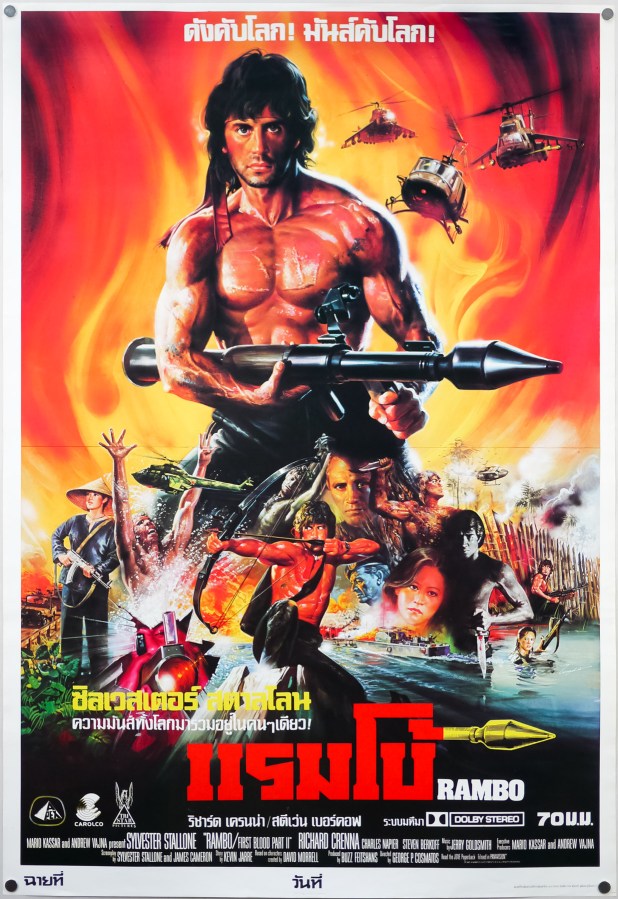
Rambo: First Blood Part II (1985)

When it came time to do a sequel to First Blood, there was a thought that Rambo needed a partner.

Producers wanted John Travolta, but Stallone vetoed the idea. Lee Marvin (who almost played  Colonel Trautman in the first film) was offered the role of Marshall Murdock, but declined.

In fact, that sidekick character is in the first draft James Cameron wrote for this film. Stallone said of what he wrote, “In his original draft it took nearly 30-40 pages to have any action initiated and Rambo was partnered with a tech-y sidekick.”

What ended up on screen was very different.

“Rambo, John J., born 7/6/47 Bowie, Arizona of Indian-German descent. Joined army 8/6/64. Accepted, Special Forces specialization, light weapons, cross-trained as medic. Helicopter and language qualified, 59 confirmed kills, two Silver Stars, four Bronze, four Purple Hearts, Distinguished Service Cross, Medal of Honor.”

Yep — that’s our hero. Given that he kills 74 people in just two days in this film, he’s somehow more successful in Vietnam the second time. But we’ll get to that.

For now, it’s been three years and Rambo is paying for his actions in the original movie when he’s visited by Colonel Sam Trautman. Even though the Vietnam War is over, people remain convinced that POWs have been left behind. The government has authorized a solo mission to confirm if any are alive and Rambo is one of only three men suited for such a mission (who the other two are, I leave up to you, dear viewer, but if one of them isn’t Thunder, I don’t want to know about it).

Marshall Murdock (Charles Napier) is the suit in charge that tells Rambo that all he has to do is take hotos, not rescue anyone or engage the enemy. As Rambo drops into enemy territory, his parachute becomes tangled, leaving him with only a knife and a bow. He doesn’t need all those guns, trust me.

A young intelligence agent named Co-Bao (Julia Nickson) and some pirates take Rambo up river, where he saves an American POW who has been crucified and left to die. The Vietnamese troops attack and the pirates betray Rambo, so he kills everyone. Rambo’s extraction is cancelled, as Murdock says that Rambo has violated his orders and tells Trautman that he never intended for there to be any rescue — it would be too expensive and no one wants another war.

Rambo is turned over to teh Soviet troops who are training the Vietnamese, Lieutenant Colonel Podovsky and Sergeant Yushin. They demand that he read the US government a message to stay away from future missions. Instead, he warns Murdock that he’s coming for him. He escapes thanks to Co and they kiss, only for her to die seconds later. 

Rambo then becomes a slasher villain that we cheer for as he wipes out every single enemy one by one. He even steals a helicopter and uses it to destroy Murdock’s office before demanding that the rest of the POWs get recued. 

Trautman then confronts Rambo and tries to convince him to return home, but our protagonist angrily replies that he only wants his country to love its soldiers as much as its soldiers love it.

James Cameron claims that he only wrote the first draft of the script and that Sylvester Stallone made many changes to it. He claims that the star didn’t like that the sidekick got all the cool dialogue and scrapped most of the POWs backstories.

When the film was released, the political content of the movie was controversial, with many critics not ready to see any heroism in the Vietnam War. For his part, Cameron commented that he wrote the action and Stallone the politics.

That said — at the time of the making of this film, there were 2,500 soldiers missing in action, so you can see where the sentiments were coming from. There were even reports that Delta Force operatives were in training to try and find those prisoners.

Stallone explained the ending of the film quite passionately: “I think that James Cameron is a brilliant talent, but I thought the politics were important, such as a right-wing stance coming from Trautman and his nemesis, Murdock, contrasted by Rambo’s obvious neutrality, which I believe is explained in Rambo’s final speech. I realize his speech at the end may have caused millions of viewers to burst veins in their eyeballs by rolling them excessively, but the sentiment stated was conveyed to me by many veterans.”

This film was beloved by audiences worldwide just as much as it was savaged by critics. It won Worst Picture, Worst Actor, Worst Screenplay and Worst Song (“Peace In Our Time” by Frank Stallone) in the  Razzie Awards. It doesn’t matter — it started an entire genre of military revenge pictures.

Director George P. Cosmatos would go on to work with Stallone again on Cobra, as well as direct the films Leviathan and Tombstone. He was recommended for the film by Stallone’s son Sage, who liked his movie Of Unknown Origin.

This movie marks a true change from the way American audiences would view Vietnam and its veterans. It could have only been made in 1985, to be honest, and exists within that time to remind us of a completely different era.

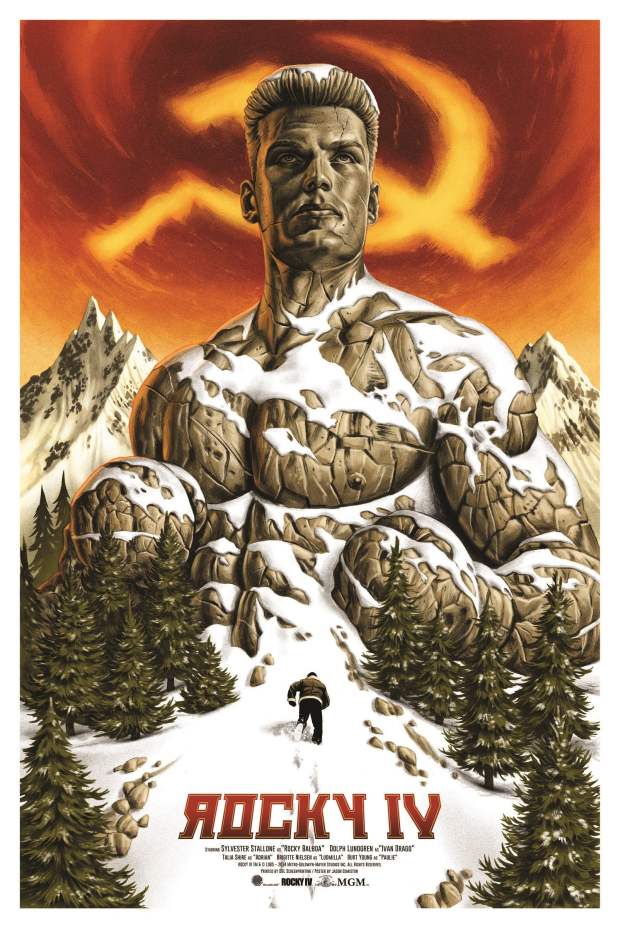
Rocky IV (1985)

Written by, directed by and starring Sylvester Stallone, this movie rode the crest of Reagan era jingoistic fervor to a $300 million dollar box office. The actual story is pretty much non-existent, as it only concerns two boxing matches and several montages. That said, it’s the kind of movie that makes me want to scream my head off and cheer. In spite of how silly it all seems, it does it’s job so very well.

Captain Ivan Drago (Dolph Lundgren) is the perfect Soviet athlete, more killing machine than boxer who has been trained to never lose. Along with a team of trainers, his Olympian swimmer wife Ludmilla (Brigitte Nielsen) and manager Nicolai Koloff (Michael Pataki!), his goal is to prove the supremacy of the Soviet athlete.

To do that, he wants a match with Rocky Balboa, but the champ doesn’t want it. Instead, his former rival and best friend Apollo Creed (Carl Weathers) takes the match, as much to prove to himself he can still fight as his patriotism is threatened by Russia’s boasts.

Their fight is incredible. Drago simply walks to the ring while Apollo has live entrance music from James Brown, who tears through “Living in America” with a team of showgirls. Yet soon, the MGM Grand in Las Vegas is quieted as Drago absolutely tears Apollo apart. Rocky and Apollo’s trainer Duke (Larry Burton, who was in Assault on Precinct 13 and played Larry Durkin, the garage owner in The Shining) beg their friend to throw in the towel, but he tells them to not stop the match no matter what. Drago hits him with one more punch that literally kills him, before he tells the assembled media, “If he dies, he dies.”

Now Rocky wants that match. The Russians agree to an unsanctioned 15-round fight in the Soviet Union on Christmas Day (to protect Drago from the threats of violence he has been getting in the U.S.), so Rocky tells his wife he must leave her behind. Now, it’s all about the fight as he goes to Krasnogourbinsk with Duke and his brother-in-law Paulie (Burt Young, who of course I’ll always love from Amityville II: The Possession).

The montage where Rocky trains in the snow, while Drago works out in a high tech gym, is the kind of thing that never happens in film anymore. It’s completely ridiculous, yet ai love every single minute of it. Drago is getting shot up with steroids while Rocky helps Russian farmers lift their sleds in the snow. It does bring a tear to one’s eye.

Finally, we arrive at the big battle, with Rocky’s wife Adrian (Talia Shire) even coming to Russia. Of course Rocky wins — “He is not human. He is made of iron.” — but you knew that coming in. The end, with Rocky telling a crowd of Russians that he has won over that, “If I can change, and you can change, then everybody can change!” makes me jump up and down nearly thirty-five years after its release.

That fight scene at the end looks so good because, well, it’s real. Or at least Stallone says they are. He wanted realism and Lundgren agreed that they would legitimately spar. One brutal punch to Stallone’s chest later and his heart slammed against his breastbone and swelled up, sending him into intensive care for eight days. Lundgren also punched Carl Weathers so hard that he walked off the set and didn’t return for four days.

While Rocky trained in a cabin (inspiring Olympians Michael Phelps and Ryan Locht), the high-tech equipment Drago uses is real and was around twenty years away from being publically used.

Speaking of high-tech, the real star of the film is SICO, the robot who played Paulie’s gift. That scene — where he sings “Happy birthday Paulie!” — is perhaps one of my top ten moments in all cinema. It’s so at odds with the rest of the movie that I can’t help but love it. It actually is in there for a great reason, the International Robotics Inc. creation — featuring the voice of the company’s CEO Robert Doornick — was written into the movie after it had been used to help treat Stallone’s autistic son, Seargeoh.

Stallone’s original plan was for Rocky V to be about the downward spiral that both Rocky and Drago would travel after this fight, with the Russian returning home in disgrace before becoming addicted to alcohol and steroids, then committing suicide. That never happened, although Creed II is all about the fight between Apollo and Drago’s sons, with Lundgren returning to play his famous role.

The film won five Golden Raspberry Awards, including Worst Actor (Sylvester Stallone), Worst Director (Stallone), Worst Supporting Actress (Brigitte Nielsen), Worst New Star (Nielsen) and Worst Musical Score. It also received nominations for Worst Picture, Worst Supporting Actress (Talia Shire), Worst Supporting Actor (Burt Young) and Worst Screenplay. I’m certain that Stallone wasn’t concerned, what with this being the biggest performing sports film ever — until The Blind Side was released.

This movie was also part of a famous copyright lawsuit, Anderson v. Stallone. Timothy Anderson developed a treatment for Rocky IV on spec. After the studio didn’t purchase it, the movie ended up very close to his treatment. The decision was that Anderson had “prepared an unauthorized derivative work of the characters Stallone had developed in Rocky I through III, and thus he could not enforce his unauthorized story extension against the owner of the character’s copyrights.”

There was even a special trailer made for this film with Drago telling the audience how he would defeat Rocky. If you don’t want to watch this movie after this scene, I have no idea what is wrong with you.

ANOTHER TAKE ON: Night Train to Terror (1985)

“Daddy’s in the dining room,
Sortin’ through the news.
Mama’s at the shopping mall,
Buyin’ new shoes.
Everybody’s got something to do,
Everybody but you.

Come on and dance with me, dance with me
Everybody’s got something to do,
Everybody but you.

Sister’s on the telephone,
Gossipin’ again.
Junior’s at the arcade,
Smokin’ with his friends.
Everybody’s got something to do,
Everybody but you.”

night_train_to_terror_poster_03

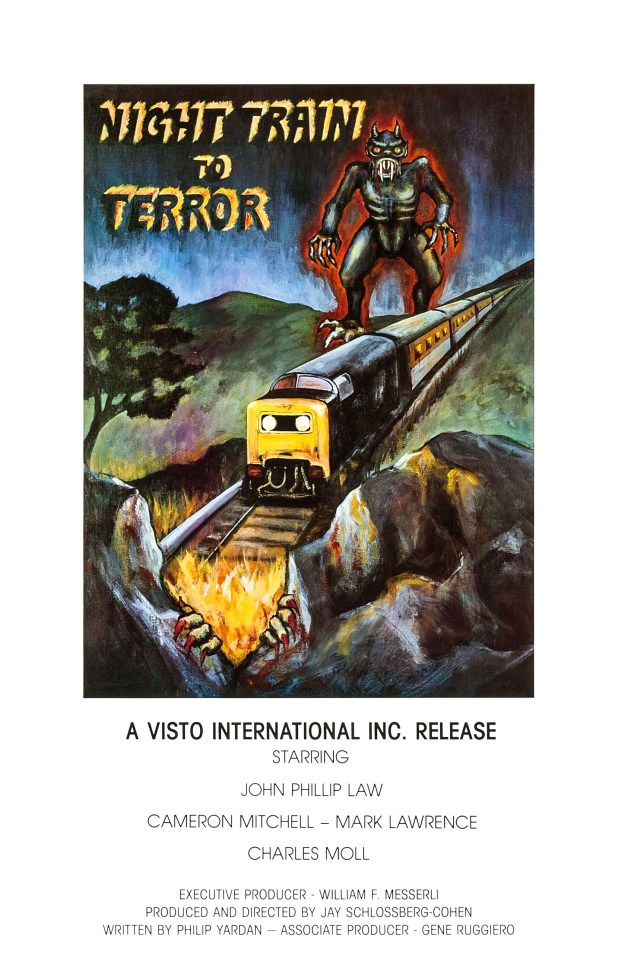
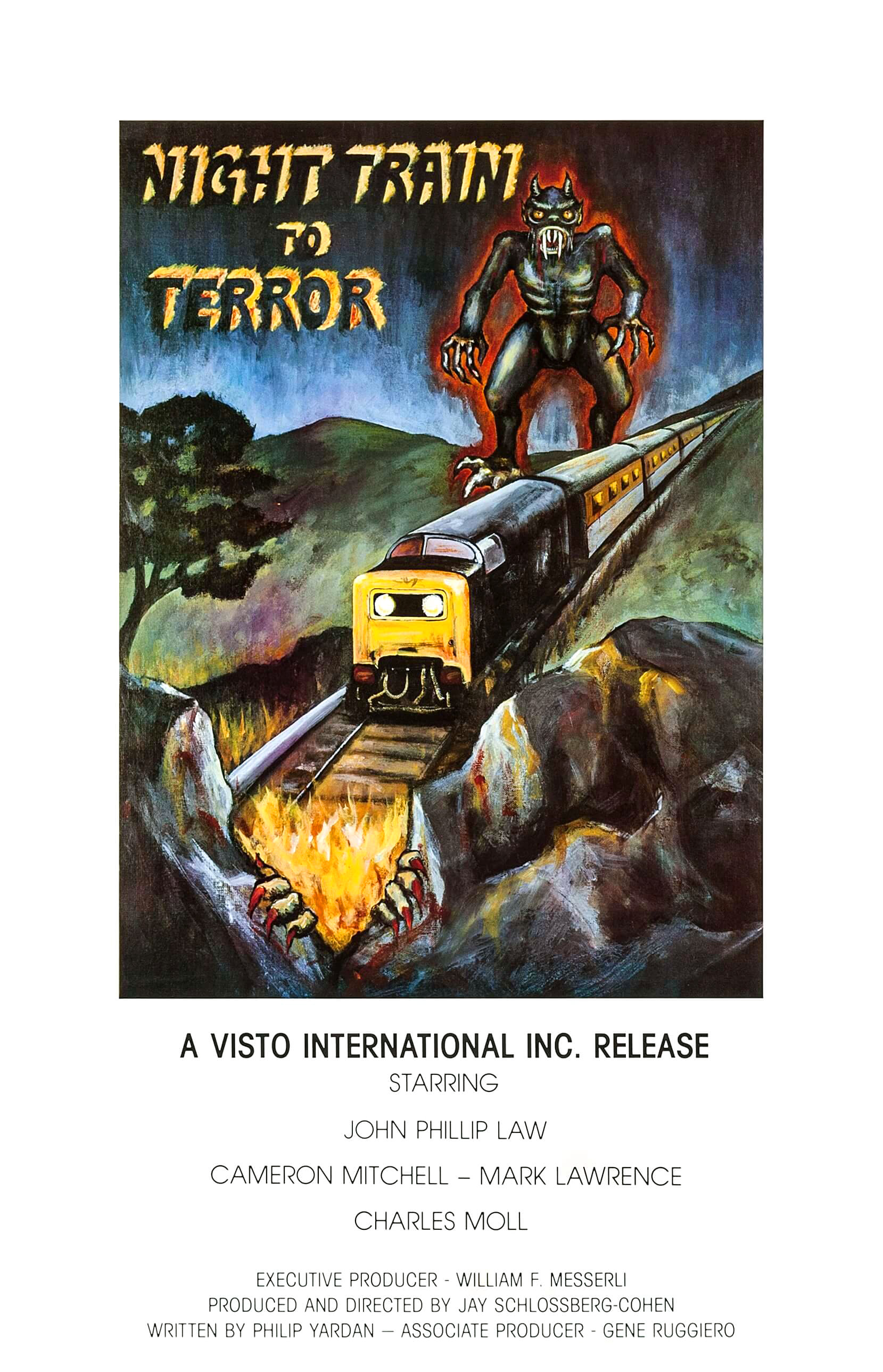
For better or worse, there’s never been another movie quite like Night Train to Terror. And how could there be? This isn’t just one movie — it’s three movies in one. None of these movies felt releasable on their own, so much like Spookies or Fright House, those three movies were all shoveled into one furnace, much like how coal powers the engine.

Unlike those films, which just jams the stories together, the stories here are linked by a framing sequence of a band that’s traveling through the night on, well, a night train to terror. All the while, God (Ferdy Mane, last seen as Count von Krolock from The Fearless Vampire Killers, who felt this movie was so poor that he penned a letter to its director) and Satan (Tony Giorgio, who wasn’t just Bruno Tattaglia  in The Godfather but the Playboy Club’s in-house gambling expert. He’s also the sheriff in another film that may possibly melt your mind, the Bigfoot-centric Cry Wilderness) are just a few cars down, debating whether or not the band will live to see their next destination. Meanwhile, the night porter makes faces at the camera years before single camera shows like The Office and Curb Your Enthusiasm made such mugging de rigueur. 

Get to know the band. After all, you’re going to see them between each and every story as they repeat the chorus of the song over and over — and over — again. They only take breaks to ask if they can get some hamburgers and beer, only to learn that there’s no food on this train. And that some call it the Heavenly Express and some call it Satan’s Cannonball, but they do guarantee to deliver every passenger to its right “dest…tin…ation!” Obviously, neither of the things people call the train are as good as Night Train to Terror, but that’s a moot point.

To determine the fate of these breakdancing fools — seriously, being in a band with fifty people has to be the worst ever because you split the door money every which way — the Divine Creator and the First of the Fallen decide to watch three different stories, at least one of which was a totally unfinished movie. 

The confusion stars with the very first story. In some releases, they are in a totally different order. But for those playing at home, we’re going to use the amazing Vinegar Syndrome blu ray release of this film to go from.

In The Case of Harry Billings, John Phillip Law (an angel in Barbarella and forever in my heart Diabolik) has been manipulated into working for the spare body parts black market. You know how it goes, right? This story is packed with nonsensical jump cuts, unnecessary surgery, gratuitous nudity and Richard Moll, who wasn’t even there for most of the scenes, with a double playing most of his action scenes. You can tell because the second version of him has incredibly hairy arms. While this movie wasn’t finished before it was pulled into this film, it was later completed and released on VHS as Scream Your Head Off.

After another band performance — they only have one song yet a near infinite number of band members and dancers — The Case of Gretta Connors is all about a nice young girl who used to work at the carnival. A man visits her booth and pays her to go out with him and before you know it, she’s a porn star. Again, that’s how life goes. 

One day, a college guy sees her on a stag loop and falls in love, eventually finding her and starting a relationship, which leads her old Hollywood producer sugar daddy husband to bring him into a suicide club. This club has a baroness and a guy who looks and acts like Jimi Hendrix, all playing games like letting a giant claymation beetle fly around and sting one of them to death or lie in sleeping bags until a giant ball crushes one of them. Back to Jimi — he’s electrocuted as he yells song lyrics. 

Like the other films, you can see the entire long version of this under many titles, such as The Dark Side of Love, Carnival of Fools, Gretta or Death Wish Club.

Speaking of song lyrics, the band is back and all they decided when they wrote this song, they’d just repeat the chorus. And then do it again. And then yell stuff like, “One more time!” That said, the song “Everybody But You” was really written by Joe Turano, who also has two other songs in this one that I’ll be damned if I can remember, probably because they weren’t repeatedly to pad the movies running time. Four years after he contributed — I should probably use another word like foisted — to this movie, he was a singing voice in The Little Mermaid. Yep. The Disney film.

Let’s get back on the train, because God and Satan have one final bet. The Case of Claire Hansen is about a surgeon who ends up battling a demon who was once a Nazi who is also in conflict with a Holocaust survivor who is best friends with Cameron Mitchell. Additionally, the surgeon is married to Richard Moll — back again with a constantly changing hairstyle and color — who inexplicably was awarded the Nobel Prize for writing a book that proves that God is dead. There’s also a swinging disco, a magical black man who calls out our heroine for America’s history of racism, more claymation scenes in the place of practical special effects because claymation was 1980’s CGI, an ex-priest named Papini who has a 666 tattoo and forced surgery. Somehow, they shrunk a 90-minute movie down into 30 minutes. That said, I’ve seen the full version of this as The Nightmare Never Ends (alternatively known as Cataclysm and Satan’s Supper, a name that sounds like a garage band fronted by a rebellious pimple-faced teen who has just read Anton LaVey for the first time). 

Are you ready to hear the song one more time? Wouldn’t you just love to see the band die in a giant train disaster? Good news — you have your wish granted. Except God has taken their souls up to heaven as we see an animated train choo-chooing up the clouds, where the nameless band will forever sing their song, driving cherubim and seraphim crazy for eternity.

To say Night Train to Terror is a strange movie is to say that Drive-In Asylum sometimes features ads from old horror movies. This is a brutal cocktail of unfinished films and a wraparound sequence that was written by writer Philip Yordan, who won an Oscar for writing the movie Broken Lance. Sound good? Well, the truth is, he was merely a front for blacklisted writers, like that movie’s true scribe, Joseph L. Mankiewicz. 

How can you not love a movie where Satan is credited as being portrayed by Lu Sifer and God by Himself? That said, if you decide to buy a ticket on this train, prepare to never escape the song that plays throughout. I sometimes go for a few days free of its power and then I start laughing about one of the lines in it, start to sing it and it goes on for hours. Hours, I tell you!

“Gonna be a bad boy,
Stayin’ after school.
Principal is workin’ hard,
Makin’ new rules.

Come on and dance with me, dance with me
(repeat 350 times)”

You can watch this on Tubi.

This article originally ran in Drive-In Asylum #14, which you can buy right here.

What Comes Around (1985)

When I was a kid, I had no illusions. I was probably never going to grow up to be Burt Reynolds. I was probably going to grow up to be Dom DeLuise. But in my heart of hearts, I was kind of hoping that I’d grow up to be Jerry Reed, who was always the dependable, no nonsense friend.

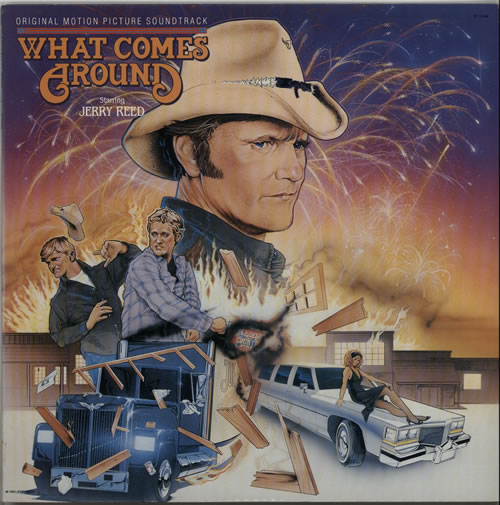
This was the first — and only — movie that Jerry Reed would direct. That alone marks it for inclusion in this week of redneck cinema.

It’s easy to only think of Jerry Reed as an actor. But there’s so much more. Despite spending seven years of his childhood in orphanges and foster homes after his parents divorce, Reed started writing and selling songs while still in his teens. His unqiue fingerpicking technique is still imitating by all manner of guitarists. And he wrote — and played session guitar — for plenty of Elvis Presley’s late 60s and early 70s releases.

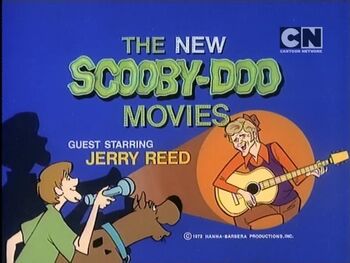
Reed also enjoyed a fruitful collaboration with Chet Atkins — they composed the theme for The Benny Hill Show, “Yakety Sax” together — as well as crossing over into the mainstream with hits like “When You’re Hot, You’re Hot.” Soon, the country star was appearing on The New Scooby-Doo Movies and getting into movies with his buddy Burt Reynolds.

The 70s, everyone.

Starting with 1974’s W.W. and the Dixie Dancekings, Reynolds and Reed would make a fine comedy team, also appearing in movies like GatorHIgh-Ballin’Hot Stuff and all three of the Smokey and the Bandit films.

Reed’s role in this film comes just one year after opening for Dexys Midnight Runners on tour, a tandem which quite frankly sets off fireworks inside my scattered mind. Reed also plays Joe Hawkins, a country singer who has been on the road for decades and feeling it. He’s basically held together with a cocktail of pills and booze.

His brother Tom (Bo Hopins, Midnight ExpressThe Wild Bunch) is pretty much estranged from our hero, at odds with the man who really runs Joe’s life, his manager Leon Redden. After Tom and his wife Sandy help Joe dry out, they discover that he’s been taken for $8 million dollars and help him get his revenge. Arte Johnson also shows up.

This is a wildly inconsistent film, one that can be a comedy one moment, a tragic family drama the next and then a comedy just as quickly. Yet it moved quickly and I was with it the whole way. It’s very much a redneck movie in that people do horrible things that should get them arrested at the very least and they’re the heroes.

Also — there’s no way to watch Eastbound and Down and not see a reflection of the way Kenny Powers and his brother Dustin interact together. In fact, it almost feels line for line from this film.

You can watch this on Amazon Prime.

Weird Science (1985)

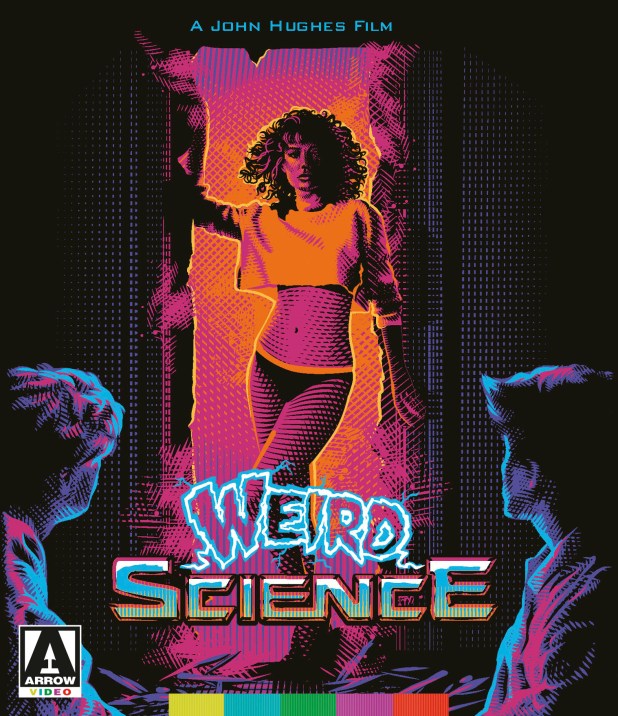
As John Hughes ruled the 1980’s with six films about teens, this was the first time that he moved from some level of realism to complete fantasy. Named after the 1950’s EC Comics title — producer Joel Silver even paid for the rights to the name — Weird Science seems on the surface that it will be teenage softcore fantasy fulfillment. That’s the bright spot of the film. Lisa may have been created on the computer to be the perfect woman, but the ideal woman would have a mind of her own.

Gary Wallace (Hughes’ avatar in three films, Anthony Michael Hall) and Wyatt Donnelly (who grew up to be a nerd in the best of ways as a professor and published Dungeons and Dragons author) are the geekiest of the geeks at Shermer High — the fictional school that all Hughes’ films emanate from. Their latest humiliation was being pantsed in front of their dream girls Deb (Suzanne Snyder, Killer Klowns from Outer Space) and Hilly (Judie Aronson, Friday the 13th: The Final Chapter) by their boyfriends Ian (an incredibly young Robert Downey Jr.) and Max (Robert Rusler, Sometimes They Come Back).

Inspired by Universal’s Frankenstein, the boys use magic, electricity and a computer to create the perfect woman. A power surge ensures and creates Lisa (Kelly LeBrock, the “it girl” of my teen years), who has limitless powers and the desire to take our boys and turn them into men. The thing is, she isn’t some bimbotastic plastic love doll created simply for their pleasure. That would render this whole movie incredibly stupid. No, she’s here to make their lives better.

There are so many obstacles in her way: Chet (an incredible Bill Paxton), who makes his brother’s life a living hell; the boy’s parents; and yep, Max and Ian. It all comes to a head at a party where a nuclear missile and mutant bikers — yes, that’s Michael Berryman and Vernon Wells — are part of the chaos. It all ends well — Chet gets turned into some form of feces monster while Gary and Wyatt get the girls. And Lisa? She ends up becoming a gym teacher.

My only issue with the film is the scene where the boys go to downtown Chicago and hang with a crowd of older black men, talking about the “eighth-grade bitch that broke his heart.” I realize that this movie was made in 1985, but even then, it completely took me out of the movie. I still have no idea why it remains. This Medium article only confirms that my feelings were valid.

Weird Science was memorable enough to lead to a 1994 to 1998 TV series version. A remake was announced, but that thankfully never made it to the screen.

Arrow Video is now bringing Weird Science to UHD. It features a 4K scan of the original negative, a high-definition 1080p presentation of the film’s theatrical version, and an exclusive extended version with two lost scenes remastered. You also get the edited-for-TV version of the movie and a comparison video showing the dubs and edits for this version.

There are interviews with unique makeup creator Craig Reardon, composer Ira Newborn, supporting actor John Kapelos and casting director Jackie Burch. There’s also It’s Alive: Resurrecting Weird Science, which was also on the 2008 DVD release of the film that has interviews with the cast and crew. If that’s not enough, there are trailers, TV and radio spots, an illustrated collectors’ booklet with Alexandra Heller-Nicholas and Amanda Reyes writing about their love of the movie, a fold-out poster featuring original and newly commissioned artwork by Tracie Ching and a reversible sleeve with the same artwork. It’s a fantastic package, even better than the Blu-ray version they released a year ago.

You can get the UHD and blu ray from MVD.

Radioactive Dreams (1985)

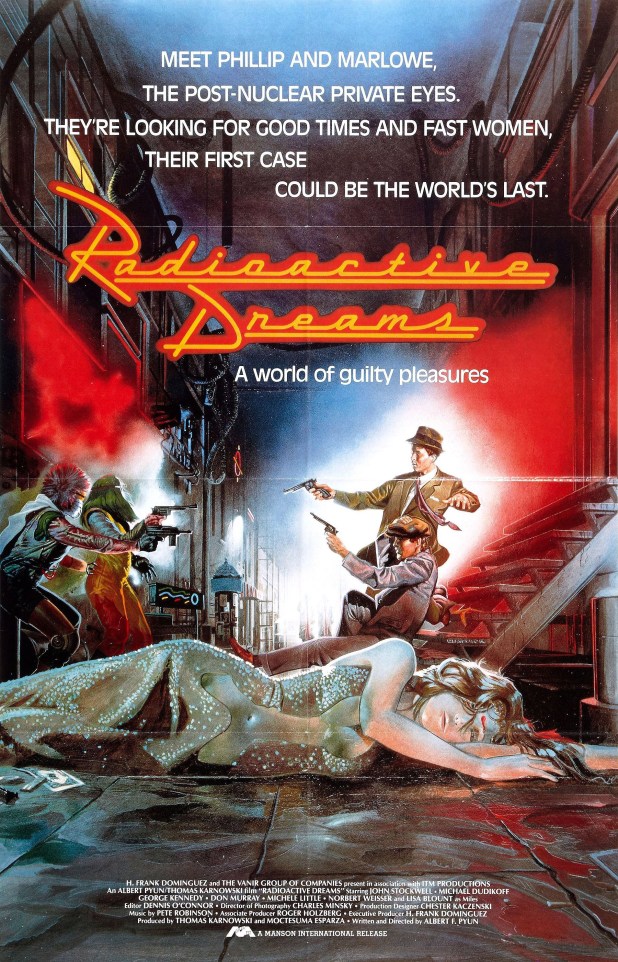
“My name’s Philip, and this is going to be a yarn about me and my pal, Marlowe. About the day we got out of this shelter and went off into the post-nuclear world. Now, as excited as we were about leaving the shelter, it was still a joint that held fond memories. I mean, it was the only world we’d ever known. Where I practiced my magic, Marlowe, his dancing; where we both dreamed of becoming private eyes, just like the one’s we’d read about.”

With those words, Philip Chandler (John Stockwell, Christine) and Marlowe Hammer (Michael Dudikoff, the American Ninja himself) — abandoned by their fathers in a fallout shelter cut into the side of a wooded mountain since the nuclear war of 1996 –enter the end of the world.

The pair have been raised by 1950s detective fiction and swing music. Now, with new haircuts and nice suits, they enter the world for their first day of adventure. They save a gorgeous girl named Miles (Lisa Blount, Prince of Darkness) within minutes and run afoul of another named Rusty (Michele Little, My Demon Lover) on the way to find the one nuclear missile that still remains.

They battle disco mutants, cannibals, child gangsters and one of their fathers — Spade Chandler, played by George Kennedy. The film ends with the duo engaging in a tap dance post-nuke shuffle throughout the city before seeming to set up future adventures.

Radioactive Dreams was written and directed by Albert Pyun, who you may know from his other films like DollmanCyborgThe Sword and the Sorcerer and Cannon’s 1990 Captain America, which featured Frank Langella as the Red Skull.

While this film never made it in theaters, it enjoyed a rich life on VHS. Yet somehow, in this era of multiple discoveries and re-releases, it hasn’t even come out on DVD yet!