Interface (1984)

Interface takes me back to the days of those “Big Box” in-a-plastic-tray oddball obscurities of yore that one happened upon a couple-of-years-after-the-fact of its release courtesy of one’s obsession (moi) of exploring the breathing-their-last-breath mom n’ pop video stores in the nooks ‘n crannies of strip malls. Just one look at that Pinhead-esque (Hellraiser didn’t come out until 1986!) villain peppered with wires . . . well, an early ’90s rescuing of this Vestron Video-imprint from the $1.00 cut-out rack was a non-brainer.

The cover I remember — and had — only it had a Vestron logo/courtesy of IMDb.

Speaking of brains: Creatively — in terms of the concepts running through its Pons connector — Interface is an SOV-styled cyberpunker with Cerebrum and Cerebellum to spare. In terms of everything else: it’s a decent could-have-been-a-concept-to-an-award-winning short that, with the proper execution of the film disciplines, could be a revered, cyberpunk-version of Equinox, THX-1138, and Dark Star — three analogous student short films so impressive, additional funding was provided to the projects for expansion into feature films.

Instead, with Interface, we ended up with a very special, but not-very-good, but still cool to watch-for-the-ideas “ancient future” (before the Wachowski’s The Matrix in 1999!) obviously influenced by David Cronenberg’s “body horror” classic Videodrome and John Badham’s cyber-forefather WarGames. If writer-director Andy Anderson (in his debut effort) had been a-few-more-years Tinseltown advanced in his career with A-List representation — and not a University of Texas at Arlington film student at the mercy of volunteer acting and film students — and made a “David Cronenberg’s Videodrome meets John Badham’s WarGames” meeting pitch — in conjunction with his villainous concept art and the tagline: “It’s not just another fantasy game. These players are serious . . . dead serious,” we’d be discussing a film that Variety proclaimed “. . . is an all-new, groundbreaking feature film from Andy Anderson, a new voice in sci-fi.”

Sure, Interface is notable for providing Lou Diamond Phillips his first film role (as Punk #1 in the film’s opening scenes) among an inexperienced University of Texas-student cast, and while seeing Lou in his debut may pique your interest, there’s a lot more, very special moments — in spite of the strained acting and ill-timed comedic moments — that makes this early cyberpunker worthy of a watch.
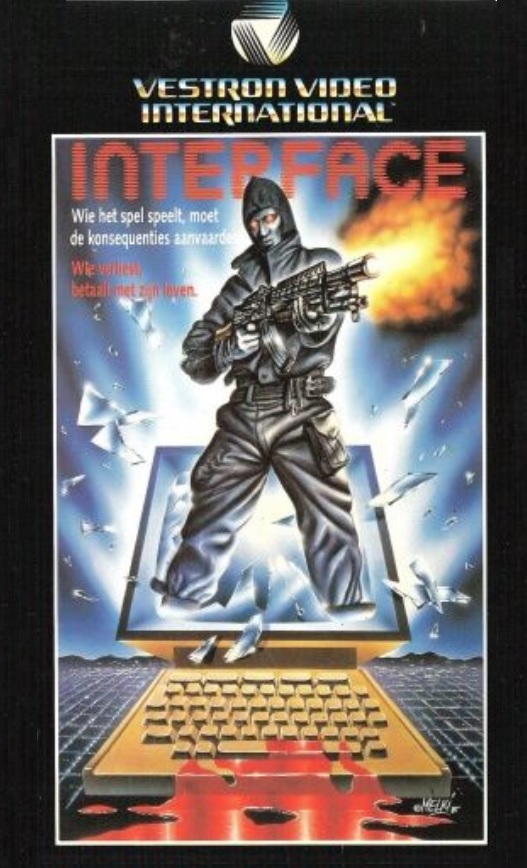
Art department for the win! Now that’s a rental-inspiring VHS sleeve!/courtesy of Rosalio Noriega Pinterest via movieposterdb.com.

As you can see from the two, embedded clips below, Anderson was way ahead of the cyber-curve — with women making-out with TV sets before Cronenberg thought of the idea. And we love, based on the voice-synthesizer preferred form of commutation by the members of the Circle, that Anderson’s a fan of the pinnacle of ’70s Frankenstein-as-a-computer flicks: Colossus: The Forbin Project — okay, maybe it’s more of an ’80s MTV-video voice-synth-thing, but we still dig it! Domo arigato, Mr. Roboto!

And yes, these clips are washed-out and muddy — the same goes for the full-length upload we’ve found. But that’s not ineptitude: the image is the result of multiple VHS rental-replays. The film is, to be honest, well-framed with solid camerawork. And kudos to Chief Production Designer Betty Burkhart (who also stars as the cyberbandit Futrista) for the obviously-up-against-the-budget art design.

These clips — HERE and HERE — give you a tease of the story: Upon the murder of his prized student and teaching aid — who’s running an on-the-sly computer scam — computer professor Dr. Rex Hobson and his students discover (Before there was a “dark web”!) the Circle of Logic (an actual circle of TRS-80s and Commodore 64s — complete with wireframe vector graphics), a vigilante computer cult comprised of masked members who go by the names Xardon, Manborn, Olympius, Eveton, Futrista, Orion, and Modem — and worship the “Master Process” (think TRON’s MCP “Master Control Program”).

Polybius is coming for you, again. So, you do feel lucky, cyberpunk? Do ya?

However, the cult is no longer content in righting the world’s wrongs via hacking and altered passwords (think of Micheal Douglas’s “Circle of Judges” in 1983’s The Star Chamber, sans computers; in fact that film is foretold in the more-violent frames of 1979’s Delirium): they’ve resorted to serial murder-by-computer. Another cult target is The Prankster, a clear-masked and cloaked vigilante that commits theft-by-computer while setting-up stings on drug dealers (one of which in Lou Diamond Phillips in his debut). Another student on the Circle’s CRTs is Bobby, who, like cinema’s most-likeable computer nerd, David Lightman, hacks the report card database to change grades — only for profit. (In part of the films comedy (?), the before-his-murder, geeky Bobby is bullied by one those thirty-year-old teenager trope-types: a college football star with one of the worst receding hairlines ever suffered by a college student). In addition to the prostitute murder-by-remote-television, our college baldy-boy has his police record tweaked with a “rape charge” and, after destroying his life, the Circle dispatches him — in a world where an “Enter” key can accomplish miracles — by electrocution-via-telephone.

Yep, the Internet back in those “ancient future” days past, is pretty scary, even if one learned their murder-by-computer tactics from a chalk board.

An overhead projector with acetates or dry-erase board wasn’t in the budget: computer science by chalk board. How ’80s!

One of those University of Texas student-cast members, Lauren Lane, who stars here as our heroine Amy Witherspoon, worked her way up the Tinseltown chain to main cast roles in NBC-TV’s Hunter (1989-1991) and L.A. Law (1992), as well as a six-year run as C.C. Babcock on CBS-TV’s The Nanny. Our male lead, John S. Davies, who stars as computer science professor Dr. Rex Hobson, Ph.D. (and worked on Anderson’s 1986 feature, Positive I.D, and his third and final film, 1998 Detention) ended up in Robocop (as Chessman, for the fans who go a-lookin’), appeared in multiple episodes of Walker, Texas Ranger during its seven-season run, and worked alongside The Rock in the 2004 remake of Walking Tall. (You can learn more about Davies’s career at his official website. What a career! And it all began with Interface.)

G.D Marcum, a member of the camera crew on Interface and Positive I.D. — as well as the Fred Williamson movies South Beach, Steele’s LawThee Days to a Kill and Night Vision — became a director in his own right, with his lone-feature film, Through the Fire. That film, while also known as City of the Living Dead: Part II in some quarters (and dedicated to the zom-maestro), has nothing to do with Lucio Fulci’s City of the Living Dead.

In December 2019, Interface was double-packed with another 1984 Vestron Video release, Soul Survivor, for sale on Amazon Prime. Uh, oh. Emptor the Caveat alert!!! Thanks to user J.L Host, we know to not let the fact that both films are Vestron releases on a single disc, fool us into thinking it’s an official release: it’s a single-layered, grey-market DVD-R — with all the ubiquitous quality-control issues for the R-format — with two films compressed onto a single-disc; as a disc only has enough space for one film. This is one time we’d appreciate a public domain, VHS-to-DVD box-set rip by the fine folks at Mill Creek (a “Cyber-Mania” set). Amazon sells VHS-ripped DVDs, as well, but the quality of those rips are unknown: beware.

But wait! In a case of the ultimate, celluloid irony: we found a very clean, 2019 You Tube rip of Interface, courtesy of Jackson Yoemans, which he discovered at the shop of our buds out at Seattle’s Scarecrow Video. Thanks for the efforts in persevering a lost film, Jackson!

So, yeah . . . Tinseltown. You can keep your major studio cyber-drivel with The Net and Disclosure. We’ll take Andy Anderson’s George Orwellian-cum-Commodore 64 debut — as well as Steven Lovy’s Circuitry Man — any day of week, and twice on Sundays. Domo arigato, Andy, for a fun film!

Interface with 40 more “Ancient Future” films with our “Exploring” round up!

Update: March 24, 2022: Clinton Rawls contacted us regarding his friendship with writer-director Andy Anderson. You can learn more about Clinton’s wares at Comics Royale.com. A fan-based site, Clinton takes foreign-language Bond comics, many which were unofficially produced, and translates them into English for the first time for the enjoyment of the Bond community and fans of the ’60s and ’70s spy craze. It’s a very cool labor of love you should visit.

By the way, B&S has reviewed all manner of Bond and the Eurospy films, so click around and discover!


Clinton: “The way Andy explained it to me: He got his students at the University of Texas at Arlington to look at the budgets for their various short films, and to also consider all of the work they put into the films: pre-production, storyboarding, etc. He convinced them that if they were able to put their budgets together, that they could make a feature film. That’s exactly what they set out to do. I believe a student wrote the script, the crew was made of students, and a student director. They set out to film during the winter break between semesters.

“They filmed one single day before (I’m not exactly sure why) it became clear that the student director wasn’t going to work out and couldn’t complete the project. With all of that money in place, actors cast, equipment and locations secured, sets built, etc., Andy stepped-in on day two of the production and took over directing the film so that the students wouldn’t see their hard work go to waste.

“I got the impression that Andy wasn’t terribly proud of the finished product, and he rarely claimed it as one of his films. In fact, someone joked that they had tracked a copy of the film down and were organizing a screening. Andy was not amused. He told them, ‘If you’re going to do a screening, have a bunch of beer and make it a fun time, but don’t look at it as one of my serious films.’

“That said, Andy was incredibly proud of all the students who went on to have careers in the business — getting their start on the film. In addition, the film played at a film festival in Germany before its purchase by Vestron for release. As result, Interface earned a profit on home video and Andy was pleased, as it allowed him to make his next feature film: Positive ID: a film he was proud of for the rest of his life.

“Sadly Andy died in 2017, and the loss was felt by many. He had a great body of work, some of it in the permanent collection of the Museum of Modern Art in New York, and his short films were especially wonderful. He was a great teacher and friend.”

About the Author: You can learn more about the writings of R.D Francis on Facebook. He also writes for B&S About Movies and publish music reviews and short stories on Medium.
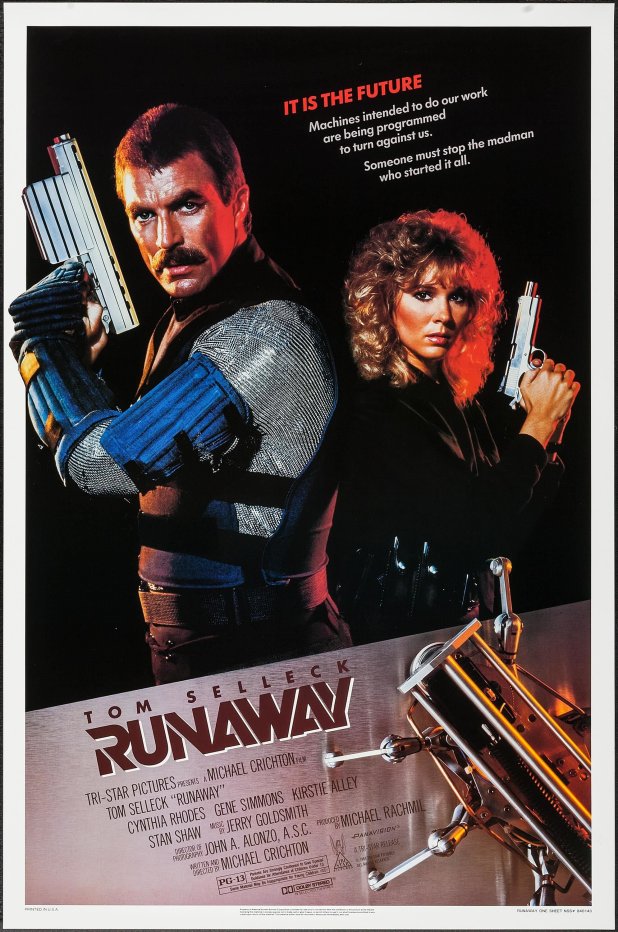
Runaway (1984)

Michael Crichton is the storytelling engine behind so many of the Ancient Future genre that we’re talking about all this week, someone who was ahead of his time at one time and now, we can look back at his films and say, “Wow, that future sure got old.”

Before he was doing ads about reverse mortgages where he has to outright tell you that this scam is not a scam, Tom Selleck ruled the world, turning down Indiana Jones for Thomas Magnum and then making this movie where he played Sgt. Jack R. Ramsay, an expert at stopping robots and machines gone wrong or “runaways.”

He used to be a real cop, but his fear of heights caused him to pause, which let a criminal escape and a family to get killed. The on the beat police look down on his robotic patrol, but his new partner Karen (Cynthia Rhodes, Penny from Dirty Dancing) is super into it. And now there’s an actual homicide by robot and untrackable computer chips and an evil genius named Dr. Charles Luther (Gene Simmons, of course) behind it all.

He’s out to kill an ex-lover (Kirstie Alley) who is trying to sell his inventions to the highest bidder. I mean, she’s right to do so, because he’s made some stuff that doesn’t even exist 37 years later, like bullets that lock onto their targets and have cameras on them to guide them to kill whomever they target.

The end of the film has the battle we’ve always wanted, Selleck vs. Simmons, on a skyscraper under construction guarded by robotic bugs that spit poison.

And in the middle of all this tech, G. W. Bailey gets his Police Academy role as Lt. Harris from started early as the chief of police.

Crichton didn’t just write this one. He directed it, too. He did the same for PursuitWestworldThe Great Train RobberyLookerPhysical Evidence and Coma, which had a small part for Selleck.

For all the fun I make of these old tech films, this one was pretty on the ball when it came to predictions of today. Sure, we don’t have bullets like that, but we do have robot vacuum cleaners, the Internet, voice-activated computers, social media, retinal identification, drones, laptops and police officers armed with semi-automatic guns.

What’s really interesting about Runaway is that it was the favorite movie of Romanian dictator Nicolae Ceausescu, who brought up Tom Select and his character from this movie numerous times during the 1989 trial that led to his execution.

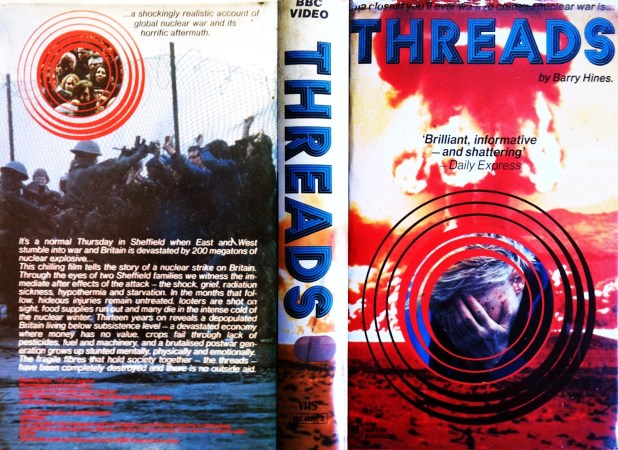
Threads (1984)

Threads looked at the hopelessness and outright nightmarishness of The Day After and said, “Hold my warm beer.”

Sure, it has the big picture story of the nuclear war between the U.S. and the U.S.S.R., but it’s really about the little people of Sheffield as they deal with the riots leading up to the war and then the cold reality of two-thirds of all British homes being destroyed the deaths of 30 million people as nuclear war comes to England.

Unlike the 1950’s duck and cover films, this movie pulls no punches when it comes to what happens next after the bombs fall. Food can barely be grown, people die at a young age from radiation-related diseases, nuclear winter sets in and mankind slides back to the dark ages.

Writer Barry Hines told the website Off the Telly, “Our intention in making Threads was to step aside from the politics and – I hope convincingly – show the actual effects on either side should our best endeavours to prevent nuclear war fail.”

Made under the name Beyond Armageddon, it’s amazing that this even got on the air in England. A previous film, a mock documentary entitled The War Game, was so upsetting to BBC execs that it didn’t air for decades, as they were convinced that it was so upsetting that people would commit suicide after watching it. It aired on July 31, 1985, the fortieth anniversary week of the bombing of Hiroshima, right after a repeat of Threads.

This is absolutely the roughest movie about nuclear war that I’ve ever seen. There is no hope whatsoever and as we’ve seen over the last year, the governments and services of the world are ill-equipped to even survive when the worst happens. It aired in the U.S. on TBS, as Ted Turner thought that it was an important movie that Americans needed to see. When he couldn’t find a sponsor for it, he paid for its airing out of his own pocket.

You know what screws me up? This brutal and uncompromising movie was directed by Mick Jackson, who went on to make The Bodyguard and the Dana Carvey movie Clean Slate.

This was also shot in the same abandoned hospital as Cabaret Voltaire’s video for “Sensoria.”

You can watch this on Tubi. There’s also a blu ray release of this movie from Severin.

L’ Ultimo Guerriero (1984)

The Italians get post-apocalyptic movies better than anyone else, because they realize that at best, they are just Western movies remade with cars instead of horses. The costumes, the dirt, the violence are all the same. They can even use the same sets — now rundown with age — from the 60’s and 70’s heights of the Italian cowboy era to become the Xerox Bartertown of their low budget epic.

unnamed

Romolo Guerrieri had been around as a director for years, working in all manner of genres like the giallo (The Sweet Body of DeborahLa Controfigura), poliziotteschi (The Police Serve the Citizens?Young, Violent, Dangerous) and, you guessed it, Westerns (he wrote Any Gun Can Play and wrote and directed Johnny Yuma).

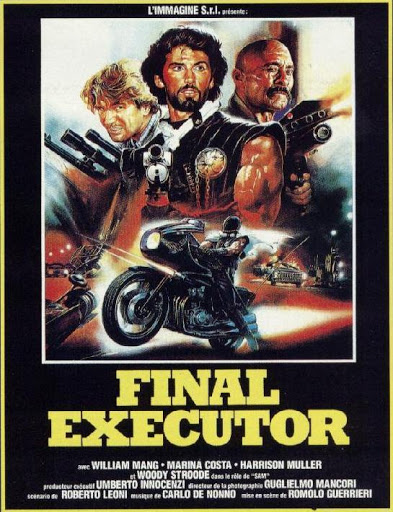
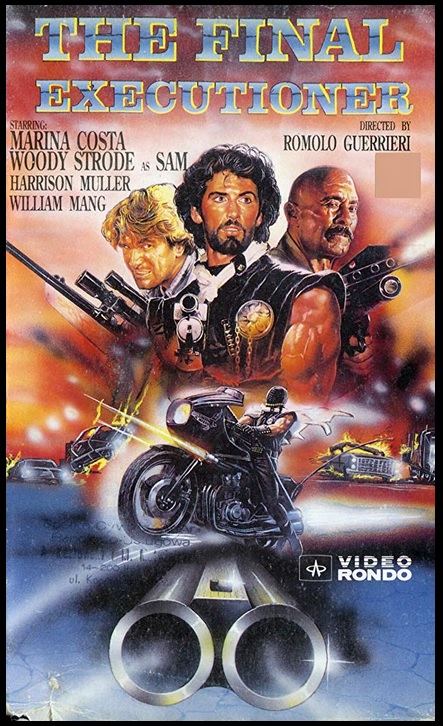
In a film also known as The Final Executioner during its U.S. video shelf life, after a nuclear war, society has been broken into two groups: the clean, uncontaminated elites and those they hunt, the people left behind who have been contaminated by radiation. At least 80 million have been killed for sport as this movie begins.

Alan Tanner tries to put a stop to this, as his wife has been selected to be hunted. He pays for it by getting shot and left for dead before being rescued and trained by ex-cop Sam (Woody Strode, who is pretty much playing the same role he played in Keoma). Together, they go against the system.

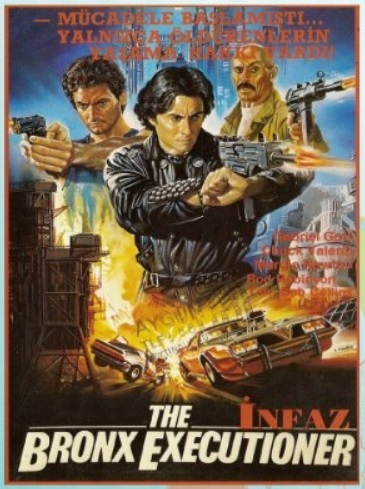
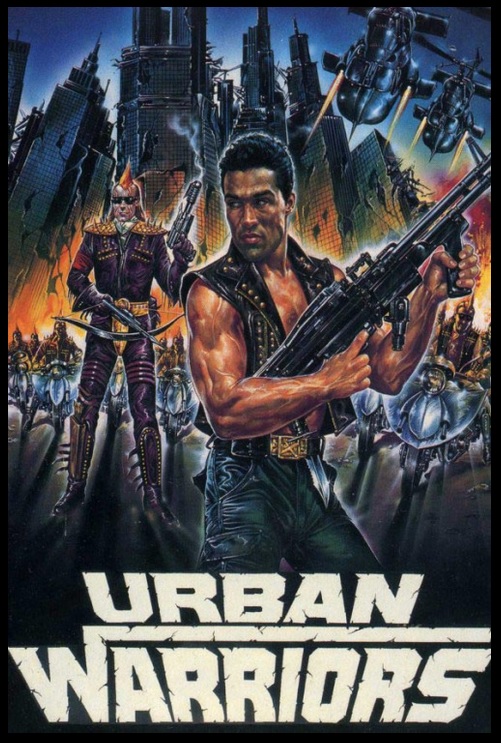
Footage from this was used in Giuseppe Vari’s Urban Warriors and Vanio Amici’s The Bronx Executioner, which should please you that even after the end of the world, some folks try to keep it green. In fact, Woody Strode’s character is renamed Warren and is in the latter, with new footage shot for Margit Evelyn Newton’s character.

Speaking of Margit, she was shooting this and The Adventures of Hercules at the same time, which she claims exhausted her and made her lose ten pounds.

Look, this isn’t great, but a dude rides around on a motorcycle and has a samurai sword in an Italian wasteland. That’s enough to get me to watch. And they’re all different . . . but the same, none the less.


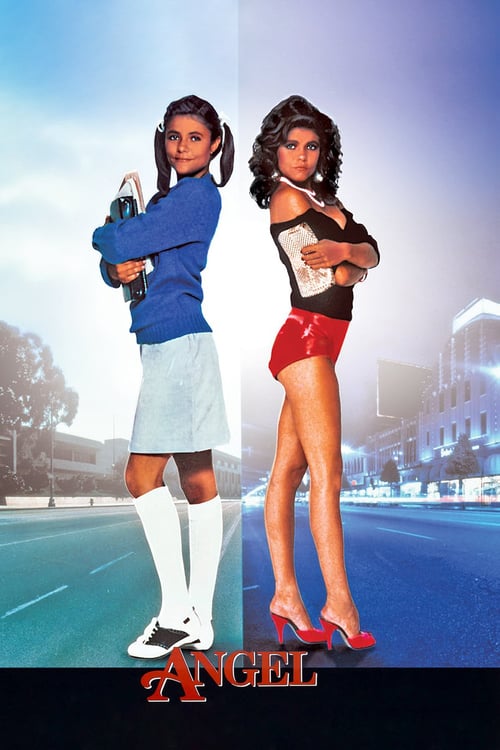
Angel (1984)

Man, Angel is pretty much everything I want in a movie. It’s filled with a cast of people I adore as well as presenting an alternative universe Los Angeles that is at once filled with scum and yet presents the nicest group of prostitutes that you’ll ever meet.

Foremost amongst them is Molly Stewart, who is an honor student by day and a streetwalker at night. She’s played by Donna Wilkes, who somehow shows up in so many of my favorite bad movies. There she is as a child in Jaws 2. Here she is in the slashers Schizoid — in love with her father Klaus Kinski — as well as Blood Song, being menaced by Frankie Avalon, and alongside Linda Blair in Grotesque. She took this role so seriously that she did plenty of research, saying “I actually walked on the streets with these girls and talked with them and I also talked to the people with the group called Children of the Night and to the Hollywood Police Department, too.” Of course, she was 22 and not 15, but isn’t that true of every bad girl in every movie we’ve watched this week?

At night, Molly becomes Angel, sparks of her high heels clacking against the stars on the Walk of Fame and all down Hollywood Boulevard. Her street family — her father left nine years ago and her mother abandoned her three years ago, leaving her to pay her own way ever since — takes care of her. They’re made up of senior citizen cowboy actor Kit Carson (Rory Calhoun, Motel Hell), street magician Yoyo Charlie, the trans Mae (Dick Shawn, Love at First Bite), Crystal, Lana and landlady Solly Mosler. She’s played by Susan Tyrrell, who as always owns every single moment of screen time, looking in control while forever out of control.

The problem? Well, there’s a serial killer who likes to sleepwith his victims — after he kills them — to further sleaze this up and he’s after our heroine. After finding Lana’s body in the shower, Angel  goes to the police and her description gets him arrested. The only problem? He shoots his way out and knows that she’s the one who identified him.

Things get worse when classmates recognize her on the streets and Mae’s impression of her mother doesn’t convince one of her teachers. When Mae is stabbed by the serial killer, Angel grabs a gun and decides to take her life and the law into her own hands.

There are three sequels to this film, all with different actresses as Angel. You know us. We’ll be talking about them all this week. They could have made forty of these films and I would have watched every single one of them. I mean, I watched six Vice Academy films.

You can watch this on Tubi.

KAIJU DAY MARATHON: King of Snake (1984)

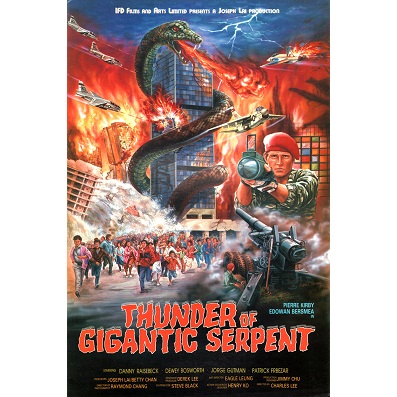
Tingting loves her snake Moser, who she found while fishing, and hides him in her bedroom. He can understand everything that she says and things seem like they are going to have a fairy tale life until we realize that this is a kaiju movie and that sooner or later, Moser is going to be big enough to crush a building just like the poster art and he’s going to get blown up real good and we’re going to have to watch an adorable Taiwanese girl cry.

To the surprise of no one, Godfrey Ho took the footage from this film — originally called Da She Wang and directed by Yu-Lung Hsu — and remade, remixed and ripped it off as Thunder of Gigantic Serpent.

What makes the circle of life turn is that the inventor of R19, the chemicals that terrorists want because they can turn the smallest of snakes into gigantic city smashing kaiju, is Dr. Li. And he’s played by Danny Lee, who knows a thing or two about this genre, as he was Infra-Man!

Look, it’s bad enough when a giant snake dies at the end. We all know it’s coming, it’s no real spoiler and yes, every kaiju must fall. But the sheer audacity to set the death scene to Enrico Morricone’s Once Upon a Time in the West song “Jill’s Theme*”? That’s a special kind of emotional warfare.

You can download this from the Internet Archive.

*Thanks to Die Die Danger Die Kill for that fact.

The Wild Life (1984)

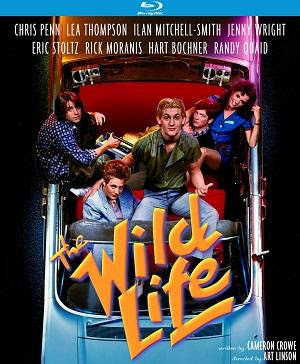
The Wild Life isn’t necessarily a direct sequel to Fast Times at Ridgemont High, but it’s definitely a spiritual one, moving beyond high school and into whatever comes next, but still within the shared universe of a California awash in drugs, music and retail jobs.

Bill (Eric Stoltz) is in love with Anita (Lea Thompson), even though they’ve broken up. He decides that it’s time to become a grown-up and get an apartment of his own with Tom (Christopher Penn), one of his co-workers at a bowling alley. His younger brother Jim (Ilan Mitchell-Smith) is obsessed with Vietnam and spends most of his time with a strung-out vet (Randy Quaid). Along the way, they meet Anita’s best friend Eileen (Jenny Wright), their manager Harry (Rick Moranis) and a cast of weirdos who are constantly partying inside Bill and Tom’s apartment.

There are plenty of cameos and small roles by some interesting people as well, including Sherilyn Fenn, Hart Bochner, Michael Bowen, Angel Salazar, Dick Rude (Straight to Hell and the director of several early Red Hot Chili Peppers videos), Lee Ving from Fear as a cable installer, Penn’s father Leo, Crowe’s ex-wife Nancy Wilson from Heart, Ben Stein, Kevin Peter Hall not in Predator or Harry and the Hendersons or Without Warning makeup, Ashley St. John, Kitten Natividad, Ted White (who was many of the Jason stuntmen) and Ronnie Wood raiding a refrigerator at a party.

“The Wild Life” has a theme song written and performed by Bananarama and a soundtrack that includes incidental music by Eddie Val Halen*, Prince, Madonna, Andy Summers, Little Richard, Van Halen, Billy Idol, Steppenwolf and Jimi Hendrix. That soundtrack — and the music licensing fees — are why it so long to get this onto DVD, other than a made to order Universal Vault series DVD.

The new Kino Lorber blu ray of this has nine radio commercials for the film and commentary by the late Mike McBeardo McPadden and Ian Christe.

*Two Van Halen songs came out of this movie: “Good Enough” and “A.F.U. (Naturally Wired)” from 5150, “Right Now” from For Unlawful Carnal Knowledge, and “Blood And Fire” on A Different Kind a Of Truth. Some of this score also shows up in Back to the Future when Marty uses the Walkman to wake up his father. Upon the recent death of Eddie Van Halen, we examined all of his various film and TV soundtrack contributions with our “Exploring: Eddie Van Halen on Film” featurette.

Deception of a Generation (1984)

Paul Crouch Jr., who directed this — which seems like “point and shoot” as it gets — was a Praise the Lord host from 2005 to 2011, as well as doing second unit on The Omega Code and producing Trump 2024: The World After Trump, a movie that posits that without Trump running things, America will lose its freedoms and Judeo-Christian values. I assume that there’s an asterisk that says something like “for white people” or somesuch there.

And if you’re offended already, you can turn back now.

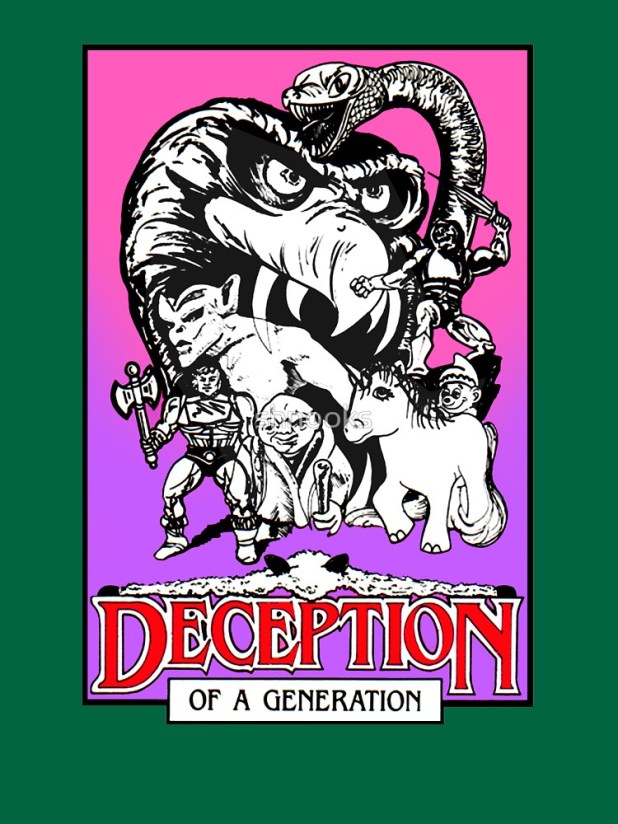
Sitting in front of a clock that never changes time, hosts Gary Greenwald (who used to have a show called The Eagle’s Nest) and Phil Phillips take apart the growing consumerism that is facing kids. Of this I cannot deny, as even though I am a lifelong G.I. Joe fan, I’ve heard speeches from its creators proclaiming their “insidious plan” to use TV commericals, cartoons and comics to mass market to kids. Post-Star Wars, all manner of merchandising was made for nearly every movie and post-G.I. Joe, every toy had a multi-faceted marketing attack so that it became more than just a toy.

Phil was on a two week fast as part of a Christian retreat and decided to go to a Toys R Us. There, he found He-Man and realized that Satan was in the toybox. After all, Teela had a cobra-headed staff and the cobra is the symbol for all Satanic warriors, right?

Before our friends here get to Eternia, they spend plenty of time freaking out about the Vincent Price-starring The 13 Ghosts of Scooby Doo is all aboutthe vast occult conspiracy threating kids. That said, I totally was into every single scene they showed of this show, but they are kind of missing the point that Price’s character, Vincent Van Ghoul, and the Scooby Gang* are out to protect the world from the evil inside the Chest of Demons.

Now, the He-Man these guys finally are worried about is the post-Filmation cartoon He-Man. Sure, there’s magic and all, but in no way is the Masters of the Universe these guys are worried about as odd and, well, occult as the original comics, which show He-Man as a barely evolved caveman who comes across magical artifacts given to him by a sorceress who tells him that he must find the power to win Castle Greyskull, a skull-faced mountain. There’s no cute Orko. There’s just swords and steel and loincloths.

This is every sermon I heard throughout my childhood, every Christian radio show I ever listened to and every mimeographed warning from teachers about what bands worship the devil — mimeographed church and school warnings were the original internet conspiracy theories — all in one.

The Force from Star Wars is the same power that witches feel. Even better, because Yoda has only three fingers, that means “Satan is Lord.” And even E.T. is just a cloaked reason for kids to get into eastern occult practices like yoga and meditation.

A lot of people wonder how our country got in the state that it’s in, where Q-Anon suddenly became reality to so many people. The members of my family the fastest to start sharing memes and posts about Wayfair having children on their site are the very same ones that took vacations to Heritage U.S.A. before the secular world ever knew who Jim and Tammy Baker were and the very same folks who made me watch Little House on the Prarie when I visited instead of the Godzilla movies I knew were on another channel. They’d speak in tongues to you at the quickest drop of any hat and while I know their hearts were in the right place, people who so easily accept any story at face value scare me more than any occult meanings seen in children’s toys.

Except Thundercats. I can 100% assure you that there’s tons of Satanism in that show.

*The Scooby Gang being Scooby, Shaggy, Daphne, Scrappy-Doo and a Tibetian con artist named Flim Flam, who went to jail for his crimes, as we learned in Scooby-Doo! Mystery Incorporated.

You can watch this on YouTube.

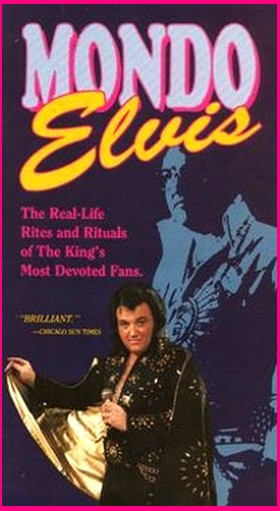
Mondo Elvis (1984)

Twin sisters who believe Elvis was their father.

A woman whose husband left her because she loved Presley more than him.

An impersonator duly appointed to do his routine because The King came to him in a dream.

Elvis Presley — only five years gone when this was made — inspired a legion of fans that really turned him into a religion.

This film is the perfect way to see thirty minutes of a window into their world.

Elvis is the kind of performer who could release an entire album of stage banter. Having Fun with Elvis on Stage was another con by his boss Colonel Parker, who wanted to put out an album on his Boxcar Records label so that he could make all of the profits. Elvis’ RCA contract never said that they owned the rights to a spoken word album, so this record was created. It’s basically Elvis humming and telling stories that have no context because we have no idea what song he is about to sing. This dialogue is all taken from the middle of shows, so we have no real idea what he is talking about and potentially neither does Presley at this late stage. This was sold at Elvis’ concerts before RCA learned of the duplicity and released it. Surprisingly, this record made it to 130 on the Billboard charts before Elvis asked for it to be deleted.

I bet everyone in this movie owns a copy.

You can watch this on YouTube.

The Excellent Eighties: Tuareg: The Desert Warrior (1984)

Okay, ye purveyor of B-Trash, let’s unpack the caveats:

  1. While that looks like a rendering of Michael Sopkiw on the one-sheet, this isn’t a repack of Blastfighter made to look like a First Blood/Rambo sequel — although that film was inspired by the adventures of Rambo.
  2. While it looks like it’s a Mark Gregory War movie — of which he made four, plus three Thunder movies — themselves each inspired by Rambo — this isn’t a repack of any of those movies. (We break those flicks down as part of our “Mark Gregory Week” tribute.)
  3. Do not do what I did and confuse this with Jim Goldman, aka John Gale, aka Filipina Jun Gallardo’s Mad Max apoc-poo Desert Warrior starring Lou Ferrigno.
  4. No, this isn’t a Stallone Rambo foreign repack with bad art work.
  5. Yes, as incredible as it may seem, the Mark Harmon in the credits — in lieu of Michael Sopkiw or Mark Gregory (!) that should be starring — is the same Mark Harmon you’re now watching in reruns from CBS-TV’s NCIS.
  6. This is, in fact, a Enzo G. Castellari’s production, aka The Desert Warrior, aka Tuareg: The Desert Warrior, aka Rambo of the Desert Warrior, which makes no sense. Why not Rambo, the Desert Warrior or Rambo: Desert Blood?

Now, when you see the dependable name of Enzo G. Castellari — the man who gave us Inglorious Bastards, 1990: The Bronx Warriors, Escape from the Bronx, and Warriors of the Wasteland, you know you’re getting intriguing action, and a bag o’ chips.

In a desolate section of the Libyan-Algerian Sahara once ruled by the French, Gacel Sayah (Mark Harmon), a Tuareg tribal leader (in tanning make-up and blue contacts), offers refuge to two government fugitives. When soldiers from the newly-installed Arab regime demand the “war criminals” be turned over to them, our desert Rambo refuses, based on the region’s ancient, scared laws. When the soldiers murder one and kidnap the other war criminal, Sayah mounts a bloody campaign to rescue his charge, for so says “the law.”

If you’ve watched any of Enzo’s westerns — A Few Dollars for Django and One Dollar Too Many — then you’ll know that Enzo was into desert-based mayhem long before Stallone came on the scene, so what you get with this much HBO-aired ditty is a war-modernized Spaghetti Western. And be it western, poliziotteschi, or post-apocalypse, Castellari never disappoints, non-A-List Hollywood budgets be damned.

By the time Harmon went all spaghetti-Rambo in the joint, he got his start with guest shots as cops on Adam-12 and its ’70s sister show, Emergency (which I’ve seen these past months as Antenna TV reruns). Harmon also starred in two, failed one-season series with the cop procedural-dramas Sam (1977) and (the one I remember watching first-run) 240-Robert (1979). He was one season deep into his breakthrough role as Dr. Robert Caldwell in the NBC-TV medical drama St. Elsewhere when Tuareg: The Desert Warrior was released. But I have a feeling Harmon probably filmed this Italian romp long before production on the series began — with Enzo holding back the film (due to creative or cash flow issues), then realized he had a “star” in his film. As for Harmon: when it came to crossing over to a theatrical career, he went for comedy instead of action, with the (date night) flops Summer School and Worth Winning (both utter awful) and some military drama with Sean Connery (that I am too lazy to research, but also sucked) and eventually, like David Caruso before him, came back to television.

When you think that Harmon is the guy from TV’s NCIS . . . made-up to look Middle Eastern . . . makes this spaghetti Rambo an even more fascinating watch. And you can watch this Mill Creek box set public domain ditty on You Tube or get your own copy as part of their Excellent Eighties 50-Movie Pack.

About the Author: You can learn more about the writings of R.D Francis on Facebook. He also writes for B&S About Movies.