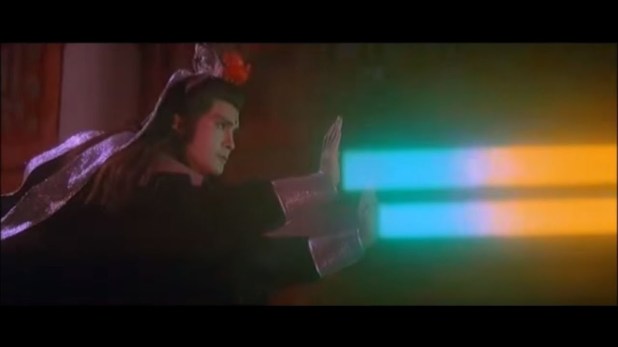
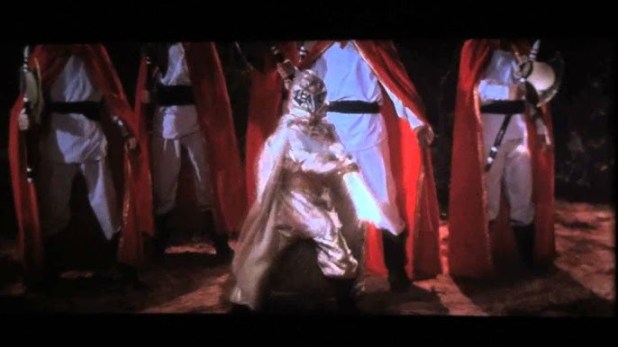
As a baby, Shue Sang (Derek Yee) was found in a cave by an elderly childless woodcutter. And like Kal-El, he grew into a man with powers above and beyond normal men. Also, like Superman, he is powered by our sun and sent here before the destruction of his homeworld. Well, it was an explosion that destroyed Krypton, but his world was smashed by the Demon Spawn, who is coming to Earth in the form of an eclipse, which means that Shue Sang has to figure out his powers quickly.
So as you listen to the John Williams score from Superman, you will realize that if Shue Sang is Superman, then Mo Ying the Demon Spawn is General Zod and the evil Regent is, I guess, Lex Luthor. Except that Zod never blew people up real good when he blasted them with laser beams. Also, Shue Sang’s move set might copy the Man of Steel, including powers like flight, super strength and energy beams (well, from the hands if not the eyes), but he also has Mort Weisinger-era Superman family powers too, like being able to have conversations with animals. He can also create laser shapes to fight with, kind of like Lou Ferrigno Hercules. Oh yeah — he can also pluck chickens with his mind. What other hero can do that?
This ends with a crucified princess (Cherie Chung), hopping vampires, an eclipse and a dramatic comeback before a flying laser fight. What other film has a bad guy with an extreme eugenics agenda using his blood to awaken a murderous demon baby? Pure movie drugs, Shaw Brothers strain.
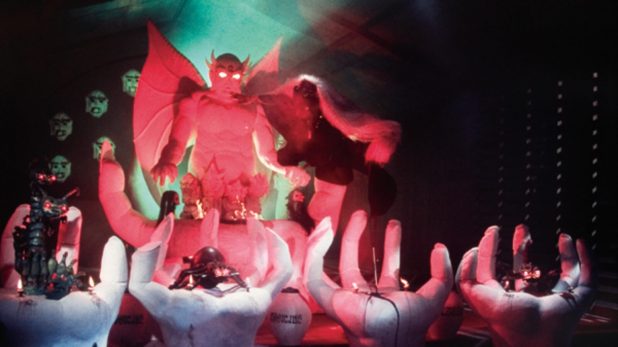
The first film by Lung Yi-sheng, this is the tale of Yuan Fei the Flying Monkey (Chin Siu-ho), who takes on the challenge of finding a weapon that can defeat the Demon Lute, which has been made from the muscles of dinosaurs. In his journey, he meets swordswoman Feng Ling the Rainbow Sword (Kara Wai), the drunken Old Naughty and his scissors, the Woodcutter and his son Doraemon, called that because he carries around a Doraemon doll.
They will battle The Long Limb Evil, a demon who has an arm that can keep growing; the One Eyed Dragon, who has a crazy spider eyepatch; Red-Haired Devil, who can attack with his afro and the demonic lute itself, which becomes a transparent hand with six fingers that keeps grabbing for our heroes before they use the only weapon can stop it, a bow that was jammed into the stone wall of a cave.
There’s a dog-pulled chariot, a rainbow sword, gigantic axes and wirework fights that are made for kids, all set to 80s guitar-driven music. There are some people online who have given this poor reviews and what kind of heartless creep to you have to be to watch something so perfect and judge it that way?
Directed by Chun-Ku Lu, this is a movie that I described to my wife as a psychedelic drug film that is also a martial arts epic and at times, feels like it has the colors of an Italian movie. You remember how Crouching Tiger, Hidden Dragon make people go nuts when they saw it? Could you imagine the uninitiated going directly into this, mainlining it into their eyes and trying to keep their sanity?
Keep in mind that this was made completely with physical tricks and what special effects were available in Hong Kong in 1983 and then be amazed that no computer touched this.
Yin Tien-Chou (Max Mok) and his sister Tu Chuan-erh (Ching-Ching Yeung) lost their parents when they were just born, thanks to their murder at the hands of Tsing Yin (Leanne Lau) and Monster Yu (Jason Pai), who wanted the Holy Flames, two swords that make people unstoppable. Our heroes have been split up ever since, with “The Phantom” You-ming Elder (Phillip Kwok) raising Yin Tien-Chou and Tsing Yin teaching Tu Chuan-erh, so while the two start on opposite sides, they soon learn that the Holy Flames can only be handled by twins who are male and female, like them. Also, You-ming Elder just sits in lotus position and laughs his head off for most of the movie and I would love to hang out all the time with him.
This has it all and by all, I mean finger lasers, flying fights, a Snake Boy, a mummy, ghosts. vampire blood sects, female fighters devoted to maintaining their virginity, enough wire work for a hundred movies and colors so neon and garish that Mario Bava looking down from Paradise and said, “Wow. That’s really bright.”
When I watch movies like this, I start to wonder if I should ever watch another film afterward. They are too perfect and that nothing will be better than what I have just seen.
A black magic sorcerer is just trying to dig up some bones for his latest spell when he’s chased by a group of angry citizens, right into the cab of our hero, Chau. He lives through getting hit by the car, but tells the cab driver that he’s about. to go through some bad luck.
And just like that, Chau’s wife starts sleeping with a gambler who really doesn’t care about her, even leaving her in a bad part of town where she’s assaulted and killed, falling out a window to her death, her spirit calling to Chau via his CB radio.
That’s when Chau decides that it’s time to find that black magic dude and get some horrible, horrible revenge.
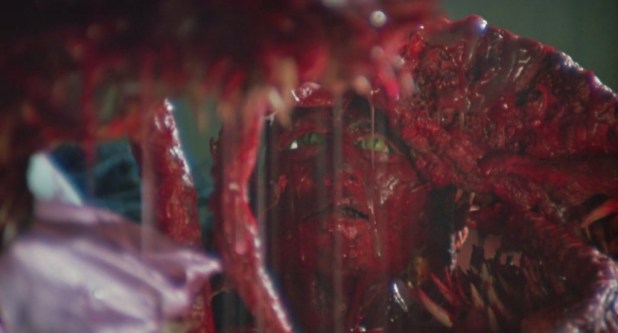
The spell that ensues is so powerful, it blows the lid off Chau’s wife Irene’s coffin. There’s also corpse sex and a monster baby sent to destroy the two villains who dared to ruin Chau’s life. And he also learns that the more magic he uses, the more his body pays the price.
Look, a ghost has sex with a reanimated corpse over a black magic altar, a tentacled demon baby runs around and a toilet blows up real good. It’s not the best movie you’ve ever seen, but it may be the goopiest, the kind of film that tells The Thing, “Oh yeah? Hold my San Miguel.”
Screw the Snyder Cut. Whatever drugs the Shaw Brothers had access to, release them to the rest of the world.
After being crippled in the ring, boxer Zhen Wei asks for his brother Zhen Xiong to avenge him, which will take finding the key necessary to release their family from a horrible curse.
Simple start, right?
Buckle up, because this is the kind of movie that will make your brain bleed. Seriously and without hyperbole, The Boxer’s Omen is a phantasmagorical thrill ride into how much insanity one can pack into 105 minutes.
Sure, your movie may have a crocodile in it, but does it have a reanimated corpse that’s been sewn into the mummified body of a dead crocodile? I don’t think so.
Then, let’s add in spiders drinking from people, demon bats, flying heads, goo, gore, gristle, black magic wizards, maggots, a sexy zombie, spiritual monk training montages, caterpillars, eels coming out of peoples’ mouths, neon magic, vomit magic, intestines and more.
You know when people use silly terms like fever dream and madness to describe a movie? They are only dreaming of a movie like this, one that takes you on a life-changing journey and repeatedly makes you wonder exactly what the hell you’re watching and just how they captured all of this on celluloid.
After making movies like this, Corpse Mania and Hex, director Kuei Chih-Hung quit the business, moved to America and started a pizza restaurant. He’s sadly no longer with us, but I have no doubt that his pizza was a messy, greasy, gooey and delicious dish that was most definitely spiked with all manner of Taoist magic and the most potent LSD known to man and demon.
The world is a better place for this movie being in it.
EDITOR’S NOTE: Legs was on the CBS Late Movie on March 10 and October 6, 1986 and August 8, 1988.
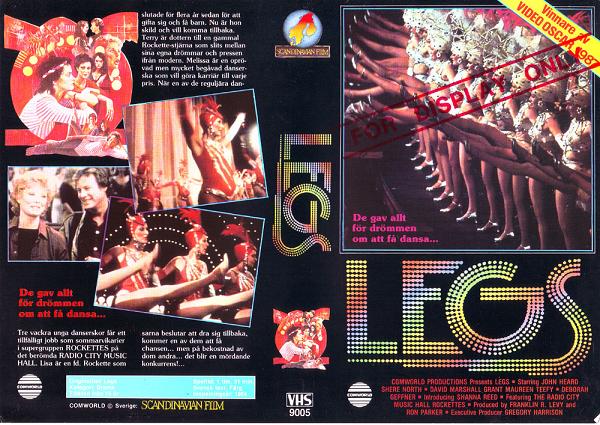
Known as Rockettes in the UK, this was filmed at Radio City Music Hall with the 1982 Rockettes. It played there as a movie before it aired on TV.
Lisa Norwood (Shanna Reed), Terry Riga (Deborah Geffner) and Melissa Rizzo (Maureen Teefy) are three dancers trying to get the one chorus line position open under choreographer Maureen Comly (Gwen Verdon). Sheree North also shows up as a former dancer and John Heard as a love interest.
Really, the reason to watch are all the dance scenes, some of which seem like space disco numbers. The rest is soap opera, but it’s fine. It’s no All That Jazz, which Deborah Geffner was also in.
I was a pro wrestler for years and people always said, “This isn’t ballet.” Dude. Ballet is way rougher.
EDITOR’S NOTE: Packin’ It In was on the CBS Late Movie on April 30 and December 3, 1986.
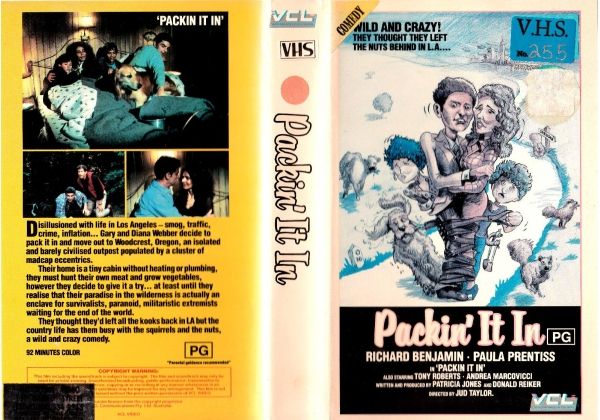
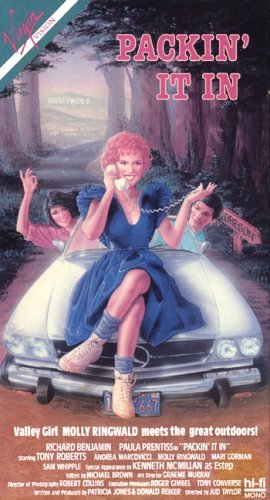
The Webbers — Gary (Richard Benjamin), Dianne (Paula Prentiss), Melissa (Molly Ringwald) and Jay (David Hollander) — leave Los Angeles behind for Oregon after Gary loses his job. I mean, what are they leaving behind? Smog? Little Jay being addicted to Cinemax After Dark? Melissa’s punk rock boyfriend Johnny Crud (Clinton Dean)?
Oregon is just like the MAGA world of today, filled with doomsday preppers, gun lovers and book burners. But strangely, the kids start to like it and Benjamin goes kind of crazy like he always does and a big storm ends up bringing the whole town together.
The family had friends who did the same thing, the Baumgartens — Charlie (Tony Roberts), Rita (Andrea Marcovicci) and Claire (Laura Bruneau) — but the country has changed them. Even when Dianne tries to teach the local children who can’t read, she’s treated like a criminal.
Directed by Jud Taylor (The Disappearance of Flight 412) and written by Patricia Jones and Donald Reiker (who scripted The Jesse Ventura Story together), this is a fine TV movie that used Ringwald’s fame once it was released on VHS.
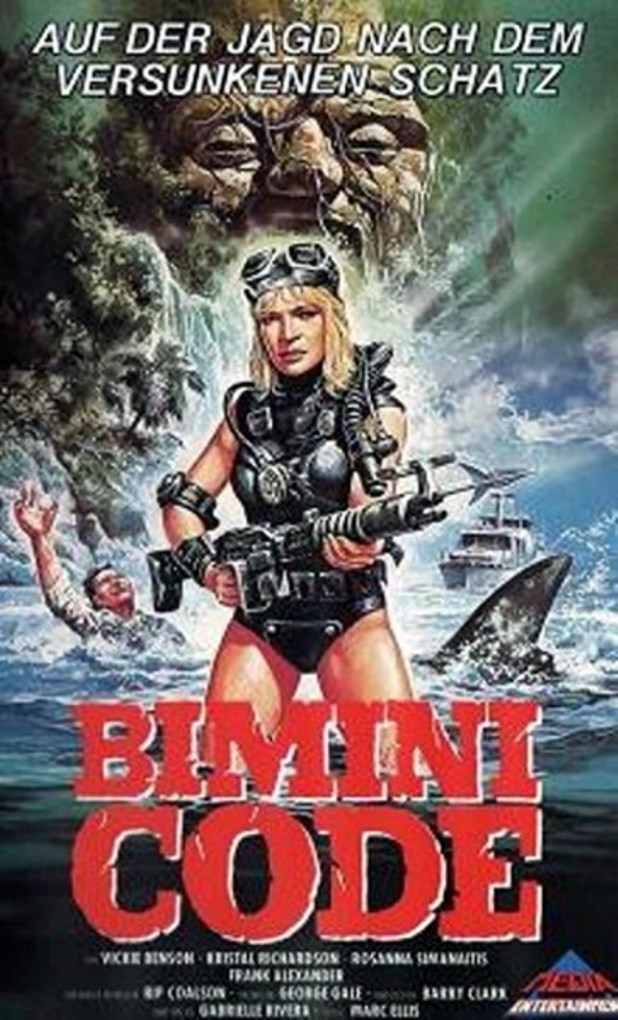
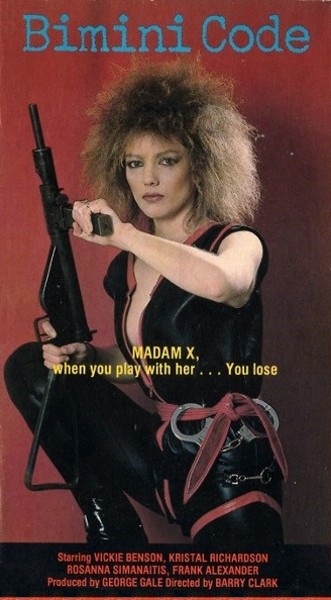
EDITOR’S NOTE: Bimini Code was on the CBS Late Movie on May 8, June 4 and November 20, 1986.
Stacey (Vickie Benson, Cheerleader Camp) and Cheryl (Kristal Richardson) own a scuba shop, but also decide to help save a missing boy along with their friends Rick and Fuji. They end up being kidnapped themselves and taken to the undersea base of Madame X, AKA Countess Magda von Cress (Rosanna Simanaitis), a totally mean, totally eyepatched super villainess who of course is my favorite person in this movie. She even has a small dog!
Madame X is after the Power Stone — “The secret of the ancient Mayans! The secret of nuclear fusion!” — but she didn’t count on two women who can swim underwater and ride motorcycles. Not even a tarantula can stop them. And then in the last half of this movie, it becomes Raiders of the Lost Ark!
The bad guys in this work for the Scorpio Peanut Company. Let that set in.
This movie taught me that people can speak underwater, that if you’re a bad guy you can dress however you want no matter how hot the jungle is, that a film can have tons of action and locations and still drag, that women in bikinis are our last line of defense and that you should always screen your henchmen.
Director Barry Clark and writer Gabrielle Rivera have made a movie that feels like if Andy Sidaris didn’t care at all about showing naked women. It has the feel of his movies, but none of the sheer wildness of them and no one remembers that you’re supposed to have several hot tub scenes.
Doris Wishman week (July 21 – 27) Doris made the loopiest of movies. A self-proclaimed prude who made nudist camp movies, her filmography is filled with contradictions. When she tried to be mean spirited with something like Bad Girls Go To Hell there was always an undercurrent of silliness and fun, but when she tried to be silly and fun in things like Keyholes Are For Peeping there was an underlying seediness and grime that couldn’t be wiped off. It’s hard not to love her!
Doris Wishman produced and directed at least thirty films over four decades, mostly in the usually male-dominated genres of sexploitation and pornography. Her film career began as a hobby after the death of her husband in 1958 and her feature debut was 1960’s Hideout in the Sun.
She’d already had experience in the film industry, as she worked for her cousin Max Rosenberg as a film booker for his art and exploitation films. The 1957 New York appeals court that allowed nudism to be shown in movie theaters inspired her to make that first film, which she followed in 1961 with Nude on the Moon, a film that was banned in New York because nudist colonies were legally permissible but nudism on the moon was not. She also worked with the legendary burlesque dancer Blaze Starr but as the nudie cutie genre started losing money, she moved into sexploitation.
That’s when some of her most famous — well, amongst lovers of ridiculous cinema like me — films got made, like Bad Girls Go to Hell and the Chesty Morgan vehicles Deadly Weapons and Double Agent 73, films in which Morgan kills people with her monstrous 73-inch breasts.
Wishman also produced 1972’s Keyholes Are for Peeping, which starred comedian Sammy Petrillo, a Brooklyn nightclub performer who eventually made Pittsburgh his hometown in the 1990’s. He’s probably better known for his teaming up with singer Duke Mitchell (yes, the guy who made Massacre Mafia Style and Gone with the Pope) as the poor man’s Martin and Lewis. They teamed up for Bela Lugosi Meets a Brooklyn Gorilla, which also somehow rips off Abbott and Costello monster films at the same time.
As the industry moved from softcore to hardcore, Wishman directed two Annie Sprinkle features, Satan Was a Lady and Come With Me, My Love. She wasn’t really excited about the shift and denied working on these films. As the 70’s were coming to a close, she released a film she’d been working on since 1971, Let Me Die a Woman, a groundbreaking semidocumentary on transgender issues filtered through the lens of exploitation.
That brings us to today’s movie, A Night to Dismember, which she started filming in 1978 to cash in on the slasher craze begun by Halloween. Wishman was ready to direct and produce the film from a screenplay by Judith J. Kushner. Most of the shoot took place in 1979 in New York at Wishman’s home.
From there, things get weird. Wishman claimed that multiple reels were destroyed in the photo processing lab, resulting in her having to reshoot several scenes and use stock footage to make a releasable final film. After four years (!) of post-production, the film would remain unreleased until MPI Media Group put it out in 1989.
There’s also an entirely different version of this film that was released in August 2018 on YouTube by the film’s cinematographer, C. Davis Smith. This version features actress Diana Cummings in the lead role and an entirely different plot, as adult film actress Samantha Fox replaced Cummings after the destruction of Wishman’s film.
According to Smith, Fox paid Wishman $2,000 to get the starring role of Vicki Kent. He said he doesn’t know for sure, but he believes that Wishman faked the story that the original print was destroyed in a fire and reshot the film with Fox. You can read more about that story here.
Whew! That’s a lot of history to cover, but this is a film that has plenty of it. Let’s get into what it’s really all about!
The Kent family suffers from an ancestral curse that has caused nearly all of them to be murdered, often by one another. Bonnie was first, hacked to pieces by her sister Susan, who was upset that her father favored her sister. After the murder, she slipped on the blood and was killed by the very same axe.
Broderick Kent’s wife Lola is next, murdered in the bathtub. While Kent tries to proclain his innocence, he eventually hangs himself.
That’s when we get to Vicki Kent (Samantha Fox), who has just ben released from an insane asylum after killing two boys. Her brother and sister, Billy and Mary, want her to be committed again.
Despite wanting to rekindle her relationship with her ex-boyfriend, she struggles to make it in the real world, constantly hallucinating. Then again, with Frankie getting decapitated and his head burned in a fireplace, that relationship seems doomed.
Vicki tries to visit some relatives who turn her away before they’re all killed by hatchet and by car. Even a trip to the lake is fraught with horror, as a zombie chases her around, only to be revealed to be her brother Billy who has been trying to frighten her back into the sanitarium.
This is the kind of movie that rewards your lack of attention with shifts in characters, hairstyles and clothing all within the same scene. It doesn’t help that there is next to no voiced dialogue and only a narrorator’s voice to carry us through every scene and change in tone. We go from Vicki performing a sexy dance and trying to seduce a detective to Vicki’s sister Mary actually being the one behind all the killings.
The detective makes his way to the house where he finds a confused Vicki holding a hatchet. Despite hitting him several times with it, he manages to strangle her to death. That’s when we get the voice over from the detective, telling us that Mary was the real guilty party, but she’s escaped after killing a cab driver. And that’s the movie, I guess.
To put it bluntly, A Night to Dismember is a mess. It’s got songs that stop and start, horrible acting, bad gore and footage that appears to be the quality of a 1970’s super 8 home movie. It’s the kind of movie that if I watched it with a roomful of normal folks, they’d scoff and laugh. And that’s why I woke up at 4 AM so that I could enjoy it all by myself, away from the insults of people not ready to cheerful enjoy a movie that combines the insane and the inane. There’s also plenty of 1970’s fashion and an unhinged voiceover to love, which continues over the credits, making me adore this piece of film even more.
Back to Wishman. Before her death in 2002, she was finally honored for her groundbreaking work, with John Waters featured a clips from her films in Serial Mom, appearances on Late Night with Conan O’Brien, appearances at the New York and Chicago Underground Film Festivals and a showing of her films at Los Angeles’s Nuart Theatre entitled “Doris Wishman: Queen of Sexploitation.”
Directed by Ferdinand Fairfax and written by Lloyd Phillips, David Odell (the writer of Masters of the Universe, Supergirl and The Dark Crystal, as well as the director of Martians Go Home and “No Strings” and “The Yattering and Jack” episodes of Tales from the Darkside) and John Hughes — yes, that John Hughes — I would have no idea this movie existed if not for the magic that is the Red Eye movie section of the Chattanooga Film Festival.
Based on the adventures of real-life blackbirders Bully Hayes and Ben Pease and shot in New Zealand — Sir Richard Taylor of Weta Workshop claims that it started the 1980s Kiwi filmmaking boom — this is known as Savage Islands everywhere but America.
Missionary Nathaniel “Nate” Williamson (Michael O’Keefe from Caddyshack) is at sea, trying to save souls. Bully Hayes (Tommy Lee Jones, a few years from The Eyes of Laura Mars but looking like some kind of young lady killer) is a pirate who is trying to make money anywhere he can. They’re forced to work together and are both in love with the same woman, Sophie (Jenny Seagrove, Appointment With Death) and have to save her from slaver Ben Pease (Max Phipps).
Does this sound somewhat similar to the triangle between Will Turner, Captain Jack Sparrow and Elizabeth Swann in Disney’s multifilm Pirates of the Caribbean movies? Perhaps. Except those films made millions and this one was forgotten.
Roger Ebert referred to it as “one of the more inexplicable films I’ve encountered recently. The part I can’t explain is: Why did they make it? The movie is a loud, confusing, pointless mess that never seems to make up its mind whether to be a farce or an adventure.”
For some reason, more than these filmmakers wanted to bring pirates back in the 80s. So I’ll say that this is better than most of them, but it’s up against Yellowbeard, The Pirate Movie, The Pirates of Penzance and the excoriable Pirates, a movie that could be the worst thing Roman Polanski ever did that wasn’t a crime against humanity and also had Cannon buy a boat and leave it shipwrecked at Cannes for years.
Speaking of Cannon, this feels a lot like the kind of movie they’d make, except it’d be directed by Michael Winner or Sam Firstenberg, which means that it would be a lot weirder.
Maybe the fault isn’t in the movie — at least in the U.S. — but in Paramount, the studio that made it.
Allegedly, when they saw the final cut, they were concerned about how close it was to Raiders. And Temple of Doom was being filmed and ready to be their next big summer movie. They didn’t want two swashbuckling movies out at the same time — much less two that rip off the rope bridge scene from The Lady Hermit (shoutout to The Betamax Rundown) and have a scene where the female lead is about to be cooked in a pot — so they released it in November when no one would go see it.
So despite all of that, by the end of this — and the last dramatic rescue — I was cheering. It won me over. Isn’t it cool when that happens and you don’t expect it?
You can watch this and so many of the films at CFF by buying a pass on their website. I’ll be posting reviews and articles over the next few days, as well as updating my Letterboxd list of watches.



 B&S About Movies
You must be logged in to post a comment.