Commando the Ninja (1983)

Also known as American Commando Ninja, IFD claims that this is made by Joe Law. Really, who can tell you the truth? Who even knows how many titles this has, how much music it stole or what it’s about? Hocus pocus, as the sensei says at the beginning. It doesn’t have to make sense. Seeing as how this was produced by Joseph Lai and Betty Chan, all bets are off.

Jow Law is also Law Chi AKA Chi Lo, the director of The Crippled MastersDeadly Hands of Kung Fu (using the name Lo Ke), Girl with Cat’s Eyes and Magic Swords.

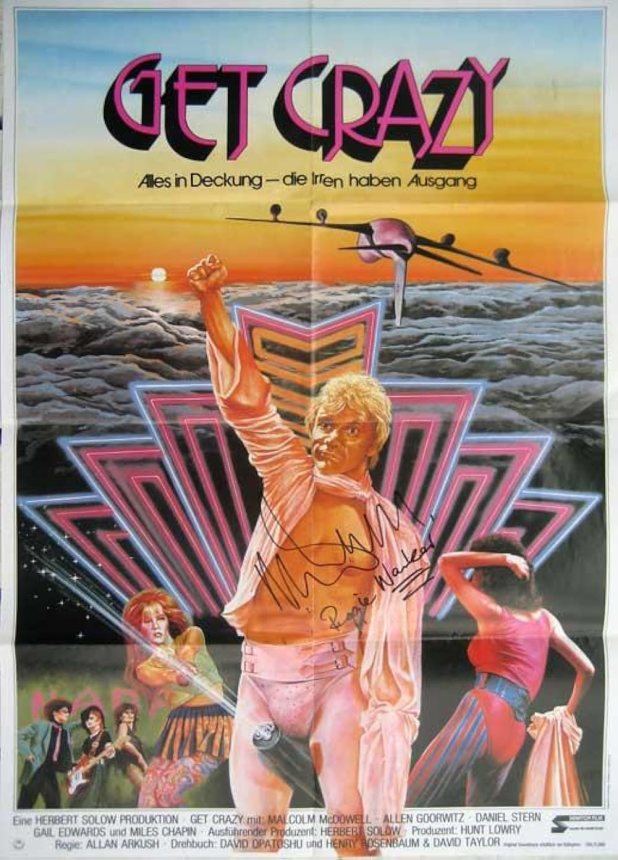
This poster has nothing to do with the movie you’re about to watch. Who cares? You’re here, one assumes, for ninjas. Or commandoes. Or Commando the Ninja.

IFD also lets us know what this should be about: “David, an up-coming young master of Ninjitsu, is recruited by his master to steal the formula for a bacteriological weapon and to free the Japanese scientist who is responsible for developing it. He is pitted against two wily opponents: Mark, a KGB operative, and Martin, who are bent on using the formula in a bid for world domination. The fate of humanity is in the hands of David and a group of four surprisingly acrobatic young fighters.”

Ninjas. “Life means nothing to them,” says Mister Tanaka, a man who shows up in this outfit, wearing an outfit like my dad’s in the mid-80s, a striped red polo, and short shorts.

If you asked IFD twice what this movie was about, they’d say, “A Japanese scientist tries to conceal a deadly formula, but an undead ace and his ninja devils are determined to use it to cause mischief and mayhem. It is up to Lung, a master of the lost art of Hocus Pocus, to keep evil at bay and prevent mass destruction on a global scale.”

Sure, maybe.

IMDB lists the director as Chi Lo, who used the name Joe Law to make Crippled Masters and Lo Ke to direct Deadly Hands of Kung Fu.

This also combines a Taiwanese TV show, another movie called Born a Ninja, and the kind of dialogue that only can come from an 1980s dubbed into incomprehension ninja movie can give you. Or it’s Silent Killers. It could have many titles, but it would still be hard to tell you what happened.

Let me try.

Mister Tanaka had a secret formula from World War II that could destroy the world. That much is true. Two women want the formula, and they are Becky, who wears a yellow vest and Confederate flag shorts. Still, I think that means she’s into late 70s and early 80s redneck trends in America a little too late as they move across the globe and isn’t racist like my neighbor who wears short shorts and throws away all his kids toys after his wife took them and also has a huge Southern Cross up on his garage wall despite being an Italian man in Southwestern Pennsylvania. Did I go on a tangent? Becky is joined by Brenda, who loves denim so much that she wears it on the top and bottom. They’re joined by a master of the hocus pocus style, Larry, who involves your everyday kung fu and the ability to shoot fire out of his fingertips.

As for the evil guy ninja, that’s Meng Fei, who was also in the Ninja Death trilogy, Night Orchid, Everlasting Chivalry, The Sun Moon Legend and Middle Kingdom’s Mark of Blood. He’s pretty impressive in the last fight scene.

Anyway, Mister Tanaka keeps dreaming of dead people who were killed by this secret back in the war. The secret is a mirrored mustache that you put on a devil mask. There’s also a white ninja named David who battles Larry before they decide to be friends, get a room, drink beer and eat fried cabbage.

Or maybe that was the last movie? Have years of drinking, substances, and Godfrey Ho movies dulled my reason, and when confronted by this synth-scored shot on video, my mind just wanders in between different martial worlds, unsure of all the things I’ve seen, all the ninja deaths I’ve felt as if they were my own? In truth, the only important thing is that ninjas can become straw men and that you can swallow a sword in the middle of a fight and live.

I do know one thing. When David sees Larry hanging out with the two ladies, he says, “Two chicks? You are an animal!” That’s exactly how I felt.

Like all IFD movies, this steals a lot of the soundtrack. There’s Miklos Rozsa’s soundtrack for The VIPs, electroacoustic composer Francis Dhomont’s “Pointe De Fuite,” the Michelle Yeoh-starring Royal Warriors, Alexander Lo Rei ninja films like Ninja Death, lots of the John William soundtrack for The Protector, the Bill Conti soundtrack for For Your Eyes Only and the Roy Budd soundtrack for Something to Hide. I’m shocked there was no Sisters of Mercy, myself.

You can watch this on Tubi.

88 FILMS BLU-RAY RELEASE: The Lady Assassin (1983)

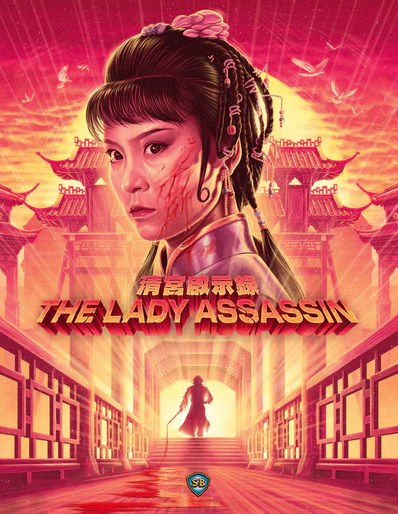
Directed and written by Lu Chun-ku (Bastard Swordsman), this is about the power struggle between the Fourth Yung Cheng (Tony Leung) and Fourteenth Princes (Mok Siu-Chung) — as the Kangxi Emperor (Ching Miao) is dying — with the Lady Assassin Lui Si Niang (Leanne Lau) caught between them and bodyguard Teng Tsung (Norman Chui) ready to protect the Fourteenth Prince with his life. He just might, as the Fourth Prince has hired the unstoppable Min Geng-Yiu (Jason Pai Piao) to kill everyone in his path.

Yes, there are some parts about how the rulers treat the Han Chinese, but it also has most of the cast battling a Japanese ninja (the director!) and his army of gold ninjas. After you just read about all that palace intrigue, let me assure you that there are throwing stars, wire fighting, sword battles, a giant throwing star and two people cut in half—all in one scene—one up and down and the other left to right.

The title doesn’t come into play until the movie’s last few minutes, but who cares? Let me reiterate: giant throwing star and gold ninjas.

The 88 Films Blu-ray release of The Lady Assassin comes with a set of 4 collector art cards, an interview with Poon Kin-Kwan, a stills gallery, a trailer and a reversible sleeve featuring original art. You can get it from MVD.

MOVIES THAT PLAYED SCALA: Variety (1983)

Directed by Bette Gordon and written by Kathy Acker, Variety is the story of Christine (Sandy McLeod), a woman in the city looking for work and ending up in the ticket booth of the Variety, a job that her boyfriend Mark (Will Patton) hates. None of the men that she encounters turn her on, even though a co-worker named Jose (Luis Guzmán) tries. Then she meets Louie (Richard M. Davidson), an older wealthy man who takes her to a baseball game before disappearing. She becomes obsessed with him and her sexuality is awakened by this man and a series of prank phone calls (Spalding Gray is the voice).

According to Downtown Express, “The film is a sort of Who’s Who of downtown street cred: music by John Lurie, cinematography by frequent Jarmusch collaborator Tom de Cillo, script by former sex worker and Pushcart Prize-winning feminist novelist Kathy Acker, and roles played by Spalding Gray, Luis Guzmán, Mark Boone Junior and photographer Nan Goldin, who also took production stills.” Despite that, the theater isn’t really in Times Square. It’s the Variety Photoplays, which was located on Third Avenue between 13th and 14th Streets in the East Village, the same theater as Taxi Driver where Jodie Foster jumps into the cab to escape her pimp.

As a feminist filmmaker, Gordon got criticism and praise for making a film about pornography. Yet I loved Christine’s character, someone fascinated and also upset by the sex that she spends so much of her time around, but it’s not real sex, it’s created for the male gaze. However, it inspires her, even as she reads her sexually frank writing to a boyfriend who doesn’t seem to care, is surrounded by men who just see her as the law of the invisible sex object and the strange man who keeps ghosting her. This movie has stuck with me since I watched it and I wonder, did Louie come back to meet her in that alley?

MOVIES THAT PLAYED SCALA: Videodrome (1983)

Thanks to the British Film Institute, there’s a list of films that played Scala. To celebrate the release of Severin’s new documentary, I’ll share a few of these movies every day. You can see the whole list on Letterboxd.

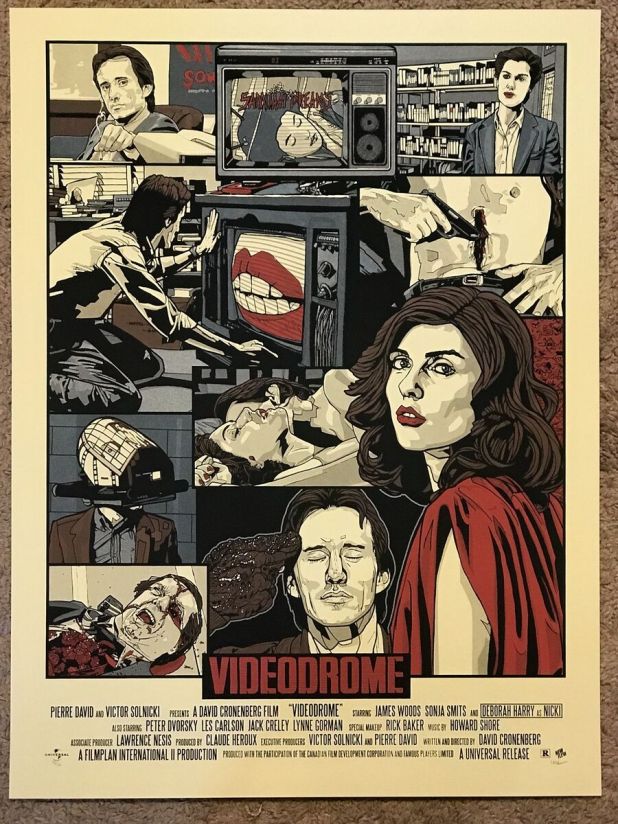
“The battle for the mind of North America will be fought in the video arena: the Videodrome. The television screen is the retina of the mind’s eye. Therefore, the television screen is part of the physical structure of the brain. Therefore, whatever appears on the television screen emerges as raw experience for those who watch it. Therefore, television is reality, and reality is less than television.”

As a kid, David Cronenberg used to pick up American television from across the border and worried that he’d see something he wasn’t supposed to see. Videodrome’s CIVIC-TV was based on the Canadian television network Citytv, which had a show called The Baby Blue Movie that played stuff like Camille 2000 and Wild Honey. There’s also an urban legend that Cronenberg saw Emanuelle In America and wondered how anyone could enjoy a movie that combined sexuality with snuff footage. I don’t know — or care — if that story is true. I’d like to just have complete faith in it.

The director was between Scanners and The Dead Zone and got a bigger budget on this movie than he never had before. Of course, it barely made its money back yet became a classic film, which is usually the way of the world.

Max Renn (James Woods) is the president of CIVIC-TV, a Toronto UHF television station that shows footage on the absolute limit of what is allowed to be shown on TV. One of the satellite dish operators shows Max Videodrome, which is either coming from Malaysia or Pittsburgh — as a lifelong resident, I am pretty pleased with that — that shows people being tortured and murdered with no storyline to get in the way.

Max’s lover, Nikki Brand (Debbie Harry) is so turned on by Videodrome that she goes to try out and never returns. Max is now obsessed and learns that the channel is so much more than just a video show. It may also be the voice of a political movement.

Media theorist Brian O’Blivion is the only person who can guide Max further down the tunnel. At the homeless shelter where O’Blivion’s daughter Bianca (Sonja Smits, The Pit) conducts marathon TV watching experiments. He soon learns that O’Blivion was killed by his partners who created Videodrome but lives on in the hours of video footage he created. Oh yeah — Videodrome also creates brain tumors and hallucinations which are both the symptom and the cause.

Videodrome is really part of an ideological war between its sex and violence-obsessed viewers and Barry Convex (Leslie Carlson, Black Christmas) and the Spectacular Optical Corporation, a combination ophthalmology and arms company. They program Max — via videotapes inserted into a vaginal opening in his chest that causes his body to transform and even grow a gun in his hand — to murder anyone that gets in their way, which may or may not all be hallucinations, until Bianca reprograms him to start killing for her father’s cause, shouting “Death to Videodrome. Long live the new flesh.”

That new flesh means ascending outside of the bonds of our normal form, which for Max means suicide. Or does it? There were plenty of endings made for this movie, including one where Max, Bianca and Nicki appear on the set of Videodrome, all with slits in their chests filled with sex organs. As an atheist, Cronenberg cut this ending, as he felt it may make people think he believed in Heaven. He was also forced to cut all manner of berserk things from the script, like Max having a grenade for a hand, as well as him melting into Nicki as they kissed and a total of five more characters dying of cancer.

This sequence sums up why I love this movie so much:

Max Renn: Why do it for real? It’s easier and safer to fake it.

Masha: Because it has something that you don’t have, Max. It has a philosophy. And that is what makes it dangerous.

You can hear dialogue from this movie in tons of songs, including “Microphone Test” by Meat Beat Manifesto, “Master Hit” by Front 242, “Children” by EMF, “Draining Faces” by Skinny Puppy, “Scared to Live” by Psychic TV and so many more.

For a movie made in 1983, it really could have been made today. There’s so much to experience here and I will be going back for another experience. See you in Pittsburgh.

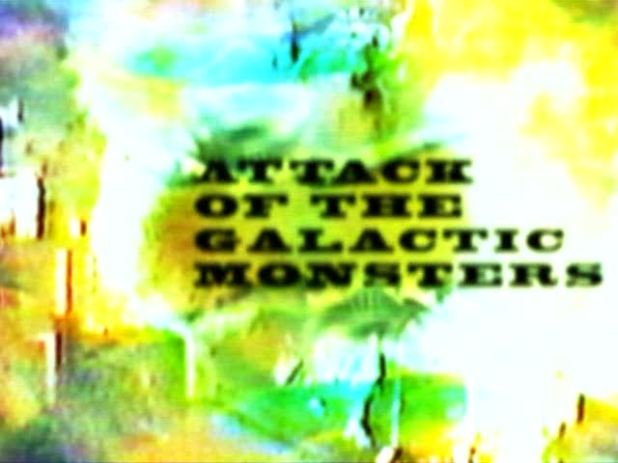
RETURN OF KAIJU DAY: Attack of the Galactic Monsters (1983)

I have no idea how and why this exists, but I’m ready to find out.

Supposedly made for Hawaiian TV, this 55 minute movie is made out of parts of War In Space and Godzilla scenes from the TV show Zone Fighter. And it’s a mess, a glorious mess, nearly an hour of footage of space ships, aliens yelling and kaiju beating one another up.

Or maybe it’s an elaborate hoax, a bootleg put together to sell at cons and post to the internet.

Does it matter? This does what I have always wanted: Chop out the boring exposition and human drama and just give the audience what they want: explosions, kaiju combat and destruction.

I could tell you that this is about Hell, the Supreme Commander of the Empire of Galaxy kidnapping the daughter of Captain Takigawa and holding the Earth hostage.

Meanwhile, Zone Fighter was a Toho tokusatsu show that took place — in continuity! — between Godzilla vs. Megalon and Godzilla vs. Mechagodzilla. It’s all about the zone Family, whose planet Peaceland was destroyed by the evil alien race known as the Garogans. The children of the family are Zone Fighter, Zone Angel and Zone Junior, powered by toy-like weapons.

King Ghidorah and Girus show up, as does Godzilla, who has a special cave built for him by the Zone Family so he has a place to relax. It lasted for 26 episodes before poor ratings ended the show, even with the appearances of Toho’s most famous monsters. Also: Every bad guy monster dies horribly on this show.

For an example of that, Godzilla sets Wargilgar on fire in this, as we watch that poor kaiju dance around ablaze. Burn, Tokyo, burn! There’s also a magnetic kaiju named Jikiro that gets torn apart. In America, we only saw fights between monsters. Kids in Japan demanded blood.

This also ends as so many Japanese movies do with one of the heroes bravely sacrificing his life to save everyone else. I didn’t understand the idea of nobility as a child and it just made me sad. It still does. But then again, did I really want. these antenna aliens telling me how to live my life? Today, I’d do the same thing, but it’s not as cool to drive a minivan into a spaceship as it is to drive a big flying battleship.

Anyway: This movie goes good with drugs.

You can download this from the Internet Archive.

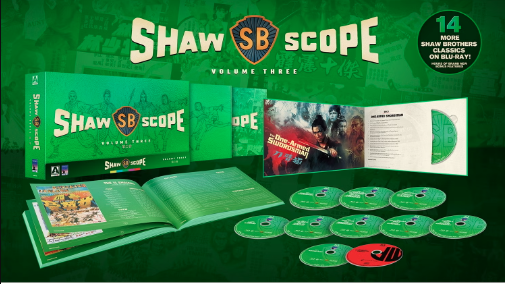
ARROW VIDEO SHAW SCOPE VOLUME 3 BOX SET: Bastard Swordsman (1983)

Director Chun-Ku Lu (Holy Flame of the Martial World) is here to tell us the story of Yun Fei Yang (Norman Chui), an orphan who is given the worst tasks at Wudang, a martial arts school. Every privileged student abuses him, but he remains there, studying and working on his kung fu when he isn’t being treated like trash. There’s a real problem, however, as the rival Wu Di school and their best fighter, Kung Suen Wang (Meng Lo), is coming back to duel the school’s master swordsman Qing Song (Jung Wang) after having already defeated him twice.

Yun Fei Yang also is in love with the daughter — Fang Er (Yeung Jing-Jing) — of the leader of the school, Chief Dugu (Alex Man Chi-Leung), who has left for two years. As Dugu rests as a tavern, he’s attacked by four killers — Wind (Yuen Tak), Thunder (Wong Lik), Rain (Yuen Qiu) and Lightning (Kwan Fung), in case you ever wondered if John Carpenter watched these movies — and is saved by Fu Yu Shu. Yet after he’s attacked a second time, Yun Fei Yang is blamed and the school starts to tear itself to pieces A new master shows up, Fu Yu Xue (Tony Liu), and he soon steals away the school.

Yun Fei Yang starts to train with a stranger — Shen Man Jiun (Chan Si-Gaai) — and begins to master the signature style of the school, the Silkworm, all while running for the law, who thinks that he is a murderer. Yet despite the odds being against this “bastard,” the only way the true Wudang style will live on is through him.

Don’t think that this movie is rooted in our world. After all, Yun Fei Yang soon learns how to spin himself into a cocoon and emerge as a silver armored superhero who can shoot webs and emit blasts of energy. By the end, the final battle takes place inside his cocoon and it ends with the bad guy turned into a skeleton.

Based on a TV series, Reincarnated or The Transformation of the Heavenly Silkworm, this would be followed by a sequel, Return of the Bastard Swordsman.

The Arrow Video Shaw Scope Volume Three box set has a brand new 2K restoration of The Bastard Swordsman as well as commentary by Frank Jeng and a trailer.

You can get this set from MVD.

The Creature Wasn’t Nice (1983)

Also known as Naked Space and SpaceshipThe Creature Wasn’t Nice was directed and written by Bruce Kimmel, who is probably best known for his other movie, The First Nudie Musical, as well as his acting career. He’s also worked on numerous stage plays, written twenty-five books and even put on production of a musical, Levi, that was based on the story of Levi Strauss with a book by Larry Cohen and a score by the Sherman Brothers. He also came up with the idea for The Faculty.

Kimmel’s director’s cut was only seen twice before producers cut it to pieces. Kimmel loved the old science fiction movies but thought that slashers were evil and despicable.

Beyond Leslie Nielsen — which explains the Spaceship and Naked Space titles being named after Airplane! and The Naked Gun — this has a great cast with Cindy Williams, Gerrit Graham and Patrick Macnee, all of whom seem to be having a wonderful time. Along with Kimmel, they make up the five-person crew of the Vertigo, which is looking for new life when they must land on a planet.

Soon, a goopy red alien is on board and singing “I Want To Eat Your Face” and there’s also a series of parodies, like a cooking show and an elderly Dirty Harry. There’s also footage from This Island Earth and Spectreman, as well as a talking computer that was supposed to be played by Broderick Crawford.

It’s all over the place and frequently falls apart, but Cindy Williams is so plucky and Leslie Nielsen is always funny even in sub-zero parody films and this doesn’t reach those lows.

This feels like if no one on Dark Star smoked grass.

88 FILMS 4K RELEASE: The Project A Collection

88 Films has been releasing some incredible things this year, but The Project A Collection is the best set yet. It features both Jackie Chan films in a 4K UHD presentation with both the Hong Kong and Taiwan versions, as well as English and Cantonese-language options. There are so many extras, including a perfect-bound book, six lobby cards, a double-sided poster, a slipcase with brand-new artwork from Kung Fu Bob and interviews with Jackie Chan, Lee Hoi San, Mars, Yuen Biao, Dick Wei, Michael Chan Wai-Man, Michael Lai and Edward Tang. There’s even more, such as new audio commentaries by Frank Djeng and FJ DeSanto, making-of videos, outtakes, trailers, still galleries, the Japanese ending and more!

You can order this from MVD.

Project A (1983): Project A has a clock tower stunt in it, but Jackie Chan had not seen the films of Buster Keaton and Harold Lloyd when he made this movie, as they were not available on home video. He saw this as the evolution of comedy, action and martial arts that he’d been working on since The Young Master.

This movie and Dragon Lord were the first films since Jackie came back from his initial failed time in America and he had something to prove.

Sergeant Dragon Ma (Chan) is part of the Hong Kong Marine Police, which is battling both pirates and their Hong Kong Police rivals. After one fight too many, the Marine and regular police have to join forces.

Beyond Dragon Ma, Project A also has Sammo Hung as Zhuo “Fei” Yifei and Yuen Baio as Inspector Hong Tin-Tzu. In time, they all join together to face pirate lord Sam Pau (Dick Wei), who is smuggling guns directly from the cops.

Up until Project A came out, Hong Kong movies didn’t have the large sets and attention to period detail that other movies did. It’s also a film that isn’t all fighting, but instead a mix of action and combat.

Project A Part II (1987):Sergeant Dragon Ma (Jackie Chan) is back and has been sent on a new mission, far from the pirates who have pledged to kill him at the end of the first film. He soon learns that his new assignment, Sai Wan Police Station, is full of corrupt police like Superintendent Chun (Lam Wai), all except for one officer. He takes that man, Ho (Kenny Ho) and three of his friends to try to arrest gangster Tiger “Awesome Wolf” Au (Chan Wai-man) and is nearly killed. He’s saved at the last moment by his friends in the Marine Police.

Once he gets through that challenge, Dragon gets set up for a jewel robbery and must work with revolutionaries to clear his name. If that’s not enough, he also has three incredibly attractive women to deal with in Yesan (Maggie Cheung), Miss Pak (Rosamund Kwan) and Carina (Carina Lau), who gets kidnapped by the same criminals who have tried to ruin Dragon Ma’s reputation.

Yuen Biao and Sammo Hung only have cameos in this, allowing Chan to take center stage. Who knew that a martial arts movie could pay tribute to the Marx Brothers and Buster Keaton while changing the way fights would be filmed? Instead of lining the bad guys up one at a time, Chan battles numerous opponents at once.

By the end, even the pirates love Jackie. This movie is worth watching so many times as the sets, costumes and action has to be savored.

VINEGAR SYNDROME BLU RAY RELEASE: Forgotten Gialli: Volume Seven

This is the seventh Forgotten Gialli set from Vinegar Syndrome. ou can check out my articles on the others here:

This box set has the following movies:

Mystère (1983): 1983 is pretty late for the giallo, but hey — I’ve been trying to expand into the period before and after the major years for the genre.

Also known as Dagger Eyes and Murder Near Perfect, this film was written and directed by the Vanzina brothers, Carlo and Enrico. They loved the 1981 French thriller Diva, a film that moved away from the realist 1970s French cinema to the more colorful style of cinéma du look. Carlo also directed Nothing Underneath so he gets a forever pass from me.

Mystère is divided into chapters, starting with a prologue, then each section is one of the four days that follows, then an epilogue. The producers demanded this happy ending, while the brothers wanted something more cynical.

Mystère (Carole Bouquet, For Your Eyes Only and the face of Chanel No. 5 from 1986 to 1997) is a high class call girl in Rome who comes into the possession of a mysterious lighter when her friend Pamela (Janet Ågren, City of the Living Dead) and one of her customers are killed over it, as inside the lighter are images of a political assassination.

Unlike the normal giallo — or adjacent giallo or whatever this is — the hero, Inspector Colt, ends up killing the assassin (John Steiner, Shock) and his bosses and then leaves behind our heroine, who ends up tracking him down to Thailand and making up with him. He was good with nunchucks, maybe?

I mean, how many movies are you going to see that somehow take the spirit of the good parts of 1970’s giallo, mix in the Zapruder film, throw in some Eurospy and still end up looking like a super expensive perfume ad?

Also — thanks to BodyBoy on Letterboxd who called out that Mystère’s apartment looks like something straight out of Messiah of Evil.

Obsession: A Taste for Fear (1988):  Pathos: Segreta Inquietudine, the original Italian title for this movie, means Passion: Secret Anxiety. That pretty much sums it up, as this giallo feels closer to one of those Cinemax After Dark films that mixes up murder with softcore sex. Well, this movie also has Lou Gramm’s “Midnight Blue” in it, which is a first for any giallo I’ve seen.

This is the only movie that writer/director Piccio Raffianini’s ever made, which is pretty astounding, because the guy obviously had talent.

Diane (Virginia Hay, The Road Warrior and also the blue skinned Pa’u Zotoh Zhaan from Farscape) is a photographer whose favorite model — and lover — Tegan (Teagan Clive, who was also The Alienator) shows up bound and dead, just like the adult photos that our heroine is famous for. Imagine — a Skinemax The Eyes of Laura Mars and you’re not far off.

Lieutenant Arnold (Dario Parisini) is on the case and suspects both Diane and her ex-husband, particularly after other people close to her are tied up and stabbed, as if they were doing some knifeplay and then gave their lives up.

Eva Grimaldi, who was in Demons 5 and Ratman, is in this. And look out! There’s Kid Creole, from Kid Creole and the Coconuts, probably the last dude I expected to see walk on to a giallo film*. What is happening?

I love the first club that shows up in this film, with little people dancing, muscular folks dancing, mirrors covered with coke, quick cuts and improbably synth Gershwin songs.

Obsession: A Taste for Fear is a completely deranged film, one that supposes a world where everyone wears sunglasses at night, where colors come straight out of the brainstem of Dario Argento, where softcore porn photographers are huge celebrities, cops shoot laser guns, hovering cars are a dime a dozen and no one bats an eye.

Imagine if Rinse Dream made a giallo and had the money to get legitimate recording artists to appear on the soundtrack. Now, do some lines. And then, you will have just some of the strangeness that is this movie, which demands to get a release from a boutique label so that maniacs other than just me can obsess over it.

*To be fair, Kid Creole is also in Cattive ragazze, which is at least an Italian movie with hints of giallo made at the same time.

Sweets from a Stranger (1987): Caramelle da uno sconosciut has the elements of a giallo — a masked and black-gloved killer is slicing sex workers with a razor and then killing them with a bolt gun — but it’s just about how the women decide to stop taking it and empower themselves, which may not have been what audiences were looking for.

It was directed and written by Franco Ferrini (PhenomenaNothing UnderneathDark Glasses), who worked on the script with Andrea Giuseppini and got the idea while writing Red Rings of Fear. It’s the only movie that he ever directed.

Stella (Mara Venier) and Nadine (Athina Cenci) are a high end call girl and an older experienced prostitute who learn of the death of Bruna, a mutual friend. They organize their fellow sex workers Lena (Barbara De Rossi, Vampire In Venice) and Angela (Marina Suma) with the goal of finding out who the killer is and stopping him while the police are fumbling in the dark.

Ferrini has spent a lot of time working with Argento — as has editor Franco Fraticelli — so the film looks good. The first kill is totally Bava with a woman being killed while surrounded by sculptures of angels. In fact, it’s nearly one of the scenes from Blood and Black Lace. Thanks for noticing, Giallo Files. Steal from the best, right?

Yet it’s also a serious movie that doesn’t exploit the woman and shows the reasons why someone would sell their body, as well as the abuse and trauma that often comes with this profession. It’s an intriguing way to use the giallo form to tell a story about real life. Of course, the first two girls are simply to get you in, using the exploitative nature of the giallo trappings to whet your appetite for more mayhem and then making you consider the actual people who are often only presented as victims.

You can get all three of these in this new box set from Vinegar Syndrome.

CANNON MONTH 3: Rescue Team (1983)

EDITOR’S NOTE: For the last two days of Cannon Month, I’m going to cover movies that weren’t produced by Cannon but which were distributed by them on one of their various home video labels including Cannon / MGM/UA Home Video, HBO/Cannon Video, Cannon Video, Cannon / Guild Home Video, Cannon / Rank Video, Cannon Screen Entertainment Limited, Cannon Classics, Cannon / Warner Home Video, Cannon/VMP, Cannon Screen Entertainment, Scotia/Cannon, Cannon International, Cannon/ ECV, Cannon / Showtime, Cannon / United Film, Cannon / Isabod, Cannon / Mayco and so many more.

Jim Goldman is also Jun Gallardo, the director of fifty plus movies like SFX Retaliator and The Firebird Conspiracy. Are you surprised that he’s recruited Richard Harrison for this film mission? If you’ve watched as many movies where the Philippines become the new Vietnam, you’re not.

Also known as Operation Coleman — Frank Coleman is the man who needs to be rescued — and featuring the same cast as Intrusion: Cambodia (coming later this week) this one finds Harrison as CIA agent Robert F. Burton. He’s offered a hundred thousand dollars to save the POW and uses a government computer to choose the best men for the job.

Between pretending to be archaeologists and spending the night before their mission getting drunk at a strip club may not be the best move for these soldiers. Plus, in any gathering of thirteen — or however many people go to Vietnam to get a treasure or rescue someone in an 80s VHS rental movie — expect a Judas.

Somehow, Tetchie Agbayani — who plays Kara in this movie — would also appear as Princess Rubali in Gymkata, get to be in The Money Pit and Disorderlies (of all movies!) and was the first-ever Filipino woman to appear in Playboy (even if it was the German version). She’s still acting today.

This has all your favorite soldiers in VHS films like Mike Monty, Romano Kristoff (who was in a few Mark Gregory movies including Just a Damned Soldier and Tan Zan: The Ultimate Mission), Jim Gaines (Strike CommandoCop Game), Korea war orphan and writer of this movie Don Gordon Bell (Enter the NinjaStryker), Mike Cohen (The One Armed Executioner) and more.

It’s not the best one of these movies you’ll find, but it’ll pass the time. And no, we don’t get to win this time.

Also…

It’s a Cannon (international) movie!