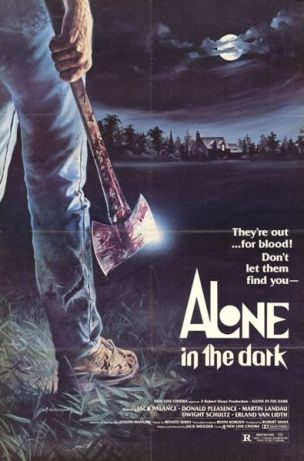
Alone in the Dark (1982)

I’m always searching for movies. After the April Ghoul’s Friday night, I headed back to our room and watched this movie on TCM and wanted to add it to my collection. It’s out of print, with prices going anywhere from $90 to $120 for the DVD. Imagine my happiness when I found it for $4 at an antique store!

The film opens with a dream sequence where Byron “Preacher” Sutcliff (Martin Landau, forever Bela Lugosi and John Koenig to me) finds himself in a diner where he is chopped in half by a demented short order cook (Donald Pleasence!).

That cook turns out to be Dr. Leo Bane, who runs a psychiatric hospital that is able to reach the unreachable. Sure, his methods are practically surreal and he randomly smokes weed during the day. But they work.

Dr. Dan Potter (Dwight Schultz, Murdock from TV’s The A-Team) is the new doctor in town, the replacement for Dr. Harry Merton who has moved to another hospital in Philadelphia. He’s brought his wife Nell and daughter Lyla (Elizabeth Ward, who played the original Carol Seaver in the pilot for TV’s Growing Pains before Tracey Gold won the role) to town and is preparing for a visit from his punk rock, post-nervous breakdown having sister Toni.

The really dangerous people in Dr. Leo’s care are all on the third floor. We already met the preacher, who loves setting things on fire. Then there’s the paranoid prisoner of war Frank Hawkes (the transcendent Jack Palance), child molester Ronald Elster (Erland van Lidth, Dynamo from The Running Man who was also in Stir Crazy) and John “The Bleeder” Skagg (Phillip Clarke, The Reincarnation of Peter Proud ), a killing machine who bleeds from the nose when he kills. No one has seen The Bleeder’s face, as he hides it from everyone but his close friends.

Dan learns from security guard Ray Curtis (Brent Jennings, Witness) that the third-floor men all believe that he killed Dr. Merton and want revenge. He blows this off.

A night at the punk rock club — a place that Dan hates — ends after the power goes out, as a nuclear power plant has caused a regional blackout. Lyla is at home with Bunky, her babysitter. And the men from the third floor kill their way out of Dr. Leo’s hospital, with all three but The Bleeder staying together.

Preacher makes the first move, trying to deliver a telegram to the Potter house. Then, Nell and Toni go to protest the nuclear power plant but are arrested, forcing them to bring in Bunky to babysit. However, Ronald gets there first and teaches Lyle origami. As for Bunky, well, she calls over her boyfriend Billy for some sex, but Preacher and Ronald kill them in a scene that has a disconcerting bit with a knife emerging from the bed.

When Dan bails out Nell and Toni, they bring along Tom Smith, a man they met in jail. The police are all over the house, investigating the murders of Bucky and Billy. Luckily, Lyle was in bed sleeping the whole time after playing with Ronald.

What follows is a night of murder and mayhem, with cops getting killed by crossbow bolts, Dr. Leo trying to reach out and hug the Preacher (he had previously told him that if he didn’t settle down he would cut him in half, leading to the nightmare we saw at the start of the film) before getting killed with an axe, a fire in the basement, the reveal of The Bleeder and so much more.

“It’s not just us crazy ones who kill,” says Dan at one point. The end of the film and the closing scene are harrowing. I’m not giving it away. You need to hunt this down for yourself.

Co-written and directed by Jack Sholder (The Hidden, the near franchise realigning of A Nightmare on Elm Street 2: Freddy’s Revenge and The Omen TV movie remake) along with additional writing from producer and New Line co-chair and co-CEO Robert Shaye (who worked on the first two Elm Street movies), this was New Line’s first release. It also features a quick effect from Tom Savini.

One of the members of the band in the movie, The Sick Fucks, said that he ran into Jack Palance years after the movie. He told him he was one of The Sick Fucks from Alone in the Dark and Palance replied, “We were all sick fucks in that movie.” He’s right — Palance is awesome in this. He went so far into character that he refused to film a scene where he would kill the driver outside the Haven. He said that the audience didn’t need to see him kill the man to know how dangerous he was. He was totally right.

Alone in the Dark was written off as just another slasher in the early 1980’s. It’s basically disappeared as there hasn’t been a major re-release by a label like Shout! Factory or Arrow Video. That’s a shame — it’s an intelligent film that is as comfortable discussing the existential philosophy of R.D. Laing as it is with showing people get skewered.

UPDATE: You can now stream this on Shudder.

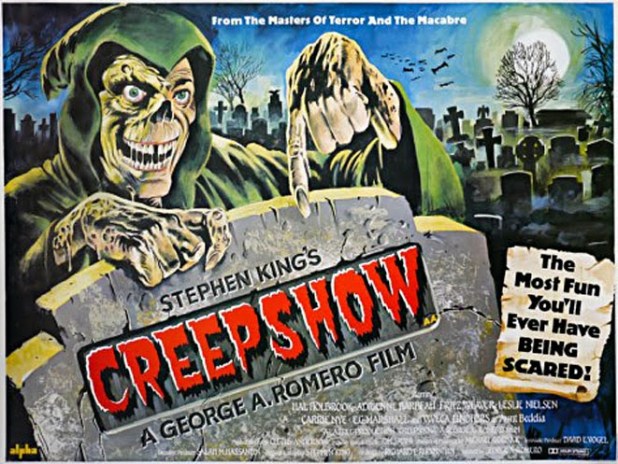
STEPHEN KING WEEK: Creepshow (1982)

Sometimes, a movie is so perfect that you can’t objectively discuss it. Creepshow is that kind of movie — a perfect combination of portmanteau, E.C. comics, goopy special effects and gross-out humor. It’s also the perfect melding of some of the greatest talents in horror — George Romero, Tom Savini, Bernie Wrightson and Stephen King.

This film is King’s screenwriting debut and consists of five short stories (two based on King stories) and a framing element where Billy (played by King’s son Joe Hill) fights with his father (Tom Atkins!) over his horror comics. Soon, the Creep himself comes to his window, asking Billy to come closer as he transforms from a practical effect (that uses a real human skeleton) to animation (done by Pittsburgh-based group The Animators, who also did the Tom Petty video for “Running Down a Dream”).

In the first story, Father’s Day, Nathan Grantham is the old man of the family, rich from a life of murder, fraud and extortion. Finally, on Father’s Day, his long-suffering daughter Bedelia (Viveca Lindfors, A Bell from Hell)  finally rises up against a lifetime of abuse and torture (he even killed the only man she ever loved) and kills him.

Every year on Father’s Day, his family gathers to celebrate his life. And by that, I mean that they talk about how much they hated him. There’s Sylvia (Carrie Nye, wife of Dick Cavett), Richard, Cass and Cass’s husband Hank (Ed Harris, showing up in another Romero film after his star turn in Knightriders).

Bedelia is late, but she has to stop at the cemetery and see the grave. She’s drunk — again — and spills her whiskey all over the headstone, which brings her horrible father back from the dead. One by one, he wipes out his family, all while screaming for his Father’s Day cake. Well, he gets it.

Some minor trivia here — Nathan’s corpse is played by John Amplas, who is a noted theater teacher in Pittsburgh. However, you may know him better as the title protagonist of Romero’s classic Martin.

Up next, The Lonesome Death of Jody Verrill is nearly a one-man show for King. Based on his story Weeds, it’s a Lovecraftian tale (think The Colour Out of Space) of a meteor destroying a simple man. It also has some great old WWWF footage and an appearance by Pittsburgh stage legend Bingo O’Malley.

Something to Tide You Over is a very E.C. Comics story, where a wife (Gaylen Ross) and her lover (Ted Danson from TV’s Cheers) finally get caught by her husband (Leslie Nielsen in a rare villainous role). It’s a simple story told well with incredible effects from Savini, as instead of just zombies, he creates seaweed and salt water damaged undead monsters.

The Crate is the real crowd pleaser of the film and is based on the King short story of the same name. Between Hal Holbrook, Fritz Weaver and Adrienne Barbeau, it’s packed with star power. And the actual beast inside the crate is a Savini tour de force, a perfect monster. There’s also a cameo by Romero’s ex-wife, Christine Forrest.

Finally, in They’re Creeping Up on You, E.G. Marshall rules the screen as Upson Pratt, a Howard Hughes-like man who lives in a sealed apartment because he’s deathly afraid of insects. As in any E.C. Comics story, what you fear the most is what will destroy you.

There’s an interesting object that keeps showing up throughout the film — a marble ashtray that shows up in nearly every scene. It’s the one used to kill Nathan in the first story, but it keeps reappearing. Is it the Loc-Nar of Creepshow?

If you’re from Pittsburgh, Creepshow is a tour of home. There’s an abandoned girl’s school in Greensburg that was used for the majority of the shoot, as well as Carnegie Mellon University, Romero’s own backyard in Shadyside and a mansion in Fox Chapel. The only non-Pittsburgh setting was a New Jersey beach for the drowning scenes.

Soon after the film was released, a comic book adaption was released, with art by comic legend Bernie Wrightson. It was a prize possession of mine throughout my teen years and I dog-ear read it, nearly tearing off the cover.

The prop comic in the film was actually created by E.C. Comics vet Jack Kamen, as was the poster for the film. King had wanted “Ghastly” Graham Ingels, but he refused and Kamen was recommended by former E.C. owner (and publisher of MAD) William M. Gaines.

People love this film. There’s a Creepshow Museum dedicated to the movie that’s packed with replicas, posters and autographs from the stars of the film. And there’s a ton of merch for the film — Fright Rags has released numerous t-shirts; I’ve worn out this one from Pizza Party Printing; Horror Merch Store has masks of Fluffy from The Crate and Nate, as well as the soundtrack; and there’s even action figures of Nate, Harry and Becky (from Something to Tide You Over) from AmokTime!

Synapse Films even released Just Desserts, a making-of film that has interviews with nearly everyone involved that you can find right here.

Creepshow truly is the most fun you’ll ever have being scared. It was followed by two sequels of diminishing quality, but it’s held up for over thirty years. It’s a movie I bring out and watch at least once a year. And now that Shudder is celebrating featuring Stephen King movies on their streaming service, you can watch it whenever you want!

UPDATE: The Creepshow Museum doesn’t just have replicas! They have screen used props, original production materials and many one-of-a-kind items as well. I really appreciate them reaching out to us and setting the record straight!

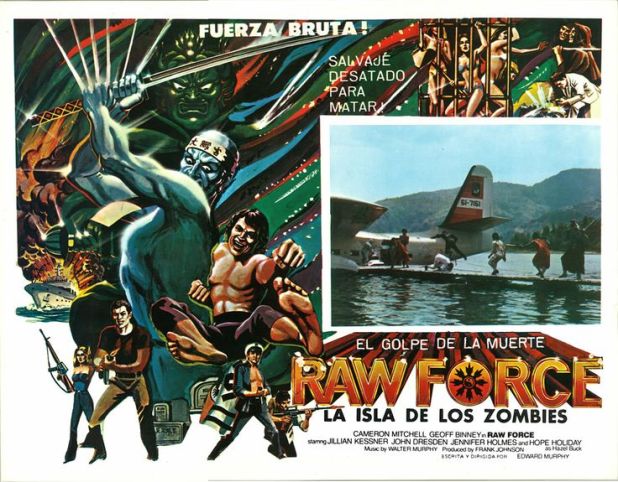
Raw Force (1982)

Let’s say there’s this island where drugs come from. Also, there’s a white slavery ring that trades in pretty girls. Additionally, a Nazi who looks a lot like Hitler is interested in the place. And oh yeah — it’s also the burial ground for disgraced martial artists who will one day be raised from the dead by the strange monks who live there. Got all that? Throw in Cameron Mitchell as a boat captain and you’re ready for the pure batshit piece of trash that is Raw Force.

But wait — the film is also a travelogue of the worst parts of the Far East, as the members of the Burbank Karate Club make their way to the island. Bar fights. Dens of ill repute. Strip clubs. And then the film becomes the Love Boat, but then people start getting killed.

Toss in a nude scene of Camille Keaton (I Spit On Your GraveWhat Have You Done to Solange?) while she’s in the bathroom (she’s billed as “Girl In Toilet” and was paid in cash for her part) and a final act where the zombie martial artists all rise and begin killing everything and everyone (and are dressed as Mortal Kombat castoffs ten years before that game even came out), as well as piranhas and you, have quite the stew.

Originally written as Kung-Fu Zombies, the film ends with a To Be Continued… The sequel would have featured Jonathan Winters (!!!) as Hope Holiday’s ex-husband and of course, Cameron Mitchell would have returned.

This is a delirious cocktail of everything you want to watch while at the drive-in or inebriated in the middle of the night: sex, chop sockery, zombie gore, Nazis, mayhem, more sex, more gore, bad kung fu and daring airplane hijinks. Luckily, it’s easy to find on Shudder. Or you can grab a blu ray from the awesome people at Vinegar Syndrome.

I can’t overemphasize how much fun this movie is. Director Edward Murphy claims that he was making a film for seventeen-year-old boys. He succeeded beyond my wildest dreams.

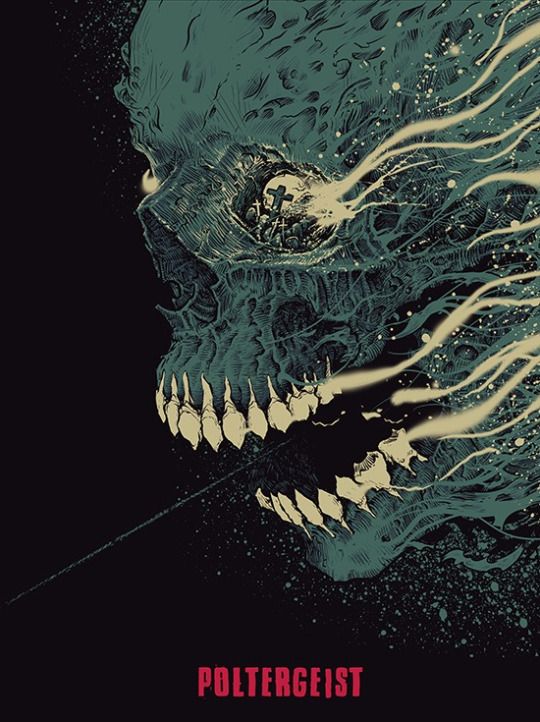
Poltergeist (1982)

If a movie is a great film, does it matter who made it? I come from advertising, where it’s hard at best to figure our credit and uncouth to loudly demand it. So the controversy about this film — whether Spielberg or Hooper directed it — doesn’t really matter to me Because the important thing is that it’s a great movie.

Steven and Diane Freeling (Craig T. Nelson from TV’s Coach and the voice of Mr. Incredible from The Incredibles and JoBeth Williams, Stir Crazy) are living the American dream. After all, Steve is a successful real estate developer. They have three great kids. And they’ve recently moved into a planned community called Cuesta Verde. Sure, the newer houses in the plan look much better. And you can’t even watch a football game without losing what channel you’re on because the houses are so close together. But it’s the American Dream, right?

That TV is the fixation of America in this movie, starting with the National Anthem and continuing with the people inside the TV that fascinate their youngest daughter, Carol Anne (who would sadly die at the age of 12 of cardiac arrest and septic shock caused by a misdiagnosed intestinal stenosis). The connection between the hand that emerges from the TV and the young girl is so powerful that it shakes the entire town before she announces the film’s best-known line, “They’re here.”


All hell breaks slowly loose over the following day. A glass of milk breaks out of nowhere, drenching daughter Dana (Dominique Dunne, daughter of writer Dominick and brother of Griffin, she would be killed by her stalker ex-boyfriend John Thomas Sweeney at the age of 22). The son, Robbie (Oliver Robins, Airplane 2), has his silverware twist and turn after he uses it. Furniture slides and rearranges at will, even in front of more than one person.

Here’s the beauty of this film. These teases start slow and you expect the Val Lewton jump scare model, where the pressure will be let off after a minor scare. But once a tree emerges from the backyard to crash through the window and pull Robbie outside, the movie jumps onto a rollercoaster track. While saving their son, Carol Anne disappears into the closet and can only be heard through the TV set.

They turn to parapsychologists Dr. Lesh (Beatrice Straight, Chiller), Ryan (Richard Lawson, Scream Blacula ScreamSugar Hill) and Marty, who discover that there is more than one ghost. That info is confirmed when Steven finds out from his boss Lewis Teague (James Carren, The Return of the Living DeadInvaders from Mars) that Cuesta Verde was built over an Indian cemetery.

Dana and Robbie are sent away and Tangina Barrons (Zelda Rubinstein, Teen WitchBehind the Mask: The Rise of Leslie Vernon), a spirit medium, is called in for help. She explains how they have to get Carol Anne back from spirits that are not at rest. There’s also another ghost, the Beast (which uses the same sound effect as the MGM lion roar), who has their daughter restrained. Diane enters a portal to the beyond to bring her daughter back and they both emerge covered in ectoplasm as the house is said to be clean.

Steven believes that it’s anything but, so he gets the family ready to move. On their last night there, he goes to quit his job while Dana goes on one last date before leaving town. The Beast attacks, turning Robbie clown doll into a demon and pushing Diane all over the walls of her room before throwing her into the backyard hole that is due to be a swimming pool. The bodies of the dead begin to explode from the ground, some in coffins, some just covered with filth and rot. Steven screams into his boss’s face that he may have moved the cemetery’s headstones, but the bodies were left behind. Finally, the house collapses within itself as the family drives away. As they stay in a Holiday Inn, unsure of their future, the TV is pushed outside.

Alright. Let’s get into that discussion of who really directed this film. Going the whole way back to a 1982 Fangoria article, there were rumors that the film wasn’t really Hooper’s. And Spielberg didn’t help Tobe’s case when he said, “Tobe isn’t a take-charge sort of guy. If a question was asked and an answer wasn’t immediately forthcoming, I’d jump in and say what we could do. Tobe would nod agreement, and that became the process of collaboration. I did not want to direct the movie-I had to do E.T. five weeks after principal photography on Poltergeist. My enthusiasm for wanting to make Poltergeist would have been difficult for any director I would have hired. It derived from my imagination and my experiences, and it came out of my typewriter (after re-writing the Grais/Victor draft). I felt a proprietary interest in this project that was stronger than if I was just an executive producer. I thought I’d be able to turn Poltergeist over to a director and walk away. I was wrong. If I write it myself, I’ll direct it myself. I won’t put someone else through what I put Tobe through, and I’ll be more honest in my contributions to a film.”

The Directors Guild of America investigated the film, checking to see if Hooper’s official credit was hurt by Spielberg’s comments, which seemed to claim some level of ownership.” Frank Marshall, the co-producer, told the Los Angeles Times that Spielberg was the creative force of the film and designed every storyboard. Plus he was on the set for all but three days.

Finally, an open letter from Spielberg to Hooper was sent to The Hollywood Reporter, which stated, “Regrettably, some of the press has misunderstood the rather unique, creative relationship which you and I shared throughout the making of Poltergeist. I enjoyed your openness in allowing me… a wide berth for creative involvement, just as I know you were happy with the freedom you had to direct Poltergeist so wonderfully. Through the screenplay you accepted a vision of this very intense movie from the start, and as the director, you delivered the goods. You performed responsibly and professionally throughout, and I wish you great success on your next project.” He also sent a letter to Time where he stated, “While I was creatively involved in the entire production, Tobe Hooper alone was the director.”

Over the years, this controversy has gone back and forth. Zelda Rubinstein claimed that Spielberg directed every day that she was on set, with Tobe working almost as a DP who would set up the shots.  Assistant cinematographer John R. Leonetti (who would go on to direct Annabelle) reported that due to an upcoming strike, he was trying to get every movie he wanted to film done (he was also working on E.T. The Extra-Terrestrial at the same time). Hooper was happy to be there, had some input but it was basically not his film.

Jo Beth Williams stated that “Steven was there every day. He had very clear and strong ideas about what he wanted done and how he wanted it done. Even though Tobe was there and participating, you felt Steven had the final say on everything. Sometimes Steven would tell us one thing and Tobe another. But they soon realized that was doing us more harm than good, so they stopped. Later on, whatever discussions Tobe and Steven had, they held in private and then came to us with their decisions.”

At the time of filming, Hooper said, “I don’t understand why any of these questions have to be raised. I always saw this film as a collaborative situation between my producer, my writer, and myself. Two of those people were Steven Spielberg, but I directed the film and I did fully half of the storyboards. I’m quite proud of what I did. I can’t understand why I’m being slighted. I love the changes that were made from my cut. I worked for a very good producer who is also a great showman. I felt that was a plus, because Steven and I think in terms of the same visual style.”

He’d grow tired of the controversy in later years, claiming that “the genesis of it came from an article in The L.A. Times: When we were shooting the practical location on the house, the first two weeks of filming were exterior, so I had second-unit shots that had to be picked up in the front of the house. I was in the back of the house shooting Robbie [actor Oliver Robins] and the tree, looking down at the burial of the little tweety bird, so Steven was picking those shots up for me. The L.A. Times arrived on the set and printed something like, “We don’t know who’s directing the picture.” The moment they got there, Steven was shooting the shot of the little race cars, and from there the damn thing blossomed on its own and started becoming its own legend.”

Composer Jerry Goldsmith and casting agent Mike Fenton claimed that they worked directly with Spiegberg as if he were the director.

However, others were more upset than Hooper let on. Craig T. Nelson said, “Tobe gave me a lot of direction. It’s not fair to eliminate what Tobe did. He gave me a tremendous amount of support because he’s a warm, sensitive, caring human being. Tobe was simply pushed out of the picture after turning in his cut.”

You can read even more in-depth analysis in the three articles I referred to for this article, “Who REALLY directed Poltergeist?” at the Poltergeist Fan Site.

The film did get an R rating, which was eventually changed to PG. It would have definitely got an R if the original draft was filmed, where Carol Ann was going to get killed in the first act and subsequently haunt the house in the second. As it stands now, only one death occurs in the film: the bird who gets buried in the beginning.

Poltergeist is really a must see horror film. It sets up so much so effectively and does a great job of paying off each scare. It’d be followed by two sequels and a TV series, which we’ll definitely be getting to.

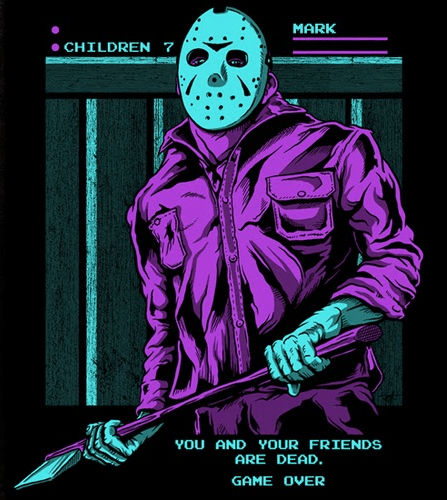
WATCH THE SERIES: Friday the 13th part 1

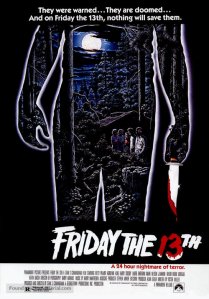
At this point, this is the longest that we’ve ever gone without a Friday the 13th film since the break between Jason Goes to Hell and Jason X in 1993 and 2001. But at one point, these movies owned the box office, with one nearly every summer from 1980-1989. Why did people love them so much? And what were they all about? That’s why we’re here.

Friday the 13th (1980)

After the success of John Carpenter’s Halloween, every studio wanted a piece of the horror pie, which to this point had been exploitation fodder. Paramount Pictures was first. Sure, critics salvaged the film, but after $40 million in profit, no one really cared.

Produced and directed by Sean S. Cunningham (Last House on the Left), this movie was envisioned as a roller coaster ride. The script came from Victor Miller, a soap opera scribe. And spoilers — but this movie doesn’t even really have Jason in it!

The movie starts in the summer of 1958 at Camp Crystal Lake, where two counselors sneak off and have sex before being killed. This sets up one of the many rules of slasher films: never fuck in the woods.

The camp closes for 21 years, but on Friday, June 13, 1979, that’s all about to change. That said, no one in the town wants it to happen. When Annie Phillips arrives in town, everyone treats her strangely or acts like Crazy Ralph (Walt Gorney, who shows up in the next film and was the narrator for Friday the 13th Part VII: The New Blood). She lasts for about five minutes, as she gets killed after her third hitchhike of the day. I’d say this is more of a warning against hitching in the late 1970s than I would serial killers in the woods.

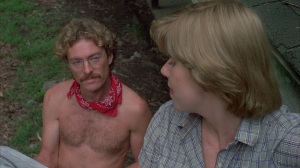
The other counselors — Jack (Kevin Bacon!), Ned, Bill (Harry Crosby III, son of Bing), Marcie, Alice and Brenda (Laurie Bartram, The House of Seven Corpses) — and owner Steve Christy all show up to get the camp ready. This is where you’ll notice just how different fashion is. Becca and I have seen this live several times in a theater now and everyone laughs as soon as Steve shows up in his short shorts and bandana.

Ned is killed pretty quickly, then Jack is killed with an arrow and Marcie takes an axe to the face. Brenda is murdered as she responds to the voice of a child. Steve gets killed on the way to camp. Before you know it, Alice and Bill are the only ones left, but Bill lasts pretty much seconds. Then we have another future slasher trope: every body is discovered, hung like trophies.

Now, we have our Final Girl: Alice, who ends up meeting Mrs. Vorhees, who tells the tale of how her son Jason drowned and the horrible counselors who allowed it to happen. Much like the giallo/pre-slasher film Torso, the movie now focuses on the battle between Alice and the real killer. Alice ends up beheading her and sleeping in a canoe. As the police arrive, she has a dream that Jason rises from the water to kill her. This scene wasn’t in the script, but special effects king Tom Savini thought a Carrie-like ending would be more powerful.

Another way that the film pays sort of homage to Italian filmmaking is in the snake scene. It was another Savini idea after an experience he had in his own cabin during filming. The snake in the scene? Totally real, including its on-screen death — someone alert Bruno Mattei!

Some trivia: the film was shot just outside Lou Reed’s farm. The rock star performed for the cast and even hung out with them! Sweet Jason?

To me, the film works because of how great Betsy Palmer is as Jason’s mom. It’s a fine film, but nowhere near the excesses that the series would grow into. This was also the start of critics really hating on slasher films. Gene Siskel was so upset about Betsy Palmer being in the film that he published her address in his column and encouraged people to write her and protest. Of course, he published the wrong address.

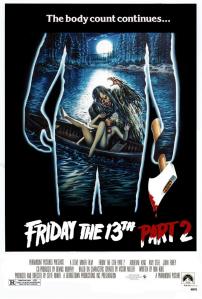
Friday the 13th Part 2 (1981()

Of course, there was going to be a sequel. Sean S. Cunningham refused to direct it because he was against the studio plan to bring Jason back from the dead. He said that it was too stupid and would never work. Hmm.

Beyond a plan to be an anthology of stories on Friday the 13th (which sounds a lot like the plans for Halloween), another thought was that Alice would be a reoccurring hero in this series, continually facing off against Jason again and again in sequel after sequel (again, think Halloween and Laurie Strode). Sadly, after was stalked by a fan, she said she wanted out (she even stayed out of acting for a long time).

That’s why this movie starts with her death. I always wondered why this happens, because it invalidates all of the emotional investment that you put into the last film!

So of course, everyone decides that re-opening Crystal Lake would be a great idea. We’ve got Ginny (Amy Steel, April Fool’s Day), Sandra, Jeff, Scott, Terry, Mark, Vickie and Ted, who sit around a campfire and listen to the legend of Jason. Even Crazy Ralph from the last movie shows up to warn everyone before getting killed.

Here’s my problem with this sequel: it rips a lot off. Jason doesn’t have his trademark hockey mask, so he steals the look of the Phantom of The Town that Dreaded Sundown. And then there’s the issue of taking two murders shot for shot from Mario Bava’s A Bay of Blood. A machete to the face and a couple stabbed together by a spear? Attention director Steve Miner: Bava did it first and better. Miner would go on to direct Halloween H20, so his sins are many.

Just like Shakespeare, everyone dies. Except Ginny. She discovers Jason’s altar to his dead mother and ends up stabbing him in the should with a machete. And then the movie does another shock ending, making you think Jason survived. He, of course, did not. Or he did. You know how these things go.

My question is: Did Jason rise from the dead? Or was he alive in the forest all these years? And how did he learn how to use a telephone? Let’s just stop asking questions.

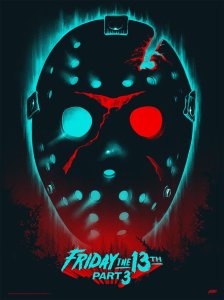
Friday the 13th Part III 3D (1982)

With Amy Steel uninterested in returning to the series, the filmmakers had to reboot and figure out what made Jason tick. And that ticking was a hockey mask — three movies into the series. The original plan was that Ginny would be confined to a psychiatric hospital and he would track her down, then murder the staff and other patients at the hospital. If this sounds kind of like Halloween 2 to you, well surprise. This is not a movie series known for its originality.

He starts the film by killing a store owner and his wife just for clothes. Then, he goes after the friends of Chris Higgins: Debbie (Tracie Savage, who played the younger Lizzie in the awesome made-for-TV movie The Legend of Lizzie Borden), Andy, Shelley, Vera (Catherine Parks, Weekend at Bernie’s), Rick, Chuck and Chili. They run afoul of bikers Ali, Fox and Loco, who follow them back to their vacation home.

Jason starts killing quick, but he’s already mentally scarred Chris, as she survived an attack from him two years ago. This has left her with serious trauma and an inability to enjoy intimacy (which, come to think of it, comes in handy in these movies).

Jason takes the mask from the dead body of prankster Shelley and it’s on, with speargun bolts to the eye, heads chopped in half with machetes, knives through chests, electrocutions, hot pokers impaling stoners and even someone’s skull getting crushed by Jason’s supernaturally powerful hands.

Of course, it ends up with Final Girl Chris against Jason, who she kills by hitting him in the head with an ax before falling asleep on a canoe and having a nightmare of Jason killing her. It’s OK. Don’t worry. We see that all is right in the world and the killer’s body is at the bottom of the lake.

Here’s some trivia: To prevent the film’s plot being leaked (I could tell you the plot in less than a sentence, so this seems like bullshit), the production used the David Bowie song “Crystal Japan” as the title of the movie. They’d use Bowie songs as working titles during several of the other films.

There is a ton of footage that was cut from the film so that it didn’t get an X rating. And there’s an alternate ending where Chris dreams that Jason decapitates her. None of these things make this a better movie.

Whew! We made it through three Friday the 13th movies. Let’s take a little break and then we’ll be back in a bit with three more!

Butterfly (1982)

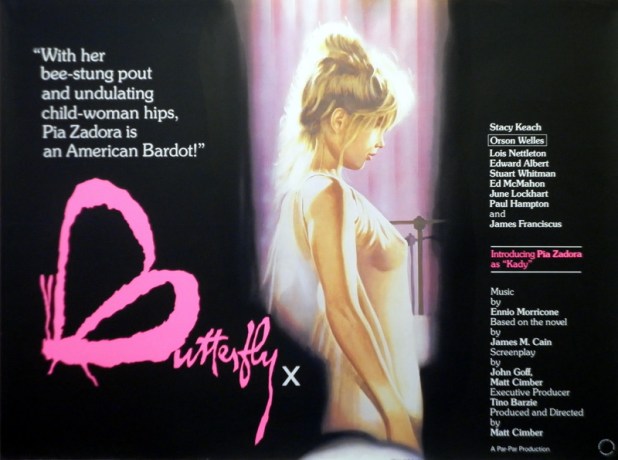
This is a movie that received 10 nominations for the 1982 Golden Raspberry Awards,  including Worst Picture, with star Pia Zadora winning Worst Actress and Worst New Star, and Ed McMahon winning Worst Supporting Actor. But more than that — Zadora also won Best Female Newcomer at the Golden Globes for this movie, beating out Elizabeth McGovern and Kathleen Turner. Sure, her super rich husband may have flown members of the Hollywood Foreign Press Association to Las Vegas to watch Pia sing. Sure, he may have bought the award. But for awhile, Pia had quite the movie career going.

That said, we’re not the kind of people to pile meanness on. Since Sam was a kid, he’s always loved Pia Zadora. She stared those elitist critics down and kept going. And she’s still going today, playing Piero’s in Vegas every Friday and Saturday, looking gorgeous as ever and with plenty of good humor about her movie past.

Is Butterfly as bad as you think it will be? Guess what? It’s worse. And it’s awesome. It’s the story of a girl moving back in with her dad who isn’t her dad but having sex with him while he thinks he’s her dad because there’s a silver mine and she wants to marry a rich guy and holy fuck there’s Ed McMahon and holy double fuck there’s Orson Welles and then her mom comes to visit only to die and then there’s a murder and then there’s a court scene and then there’s almost a rape in a bar while she dances to a jukebox and my continuity is all over the place.

Matt Cimber did more than direct the GLOW TV show and The Witch Who Came from the Sea. He also blessed us with this, well, opus is the word I’ll use. He also got Stacy Keach to play the lead, which makes me feel bad for the guy. Also along for the ride are Edward Albert (the son, from Galaxy of Terror), James Franciscus (The Cat o’ Nine TailsKiller Fish), Stuart Whitman (The Monster Club), June Lockhart (TV’s Lost in Space, Curse of the Black Widow), the aforementioned Ed McMahon and George “Buck” Flower (Back to the Future and cameos in nearly every John Carpenter movie, including Starman, Village of the Damned, Escape from New York and The Fog).

They are all but pale shadows to Zadora, who wanders around in see-through babydoll gowns and pouts throughout. She even sang the film’s theme song, “It’s Wrong for Me to Love You.”

The truth is — it is wrong for her to love him. What’s with all these early 1980’s incest-driven films, like Flowers in the Attic? Who wanted to see this? Then again, a quick glance at any porn site will show you — lots of people.

Want to see it for yourself? I’ve really sold it, huh? Look — it’s a glorious mess and you should enjoy it for exactly that. It also feels like it’s 9 hours long. So there’s that. But it is streaming for free on Amazon Prime.

LARRY COHEN WEEK: Q The Winged Serpent (1982)

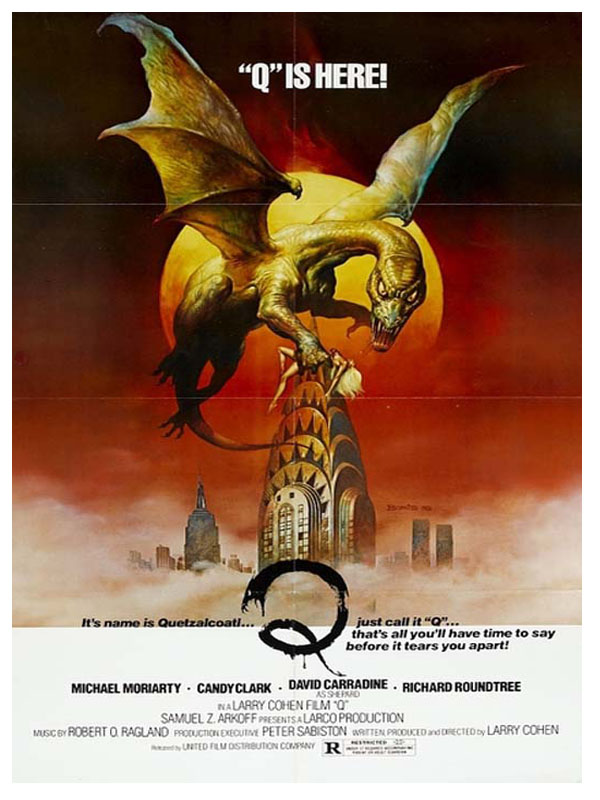
Back in the early 1980’s, the VHS market allowed my family to enjoy movies that never made it to Ellwood City, about an hour from Pittsburgh. Our hometown video store, Prime Time Video, was packed with films that fascinated me. I wish that someone had footage of all of the movies on shelf. I know we definitely rented Ruggero Deodato’s Raiders of Atlantis and this bizarre piece of cinema about an Aztec god loose in Manhattan. What a time to be alive, when you could walk down the street and wander row after row of horror movie choices!


The Aztec god Quetzalcoatl, a feather winged dragon, has found its new pyramid on the Chrysler Building. The film starts by showing us how it finds and devours the heads of its victims in gory detail. Meanwhile, an Aztec cult is leaving sacrificed victims in its wake as Detective Shepard (David Carradine, Death Race 2000) and Sgt. Powell (Richard Roundtree, Shaft) try to keep up.

The film cuts to a failed diamond heist that leads Jimmy Quinn (Michael Moriarty, who owns this film with a manic Method performance) to the title monster’s nest. He uses his new knowledge to move away from crime (and jazz piano playing) as he extorts the city for the location of the creature’s egg.

Shephard finds out the location on his own, ruining Quinn’s plans. The cops conduct an attack that takes out a baby Q as the creature returns home, wiping out nearly everyone (don’t take Shaft, Q!) until it’s shot over and over, falling dead to the streets below. The cop also saves Quinn as a crazed Aztec priest almost sacrifices the crook to his gods.

That said — the magic of the past in man’s modern world is not gone. The film ends with one last egg hatching.

Q is a great movie even without the monster. In Will Harris’ great oral history of the film, David Caradine said: “I thought if [Larry] had left the monster out of it, between me and Michael Moriarty, there was a real great story there between the detectives and the sleazebag heroin addict/petty-thief character. That’s where the power in the movie is. That’s where the heart of it is… and not in the chicken that ate New York!”

And this is a movie that rose from tragedy! Cohen had just been fired from I, the Jury and didn’t want to waste the hotel room he had already paid for. He wrote the script, hired actors and was done with pre-production in just six days!

Like all of Cohen’s films — do I sound repetitive yet? — this is a movie that outdoes its small budget and looks like a million bucks. It has heart — and plenty of other organs — and verve and panache and any other hyperbole you’d love to bestow upon it.

It‘s easy to find, too. If you have Shudder, it’s right here! And you can grab the blu-ray from Scream Factory.

MANGIATI VIVI: Eating Raoul (1982)

I love Paul Bartel. He elevates any movie that he makes a cameo in. And if he only directed Death Race 2000, he’d already have earned my adoration. Additionally, I love Mary Woronov. Much like her frequent collaborator Paul, she also makes any movie better just for showing up for a few moments.

Together, they made Eating Raoul, a movie that for some reason I never watched until now. And it’s pretty much perfect.

Paul and Mary play The Blands, a wine dealer and nurse who dream of a better life. They’re prudes who only believe in hugging and kissing, saving their passion for food and drink. They’re also given to quick anger, which leads to Paul being fired from his job and those dreams fading. Throw in the fact that they live in a building full of swingers and things start to look bleak for the Blanks.

After one of those swingers breaks in, Paul kills him with a frying pan and they throw him into the trash compactor. One day later, they do the very same thing and realize that just by killing people and getting their wallets, all their dreams may come true. After all, the bank only tried to get into Mary’s pants (as everyone but Paul tries to do).

After meeting with suburban dominatrix Doris, the Blanks make an ad. Believe it or not, the film’s budget was so small, they couldn’t afford to make a fake ad. So they ran a real ad in L.A. Weekly, but it only got one answer.

Soon, they meet Raoul (Robert Beltran, Night of the Comet and TV’s Star Trek Voyager), a locksmith con artist who breaks into their house the night after installing new locks. While in their apartment, he falls over a dead Nazi that Paul had just killed and cleaned up. He agrees to keep their secret and sell the bodies for more cash. Sure, he’s selling those bodies to a dog food company, but he’s also stealing their cars and selling them.
The very next day, while Paul is buying groceries and a new frying pan (as Mary doesn’t want to kill and cook with the same pan), a hippie client (Ed Begely Jr.) arrives late and tries to rape Mary. Luckily, Raoul arrives and kills the man with his belt. Soon, he and Mary are smoking the man’s weed and making love.

Raoul soon falls for Mary, despite her continually saying that it’s all wrong and needing marijuana to relax. The lusty locksmith tries to kill Paul with his car (after a sequence where John Paragon plays a sex shop salesman. Paragon is better known as Jambi the Genie and the voice of Pterri the Pterodactyl on Pee Wee’s Playhouse, as well as collaborating with Cassandra Peterson on her many Elvira projects), which leads to our hero working with Doris the Dominatrix to start a gaslighting campaign against Raoul, climaxing with prescribing him saltpeter pills that keep him from getting hard.After a giant swinger party, Paul ends up killing tons of rich swingers, taking their cars and money, finally able to achieve the dreams he shares with his wife. This leads to a drunken Raoul breaking back into the Bland house, disclosing the affair and telling Paul that he is taking Mary away. Of course, he has to kill Paul first, so he asks Mary to bring him the frying pan.

Instead, Mary shows her true colors and love for Paul, killing Raoul. But wait! The real estate agent is on his way and there’s no time to make him dinner! Of course, there’s always…Raoul.

The film ends with our cute little couple standing in front of their new restaurant, Paul and Mary’s Country Kitchen, with the caption, “Bon Appétit.”

Bartel shot this film on odds and ends of stock in between projects. Some of the longer runs of stock given to the production had been rejected by others because their cases had mold grown on the cans that house the film. Often, the crew would have no idea if the film they were shooting was even usable. That said, this movie has a quick, bouncy, punk rock energy that seems improvised throughout.

Sadly, there was a never-made sequel to this movie ready to go into production called Bland Ambition at the time of Bartel’s death. The Blands would be happily working at the Country Kitchen when the governor of California (Chevy Chase) would shut it down in retaliation for them not giving him special treatment. The Blands would then run against him for his office and even get a daughter, who would be a parody of The Bad Seed. Oh man! How I wish this movie had been filmed!

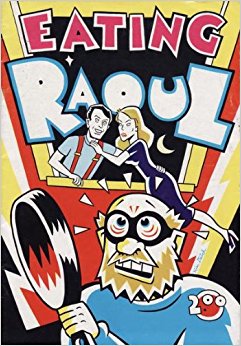
There was even a comic book released along with the movie by Kim Deitch (Waldo the Cat) that I need a copy of! Sure, Eating Raoul isn’t packed with the human eating spectacle of every other film this week, but that shouldn’t stop you from watching it. It’s pure joy from beginning to end!

FULCI WEEK: The New York Ripper (1982)

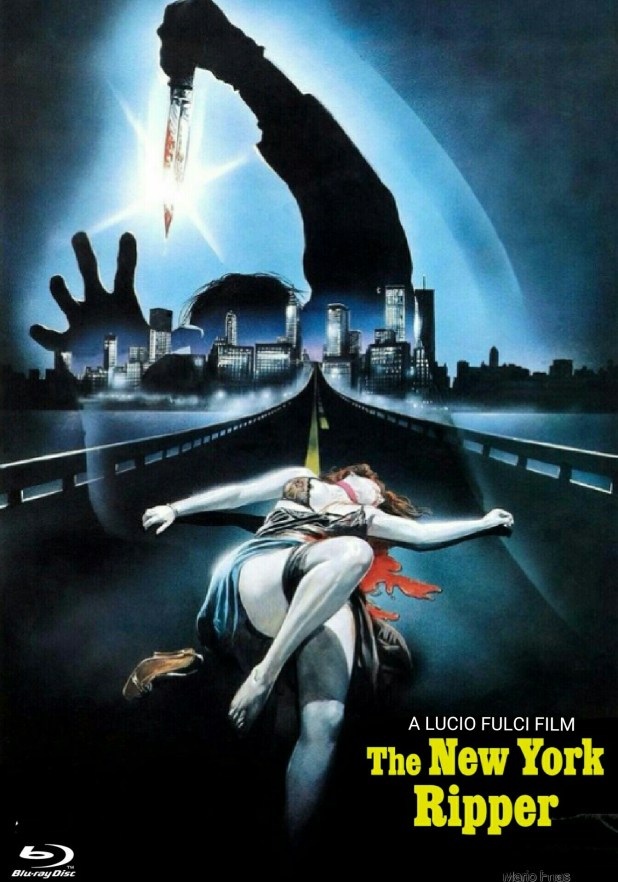
The New York Ripper is the hardest, roughest, bloodiest and sleaziest of Lucio Fulci’s films. That’s saying a lot. It has a lot to live up to, with the horrors that had come before. If you backed off of the gore and roughness of the film, you’d be left with a somewhat decent detective film. But what got made…

It’s like Fulci watched William Lustig’s Maniac and said, “This movie is for pussies.”

Literally, the photo below is the very least of what happens:

ny-ripper

Seriously, as upset as people get by some movies these days, I’d like to warn anyone easily upset to avoid this movie at all costs. Some see it as Fulci’s rock bottom, reaching out to the lowest common denominator. But once his violence is removed from the fantastic, it seems much more horrifying. It’s also a film where all of Fulci’s tics — especially injuries to the eye — are not held back. In fact, fucking nothing is held back by this film. It’s brutal. This isn’t a warning like at a fun house or sideshow, hyping up what is to come inside with overblown carny barker snake oil. This is legitimately a brutish, punishing film.

An old man complaining about his balls hurting is walking his dog, who finds a rotting human hand that once belonged to a prostitute. Fulci predates Law and Order with this beginning, which is how every episode starts. Police detective Lieutenant Fred Williams is on the case, but he’s been beaten down by New York City. This isn’t the NYC of today, this is 1982 end of the world cesspool that Fulci would travel to as a tourist. This is a bleak, nihilistic world with people that are either taking advantage of one another, being taken advantage of or so cold that they have shut off all humanity.

As Lt. Williams investigates, he learns that the first victim had set up a meeting with a john who used a Donald Duck voice. Yep — this is the first hint that you are watching Fulci at his most insane. It’s either going to freak you out, draw you in or shut off the movie because it’s too strange. Me? I’m in.

A young woman rides her bike through the city. She’s tough. She’s spunky. She gives it right back to guys who come at her with sexual misogyny, particularly a man who nearly hits her with his car. She notices his car on the ferry and scratches up his car. As she commits her vandalism, a man walks up to her. She tries to speak to him, but his duck voice stops her, as well as his knife. She’s brutally slashed open and this being Fulci, the gore is not off camera. It’s as in your face as possible.

Cut to the morgue, where a pathologist tries to link this killing to the body that started the film and another murder in Harlem. Lt. Williams informs the press that a serial killer is at work, which upsets the chief of police (Fulci) and starts phone calls from the Ripper. Realizing he needs help, the cop turns to Dr. Paul Davis (Paolo Marco, The House by the Cemetery), a psychotherapy professor who wants to help him create a profile for the killer.

Meanwhile, Jane Lodge (Alexandra Delli Colli, Doctor Butcher M.D.) attends a live sex show along with her tape recorder. She’s much better dressed than anyone else in the theater and is obviously out of place.

The dangerous looking man with two missing fingers is not out of place, however.

Meanwhile (I feel like with all of the detours that this movie takes, I’ll overuse this word), the female performer (Zora Kerova, who was infamously hung by her breasts in Cannibal Ferox, as well as Anthropophagus and The New Barbarians) we just watched on stage is decimated by the Ripper, who has a broken glass bottle as his weapon. Kerova did interviews afterward where she claimed that Fulci didn’t hate women and was really warm to her, but that’s nearly impossible to conceive upon watching this scene.

Lt. Williams goes to see his girlfriend Kitty — or at the very least, his favorite prostitute — where he gets a duck-voiced call from the Ripper.

Remember Jane? Well, she has an open marriage with Dr. Lodge, who likes to listen to the recordings she makes. She goes to a rough bar where two men taunt her. One uses his foot on her — yep, exactly what I just wrote — and exposes her to the entire bar before she runs away.

Finally, we meet our heroine. Fay Majors rides home alone on the subway when she notices the man missing two fingers. She runs into a dark alley where the quacking Ripper attacks her by stabbing her in the leg and slashing at her. She escapes into an apartment building and locks the door before passing out. She has a vision of watching cartoons in a movie theater as her boyfriend, Peter Bunch (Andrea Occhipinti, Ilias from Conquest), arrives and slashes her throat with a straight razor. She awakens in the hospital, where Lt. Williams and Dr. Davis determine that the killer is left-handed and has to be the man missing two fingers.

Remember Jane? Well, she gets picked up by the man with two missing fingers for some rough bondage, which includes him beating her and making whispered phone calls to other people, but she’s also pretty insane, so it’s left to your own judgment as to whether she wants this treatment or not (positive depictions of BDSM relationships, of which this is not one, are rarely presented in any cinema, much less grindhouse films). Post-sex, as the two sleep next to one another, she hears a radio DJ ask the Ripper, the man missing two fingers, to leave those ladies alone. It sounds so much like the DJ from The Warriors that it can’t be an accident (Fulci would use a similar narrative device in Zombi 3). This is the best scene in the film, as Jane has to untie herself without waking up the man who, worst case, is the killer and best case, is a maniac, next to her. There’s a ton of suspense here. As she finally makes her way into the hallway and gets away, she walks right into the Ripper, who stabs her to death.

Lt. Williams listens to Dr. Lodge defend his open marriage as they tell him that his wife is dead. Williams takes the man to task, as obviously the recordings she made were for him, possibly against her will. The police determine that the killer is Mickey Scellenda, who has an apartment filled with porn, drugs and photos of most of the Ripper’s victims. But Dr. Davis has his doubts, as the Ripper is intelligent and Mickey isn’t.

Also, there’s a long scene of Davis buying male pornography here, revealing that he’s a repressed homosexual. He goes to ask more questions of Peter and Fay, which keeps him suspicious. After he leaves and Peter goes out, Mickey attacks Fay. Peter returns just in time to save her.

Lt. Williams then gets a call where the Ripper dedicates a kill to him. The police set up a trace and Williams keeps him on the phone until they find the telephone booth where they think the killer is, but it’s just a walkie talkie. The killer is really at the home of William’s favorite prostitute, Kitty, and taking his time killing her. This is where Fulci gives in to his worst impulses and has a long, gory razorblade sequence. If his previous eye injury gore has ever upset you, well, you shouldn’t even be watching this film. This is the hard part of watching Fulci. So much of this is indefensible sleaze, but so much of it is also well done, as Williams fighting to get to the crime scene and save Kitty, with traffic getting in the way and even his body giving out are powerful. I’m not sure how many people will get past the grimy murder scene to appreciate it, though.

Days later, Mickey’s body is found. He’s killed himself by what looks like self-suffocation. That said, the coroner thinks that Mickey has been dead for eight days, which means that he can’t be Kitty’s killer. Dr. Davis explains that this fits into his theory — the Ripper hates women and is an incredibly intelligent man who has used Mickey to keep the police off his trail.

Fay visits a hospital where Peter’s daughter from his previous marriage, Suzy, is dealing with a rare bone disorder that has led to her losing her left arm and right leg. Williams and Davis later visit the girl and notice her nurse reading Donald Duck stories to her, which leads to them racing to Peter and Fay’s place to arrest both of them.

At their house, Fay has disappeared after a call from the Ripper. Peter leaves dinner only for her to attempt to stab him, which makes you think that she is the killer. However, he rises and begins quacking, throwing her down the stairs. He grabs the knife and just as he is about to kill her, Williams arrives and shoots him in the face — another incredibly graphic scene that shocked me.

As Fay is taken away by an ambulance, Williams explains that her boyfriend hated sexually active women because his daughter would never get to enjoy the chance to live life.

The film ends with Suzy calling for her father, begging for him, as her voice is covered by the traffic of New York City.

Again, imagine Law and Order filled with beyond graphic gore, sex scenes and a lack of any heroes and you’ll have something close to The New York Ripper. Except that it’s so rough, it’s going to take a strong stomach to get through it. There have been people upset with mother! earlier this year, as it feels like a movie that attacks the audience. This film does less of that. But as upset as people get about things today, this is a hard movie for me to tell others to watch. It’s a giallo, sure. But where so many of those films are satisfied with the flash of the blade and the suggestion of gore and sex, Fulci wallows in it. There’s a lot to like in this film, but it all depends on how much you can handle.

UPDATE: This is streaming for free with an Amazon Prime membership.
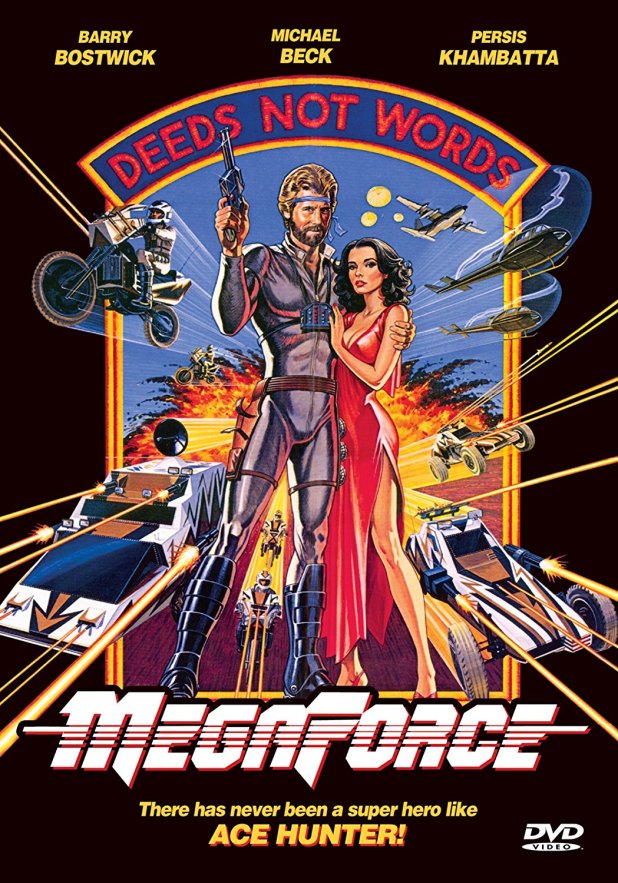
FORGOTTEN HEROES: Megaforce (1982)

In 1982, you could not read a comic book without seeing the ad for Megaforce. It’s the first hype I can truly remember, save for the similar ad strategy for 1977’s Orca. As a ten-year-old chubby geek, I needed to know all about Ace Hunter and his crew of super soldiers.

I wondered, “As a small child living in a small town, could I truly be ready to join Megaforce?” The answer was no. I was too small for the bikes, too rotund for the jumpsuits. But it was a dream. A dream I have refused to give up on.

The Republic of Sardun is peaceful. Gamibia, a neighboring country, is not. So they send General Byrne-White (Edward Mulhare from TV’s Knight Rider and The Ghost and Mrs. Muir) and Major Zara (Persis Khambatta, Star Trek: The Motion Picture) to ask Megaforce for help. The conflict will bring their leader, Commander Ace Hunter (Barry Bostwick from The Rocky Horror Picture Show), into conflict with his former friend and now rival, Duke Guerrera (Henry Silva, Killer Kane from 1979’s Buck RodgersChained HeatFists of SteelAmazon Women on the Moon).

That’s alright, though. Megaforce has incredible motorcycles, dune buggies and a big RV. Things will all work out.

Zara decides to try out as Hunter falls in love with her. She passes, but he cannot allow her to join them in combat — she’d throw off the rest of the guys. That’s right — an empowered woman success against the odds but can’t make it to the team because these guys wear spandex and headbands and need to just be guys, alright? It was 1982. The glass ceiling for Megaforce was ankle level.

Megaforce attacks Gamibia and blows up the base, then have some trouble getting out of the country. Seems that all these tanks are in the way. No worries — the boys all make multicolored smoke come out of their vehicles, which self-destruct and they leave on foot, except for Hunter, who flies his into the cargo plane. Even then, he gives Guerrera the thumbs up, which the bad guy returns. Again, this was 1982. America was back, baby, and if we wanted to blow up all the vehicles instead of saving them, no matter how great and unique they were, we were going to do it. Who the fuck are you to deny Ace Hunter? Does he come down on the corner and knock the dicks out of your mouth? Don’t presume to tell this bandana-clad gentleman how to lead Megaforce.

Barry Bostwick was all in on this movie. And why not — he had a three picture deal in case things picked up. His interviews at the time are so wonderful, like when he said that the Pentagon tried to stop the movie because of how close Megaforce was to covert CIA strike teams (one only wonders if they all had flags on their bikes and crazy collared dress uniforms, too). Or when he opined that the world needed a real-life Megaforce.

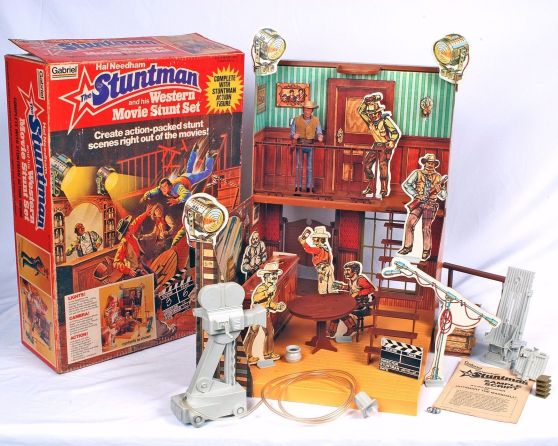
Megaforce came to us from Hal Needham, a former stuntman who went on to direct Smokey and the Bandit, Hooper, The Cannonball Run, Stroker Ace and 80’s BMX megafilm (seriously, it ruled the video stores of my teenage years) Rad. He even had his own toy — the Hal Needham Western Movie Stunt Set! You don’t even have to guess if I had it as a kid.

Barry Bostwick and Hal Needham weren’t alone, though. There were other members of the team, like Dallas (Michael Beck from The Warriors and Xanadu), who has a Confederate flag on his uniform, because we didn’t understand racism in 1982. Other team members have one name and are one note, like Ivan, Suki, Sixkiller, Anton and Lopez. All of their clothes were designed by Mattel, who saw big toy potential in the film, but only ended up making a playset and some Hot Wheels. My brother and I had them, even if he would not allow anyone else to play with his Megafighter dune buggy. There was even an Atari game!

That said — the film flopped hard. It’s been forgotten by nearly everyone, save the ridiculous folks like me that kiss their thumb and give people the “Megaforce salute.”

In fact, two of those people were Matt Stone and Trey Parker. There is no way to watch their Team America: World Police without seeing echoes of Ace Hunter’s hard work.

And the government itself got really interested. After the military refused to aid the production, they asked Needham for the plans for the Megaforce vehicles. He happily handed them over and claimed that Desert Storm’s hardware came directly from this film.

I cannot stress how completely dumb this film is. No one is ever in danger. No one ever appears to be a real human being. Therefore, it is wonderful and I also recommend that you seek it out. Deeds not words!