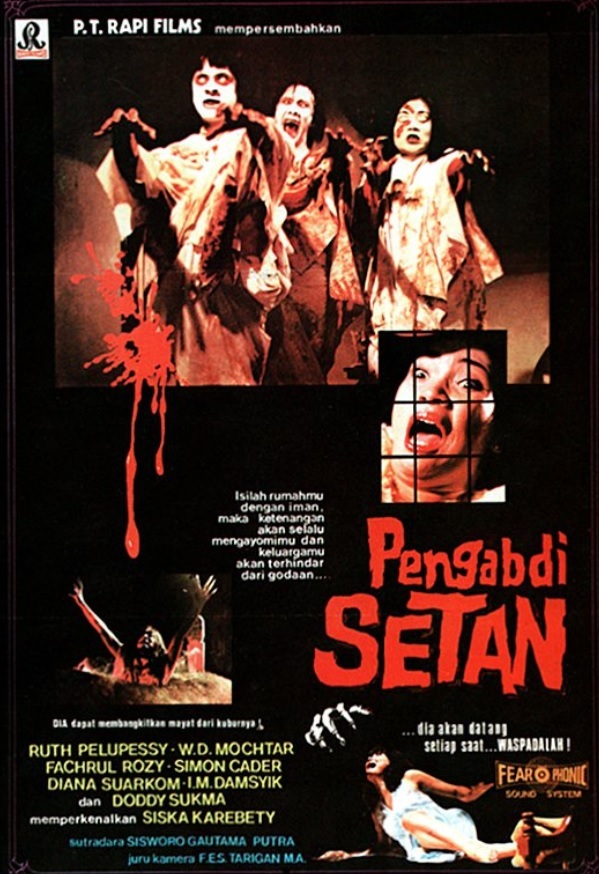
Editor’s Note: We got hornswoggled on this one. Mill Creek’s Pure Terror 50-pack doesn’t carry this Indonesia horror: it programs the British-made Satan’s Slave (1976). No worries, we reviewedthat Norman J. Warren programmer as part of its inclusion on Mill Creek’s Gorehouse Greats 12-pack.You can read it, here.
Now, let’s check out the Indonesian one — with that pesky plural “S” that hung us up.
It’s time for more cheap n’ scary—yet creative—fun with another Indonesian horror film with its roots nourished in the horror films of the West—with Muslim and Hindi religious beliefs substituted for the usual Christianity-based horror themes. However, while American horror films are mostly blood and gore for the sake of blood and gore, Indonesian horror films carry a deeper religious message regarding the folly of abandoning one’s longstanding traditions and beliefs.
How accurate are the various, bargain-DVD imprints marketing Satan’s Slaves as an Indonesian version of Don Coscarelli’s cult horror hit, Phantasm?
If you go into this expecting an Asian-inspired Angus Scrimm-cum-Leàk crypt keeper guiding an army of dwarfs and flying cutlery guarding a dimensional portal with a Lady in Lavender sidekick, you’ll be disappointed. There are, however, moments of visual déjà vu with the film’s teen protagonist riding a motorcycle through a cemetery and there’s a fortune teller that knows more than she’s telling, and . . . that’s about it.
The more expansive similarities are of the narrative persuasion: Phantasm’s Mike and Satan’s Slaves Tommy are both teenagers dealing with the death of a parent and the resulting fears regarding death and dealing with loss and abandonment issues that leave them tangled in a psychological web.
As with its American antecedent, a teenager, Tommy, and his sister (instead of a “Jody”) deal with the death of their mother; their affluent-materialistic family, unable to cope with the loss, completely abandoned their already lackadaisical religious beliefs. As result, Tommy delves into black magic and searches for solace with Darminah, a fortune teller he recognized attending his mother’s funeral. Once Daraminah works her way into the family’s good graces as the family’s maid, Tommy’s friends and family members suffer violent, Omen-styled deaths and the Salem’s Lot-reminiscent shrouded ghosts and reanimated zombie-vampires appear.
Is this Indonesian horror entry worth the watch? It depends on a horror buff’s opinion. Me? I say pair it up with the shot-for-shot The Exorcist clone, Seytan (1974), and The Evil Dead clone that is Mystics in Bali (1981) for a night of fun.
Did Bach Ke Zara (2008) deliver on its reputation as Indonesian remake of Sam Raimi’s The Evil Dead (1981)? What are your feelings about Mystics in Bali (1981; The Leàk), its Taiwanese remake, The Witch with the Flying Head (1982; Fei tou mo nu), and the Chinese-inversion, The Corpse Master (1986; Jiang shi shao ye)—all which are rooted in the 1967 Russian film, Viy, based on the Nikolai Gogol tale?
While this Mill Creek reissue of Satan’s Slaves—as part of their Pure Terror 50 Movie Pack—is a minor curiosity for U.S audiences, it was a major, influential hit in its homeland and Japan. Sources place the domestic release of the film at 1980, but it seems to be more likely released in 1982; international distribution outside of the Pacific Rim countries didn’t occur until 1987.
The film was such a substantial hit that a remake became a pet project for Indonesia’s most successful horror director, Joke Anwar (Ritual, The Forbidden Door), who cited the film (as B&S Movies’ readers cite Phantasm) as his favorite childhood film. He eventually convinced Rapi Films, who released the original, to let him do it. Released in 2017, Anwar’s remake received thirteen nominations—the most for any picture that year—including Best Picture in The Film Festival Indonesia, and became the highest grossing film of 2017 in Indonesia.
If you’re up for other films influenced by Nikolai Gogol’s classic horror tale, search out the Yugoslavian film, A Holy Place (1990), the Russian horror film, The Witch (2006), and Park Jin-seong’s excellent, Evil Spirit (2008).
There’s a non-dubbed and non-subtitled upload of the 1982 original on You Tube. Vudu has the 2017 remake.
About the Author: You can learn more about the writings of R.D Francis on Facebook.He also writes for B&S About Movies.
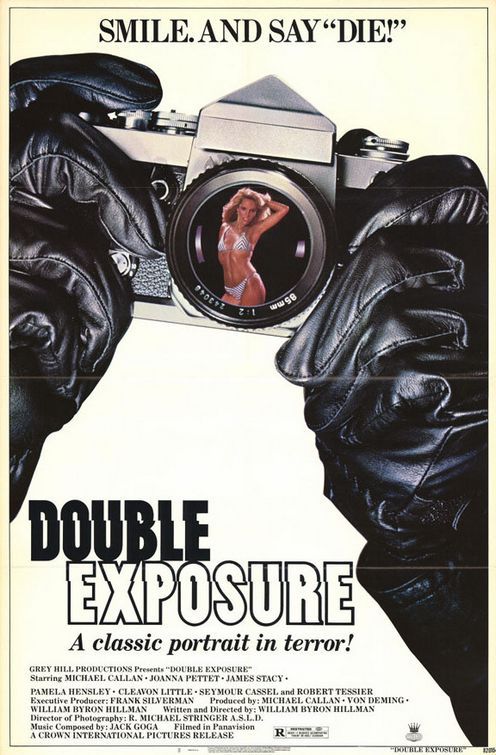
A photographer for a men’s magazine keeps having dreams where he’s killing all of his models. Then, it just so happens that the models begin to die in real life, which means that he may be the killer.
Director William Byron Hillman was also behind the Gary Busey dog reincarnation film Quigley, as well as The Photographer, which is similar to this movie, and he also wrote the 1984 movie Lovelines, which is all about a phone romance line and a battle of the bands.
The lead, Michael Callan, was in Cat Ballou and Leprechaun 3, which is quite an arc. There are also roles for Joanna Pettet (Casino Royale), James Stacey (who was Johnny Madrid Lancer on Lancer), Pamela Hensley (Princess Ardala from the TV version of Buck Rogers), Cleavon Little (Blazing Saddles, Once Bitten), character actor Seymour Cassel, Robert Tessier (who was in The Sword and the Sorcerer as well as Starcrash), Misty Rowe (Class Reunion), Sally Kirkland and Jeana Keough.
While the version you can find in this set and on Amazon Prime is pretty rough to watch, Vinegar Syndrome has released a better blu ray of this.
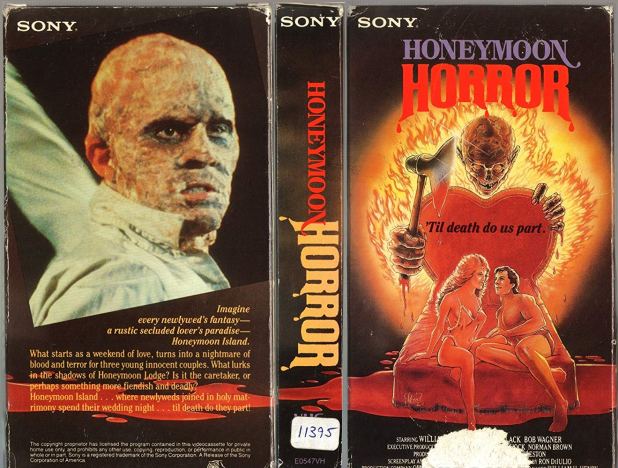
I kind of love the copy that was used to sell this movie: “Imagine every newlywed’s fantasy, a rustic secluded lover’s paradise — Honeymoon Island. What starts as a weekend of love, turns into a nightmare of blood and terror for three young innocent couples. What lurks in the shadows of Honeymoon Lodge? Is it the caretaker, or perhaps something more fiendish and deadly? Honeymoon Island, where newlyweds joined in holy matrimony spend their wedding night screaming in terror!”
This movie was filmed at the Austin Patio Dude Ranch in Grapevine, Texas, which was built at the head of DFW Airport’s main landing strip. In case you didn’t realize, like the filmmakers, this is a busy airport, so all of the planes kept interrupting the movie.
Yet somehow, this was one of the very first direct to video films purchased by Sony Home Video and released to rental stores. Somehow, this movie isn’t available on DVD, despite how successful it was for Sony. They spent $50,000 on the film and made around $22 million off of it. Then again, I got that statistic from IMDB and it could very well be bull.
Director Harry Preston only has one other credit to his name, a movie called Blood of the Wolf Girl that was never released and may have never ran in a theater.
I’m telling you all of these facts to cover up for this film, because it’s one of the more pointless slashers you’ll ever seen. Perhaps the only reason to watch it is for the fat sheriff, who is so ineffectual that he locks his keys in his car, meaning that he doesn’t even catch the killer, who is a burned up ex-husband. Actually, he’s a good reason to see this, too.
Actually, let me be honest again. As bad as this 1982 slasher is, it’s better than any that came out this year. Talk about dwindling returns!
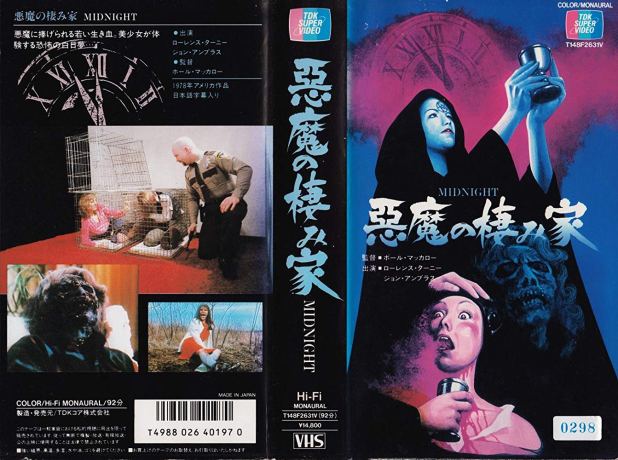
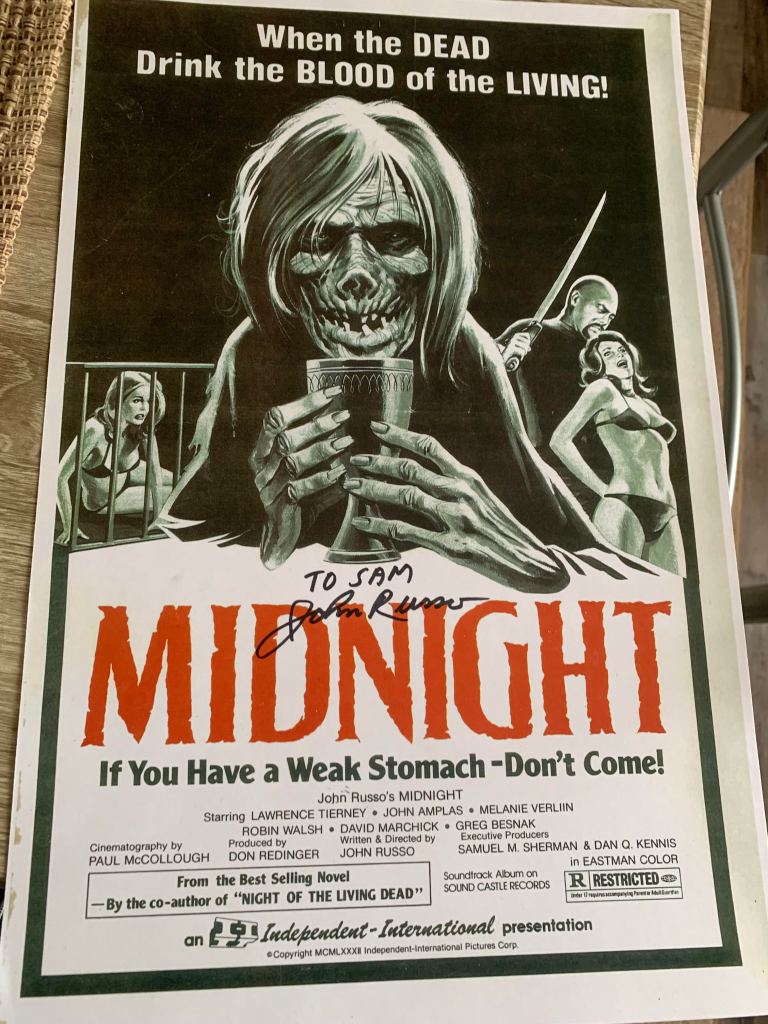
Midnight is the movie Rob Zombie keeps trying to make. It’s seriously demented and filled with so many truly unlikeable characters. Most of them make you want to take a shower just watching them.
Written and directed by John Russo, one of the creators of Night of the Living Dead, Midnight was shot on location outside Pittsburgh, Pennsylvania, and features special effects by Tom Savini. While never prosecuted, the film was seized and confiscated in the UK as a section 3 video nasty.
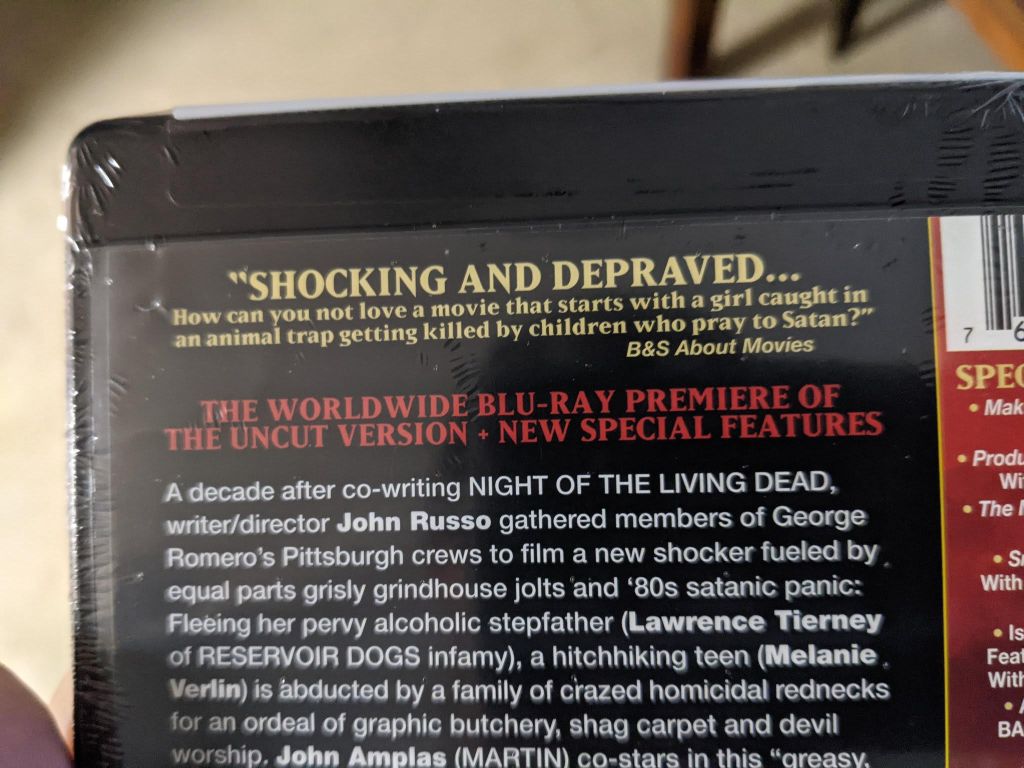
How can you not love a movie that starts with a girl caught in an animal trap getting killed by a bunch of children who all pray to Satan while they murder her? And hey look — one of the killers is John Amplas, Martin in the flesh.
Midnight is really about Nancy Johnson, who runs away from home after her police officer stepfather Bert (Lawrence Tierney, berserk as always) tries to assault her. She gets picked up by two guys, Hank and Tom, who also grab a Baptist preacher and his daughter.
As they stop to see the preacher’s wife’s grave, the older man is soon killed. To top that off, the killer delivers the body to his daughter’s door and then kills her with the same machete.
After racists in the town refuse to serve Hank, the three heroes steal groceries before they’re stopped by some even more racist cops. The two men are quickly gunned down and Nancy goes on the run. Of course, the house she ends up in just so happens to be the one where her friends are being cut into pieces.
The movie then descends into even more depravity, like locking our heroine in a cage to witness a Black Mass, her insane stepfather tracking her down and finally, our heroine discovering herself in time to wipe everyone out with extreme malice.
The original ending had the crazed family — who had already killed the cops and stolen their uniforms — getting away with the murders. However, the distributors demanded that the film have a more uplifting ending, which is why the one that is in here happens so quickly. It works for me — it’s really shocking.
While the film was released as Backwoods Massacre, I’d compare it to more of a Western Pennsylvania Texas Chainsaw Massacre in tone.
UPDATE: I’m beyond happy that Severin has released this on blu ray and even used a quote from our site on the back cover!
How much do I love this movie? This poster is in our movie room.
DAY 29. COMEDY OF TERRORS: A matter of laughter at the splatter of the matter. A funny one, duh.
There was a time, let’s call it 1983, where we couldn’t just sit down and instantly find any single movie from anywhere in the world and any point in time. You might think that that would have been a dreary existence, but it was actually kind of awesome. You were at the mercy of the HBO Guide, whatever was on TV that day and whatever new releases were in your video store. Now, it’s all very robotic.
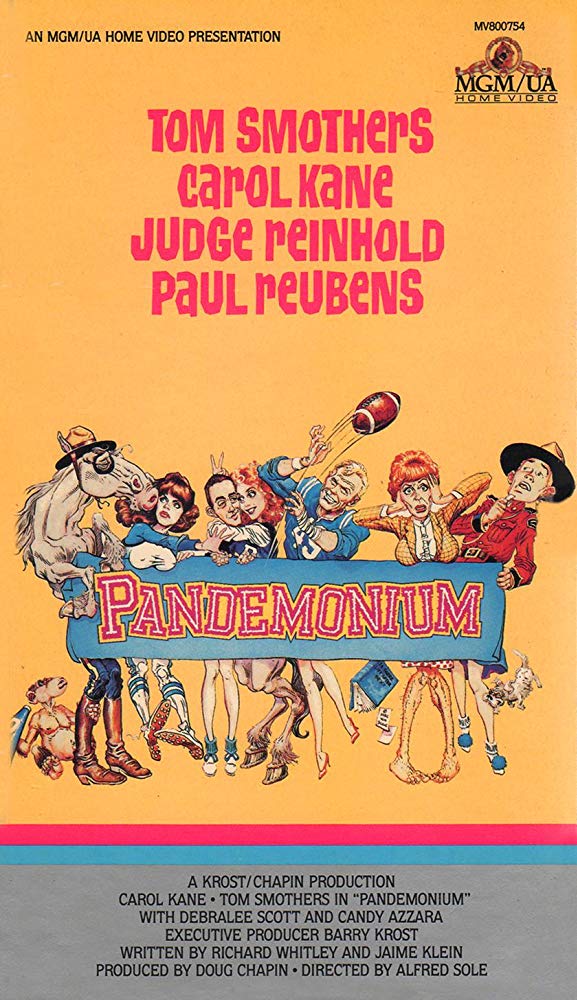
Pandemonium is exactly one of those movies, a film that would just show up on HBO to my delight and one that I’d often stare at on the video shelves. Did it belong in horror? Did it belong in comedy? What kind of maniacs would make this?
Alfred Sole, that’s who. It’s the last movie he’d direct. If anyone knew what slashers were — and had the timing to make fun of their conventions — the director of Alice, Sweet Alice was more than up to the task.
Welcome to It Had To Be, Indiana. It’s a place where football is king and Blue Grange (Tab Hunter!) wins the 1963 National Championship before he goes on to professional glory. As the game ends, Bambi the cheerleader (Candy Azzara, who played Rodney’s wife in Easy Money and was almost Carol — she was in the second failed pilot — on All In the Family) tries to win his heart before the rest of the cheerleaders kick her out. Seconds later, they’re all skewered together by a javelin.
Almost two decades pass and the cheerleading camp remains closed due to this tragedy, but Bambi comes back to town to start it back up. I just love how the words EXPOSITION and STILL MORE EXPOSITION flash on the screen while she explains her backstory to Pepe (David Landers, who was Squiggy on Lavern and Shirley) and his mother, Salt.
As each student arrives at the school, they’re labeled VICTIM #1, 2, 3 and so on and so forth. The first is Candy (Carol Kane!), who is basically Carrie as she gets into a fight with her mother about dirty pillows at the bus station.
Then there’s VICTIM #2: Glenn Dandy (Judge Reinhold), who comes from a strange family made up of Kaye Ballard (who was in Spike Jonze traveling group of musicians and would use her catchphrase “Good luck with your MOUTH!” on shows like The Patty Duke Show and The Perry Como Show) and Donald O’Connor from Singin’ In the Rain. And VICTIM #3: Mandy, whose dad (James MacKrell, who played Lew Landers in both Gremlins and The Howling) introduces her as if he were Bert Parks (look for Victoria Carroll from Nightmares In Wax as her mom).
VICTIM #4 is Sandy (Debralee Scott, Cathy Shumway from Mary Hartman, Mary Hartman, a show that probably will elicit blank stares from, well, anyone), who gets a ride from Ronald Reagan. And then there’s Andy and Randy, VICTIMS #4 and #5, played by Mile Chapin (Richie from The Funhouse) and Marc McClure (Jimmy Olson himself!).
“Candy, Mandy, Sandy, Andy and Randy,” they all shout.
“And me, Glen.” Everyone stares at Glen.
“Glen Dandy!” This line makes me laugh like a maniac. Look, I was 11 when I first saw this.
After meeting all of these folks, we get to know Sgt. Reginald Cooper (Tommy Smothers), a mountie who is the U.S. for some reason. He’s on the trail of a convict named Jarrett (Richard Romans, who provided voices for Heavy Metal), who killed his family with a drill and turned them into bookshelves. Perhaps he can meet up with The Breather from Student Bodies and they can discuss bookends. Anyways, he’s escaped and Warden June (Eve Arden, Our Miss Brooks and Principal McGee from Grease) has no idea where he’s gone.
This is where I should mention that Johnson, Cooper’s assistant, is played by Paul Reubens in an almost proto-Pee-Wee Herman mode. In fact, much of the cast are Groundlings, so you get appearances by a young Phil Hartman and John Paragon as a prisoner.
The movie turns into a slasher as the killer makes his way to campus and Cooper falls in love with Candy. Glenn gets blown up on a trampoline. Mandy is trying to brush her teeth for hours when she gets drilled.
But it’s not Jarrett or another killer named Fletcher or ever Dr. Fuller from the mental hospital that’s behind it all. The real killer is still at large, with Bambi getting drowned in a tub full of milk and cookies. Randy, Andy and Sandy are killed after a game of strip poker. And now the killer is after Candy, revealing that he’s…
Well, don’t you want to watch this for yourself?
Other notables that show up are Alix Elias (Coach Steroid from Rock ‘n Roll High School), Pat Ast (Edna from Reform School Girls), Don McLeod (T.C. Quist from The Howling), Edie McClurg (who was in, well, any role that needed a funny redhead mom in the 1980’s) and former pro wrestler Lenny Montana (who was most famously Luca Brasi in The Godfather).
Will you like it? Well, I know some people that love Full Moon High and Wacko, while I dislike those films. And I’ve read plenty of folks online who have negatively compared this film to those. But this is just so much better, in my eyes. Sole has a great eye for a gag and some innovative camera movements. And despite the racism of the Japanese Airlines scene, having Godzilla as a stewardess that uses atomic breath to warm up coffee is still hilarious to me.
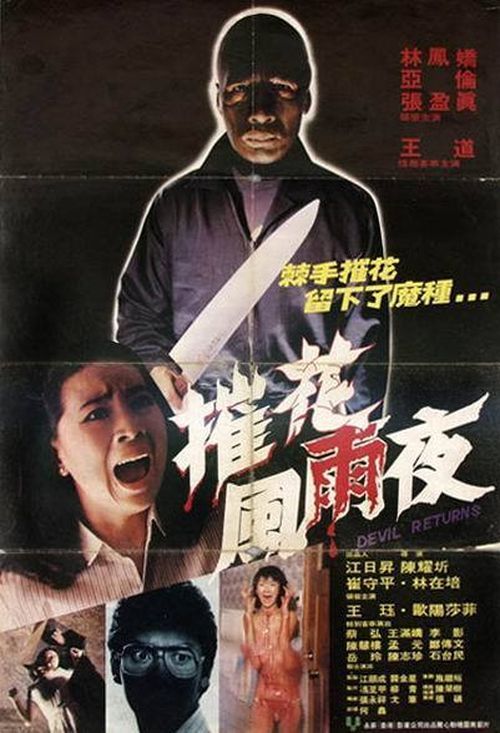
Imagine, if you will, a movie with the termenity to steal large chunks of Halloween while also taking most of its soundtrack — and some ideas — from The Omen and The Exorcist. Then you’d have Jing hun feng yu ye, or as we would say in America, Devil Returns.
It is as amazingly ridiculous as you’d hope it would be.
Our heroine Mei-hsun Fang called for the wrong cab. Its driver is a wanted robber and serial rapist who attacks her and leaves her to die. But she survives and her testimony puts him in front of a firing squad. Even though she can see his death in her dreams, he hasn’t left her memory and she begins to fear that the life growing in her womb isn’t from her husband, but from that killing machine.
Her attempt to have an abortion ends with the nurse attacked and the doctor being violently hurled from the operating room and out a window. By violently, I mean that this is a Hong Kong movie where life is cheap and stunts are painfully real.
What would you do now? Throw yourself down a flight of stairs? How about throwing yourself down the stairs accompanied by Jean Michel Jarre’s “Oxygene?” Could it be because the second part of that song was also used in Jackie Chan’s Snake in the Eagle’s Shadow?
Well, that doesn’t work either and the baby is born. Mei-hsun is so fearful of the child that she refuses to name it. And when no one is around, the baby torments her, crying non-stop. Luckily, an exorcism turns the child to the side of good.
The killer is enraged that his son is no longer evil, so he returns back to the world of the living, wiping out everyone in his path, from the nanny who suggested the exorcism to a young couple.
Finally, the movie settles into straight-up Halloween ripoff mode, except you know, with the Asian twist of the murderer being covered in wine to banish his evil spirit before he’s shot several times.
This movie plays with the issue of motherhood and the changing role of women within Chinese culture pretty well until it decides that someone needed to see an Asian version of Jamie Lee stab those knitting needles into the eyes of a killer all over again.
Of course, this is also a movie that takes large bits of its story from When a Stranger Calls and Black Christmas, so you can’t fault it from stealing as much as it can.
However — can these movies claim to have a scene shot in a karaoke parlor where the singer outright brutalizes every single man in the club with her lyrics that take down each one of them as they try to laugh it off? Nope. They cannot. It’s moments like this that make this movie shine.
As you watch this clip, you may notice that my copy of Devil Returns isn’t a high-end boutique blu ray release. No, it’s a shoddy VCD downloaded off the internet, featuring hardcoded Asian and Chinese subtitles, while each line of dialogue is spoken in both Cantonese and Mandarin. The strange feedback from all of this information overload makes this movie somehow even better as a result. It’s also a grainy mess, transferred from VHS to a CD-R, with no care whatsoever for quality. Magical.
DAY 21: POWER PLANTS. One where the vegetation fights back.
Swamp Thing can trace his roots — yes, it’s a he — back to “It,” Theodore Sturgeon’s short story that ran in the pulp magazine Unknown in 1940. The story is all about a man — Roger Kirk — who dies and is reborn in a swamp.
This was an influential tale whose roots — pardon the pun — took hold throughout comic books, which were the younger brother of the pulps. In Air Fighters Comics #3, published in 1942, Sky Wolf (a World War II fighting ace given to wearing the mask of a wolf and helping Airboy battle the Axis) the muck-encrusted form of World War I German pilot Baron Eric von Emmelman returned from the grave in the same way that Roger Kirk did two years before.
Thanks to his immense force of will and the help of the goddess Ceres, as the Baron’s body decayed, he became one with the vegetation of the swamp that he was shot down over. Now, he was more marsh than man, and fought Sky Wolf until discovering the fanaticism of his countrymen.
Before long, The Heap was the heroic star of his own backup in Airboy Comics, with adventures lasting from 1946 to 1953. He’d return in 1986 as part of Eclipse Comics’ reboot of Airboy before being bought by Image Comics, where he’s now part of Todd McFarland’s Spawn Universe.
After EC Comics (the creators of Tales from the Crypt and The Vault of Horror amongst others) and other horror comics publishers were taken to task for their extreme material, the Comics Code Authority outlawed all monstrous characters unless they had literary roots. In fact, until the year 1989, you weren’t even allowed to say the word zombie in a mainstream comic book (Marvel got around this by calling them zuvembies, if you can believe that).
As the CCA relaxed its rules at the start of the 70’s, two different characters that both grew from the Heap started at both Marvel Comics and their cross-town rivals, DC.
Man-Thing was created by Stan Lee and Roy Thomas (who’d go on to write Fire and Ice and adapted plenty of Conan stories, including the one that would be filmed for Conan the Destroyer). A series of conversations led to five different potential origins for the character, with the name being recycled from another character that had already appeared in Tales of Suspense #7 and #81.
Thomas would tell Alter Ego that Lee “had a couple of sentences or so for the concept — I think it was mainly the notion of a guy working on some experimental drug or something for the government, his being accosted by spies, and getting fused with the swamp so that he becomes this creature. The creature itself sounds a lot like the Heap, but neither of us mentioned that character at the time.” Lee also had the name for the character, which would lead to perhaps by favorite comic book title of all time: Giant-Sized Man-Thing.
While you’d think that Man-Thing would be a one-note character — he never speaks and he just kind of shows up in the swamps — but he grew from his first appearance, where he battled Marvel’s Tarzan-esque Ka-Zar to become something much different thanks to the deranged hands of Steve Gerber, who made Man-Thing the center of the Nexus of All Realities, which just so happened to be inside his swamp.
Once biochemist Dr. Theodore “Ted” Sallis and a former co-worker with Dr. Curtis “The Lizard” Connors, the man who would become Man-Thing was working on a version of Captain America’s Super Soldier formula with Dr. Barbara Morse (who would become Hawkeye’s wife Mockinbird, man, I read too many comics as a kid) when techno soldiers from Advanced Idea Mechanics (A.I.M.) and his betraying wife attacked. The result? You guessed it. Fused with the swamp, no brains and a tendency to wander. That said, Man-Thing also gained the ability to burn anyone who felt fear in his presence, so he had that going for him.
Man-Thing became a story engine for Gerber (who contended that he was just a reporter for the very real tales of the character, as he appeared as a fictional character within the comic), who used these stories to introduce sorceress Jennifer Kale, the barbarian Korrek who emerged from a jar of peanut butter, the serial murdering Foolkiller, Dakimh the Enchanter and Howard the Duck. Yep, Gerber’s Man-Thing was pure imagination writ large across the comic book page. After leaving comics, Gerber would write for plenty of cartoons, including Dungeons & Dragons, which his work had a major influence on.
At pretty much the same time, Len Wein came up with the idea for a swamp-based character as he rode the subway. “I didn’t have a title for it, so I kept referring to it as that swamp thing I’m working on. And that’s how it got its name!” Master illustrator Bernie Wrightson (he drew the comic cover for Creepshow) designed the character’s visual image and helped tell his first few adventures.
The Swamp Thing was once Dr. Alec Holland, who was working with his wife Linda to invent a solution for the world’s food shortage problems. After some thugs blew up their lab, his destroyed body was coated in one of his formulas and grew within the swamp, transforming him into a conscious plant with all of his old memories. Of course, once Alan Moore came on board — after this movie brought the character back to comics — we would learn that Swamp Thing was really the latest in a long line of Earth elementals that protect the Green.
If this all sounds like DC was stealing ideas from Marvel — well, they were all stealing from the Heap who was stealing from Theodore Sturgeon — let me blow your mind a little further. Swamp Thing writer Len Wein and Man-Thing’s co-writer, Gerry Conway, were roommates.
Despite the first version of Swamp Thing appearing House of Secrets #92, Len Wein would later say, “Gerry and I thought that, unconsciously, the origin in Swamp Thing #1 was a bit too similar to the origin of Man-Thing a year-and-a-half earlier. There was vague talk at the time around Marvel of legal action, but it was never really pursued.”
It was decided that this was just a strange coincidence and after a while, the characters became so different, no legal action was necessary.
If you’d like to learn more about the fascinating lives of comic book swamp men, I recommend TwoMorrows’ Comic Book Creator 6: Swampmen.
Whew! I told you all that so I can tell you this: In 1982, Wes Craven wrote and directed an adaption of the comic, long before comic book movies were a thing. His intent was to show the major Hollywood studios that he could handle action, stunts and major stars, all while doing it under his $2.5 million dollar budget. Good news — he succeeded.
A top-secret bioengineering project in the southern swamps is dealing with sabotage, so Alice Cable (Adrienne Barbeau, playing a mix of the comic’s Matt Cable and Abigail Arcade) has been dispatched to replace one of the scientists who has been killed. She soon meets lead scientist Dr. Alce Holland (Ray Wise) and his sister Dr. Linda, who together have developed a glowing plant with explosive properties, as well as a combination animal/plant hybrid.
The real issue is that the secret base is being eyed by the evil Anton Arcane, a paramilitary leader who wants the fruits — and vegetables — of all this labor for himself. He’s played by Louis Jourdan, who is absolutely perfect in the role, oozing menace from every pore while remaining aloof and almost high cultured in his pursuit of evil.
Soon, Arcane’s forces attack, murdering Linda and blowing Alec up real good. However, just like the comic, he now rises as the Swamp Thing, played by stuntman DIck Durock (who was also the pie-eating champion in Stand By Me). Now, he must protect Alice and his notes, keeping them both from Arcane.
The movie differs from the comic in that Holland’s formula unleashes whatever the dominant personality trait exists within each person. For Holland, it’s the ability to heal and transform his inner strength into outer muscle. Yet Bruno (Nicholas Worth, who played the heavy in plenty of films and lent his voice to the Reaper in The Hills Have Eyes Part II), the biggest of Arcane’s henchmen, becomes a small rat-like creature and Arcane himself becomes a gigantic boar.
Another of Arcane’s henchmen — Ferret, the one who gets his neck snapped by Swamp Thing — is played by David Hess, who was Krug in The Last House On the Left. Also, Karen Price, who plays one of Arcane’s messengers, was Playboy‘s Playmate of the Month for January 1981. I tell you that because it’s her centerfold that appears on the tail of Gyro Captain’s copter in The Road Warrior.
There was one bit of controvery this film caused, more than a decade after it was released.
In August 2000, MGM released this movie on DVD and althought it was labeled PG, it actually included the 93-minute international cut, which amps up Adrienne Barbeau’s ample charms and nudity in the skinny dip sequence. Two years after that, a woman rented this film in Dallas for her kids and was shocked and dismayed by what her family saw. Trust me — they should be so lucky!
Durock and Jourdan — along with much of the crew, including producers Michael E. Uslan and Benjamin Melniker — would return in 1989 for The Return of Swamp Thing. It’s directed by Jim Wynorski and features Heather Locklear as Abigail Arcane, who heads to the swamp to confront her stepfather Dr. Arcane. He’s been brought back to the dead by the evil Dr. Lana Zurrell (Sarah Douglas, Ursa from Superman) along with an army of mutant Un-Men, all ready to do battle with Swamp Thing.
If anything, that movie gave us more than a series on the USA Network and a cartoon complete with Kenner action figures (of course I bought every single one). It also gave us this, a PSA where Swamp Thing speaks for Greenpeace.
Good news. Today you learned way more than you ever thought you would about 20th century popular fiction involving swamp based creatures. Would it help even further if I told you that Man-Thing also appeared in a 2005 SyFy movie directed by Brett Leonard (The Dead Pit, The Lawnmower Man, Hideaway)? I sure hope so.
You can watch this for free on Tubi. You can also grab the blu ray from Shout! Factory and the MVD blu ray reissue of the sequel from Diabolik DVD.
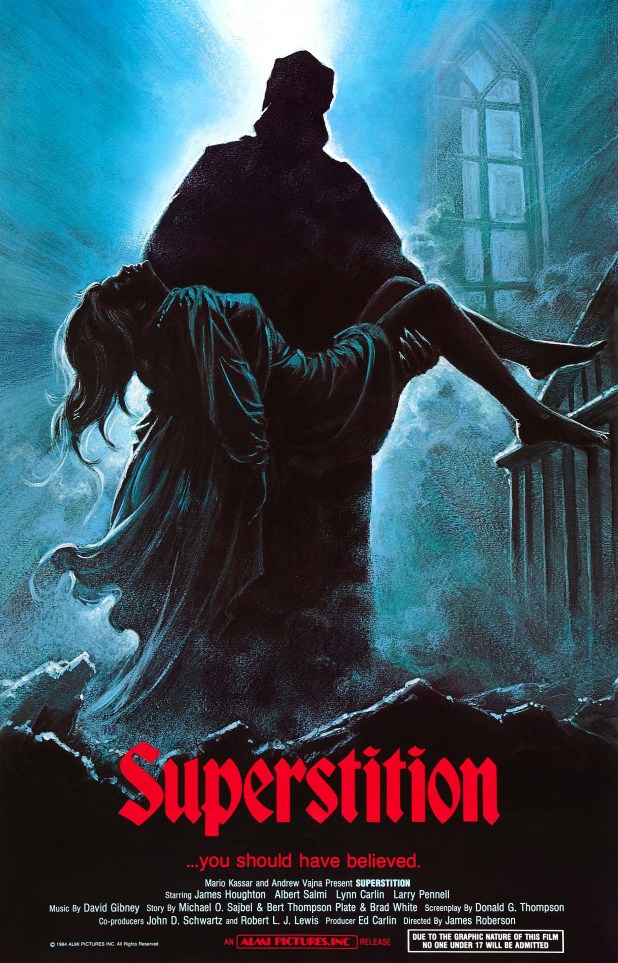
For years, Superstition was a movie that was impossible to find. The 2006 Anchor Bay release was out of print and you could only find bootlegs of the film at conventions. That’s just part of this movie’s troubled history, as even though it was finished in 1981, it wasn’t released in the U.S. until 1985.
That’s probably why when people bring up great 80’s horror, this is a film that rarely enters the conversation. That’s changing, thanks to Shout! Factory finally bringing this odd film out on blu ray.
Filmed under the title The Witch, Superstition is all about murder. Violent, slasher-like murders filled with brutal amounts of blood-spraying gore. This is a movie that does more than not care about its characters. It seems to outright despise them, reveling in their horrible destruction. That makes it stand out from the pack of Amityville Horror and Poltergeist films. Much like Umberto Lenzi’s Ghosthouse, it melds the world of the slasher with the supernatural.
It all starts when two boys play pranks on a couple parked on lover’s lane. As they hide inside an abandoned house, they’re soon dispatched, which brings Inspector Sturgess (Albert Salmi, Viva Knievel!) and Reverend David Thompson (James Houghton, TV’s Knot’s Landing) in to investigate. Sturgess believes that the house is a place where occult rituals are taking place, as more than one murder and several drowings have happened on the estate.
What follows is a brutal series of kills, such as Sturgess’ partner being dragged under the lake, an elderly priest (Stacy Keach Sr., father of Stacy and James) being killed by a table saw, a contractor being hung by a clawed hand, exploding shards of glass mutilating another priest and so much more. Don’t fall in love with a single character in this movie — man, woman or even child.
Everything can be traced way back to a witch trial that happened in 1692, during when Elondra Sharack was accused of murdering a nine-year-old girl named Mary. The witch was drowned and then the church nearby instantly burned down. So when young Mary’s ghost starts wandering thr grounds, nothing good can happen. By the end, not even a crucifix can stop the witch from killing anyone and everyone that crosses her path.
Look for Larry Pennell — Dash Riprock from The Beverly Hillbillies — as doomed priest George Leahy, who somehow has a wife and three kids, one of whom is played by Billy Jayne, who is also Billy Jacoby, brother of actors Robert Jayne, Susan Jayne and Laura Jacoby, as well as the half-brother of Scott “Bad Ronald” Jacoby. Billy is also in Bloody Birthday, The Beastmaster and Cujo.
While not an official sequel, Alessandro Capone’s 1989 film Witch Story was also sold as Superstition2. That makes sense, as thematically these movies are incredibly similar. However, in Germany, Witch Story was retitled Tanz der Hexen Teil 2 and sold as the sequel to Larry Cohen’s Wicked Stepmother, a movie that feels like a complete 180 from Capone’s attempt at making a haunted house film.
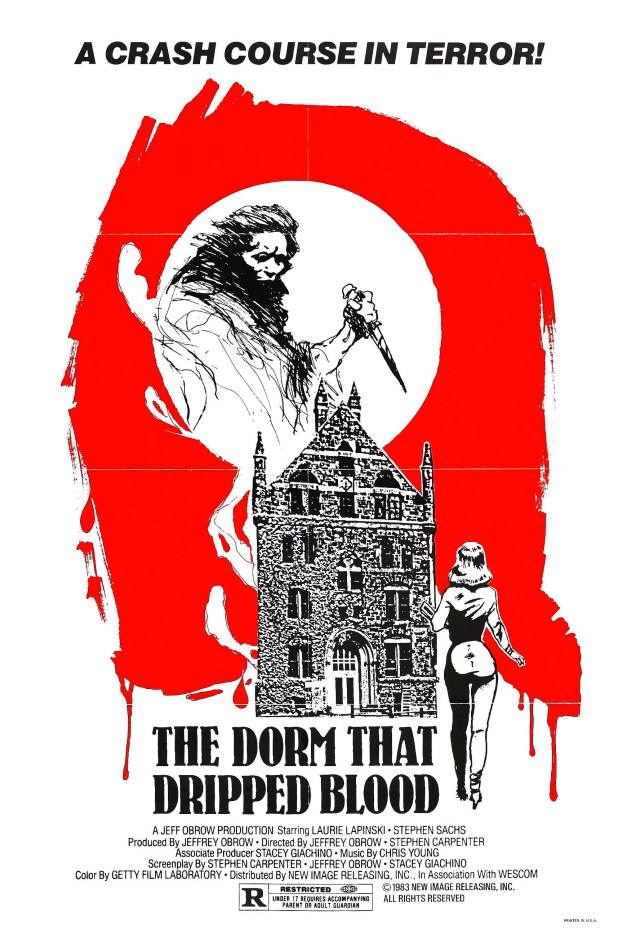
Inspired by Friday the 13th, Stephen Carpenter and Stacey Giachino wrote the script for this film while students at UCLA under the title The Third Night, which later became Death Dorm.
We start with a man running from someone, then hiding in the bushes, before he’s attacked from behind and murdered. Yep — get ready to meet one of the more downbeat slashers you’ll find. To quote Jim Morrison, “Nobody gets out alive.”
Laurie Lapinski — in her one and only role — plays Joanne, a college student staying behind over the holidays to clean up Morgan Meadows Hall before its demolished.
Of her friends, only Daphne Zuniga, in her very first role, may be the only actor you’d recognize. She plays Debbie, whose parents show up only to be murdered with a spiked baseball bat and strangled (not at the same time, mind you). Then, as if that wasn’t enough, the killer drives their car over poor Debbie’s head.
This movie sets up more red herrings than a giallo, with drifters and traveling salesmen fingered as the manic.Along the way, a drill and a pressure cooker get used as the real killer uses the confusion to continually kill more innocent people.
So what was the motive? Love. Well, the kind of love incels have for women that we didn’t understand all the way back in 1982. Of course she should be happy he killed all of these people for her!
I won’t tell you who the killer is, but I will say that you have to like a movie willing to end on the down note of its final girl shoved into an incinerator and leaving behind foul-smelling smoke. You also have to love a movie that completely apes its title from The House That Dripped Blood.
This movie was released in the UK as Pranks, where it was placed on the category 2 video nasty list. It must have been all the nail-covered baseball bats. UK censors are particularly squeamish about weapons that kids can easily get their hands on.
Synapse has released the Death Dorm director’s cut and all of the censored gore on a great blu ray release. It’s not the best slasher you’ll ever see, but it’s certainly worth a watch.
Middletown, U.S.A. is the biggest show on TV. Sure, it’s controversial, but the ratings are through the roof. The only problem is that every time a major villain gets any traction, they end up dying for real.
Last year, we interviewed Amanda Reyes from Made for TV Mayhem. She recommended this film and it’s been on our list for awhile. Trying to get in sixty slashers that aren’t all that well-known for October gave us the perfect opportunity to watch it. If you’d like to read Amanda’s take on the movie, check out her site.
Director William Wiard was also behind This House Possessed, a fine example of made for TV horror. Here, he’s working from a script by David Levinson, who also worked on that film.
Suzanne Pleshette plays Carla Webber, who after being left by her husband decided that she’d become an independent woman. After watching daytime soaps, she soon learned that she was pretty good at writing for them, which leads to her running the biggest soap around. Barry Newman from Vanishing Point shows up as her love interest, plus Robert Vaughn is the slimy network president.
While this film doesn’t have much gore, it doesn’t skimp on the murders. It’s close to giallo territory with a humming killer only seen from their own POV, as well as a duplicitous identity and mental disorders at the end.
It’s not perfect, but Pleshette is. It’s fun to see her fully embracing a leading role after so many only knew her as Newhart’s wife. I know that Lifetime exists now to create movies similar to this, but there’s just something missing in a world that no longer has made for TV movies quite like this. Sure, TV is going through a golden age now, but give me the 1970s and 1980s past.




 B&S About Movies
You must be logged in to post a comment.