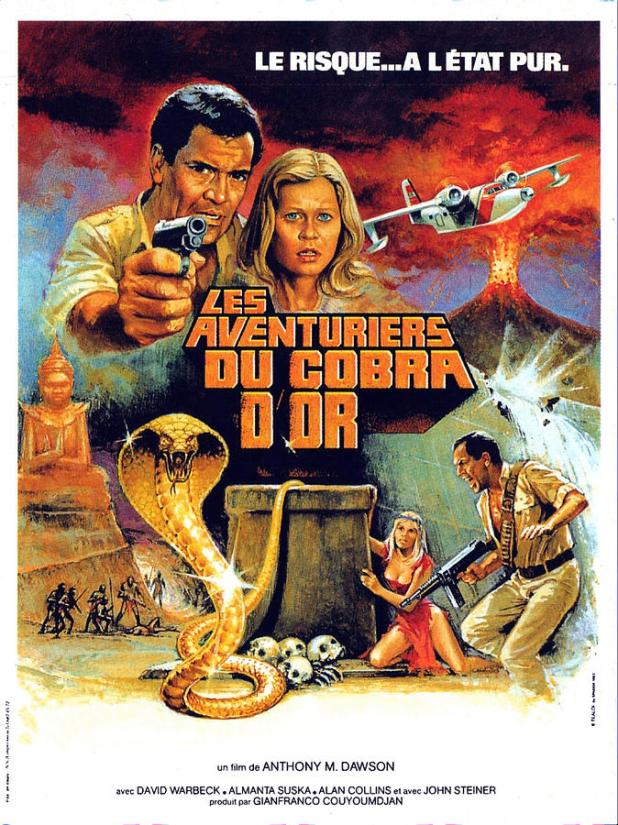
The joy of Antonio Margheriti’s Raiders of the Lost Ark remixes — you can add The Ark of the Sun God and Jungle Raiders to this film — is that you get sequels without waiting for Indiana Jones and the Temple of Doom.
Starring David Warbeck as Bob Jackson, an American soldier who is hired by British Captain David Franks (John Steiner) to make another try at finding the Golden Cobra, an artifact he almost got a year ago. Jackson has been thinking about another mission since then, as well as the gorgeous non-native woman who somehow was living amongst the tribe of Awoks. No, not Ewoks. Awoks. She saved his life as she was able to command the cannibal tribe, who follow her like a goddess.
But then he meets her twin sister (they’re both played by Almanta Suska from The New York Ripper). She and her uncle Greenwalter (Luciano Pigozzi, as always showing up in a Margheriti movie) have been trying to find her for years and Jackson seems like the best bet.
You know, I’m all for the Philippine jungle being used to great effect in Italian movies, as well as Margheriti’s great use of budget, miniatures and effects. There’s an entire room of cobras and a dummy drop to end the film!
Writers Gianfranco Couyoumdjian (The Last Hunter, The Last Blood, Code Name: Wild Geese) and Tito Carpi (Alien from the Deep, Atlantis Interceptors, Marta) have the Italian movie magic language to make this movie sing. As far as I’m concerned, this crew could have made twenty of these movie serial style movies, particularly when they include scenes where a crazed cult leader interrupts a slide show presentation. Also: Warbeck and Steiner are a fabulous adventure team and their dialogue is sparkling.
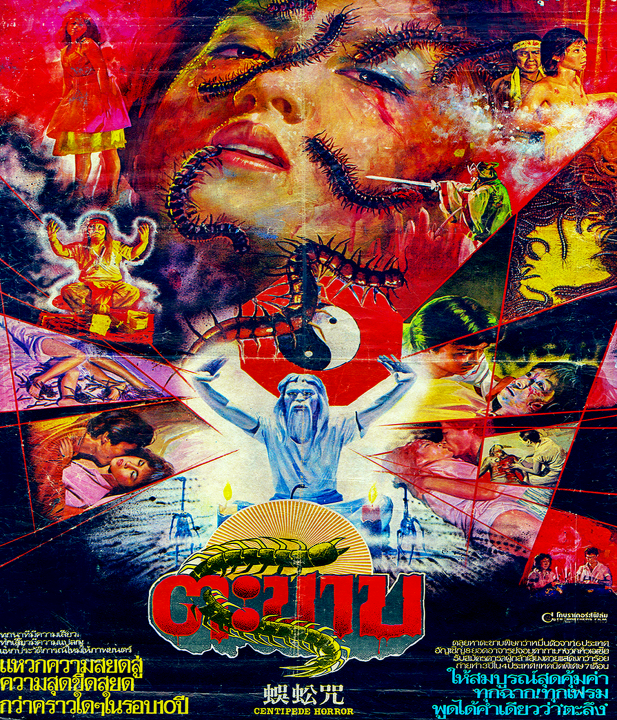
Thank you Keith Li for reminding me that I still can get physically sick while watching a movie. I thought that I had become numb to such a thing and then i watched your 1982 blast of insanity, Centipede Horror.
Centipedes may not get much love — well, they did get a video game back in 1980 — but they’re pretty horrifying. All centipedes are venomous, most are carnivorous and they can inflict painful bites that inject poison through their pincers. And they don’t just have a hundred legs. Nope, they can have anywhere from 30 to 382 legs.
A rich young woman named Kay goes to Thailand, despite her grandfather warning her to never visit there. Of course, as you can guess from the title of this movie, she’s assaulted by hundreds of centipedes, which causes her wounds to fester and bubble as only a category III would can become. She dies, which brings her brother Wai Lun to Thailand to watch her die and then get on the case of who did this to her.
If only she had worn the ugly necklace that was to protect her from centipedes! Yet as we all know, fashion can be dangerous.
Wai Lun brings his friend Yeuk-Chee along to figure out how they can make up for the crimes of his grandfather and stop a wizard’s curse. A wizard who curses and uses ghost children in his nefarious plans! This movie has it all and by all, I mean thousands of centipedes, including Margaret Li — who plays Yeuk-Chee — being an absolute trooper by sitting there with a mouthful of live centipedes crawling around her mouth waiting for Keith Li to say action so she can throw them up all over the place.
So yes, the pace is slow, it even drags until we get to the sorcerer battle at the end. But a reanimated chicken skeleton shows up and, yes, we have the heroine blowing centipede chunks and how can you ask the filmmakers to give us more than that?
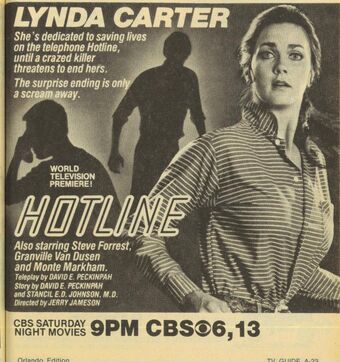
EDITOR’S NOTE: Hotline was on the CBS Late Movie on October 30, 1986 and March 10, 1987.
Originally airing on CBS on October 16, 1982, this made-for-TV movie was directed by Jerry Jameson, who also was the in the director’s chair for movies like The Bat People, Airport ’77 and the Gunsmoke and Bonanza reunion movies. Lynda Carter (TV’s Wonder Woman as well as Miss World USA 1972) plays Brianne O’Neill, an art student who is getting stalked by The Barber, a man who claims to be behind several killings in the paper.
Who is The Barber? Is it Justin Price (Granville Van Dusen, who was the voice of Race Bannon on The New Adventures of Jonny Quest)? Deranged killer Charlie Jackson (James Booth, Airport ’77)? Former actor Tom Hunter (Steve Forrest, Mommie Dearest), who has been in love with Brianne for a long time? Her boss Kyle Durham (Monte Markham, Jake Speed, We Are Still Here)? Or her co-worker Barnie (Frank Stallone!, Ground Rules)?
Look for Harry Waters, Jr. in this movie. He played Marvin Berry in Back to the Future, the guy that Marty McFly used to steal rock ‘n roll from black people. There’s a death by harpoon gun, so this movie has that going for it. Consider it an early 80’s American low budget made for TV giallo and you’ll be fine.
Swamp Thing can trace his roots — yes, it’s a he — back to “It,” Theodore Sturgeon’s short story that ran in the pulp magazine Unknown in 1940. The story is all about a man — Roger Kirk — who dies and is reborn in a swamp.
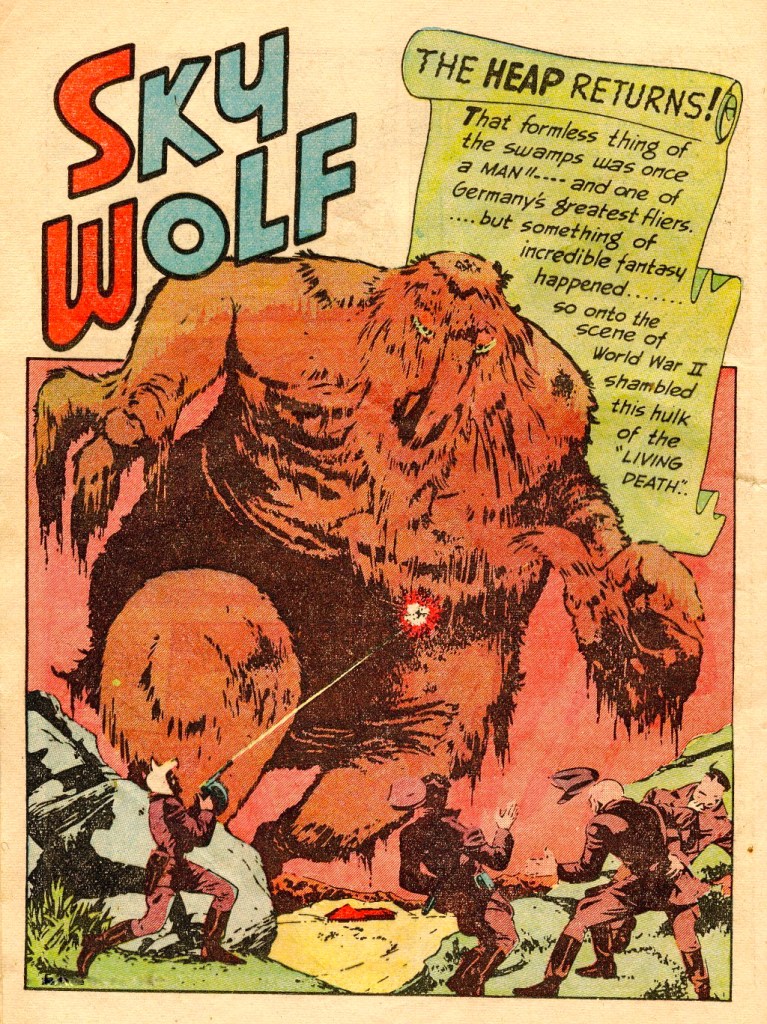
This was an influential tale whose roots — pardon the pun — took hold throughout comic books, which were the younger brother of the pulps. In Air Fighters Comics #3, published in 1942, Sky Wolf (a World War II fighting ace given to wearing the mask of a wolf and helping Airboy battle the Axis) the muck-encrusted form of World War I German pilot Baron Eric von Emmelman returned from the grave in the same way that Roger Kirk did two years before.
Thanks to his immense force of will and the help of the goddess Ceres, as the Baron’s body decayed, he became one with the vegetation of the swamp that he was shot down over. Now, he was more marsh than man, and fought Sky Wolf until discovering the fanaticism of his countrymen.
Before long, The Heap was the heroic star of his own backup in Airboy Comics, with adventures lasting from 1946 to 1953. He’d return in 1986 as part of Eclipse Comics’ reboot of Airboy before being bought by Image Comics, where he’s now part of Todd McFarland’s Spawn Universe.
After EC Comics (the creators of Tales from the Crypt and The Vault of Horror amongst others) and other horror comics publishers were taken to task for their extreme material, the Comics Code Authority outlawed all monstrous characters unless they had literary roots. In fact, until the year 1989, you weren’t even allowed to say the word zombie in a mainstream comic book (Marvel got around this by calling them zuvembies, if you can believe that).
As the CCA relaxed its rules at the start of the 70’s, two different characters that both grew from the Heap started at both Marvel Comics and their cross-town rivals, DC.
Man-Thing was created by Stan Lee and Roy Thomas (who’d go on to write Fire and Ice and adapted plenty of Conan stories, including the one that would be filmed for Conan the Destroyer). A series of conversations led to five different potential origins for the character, with the name being recycled from another character that had already appeared in Tales of Suspense #7 and #81.
Thomas would tell Alter Ego that Lee “had a couple of sentences or so for the concept — I think it was mainly the notion of a guy working on some experimental drug or something for the government, his being accosted by spies, and getting fused with the swamp so that he becomes this creature. The creature itself sounds a lot like the Heap, but neither of us mentioned that character at the time.” Lee also had the name for the character, which would lead to perhaps my favorite comic book title of all time: Giant-Sized Man-Thing.
While you’d think that Man-Thing would be a one-note character — he never speaks and he just kind of shows up in the swamps — but he grew from his first appearance, where he battled Marvel’s Tarzan-esque Ka-Zar to become something much different thanks to the deranged hands of Steve Gerber, who made Man-Thing the center of the Nexus of All Realities, which just so happened to be inside his swamp.
Once biochemist Dr. Theodore “Ted” Sallis and a former co-worker with Dr. Curtis “The Lizard” Connors, the man who would become Man-Thing was working on a version of Captain America’s Super Soldier formula with Dr. Barbara Morse (who would become Hawkeye’s wife Mockingbird, man, I read too many comics as a kid) when techno soldiers from Advanced Idea Mechanics (A.I.M.) and his betraying wife attacked. The result? You guessed it. Fused with the swamp, no brains and a tendency to wander. That said, Man-Thing also gained the ability to burn anyone who felt fear in his presence, so he had that going for him.
Man-Thing became a story engine for Gerber (who contended that he was just a reporter for the very real tales of the character, as he appeared as a fictional character within the comic), who used these stories to introduce sorceress Jennifer Kale, the barbarian Korrek who emerged from a jar of peanut butter, the serial murdering Foolkiller, Dakimh the Enchanter and Howard the Duck. Yep, Gerber’s Man-Thing was pure imagination writ large across the comic book page. After leaving comics, Gerber would write for plenty of cartoons, including Dungeons & Dragons, which his work had a major influence on.
At pretty much the same time, Len Wein came up with the idea for a swamp-based character as he rode the subway. “I didn’t have a title for it, so I kept referring to it as that swamp thing I’m working on. And that’s how it got its name!” Master illustrator Bernie Wrightson (he drew the comic cover for Creepshow) designed the character’s visual image and helped tell his first few adventures.
The Swamp Thing was once Dr. Alec Holland, who was working with his wife Linda to invent a solution for the world’s food shortage problems. After some thugs blew up their lab, his destroyed body was coated in one of his formulas and grew within the swamp, transforming him into a conscious plant with all of his old memories. Of course, once Alan Moore came on board — after this movie brought the character back to comics — we would learn that Swamp Thing was really the latest in a long line of Earth elementals that protect the Green.
If this all sounds like DC was stealing ideas from Marvel — well, they were all stealing from the Heap who was stealing from Theodore Sturgeon — let me blow your mind a little further. Swamp Thing writer Len Wein and Man-Thing’s co-writer, Gerry Conway, were roommates.
Despite the first version of Swamp Thing appearing in House of Secrets #92, Len Wein would later say, “Gerry and I thought that, unconsciously, the origin in Swamp Thing #1 was a bit too similar to the origin of Man-Thing a year-and-a-half earlier. There was vague talk at the time around Marvel of legal action, but it was never really pursued.”
It was decided that this was just a strange coincidence and after a while, the characters became so different, no legal action was necessary.
If you’d like to learn more about the fascinating lives of comic book swamp men, I recommend TwoMorrows’ Comic Book Creator 6: Swampmen.
Whew! I told you all that so I can tell you this: In 1982, Wes Craven wrote and directed an adaption of the comic, long before comic book movies were a thing. His intent was to show the major Hollywood studios that he could handle action, stunts and major stars, all while doing it under his $2.5 million dollar budget. Good news — he succeeded.
A top-secret bioengineering project in the southern swamps is dealing with sabotage, so Alice Cable (Adrienne Barbeau, playing a mix of the comic’s Matt Cable and Abigail Arcade) has been dispatched to replace one of the scientists who has been killed. She soon meets lead scientist Dr. Alce Holland (Ray Wise) and his sister Dr. Linda, who together have developed a glowing plant with explosive properties, as well as a combination animal/plant hybrid.
The real issue is that the secret base is being eyed by the evil Anton Arcane, a paramilitary leader who wants the fruits — and vegetables — of all this labor for himself. He’s played by Louis Jourdan, who is absolutely perfect in the role, oozing menace from every pore while remaining aloof and almost high cultured in his pursuit of evil.
Soon, Arcane’s forces attack, murdering Linda and blowing Alec up real good. However, just like the comic, he now rises as Swamp Thing, played by stuntman DIck Durock (who was also the pie-eating champion in Stand By Me). Now, he must protect Alice and his notes, keeping them both from Arcane.
The movie differs from the comic in that Holland’s formula unleashes whatever dominant personality trait exists within each person. For Holland, it’s the ability to heal and transform his inner strength into outer muscle. Yet Bruno (Nicholas Worth, who played the heavy in plenty of films and lent his voice to the Reaper in The Hills Have Eyes Part II), the biggest of Arcane’s henchmen, becomes a small rat-like creature and Arcane himself becomes a gigantic boar.
Another of Arcane’s henchmen — Ferret, the one who gets his neck snapped by Swamp Thing — is played by David Hess, who was Krug in The Last House On the Left. Also, Karen Price, who plays one of Arcane’s messengers, was Playboy‘s Playmate of the Month for January 1981. I tell you that because it’s her centerfold that appears on the tail of Gyro Captain’s copter in The Road Warrior.
There was one bit of controversy this film caused, more than a decade after it was released.
In August 2000, MGM released this movie on DVD and although it was labeled PG, it actually included the 93-minute international cut, which amps up Adrienne Barbeau’s ample charms and nudity in the skinny dip sequence. Two years after that, a woman rented this film in Dallas for her kids and was shocked and dismayed by what her family saw. Trust me — they should be so lucky!
Durock and Jourdan — along with much of the crew, including producers Michael E. Uslan and Benjamin Melniker — would return in 1989 for Return of Swamp Thing. It’s directed by Jim Wynorski and features Heather Locklear as Abigail Arcane, who heads to the swamp to confront her stepfather Dr. Arcane. He’s been brought back to the dead by the evil Dr. Lana Zurrell (Sarah Douglas, Ursa from Superman) along with an army of mutant Un-Men, all ready to do battle with Swamp Thing.
If anything, that movie gave us more than a series on the USA Network and a cartoon complete with Kenner action figures (of course I bought every single one). It also gave us this, a PSA where Swamp Thing speaks for Greenpeace.
Good news. Today you learned way more than you ever thought you would about 20th century popular fiction involving swamp-based creatures. Would it help even further if I told you that Man-Thing also appeared in a 2005 SyFy movie directed by Brett Leonard (The Dead Pit, The Lawnmower Man, Hideaway)? I sure hope so.
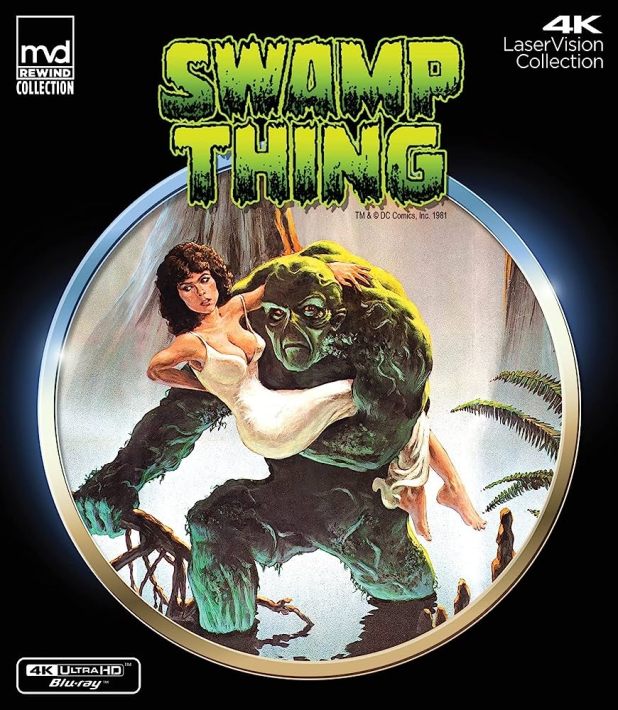
The MVD 4K UHD/bluy ray combo of Swamp Thing include a new 4K restoration — a 16-bit scan of the original camera negative — of the U.S. theatrical PG and unrated international versions of the film. There’s archival commentary by Craven moderated by Sean Clark, as well as alternate commentary with makeup artist William Munn moderated by Michael Felsher. Yoy also get a collectible 4K LaserVision mini-poster and a limited edition slipcover.
Special features include interviews with Adrienne Barbeau, Reggie Batts and creator Len Wein, as well as features on drawing Swamp Thing and Craven’s direction. Plus, there’s a photo gallery of the posters and lobby cards, photos from the film, behind-the-scenes photos and a trailer.
EDITOR’S NOTE: Mae West was on the CBS Late Movie on May 4 and August 11, 1987.
At the age of ten, I had a huge crush on Ann Jillian even if I had no idea why I felt that way.
Now I do and I still have that crush.
Directed by Lee Phillips (The Spell, Sweet Hostage) and written by E. Arthur Kean, this has Jillian as Mae West and takes you through enough of her career to see how she went head-first against small-minded censors. Jillian is great in it and has several performances of West’s songs, too.
James Brolin is Jim Timothy, her manager and former love interest, while Roddy McDowall plays her co-writer Rena Valentine — based on Julian Eltinge — and Piper Laurie is West’s mother Matilda. I wouldn’t depend on this film for factual accuracy, but if you’d like to see JIllian pretty much put on a one woman show, it’ll definitely deliver on that. The costumes are pretty great, too.
EDITOR’S NOTE: Honeyboy was on the CBS Late Movie on January 29, June 25 and December 21, 1987.
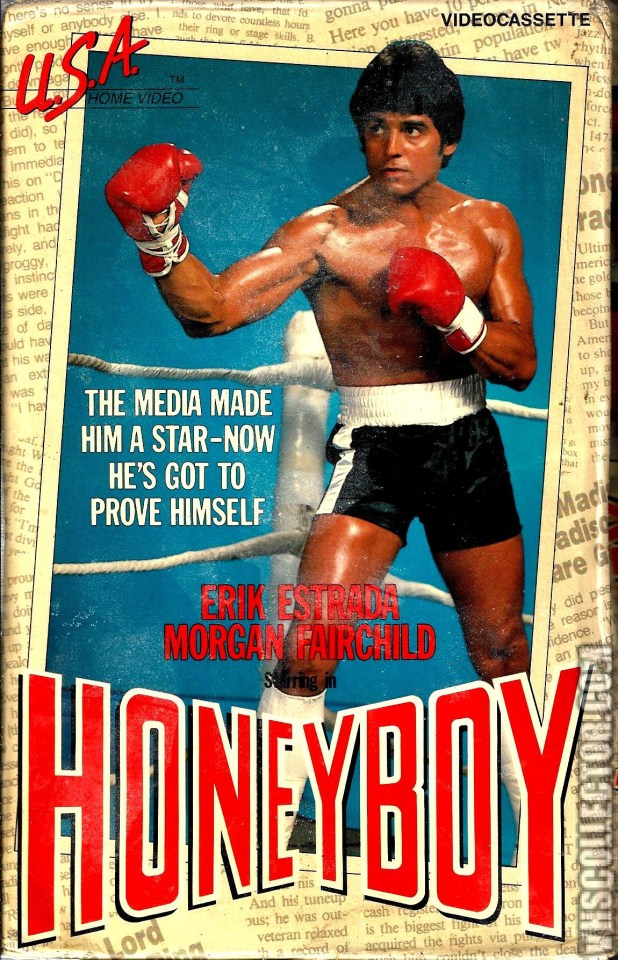
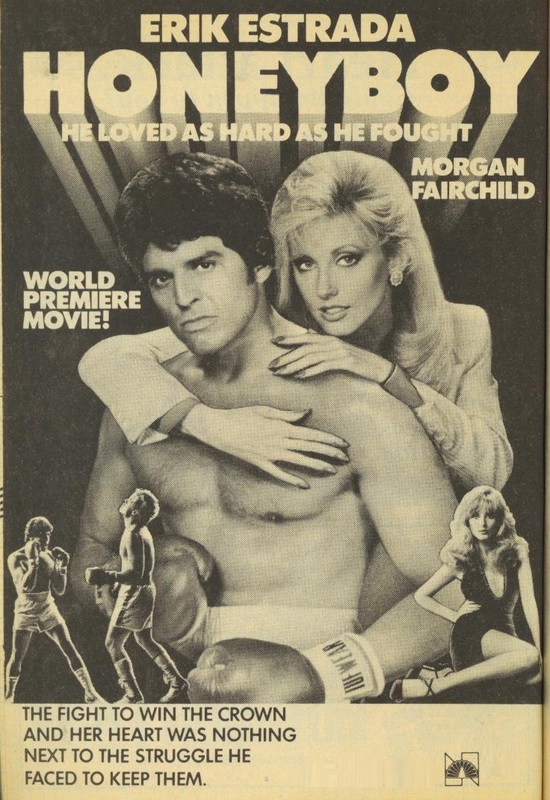
Erik Estrada is pretty much going to get a whole week of movies on this site before too long but until then, let’s look at this movie, in which he plays Rico “Honeyboy’”Ramirez, the son of a boxer (Hector Elizondo) who never made it and walked out on his family.
This was an NBC TV movie of the week and came out while Estrada was fighting with his bosses on CHiPs over his salary. He was replaced on that show by Bruce Jenner, but came back for the last season.
To get to the top, Honeyboy gets a PR agent named Judy Wellman, played by Morgan Fairchild, so this movie had some incredible wattage when it came to early 80s TV starpower. He’s on a quest to win the title from Tiger Maddox (Jem Echollas), who claims that the fight promoter that got Honeyboy this far worked all his fights like pro wrestling matches. Or, you know, pro boxing for the most part.
Of course the third act is all Honeyboy chasing away everyone who got him this far, but if you know boxing movies, you know he’s going to win. I kind of loved the scene between Sugar Ray Robinson — that’s really him — and Honeyboy’s father. Their title match was as far as he got and Sugar Ray is pretty much giving him a little bit of recognition and you can see that Emilio doesn’t want it but really does want it and it’s some masterful acting for such a small moment in such a tiny TV movie and man, I’ve been thinking about it for several days and it still makes me choke up a little.
This was directed by John Berry, who co-wrote the script with Lee Gold. Berry was a member of Orson Welles’ Mercury Theater and ended up blacklisted in 1950. He had agreed to direct a short documentary on the Hollywood 10, the group that had refused to cooperate with the House Un-American Activities Committee as they tried to find Communists in Hollywood. After directing He Ran All the Way, Hollywood 10 member Edward Dmytryk — who had been jailed for contempt of Congress — named Berry as a Communist when he was released from prison as part of his hope to get work in Hollywood again.
Settling in Paris, he co-directed Atoll K, the last comedy film of Stan Laurel and Oliver Hardy, and spent the rest of his career there, even after being permitted to make movies in Hollywood again, like The Bad News Bears Go to Japan.
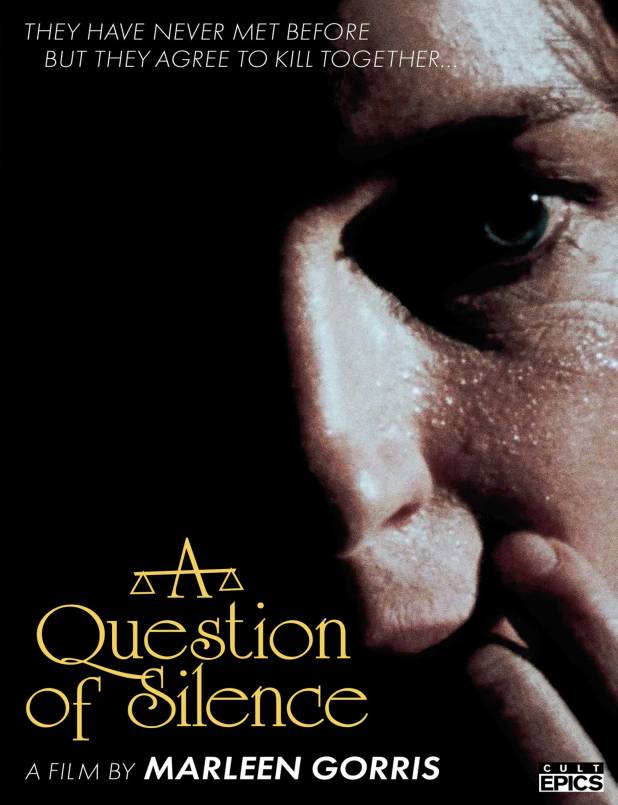
Three women — a housewife named Christine M. (Edda Barends), a waitress named Ann Jongman (Nelly Frijda) and executive secretary Andrea Brouwer (Henriëtte Tol) — have murdered a male shopkeeper in the middle of the day for no reason. No premeditation. And none of them know one another. A female psychiatrist (Cox Habbema) must now discover why.
Directed by Marleen Gorris, who also made the Oscar-winning Antonio’s Line, this film takes us into the lives of each of the women as the doctor interviews each of them as well as the people in their lives, all to learn if this murder was thought through or was simply a random act.
The movie finally shows precisely how the woman led the man to his death without revealing the actual killing. But we do learn all of the negative experiences they’ve had with men throughout their lives and what would lead them to destroy a man, even castrating him and crushing his face. By the end, they laugh about the murder during their trial and their laughter is repeated by every woman in the room. To the credit of the director and her cast, this movie is still so potent more than forty years later.
The Cult Epics Blu-ray release of A Question of Silence has a new 2K HD transfer and restoration audio commentary by film scholar Patricia Pisters. It also features interviews with director Marleen Gorris and actress Cox Habbema, a promotional gallery, trailers and more. You can get it from MVD.
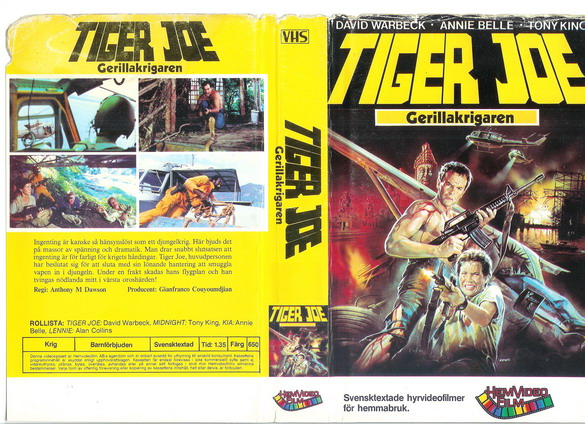
Known as Fuga dall’arcipelago maledetto (Escape from the Cursed Archipelago) in Italy, this Antonio Margheriti-directed and Tito Capri-written film stars David Warbeck as Tiger Joe, a former US Army Special Forces Vietnam Veteran who works with “Midnight” Washington (Tony King, Atlantis Interceptors) and Lenny (Luciano Pigozzi) to airlift all sorts of cargo but mostly guns.
When he gets shot down, he joins up with Kia (Annie Belle, who started her acting career appearing in Jean Rollin’s Lips of Bloodand BacchanalesSexuelles; she’s in so many movies by directors and personalities I’m obsessed with: Deodato’s House On the Edge of the Park, D’Amato’s Absurdand L’alcova, the supposed Emmanuelle Arsan-directed Forever Emmanuelle, Marco Antonio Andolfi’s Cross of the Seven Jewels and the Cannon film Nana) and her companion Datu (Abadeza) to get out of the jungle alive.
This has a lot of cast, crew and shots from the much better The Last Hunter, but I just love Antonio Margheriti. He brings something extra to every movie. Sadly, cinematographer Riccardo Pallottini lost his life in a plane crash while filming the final shot of the film.
May I never ever get tired of seeing bamboo huts in the Philippines blow up. If you want more Margherti in the jungle, check out Tornado: The Last Blood, Code Name: Wild Geese, The Last Hunter, Commando Leopard, The Commander, Indio and Indio 2: The Revolt.
June 12: Junesploitation’s topic of the day — as suggested by F This Movie— is Westerns! We’re excited to tackle a different genre every day, so check back and see what’s next.
John Liu’s first kung fu lessons came from his grandfather but the flexible kicks that he became famous for were from his lessons with “Flash Legs” Tan Tao Liang, who put him through a rigorous training regime — Drunken Master-style pain like resting each foot on two piles of bricks — to improve his skills.
He started off as an actor in several Hong Kong movies — Secret Rivals, The Invincible Armor, Snuff Bottle Connection — before directing and writing four quite baffling movies: Zen Kwan Do Strikes Paris, Made In China(AKA Ninja In the Claws of the CIA) and the unfinished — until 2021 — New York Ninja. Years later — and after his acting career ended — Liu developed Zen Kwan Do, which he claimed was popular in France
Man, those four movies.
Man, this movie.
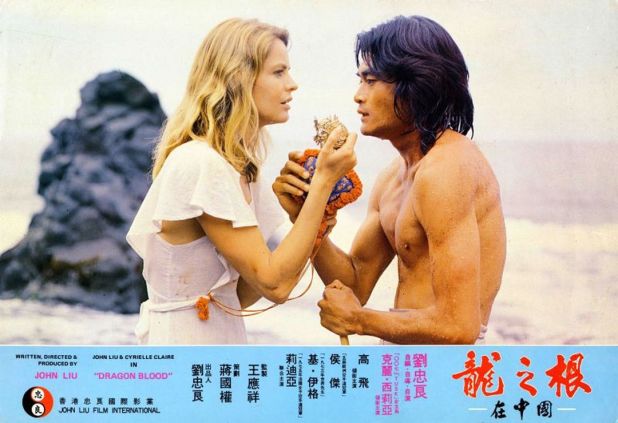
As always, John Liu plays John Liu, except this time he’s in 1886 Mexico. He’s the son of the best fighter in China, a man who was given two gold dragons by the Emperor to prove just how talented he was. Those dragons, however, were a curse. He had to fight anyone who came his way. His last challenger, however, just wanted to fight him for honor. But during that fight, John’s father gets jumped and killed. With his last words, he makes the honorable martial artist the guardian of his son and of one of the dragons.
After his guardian is killed — fighters kept showing up and one finally killed him — John takes all the fighting skills he has known, the gold dragons and himself to the New World, where he wants to protect the Chinese who are fighting racism and the slavery of working on building railroads.
That sounds like a movie that makes a fair amount of sense.
Well, this is a John Liu movie.
Once he arrives in Mexico, he battles a gang of outlaws. They overcome him with their guns and push his face into a blazing campfire. Now blind as a result of his pride, he gives up. The woman he once saved — Paulette (Cyrielle Clair, Sword of the Valiantand another major film I’ll get into in a minute) — trains him with a series of tests, like a mobile that makes sounds, a cactus he must defeat with his feet and even being able to catch knives blind that she throws at him with no warning. There’s another scene where she throws a series of eggs at him and while blindfolded, he knocks every one out of the air before they touch him.
There are enemies in wait. There’s a killer (Phillip Ko Fei) sent by the Chinese government. There’s a karate fighter (Roger Paschy) who is the guardian of a large chubby child who may never learn martial arts. There’s a scene where the kid nearly wipes himself out with nunchucks.
Paulette and John alternate training with arguing, including one time when she goes to town without telling him for two days and leaves him alone. When she returns, he asks why she didn’t leave a note. She tells him he couldn’t read it anyway. A pause and he yells, “Because I’m blind!”
This has a lot of messages in it. There are Chinese people being mistreated. There’s pride. There are the dragons, which are the symbols of the Chinese bloodline and the endless bloodshed. Most of all, while John is the best fighter of all time, he doesn’t want to fight.
But the end, man. The end. John gets shot by the mayor of the town — after winning his greatest fight — who was trying to kill Paulette. Then she’s killed by a female assassin who is killed by the chubby kid and as John Liu sits on the beach and discusses death. And we end up with that goofball kid and dead bodies everywhere.
Back to Cyrielle Clair. The credit for her in this movie literally says “Star of Tusk.” I was wondering, at the scene where John cuts open a cactus to drink while struggling to survive the desert if this movie was suddenly becoming El Topo. I mean, I get it. I’m obsessed with Alejandro Jodorowsky and see him in so many movies. But when the credits of a film — inside the film itself — call out the fact that one of the few actors in it starred in Jodorowsky’s comeback picture, well…there are no coincidences, right?
I adore this movie and not just for how weird it is. It’s a Western Kung Fu Zaitochi that’s assistant directed by Godfrey Ho. Of course I’m going to enjoy it. But I really love it because it uses the same TV sports highlight theme throughout.
June 4: Junesploitation’s topic of the day — as suggested by F This Movie— is Cars! We’re excited to tackle a different genre every day, so check back and see what’s next.
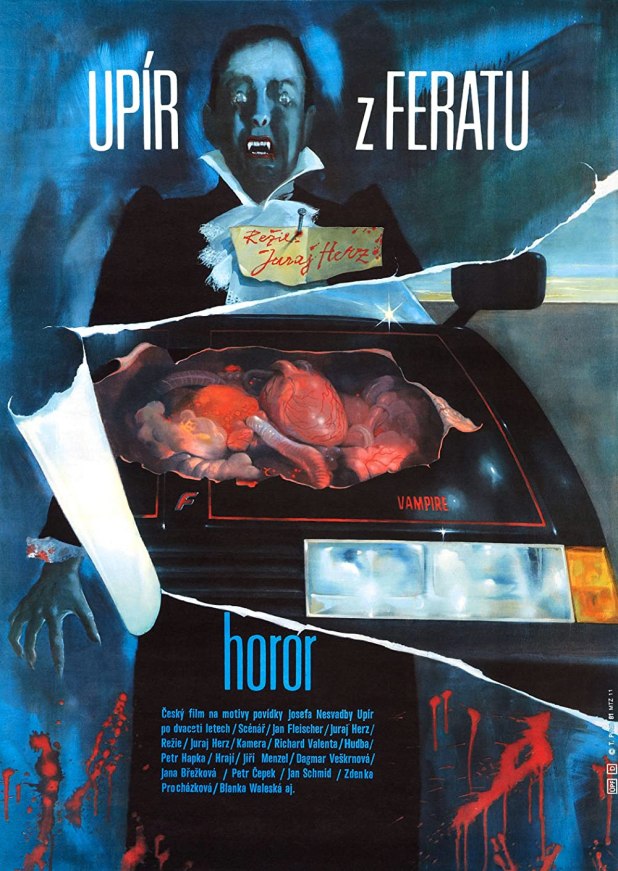
The Ferat rally car used in the film wasa prototype for the Škoda 110 Super Sport, which is now known as the Škoda Super Sport Ferat Vampir RSR because of this movie. The car is so famous in Czechoslovakia that Škoda remade it as part of their Icons Get a Makeover series.
This was directed by Juraj Herz, who also made the must-see films Morgiana and The Ninth Heart. He also wrote this with Jan Fleischer. It was based on “Upír Ltd.” by Josef Nesvadba. Another movie based on that writer’s work, Tomorrow I’ll Wake Up and Scald Myself with Tea, also has the Škoda Super Sport Ferat Vampir RSR in it. That movie is a science fiction film about the Third Reich trying to go back in time to give Hitler a nuke and the twin of the pilot of the time machine — who choked to death on a croissant — trying to stop them.
Dr Marek (Jirí Menzel) loses his driver Mima (Dagmar Havlová) — who he obviously has feelings for — to the Ferat team, which has developed a car that just may be fueled by human plasma through the lead foot of the driver.
The real vampire is the Ferat company, which sucks the blood of all who work for it. Or, well, uses them and throws them away, like any big corporation. The car is also a vampire in a way that may not be about blood. Once driven, it obsesses everyone that has felt its power.
I love that Juraj Herz is the vampire in the silent movie within this film, just as much as how Ferat is taken from Nosferantu and Mimi is very close to Mina Harker.



 B&S About Movies
You must be logged in to post a comment.