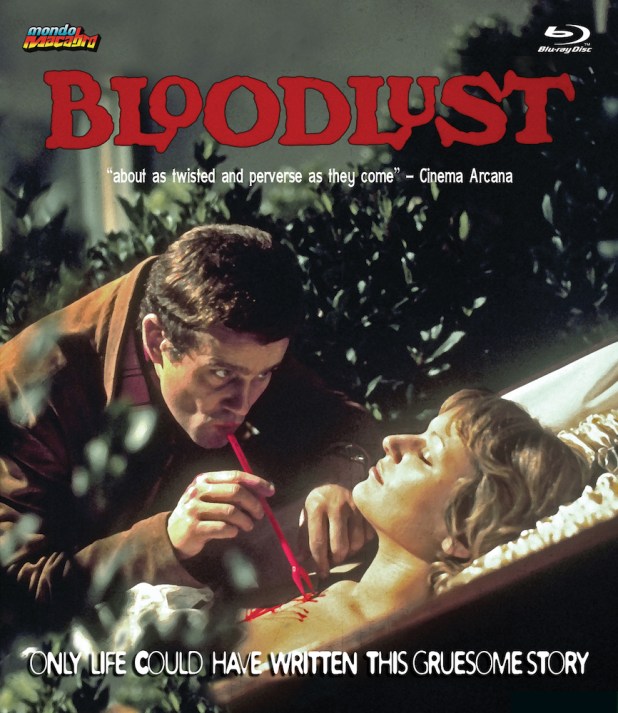
Bloodlust (1977)

Known by several other titles Mosquito der SchänderBloodlust: The Black Forest Vampire, Bloodlust: The Vampire of NurembergMosquito and Mosquito the Rapist, this is a dark and disturbing 1970’s Eurohorror based on the macabre true story of Kuno Hofmann, the “Vampire of Nuremberg.” Cut and banned in many countries, Mondo Macabro is finally bringing the full-length and uncut version to blu ray.

Mondo Macabro describes this one as a “grown up fairy tale, albeit one that includes bloodsucking, eyeball evisceration and voyeuristic lesbian sex scenes among a host of other activities.” That pretty much covers it!

Director Marijan Vajda mainly worked in documentaries, which is a way of seeing this film. No one is named, but The Man (Werner Pochath, who was in both Ratman and Thunder 3, so he’s on the Sam movie spectrum) is a deaf and mute accountant who has been abused his entire life, from a father that beat him and raped his sister in front of him to his fellow schoolmates attacking him and now, his co-workers and neighbors with treat him with scorn. Maybe it’s because he’s weird. Maybe it’s because he’s so quiet. Maybe it’s because he plays with dolls.

The only light in his life is The Girl (Birgit Zamulo), who dresses up all day and dances, and may be potentially just as damaged as our hero. The Mother warns her to stay away from The Man, because there’s something off about him.

At night, The Man tries to visit prostitutes, but he can’t communicate or perform. Soon, only the dead provide him with comfort, as he starts slicing up bodies, decapitating them, stealing their eyes and even using a glass straw to drink their blood. He starts leaving a graffiti tag behind, the words M.Q. or Mosquito, and the press panics the city with news of a modern day vampire.

The living are still safe until The Girl falls from the roof, in an act that we’re left. to believe may or may not be suicide. Losing the only person he really loves sends The Man over the edge and into a spiral of violence after he fails to bring her back to life by feeding her his blood.

This bit of Swiss weirdness isn’t everyone’s cup of tea. It’s slow-moving, but I wasn’t bored. By the time The Man gets to killing, it descends into the sleazy madness hinted at by the back of the box. But it’s a near-silent meditation on trying to escape abuse and man’s continual inhumanity to man. It also starts with a great square up real that attempts to paint this movie as an educational experience when all it really wants to do is get you to watch the creeptastic carnage on display.

I’d never heard of this before and was pleasantly surprised that it’s such a sensitive — well, as sensitive as a vampire movie with plenty of gore can be — and well-acted film.

The new release features a 2K scan that looks beautiful, as well as exclusive interviews with assistant director Marijan David Vajda on the film (as well as his career and the career of his father) and actress Birgit Zamulo, who has some insightful thoughts on what it’s like to be in a film that’s sympathetic to a murderer. Plus, you get the original UK trailer, audio choices and some great trailers that’ll inspire you to buy more of the great stuff these guys put out. It comes out on November 13 and you can grab it from Mondo Macabro or Diabolik DVD.

Disclaimer: I was sent this film by Mondo Macabro for review and in no way did that impact this article.

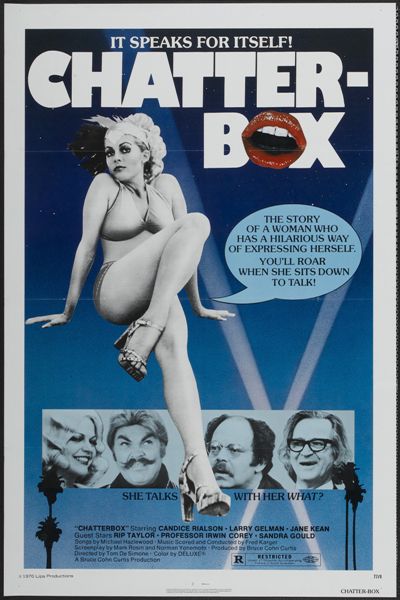
Chatterbox (1977)

You know what Deep Throat was about? Well, Chatterbox is the exact opposite — a woman who discovers that she has not just another voice, but a whole other personality inside her vagina.

Penelope (Candice Rialson, the inspiration for Bridget Fonda’s character in Jackie Brown and the star of Pets) is a hairdresser who learns that her vagina can speak after it makes fun of her lover’s lack of sexual skill.

Soon after, her lady business gets her in all sorts of trouble, like getting a lesbian client to tackle her at her hairdresser job (her boss is played by Rip Taylor, who is over the top and out of control, but why else would you hire Rip Taylor, you know?).

She then reveals her secret to her therapist, Dr. Pearl (Larry Gelman from TV’s The Bob Newhart Show and porn’s Alice in Wonderland). Soon, they both learn that she can sing from her hoo-hah and this leads her to become a big star. Oh yeah — her vagina is named Virginia and becomes more loved by her mother and more famous and in demand than its owner.

If you ever wanted to see someone sing showtunes and disco from their secret garden, then this is the film for you. I don’t know who you are, but I know they haven’t made all that many movies for you.

This is as 1977 as it gets. I mean, it has Professor Irwin Corey, the guy who accepted Thomas Pynchon’s National Book Award Fiction Citation for Gravity’s Rainbow with a pun-filled speech that confused many and was a frequent talk show guest that went on to panhandle for charity well into his 90’s.

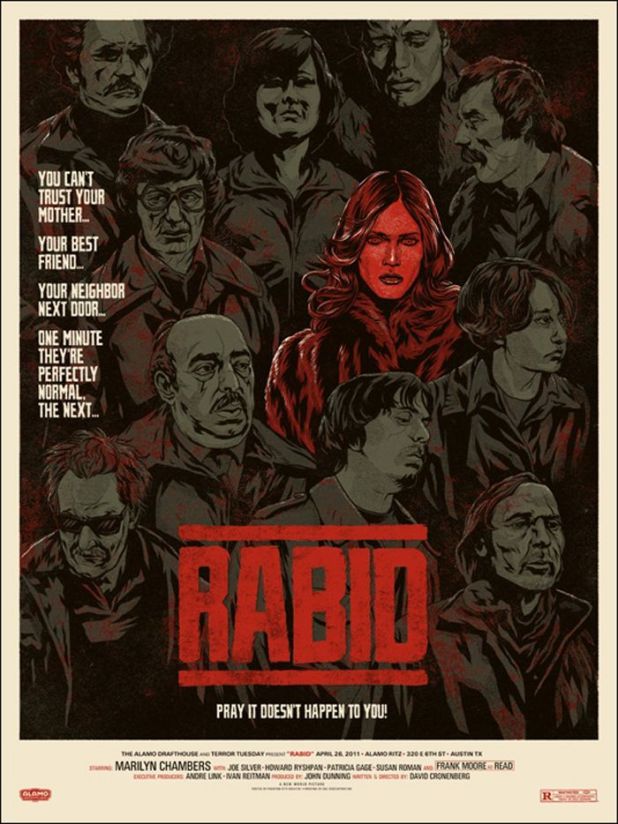
Rabid (1977)

I’ve stayed away from talking about David Cronenberg movies on here because, well, better and smarter people have already done so. After all, there’s an entire zine devoted to discussing his works, House of Skin. And friend of the site Bill Van Ryn has already written an incredibly well-written appreciation of this one. But hey — I made it through the whole Joe Bob Briggs marathon and am trying to share my thoughts with you. So please indulge me. Thank you.

The film starts with Rose and her boyfriend Hart getting into an accident in the remote countryside. With no other option, they are sent to the Keloid Clinic for Plastic Surgery, with Hart suffering only a broken hand, separated shoulder and a concussion. Rose, however, is barely alive, needing several operations and skin grafts from being burned. Dr. Dan Keloid decides to try something new: he uses “morphogenetically neutral grafts” to heal her damaged tissue, hoping that it will heal on its own. A month later, Hart is ready to go home, but she remains in a coma.

Sometime later — time isn’t really of the essence in this nightmare world — Rose awakens screaming. When Lloyd, another patient in the clinic, comes to help her, she somehow cuts him. He doesn’t remember how it happened, but his blood no longer clots and he can no longer feel pain. And Rose? Well, now she has a wound in her armpit that looks sexual — male and female at the same time. Shades of God Told Me To?

Now, Rose can only subsist on human blood, which she discovers after cow’s blood causes her to puke. A farmer watches and tries to rape her, but she is the predator now, soon devouring him and turning him into a zombie-like monster.

All hell soon breaks loose — Lloyd attacks a taxi driver after escaping from the clinic, killing them both. Dr. Keloid attacks everyone within his own clinic. Rose tries to get Hart to save her, but escapes on her own, infecting people all along the way.

Soon, Quebec is a nightmare city, with maniacs using jackhammers to tear people from cars, Santa Claus getting shot and a shoot to kill martial law policy being enacted on anyone showing signs of the virus.

Hart tries to reason with Rose — she is the cause of all of this and needs to be stopped. Of course, things can’t work out well. The world of Soylent Green has become near truth — there are so many dead people, garbage trucks are the only solution.

Cronenberg wanted to cast Sissy Spacek in the lead, but her accent didn’t work for the film’s producers. He heard from Ivan  Reitman, the executive producer, that adult film star Marilyn Chambers was looking for a mainstream role. Her being in the film would help sell it and she put in plenty of work, so Cronenberg was happy with the results. In fact, he had never seen the movie that made her famous, Behind the Green Door.

Chambers was quite literally a pure Ivory Soap girl — appearing on a box of that cleaning product as a young mother with the tag “99 & 44/100% pure.” Her appearing in the Mitchell Brothers’ film — released at the height of post-Deep Throat porn chic, when adult films entered mainsteam consciousness — was a sensation. It didn’t hurt that she was also the first white women in a major adult film to have a scene with a black man, Johnnie Keyes.

Chambers was in the midst of trying a singing career — her song “Benihana” can be heard in this film — and she was married to Chuck Traynor, ex-husband of Linda Lovelace. You could write a novel about the mania of that dude.

That said — for being a sex queen, Chambers comes off as cold in this film. That’s probably Cronenberg’s goal, to subvert notions. Even his heroes are no heroes. No one can stop what is set in motion and everyone is ineffectual. Such is the Cronenberg universe.

One thing I’ve always wondered — why did they spoil the ending of this film in the original poster?

If you want to see Rabid, you can grab the Shout! Factory reissue. Or turn in to Shudder, who has versions with and without commentary from Joe Bob Briggs.

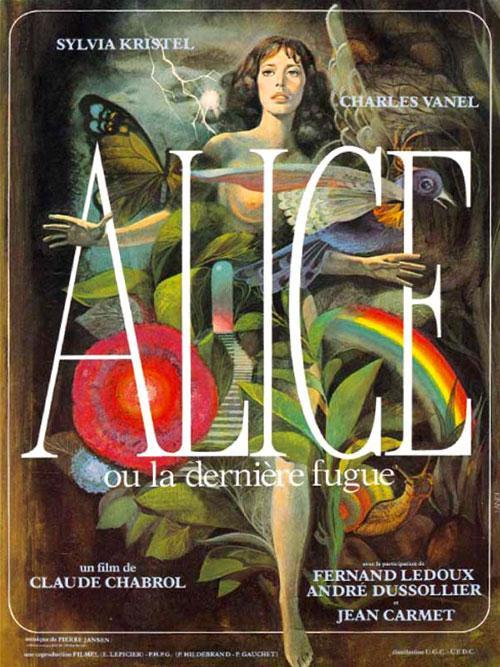
Alice or the Last Escapade (1977)

A French surrealistic retelling of Alice in Wonderland with Sylvia Kristel in the lead? It’s as if a message from space was sent directly to my brain, demanding that I stop whatever I was planning and sit inches from my TV and yelling out every translated word via closed captioning.

Alice Caroll is leaving her husband, who she has grown to hate, driving through the countryside until her windshield cracks and she ends up at an old house. It seems she’s been expected and is asked to stay overnight. The next morning, the servants are all gone and her car is fixed, but she can’t find the way out.

She tries to walk away from the house and still can’t escape when a young man tells her to accept her fate. After staying a second night, she finally gets away in her car down the pathway before she crashes her car. As Jason Mantzoukas would say, “This is a Jacob’s Ladder scenario.”

Claude Chabrol — the “French Hitchcock” — dedicated this film to Fritz Lang and it’s a visual essay of Kristel navigating scenery, of the futility of existence, of trying to navigate life’s path without any answers. It’s gorgeous yet icy and mysterious, much like the visage of Chabrol’s muse her, Kristel.

I’d compare this to 1970’s Valerie and Her Week of Wonders, as this is an absolute film, one that you experience on an emotional — and not rational — basis. It’s my first exposure to Chabrol, but I know it will not be my last.

WATCH THE SERIES: Airport

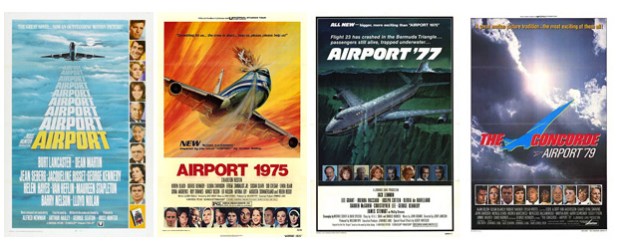
Based on the novel Airport by Arthur Hailey (whose novel Flight into Danger was adapted into Zero Hour! (as well as a later TV movie using the original title) which was later remade as Airplane!, which is also a parody of these films, but more about that later), these four films go from class to cash-in. And the worse they get, the more I love them.

The only constant throughout the series is Joseph Patroni, played by George Kennedy. His career improbably goes from a chief mechanic with a license to taxi planes to vice president of operations to consultant to pilot, surely a lateral and perhaps even regressive career path.

Despite having a big budget and high pedigree cast, Burt Lancaster, who starred in the original, claimed that the film was “the biggest piece of junk ever made.” He should have waited a few movies in to say that!
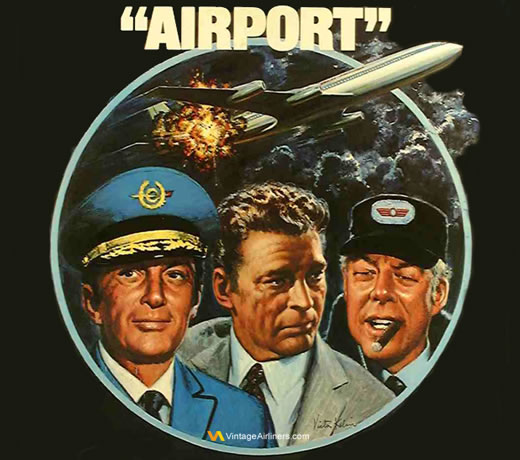
Airport (1970)

George Seaton (Miracle on 34th Street) directed the initial installment, which originated the entire big budget disaster genre that ruled the 1970’s. The actual story is simple — there’s a big snowstorm in Chicago and a flight to Rome is in danger, thanks to a down on his luck demolition expert (Van Heflin in his last role) looking to blow up the plane so that his wife (Maureen Stapleton, who won a Golden Globe for her work) can cash in. Along the way, we meet airport manager Mel Bakersfield (Burt Lancaster), whose is married to the airport over his wife (Dana Wynter from Invasion of the Body Snatchers) while a co-worker (Jean Seberg, the gorgeous star of the original Breathless whose support of the Black Panthers led to the FBI COINTELPRO hounding her for the rest of her short life) pines for him. Then there’s Vernon Demerest (Dean Martin), who is married to Bakersfield’s sister (Barbara Hale, mother of William Katt) but is having an affair with a stewardess (Jacqueline Bisset, The Mephisto Waltz). Then there’s Mrs. Quonsett (Helen Hayes, who won an Oscar for the role), an elderly woman who sneaks her way onto planes.

This big cast all interplays with one another, ending up on the seemingly doomed flight or aiding in its rescue. Will love win out? Will anyone who works in the airline industry get along with their spouses? Can Patroni shovel out a plane in time after being called in while he’s trying to enjoy a night of passion with his wife? Sure. Yes. Of course.

To get big stars like Burt Lancaster and Dean Martin, the producers gave that 10% of the profits after the film reached $50 million. With a US gross of over $100 million, the stars did more than fine making this one.
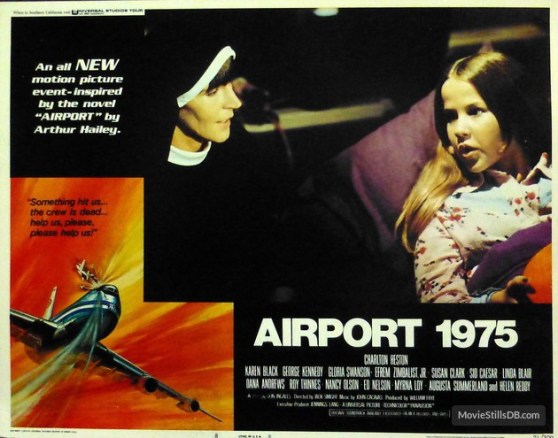
Airport 1975 (1974)

A small airplane crashes into a 747, taking out nearly the entire crew of flight 409, and only the stewardess can land the plane! Such is the plot of Airplane 1975, but that thin story doesn’t matter. You’re coming here for starpower and you’re gonna get it, baby!

Charlton Heston (the undisputed 1960’s and 1970’s king of the post-apocalyptic film, between Planet of the ApesSoylent Green and The Omega Man) is Captain Alan Murdock and he’s the only person who can save the day, with heroics that include being dropped into a plane that’s actually in flight! Karen Black (Trilogy of Terror, Burnt Offerings) is his girlfriend and the air hostess charged with keeping the plane aloft.

The doomed flight crew is played by Efram Zimbalist, Jr., Roy Thinnes from TV’s The Invaders and Erik Estrada. It’s shocking just how sexist they are with the rest of the in-flight crew and even more shocking just how much the ladies like it. The 1970’s were a doomed time when women just had to take the sexual harassment and like it, or return it back in kind.

Then there’s Gloria Swanson playing herself (Greta Garbo was the original plan) with Linda Harrison from Planet of the Apes as her assistant. Strangely, Harrison renamed herself Augusta Summerland for this movie.

And then there’s Myrna Loy as an alcoholic actress in the role originally meant for Joan Crawford! Three drunk guys (Jerry Stiller, Norman Fell and Conrad Janis) who would go on to be dads in sitcoms! Sid Caesar as a guy who can’t keep his fucking mouth shut! Linda Blair as a sick girl who just wants to listen to Helen Reddy perform as a singing nun! And Patroni’s wife (Susan Clark from TV’s Webster, who was spotted by the eagle eyed Becca) and son are on the flight, too!

Airport 1975 is big, bombastic and stupid. And it’s also awesome. It’s pure escapism and is devoted to entertaining you. It’s also a film packed with men patronizing women, calling them honey and yelling at them when they can’t get their shit together.
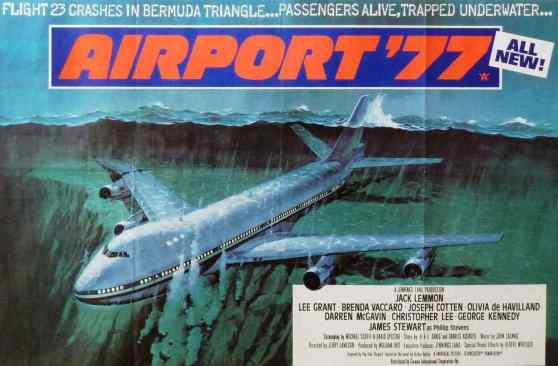
Airport ’77 (1977)

Jerry Jameson, the director of The Bat People, is in the director’s chair for the third installment of the franchise, which takes a turn into the fantastic. A private 747, filled with the rich and powerful, is hijacked and crashes into the Bermuda Triangle where it slowly fills with water.

This one boasts Jack Lemmon in the lead as Captain Don Gallagher and he pals around with Darren McGavin as they work to save everyone. Lee Grant and Christopher Lee (!) play a bickering married couple. Joseph Cotten appears, leading me to wonder when Dr. Phibes will strike. TV’s Buck Rogers, Gil Gerard, shows up. And hey look, there are Jimmy Stweart and Olivia de Havilland (replacing Joan Crawford yet again, just as she did in Hush…Hush, Sweet Charlotte and Lady in a Cage). And I bet Bill from Groovy Doom would never forgive me if I didn’t mention that Michael Pataki appears, too.

This one is…well, it’s certainly a lot more ridiculous than the previous entries. And if you think the next one is going to be better, have I got some news for you!

The Concorde … Airport ’79 (1979)

A few minutes into this movie, Becca turned to me and said, “There isn’t anyone good in this one like the others.” I disagreed. This film is filled with some of my favorite people and while it’s the worst film in the series, it’s also my favorite. If they ever make a blu ray of it, I demand to do a commentary track for it!

Directed by David Lowell Rich (Satan’s School for GirlsEye of the Cat), this film is quite relevant today, as it’s rife with corrupt corporations, drone planes and media scandals. You’ve got Robert Wagner playing a corrupt arms dealer who is in love with Susan Blakely, yet he keeps trying to kill her.

For the ladies, there’s Alain Delon as the dashing captain. And for the men, there’s Sylvia Kristel as the gorgeous airline hostess. And for the fans of The Omen, there’s David Warner as a henpecked flight officer.

There may never be a movie as sexist as this one. Just look at the way the character of Patroni has changed. He’s no longer a ground crew guy who will kick a pilot out of his own plane. Now, he’s flying the plane while making sexist jokes at every opportunity To wit:

Isabelle: You pilots are such… men.

Capt. Joe Patroni: They don’t call it the cockpit for nothing, honey.

Or when he asks Delon’s character about Vietnam:

Capt. Joe Patroni: Gee, I remember this Eurasian gal. She had these great big blue eyes. They called her the tarantula. You ever run into her?

Capt. Paul Metrand: No, I don’t think so.

Capt. Joe Patroni: You’d remember if you did. She was a real ball breaker!

That makes me wonder — how was Patroni in Vietnam? Wasn’t he already working in the Chicago airport back in the original? Well, now his wife is dead, his son is in college and he’s ready to party. In fact, when they get to Paris, he gets set up with a prostitute and has the night of his life. Is he mad when the ruse is revealed? Hell no! It makes him overjoyed as he slaps his pal’s back!

Then there’s Eddie Albert as a rich businessman and Sybil Danning as his wife, to which Patroni comments “She’s his fourth wife. He always was a horny bastard. There’s this story that back in the 20’s when he was barnstorming he made a bet that he could put it to this good lookin’ wing walker. He boffed her right out on the wing a thousand miles above El Paso. His ass got so sunburned he couldn’t sit down a week!”

What is happening with this film? I literally yelled at loud several times during it, shocked at how raw it seems in the world of political correctness. But this isn’t Blazing Saddles, a film that uses non-PC language for comic effect. This is a scummy cash-in, the final film of a once high prestige franchise. And I loved every minute of this strange bird!

Martha Raye gets locked in a bathroom as a plane faces turbulence! Jimmie “Dynomite” Walker smokes up and carries his saxophone everywhere! Cicely Tyson just wants to get her son a new heart! John Davidson performs his own marriage ceremony to a Russian gymnast! Mercedes McCambridge, the voice of Pazuzu, is in this! And oh shit, Charo is in the credits and has around thirty seconds of screen time, thirty seconds which had me screaming in pure joy!

Have you realized yet how much I adore this movie? How can you not love a film where a heat sinking missile is defeated by rolling down the window of a supersonic airplane and shooting a flare gun out the window? And after the plane went through such chaos between New York and Paris, why would anyone allow it to fly again the next day? Why wouldn’t security be increased? And why not crash land the Concorde in the alps? Why would they even get on the plane in the first place?

Even better, there’s a news report earlier in the film that sounds like it came straight out of The Simpsons, a strange piece of comedy in a film that has been serious so far. That’s because that voice belongs to Harry Shearer!

Obviously, we wouldn’t have Airplane! without these films. But after watching the last two films, it’s pretty hard to parody what has become a parody.

I lucked into finding the Airport Terminal Pack, a collection of all four films, for just $6. It’s literally the best purchase I’ve ever made in my life. If anyone reading this ever wants to come over and have me scream and yell through any of these films — please pick the last one — consider this a standing offer!
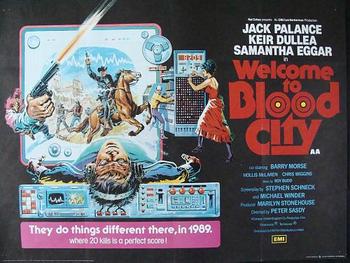
Welcome to Blood City (1977)

Sometimes, I just sit and search through YouTube looking for a movie to watch while I work. Often, that search finds horrible films that I wouldn’t be able to enjoy if I were truly paying attention to them. And sometimes, like with this movie, I end up taking a break from writing and find something I really enjoy.

Directed by Peter Sasdy (The Lonely LadyTaste the Blood of DraculaHands of the Ripper), this film was a UK/Canadian tax shelter affair. But don’t hold that against it! Five strangers all wake up at the same time and have no memories of who they are, other than that they are all killers. They must travel to a Wild West town called Blood City.

Once there, they will spend a year in servitude before they can become free. Then, they’ll be able to own a business and work toward becoming immortal — free from constant worry of challenges to the death. They get there by winning twenty challenges. And there’s only one law in Blood City — Frendlander, played by Jack Palance. It’s no accident that the bad guy from Shane is playing this part. Palance might only be known to younger folks from his Oscar turn in City Slickers, but in the 1970’s he was taking whatever parts he could get. And then he’d sink his teeth into them! He’s fabulous in this movie!


Keir Dullea (Black Christmas2001The Haunting of Julia) stars as Lewis, who finds himself coming up against Frendlander over and over again. The real secret of the film? None of them are in this town at all — it’s a virtual reality simulation to determine the best warriors in a future war. So basically, it’s a combination of WestWorld and The Matrix.

Samanta Eggar (The Brood) shows up as a scientist who falls in love with Lewis and inserts herself into the virtual reality experiment. Barry Morse is also in here, who you may remember as Lt. Philip Gerard from TV’s The Fugitive. And Chris Wiggins is in this as well. He was Jack Marshak on Friday the 13th: The Series.

If you’re looking for this movie, you can find a horrible transfer of it on the Mill Creek Sci-Fi Invasion 50 Pack. That said, the set is pretty worthwhile, as you also get stuff like The Crater Lake MonsterDeath Machines, Sergio Martino’s Hands of SteelHorror High, the Florinda Bolkan film Le OrmeThe Raiders of AtlantisR.O.T.O.R., Robo Vampire, one of the worst/best films ever Rocket Attack U.S.A. and more.

This is totally of the doomed 1970’s genre and the end — where Lewis chooses the fantasy of Blood City instead of the lies of modern life — still ring true today. I completely expected a ripoff of WestWorld and FutureWorld, yet was rewarded with something really good. It’s slow moving, but if you understand that and can see a movie for what it could be versus what it is, I think you’ll enjoy it.

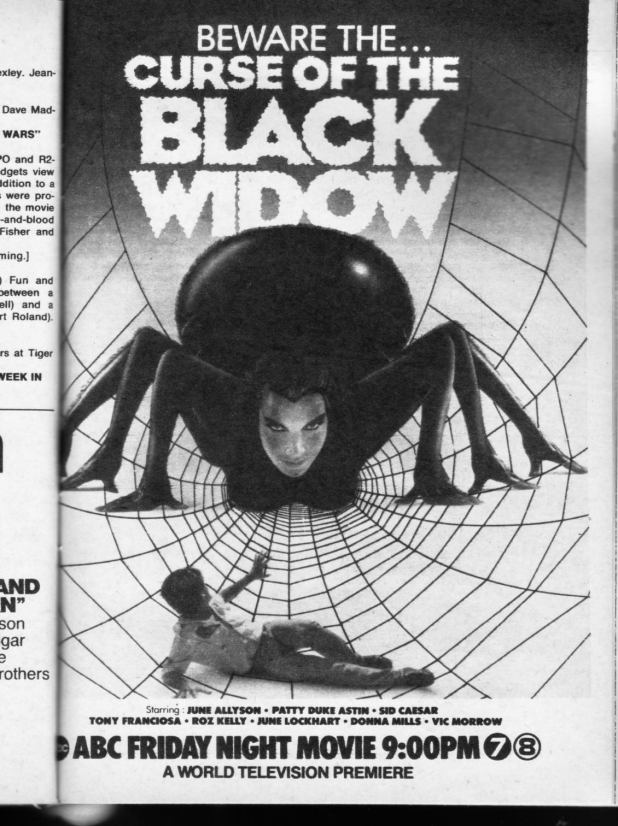
SON OF MADE FOR TV MOVIES WEEK: Curse of the Black Widow (1977)

To end our second week of made for TV movies, Bill Van Ryn from Drive-In Asylum and Groovy Doom is back!

Dan Curtis was responsible for delivering a number of memorable genre productions. Cult TV series “Dark Shadows” is definitely his most successful and enduring endeavor, but he got a couple of other major lobbies into his lengthy career as well. Including being a producer of the original TV film The Night Stalker, he directed the sequel himself, The Night Strangler. Although he wasn’t involved the weekly series that followed, titled “Kolchak: The Night Stalker”, it’s interesting that the rest of the output Curtis was involved in took a similar direction. While “Kolchak” came up with a series of diverse supernatural monsters and threats for its hero to encounter every week, Curtis also gave us a bizarre menagerie of villains and creatures that his characters faced. Perhaps feeling he had exhausted the typical canon of vampires (“Dark Shadows”, House of Dark Shadows, and the TV production of “Dracula” starring Jack Palance) and werewolves (Scream of the Wolf), Curtis relied more and more on invented myths and legends, such as the killer hunting fetish doll that terrorizes Karen Black in TV anthology film Trilogy of Terror.

Curtis didn’t get around to today’s subject at hand, Curse of the Black Widow, until 1977, and even for Dan Curtis, it’s way out there. Just like his other films and programs, Curtis approaches the far-fetched material with great seriousness and realism that could be construed as camp, although this writer would never say that’s a bad thing. The creature that the creators have summoned in this film is a woman who can shape shift into the form of a giant spider. The structure of the movie presents this as a mystery, going through the motions and hoping you don’t notice that Patty Duke is playing a dual role. Duke plays Laura Lockwood, one of two twin sisters who were born when their father crashed his private plane in the desert. They and their mother survived for two days in the wilderness until they were rescued by a Native American. One of the babies had been bitten repeatedly by spiders, which apparently caused her to turn into a giant spider whenever there’s a full moon.

The script has a little fun making it seem as if the spider baby is going to turn out to be Laura’s sister, Leigh (Donna Mills), who also happens to be a romantic interest to the male lead, a private investigator played by Anthony Franciosa. Franciosa gets help with his investigation from a young hopeful he calls “Flaps”, played by Roz Kelly, who apparently could not play any role without her exaggerated New York accent. Franciosa tracks down the guy who discovered the plane crash when Leigh and Laura were babies, now living as a caretaker in one of the family’s abandoned vineyard properties, and there’s some suggestion of Native American mysticism that explains the spider transformation. I did a little research myself, and although there is indeed a spider woman myth, she’s a godlike creature and not a murderous monster that transforms during the full moon.

I don’t feel bad spoiling the fact that Laura is our trans-species mutation, because the film doesn’t do that great of a job disguising it. The script can’t really decide if Laura does or does not know she’s a spider lady; she has mental flashes that reveal snippets of the deaths of her unfortunate victims, but she also seems genuinely bewildered by them, and also of the existence of “Valerie”, an alter-ego she creates by putting on makeup and a wig and speaking with an accent. “Valerie” serves the purpose of frequenting bars and picking up men to serve are victims. The script suggests that she does this as a form of vengeance against men in general, having been victimized by a male rapist in her past. One of the best scenes occurs at the climax, where Donna Mills comes face to face with “Valerie” and somehow does not immediately recognize her as her sister wearing a wig. It seems one of Laura’s transformations had been witnessed by their mother, played by June Lockhart from “Lost In Space”. Lockhart went insane, and for some reason Laura decided to fake the woman’s death and keep her confined to an attic apartment in the family mansion. Leigh is stunned to discover their mother still alive, although once “Valerie” turns into a giant spider again, their mother isn’t alive for much longer.

The weird climax of the film is when we get most of the spider action on camera, and it’s none too convincing. Most shots reveal it to be a motionless prop dangling from wires, although some clever editing almost makes it passable. There’s a lot of creepy atmosphere in this sequence though, which includes Franciosa discovering the spider’s lair with tons of cobwebs and the skeletons of its victims hanging in cocoons.

Curse of the Black Widow plays like an episode of “Kolchak: The Night Stalker” with a different actor as Kolchak. The last film I commented on here was another TV movie, Don’t Be Afraid of the Dark, which was filmed partially at the Piru Mansion in California. Curse of the Black Widow also uses the same house one of the main locations, proving that once a mansion has been cursed with such things as demonic imps, cannibalism (Folks At Red Wolf Inn/Terror House), sexual slavery (Pets), or Robert Wagner (“Hart to Hart”), nothing will ever change that.

Want to hear what Bill, Sam and Becca had to say about Folks at Red Wolf Inn? Listen here: part one and part two

MANGIATI VIVI: Emanuelle and the Last Cannibals (1977)

Legend has it that David Cronenberg for the idea for the torture TV channel that lends its name to his opus Videodrome from this Joe D’Amato film, which is also known as Trap Them and Kill Them. Think of this — a film that upset Cronenberg for its mash-up of snuff, cannibalism and sex. Take it from me. This one totally lives up to its promise. Or lives down. You almost have to appreciate it for how lurid it is, as if it just screams at you, “I am the kind of movie you should feel ashamed for watching.”

First, a history lesson. This film isn’t about the French film Emmanuelle, which starred Sylvia Kristel and had an extra “m” in the title. Nope, that series was made to cash in on the trend and features Laura Gemser, an Indonesian-Dutch actress who is more dark brown than black. But why quibble? This is exploitation filmmaking, after all. The Black Emanuelle films follow the formula of the original, all about a young woman discovering her sexual identity. But I have no idea how they morphed into a series where she becomes an investigative journalist who increasingly discovers more and more depraved behavior. Is there a thin line between swingers clubs and cannibals in the jungle? I would hope that there is. After five increasingly batshit Joe D’Amato vehicles, Gemser teamed with Bruno Mattei for two women in prison movies starring the titular heroine.

It’s really Emanuelle in America that sets up the craziness of these films, as D’Amato casts her up as a journalist that goes from learning how the rich and famous have sex to seeking out a snuff film conspiracy to giving up on journalism altogether when her story gets, well, snuffed.

Somewhere in between that picture and this one, our heroine has had a change of heart and is back in the yellow journalism game.

We start in a New York City mental hospital, where Emanuelle is undercover, looking for a lesbian nurse who is abusing her patients. Her idea of undercover is wearing lots of makeup and carrying around a stuffed animal. And how does she get her info? Well, once she learns about a girl who was raised by the Apiaca, a tribe of cannibals thought to be lost, she meets the girl and has sex with her. We realize this girl is a cannibal when she bites a girl’s nipples off within her first minute of screen time. That’s the kind of movie this is, one where the heroine makes out with a girl who just ate a piece of someone’s tit.

Again — I’m warning you. You’re in for some real scum here.

She contacts Professor Mark Lester (Gabriele Tinti, husband of Gemser who also appeared in Enter the Devil and Lisa and the Devil), a curator at the National History Museum, and gets him to join her on a visit to the Amazon. How does she convince him? Well, she has sex with him. Come on. Get with the program.

They’re also joined by several others, including Isabel, MacKenzie (Donald O’Brien, Dr. Butcher, M.D.), Sister Angela and Maggie (Nieves Navarro, All the Colors of the Dark).

The film alternates between Emanuelle in danger and Emanuelle having sex. There’s a scene that defies logic with Emanuelle and Isabel making out while a monkey steals their cigarettes, lights one up and watches. Yes. A real, honest to goodness monkey.

Look — if there’s one thing I’ve learned from watching cannibal films. most of the white folks aren’t on the straight and narrow. MacKenzie is really after some diamonds and his wife, Maggie, is just here to sleep with the natives.

Soon, much like Shakespeare — if the bard had dared to make a film that combines a Cinemax After Dark film and an Italian gutmuncher — everyone dies except Isobel, Lester and our girl. She covers her body with tattoos — pay attention, Dr. Butcher, M.D. — and convinces the natives that she is a goddess. Everyone escapes on a rubber raft and gets over it, surely after plenty more sex.

Trivia note: American hardcore band Trap Them take their name from this film.

Gemser would become a costume designer after acting, working on several films, including Beyond DarknessQuest for the Mighty Sword and Door to Silence. She also created the most demented costumes ever for the movie Troll 2. And she also was responsible for this, which I found thanks to the Found Footage Festival:

Emanuelle and the Last Cannibals isn’t the kind of adult film that’ll get you in the mood, unless you’re a maniac. But when you get bloody peanut butter and sexy chocolate together, you get a movie that should not, cannot and yet does exist.

After all of that, if want to watch Emanuelle and the Last Cannibals for yourself, Shudder has it right here. Even better, Severin has just re-released this on blu-ray with all the attention that it deserves. Make that more than deserves.

Feed Shark

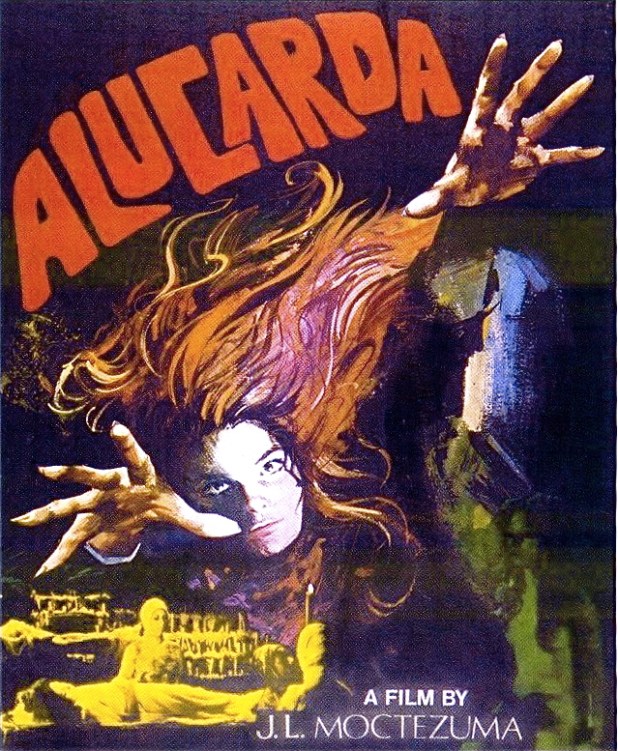
Alucarda (1977)

Alucarda is:

A 1977 nunspolitation/vampire/Mexican horror/Exorcist inspired film about two girls who become possessed by Satan.

The source of many My Life with the Thrill Kill Kult samples, specifically the song “And This Is What the Devil Does.”

A movie filled with so much screaming, it upset my dog.

All of the above and so much more.

Juan López Moctezuma, the director of the film, was close with Alejandro Jodorowsky (some claim he was behind the camera for El Topo). So you should expect something much stranger than your average horror film.

In a Mexican convent and orphanage, a new girl named Justine arrives. She becomes close with another orphan named Alucarda, who was born in a mysterious barn and may be evil before this film even starts. In fact, she often appears in the film out of the shadows, filled with menace and questioning everyone’s faith.

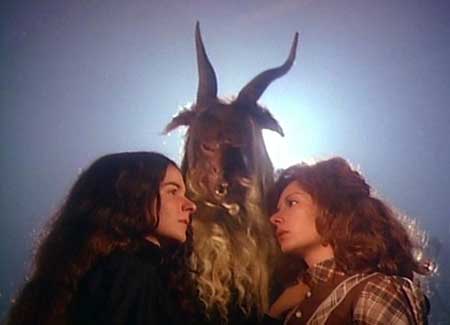
While the two girls — whose relationship is nearly sexual — play in the forest, they discover a band of gypsies and the barn where Alucarda was born. Then, of course, they open a casket and unleash Satan, who possesses them. They take part in an orgy where the literal goat-headed one himself shows up, which is only stopped when Sister Angélica prays for Jesus to intervene. The witch conducting the ritual is struck down in bloody fashion.

A title card comes up telling us that this is the end of part one. I stood up and cheered. I was home alone.

Justine and Alucarda start questioning every mass and even praise Satan out loud, questioning the faith of every member of the convent. Father Lazardo demands an exorcism, one that costs Justine her life. Alucarda is saved at the last moment by Dr. Oszek (Claudio Brook, who also appeared in Del Toro’s Cronos and who also plays the hunchback who leads the women into the forest). Now, Alucarda has a new love interest, the Doctor’s daughter Daniela.

Alucarda isn’t done. She must have her revenge. She possesses a nun and sets her on fire. Father Lazardo beheads her and the entire monastery must self-flagellate to prepare themselves to fight Satan.

Justine’s body is gone — it’s in the barn where Alucarda was born. When they open it, it’s filled with blood and she emerges, now a vampire. While Alucarda kills everyone else. Sister Angélica attempts to save Justine. The doctor tries little spurts of Holy Water but it’s not enough. He barely escapes with his life, while the sister pays the ultimate price. Only Angélica’s dead body can stop Alucarda, who screams and disappears.

You know how I get evangelical about movies? Well, Alucarda is one of them. From the sets to the clothes to the acting to sound design to the just plain weirdness of it all, there’s never been a movie quite this weird. And with the movies I’ve seen, that’s an achievement.

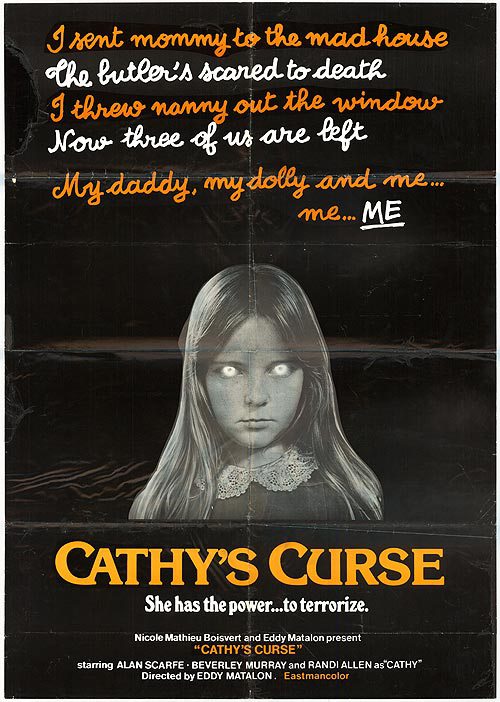
Cathy’s Curse (1977)

How do Canadian little girls act when they’re possessed? Well, they stop being polite, for one thing. Let’s get right into the batshit insanity of Cathy’s Curse.

Back in 1947, a man learns that his wife has left and taken their five-year-old son, George. His daughter, Laura, is a crying mess, but her father yells that, “Your mother is a bitch! She’ll pay for what she did to you!” They race out into the snow and narrowly miss hitting a white rabbit. The car crashes and they burn to death.

Fast forward a few decades. When George grows up, he moves back into his family home with his clinically insane wife Vivian and daughter Cathy. George is really happy that Cathy is adjusting so well, which upsets his wife, because he always judges how crazy she is.

Well, Cathy isn’t doing so well. She sees Laura’s face — the girl we saw die in the beginning — in the mirror and has started to play with the dead girl’s doll. When anyone tries to take the doll, she throws her cereal across the room, to which the maid answers, “Don’t worry about it!” No. Much like The Babadook and Manhattan Baby, the majority of these supernatural kid problems come down to bad parenting.

Basically, this movie is a collection of Cathy doing crazier and crazier things, like getting neighborhood kids to re-enact the car crash that started the film, which includes making young boys say things like, “All women are bitches.” Then she tries to stab a girl’s eyes out.

Then she throws a maid out the window in a scene that has nothing to do with The Omen.

There’s also a medium who shows up just to hang out and see the past through a photograph, yelling out moments of the car crash. Because you know, that’s what you do when ladies lunch. She keeps coming back to try and stop Cathy, but the first time she’s scared off when the little girl is rude and calls her an old bitch and a fat whore. This being Canada, one can see how that level of improper behavior could scare off anyone. But she comes back a third time and Cathy conjures another old woman — a power she only uses once in the film — who refers to her as “not a medium, but an extra rare piece of shit.” If you think I haven’t used this line in casual conversational already, you don’t know me very well.

The handyman agrees to watch her, but she keeps making him drink. Then, she kills his dog. Really, if you’re a handyman in a possession film, your life is going to be ruined. I’m going to film a tender side story dealing with how a handyman gets over the impact of a possessed child. It’ll be a drama and totally realistic, but at its heart, it deals with a supernatural event. Everything — all the grief and the stages of dealing with it — will be real. Except, you know, the possession scenes. I smell Oscar.

Cathy’s powerset is never clearly defined. She can teleport. She can become other people. She can change her voice. She can shake, smash, move and explode objects. She can make food go bad just by looking at it! What else can she do? Oh Cathy!

That said — the reason why Laura’s ghost possesses Cathy is never really defined either. Does she want to get back at George? Does she want to be alive again? Does she want Cathy to die when she tries to drown her? Does she want to kill Cathy’s mom? You’ll wonder, too! Oh Laura!

Even the ending makes no sense!

So you’d think I hated this movie. No. I loved it. I fucking loved it. It has no establishing shots. Characters and subplots float in and out and are never referenced again. The acting is amateurish at best. None of this matters to me. The fact that a seven-year-old girl has glowing eyes and a filthy mouth and is out to kill people makes me filled with joy.

For years, Cathy’s Curse only existed in the most beat-up of prints. Leave it to the folks at Severin to clean it up, get a director’s cut and interviews with the folks that made it. It’s like watching a whole new movie. If you’ve only seen the beat up orange tinted prints on YouTube and on Mill Creek multipacks, you’re in for a surprise. I love that Severin spent so much time making a movie that so few people know into such a great looking preservation.

You can find it here and trust me, this isn’t an ad. Their attention to detail, packaging and extras for such an unknown release is just awe-inspiring!