Infra-Man (1975)

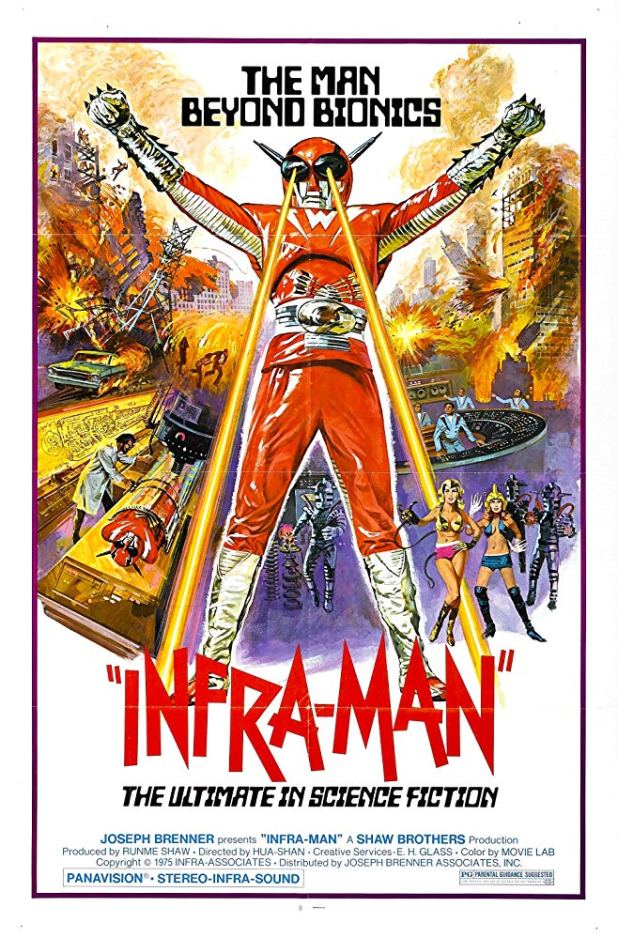
Inspired by the huge success of the Japanese superhero versus monster fare such as Ultraman and Kamen Rider in Hong Kong, the Shaw Brothers produced the first Chinese superhero in 1975, which they called Infra-Man. However, they pushed the envelope created by the Japanese even further, inventing a world where a school bus can crash, Hong Kong can be destroyed, an earthquake can happen and monsters appear all within the first minute of the film.

Let me see if I can summarize the blast of pure odd that I just watched at 5 AM: Princess Dragon Mom (known in the original version of this film as Demon Princess Elzebub) is a ten million-year-old mother of monsters who wants to destroy the Earth. She carries around a whip and has a dragon head on her hand, but can also turn into a monster herself. She also has an entire legion of beasts ready to do whatever she asks, like her assistant She-Demon (Witch-Eye in the original), who is an Asian girl with a hand that has an eyeball in the middle of it. Also: both of these ladies wear metallic bikinis with skulls all over them and have several costume changes. They also have an army of cannon fodder dressed in skeletal costumes, which was obviously the influence for the Skeleton Crew in the new episodes of Mystery Science Theater 3000.

They’re battling with Science Headquarters, led by Professor Liu Ying-de. He’s used the BDX Project to transform Lei Ma (Danny Lee, The Killer) into the bionic kung-fu kicking motorcycle riding Infra-Man, who has whatever powers he needs for any situation. He’s also really good at getting tall and stepping on monsters until their green blood pours out. Bruce Lee tribute actor Bruce Le also appears as Lu Xiao-long, another member of the team.

You get all manner of monsters in this one — the Emperor of Doom, the Giant Beetle Monster, an Octopus Mutant, the Driller Beast, a Laser Horn Monster and the Iron Fist Robots. All of them are given to dramatic pronouncements, overacting and blowing up real good.

Believe it or not, Roger Ebert said, “When they stop making movies like Infra-Man, a little light will go out of the world.” Twenty-two years later, he went even further: “I find to my astonishment that I gave Infra-Man only two and a half stars when I reviewed it. That was 22 years ago, but a fellow will remember a lot of things you wouldn’t think he’d remember. I’ll bet a month hasn’t gone by since that I haven’t thought of that film. So, in answer to those correspondents who ask if I have ever changed a rating on a movie: Yes, Infra-Man moves up to three stars.”

He’s right — this movie is completely unhinged, with dragon witch women who threaten to throw little girls down volcanos, blotting out the sun and rocket fists. They should have made five thousand sequels to this.

You can watch this on Amazon Prime.

The Killer Must Kill Again (1975)

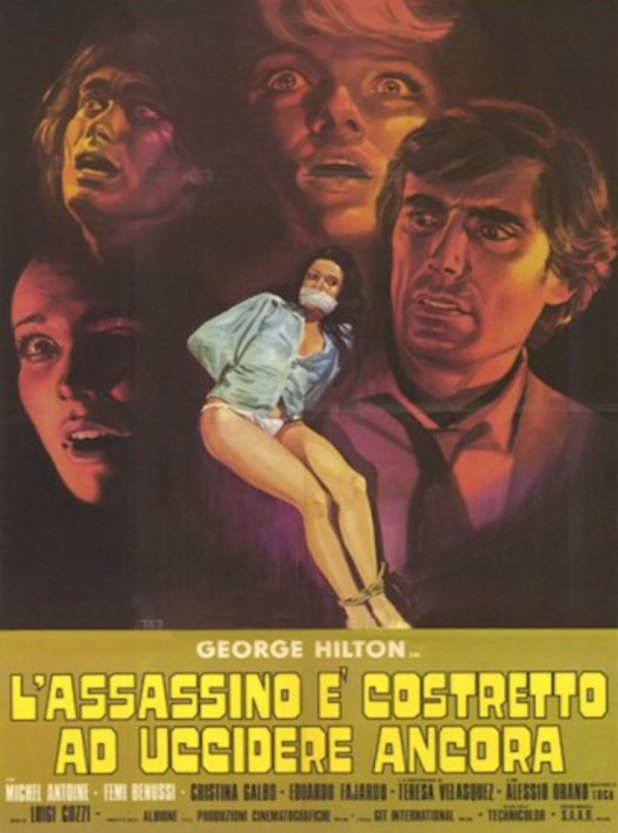
Luigi Cozzi is well thought of around these parts for his less down to the planet Earth fare like Hercules, Star Crash and Alien Contamination. However, his giallo experience exists, as he was the writer of Argento’s Four Flies on Grey Velvet. He contributed to other Argento projects throughout his career, like the special effects for Phenomena and second unit direction for The Stendhal Syndrome. He even co-owned and managed Argento’s memorabilia store, Profondo Rosso (Deep Red). Here, he brings us the tale of an adulterous man who uses a murderer to solve all of his life’s problems.

https://www.dailymotion.com/video/x56pj41

George Hilton (Sartana’s Here… Trade Your Pistol for a Coffin, The Strange Vice of Mrs. Wardh) plays a man who wants to take care of his wealthy wife. He ends up meeting an unnamed killer who is disposing of his latest murder (he’s played by Antoine Saint-John, who played Schweick, the artist who starts the events of The Beyond). They strike a deal where the killer will erase the wife and make it look like a kidnapped. That said — nothing is ever that easy.

As he’s loading Nora’s body in the trunk, Luca and Laura (Christina Galbo, The Living Dead at Manchester MorgueWhat Have You Done to Solange?) steal the car and head to the beach. The killer gives chase as they take up at an abandoned seaside house, as Luca plans on taking her virginity. She keeps putting him off, sending him out to get food while the killer sneaks in.

As the killer makes his way closer to Laura, Luca is making time with a stranded and sexed up motorist played by Femi Benussi from Strip Nude for Your Killer and Hatchet for the Honeymoon. This is an absolutely bonkers segment, as the killer attacks our heroine to somber music while a happy ditty plays as her boyfriend cheats on her, unaware what horrors are going on inside that beach house.

Every man in this movie is either a moron or a complete villain. The same can be said for most of the women, except they’re victims, too. Luckily, Laura finds it within herself to stop this cycle of madness.

This film doesn’t really follow all of the giallo conventions, but that’s just fine. It keeps moving and by the end, I was gripped as the many webs of the store all drew together. Indeed, it has an alternate title of The Spider (I saw it as The Dark is Death’s Friend). Cozzi does a nice job of building the suspense and presenting Laura as less of a faceless victim and more of a proto final girl that you want to see survive.

TABLOID WEEK: Mysteries from Beyond Planet Earth (1975)

George Gale has mostly worked as a post-production guy, but he also produced and directed two strange 1970’s Fortean documentaries, Mysteries from Beyond Planet Earth and Are We Alone in the Universe? Narrated by character actor Lawrence Dobkin, this movie pretty much hits every single theory in its 94-minute whirlwind of info.

Your host stays calm through it all as we rush past every single theory anyone has ever had about anything, basically.

UFOs, Atlantis and Cayce talking about Atlantis? We’ve got that.

Planes getting lost in the Bermuda Triangle? Sure.

Telepathy, ESP, firestarters, Kirlian photography that captures auras and plants being able to communicate? Sure, we can talk about that.

But wait! Do you have time to talk about witchcraft and Satanism, including a Black Mass? Of course. And then we’ll have to speak about the Hollow Earth, Bigfoot, black holes, genetic engineering, clones, freezing people and maybe we’ll even get to aliens again. How much time do we have left?

This is a movie that from its very tagline asked, “What is the message from beyond the stars, which has been kept secret from our world until now?” Indeed. What is that message? Or messages?

This one is bought to you by American National Enterprises, who also blessed us by distributing SheIronmasterEndgameEncounter with the Unknown and more. These guys had taste. None of it good. All of it amazing.

You can get this piece of 70’s strange from Cult Action.

Autopsy (1975)

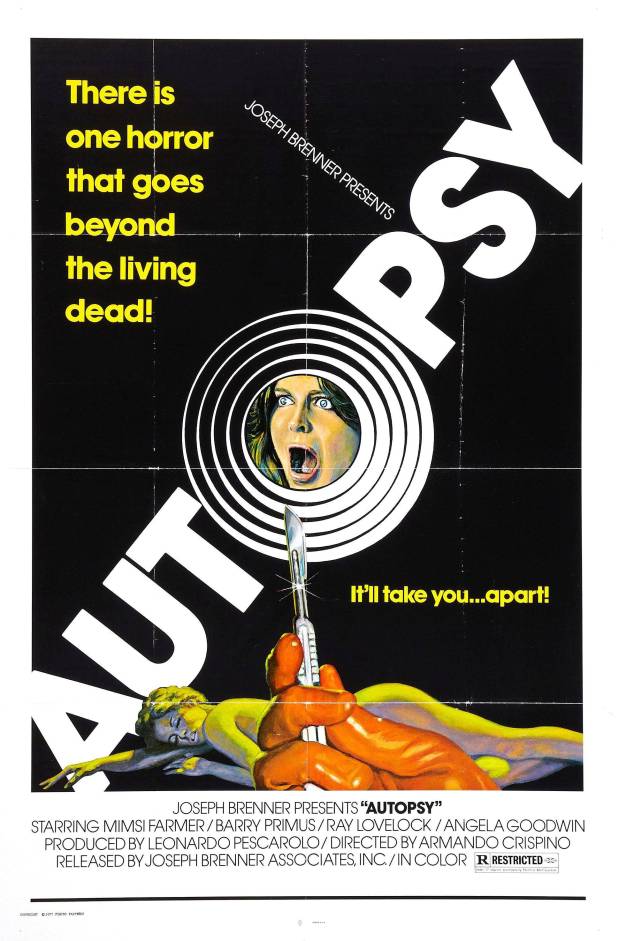
Armando Crispino really only did two horror films, 1972’s The Dead Are Alive and this 1975 giallo, which is a shame, as this is a pretty decent entry in the genre. Known in Italy as Macchie Solari (Sunspots), it does indeed feature sunspot footage from space before we see any major murders. And if you’re looking for a movie packed with autopsy footage, good news. It totally lives up to its title.

Simona Sana (Mimsy Farmer, who is also in Argento’s Four Flies on Grey Velvet and The Perfume of the Lady in Black) is a pathology student who is trying to work on a theory about suicides, one that’s disputed by a young priest, Father Paul, whose sister — Simona’s dad’s latest fling — has recently killed herself. It turns out there’s been a whole series of self-killings which are being blamed on, you guessed it, sunspots.

I mean, what can you say about a movie that starts with several of said suicides, like sliced wrists, a self-induced car explosion and a man machine gunning his kids before turning the gun on himself? Obviously, this is a rather grisly affair, with real corpse photos spread — quite literally — throughout the film.

In between all of the gore, corpse penises, two bodies falling to their deaths and crime museums, there’s also Ray Lovelock (The Living Dead at Manchester Morgue) as Simona’s boyfriend, an out there Morricone score and a heroine who hallucinates that the dead are coming back to life.

The plot gets pretty convoluted, but if you’re on this site, you obviously appreciate films like this and will get past it. This is an Italian 70’s murder movie, though, so if you get easily upset about the way men behave, well, be forewarned.

You can watch this on Amazon Prime.

Keep My Grave Open (1977)

I’d love to have heard what people in the 1970’s felt like when they encountered a movie from S. F. Brownrigg at the drive-in. Something like Don’t Look in the BasementScum of the Earth or this truly inspiringly strange affair, a movie that riffs on Repulsion while presenting a woman who is in the grips of madness — or maybe not.

Leslie Fontaine (Camilla Carr) lives in a mansion with her husband Kevin — or maybe she doesn’t or maybe Kevin is her brother, this movie isn’t going to give you any easy answers — who is locked in their bedroom and doesn’t want to make love to her, no matter what she does. Finally, she allows herself to seduce a local teenager — a scene that is the Wikipedia definition of awkward — before “Kevin” emerges and kills the guy with a saber.

Everything proves that Leslie and Kevin are the same person, but at the end, after she consumes pills and broken glass in equal measure, we see her funeral. And Kevin’s there, ready to move into the mansion. There’s no explanation at all for this, but I’m not certain there’s one that will suffice.

I’ve often discussed that the difference between a film seen as art and one seen as exploitation really comes down to the theater that shows the film. This is a movie that aspires to the former while emerging from the muck of the grindhouse and drive-in, a burst of strangeness even amongst the other movies that it would play with.

You can watch this on Amazon Prime.

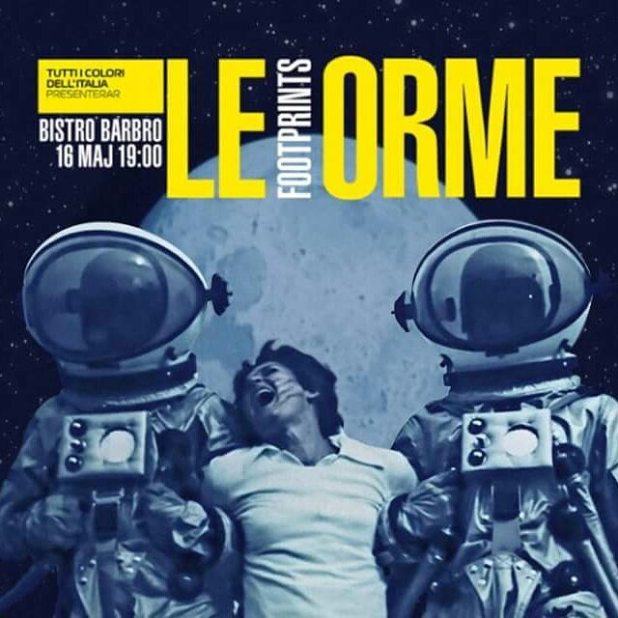
Footprints on the Moon (1975)

Alice Cespi (Florinda Bolkan, A Lizard in a Woman’s Skin) watched a strange film in her childhood called “Footprints on the Moon,” where astronauts were stranded on the moon’s surface. Now, as an adult, the only sleep she gets is from tranquilizers and she starts missing days of her life. Get ready for a giallo that skips the fashion and outlandish murders while going straight for pure weirdness.

After losing her job as a translator, Alice find a torn postcard for a resort area called Garma. That’s where she meets a little girl named Paula (Nicoletta Elmi, DemonsA Bay of Blood) who claims that Alice looks exactly like another woman she met named Nicole, who is also at the resort. Slowly but surely, our heroine starts to believe that a huge conspiracy is against her.

This is the last theatrical film of Luigi Bazzoni (he has directed some documentaries and wrote a few films since), who also directed The Fifth Cord. There are only two murders, but don’t let that hold you back. There are also abrupt shifts in color and a slow doomy mood to the entire proceedings. It’s unlike any other giallo I’ve seen and I mean that as a compliment.

Klaus Kinski also shows up as Blackman, the doctor who was behind the experiment that Alice saw as a child. He’s only in the film for a minute or so, but he makes the most of his time, chewing up the scenery as only he can. And cinematographer Vittorio Storaro, beyond working on The Bird with the Crystal Plumage, also was the DP on films like Apocalypse Now, RedsLast Tango in Paris and Dick Tracy.

Shameless Films, who are the folks to order this from, referred to it as “the loneliest, most haunting and beautiful giallo you will ever see.” I have to agree — especially with its shocking ending. This isn’t like any of the films that came in the wake of The Bird with the Crystal Plumage and it’s a shame that its director didn’t make more films in the genre.

CHILLING CLASSICS MONTH: Sunburst (1975)

Sometimes the Chilling Classics rewards you with magic. Other times, it assaults you with a film like Sunburst, also known as Slashed Dreams.

Robert (Peter Hooten, the original Dr. Strange) and Jenny (Katharine Baumann, The Thing with Two Heads and now a handbag creator) are going up to the woods to find their friend, Michael (Robert Englund), who has left the world of capitalism behind for a simpler one in the woods.

Once they’re up there, they run into one of a store owner played by Rudy Vallee. In his era, Vallee was one of the biggest teen hearthrobs ever. Here, he’s singing and trying to sell our protagonists a knife. You can also see Vallee in The Phynx and Michael Winner’s strange family film, Won Ton Ton, the Dog Who Saved Hollywood. Seriously, if you’re a fan of old Hollywood, that movie has so many cameos that your head will spin.

Anyways, while skinny dipping, two hooligans (James Keach and David Pritchard, the writers of the film) attack Robert and rape Jenny. Michael saves them, then Robert has a mudwrestling fight with the two men, who run away. Jenny reads a poem from Khalil Gibran and…that’s the end of the movie.

To no surprise, this slice of 1970’s post-hippie weirdness comes from James Polakof, who was also behind the lost woman in the 1970’s trying to make sense of it all by having sex with the devil movie Satan’s Mistress.

To make matter worse — or better — the film features seven songs by Roberta Van Dere, including one titled “Animals Are Clumsy Too” and “Theme from Sunburst.” Actually, best of all, the version of this film on the Chilling Classics set has a video effect over the Sunburst title, replacing it with a keyed out box and the words Slashed Dreams.

Why a movie about Deliverance-esque hillbillies raping and attacking a couple ala Straw Dogs needs a legendary jazz crooner and numerous Carol King sounding songs is beyond me. I met James Keach once, as his son’s band (he was once married to Jane Seymour) was playing a benefit for the charity my agency did work for. If only I had seen Sunburst, because I would have driven him insane asking a million questions about this movie. Or maybe he would have loved the fact that someone had actually seen it.

You can get this in the set or pick up all on its lonesome from Cheesy Flix.

CHILLING CLASSICS MONTH: Deep Red (1975)

Deep Red is one of the few Argento movies that I’ve seen in a theater. I’m not sure what the audience expected, as it was on what was presented as a grindhouse night. I think they wanted something like the modern interpretation of the term, all fast moving action and laughs. I don’t think that many of them were happy with what they got from this film — a movie that started with a 500-page script that even Dario Argento’s family felt was too cryptic and continues with not just one, but two references to American painter Edward Hopper. This isn’t just a movie about murder. This is a movie that transforms murder into art.

The movie begins at Christmas, as two shadowy figures battle until one of them stabs the other. Screams ring out as a knife drops at the feer of a child.

Fast forward to Rome, as a medium named Helga Ulmann is conducting a lecture about her psychic powers. Within moments, she senses that one of the people in the theater is a killer. Later that night, that killer kicks in her front door and murders her with a meat cleaver (which is probably why this movie got the boring American title of The Hatchet Murders).

British musician Marcus Daly (David Hemmings, BarbarellaBlowup, Harlequin), who fits the giallo mold of the stranger in a strange land thrust into the middle of a series of murders that he must solve, is returning home from drinking with his gay best friend Carlo (Gabriele Lavia, Beyond the DoorInferno) when he sees the murder that we’ve just witnessed from the street. He runs to save Helga, but she’s thrust through the window and her neck is pierced by the broken glass of her window in a kill that has become Argento’s trademark.

As he tells the police what has happened, he notices that a painting on Helga’s wall is gone. That’s when Gianna Brezzzi (Argento’s wife at the time, Dario Nicolodi, who met him during the filming of this movie) takes his photo, which ends up on the cover of the newspaper the very next day.

Unlike most giallo women, Gianna is presented as more competent and even stronger than our hero — she sits high above him in her Fiat 500 and continually bests Marcus every time they arm wrestle.

Marcus isn’t your typical hero, though. When the killer attacks him, he doesn’t stop them by daring or skill. He locks himself in his study to escape them. He does remember the song the killer played — we also have heard it when Helga is murdered — that psychiatrist (and Helga’s boyfriend) Professor Giordani believes is related to some trauma that motivates the killer.

Feeling guilty that she’s caused the killer to come after Marcus, Gianna relates an urban legend of a haunted house where the sounds of a singing child and screams of murder can be heard. The truth lies in House of the Screaming Child, a book written by Amanda Righetti, which tells the truth of the long-forgotten murder. Marcus and Gianna would learn even more, but the killer beats them to her house and drowns her in a bathtub of scalding hot water (directly influencing the murder of Karen Bailey in Halloween 2). As she dies, the writer leaves a message behind on the wall, which our heroes find. They’ve already assumed the investigation — again, in the giallo tradition — and think the police will assume that Marcus is the murderer, so they don’t report the crime.

Marcus follows the trail of the killer from a picture in the book to the real house, which has been abandoned since 1963. As he searches the home, he uncovers a child’s drawing of a murdered man and a Christmas tree, echoing the flashback that starts the film. Yet when he leaves the room, we see more plaster fall away, revealing a third figure.

Marcus tells his friend Carlos all that he’s learned, but his friend reacts in anger, telling him to stop questioning things and to just leave town with his new girlfriend. At this point, you can start to question Marcus’ ability as a hero — he misses vital clues, he hides instead of fighting and he can’t even tell that someone is in love with him.

Professor Giordani steams up the Righetti murder scene and sees part of the message that she left on the wall. That night, a mechanical doll is set loose in his office as the killer breaks in, smashing his teeth on the mantle and stabbing him in the neck.

Meanwhile, Marcus and Gianna realize that the house has a secret room, with Marcus using a pickaxe to knock down the walls, only to discover a skeleton and Christmas tree. An unseen person knocks our hero out and sets the house on fire, but Gianna is able to save him. As they wait for the police, Marcus sees that the caretaker’s daughter has drawn the little boy with the bloody knife. The little girl explains that she had seen this before at her school.

Marcus finds the painting at the young girl’s school and learns that Carlo painted it. Within moments, his friend turns up, stabs Gianna and holds him at gunpoint. The police arrive and Carlo flees, only to be dragged down the street and his head messily run over by a car.

With Gianna in the hospital and his best friend obviously the murder, Marcus then has the Argento-esque moment of remembering critical evidence: there’s no way Carlo could have killed the psychic, as they were together when they heard her screams. The portrait that he thought was missing from the apartment was a mirror and the image was the killer — who now appears in front of him.

The real killer is Martha (Clara Calamai, who came out of retirement for this role, an actress famous for her telefoni bianchi comedy roles), who killed Carlo’s father in the flashback we’ve seen numerous times after he tried to commit her. She chases Marcus with a meat cleaver, striking him in the shoulder, but he kicks her and her long necklace becomes caught in an elevator which beheads her. The film ends with the reflection of Marcus in the pool of the killer’s blood.

While this film feels long, it has moments of great shock and surprise, such as the two graphic murders that end the film and the clockwork doll. The original cut was even longer, as most US versions remove 22 minutes of footage, including the most graphic violence, any attempts at humor, any romantic scenes between David Hemmings and Daria Nicolodi, and some of the screaming child investigation.

This is also the first film where Argento would work with Goblin. After having scored Argento’s The Five Days — a rare comedy —  Giorgio Gaslini was to provide music for the film. Argento didn’t like what he did and attempted to convince Pink Floyd to be part of the soundtrack. After failing to get them to be part of Deep Red, Goblin leader Claudio Simonetti impressed the director by producing two songs in one night. They’d go on to not only write the music for this film, but also for plenty of future Argento projects.

A trivia note: Argento’s horror film museum and gift shop, Profondo Rosso, is named after the Italian title to this movie.

Deep Red is the bridge between Argento’s animal-themed giallo and supernatural based films. While its pace may seem glacial to modern audiences, it still packs plenty of moments of mayhem that approaches high art.

Want to see it for yourself? Sure, it’s on the Chilling Classics set, but for the best possible home experience, get the Arrow Video blu ray. You can also stream Deep Red on Shudder and Amazon Prime for free with your membership.

2018 Scarecrow Psychotronic Challenge Day 14: The Four of the Apocalypse…(1975)

Day 14 of the Scarecrow Psychotronic Challenge is Westerns. Hats and boots are a must on this trail, y’all. Yeehaw! I chose Lucio Fulci’s Four of the Apocalypse…, which was made years before he became known as the Godfather of Gore.

Salt Flats, Utah. 1873. Professional gambler Stubby Preston (Fabio Testi, Contraband) is arrested the moment he steps off the stagecoach, thwarting his plans to win money from the town’s casino. It turns out that he’s actually lucky, because the town has become a vigilante mob that burns that den of iniquity to the ground, leaving only Stubby and three other criminals alive: Bunny (Lynne Frederick, Phase IV), a pregnant prostitute, a black man named Bud and the alcoholic Clem (Michael J. Pollard, Bonnie and Clyde).

The four are given safe passage out of town by the sheriff, who gives them a wagon and horses for all of their remaining money and possessions. Soon, they are traveling with a Mexican gunman named Chaco (Tomas Milian, Don’t Torture a Duckling) who saves the group from lawmen, only to torture one of the remaining lawmen in front of the group.

Nevertheless, everyone agrees to take peyote together. The four wake up tied up as Chaco (Milian claims he based his performance on Manson) taunts and beats them, shooting Clem and raping Bunny in front of the entire group.

There have been rumors for decades that Frederick and Testi were having an affair during this film. Testi was dating Ursula Andress at the time, who was incredibly jealous. Some evidence is that even when Frederick’s scenes were all wrapped, the two actors improvised scenes that would include the two of them, including a love scene that has been lost. During the aforementioned rape scene, Milian was so into character and so rough that Testi’s reaction in that scene is real.

The four manage to get the gravely injured Clem onto a makeshift stretcher and follow Chaco and his gang as they kill everything in their path. Finally, they find a ghost town where Clem dies, Bud loses his mind and Stubby and Bunny admit that they love one another — just in time for her to die in childbirth and Stubby to leave her son to a town made up of only men.

Stubby hunts down Chaco, learning that the sheriff set up the events of the entire movie. Enraged, he murders every single person there, leaving Cacho alive so that he can torture him. When Chaco reminds him that he raped Bunny, Stubby shoots him without a word, as he walks into the sunset with only a stray dog as a companion.

Four of the Apocalypse… is influenced by Easy Rider and attempts to offer up a journey of redemption, but you have to understand that Fulci is at the helm. That means that as soon as you have a tender, feel-good moment, you’re going to be given moments of pure gore, like people skinned alive or used for food. Yet there’s also art to be found, thanks to Fulci’s first of ten collaborations with cinematographer Sergio Salvati. It’s also the first time Fulci would work with Fabio Frizzi on the soundtrack. The result is unlike anything you’ve heard in a spaghetti western.

2018 Scarecrow Psychotronic Challenge Day 8: Eyeball (1975)

The Scarecrow Psychotronic Challenge for today is THE EYES HAVE IT. This pick must have an eye specific scene. I’ve already covered the granddaddy of all eye torture, Fulci’s Zombi, as well as his other paean to ocular decimation,The New York Ripper. There’s also Demonia, where nuns eat a dead baby’s eyeballs. And Cat in the Brain, with a whole plate of eyeballs. Oh, Fulci. You do love seeing the eyes get killed, as they have seen so much.

I already hit Dead and Buried, which has an eyeball impalement that upsets many. And Lamberto Bava’s Demonia, where a woman looks like a giant eyeball. So that leaves Umberto Lenzi’s Eyeball, where a killer in a red raincoat kills tourists in Barcelona.

It’s time for the creator of GhosthouseNightmare City and Cannibal Ferox to show us how he does giallo (to be fair, he also created Spasmo, Seven Blood-Stained Orchids, Orgasmo,  and So Sweet… So Perverse).

Any of the main characters could be the killer, one with this amazing motive: “I was like you… before this friend of mine ripped out my eye playing doctor with me… leaving an empty socket!” That means with each kill, the killer keeps an eyeball.

Unlike most giallo, the killer is all in red, with red gloves, which is a rarity unless we’re considering The Red Queen Kills Seven Times. Like most giallo, it has the worst cops ever on the case. And for 1975. it’s pretty woke, considering one of the couples is an interracial lesbian duo.

Seeing as how this is a movie with an Italian director and a Spanish crew, you just know that the dubbing is going to be great. Witness this exchange:

“Spanish or Italian, it makes no difference to me. He made a terrible mistake. You don’t think America’s worth all that trouble do you?”

“Oh my God! You’re not a communist, are you?”

That said, I came off really enjoying this. There’s a lot of red highlights hidden in every scene, which for a Lenzi movie is as close as he’s going to get to art. Then again, I tend to love all of his films way more than most people.