Mill Creek Drive-In Classics: Katie Tippel (1975)

“The beauty of [a] Mill Creek box set is discovering a movie that you would otherwise never find.”
— Sam Panico, in his review of fellow the “Drive-In Classics” entry, Throw Out the Anchor

Sure, by way of his string of hits with Robocop (1987), Total Recall (1990), and Basic Instinct (1992), we’re all fans of Dutch writer and director Paul Verhoeven. Then there’s the box office flop that is Showgirls (1995; Golden Raspberry for “Worst Director”) and his (I felt, misguided) fascism-in-space romp, Starship Troopers (1997). While he had a career in the Netherlands dating to the early 1960s, Verhoeven didn’t make his feature film-debut proper until a decade later with the comedy Business Is Business (1971) and the romantic “erotic drama,” Turkish Delight (1973; Oscar-nominated as “Best Foreign Language Film”). Katie Tippel, aka Keetje Tippel, was Verhoeven’s third film prior to his critically-acclaimed, international breakthrough with the romance-thriller Solider of Orange (1977), which introduced the world to Jeroen Krabbé and Rutger Hauer. Both actors came to star in two of Verhoeven’s later international hits, the murder-mystery, The Fourth Man (1983), and the historical adventure, Flesh + Blood (1985), respectively.

It tells the story of Katie (Monique van de Ven, the wife of cinematographer and director Jan de Bont of Speed and Die Hard fame; she made her debut in Turkish Delight), a young girl led into a life of prostitution to help support her impoverished family in 1881 Amsterdam. Based on the memoirs (it’s debated if the story is, in fact, real, made-up, or a patch work of the lives of others) of Dutch-born, Belgium-bred and French-writing Cornelia Hubertina “Neel” Doff, she is remembered as one of the Netherlands’ most important authors. Then noted as that country’s most expensive production, the film became the Netherlands’ number one box office draw of the year. Paul Verhoeven has said that, of all of his films, this is the one that he wants to remake and, in fact, he pulled elements of Katie Tippel into the Joe Eszterhas-penned disaster, Showgirls.

He should remake this film . . . or at least see this though a restoration (well, he did, as we’ll discover). The Mill Creek version does nothing to enhance your appreciation of the film as the version, here, is muddy and the dubbing, awkward. However, as Sam stated: this is a unique, bargain-based introduction to exposing yourself to Paul Verhoeven’s Dutch-language works; a film you would not see, otherwise.

In addition to Mill Creek, Anchor Bay offers a higher-quality, single-disc version — complete with an audio commentary track by Paul Verhoeven. For a deeper dive into that Anchor Bay version, this November 2002 examination by Dale Dobson at Digitally Obsessed will get you there. For another take — in addition to insights on four more of Verhoeven’s Dutch-language works, there’s no review finer than James Newman’s for Images Journal. Of course, Anchor Bay is no more, but used DVDs abound in the online marketplace.

You Tube offers a very clean, subtitled rip from the Anchor Bay version. I never heard of or seen this film (I’ve only gone back as far as Solider of Orange at Roger Ebert’s urging, as I recall) and I enjoyed it. It is, however, a dark, depressing film . . . and hardly a film you’ll snuggle up next to your honey near a crackling speaker and burning mosquito coil. It is also classic Paul Verhoeven: a film rich set design, costuming, and exquisite cinematography.

About the Author: You can learn more about the writings of R.D Francis on Facebook. He also writes for B&S About Movies.

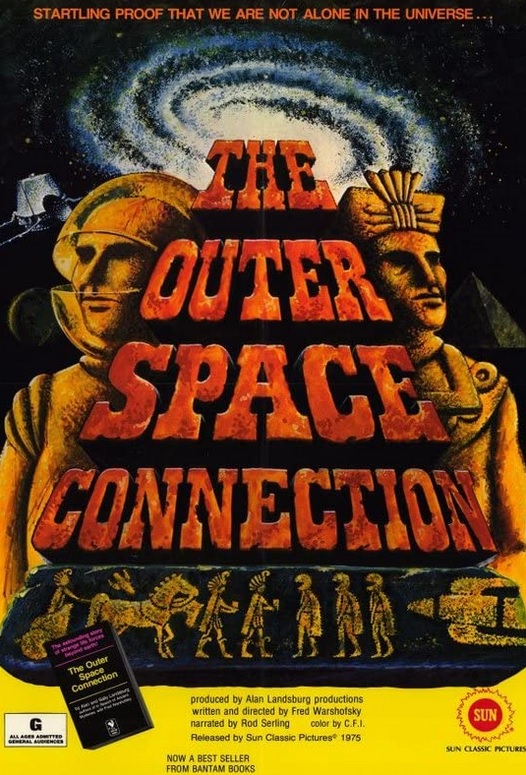
The Outer Space Connection (1975)

Stanley Kubrick, in conjunction with MGM Studios, may have opened the door with with 2001: A Space Odyssey, but Sunn Classics kicked the door down with their Oscar-nominated (Best Documentary Feature), box-office bonanza, Chariots of the Gods? (1970).

Now, U.S. indie studios and Drive-In distributors saw the sci-fi possibilities. Cash-strapped shingles didn’t have to create later, MST3K-lambasted muck jobs like Hammer’s “space western” Moon Zero Two nor meet Roger Ebert-indifference with films such as Universal’s Silent Running. There’s was no sense in trying to create copycat non-starters such as Mission: Mars in Kubrick’s backwash. The pre-Kubrickian productions The Angry Red Planet, Mutiny in Outer Space, Project Moonbase — even the really fine Planet of the Vampires — weren’t cutting it, anymore, for everyone was over the old Martians and space monsters jig.

Now audiences wanted “ancient astronauts”; films that connected UFOs to the Earth’s architectural structures of old. There’s no sense of pulling a Bill Rebane-on-a-shoestring to give audiences the-people-talking-and-drinking-coffee-epics Invasion from Inner Earth, The Alpha Incident or, worse, UFO: Target Earth. We had to wait until Glen “Larceny” Larson gave us his Lucasian-biblical answer to it all with Battlestar Galactica.

Mayan statue? A galaxy? Ticket sold!

Documentaries. That was a genre the cheapjack studios could pull off with self-confidence: insert a talking head here, a fuzzy photo there, a film clip here, some stock footage of Egyptian and Mayan structures there . . . create a poster that oversells the film . . . we have ourselves a science fiction movie on the cheap . . . with profits a guarantee. Cha-ching!

Thou loose the floodgates through Roland Emmerich Stargate.

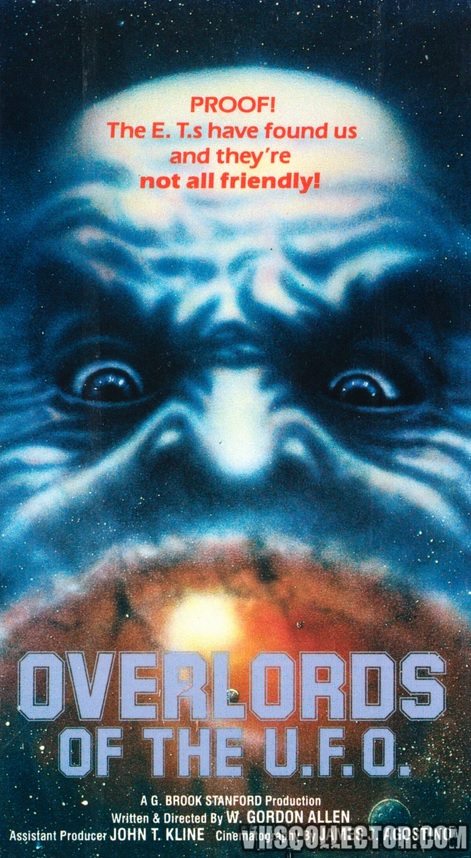
So came forth the box-office mop ups Encounter with the Unknown (1973) and Mysteries from Beyond Planet Earth (1975). And G. Brook Stanford’s own Schick-Sunn Classics-styled document with Overlords of the U.F.O (1976). Film Ventures International jumped into the frey with The Force Beyond (1978). We got docutales about the alien-infested The Bermuda Triangle (1979). Jack Palance and William Shatner, respectively, earned paychecks hosting the films The Unknown Force (1977), which tossed in psychics, miracle healers, and Man’s and the Earth’s untapped energies, while Bill got into the ancient-biblical astronauts game with Mysteries of the Gods (1977). Then there were the even chintzier UFOs: Past, Present, and Future (1974; You Tube), UFO: Top Secret (1978; You Tube), the most psychedelic-tripping of them all: UFO – Exclusive (1979; You Tube), and the forever-lost UFOs: Are We Alone? (1979). However, in the fictitious UFO sweepstakes, there’s the Ezekielian ancient astronaut romps — and Mill Creek box set losers — Escape from Galaxy 3 (1980) and Star Knight (1985) to ponder. . . .

Typical 1970s poster overselling a documentary. Who’s not going to see this? Especially when it’s re-released in a post-Spielberg world.

Amid that rash of films was this superior flick that served as the third project between prolific television producer Alan Landsburg (Terror Out of the Sky, The Savage Bees are two of his many, classic TV movies) and Rod Serling for Sunn Classics. Their other two were In Search of Ancient Astronauts and In Search of Ancient Mysteries, both issued in 1973.

If that pre-Roland Emmerich, upselling theatrical one-sheet connecting Mayan structures to distant galaxies doesn’t tell you: we’re on a speculative journey regarding the “ancient astronauts” theory begun with Chariots of the Gods?. Those were tales that aliens visited Earth in ancient times to built structures to which they will return at a future date. Why and for what reasons are their return? To save man? And, if so, from what catastrophe?

Yeah, this one has it all: All the theories and speculations you’ve since seen many times on A&E, Discovery, and The History Channel with their endless series on the subject. Sure, it’s old news today, but back in the ’70s, woe, baby: this was “groundbreaking” insights that connected the Bimini Wall to Atlantis (build by the same aliens who built the Mayan and Egyptian civilizations), that connected Macchu Picu in Peru as an alien space port, and that a pyramid — larger than the Great Pyramid of Giza, in the deep waters of the Bermuda Triangle — with an “energy stone” in its apex, was responsible for the disappearance of Flight 19. (Remember went Spielberg’s aliens “found” them — and they gave us back the planes?)

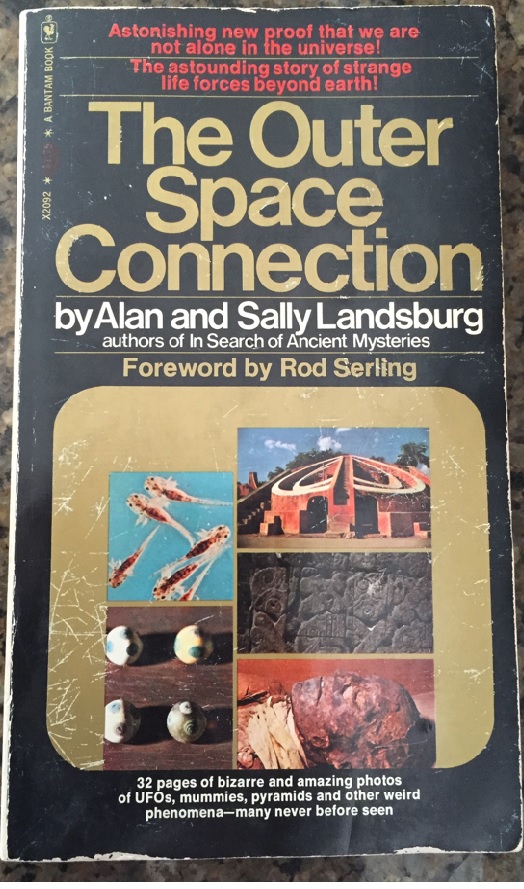
The book that lead to the film. One of its many covers.

If there’s any of the many ancient astronauts/UFO docs you need to watch, always err to the side of the ones narrated by the engaging voices of Jack Palance, William Shatner, Rod Serling, and Orson Wells — and surely watch the Landsburg-Serling trilogy. But definitely double-feature Harald Reinl’s Chariots of the Gods? with The Outer Space Connection. In a race against filmmakers with a UFO fetish, do you go with Alan Landsburg or Ed Hunt (with UFO’s Are Real). Eh, it’s a close one, but Landsburg for the win. And Alan Landsburg kept on going with Secrets of the Bermuda Triangle and a Bigfoot/Yeti exploration known as Manbeast! Myth or Monster? (both 1978).

Yeah, the documentary ’70s were good times. My pop loved these movies and read the books that inspired the films. Good times. And great times to revisit and write reviews on them.

You can watch The Outer Space Connection on You Tube.

About the Author: You can learn more about the writings of R.D Francis on Facebook. He also writes for B&S About Movies.

Mill Creek Drive-In Classics: I Wonder Who’s Killing Her Now? (1975)

You’ve heard Sam and myself rave — as result of his incessant, ’70s and ’80s TV movie work — the wares of Canadian filmmaker Steven Hilliard Stern. From his work with Portrait of a Showgirl (Tony Curtis and Rita Moreno!) The Ghost of Flight 401 (Ernest Borgnine!) and This Park Is Mine (Tommy Lee Jones!), Mr. Hilliard rocked our television sets. Then, in one of his rare, later theatrical works, Rolling Vengeance, well . . . a movie where a man reacts to the death of his wife and children by making a monster truck and killing everyone responsible . . . that’s our kinda movie!

Other entries in Stern’s superior TV movie oeuvre (on U.S. TV and cable; in Canada, they ran as theatrical features) are the James Brolin-starring The Ambush Murders (1982), the pre-stardom Tom Hanks-starring Mazes and Monsters (1982), and the Ned Beatty-starring Hostage Flight (1982).

I know. I know. Stop squeezing the Hilliard Stern toiletries. Get on with the review. . . .

Well, by the time of this not-so-comedy featuring second and third tier comedians, Stern was four films into theatrical features: B.S. I Love You (1971; a sexual revolution comedy starring JoAnna “Isis” Cameron), Neither by Day Nor by Night (1972; a war drama starring Zalman “Red Shoe Diaries” King), and Harrad Summer (1974; more “sexual revolution drama” starring Laurie “Eight Is Enough” Walters) — only Harrad Summer was a box office hit (and also a flop, when compared against the hit status/box office of the previous The Harrad Experiment). So off to TV Steven went, with U.S. series such as McCloud, Quincy M.E., and Hawaii Five-O. Remember when they tried to make Al Pacino’s hit cop flick, Serpico, and Logan’s Run, into TV series: Stern helmed them both.

“Ugh, R.D. The movie at hand, please.!”

Get your own copy as part of Mill Creek’s Drive-In Classics box set.

Okay, well, we have to remember Hilliard’s career is still in its infancy, but he did have a sort-of-hit on his hands with Harrad Summer leading to this . . . maybe if Steven was given a cast of better actors and comedians? And if this — being a “sex comedy” — had some actual (implied) sex or nudity? Ugh, Bob Dishy and Bill Dana (name a ’60s TV comedy), and Vito Scotti (name a ’60s comedy series that needed a Bela Lugosi-ham job), and a young Pat Morita just aren’t funny. No, the gag of Severn Darden’s (the Apes franchise) art collector walking around on his knees isn’t funny.

So, do we blame our TV movie god Steven Hilliard Stern for the out-dated, behind-the-times humor?

Nope.

Blame Mickey Rose, the brains behind the early ’60s Sid Caesar Show, as responsible for the comedic faux pas. And let us not forget the abysmal failures to spin off Tim Conway, Dean Martin, and Jonathan Winters into their own, out-of-date-before-they-made-it-to-air, one-season variety series. But wait . . . this is the same Mickey Rose who gave an assist to Woody Allen with What’s Up, Tiger Lily?, Take the Money and Run, and Allen’s first, runaway hit, Bananas (1971)? It is the same Mickey Rose!

So, what happened with Rose’s spoof of ’40s mafia films: one that plays, not as a film of the ’70s, but as a zany, madcap ’60s comedy, à la 1963’s It’s a Mad, Mad, Mad, Mad World? But perhaps that was Rose’s scripting — and Stern’s — retro-intent? But who — in the post Vietnam ’70s — wants a zany, madcap ’60s throwback?

Was nothing learned from the failed Conway, Martin, and Winters TV series? Well, this sure as hell ain’t a Mel Brooks joint by any stretch of imaginary hopes. Maybe if Peter Sellers — who had to bow out due to a medical issue with his heart — remained as our hen-pecked, embezzler-cum-assassin?

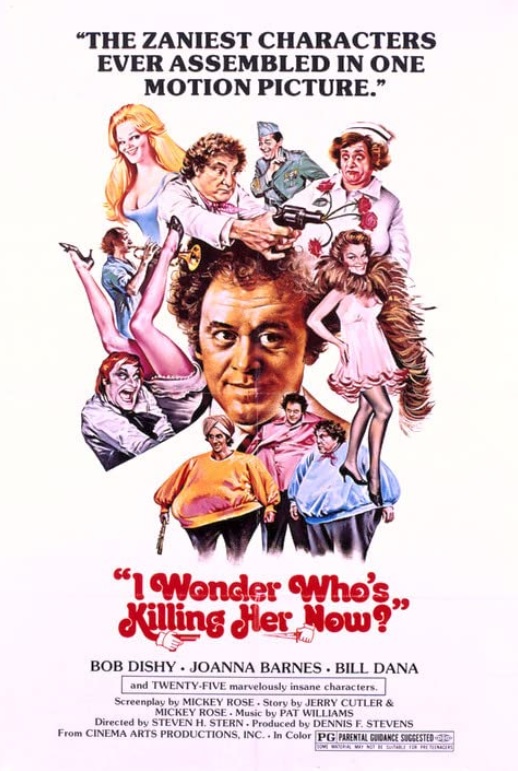
So . . . Jordon Oliver (the awful Bob Dishy in the planned Sellers role) has been fired from his job for embezzlement. His wife wants a divorce. Now, Jordon decides on a insurance scam: take out a million dollar policy and bump off his rich wife (the never-hard-to-gaze-at Joanna Barnes of Spartacus and The Parent Trap). But that means she needs a medical examine — on the q.t. — so Jordon contracts a shady (and offensively-troped) doctor (a young Pat Morita) on the scam. Then, Jordon hires a hitman (Bill “Jose Jimenez” Dana, who, as with Tim Conway, leaves no wonder as to why he was stuck on TV for the remainder of his career). The comedy ensues as our lazy, inept hitman contracted another hitman. And its just goes on and on . . . and it gets sillier and sillier . . . and more groan-inducing with, what seems, the ad-libbed dopiness of desperate, no-longer-relevant comedians calling attention to themselves in an attempt to outdo the other . . . as the celluloid frames creak through the analog sprockets.

I mean, come on: one assassination attempt is by a-shark-in-the-swimming pool — complete with an “Acme Shark Rentals” truck at the curbside. And that’s after Dishy wears a chicken suit. And that’s after Dishy’s fakes a piano recital by way of a backstage dwarf (disguised as a daisy) on a mini-piano peckin’ off the classics. And Dishy’s awful, ongoing “Bogart” impression jokes. And on and on and on it goes . . . where it stops, nobody knows. Even at a meager one hour twenty-seven minutes, it’s still too long. No way Peter Sellers could have made this work. Never.

Ugh. Argh! What I do for you, Steven. What I do for you.

So, yeah. Cue the T.L.P Swicegood “Wah-Wah-waaaahhhhhhs” trombones from The Undertaker and his Pals, then file this madcap farce on the not-funny-words-on-a-dusty-shelf next to the analogous box office failures of Angel, Angel Down We Go, Myra Breckinridge, and Skidoo — as a celluloid curiosity to pick at on a lazy Sunday afternoon.

Eh, well . . . at least Mickey Rose wrote and directed the original slasher spoof, Student Bodies. So, without ol’ Mickey, we’d have no ’90s Scream spoofs, so there’s that to ponder. And you can ponder it all — for free — on You Tube. Sure, it’s over on Amazon Prime, EPIX, and Paramount +, but do you really want to waste your hard-earned dollars on this? Do ya’ really? No, do you?

About the Author: You can learn more about the writings of R.D Francis on Facebook. He also writes for B&S About Movies.

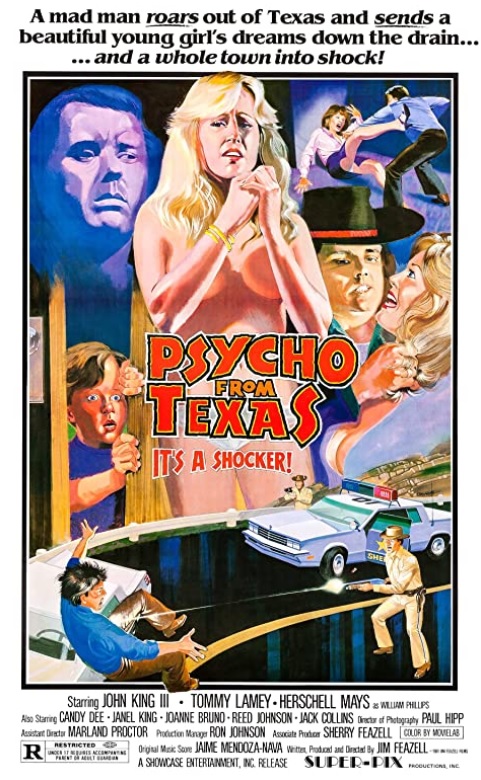
Slasher Month: Psycho from Texas (1975)

“Momma? Momma, please don’t hurt me, momma!”
— thus Wheeler’s love of the knife

He hunts women. His knife tells him to!
— a tagline that says it all

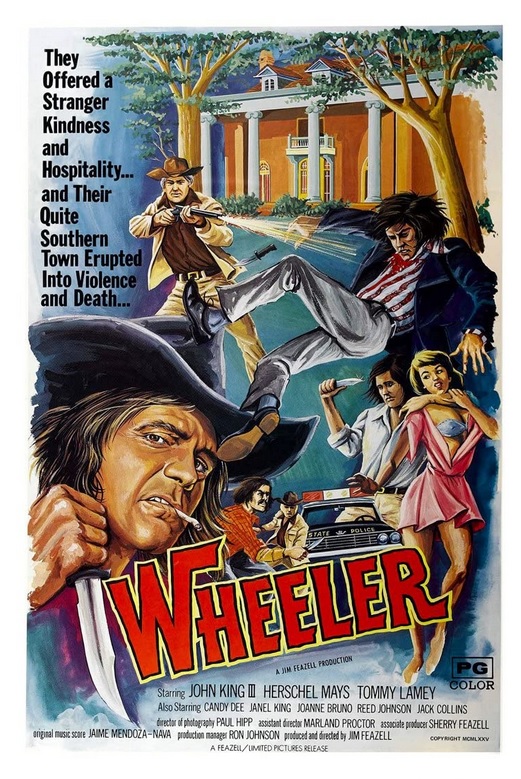
Okay, if that tagline and line of dialog doesn’t sell it, along with the one-sheets: This is a story of a drifter who makes his way as an ersatz hitman — now hired by a local businessman to kidnap the local, big wig oil baron. Our hitman, of course, was reared in squalor, suffering the abuses of his whoring mama. So when the baron escapes, it’s time to go “Texas Chainsaw” — only cheaper and less effectively — to tie up those few loose ends, you know, to get back at momma.

Hey, our beloved Linnea Quigley had to start her exploitation career, somewhere . . .in this lone writer, directing, and producing credit by Hollywood stuntman Jim Feazell. You’ve seen Jim’s work in the iconic, late ’60s westerns The Wild Bunch, Butch Cassidy and the Sundance Kid, The Undefeated, Paint Your Wagon, and Chisum. He also manned the cameras on 1971’s Blood and Lace and Wild Riders.

If you’re a biker flick maven, you may recognize our star, John King III, as the twisted Wheeler; he made his debut in the blaxploitation biker romp, Black Angels (1970), which he followed with Guess What’s Happening to Count Dracula? (1971). King made his last film appearance in the oft-programmed Mill Creek box setter, the cheapjack . . . but pretty decent horror anthology, House of the Dead (1978). Yep! You can find House of the Dead on Mill Creek’s Chilling Classics and their Nightmare Worlds 50 film packs.

Because in the ’80s “aliens” were hot and ’70s Amicus anthologies were not: a drive-in repack of House of the Dead.

As for Wheeler, itself repacked for a renewed drive-in live as Psycho from Texas: Well, it’s still a great, sloppy-on-the-cheap drive-in hokum produced in the Texas Chainsaw backwashes. This is the stuff we packed in the cars for . . . in between The Exorcist ripoffs and the eventual, later ripoffs of The Omen. Hey! A “Ten Backwoods Slashers* (That Aren’t The Texas Chainsaw Massacre)” exploration, anyone? Come on! Who’s up for it!

You can watch Lone Star State slashin’ fun on You Tube HERE and HERE — and sample the trailer, HERE, because, well, fool us once, trailer embed elves. No more black boxes, here!

Bonus! You can git yerselves a restored copy of this redneck romper stomper courtesy of Dark Force Entertainment with their “Drive-In #6” DVD restoration.

About the Author: You can learn more about the writings of R.D Francis on Facebook. He also writes for B&S About Movies.

ARROW UHD RELEASE: Deep Red (1975)

EDITOR’S NOTE: We originally wrote about Argento’s Deep Red on November 9, 2018. Arrow’s truly landmark UHD release is something to celebrate, so we’ve updated and expanded this article to cover this must-have purchase.

Deep Red is one of the few Argento movies that I’ve seen in a theater and the drive-in. It’s not the best film for the fast moving grindhouse or drive-in, but it is a great film. After all, it started with a 500-page script that even Dario Argento’s family felt was too cryptic and continues with not just one, but two references to American painter Edward Hopper. This isn’t just a movie about murder. This is a movie that transforms murder into art.

We begin at Christmas, as two shadowy figures battle until one of them stabs the other. Screams ring out as a knife drops at the feet of a child.

Fast forward to Rome, as a medium named Helga Ulmann is conducting a lecture about her psychic powers. Within moments, she senses that one of the people in the theater is a killer. Later that night, that killer kicks in her front door and murders her with a meat cleaver (which is probably why this movie got the boring American title of The Hatchet Murders).

British musician Marcus Daly (David Hemmings, BarbarellaBlowup, Harlequin), who fits the giallo mold of the stranger in a strange land thrust into the middle of a series of murders that he must solve, is returning home from drinking with his gay best friend Carlo (Gabriele Lavia, Beyond the DoorInferno) when he sees the murder that we’ve just witnessed from the street. He runs to save Helga, but she’s thrust through the window and her neck is pierced by the broken glass of her window in a kill that has become Argento’s trademark.

As he tells the police what has happened, he notices that a painting on Helga’s wall is gone. That’s when Gianna Brezzzi (Argento’s soon-to-be wife, Dario Nicolodi, who met him during the filming of this movie) takes his photo, which ends up on the cover of the newspaper the very next day.

Unlike most giallo women, Gianna is presented as more competent and even stronger than our hero — she sits high above him in her Fiat 500 and continually bests Marcus every time they arm wrestle. Nicolodi is so perfect in this film that she both breaks and warms your heart at every turn.

Marcus isn’t your typical hero, though. When the killer attacks him, he doesn’t stop them by daring or skill. He locks himself in his study to escape them. He does remember the song the killer played — we also have heard it when Helga is murdered — that psychiatrist (and Helga’s boyfriend) Professor Giordani believes is related to some trauma that motivates the killer.

Feeling guilty that she’s caused the killer to come after Marcus, Gianna relates an urban legend of a haunted house where the sounds of a singing child and screams of murder can be heard. The truth lies in House of the Screaming Child, a book written by Amanda Righetti, which tells the truth of the long-forgotten murder. Marcus and Gianna would learn even more, but the killer beats them to her house and drowns her in a bathtub of scalding hot water (directly influencing the murder of Karen Bailey in Halloween 2). As she dies, the writer leaves a message behind on the wall, which our heroes find. They’ve already assumed the investigation — again, in the giallo tradition — and think the police will assume that Marcus is the murderer, so they don’t report the crime.

Marcus follows the trail of the killer from a picture in the book to the real house, which has been abandoned since 1963. As he searches the home, he uncovers a child’s drawing of a murdered man and a Christmas tree, echoing the flashback that starts the film. Yet when he leaves the room, we see more plaster fall away, revealing a third figure.

Marcus tells his friend Carlos all that he’s learned, but his friend reacts in anger, telling him to stop questioning things and to just leave town with his new girlfriend. At this point, you can start to question Marcus’ ability as a hero — he misses vital clues, he hides instead of fighting and he can’t even tell that someone is in love with him.

Professor Giordani steams up the Righetti murder scene and sees part of the message that she left on the wall. That night, a mechanical doll is set loose in his office as the killer breaks in, smashing his teeth on the mantle and stabbing him in the neck.

Meanwhile, Marcus and Gianna realize that the house has a secret room, with Marcus using a pickaxe to knock down the walls, only to discover a skeleton and Christmas tree. An unseen person knocks our hero out and sets the house on fire, but Gianna is able to save him. As they wait for the police, Marcus sees that the caretaker’s daughter has drawn the little boy with the bloody knife. The little girl explains that she had seen this before at her school.

Marcus finds the painting at the young girl’s school and learns that Carlo painted it. Within moments, his friend turns up, stabs Gianna and holds him at gunpoint. The police arrive and Carlo flees, only to be dragged down the street and his head messily run over by a car.

With Gianna in the hospital and his best friend obviously the murder, Marcus then has the Argento-esque moment of remembering critical evidence: there’s no way Carlo could have killed the psychic, as they were together when they heard her screams. The portrait that he thought was missing from the apartment was a mirror and the image was the killer — who now appears in front of him.

The real killer is Martha (Clara Calamai, who came out of retirement for this role, an actress famous for her telefoni bianchi comedy roles), who killed Carlo’s father in the flashback we’ve seen numerous times after he tried to commit her. She chases Marcus with a meat cleaver, striking him in the shoulder, but he kicks her and her long necklace becomes caught in an elevator which beheads her. The film ends with the reflection of Marcus in the pool of the killer’s blood.

While this film feels long, it has moments of great shock and surprise, such as the two graphic murders that end the film and the clockwork doll. The original cut was even longer, as most US versions remove 22 minutes of footage, including the most graphic violence, any attempts at humor, any romantic scenes between David Hemmings and Daria Nicolodi, and some of the screaming child investigation.

This is also the first film where Argento would work with Goblin. After having scored Argento’s The Five Days — a rare comedy —  Giorgio Gaslini was to provide music for the film. Argento didn’t like what he did and attempted to convince Pink Floyd to be part of the soundtrack. After failing to get them to be part of Deep Red, Goblin leader Claudio Simonetti impressed the director by producing two songs in one night. They’d go on to not only write the music for this film, but also for plenty of future Argento projects.

A trivia note: Argento’s horror film museum and gift shop, Profondo Rosso, is named after the Italian title to this movie.

Deep Red is the bridge between Argento’s animal-themed giallo and supernatural based films. While its pace may seem glacial to modern audiences, it still packs plenty of moments of mayhem that approaches high art.

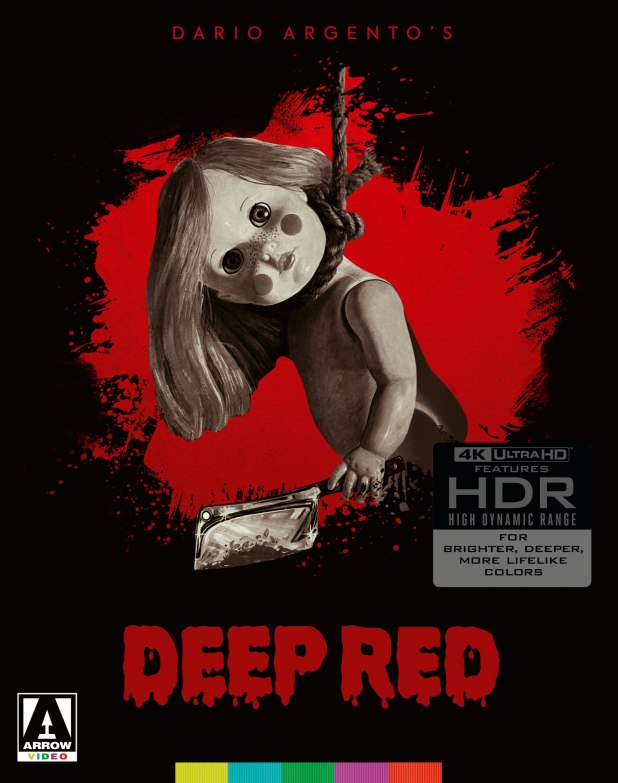
Arrow Video’s new UHD release has 4K restorations of both the original 127-minute Italian version and the 105-minute export version from the original negative by Arrow Films, as well as limited edition packaging with a reversible sleeve featuring originally and newly commissioned artwork by Obviously Creative.

Plus, you get an illustrated collector’s booklet featuring writing on the film by Alan Jones and Mikel J. Koven and a new essay by Rachael Nisbet, as well as a fold-out double-sided poster featuring original and newly commissioned artwork by Obviously Creative and six double-sided, postcard-sized lobby card reproduction artcards.

As for the on-disk extras, there’s new audio commentary by critics Troy Howarth and Nathaniel Thompson, archival audio commentary by Argento expert Thomas Rostock and nearly three hours of new interviews with members of the cast and crew, as well as an introduction by Claudio Simonetti of Goblin, a visual essay by Michael Mackenzie and several trailers.

If you love giallo, Argento and collecting the most important films in the history of horror, you simply must buy this. It’s as perfect as it gets. You can order it from MVD or Diabolik DVD.

GIALLOPALOOZA PRIMER: Deep Red (1975)

EDITOR’S NOTE: You think you’re telling the truth, but in fact… you’re telling only your version of the truth. It happens to me all the time. That said, we originally watched and talked about this movie on December 7, 2018, but because it’s one of the Drive-In Super Monster-Rama Giallopalooza selections, we’re posting it again.

Deep Red is one of the few Argento movies that I’ve seen in a theater. I’m not sure what the audience expected, as it was on what was presented as a grindhouse night. I think they wanted something like the modern interpretation of the term, all fast moving action and laughs. I don’t think that many of them were happy with what they got from this film — a movie that started with a 500-page script that even Dario Argento’s family felt was too cryptic and continues with not just one, but two references to American painter Edward Hopper. This isn’t just a movie about murder. This is a movie that transforms murder into art.

The movie begins at Christmas, as two shadowy figures battle until one of them stabs the other. Screams ring out as a knife drops at the feer of a child.

Fast forward to Rome, as a medium named Helga Ulmann is conducting a lecture about her psychic powers. Within moments, she senses that one of the people in the theater is a killer. Later that night, that killer kicks in her front door and murders her with a meat cleaver (which is probably why this movie got the boring American title of The Hatchet Murders).

British musician Marcus Daly (David Hemmings, BarbarellaBlowup, Harlequin), who fits the giallo mold of the stranger in a strange land thrust into the middle of a series of murders that he must solve, is returning home from drinking with his gay best friend Carlo (Gabriele Lavia, Beyond the DoorInferno) when he sees the murder that we’ve just witnessed from the street. He runs to save Helga, but she’s thrust through the window and her neck is pierced by the broken glass of her window in a kill that has become Argento’s trademark.

As he tells the police what has happened, he notices that a painting on Helga’s wall is gone. That’s when Gianna Brezzzi (Argento’s wife at the time, Dario Nicolodi, who met him during the filming of this movie) takes his photo, which ends up on the cover of the newspaper the very next day.

Unlike most giallo women, Gianna is presented as more competent and even stronger than our hero — she sits high above him in her Fiat 500 and continually bests Marcus every time they arm wrestle.

Marcus isn’t your typical hero, though. When the killer attacks him, he doesn’t stop them by daring or skill. He locks himself in his study to escape them. He does remember the song the killer played — we also have heard it when Helga is murdered — that psychiatrist (and Helga’s boyfriend) Professor Giordani believes is related to some trauma that motivates the killer.

Feeling guilty that she’s caused the killer to come after Marcus, Gianna relates an urban legend of a haunted house where the sounds of a singing child and screams of murder can be heard. The truth lies in House of the Screaming Child, a book written by Amanda Righetti, which tells the truth of the long-forgotten murder. Marcus and Gianna would learn even more, but the killer beats them to her house and drowns her in a bathtub of scalding hot water (directly influencing the murder of Karen Bailey in Halloween 2). As she dies, the writer leaves a message behind on the wall, which our heroes find. They’ve already assumed the investigation — again, in the giallo tradition — and think the police will assume that Marcus is the murderer, so they don’t report the crime.

Marcus follows the trail of the killer from a picture in the book to the real house, which has been abandoned since 1963. As he searches the home, he uncovers a child’s drawing of a murdered man and a Christmas tree, echoing the flashback that starts the film. Yet when he leaves the room, we see more plaster fall away, revealing a third figure.

Marcus tells his friend Carlos all that he’s learned, but his friend reacts in anger, telling him to stop questioning things and to just leave town with his new girlfriend. At this point, you can start to question Marcus’ ability as a hero — he misses vital clues, he hides instead of fighting and he can’t even tell that someone is in love with him.

Professor Giordani steams up the Righetti murder scene and sees part of the message that she left on the wall. That night, a mechanical doll is set loose in his office as the killer breaks in, smashing his teeth on the mantle and stabbing him in the neck.

Meanwhile, Marcus and Gianna realize that the house has a secret room, with Marcus using a pickaxe to knock down the walls, only to discover a skeleton and Christmas tree. An unseen person knocks our hero out and sets the house on fire, but Gianna is able to save him. As they wait for the police, Marcus sees that the caretaker’s daughter has drawn the little boy with the bloody knife. The little girl explains that she had seen this before at her school.

Marcus finds the painting at the young girl’s school and learns that Carlo painted it. Within moments, his friend turns up, stabs Gianna and holds him at gunpoint. The police arrive and Carlo flees, only to be dragged down the street and his head messily run over by a car.

With Gianna in the hospital and his best friend obviously the murder, Marcus then has the Argento-esque moment of remembering critical evidence: there’s no way Carlo could have killed the psychic, as they were together when they heard her screams. The portrait that he thought was missing from the apartment was a mirror and the image was the killer — who now appears in front of him.

The real killer is Martha (Clara Calamai, who came out of retirement for this role, an actress famous for her telefoni bianchi comedy roles), who killed Carlo’s father in the flashback we’ve seen numerous times after he tried to commit her. She chases Marcus with a meat cleaver, striking him in the shoulder, but he kicks her and her long necklace becomes caught in an elevator which beheads her. The film ends with the reflection of Marcus in the pool of the killer’s blood.

While this film feels long, it has moments of great shock and surprise, such as the two graphic murders that end the film and the clockwork doll. The original cut was even longer, as most US versions remove 22 minutes of footage, including the most graphic violence, any attempts at humor, any romantic scenes between David Hemmings and Daria Nicolodi, and some of the screaming child investigation.

This is also the first film where Argento would work with Goblin. After having scored Argento’s The Five Days — a rare comedy —  Giorgio Gaslini was to provide music for the film. Argento didn’t like what he did and attempted to convince Pink Floyd to be part of the soundtrack. After failing to get them to be part of Deep Red, Goblin leader Claudio Simonetti impressed the director by producing two songs in one night. They’d go on to not only write the music for this film, but also for plenty of future Argento projects.

A trivia note: Argento’s horror film museum and gift shop, Profondo Rosso, is named after the Italian title to this movie.

Deep Red is the bridge between Argento’s animal-themed giallo and supernatural based films. While its pace may seem glacial to modern audiences, it still packs plenty of moments of mayhem that approaches high art.

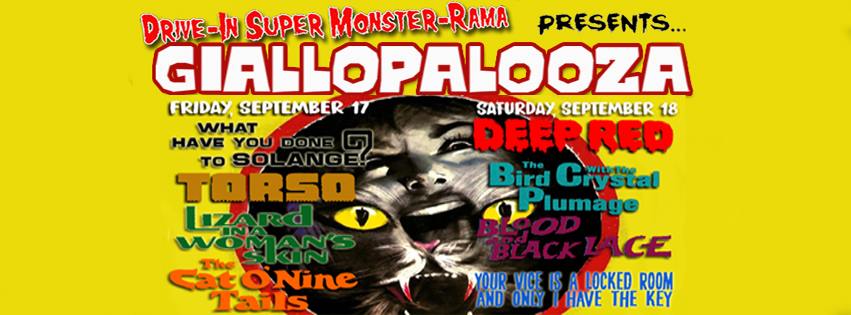
Drive-In Super Monster-Rama is presenting “Giallopalooza”, two big nights of classic, fully restored giallo thrillers from such maestros as Dario Argento, Mario Bava, Lucio Fulci and Sergio Martino!

On Friday, September 17, the line-up will be What Have You Done to Solange?, Torso, A Lizard In a Woman’s Skin and The Cat O’Nine Tails. Saturday, September 18 they will present Deep Red, The Bird with the Crystal Plumage, Blood and Black Lace and Your Vice Is a Locked Room and Only I Have the Key.

Admission is $10 per person each night (children 12 and under FREE with adult guardian). Camping on the premises is available each night for an additional $10 a person, and that includes breakfast.

Advance tickets are available online at the Riverside Drive In’s webpage.

The Flower in His Mouth (1975)

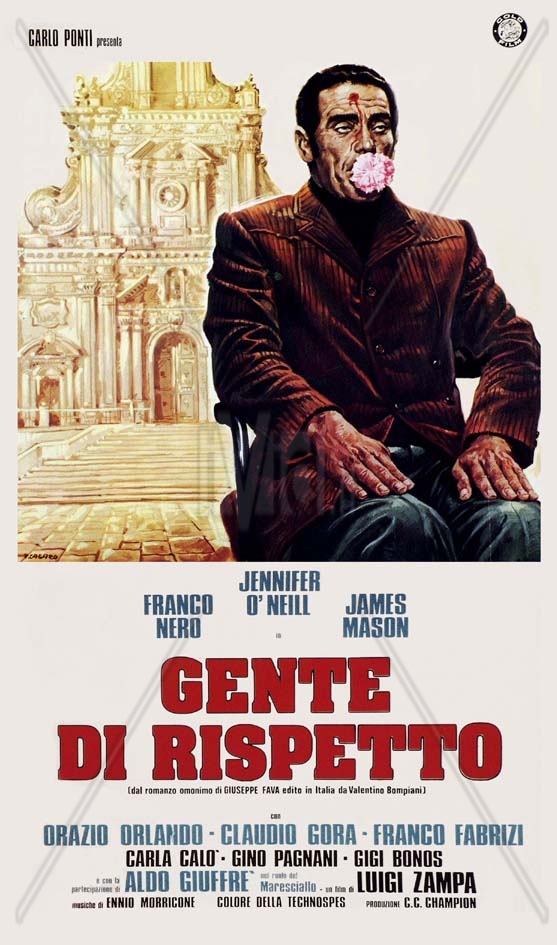
Elena Bardi (Jennifer O’Neill, The Psychic) has moved to a small Sicilian town to teach, but on her first day she’s harassed by a man and no one helps her. The next day, that man is dead and she’s a suspect. Everyone in town treats her with near contempt except for Bellocampo (James Mason, absolutely incredible in this)m a lawyer who teaches her all of the secrets of the city, such as how she can change the laws about students evading school. The only other person she grows close to is Professor Belcore (Franco Nero), but he won’t even appear in public with her.

When a second person insults her and also winds up dead, the superstitious people of the small town believe that she has a secret power. She uses this belief to give grants to poor families and then further uses it to send their children to school. Even powerful senators begin to listen to her and change the laws to fix up the neighborhoods where the most cash-strapped citizens live.

The real reasons why Bellocampo has led her to improve the city is incredibly shocking, so much so that I’d like you to discover it for yourself, as well as Mason’s astounding work in this motion picture.

This may be discussed as a giallo, but beyond the murders, it is truly a story of human nature.

La donna della domenica (1975)

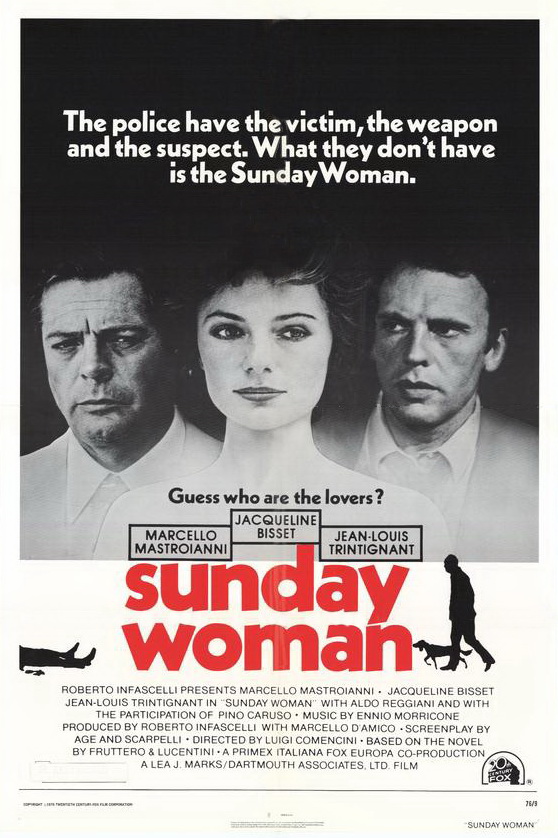
Commissioner Santamaria (Garrone, an architect who was playing an intellectual game of murder within a series of letters to his friend Massimo Campi (Jean-Louis Trintignant). While investigating, Satanamaria falls for one of the suspects, Anna Carla Dosio. Can we blame him when she’s played by Jacqueline Bisset?

It seems that Garrone has been killed for his blackmailing, but now that Campi’s boyfriend Lello has also been killed — amongst others — the plot is thickening.

Luigi Comencini is usually the director of more high brow things than we cover here. But hey — there’s a Morricone soundtrack to tether us to the tenuous connections to the giallo genre that we hold so dear. I guess I shouldn’t say too high brow, as after all the main victim is murdered with a stone penis, so there’s that.

Deadly Strangers (1975)

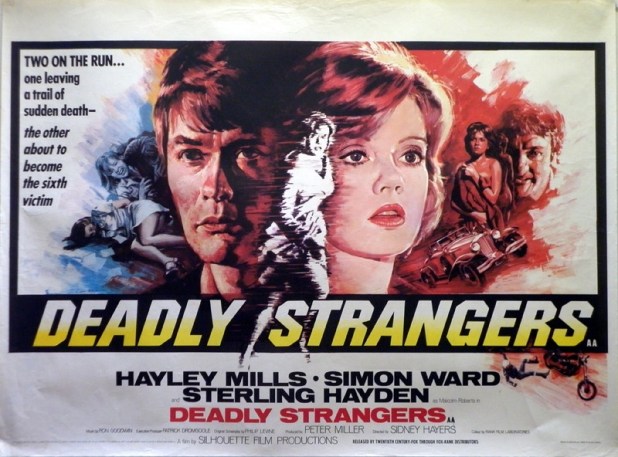
Someone has escaped Greenwood Mental Hospital, broken into someone’s home and stolen a car. And now, they’re on the loose.

Could it be Stephen Slade? He has the same car as the one that has just been stolen. And why is he stalking Belle Adams (Hayley Mills!) when she heads home from the bar with a truck driver that assaults her? He saves her and then keeps telling her less than truths to stay in her company.

The evidence keeps piling up, as through flashbacks gradually reveal that Stephen is a voyeur — and Belle is an abused orphan whose uncle used to watch her, so maybe they aren’t meant to be — and when they stop for gas, the one lone female employee ends up dead.

As they avoid roadblocks — at first because Stephen’s been drinking and later because they may have injured a motorcyclist who was bothering them — it seems like they’re growing closer. But is that the worst possible thing for Belle? Or Stephen?

Directed by Sidney Hayers (Burn, Witch BurnAssault), this film definitely has the giallo vibes of red herrings, mistaken identity and a question of who the killer is well in hand. This doesn’t get discussed much but it’s definitely worth a watch.

You can watch this on Tubi.

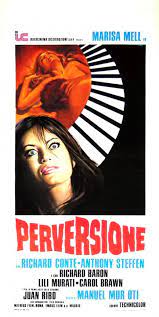
Diary Of An Erotic Murderess (1975)

As far as I’m concerned, Marisa Mell can be in every giallo. She can be in every movie, actually.

In this one, originally called La encadenada, she plays the live-in psychologist of millionaire widower Alexander’s (Richard Conte, wow what a get!)  slightly — well, perhaps completely — insane silent son. Within a few moments of plot time, she’s marrying the father, disposing of him and then moving on to his son. But then, of course, her evil ex (Anthony Steffen, who somehow played Django more than Franco Nero) shows up to ruin everything.

There are some wild ideas here — Alexander owns the Holy Grail, the real cup and it’s treated with all of the excitement that another Alexander gets when he shows off his magic window — but the film suffers from a lack of style. It needs the sex, the sizzle, the score, the everything that makes a giallo a giallo.

But man, the ending is slam bang great and Mell is awesome in this, an actress in search of a movie. And it’s got a really great supporting cast. Manuel Mur Oti never really directed that I’ve seen before, but his style here seems very point and shoot. That could be the result of the horrible print that is out there. But hey, let’s be honest: you could do worse than to watch Marissa Mell ruin men for 87 minutes.