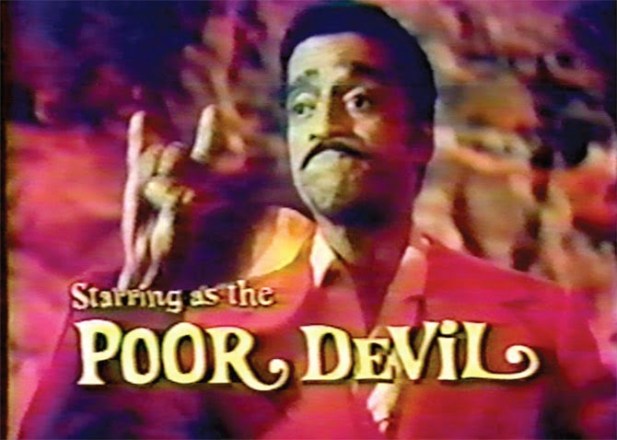
CBS LATE MOVIE MONTH: Poor Devil (1973)

EDITOR’S NOTE: Poor Devil was on the CBS Late Movie on August 8, 1977.

Sammy Davis Jr. battled racism throughout his career, even from the wings of the stage as his Rat Pack cohorts would call him racist names like smokey.

In an interview with Roots author Arthur Haley in Playboy, the entertainer talked about the first time he came up against his race: in the Army. He was beaten for looking at a white female commanding officer while she was giving him orders, with his body covered with anti-black graffiti and covered in turpentine. That night, as in every night he served, he was still asked to perform for the troops. That’s when Davis learned he’d have to fight to be respected. And once he was in, he’d stay in by any means necessary — even coming off as insincere.

Despite being a member of the Hollywood crowd, Davis still could never be a full member. His romance with white girls like Kim Novak rubbed people the wrong way. And even though he was a large financial supporter of the Civil Rights Movement, he still had a complex relationship with the black community.

For example, he earned plenty of ire when he supported Nixon in 1972. Although he was originally a Democrat and supported JFK in 1960 and RFK in 1968, John F. Kennedy would go on to revoke an inauguration invitation to “Mr. Show Business” because he married white actress May Britt. So maybe his conversion makes sense because Nixon invited him to be the first black guest at the White House.

Once, Jack Benny asked Sammy about his handicap on the golf course. He answered, “Handicap? Talk about a handicap. I’m a one-eyed Negro Jew.”

That said — it’s also believed that Davis was introduced to Anton LaVey’s Church of Satan at an orgy at the nightclub that he owned, The Factory. This also makes sense. There are plenty of stories about how Sammy loved the free-swinging sex scene of the 70s, even learning how to deep throat from the woman who introduced it to the zeitgeist, porn star Linda Lovelace.

Anyways — I could go on about Sammy Davis Jr. He was a fascinating man — who could smoke four packs of cigarettes a day, draw and fire a Colt Single Action Army Revolver in a quarter of a second and was able to both be a parody of himself and parody himself seemingly at the same time. But today, we’re here to discuss a strange TV pilot that Davis was in, one that would lead to him accepting an honorary second-degree membership in the Church of Satan.

Originally airing on February 14, 1973, on NBC, Sammy would star as Sammy in this series pilot. He’s a demon who has screwed up for the last thousand or so years and now wants to succeed and prove himself to his boss Lucifer, who is played by Christopher Lee. If you don’t immediately stop reading this and go watch this show, allow me to share this photo of Sir Christopher Frank Carandini Lee CBE, CStJ, with a gorgeous head of hair.

To win over his boss, Sammy has to convince Burnett J. Emerson (Jack Klugman!) to sell his soul. In return, he’ll get revenge on his boss (Adam West!) and gain wealth for seven years (and then go to Hell for eternity, which is a lot like Miami, only less humid). 

Davis would flirt with The Church of Satan for some time, painting one fingernail red, wearing the Baphomet medallion and flashing the horns from time to time before dropping out by the mid-1970s (around the time that Anton LaVey went into seclusion).

One wonders where this show would have gone if it had become a weekly series. Would the Devil tempt a new celebrity every week? Would Klugman stick around? Would LaVey make a cameo?

All we have is this pilot, which is filled with Satanic imagery, a lack of a laugh track and plenty of early 1970s strangeness. What a weird time to be alive, one that we’ll never truly comprehend today. Still, if all that came of this was this photo of Davis with LaVey and future Temple of Set leader Michael Aquino, I’ll consider it a success.

CBS LATE MOVIE MONTH: Dark Places (1973)

EDITOR’S NOTE: Dark Places was on the CBS Late Movie on December 18, 1985.

Edward Foster (Robert Hardy) has inherited a mansion rumored to be haunted. Instead of being scared off, he decides to renovate it. What he doesn’t know is that the doctor of the previous owner, Andrew Carr, Dr. Ian Mandeville (Christopher Lee) and his sister Sarah (Joan Collins), as well as Prescott (Herbert Lom), the solicitor, know that there are two suitcases of money hidden somewhere.

They didn’t count on Edward being violently deranged, as he can see the past of the house, as he looks precisely like Carr and experiences the last days of that man’s life, in which he plans to leave his wife Victoria (Jean Marsh) for a governess named Alta (Jane Birkin). This house seems to lead to mental illness, as Victoria is impossible to be around. She knows Andrew is leaving, so she has her two children kill her rival while she’s seducing her husband. When he finds out, he strangles her and kills the little ones with a sword, bricking up all of the dead bodies — and the money — inside the house.

These flashbacks lead to him ridding his home of the others, just in time for the police to show up. Poor Joan Collins, yet another movie where she gets strangled! For her part, she said in her autobiography Past Imperfect, “I became known by the British press as Queen of the Horror Films — a title I didn’t particularly relish. But I was resilient. A survivor. I was lucky to be working so much after such a long period away from the British screen, particularly since I was well into my thirties.”

Dark Places was directed by Don Sharp, who also made The Creeping Flesh and written by Ed Brennan and Joseph Van Winkle. This was shot in an old asylum, which, while run down, made it the perfect location.

You can watch this on Tubi.

CBS LATE MOVIE MONTH: Santee (1973)

EDITOR’S NOTE: Santee was on the CBS Late Movie on October 16, 1975 and January 5, 1977.

Here’s some trivia you can use on your friends. Santee was one of the first motion pictures to be shot electronically on videotape, a groundbreaking technique at the time. This was achieved using Norelco PCP-70 portable NTSC cameras and portable Ampex VR-3000 2″ VTRs, marking a significant shift in film production technology.

Director Gary Nelson mainly worked in TV before this, but he has some interesting films to his credit, like the original Freaky FridayThe Black Hole and the Mike Hammer TV movies.

Jody’s long-awaited reunion with his father takes a dramatic turn when he discovers that his father is an outlaw on the run from a relentless bounty hunter named Santee (Glenn Ford). The story takes an unexpected twist when the two adversaries, Jody and Santee, find themselves forming an unlikely bond, realizing that they share a deeper connection than they could have ever imagined.

Santee boasts a diverse and intriguing cast, including Dana Wynter (Invasion of the Body Snatchers), Jay Silverheels (Tonto himself, who for some reason has been showing up in nearly every movie I’ve watched lately), Robert Donner (who also is in Nelson’s Allan Quatermain and the Lost City of Gold), Dark Brothers repertory actor Jack Baker, X Brands (the oddly named actor who may have been of German descent and from Kansas City, but always played Native Americans), Chuck Courtney (who played Daniel Reid Jr. on The Lone Ranger, the character who would grow up to be the father of The Green Hornet) and Lindsay Crosby (Bigfoot).

Edward Platt, the Chief on Get Smart, produced this film and played a crucial role in financing it. Platt raised the money to buy the video cameras, a significant contribution to the film’s production. One can only assume that his involvement also led to Nelson’s directorial role in the TV movie Get Smart, Again.

You can watch this on YouTube.

CBS LATE MOVIE MONTH: The Clones (1973)

EDITOR’S NOTE: The Clones was on the CBS Late Movie on November 7, 1975, and April 18, 1977.

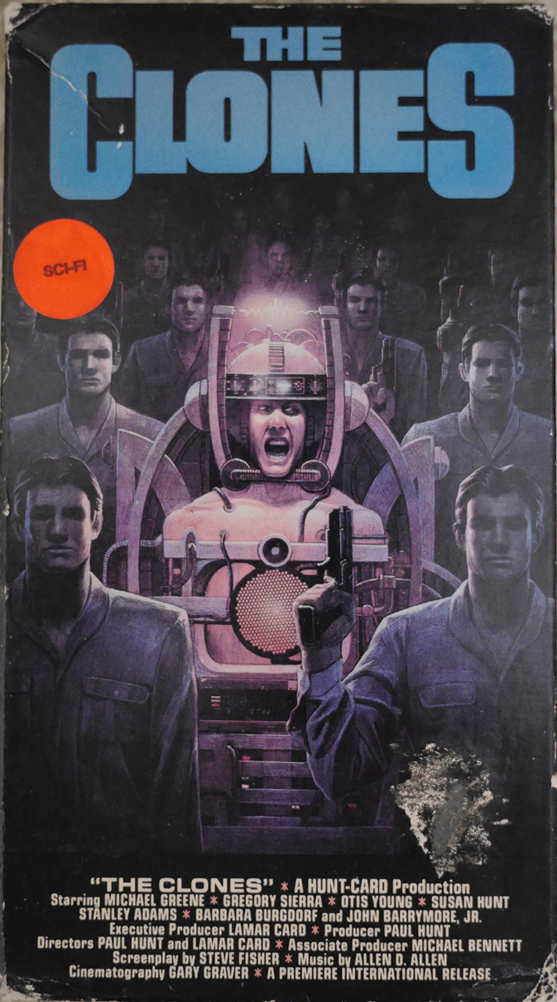
Dr. Gerald Appleby (Michael Greene) finds himself in a perplexing situation. He believes he’s been cloned. His conviction stems from a near-fatal escape from his lab’s explosion and the unsettling reports of his sightings in places he’s never been. This sets the stage for a gripping narrative as he goes on the run, pursued not only by the deranged scientist Carl Swafford (Stanley Adams, Cyrano Jones from the original Star Trek) but also by the ruthless thugs Sawyer (Otis Young, Blood Beach) and Nemo (Gregory Sierra, a stark contrast to his usual role as the virtuous Det. Sgt. Chano Amenguale on Barney Miller).

Directed by Paul Hunt (he also directed Twisted Nightmare and produced Demon Wind) and Lamar Card (who directed Supervan and Jukebox AKA Disco Fever, as well as the producer of Nashville GirlSavage Harvest and Project: Metalbeast), who co-wrote the film with Steve Fisher, who started writing movies back in 1938 with Nurse from Brooklyn. He also wrote the novel and screenplay for I Wake Up ScreamingHell’s Half AcreJohnny Angel and episodes of Peter GunnMcMillan & WifeCannon and Fantasy Island.

Most people will watch this movie and see a slow-moving film that goes nowhere, filled with fish-eye lens-addled drug scenes and an overwhelming sense of conspiracy doom. As for me, I read that sentence and only see the positives. Young and Sierra are having a blast; the ending is as cynical as it gets, and a lot of the ending takes place inside an amusement park that runs itself. It’s a movie that came out on VHS, has had no major DVD release and has never come out on Blu-ray.

You can watch this on Tubi.

CBS LATE MOVIE MONTH: Satan’s School for Girls (1973)

EDITOR’S NOTE: Satan’s School for Girls was on the CBS Late Movie on September 5, 1975 and April 1, 1977.

The early 70s were a time when Satan seemed to reign. I first learned about Anton LaVey and the Church of Satan as a child by reading the TV Guide Book of Lists. They asked him what the most Satanic TV shows were, and he replied with a list that included so many of my favorite shows. It scared me as a twelve-year-old — could I be taken by devil worshippers and be made to celebrate the Black Mass? This cultural phenomenon of the 70s is a nostalgic left-hand trip for many of us.

Made-for-TV movies reflected the Satanic bent of the early 70s. This Aaron Spelling produced, David Lowell Rich (Eye of the Cat, Airport 79 – The Concorde) directed affair brings the devil to the boarding school, along with plenty of attractive girls ready to give their souls to the Son of the Morning Star.

Martha Sayers is running from a mysterious stranger who may or may not be related to Torgo from Manos: The Hands of Fate. She locks herself in her sister Elizabeth’s (Pamela Franklin, Necromancy, The Legend of Hell House, The Food of the Gods) house and hangs herself. Of course, the police just think it’s a suicide. But we know better — The Salem Academy for Women had to have something to do with it. Martha’s roommate warns Elizabeth to stay away, but she is determined to uncover the truth.

She takes the name of Elizabeth Morgan and enrolls at the school where she’s welcomed by Roberta (Kate Jackson!), Jody Keller (Cheryl Ladd!) and Debbie Jones (Jamie Smith-Jackson from Go Ask Alice, who is married to Michael Ontkean, Sheriff Harry S. Truman from Twin Peaks). The fact that Alice and two of Charlie’s Angels (Sabrina Duncan and Kris Munroe, I’ll have you know) playing devils in a movie thrills me to no end. And throw in Alice, and we have a movie!

Debbie keeps having outbursts in class, and another girl commits suicide, prompting Headmistress Williams to start worrying about the influence of the new girl. Then there’s that painting of Martha in a dungeon that Debbie painted but is now terrified of. Just imagine — Elizabeth snoops and finds that room on campus but is chased away by a man with a knife!

Roberta is now on Elizabeth’s side. After all, there are some crazy teachers, like the professor, who make them run a rat through a maze. And when Debbie tries to leave, her body shows up. Finally, Liz can’t take anymore and bursts into Professor Delacroix’s (Lloyd Bochner, who played Walter Thornton in The Lonely Lady) office. He screams that something is stalking him, so he jumps out a window, gun in hand. He runs through a swamp before being beaten to death with sticks by several students. The popular Dr. Joseph Clampett (Roy Thinnes, David Vincent from The Invaders, The Norliss Tapes) is the real killer. The plot takes unexpected turns, keeping the audience on the edge of their seats.

He’s leading a Satanic cult that believes that he’s the devil. Only Elizabeth and the headmistress survive as the rest of the girls sacrifice themselves to the flames. And Clampett? He survives the fire and then promptly walks outside and disappears.

Interesting Wiki story: In the film’s synopsis, whoever wrote it states, “the other girls stay behind to sacrifice themselves to their leader (But are saved by God and Jesus offscreen as they were forced).” How do they know? That certainly didn’t happen in the movie version I saw!

This was remade in 2000, with Kate Jackson playing the school’s dean and Shannen Doherty. That version is unreviewed. Why pick 2000 when you can choose 1973? If only all schools could be as ridiculous as the Salem Academy for Women! If only all rooms had shag carpeting, and there were constant wine mixers and murders and 70s garish fashions! My world is so dull by comparison!

CBS LATE MOVIE MONTH: The Norliss Tapes (1973)

EDITOR’S NOTE: The Norliss Tapes was on the CBS Late Movie on January 23 and May 26, 1975.

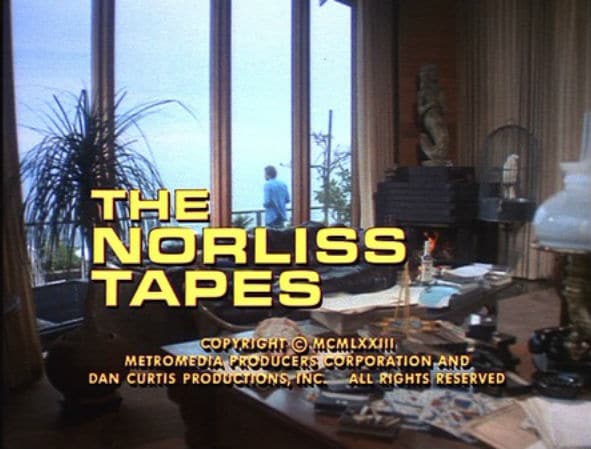
Occult investigator Norliss has disappeared, but his legacy lives on in a series of tapes that unfold the gripping narratives of his many escapades, such as his encounter with a widow and her undead artist husband. Originally developed as a series pilot by NBC, it was eventually broadcast as a TV movie on February 21, 1973.

Written by William F. Nolan (Logan’s RunTrilogy of TerrorBurnt Offerings) and produced by Dan Curtis (Dark ShadowsKolchak: The Night StalkerCurse of the Black Widow and pretty much any TV horror you’d see in the 1970s), this was initially entitled Demon.

Sanford Evans, our guide into the mysterious world of David Norliss (Roy Thinnes, Airport 1975, TV’s The Invaders), listens to the tapes that explain Norliss’s sudden disappearance.

A recent case concerned Ellen Cort (Angie Dickinson of TV’s Police Woman), whose husband has come back from the dead. It turns out that before his death from a mysterious disease, he had become involved with Mademoiselle Jeckiel (Vonetta McGee, Blacula), who gave him a scarab that he was buried with. Sheriff Tom Hartley (Claude Atkins!) doesn’t believe any of this, even when James keeps draining the blood of young women and a gallery owner who tries to break into his coffin and take his ring.

Bullets won’t stop the undead man, who’s also created a sculpture made of human blood that will bring the Egyptian deity Sargoth into our world. Our hero, Norliss, is kind of ineffectual, as the undead artist kills Jeckiel, killing Ellen’s sister and raising the demon. He finally stops the monster by setting the studio on fire with everyone inside, the dictionary definition of a pyrrhic victory.

That’s when Evans finishes the tape and wonders if this is Norliss’ last adventure. Nope. There’s another tape, even if the series never happened.  That didn’t stop this TV movie from being aired in syndication and on the CBS Late Movie.

CBS LATE MOVIE MONTH: Scream, Pretty Peggy (1973)

EDITOR’S NOTE: Scream, Pretty Peggy was on the CBS Late Movie on January 6, 1975 and November 9, 1976.

The ABC Movie of the Week for November 24, 1973, Scream, Pretty Peggy was directed by Gordon Hessler, who was behind films as diverse as The Oblong Box, Kiss Meets the Phantom of the Park and Sho Kosugi’s introduction to the U.S., Pray For Death. It was written by Jimmy Sangster (who directed Hammer’s Lust for a Vampire and wrote The Curse of Frankenstein, Whoever Slew Auntie Roo? and many more), so this film has a much better pedigree than you’d expect.

The central character of the film is Peggy, a college student who aspires to become an artist. She applies for a job at the home of noted sculptor Jeffrey Elliott (played by Ted Bessell, TV’s That Girl) and his mother, the iconic Bette Davis. Peggy’s annoyingly chipper character adds a unique dimension to the story.

Let me give you some advice, in case you are a young girl looking for a housekeeping job and find yourself in a 1970s TV movie. If the house you’re working in has an Old Hollywood actress in it, run (refer back to my past rules of always avoiding Old Hollywood actors and actresses). And if you find out that there’s a room that you aren’t allowed to go into, don’t try to go into that room. Just get away as fast as you can.

However, Peggy’s curiosity gets the better of her. She stumbles upon Jeffrey’s collection of eerie demon sculptures, each more terrifying than the last. She also encounters George Thornton, whose daughter used to work in the house. This leads to a confrontation with the formidable Mrs. Bette Davis, a situation one should never find themselves in.

It turns out that Jessica, Jeffrey’s sister, is living in the room above the garage that Peggy isn’t allowed into. Again, get out. Now.

No, Peggy decides she wants to make a new friend. And what if that friend is really Jeffrey, who killed his sister and has split his personality with her inside his head?  Oh, Peggy. You brought this on yourself.

Scream, Pretty Peggy is a fine slice of 70s TV movie thrills. Any time you have Ms. Davis deigning to be in a TV movie, you will get something good. But seriously, I wish these girls would wise up. There are better things to do in this world than live in a house of maniacs!

CBS LATE MOVIE MONTH: The Horror at 37,000 Feet (1973)

EDITOR’S NOTE: The Horror At 37,000 Feet was on the CBS Late Movie on October 31, 1975 and October 29, 1976.

Someday, scholars will speak in awe of the post-Star Trek Satanic twosome of Shatner films, which would be this movie and The Devil’s Rain! Until then, maniacs like me will yell into the uncaring silence and tell you that for a shining moment — or literally two — the once and future Kirk would die twice (spoilers be damned, again literally) while facing off with the Lord of the Flies.

Originally airing on CBS on February 13, 1973, I first learned of this movie in a TV Guide Book of Lists that featured Anton LaVey discussing the most Satanic TV moments of the last decade. This movie has it all: Mario Bava lighting, a cursed altar, Shatner drunk and railing against humanity, and finally, a bunch of Old Hollywood actors daring to sacrifice a young child to the Left Hand Path.

Sure, the flight from London to New York is supposed to be mainly cargo — that druid altar I hinted at before — but the plane still has plenty of talent on board. There’s Captain Ernie Slade (Chuck Connors), as well as an architect (Roy Thinnes, who would enter this territory again in The Norliss Tapes) and his wife (Jane Merrow, Hands of the Ripper) who have placed said altar on board. There’s also Paul Kovalik (Shatner), a priest who has lost his way, and super-rich Glenn Farlee (Buddy Ebsen, who makes it extraordinary as it’s basically Jed Clampett and Barnaby Jones against Satan). You also get Tammy Grimes — whose daughter Amanda Plummer looks just like her — as well as Lynn Loring (also in the occultist Black Noon), Paul Winfield, France Nuyen (Code Name: Diamond Head), Will Hutchins, Darleen Carr (she’s in the TV remake of Piranha), Russell Johnson (The Professor!) and H. M. Wynant (Hangar 18).

Some people have the wrong idea that this movie, shot on the sound stages at CBS Studio Center, is one of Shatner’s worst films. They’re wrong. This movie is everything. Near the end, my wife looked at me and said, “This is pretty intense for TV.” I told her that life was cheap in 1973.

Director David Lowell Rich also made Satan’s School for GirlsSST Death Flight and The Concorde … Airport ’79, all movies that some people would make fun of. Not me—this is my bread and butter. It tastes delicious.

You can watch this on YouTube:

CBS LATE MOVIE MONTH: The Creeping Flesh (1973)

EDITOR’S NOTE: The Creeping Flesh was on the CBS Late Movie on November 16, 1973.

Directed by Freddie Francis* for Tigon, this film is a thrilling collaboration that pairs the iconic Christopher Lee and Peter Cushing. It’s a gem from the end of the era of British gothic horror, and despite its occasional silliness, such as Cushing holding a gigantic prehistoric finger that appears as sexualized as it gets, I find every moment of this film utterly captivating.

Cushing is Prof. Emmanuel Hildern, a scientist who discovers a colossal skeleton — Anunnaki alert — that is older than other skeletons in the area yet much more advanced. He hopes that this finding will win him the Richter Prize, but that award looks like it’s going to be won by his brother John (Lee), who has been looking after Emmanuel’s institutionalized wife for years. He plans to use his study of his brother’s wife to win that award and refuses to pay for the professor’s skeleton-finding trips.

Whatever this skeleton is, legend says that it was a monster that feared rain—maybe because the Great Flood wiped out the other Nephilim—and that it could grow skin when it came into contact with water.

Hildern has a theory that if evil itself—the skeleton—can be a living being, then it can be biologically contained and treated like a disease. He created a serum that can stop evil using cells from the skeleton’s fleshy finger. After testing the drug on a monkey with good results, Emmanuel also immunizes his daughter Penelope, who may have inherited her mother’s mental illness.

Of course, the next day, the monkey has gone wild, and now we have Penelope dancing on tables and slashing sailors. Soon, James finds out about the serum, kidnaps his niece and steals the skeleton. The skeleton gets exposed to the rain and becomes, well, a pretty goofy-looking monster that I can’t help but completely fall head over heels for.

The ending of this movie is a masterstroke, leaving the door wide open for interpretation. You can see it as Lee’s character denying that his brother is related to him to save his reputation or that Emmanuel was never a doctor at all but just another patient. If that’s true, then who really took his finger in revenge? Does the monster exist? It’s a thought-provoking conclusion that will keep you pondering long after the credits roll.

You can watch this on Tubi.

*Don Sharp, who also made Psychomania, was the original director before Francis was hired to replace him.

CBS LATE MOVIE MONTH: Go Ask Alice (1973)

EDITOR’S NOTE: Go Ask Alice was on the CBS Late Movie on April 26 and July 27, 1976.

Originally airing on January 24, 1973, Go Ask Alice is an adaptation of the 1971 book. The film, much like the book, delves into the personal struggles of a troubled teenager, a theme that resonates with many of us. While the book is more of a diary and is written by Anonymous, most people believe that therapist and author Beatrice Sparks wrote it. She’d go on to write several similar books that were also supposed to be the actual diaries of troubled teenagers.

Jamie Smith Jackson portrays Alice, a teenager striving to blend in at her new school, as she confides in her diary. Her quest for acceptance leads her to experiment with LSD at parties, plunging her into a world of substance abuse and family discord. The portrayal of her parents, played by William Shatner and Julie Adams, reflects the societal attitudes towards youth in the 1970s.

Mackenzie Phillips — who would later have drug problems of her own — shows up, and Andy Griffith (the film’s best part), Robert Carradine and Ruth Roman (from The Baby!) all make appearances. Their performances, especially those of Andy Griffith, add depth and intrigue to the film. It’s pretty schmaltzy in parts, but it’s a preachy 1973 TV movie. You kind of expect those kinds of things.

Bonus: You can listen to Becca and I discuss this on our podcast.