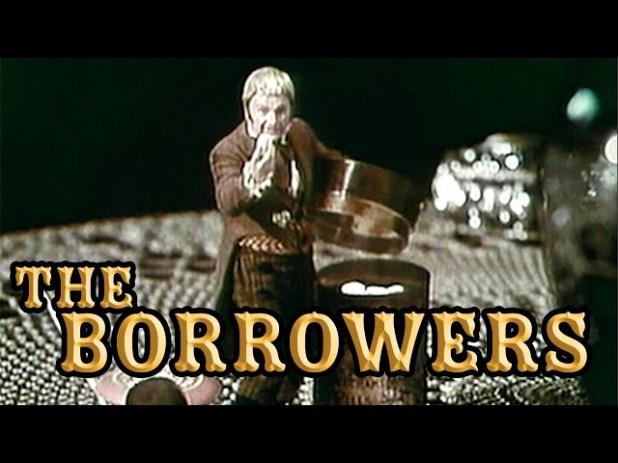
The Clock Family — Pod (Eddie Albert), Homily (Tammy Grimes) and Arriety (Karen Pearson) — are Borrowers, small people who live in the houses of human beans, as they call big people, and stay out of view. Arriety, unlike any Borrowers before, becomes friends with the eight-year-old (Dennis Larson) who lives in the house they have turned into their world.
Based on the book by Mary Norton, this was directed by Walter C. Miller (who mainly worked on the Grammy, CMA and Tony award show broadcast, as well as directing several Rodney Dangerfield specials) and written by Jay Presson Allen, who wrote the screenplays for Marnie, Funny Lady, Cabaret and Death Trap. She was a screenwriter when few women were.
The Borrowers was also made into two BBC TV series, a 1997 and 2011 movie and an anime in Japan called Karigurashi no Ariettii that was produced by Studio Ghibli.
Don’t have the box set? You can watch this on YouTube.
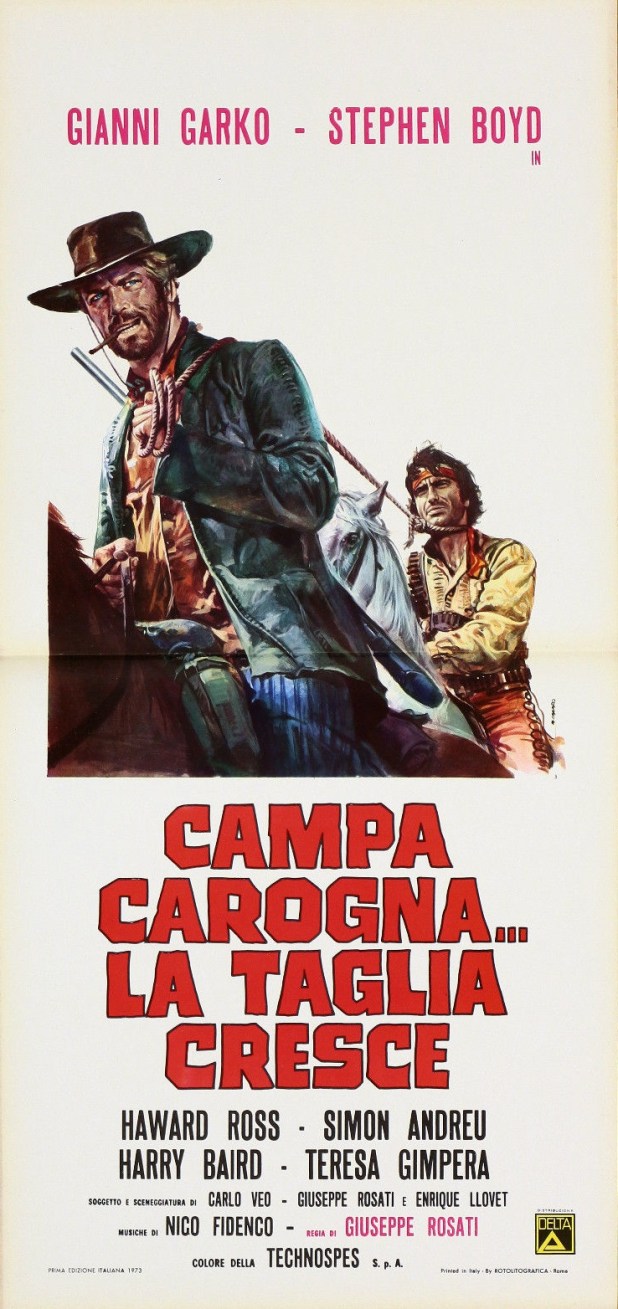
Those Dirty Dogs is also known as Campa carogna… la taglia cresce, Los cuatro de Fort Apache and Charge! It’s late in the Italian Western genre, so it has the slapstick ingredients of other latter cowboy films. It also has a song, “The Wind in My Face,” that was written by star Stephen Boyd and composer Nico Fidenco. Boyd even sings it.
Captain Chadwell Williams (Boyd), Lieutenant Junger Kohl (Howard Ross) and Sergeant Washington Smith (Harry Baird) have been assigned to get back the hundreds of rifles that Angel Sanchez (Simón Andreu) has stolen. They’re joined by Korano (Gianni Garko), a bounty hunter who carries a pink umbrella and the Koran.
It’s a weird cocktail here because fight scenes have sound effects and slaps, while the film starts off with a brutal massacre by Angel and his gang. And Sanchez isn’t even the main villain. That’s the general, played by Alfredo Mayo. He’s not frightening at all, so we start to realize that this is a post-Trinity Italian Western. At least Garko is still kind of Sartana here, having a machine gun hidden inside his umbrella.
But hey — I’ll watch anything Helga Liné is in. And this also has Teresa Gimpera (The People Who Own the Dark) and Gabriella Giorgelli (the mother of Lou Ferrigno’s Hercules) are in the cast.
It has a pretty great tagline on the poster: “The preacher of death who calls himself a follower of Mohammed; The virile Mexican revolutionary to whom every married woman is his to take; The insane General who believes he is Napoleon, destined to conquer America … and Chadwell – the dirtiest of them all!” And you know, at least a hundred people get killed, so if you’re into the more violent side of the Italian West — along with some hijinks — you’ll find something to enjoy.
The Lionsgate steelbook release of The Wicker Man is gorgeous. Just look at that illustrated package and then marvel at what’s inside it: the final cut of the film in time for its fiftieth anniversary, reborn in 4K. Plus there are exclusives like “Revisiting the Locations of The Wicker Man,” “The Wicker Man at 50,” the lost ending of the movie, an interview with Britt Ekland, an archival interview with Robin Hardy and Christopher Lee and a series of features that will reward fans of the movie. The edition I have is exclusively from Best Buy.
The Wicker Man begins with Christopher Lee, a Hammer star, talking to writer Anthony Shaffer about more interesting roles. Shaffer had read the David Pinner novel Ritual — which had first been written as a script for Michael Winner, and I can’t even imagine what he would have done — and turned that inspiration into his own story.
Shaffer’s vision for the film was unique. The story delves into the intersection of modern religion and ancient pagan practices. It departs from the typical blood and gore of horror, opting instead for a creeping, unknown terror that lurks in the shadows. This unique approach is what we now refer to as folk horror.
The Wicker Man stands at the crossroads of art and horror, somewhere between movies like Performance and The Devil Rides Out, but with a twist, as the traditional rules of horror no longer apply. The concepts of good and evil, as defined by Judeo-Christian beliefs, are absent in this story. Instead, it’s a journey into the unknown, exploring ancient ways that have existed long before the modern era.
Christian Sergeant Neil Howie (Edward Woodward) is initially presented as the virtuous hero. He is on the island of Summerisle investigating Rowan Morrison’s disappearance, yet the villagers refuse to admit that she ever existed.
He’s shocked at these people’s ways, which include putting frogs in their mouths to cure illness and dancing around phallic maypoles. He finds images of past May Queens. He meets Lord Summerisle (Lee), who leads this village. And he sees the answers that he seeks, despite perhaps not liking them.
There’s also tempted by Willow MacGregor (Britt Ekland, who was three months pregnant; she was dubbed by Annie Ross, and her body double was dancer Rachel Verney), and there’s a scene where she dances with a wall between her and Howie that is volcanic. It has no nudity, but it’s filled with sensual energy.
Director Robin Hardy also made The Fantasist and The Wicker Tree, a very loose sequel to the original movie. Hardy first published the sequel as a novel, Cowboys for Christ, about American Christian evangelists who travel to Scotland and end up in a similar situation. Lee plays the Old Gentleman, who is either Summerisle or not.
Shaffer also wrote The Loathsome Lambton Worm, a direct sequel that begins immediately after the ending of The Wicker Man. In it, Howie is saved by his fellow police officers. The movie features a fire-breathing dragon and is much more fantastic than the first one.
I love that I am still discovering things in this movie even so many years after I first saw it. The 4K version gives you a deeper and more beautiful experience as you explore Summerisle. I’ve found myself just staring at the cover in joy and wonder.
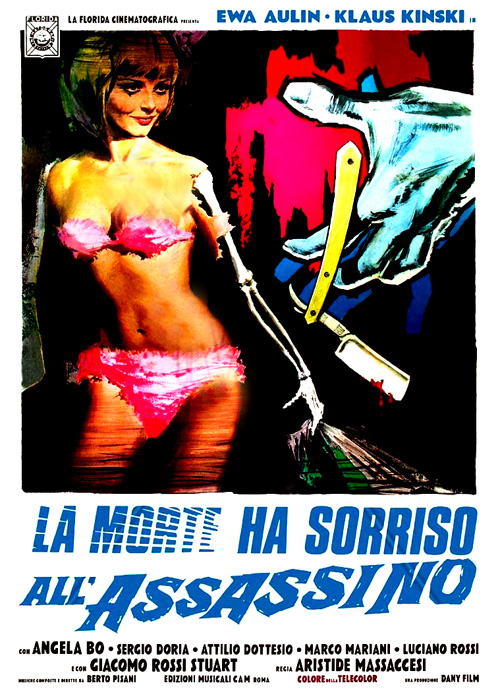
1906. Austria. Greta von Holstein (Ewa Aulin, Candy from Candy as well as Death Laid an Egg) has been used and abused by all of the men in her life, including Dr. von Ravensbrück, a rich cad who knocks her up and leaves her to die in childbirth.
Three years later. Her hunchback brother Franz, besotten with incestual love, brings her back to life with a magic medallion inscribed with the secret of life over death. He tries to get back into her pants, so she throws a black cat at his face. It eats his eyeballs, because, well, this is a Joe D’Amato movie. She then escapes into the world where she seeks revenge on the von Ravensbrück’s family.
Walter, the son of the doctor who done her wrong, and Eve, his wife, take her in after an accident outside their home. They both fall in love with her, which gives D’Amato license to shoot long lovemaking scenes. You may know him on one hand for his horror films, likeBeyond the Darkness, Frankenstein 2000,Absurdand Antropophagus. But you may also know him for his adult films like Porno Holocaust and the Rocco Siffredi vehicle Tarzan X – Shame of Jane. Here, he combines his love of the female form with his eye for murder and insanity.
Eva is becoming jealous of Greta. But what he doesn’t know is that her new lover is wiping out people left and right, just for fun. The butler in the gallery with a razor. The maid in the woods with a shotgun. A lab assistant in the lab with a metal club. Even the family doctor (Klaus Kinski, do I need to say more or tell you he was in Schizoid, Crawlspace, Marquis de Sade: Justine and more? Or that he was also maniac who was drafted to the German army, spent time as a POW and drank his own urine to get sick and get home earlier? This is not the craziest Kinski story, by the way…) is strangled right after he learned how to use her amulet to bring back the dead that he had been experimenting on (as you do).
Eva’s jealousy wins out, so she walls her up alive in the rooms beneath the castle, killing her. But Greta isn’t done yet. She shows up as a ghost at a party and lures Eva toward falling off the roof. That night, Greta’s ghost gives Walter a fatal heart attack in bed. And all of this was just to lure her old lover, Dr. von Ravensbrück, to the funeral, where she leads him to a vault and suffocates him.
A police inspector wonders if he’ll ever add up the case, as he finds the corpse of Greta’s brother near her empty grave. She’s gone and he wonders whatever happened to her. The person he has been telling the story to? Greta.
I was really struck by Berto Pisano’s music in this. He also contributed the strange soundtrack to Burial Ground. Here, his music is jazzy and then atonal, with sharp stings to call out the action.
I feel like I need to take a long shower after watching this movie. Which isn’t a bad thing, really. It’s an effective mix of giallo and gothic romance, with plenty of sleaze and gore for those seeking those thrills.
In the book Spaghetti Nightmares, Massaccesi said that he used his real name on this film because he was “encouraged by the budget…and by the presence of two important actors like Ewa Aulin and Kalus Kinski, who were appearing at the time in several Italian films, and whose presence was opposed on me by production and distribution. Kinski, in spite of everything, is an excellent professional actor.”
When asked how he felt about the movie, he wasn’t kind to himself: “Not many fond memories there. I’m afraid it’s a very imperfect film, pandering and mechanical, but this is due to the fact that I wrote the script on my own. When you don’t work with someone else who challenges your ideas, stimulates them and corrects you where necessary, helping you to make what you write credible, it’s much harder to come up with a good product.”
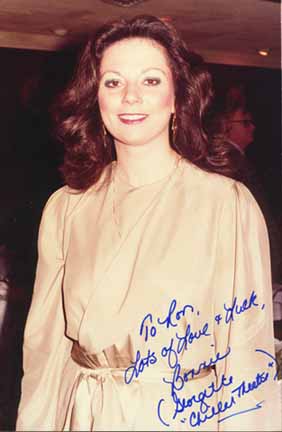
EDITOR’S NOTE: A Bell From Hell was on Chiller Theater on Saturday, July 14, 1979 and August 29, 1981.
What happens when a young man is released from an insane asylum and returns home? Well, he goes for revenge on his aunt and her three daughters, the ones who stole his insurance when they claimed he had gone crazy.
Bell from Hell isn’t an easy watch. It’s dreamy at times, brutally realistic at others, particularly the slaughterhouse scene. Juan wants revenge against Marta (Viveca Lindfors, Creepshow) and her three daughters (as well as anyone connected with them), but there are times when he could easily kill them and he lets them escape. A good chunk of this movie feels thrown together. But there’s a reason.
Director Claudio Guerín fell — or jumped — from the tower housing the title bell on the last day of shooting and was killed. The film was completed by Juan Antonio Bardem. One assumes that Bardem did the best job he could to combine all the many parts that Guerín into some whole. Throw in the fact that this movie is translated from Spanish to English and you get a swirling dervish of confusion.
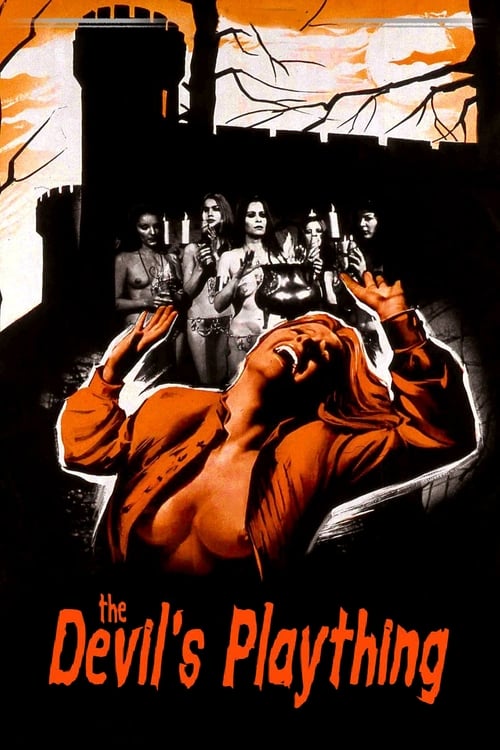
Monica (Ulrike Butz) and Helga (Marie Forså) are the guests at a huge castle where a will is about to be read. The girls will need to stay there for a year to claim the estate of Baroness Varga, who was burned at the stake for being a vampire hundreds of years ago. They’re joined by folklore scholar Dr. Julia Malenkow (Anke Syring) and her brother Peter (Nico Wolf) crash in the woods nearby. They are descendants of the women who killed Varga, which probably won’t go all that great with the castle’s maid, Wanda (Nadia Henkowa), who conducts nightly lesbian rituals devoted to the fallen blood countess.
Also known as Vampire Ecstasy, this feels like it fits right in with Jess Franco and Jean Rollin’s vampire women. I say that as a compliment. Unlike many of his New York City-shot movies, director and writer Joe Sarno shot this in an actual castle owned by the relatives of producer Christian Nebe.
Other titles include The Curse of the Black Sisters, Plaything of the Devil and Veil of Blood.
As much as I hate to admit it, this is the last chapter of Night Gallery.
If you thought it’d be an incredibly poignant story from Rod Serling, you’d be remiss.
No, the last thing of the show is…a Jack Laird directed and written black out comedy tale.
“Room for One Less” takes place in a crowded elevator that stops to let in several more people in. A monster (Lee Jay Lambert) points to a sign that says “Occupancy by more than 10 passengers prohibited by law” to the elevator operator (James Metropole), which used to be a thing up until at least the 90s, as my art school had them. The monster has a sophisticated accent when he says, “Quite.” He then blows up the elevator operator.
The end.
Ah, it’s been a journey watching all of the Night Gallery episodes and writing about them for you. Did you have a favorite episode? Did any of these bring back memories for you? This gave me a sense of joy as there is so much good here, as well as some sadness, as by the middle of the second season you can start to see that Serling wasn’t getting to tell the stories that he wanted to. Commerce always conscripts creativity but my memories before now were so rose-lensed that I forgot that even a show that I consider great has moments of not being all so good. That said, the great is enough to forget all of the one minute silly sketches that Jack Laird threw in which prove that sometimes, something extra can ruin the recipe.
Once abandoned to the wilds of public domain DVD sets, Messiah of Evil was for a time the gold amongst the dross, a film of incredible power. Hidden amongst old television shows, near-unwatchable transfers of Spanish horror and video store-era throwaways, it held a haunting power. Did I see that? Is this movie real? Can I explain it to anyone who hasn’t seen it?
Today, Messiah of Evil isn’t just a legendary once-lost film returned to power. It’s a work of art that feels like it came from beyond the wall of sleep, the place where the Ancient Ones slumber until time untold to come back and reclaim their rightful and most horrible power.
You can watch Messiah of Evil on several levels. On the most basic, it’s a film about Arietty (the never before or since more lovely Marianna Hill) attempting to find her lost artist father in the cursed town of Point Dume, California.
It’s also a zombie movie of sorts, made in the wake of Night of the Living Dead yet uninfluenced by it, where an entire town slowly becomes something like the living dead. As they bleed from the eyes and lose all sensation, they begin to crave meat from any source, be it an entire grocery store’s meat department, mice or human flesh. Once they give in to their transformation, they light fires on the shore, as their ritual of The Waiting anticipates the Dark Stranger’s return to glory, leading them toward taking over the rest of reality.
Or maybe it’s about something else. Is it about the final days of the class struggle that started in the 60s? The zombies nearly all wear suits while their targets, like collector of legends Thom (Michael Greer, who would go on to provide the voice for Bette Davis after she quit the film Wicked Stepmother) and his two lovers, Toni (Joy Bang, who worked with talents like Roger Vadim, Norman Mailer and Woody Allen before Messiah) and Laura (The Price isRight model Anitra Ford), are free love visions of style and sophistication. Yet the Dark Stranger cuts through class, even turning cop upon cop near the climax.
Parts of the film were never fully realized, but that doesn’t matter. Some critics complain that major plot points and the lead characters’ motivations are never fully explained. Even the most normal people in this film act like the strangest characters in others. At no point does it feel like we’re watching a movie set in our reality.
I don’t want that.
This is what I want. A transmission from another place where our surrealism is their everyday.
Messiah of Evil was created in an environment that will never exist again — the New Hollywood that starts with traditional studios panicking as their blockbusters and musicals would stall at the box office, while films like Easy Rider succeeded. Suddenly, deeply personal films would be made within the studio or even exploitation systems. Indeed, the previously mentioned Night of the Living Dead is packed with politics and social commentary, things only hinted at in past horror and science fiction films. This trend would die with Jaws and Star Wars. Yet at this point, as this film’s commentary track by Kim Newman and Stephen Thrower reminds us, even the creators of the blockbusters that changed entertainment forever, all the way back then, all wanted to be artists. And in a moment of true irony, the creators of this film — the husband-and-wife team of Willard Huyck and Gloria Katz — would go on to direct Howard the Duck and write American Grafitti andIndiana Jones and the Temple of Doom for Goerge Lucas.
This is a movie where the heroine finds herself in the throes of undead transformation, throwing up mouthfuls of insects while the shade of her father begs her to not tell the world what she knows before he attacks her. After murdering everyone else in their path, the dead things of Point Dume don’t kill her. No, they resign her to an even more horrible fate: she must spread the legend further so that once the Dark Stranger arrives, more of reality is receptive to his grasp. She ends the film in a mental institution, knowing that one day soon, the end of everything we hold dear will arrive.
I love that this movie once appeared in DVD bundles easily available in K-Marts and WalMarts, places where normal people would find this asynchronous transmission from another place and time and wonder what the hell they were watching. Much like the infection of Point Dume or Arietty spreading the infection into other towns, it found the right people. It always discovers the best way to transmit its message to those most willing to spread its legend. It survives, no matter what, despite not being finished, despite age, despite being lost for so long.
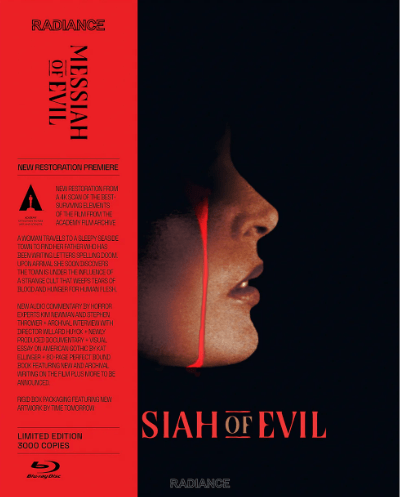
How wonderful it is to have what was once occult brought into the light and yet it loses nothing of its infernal power. In fact, it retains its power now, all the furtive watches and evangelists that loved this movie and spread that message. It’s just easier to access it thanks to the Radiance Films blu ray.
Featuring a 2023 restoration from a 4K scan of the best-surviving elements of the film from the Academy Film Archive, their blu ray release is something I never thought would happen. It creates new moments and feelings in me; I always believed that Arietty felt trapped in a comic strip world in her father’s house, but thanks to this new restoration, it appears that his paintings are real, that the mirrors and colors and brushstrokes are his way of showing how the outside city has become sick and wrong. They are as trapped in this reality as any other. The colors on her face as she drives through the night, the hum of the marquee in the center of town, the faces that appear in Ralph’s supermarket hungry for something, anything — all more vital. All more fresh. All more dead.
This release also includes an archival interview with co-writer-director Willard Huyck by Mike White from the Projection Booth Podcast; a documentary titled What the Blood Moon Brings: Messiah of Evil, A New American Nightmare that is co-directed by Dima Ballin and Kat Ellinger and has appearances by Alexandra Heller-Nicholas, Maitland McDonagh, Guy Adams, Mikel Koven and David Huckvale; and a visual essay by Ellinger on American Gothic and female hysteria.
There’s also a reversible sleeve featuring original and newly commissioned artwork by Time Tomorrow, as well as a book with contributions by Bill Ackerman, Joseph Dwyer, Amanda Reyes, Andy Marshall-Roberts and Larissa Glasser.
The extras have added even more to my love of this film, even if Newman and Thrower can’t tell the difference between Joy Bang and Anitra Ford. Not just once. Multiple times. I don’t expect two British film experts to know what Ralph’s supermarket is, but my love for both Bang and Ford — and of course Hill — is beyond human measurement. I yelled at my television!
If you love movies, you should have already bought this.
EDITOR’S NOTE: The Roommates aired on USA Up All Night on June 18 and December 11, 1993 and February 24, 1995.
Carla (Marki Bey, Sugar Hill herself!), Heather (Pat Woodell, The Big Doll House) Beth (Roberta Collins, Eaten Alive, Unholy Rollers), Brea (Laurie Rose AKA Misty Dawn, the wife of John Holmes) and Paula (Christina Hart, The Stewardesses) take a summer vacation together on Lake Arrowhead. This would seem to be a very Corman nurse movie from the surface, but the tagline — “Which will die in the class of ’73?” — points to a very frightening story.
Is it too soon to talk about 1972?
Of course, all the men in this movie are horrible, like Martin (Ken Scott), the owner of the motel who sleeps with Heather and was the man who took her virginity when she should have been doing her driver’s test. And then there’s the death of Alice (Connie Strickland), stabbed a hundred times and left in the woods so close to where the girls sleep.
Whodunnit? Socks the biker (John Durren, who wrote the movie)? His girlfriend (Paula Shaw, The Centerfold Girls, Pamela Vorhees in Freddy vs. Jason)? Creepy Harold (Greg Mabrey)? Don the handyman (Kipp Whitman)? Just about any guy in this movie? And why would Heather throw a big party when, you know, there’s been a murder?
I’m making this sound more like it has an actual story and less than a vehicle for female nudity, as each of the leads gets their clothes off as do the guest stars, which include Connie Strickland, Uschi Digard, Lindsay Bloom (H.O.T.S.), and Juanita Brown. When your movie starts with a medical school orgy, you know how it will go.
Arthur Marks also directed Detroit 9000, Bonnie’s Kids, Linda Lovelace for President, the way better than any of those movies J.D.’s Revenge, Friday Foster and uncredited work on Solar Crisis. Durren also came up with the idea for the Mickey Rooney movie The Manipulator and wrote Devil Times Five.
I like the ramshackle narrative of this movie, but this one really shows you just how good Corman’s crew was at making their girls movies.
Directed by Timothy Galfas (Black Fist) and written by Jack Laird from a story by Mary Linn Roby, “Die Now, Pay Later” never aired during the original run of Night Gallery. Instead, this and next week’s episode, “Room for One Less” were unaired stories from season 2 added to the syndication package along with episodes of The Sixth Sense. Rod Serling came back to record new introductions for these stories as well as those unconnected stories of the Gary Collins series.
Sheriff Ned Harlow (Slim Pickens) thinks that the death rate in Taunton, Massachusetts is increasing because of the January clearance sale of funeral director Walt Peckinpah (Will Geer). According to Harlow’s wife, Peckinpah has relatives in Salem and may be a relative of a warlock who was burned after the witch trials. But after getting all excited, Harlow’s wife calls the funeral home and yells at him.
The sale continues with the sheriff perhaps being a customer.
This is, as you can guess by Laird being involved, an episode of low quality. Why it’s a half hour is beyond me. Ah well — we should probably just enjoy the good stories and not be so sad about the rough ones.




 B&S About Movies
You must be logged in to post a comment.