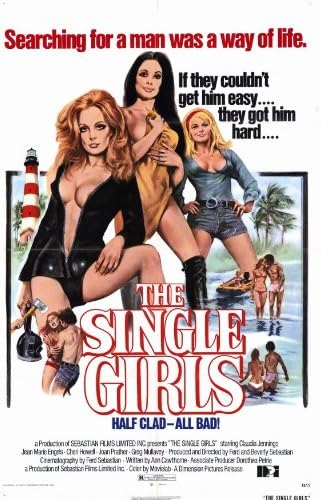
An early effort by the Sebastians, The Single Girls has a TV Guide-style write-up on Wikipedia: “A group of men and women travel to a Caribbean resort to discover themselves sexually, but unfortunately one of them has also discovered that they like to murder people, too.”
Also known as Bloody Friday and Private School, this has a bunch of singles all having an encounter on an island and when they’re not balling or having dark room milling, which is when everyone touches everyone else, and no one knows who is who, there’s a killer on the loose. Yes, a nascent slasher, as they say.
There’s Lola (Joan Prather), a virgin who decides to go to this island to lose her virginity. Allison (Claudia Jennings) hates commitment, and, you know, her boyfriend is a loser, so she shouldn’t be into it. Also, she’s Claudia Jennings. Shannon (Cheri Howell) wants to have everyone on the island. Dr. Stevens (Wayne Dvorek) has made a pretty groovy scene, but like I said, someone has a knife. The sex in this is relatively chaste, but there’s a good idea going on here.
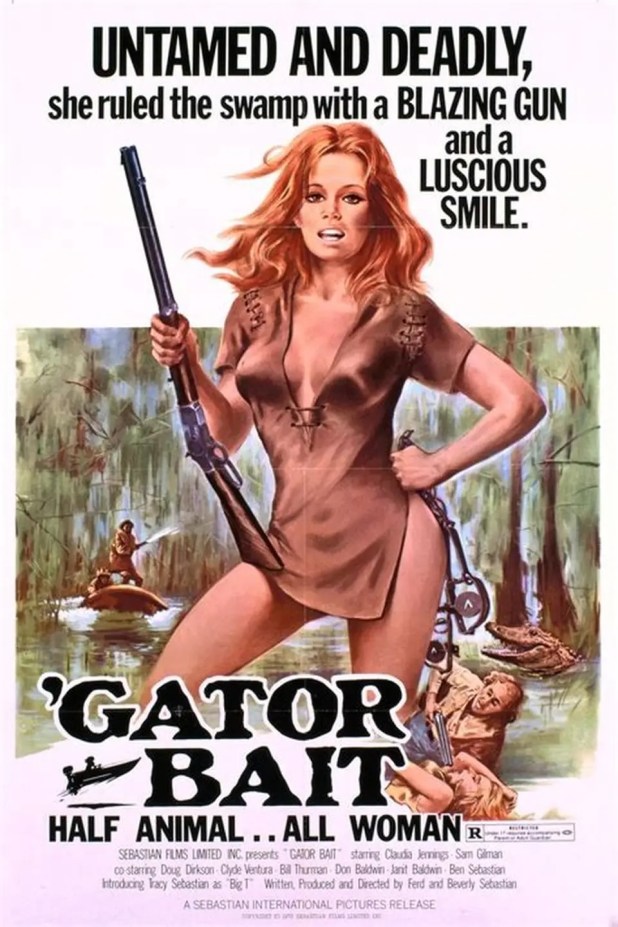
Plus, we got ‘Gator Bait out of this, as it introduced Jennings to the Sebastians.
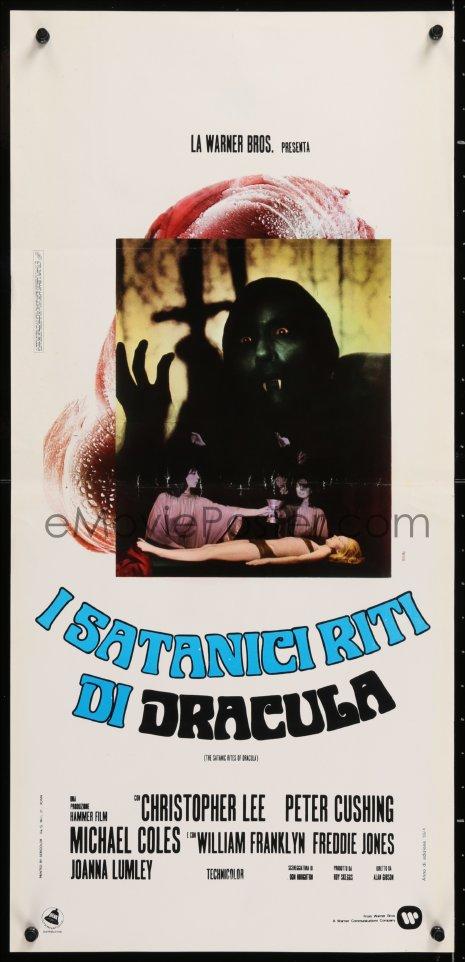
Man, what a title. Better than the original one, Dracula is Dead…and Well and Living in London, which upset Christoper Lee so much that he was outspoken at the press conference that introduced the movie: “I’m doing it under protest… I think it is fatuous. I can think of twenty adjectives — fatuous, pointless, absurd. It’s not a comedy, but it’s got a comic title. I don’t see the point.”
The eighth Hammer Dracula movie, the seventh and final to star Lee (John Forbes-Robertson played Dracula with David de Keyser as the voice in The Legend of the 7 Golden Vampires) and the third and last to put Lee’s vampire against Cushing’s Van Helsing (they would appear in only one more movie together, House of the Long Shadows), this is pretty much the end of an era.
Every time I think of this movie, I remember Bill Van Ryn of Drive-In Asylum excitedly saying to me — after we saw the trailer at a drive-in — “It’s not enough that Dracula is a vampire. Now he has an entire army of Satanists and he wants to rule the world and he has a plague!”
It turns out there’s a government occult conspiracy that only Van Helsing can stop, and he’s bringing along his granddaughter, Patsy Stone, err, Jessica Van Helsing.
As the cabal prepares for the Sabbath of the Undead, their mysterious fifth member is revealed to be, of course, Dracula, using the identity of reclusive property developer D. D. Denham and operating out of the very same churchyard where he died in Dracula A.D. 1972.
Somehow, this is more of an Eurospy science-fiction movie than a traditional horror film, and that’s kind of the beauty of the whole thing.
Somehow, this fell into the public domain in the U.S. That’s why it’s on so many Mill Creek sets under this title and the edited TV version Count Dracula and his Vampire Bride.
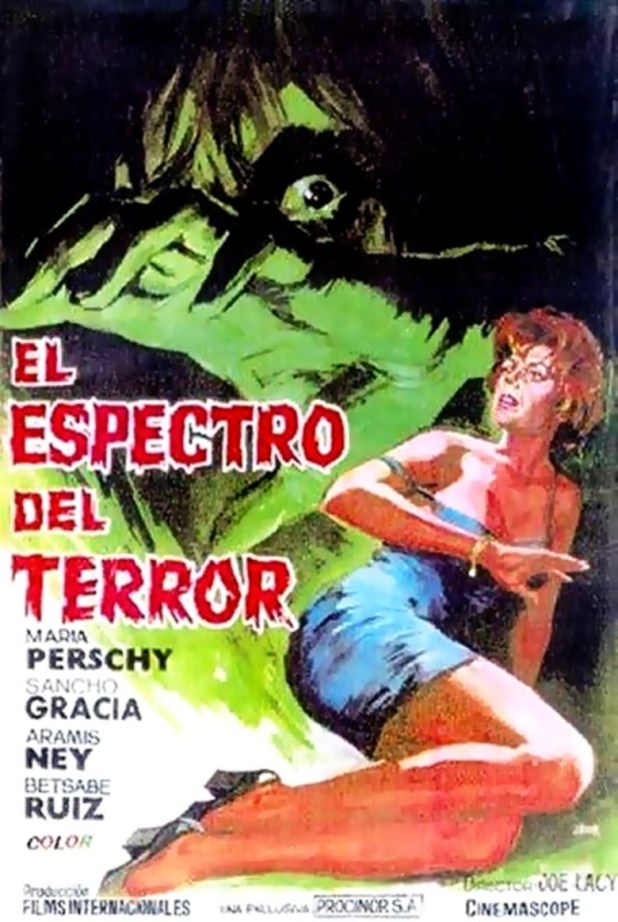
La Furia del Hombre Lobo is a 1970 Spanish horror film that is the fourth in the saga of werewolf Count Waldemar Daninsky, played as always by Paul Naschy. It was not theatrically released in Europe until 1975, yet an edited U.S. version played on television as early as 1974 as part of the Avco Embassy’s “Nightmare Theater” package, along with Naschy’s Horror from the Tomb and The Mummy’s Revenge.
This time, Daninsky is a professor who travels to Tibet, only to be bitten by a yeti which seems like not the werewolf origin that you’d expect. He then catches his wife cheating on him, so in a fit of passion, he murders them both before being killed himself. But this being a Spanish horror movie, that’s just the start of the trials that El Hombre Lobo must struggle through.
Daninsky is revived by Dr. Ilona Ellmann (Perla Cristal, The Corruption of Chris Miller), who wants to use him for mind control experiments. Soon, however, our hero learns that she has a basement filled with the corpses of her failed experiments. To make matters even worse, she brings back his ex-wife from the dead and turns her into a werewolf too!
There’s a great alternate title to this movie: Wolfman Never Sleeps. How evocative! That’s the Swedish version that has all of the sex that Franco’s Spain would never allow.
Naschy claimed that director José María Zabalza was a drunk, which may explain how this movie wound up padded with repeat footage from Frankenstein’s Bloody Terror and some stunt double continuity antics that nearly derail this furry film.
Dr. Death (John Considine) is a thousand-year-old magician who can transfer souls from one body to another. He keeps himself alive by jumping from one body to the next, and oh yeah — he has acid blood. I mean, sure, I’m down with that.
Sadly, this never got a sequel, as that was the plan. The main story is about Fred Saunders (Barry Coe), whose wife has just died and promised to return from the other side. After discovering that each spiritualist is a carny liar, he meets Doctor Death, who truly can bring the dead back from the grave. Of course, he’s also an absolute maniac.
One of the film’s financiers was Barry Gordy, who got to direct a scene. It’s also the last screen appearance of Moe Howard and has horror host Larry “Seymour” Vincent as a killer.
Consider this a 1973 TV movie that played theaters and drive-ins. It’s low budget, but groovy as it gets. I want to live in the world of this movie so badly. I really wish they’d made ten of these movies. “Enter that body!” says Doctor Death. Sure, whatever you want.
EDITOR’S NOTE: Don’t Look In the Basement was on Chiller Theater on Saturday. March 3, 1979 at 1:00 a.m. and Saturday. December 11, 1982 at 1:00 a.m.
We often refer to movies as “Brownriggian” when we watch films all night on Saturday nights with the Drive-In Asylum Double Feature on Facebook Live. There’s no better example of what this word means than S. F. Brownrigg’s 1973 shocker Don’t Look in the Basement AKA The Forgotten AKA Death Ward #13.
Dr. Stephens, the primary doctor at Stephens Sanitarium, has a theory that patients should be able to freely act out their insanities in the hopes that someday they will snap back to reality. You know, if I’ve learned one thing about asylum doctors from, well, Asylum and Alone in the Dark, it’s that they’re all just as insane as their charges.
Before one of the older nurses can retire, we have the Judge (Gene Ross) chopping the doctor with an axe and Harriet (Camilla Carr) smashing the nurse’s head inside a suitcase. So when Charlotte Beale (Rosie Holotik, the cover girl of the April 1972 Playboy, as well as appearances in Horror High and the ghostly hitchhiker in Encounter with the Unknown) shows up for a new job and things seem weird. Or Brownriggian. In short, everything feels off. Hallways and stairwells seem like passageways to other dimensions, and sweaty horror lurks, sleeping like some kind of Southern gothic force of dread and menace.
This is a place filled with human children, killer women obsessed with sex, an elderly woman who thinks that flowers are her kids, a military man who lost his platoon in Vietnam and more. Even the sane are driven mad just by being in their presence.
There are plenty of people who decry Brownrigg’s movies, but I’m certainly not one of them. They invite you to worlds that are not our own and seem to come from a dimension far from here. For that and the vacation to the psychotronic that they offer, we should celebrate them.
For an added treat, check out JH Rood’s journey to the set locations, which you can download from the Internet Archive.
Each October, the Unsung Horrors podcast does a month of themed movies. This year, they will once again be setting up a fundraiser to benefit Best Friends, which works to save the lives of cats and dogs across America, giving pets second chances and providing them with happy homes.
Las ratas no duermen denoche (Rats Don’t Sleep at Night) was released in the U.S. as Crimson, the Color of Blood and The Man With the Severed Head.
After a jewel heist, Jack Surnett (Paul Naschy) is shot in the head. His gang is smart enough to know that there’s a scientist named Professor Teets (Ricardo Palmerola) who can do some pretty wild surgeries, like a brain transplant. However, they use the brain of a serial killer named The Sadist (Roberto Mauri), going out in the middle of the evening to just chop off his head. And by this amazing procedure, Jack becomes even more violent than he was before.
Directed by Juan Fortuny, who co-wrote the script with Marius Lesoeur and H.L. Rostaine, this film features Naschy in what must have been a dream role, as every time he sees a woman, he has to make love to her. Well, not love. Violent killing maniac love. This has plenty of Eurocult goddesses in it, like Evelyne Scott (AKA Evelyne Deher, she’s also in Shining Sex), Silvia Solar (Devil’s Kiss) and Gilda Arancio (Kiss Me Killer).
More of a crime movie than a horror film, this doesn’t have much Nashy, but it does feature random dance scenes, and when he finally does show up, he’s all wrapped up. But I kind of like that it’s a gangster movie. Head transplants were a big thing in 70s!
Supposedly, The Devil’s Wedding Night (AKA Full Moon of the Virgins) was all Mark Damon’s idea. After being in House of Usher, Damon had moved to Italy and appeared in movies like Black Sabbath and Johnny Yuma.
Perhaps this idea was the start of his producing career, which was more successful than his acting job. Damon was planning on selling the movie an American production company. Luigi Batzella (Nude for Satan, The Beast In Heat) was picked to direct, but most people believe that Joe D’Amato stepped in and finished the film.
I’m a firm believer in this theory because there’s a moment near the end of this movie where an otherworldly Countess Dolingen De Vries rises from a bathtub of blood and fog and writhes near nude on the screen and somehow going beyond the confines of the screen to destroy my mind. I generally try my best not to turn reviews of movies with atrractive women into male gaze spectacles, but Rosalba Neri is absoutely iconic in this moment, a perfect scene that is never discussed nearly enough.
There’s also a magic vampire ring of the Nibelungen, which is gigantic costume jewelery and therefore better than any Hollywood baubles, village girls with sacred amulets of Pazuzu (yes, really), five virgins getting sacrificed all at once in an express line of bloodletting magic, three different twist endings in a row, tripped out Dr. Who looking tunnel moments, D’Amato billing himself as Michael Holloway and going absolutely wlld capturing every inch of womanly curves and an incredible setting, the Castello Piccolomini Balsorano, the same place Lady Frankenstein, Bloody Pit of Horror, Crypt of the Vampire, The Lickerish Quartet, The Blade Master, Sister Emanuelle, The Bloodsucker Leads the Dance, The Reincarnation of Isabel, Farfallon, Pensiero d’amore, Lady Barbara, 7 Golden Women Against Two 07: Treasure Hunt, C’è un fantasma nel mio letto, Baby Love and Put Your Devil Into My Hell were all shot at.
Plus, Xiro Papas, the monster of Frankenstein 80, plays a vampiric giant.
If you’re a fan of the harder side of Hammer, then allow this female vampire to obsess you as well.
EDITOR’S NOTE: Andy Warhol’s Frankenstein was on USA Up All Night on May 12 and July 13, 1990.
Joe Dallesandro is one of those nexus points for so many movies and parts of culture that I love. Born to a Navy man and a mother who was serving fifteen years in a federal pen for auto theft by the time he was five, Joe went from foster homes to knocking out his high school principal and stealing cars just like his mom. He got shot in the leg, and when his dad took him to the hospital, the cops arrested the fifteen-year-old and sent him to the Catskills, specifically the Camp Cass Rehabilitation Center. He escaped within a few months and made it back to New York City, where he went from nude modeling to being the star of Warhol’s films.
After roles in Lonesome Cowboys, Trash, Heat, and Warhol’s two monster films, Joe decided to stay in Europe, where he made a wide range of movies across various genres that I love. Yeah, there’s the American TheGardener, Serge Gainsbourg’s Je t’aime moi non plus, Savage Three, Killer Nun, Madness, Le Marge with Sylvia Kristel and many more. He even shows up somehow in Theodore Rex. Yes, the same man whose bulge is on the front of the Rolling Stones’ Sticky Fingers, and the cover of The Smiths’ first album, was in a movie about dinosaur cops.
This is the movie that Joe, who never once gave it away, came to Italy to make with Paul Morrissey.
Baron von Frankenstein (Udo Kier) has made his sister Katrin his wife, yet ignores her as he works to create the perfect human being, going through corpses of men and women to craft his Serbian ideal. You know, when he isn’t literally having sex with the body parts of dead women while shouting, “To know death, Otto, you have to fuck life… in the gall bladder!”
He wants Nicholas (Dallesandro) to be the body of his creature, but he escapes and makes his way to the castle, where he begins to satisfy the Baroness. Once she reveals the fact that she only cares about herself, she betrays him and, in return, is given what she really wants: The opportunity to have sex with the Baron’s creation, who responds by loving her to death. Another even more graphic scene happens when lab assistant Otto literally screws the guts out of the female monster (Dalila Di Lazzaro, Phenomena), causing the angry Dr. Frankenstein to kill him.
I kind of dig that the end of this film echoes both A Bay of Blood and Manson’s quote about “These children that come at you with knives — they are your children” by having the Frankenstein children holding scalpels that they will either use to help or to hurt. The movie doesn’t tell you what happens next.
That A Bay of Blood comparison is easier to make when you realize that one of the kids is played by one of the adorable and murderous kids from that movie, Nicoletta Elmi. In the 70s, if you wanted a frightening Italian red-headed child, you went with Nicoletta, who also appeared in Baron Blood, Who Saw Her Die?, Deep Red and many more. She also played the redhead usher in Demons when she grew up.
Despite his name appearing in this film, Andy Warhol’s contributions were minimal. He may have visited the set once and briefly examined the editing. Perhaps a more involved talent was Antonio Margheriti—Anthony Dawson—who claimed to have directed some of the film. He may have just been there so that the film could claim to be Italian, as it would need a director from the country to obtain Italian nationality for the producers.
One can only imagine that Jess Franco sat in a theater as Ken Russell’s The Devils ended and thought to himself, “But where’s the sex? I want more of it. I demand more of it!
After watching a witch burn, we meet two nuns in a convent, the virginal Margaret (Britt Nichols AKA Carmen Yazalde, who appears in The Erotic Rights of Frankenstein, A Virgin Among the Living Deadand is sacrificed in Tombs of the Blind Dead) and her more sex-obsessed sister Kathleen (Anne Libert, House of 1000 Pleasures and Sins of the Flesh).
A rich woman named Lady De Winter (Karin Field, Target Frankie and Return of Shanghai Joe) believes that Kathleen is possessed by Satan and that the two are the daughters of that blackened witch, so she puts her top man, Thomas Renfield (Alberto Dalbés, A Quiet Place to Killand Espionage In Tangiers) after her. Of course, he falls in love and lets her escape. And even when Inquisitor Lord Justice Jeffreys (Cihangir Gaffari, Dick Turpin and Bloodsport) gives him another chance, Renfield runs back to her and the two are soon tortured into near oblivion.
Meanwhile, Satan himself appears in the convent and assaults Margaret, replacing her innocence with an overwhelming desire to punish anyone who harmed her mother or sister, starting with Lady De Winter, often by kissing them into skeletons. You know, no one loves female revenge more than Jess Franco and he’s going all out here, with Margaret seducing her Mother Superior right into suicide and then leaving no man or woman safe from her vengeance.
This is one of the more gorgeous films Franco would make — it was shot by Raul Artigot (The Ghost Galleon, The Cannibal Man, The Pyjama Girl Case) — and he makes excellent use of his budget. And he lives up to those dreams of a movie that somehow answers, “What if Witchfinder Generalwas more about lesbians?”
From Vinegar Syndrome: “Italian horror in the 1960s and 70s went through several popular tonal and thematic phases. From Gothic thrillers in the early to mid-1960s, psychedelia and monster mayhem in the late 1960s and early 1970s, and, of course, all manner of gialli and other assorted murder thrillers. But what of those films that offer a form of narrative bait and switch, luring the viewer in with the pretense of one genre while slowly revealing themselves to be something else entirely? Presented here are a trio of 70s Italian horror features which play with, combine, subvert, and surprise with their genre leanings, all newly and exclusively restored from their 35mm original negatives and all presented on English-friendly home video for the very first time, from Vinegar Syndrome.”
Obscene Desire (L’osceno desiderio) (1978): Obscene Desire is the story of Amanda (Marisa Mell, a goddess if there ever were one and someone who immediately changes any movie from maybe to definitely; my favorite of her films are Marta, Danger: Diabolik and Perversion Story, a movie in which she has one of the most fabulous outfits not only in the history of Italian film but perhaps all movies ever), an American woman ready to marry the rich Andrea (Chris Avram, Enter the Devil) and move into his vast mansion.
Within the walls of that gothic expanse lies something evil, something that has possessed Amanda’s soon-to-be husband to indulge in black magic and ritual murder. In fact, the only way that he can keep his soul from being taken by his domicile is to keep killing prostitutes.
This movie should teach you to never trust a gardener (Victor Israel) and that the Italian film industry would keep on making Rosemary’s Baby rip-offs ten years after that movie was unleashed. Or The Exorcist five years later. Or The Omen two years later.
Look, I’m a simple man. Marisa Mell, with short, dark hair, looking not unlike Mariska Hargitay, is possessed by the devil and writhes on a bed, revealing that her tongue is superhumanly long. Do I even care that this movie has no real story and really goes nowhere?
Extras on the Vinegar Syndrome release include a commentary track with film historians Eugenio Ercolani and Troy Howarth, interviews with director/writer Giulio Petroni, daughter of Giulio Petroni and script supervisor Silvia Petroni, grandson of Giulio Petroni and film historian Eugenio Ercolani, censorship expert Alessio Di Rocco and director Pupi Avati, as well as alternate and extended scenes from the Spanish version and the original Italian trailer.
The Bloodstained Lawn (Il prato macchiato dirosso) (1973): The Red-Stained Lawn, also known as The Bloodstained Lawn, was initially titled Vampiro 2000 and combines science fiction, Gothic horror, and giallo genres in a wacky package with a bloodsucking robotic twist.
The film takes place in Emilia-Romagna, Italy. There, a United Nations Educational, Scientific and Cultural Organization agent finds a bottle of wine containing blood. How could this happen to such a well-known vintage from Michelino Croci? What if the winery is a front for a blood smuggling scheme? And how would blood stay good in bottles? So many mysteries!
Dr. Antonio Genovese (Enzo Tarascio), his wife Nina (Marina Malfatti, All the Colors of the Dark, The Red Queen Kills Seven Times, Seven Blood-Stained Orchids) and her brother Alfiero (Claudio Biava) look for people with no ties — hippies, drifters, prostitutes and literally gypsies, tramps and thieves — to lure to an all expenses paid getaway at their castle. Folks like freewheeling musician Max (George Willing, Who Saw Her Die?) and his lover (Daniela Caroli), who have accepted an invitation to spend some time in the Genovese estate, along with the alcoholic tramp (Lucio Dalla, who would become a major singing star in the 80s), a gypsy (Barbara Marzano, The Bloodsucker Leads the Dance) and a sex worker (Dominique Boschero, Argoman the Fantastic Superman).
The bloodsucking machine is literally right out in the open, treated like a piece of pop art. You have to admire that level of out in the open when it comes to an Italian film killer. You also have to love that the killers have a shower that sprays wine, and this doesn’t bother Max or his never-named girlfriend, nor does the hall of mirrors bedroom seem strange to anyone else. There’s also a curtain between rooms that resembles female anatomy, and even more so, a scene taken right out of The Laughing Woman.
Director and writer Riccardo Ghione made only four movies: this one, a documentary called Il Limbo, the hippy drama A cuore freddo, and La rivoluzione sessuale, a film in which seven men and seven women perform an experiment inspired by the sexual orgone energy theories of Wilhelm Reich. If that was crazy enough, it was co-written by Dario Argento. He would go on to write several other films, including the Joe D’Amato film Delizia.
I love that this movie stands on the line between arthouse and grindhouse, with every decision it makes leaning away from the artistic and toward the prurient and bloody. Sure, there’s a message about how the rich subjugate the lower classes, but it’s also a film where Malfatti gives speeches about Wagner and how meaningless her victims are, all. At the same time, a gigantic cartoony machine literally sucks young blood.
Extras on the Vinegar Syndrome release include commentary by Rachael Nisbet and interviews with film historian Enzo Latronico and filmmaker/film historian Luca Rea.
Death Falls Lightly (La morte scende leggera) (1972): Death Falls Lightly begins when Georgio Darica (Stello Candelli) comes home from a crime-related business trip only to find that his wife has been killed. So his lawyer suggests that he grab his girlfriend, Liz (Patrizia Viotti, Amuck) and head off to a hotel. Still, when he gets there, the owner (Antonio Anelli) has also killed his wife, so he asks him to help bury her, but then George remembers that the hotel was abandoned. So is he going insane? Are these people real? Did he actually kill his wife?
The next part of this movie gets absolutely ridiculous in the best of ways, as people appear, get murdered and come back to life. At the same time, someone commits suicide on a Satanic altar, invisible killers attack George, prog rock blasts, and a monkey shows up out of nowhere. It also features the most ridiculous of all giallo police, which is saying something. There’s a very low bar for giallo cops, and these ones may be the worst.
Director Leopoldo Savona also made Byleth: The Demon of Incestthe same year I was born, which probably means something.
Extras on the Vinegar Syndrome release include commentary with film historians Eugenio Ercolani and Troy Howarth, interviews with actor Alessandro Perrella and filmmaker/film historian Luca Rea, and a then and now location featurette.
This 3-disc region-free Blu-ray set features all the movies newly scanned and restored in 2K from their 35mm original negatives, along with newly translated English subtitles and reversible sleeve artwork. You can get it from Vinegar Syndrome.
You must be logged in to post a comment.