EDITOR’S NOTE: Night of Terror was on the CBS Late Movie on September 15, 1975 and August 3, 1977.
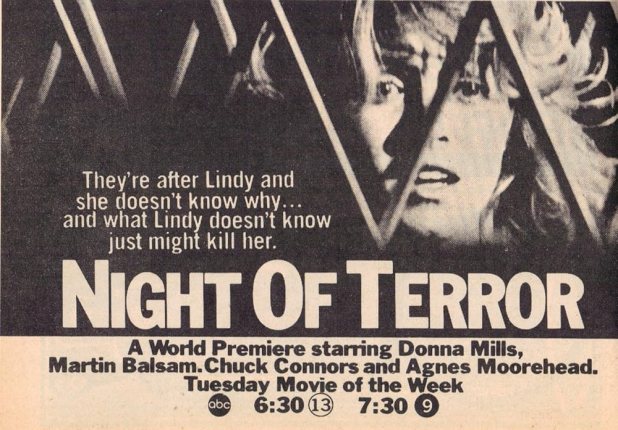
Linda Daniel (a super young Donna Mills, years before she was a star on Knots Landing and had her own eye makeup video, The Eyes Have It) is in the crosshairs of Brian (Chuck Connors), a killer who wants something that Manning (John Karlen) has but has no idea what it is. So instead, he’s coming after Linda and her roommate Celeste (Catherine Burns). He causes a car accident that kills Celeste — spoiler — and puts Linda in a wheelcahir and that’s still not enough.
Capt. Caleb Sark (Martin Balsam) puts her up in a beach safehouse, but if we know anything about killers after Wait Until Dark, we understand that there’s no stopping Brian from getting what he wants.
Director Jeannot Szwarc started his career on episodes of Ironside, It Takes a Thief and Alias Smith and Jones. His career would expand into TV movies and finally theatrical features like Bug, Jaws 2, Supergirl and Santa Claus: The Movie. He kept directing all the way to 2019, at the age of 82, working on episodes of Gray’s Anatomy, Castle and Bones. This was written by TV vet Cliff Gould and shot by Howard Schwartz, who won an Emmy for his work. He was the director of photography on shows like Cliffhangers!, The Incredible Hulk TV movie and theatrical releases including Futureworld and Batman: The Movie.
Shout out to Night Killer star Peter Hooten and Agnes Moorehead for showing up as Bronsky!
EDITOR’S NOTE: Dr. Phibes Rises Again was on the CBS Late Movie on January 31, 1975 and January 2, 1976.
The fact that this movie exists gives me hope. There are moments when life gets me down, when I wonder about my place in this world and if humanity is essentially horrible. Then I remember that great films like this exist and it makes me feel a lot better. You should do the same thing if you ever find yourself in an existential crisis.
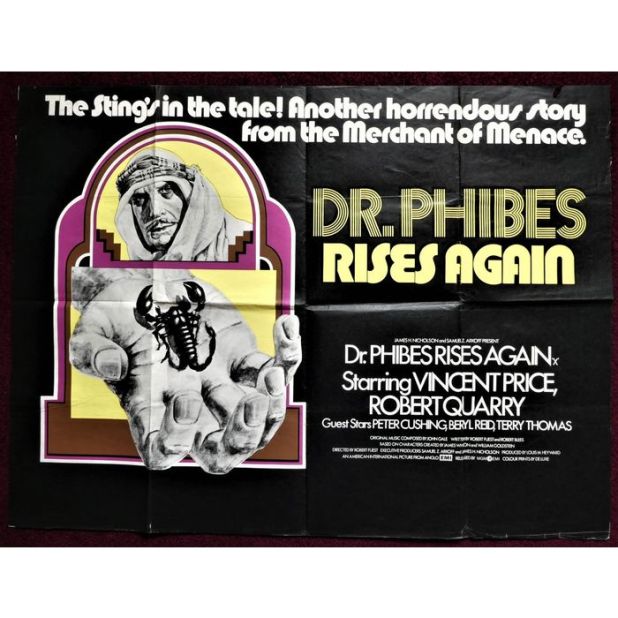
Dr. Phibes is back, three years after he lay down in the darkness next to the corpse of his beloved wife. Now, however, he has learned that the secret of eternal life, held by a centuries-old man, is in Egypt. I don’t care why he’s back. I’d watch Dr. Phibes go grocery shopping!
Dr. Anton Phibes (Vincent Price) has been in suspended animation in a sarcophagus alongside his wife Victoria Regina Phibes (Caroline Munro). When the moon aligns with the planets in a way not seen for two millennia, he returns, summoning the silent Vulnavia (thus confirming to me, at least, that she’s really one of his robots as she died in the last film; furthermore, she’s played by Valli Kemp, who took over for the pregnant Virginia North) to his side.
Phibes plans on taking his wife’s body with him to Egypt, where the River of Life promises her resurrection. As he emerges from his tomb, his house has been demolished and the safe that contained the map to the river lies empty. That’s because the map has been stolen by Darius Biederbeck, a man who is hundreds of years old thanks to a special elixir. He may also be every bit Phibes’ equal.
Darius is played by Robert Quarry, who American International Pictures was grooming to be Price’s replacement. There were tensions between the two on set, including a moment where Quarry was singing in his dressing room and challenged Price by saying, “You didn’t know I could sing, did you?” Ever the wit, Vincent Price replied, “Well, I knew you couldn’t act.” Quarry would have already played Count Yorga in two films for AIP and would go on to appear in The Deathmaster, where he played the hippie vampire Khorda; however, the AIP style had already fallen out of fashion. He’s also in numerous Fred Olen Ray films, such as Evil Toons, where he provides the uncredited voice of the demon.
Biederbeck wants eternal life for himself and his lover Diana (Fiona Lewis, Tintorera…Tiger Shark). Phibes and Vulnavia are on his trail, immediately entering his home, murdering his butler and stealing back the map. Everyone connected with Biederbeck comes to an ill end — Phibes places one inside a giant bottle and throws him overboard. That murder brings Inspector Trout back on the case, as he instantly recognizes that only one man could do something like that.
The rest of the film’s murders are based on Egyptian mythology versus Biblical plagues. Hawks and scorpions, rather than his weapons, along with gusts of wind and bursts of sand. Phibes has also brought an army of clockwork men with him the desert to do his bidding.
Phibes finally exchanges Diana’s life for the key to the River of Life. As he floats the coffin containing his wife down the water, he beckons Vulnavia to join them. As his lover tries to comfort him, Biederbeck begs Phibes to take him with them. He begins to rapidly age and dies as Phibes loudly sings “Over the Rainbow,” which might be the best ending of any movie ever made.
There were plans for many more of these films, and the fact that they were never made saddens me to this day. I’ve heard that a third film would Phibes fighting Nazis. I’ve also heard that it’d be about the key to Olympus. Or Phibes is Dr. Vesalius’ son. Or Victoria Phibes herself coming back, just as sinister as her husband. There have been titles thrown around like Phibes Resurrectus, The Seven Fates of Dr. Phibes and The Brides of Dr. Phibes. There was even a thought of Count Yorga facing off with Dr. Phibes, a fact which delights me to no end.
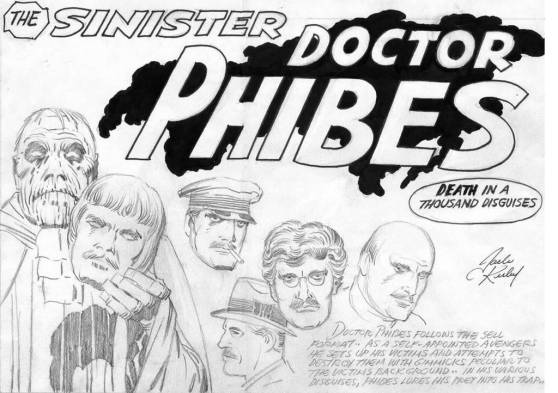
There was also a pitch for a TV series and what appeared to be an animated version, with Jack Kirby himself providing the pitch artwork.
Other ideas included Dr. Phibes in the Holy Land, The Son of Dr. Phibes (which would have pitted the doctor and his son against ecological terrorists), Phibes Resurrectus (which would have David Carradine as Phibes battling against Paul Williams, Orson Welles, Roddy McDowall, John Carradine and Donald Pleasence. The mind boggles at the thought, let me tell you!), a 1981 Dr. Phibes film where the WormwooInstitutete would have destroyed his wife’s body and then their strange members, including transvestite twins obsessed with economics and nuclear weaponry, fail to match wits with Phibes) And finally, Phibes was almost a role for Peter Sellers in a Pink Panther film where he’d also play Clouseau and Fu Manchu. You can learn more about these at the Vincent Price Exhibit site.
There was also a story in 2013 that Johnny Depp was going to star in a Tim Burton directed remake. That obviously Burton-directed film fits into the same Satanic themes as the original. However, you can add in a few new wrinkles. One of the Eleven Satanic Rules of the Earth states, “When walking in open territory, bother no one. If someone bothers you, ask him to stop. If he does not stop, destroy him.” All Phibes wished to do was take his wife to Egypt and bring her back to life. Once Biederbeck stole from him, his fate was sealed.
Ellie (Tiffany Bolling, The Candy Snatchers) and Myra Thomas (Robin Mattson, Candy Stripe Nurses) leave behind their abusive stepfather with a shotgun blast and make their way to Los Angeles and the home of their Uncle Ben (Scott Brady), who involves the two of them in a moey-laundering scheme. But Ellie knows the score and soon takes the money for herself, instructing her sister to meet her and Larry (Steven Sandor), the mark she’s conned, in El Paso. But things aren’t going to work out for them.
Director and writer Arthur Marks’ father was an assistant director on The Wizard of Oz and spent thirty years at MGM, which is where Arthur worked in the production department. His films, The Roommates, Detroit 9000, Bucktown, J.D.’s Revenge, Friday Foster, The Monkey Hu$tle, The Centerfold Girls and Linda Lovelace for President all filled a need big studios could care less about: drive-in programmers.
Every man in this movie is scum. There’s a moment in the beginning where a whole bunch of old men get drunk, sweaty and strange, sexually harassing Ellie who responds with sheer hatred. Was I in love? You know it. This also has Eddy (Alex Rocco) and Digger (Tim Brown) as two killers who in no way were totally taken by Tarantino in Pulp Fiction. Oh, he titled a chapter “The Bonnie Situation?” Well, at least he admits it.
Directed and written by Ralph Bakshi, and based on Robert Crumb’s comic, this was an attempt by Bakshi to expand cartoons beyond just being for kids, while creating an independent alternative to Disney for animated movies. Crumb and Bakshi met, during which time the animator showed Crumb drawings that had been created as a result of his learning the cartoonist’s style. Crumb gave him a sketchboard for reference. A good start, but by the end, Crumb felt this movie was making fun of hippies and Bakshi would call the comic artist “one of the slickest hustlers you’ll ever see in your life.”
Crumb said of the movie that it was “really a reflection of Ralph Bakshi’s confusion, you know. There’s something real repressed about it. In a way, it’s more twisted than my stuff. It’s really twisted in some kind of weird, unfunny way. … I didn’t like that sex attitude in it very much. It’s like real repressed horniness; he’s kind of letting it out compulsively.”
Animated by several Terrytunes artists and the first cartoon to be rated X, this finds Fritz (Skip Hinnant) on several adventures, from making love to three female cats in a bathtub to a raid by cops, starting a riot, surviving the carpet bombing of Harlem and then getting blown up real good, somehow surviving that to make love to even more ladies on what should be his death bed.
Ralph’s voice is Phil Seuling, who started some of New York City’s first comic conventions and ran an early comic book distributor, Sea Gate.
Crumb killed off Fritz in a comic called Fritz the Cat Superstar to prevent further films from being made, but The Nine Lives of Fritz the Cat was still produced, even without Bakshi and Crumb being involved.
June 22: Junesploitation’s topic of the day — as suggested by F This Movie— is Teenagers!
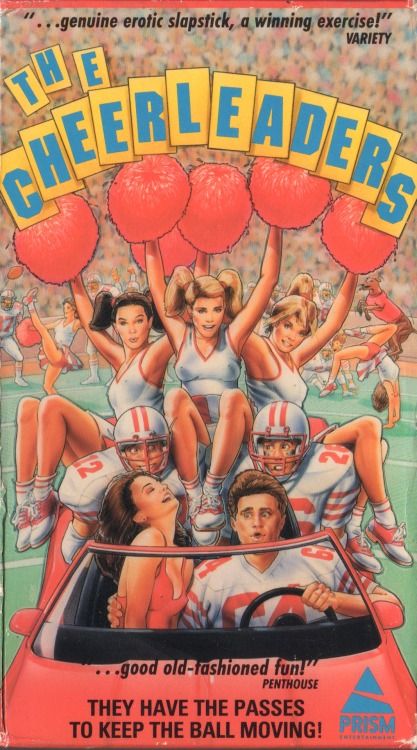
Stephanie Fondue, who stars in this as Jeannie, had an even more incredible real name. Enid Finnbogason. She was in Hollywood from Winnipeg, got hit up at lunch to try out for this movie and got it. She’d never been a cheerleader. She was twenty. Also: A nude model, so disrobing during the audition was no big whoop.
In the film, Amarosa High School is the kind of high stakes place where lives depend on football games. Along with Jeannie, Bonnie (Jovita Bush), Debbie (Brandy Woods) and head cheerleader Claudia (Denise Dillaway, who eventually did the makeup for 2000s reality specials Exposed! Pro Wrestling’s Greatest Secrets and Breaking the Magician’s Code: Magic’s Biggest Secrets as well as the VHS release of Party Games for Adults Only), the girls try and help the men win. Except that Claudia is catty and is trying to get Jeannie deflowered by the end of the season. It’s a backward teen sex comedy bet.
But hey, everyone goes to see I Drink Your Blood at one point. So there’s that.
Director and co-writer Paul Glicker also made Running Scared (the one with Ken Wahl) and adult movies Parlor Games and Hot Circuit. Other writers were Richard Lerner, Tad Richards and Ace Baandige, a name for someone who claims to have been a Presidential scriptwriter named David. David Gergen seems too clean for this, David Shipley is too young and David Frum was 11 when this came out. I am looking at Presidential writers and comparing them to someone who made a sex film.
Speaking of sex films, Suzie is played by Sandy Evans, but that’s Clair Dia, who was in Lucifer’s Women and 3 A.M. — the only porn with an Orson Welles-edited scene — and directed Screwples and The Health Spa. Patty, played by Kim Stanton, who is also Kimberly Hyde, was also in The Young Nurses and Candy Stripe Nurses. There were a lot of nurse movies. There are even sequels to this one: The Swinging Cheerleaders, Revenge of the Cheerleaders and Cheerleaders’ Wild Weekend.
June 8: Junesploitation’s topic of the day — as suggested by F This Movie— is Heists!
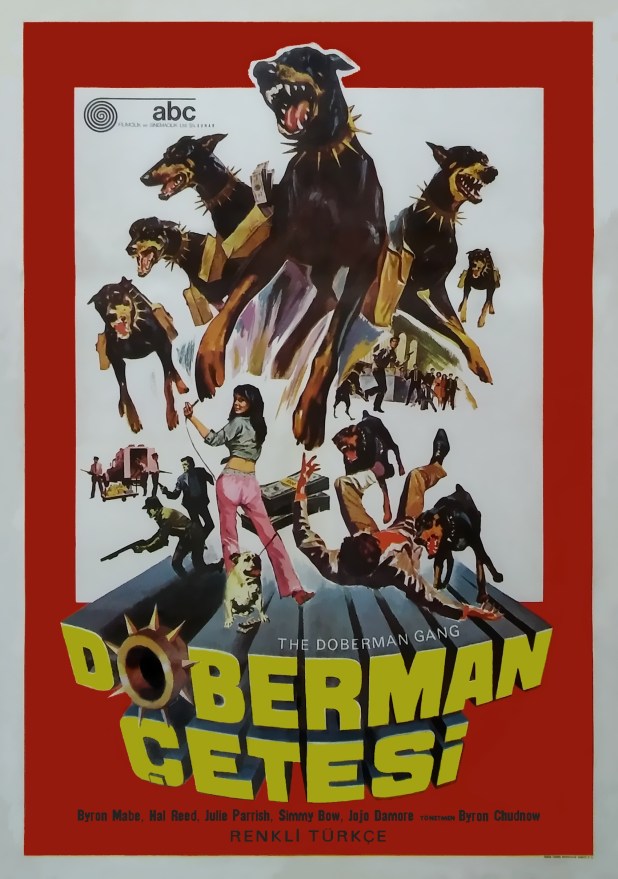
Dillinger, Bonnie, Clyde, Pretty Boy Floyd, Baby Face Nelson and Ma Barker are the Doberman Gang, six Dobermans who join the gang of Eddie Newton (Byron Mabe), Sammy (Simmy Bow), June (Julie Parrish) and former Air Force dog trainer Barney Greer (Hal Reed). Oh yes — there’s also a bulldog named J. Edgar.
Eddie and June have been a couple, but she soon sees that he could throw her away at any time. She starts getting close to Barney, who soon learns that this is a criminal plan to train these dogs. He’s told that he’ll be killed if he tries to get away, so he works with them in the hopes that he can save the dogs and June. But he soon has second thoughts when he learns that the dogs will be killed.
Good boys. J. Edgar gets them to run off with the money. The bad news is that one of the dogs was hit by a car, and I could have done without that part. Except that in the sequel, The Daring Dobermans, that dog is fine. Whew.
There are also two more movies in the series, The Amazing Dobermans and Alex and the Doberman Gang.
I didn’t have to worry so much, as this was the first movie to have the “No Animals Were Harmed” onscreen credit from the American Humane Association.
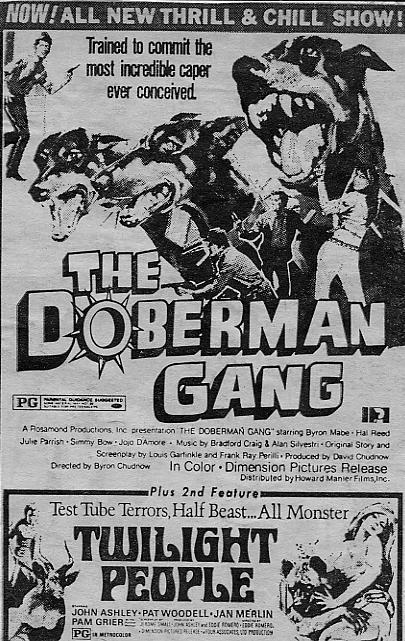
This was directed by Byron Ross Chudnow and written by Louis Garfinkle, who also wrote I Bury the Living, Face of Fire, The Hellbenders, Little Cigars and The Deer Hunter—yeah, I know, wow—and Frank Ray Perilli, who wrote Mansion of the Doomed, the Michael Pataki adult Cinderella, End of the World, Dracula’s Dog, the adult Fairy Tales, Laserblast, The Best of Sex and Violence and co-wrote Alligator with John Sayles.
Dimension Pictures played this as a double feature with The Twilight People. I love that!
Beware! The Blob or Son of the Blob is a big idea to get your head around. While the original was presented as horror, this film pretty much leans into how ridiculous it all is. Written by Anthony Harris and Jack Woods from a story by Richard Clair and Jack H. Harris, a lot of this was improvised on set, and the script—even though it took all those people—was mostly ignored.
Harris was also the producer, and Anthony was his college graduate son. They were next door neighbors with Larry Hagman — who had previously directed episodes of I Dream of Jeannie and The Good Life — who had never seen The Blob. Harris screened his print for the actor/director, who loved it and said that he could get a lot of his Hollywood friends to show up and get blobbed, as long as he could direct.
Fifteen years after the original Blob destroyed parts of Pennsylvania, Chester (Godfrey Cambridge) has brought a piece of that creature from its frozen grave in the North Pole, where he does the sensible thing and puts it in the fridge. It grows in size as it eats a fly, a kitten, and then his wife, Marianne (Marlene Clark). Finally, while Chester watches The Blob on TV, it eats him too, just in time for Lisa (Gwynne Gilford) to watch him get claimed by the creature.
As she tries to get her boyfriend Bobby (Robert Walker Jr.). to believe what she’s seen, the red jelly eats its way through Los Angeles, claiming the lives of two hippies (Randy Stonehill and Cindy Williams) in a storm drain — were they looking for Simon? — as well as officer Sid Haig, chickens, horses, a bar, a gas station, Scoutmaster Dick Van Patten, a barber (Shelley Berman) and even some home-displaced folks (Hagman, Burgess Meredith and Del Close, who is wearing an eyepatch as his cornea was scratched by a cat previous to filming; he’d return with a similar look as Reverend Meeker in perhaps the best horror remake of all time, 1988’s The Blob).
It takes an ice rink — which was torn down shortly after filming — to stop the monster — maybe — this time. As for the bowling alley in this movie, it’s Jack Rabbit Slims from Pulp Fiction.
In the first movie, the Blob was made of silicone and dyed red. It had to be stirred throughout the movie to keep its color. This Blob was made from a red-dyed powder blended with water, as well as a big red plastic balloon, red plastic sheeting and a red drum of hard red silicone spun in front of the camera. Tim Baar and Conrad Rothmann created these effects, and beyond working on the second unit camera, Dean Cundey helped, years before he’d become such a force in filmmaking.
In 1982, when Hagman was on Dallas and the shooting of his character J.R. Ewing was the biggest moment in pop culture, this was re-released with the headline “The film that J.R. shot!”
I knew the song “Ben” better than Ben the movie, but now, I know both.
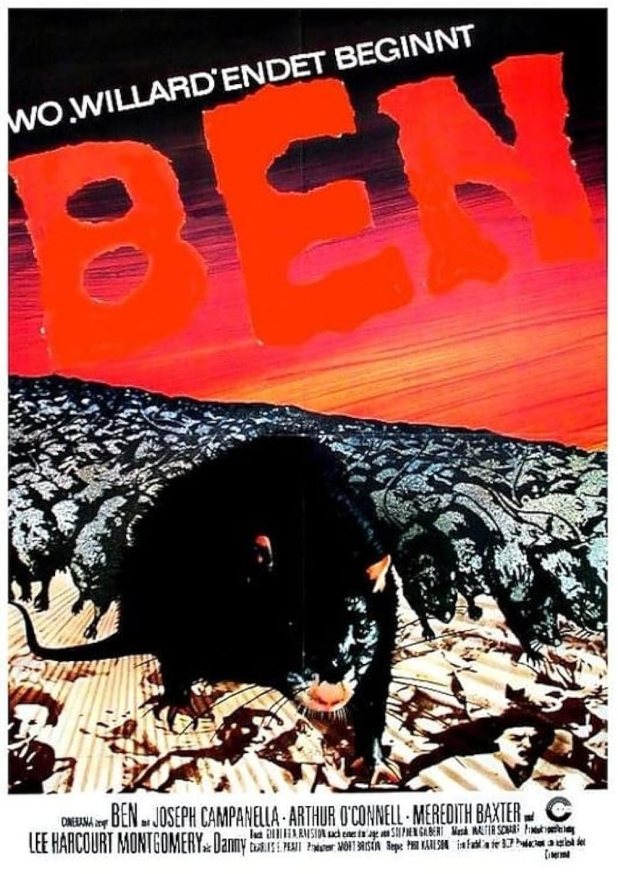
Remember when Willard Stiles was killed by Ben and all the rats when he finally tried to kill them? Well, you get to see it again when this movie starts and we follow Ben until he meets Danny Garrison (Lee Harcourt Montgomery, Burnt Offerings), a lonely boy with a heart condition. They become best friends — until now, Danny only has his mother, Beth (Rosemary Murphy) and sister, Eve (Meredith Baxter) — and Danny does fun stuff like write songs for them, put on marionette shows for their amusement and create a train ride for them.
Rats are rats, however, and they go nuts, attacking food trucks, grocery stores, and people, all while they help Danny get over bullies, loneliness and probably dying soon.
Directed by Phil Karlson (The Wrecking Crew, Walking Tall) and written by Gilbert Ralston (the creator of The Wild, Wild West), this has an ending where you will care about a rat more than you thought was possible. Seriously, I got weepy. Over a rat. A rat that got to ride in a train, dammit, not I’m crying again.
The first five and a half minutes of 1972’s All the Colors of the Dark (also known as Day of the Maniac and They’re Coming to Get You!) subvert what I call Giallo’s “graphic beauty” in intriguing ways.
An outdoor scene of a stream slowly darkens, replaced by an old crone with blackened teeth, dressed as a child and a dead pregnant woman are both made up to be anything but the gorgeous creatures we’ve come to expect from these films; even star Edwige Fenech (The Strange Vice of Mrs. Wardh, Five Dolls for an August Moon and so many more that I could go on and on about) isn’t presented in her usual role of a sex symbol. She’s covered in gore, eyes open and lifeless. As the camera zooms around the room and begins to spin, we see a road superimposed and hear a car crash. Even when Edwige’s character in this film, Jane Harrison, wakes up to shower, we’re not presented with the voyeuristic spoils that one expects from Giallo’s potent stew of the fantastique and the deadly. She stands fully clothed, the water more a caustic break with the dream world than an attempt at seducing the viewer or cleaning herself.
Again — in a genre where words possess little to no meaning — we are forced to wait five and a half minutes until the first dialogue. Richard (George Hilton, Blade of the Ripper), her husband, bemoans that he must leave but feels that he can’t. His therapy is a glass of blue pills and lovemaking that we watch from above; his penetration of her is intercut with violent imagery of a knife entering flesh. Instead of the thrill we expect from this coupling, we only sense her distance from the proceedings.
As Richard leaves her behind, we get the idea of the madness within their apartment: a woman makes out on the sidewalk with a young hippy man who asks when he’ll ever see her again. Mary (Marina Malfatti, The Night Evelyn Came Out of Her Grave, The Red Queen Kills Seven Times), a mysterious blonde, glares down at him, somewhat knowingly. His wife looks lost and trapped. Without dialogue, we’ve already sensed that some Satanic conspiracy is afoot. Echoes of Rosemary’s Baby? Sure, but you could say that about every occult-themed 1970s film — the influence is too potent, a tannis root that has infected all of its progeny.
Last year, a car crash took the life of Jane’s unborn child. Her sister Barbara (Nieves Navarro, Death Walks at Midnight, Emanuelle and the Last Cannibals) has advised therapy, which Richard laughs at. As Jane waits to see the doctor, she sees a man with the bluest eyes (Ivan Rassimov from Planet of the Vampires and Django in Don’t Wait, Django…Shoot!) — eyes we’ve seen before, eyes that hint at blood and murder and madness.
Even when surrounded by people, such as on the subway, Jane is lost in her thoughts and in another world, one of inky blackness and isolation punctuated only by the cool blue eyes of the sinister man who tracks her everywhere she goes. Even the teeming masses of the city make her feel more lost; only the light of the above-ground world erases the nightmare of her stalker. That is — until he finds her in the park, where she screams for him to stop following her. The camera is detached, following her from high above, watching her run away, needing the refuge of her home. Even then, the man is still there, banging on the door, demanding to be part of her reality.
The thing is — Richard has no faith in his wife’s sanity. And even when he’s telling her sister, Barbara, how he doesn’t trust psychiatry, he’s also watching her undress in a mirror. This scene really hints that they’ve had sex in the past (perhaps the past was just five minutes ago).
Jane finally finds a kindred soul—her neighbor, Mary, whom we saw earlier in the windows. Mary tells Jane of the Sabbath, the black mass and how it helped her. She sees Jane as a lost soul who needs to be saved and agrees to take her to her church.
The blue-eyed man returns, chasing Jane past a spiraling staircase, ax in hand. The camera spins, making us dizzy as it cuts from the building to the man and from Jane’s car to the man. Jane demands to be allowed to go to the Sabbath as she fears the madness that seems ready to overtake her.
As we approach the old mansion where the rite will occur, we feel more of a sense of belonging, a warmer color palette instead of the washed-out nature of the urban sprawl we’ve experienced until now. Everything is lit by a candle. Mary appears to have achieved a glow, and Jane stands in stark contrast to the beatific zombies of the assembled congregation. A taloned priest murders a dog in front of Jane’s eyes as Mary caresses her (trust me, this isn’t a Fulci realistic dog murder, although I hid my mutt Angelo’s eyes for this scene). The priest tells her that if she drinks the blood, she will be free. Hands and lips and bodies overtake her as an orgy breaks out, a bacchanal that she seems to want none of. This sex is presented as horror, as anything but pleasure, yet Jane seems ill-equipped to resist.
Immediately, we see her enjoying her husband, no longer frigid and everything back to normal, as he says. However, Jane tells her that she doesn’t feel real anymore. She walks to the bathroom, seeing multiple reflections of herself that harken back to the kaleidoscope effect we saw as the priest took her to the altar.
No matter what peace, love, and sex happen, Jane can’t escape the blue-eyed man. Even on a romantic lunch date with her husband, he’s outside waiting for her. A taxi drives her back to her home, the only sanctuary against the invasion that the man presents. As she goes through her husband’s effects, she finds a book of the supernatural emblazoned with a pentagram. He claims it’s just a second-hand book and accuses her of hiding things from him.
Jane returns to the Satanic church, this time willing to give herself over and actually seeming to enjoy lovemaking for the first time in this film. Mary intones, “Now you’ll be free.” Again, the long-fingernail priest takes her while the blue-eyed man watches her, his hands covered in blood. The members of the church dance around her as Mary calls to her. The priest tells her that Mary no longer exists. She is free to go, as she brought Jane to the church. The final act is for Jane to murder her, to send her away. Jane screams that she can’t do it, but Mary tells her that they must part, that this act will free her, as she lowers herself onto the dagger that Jane clutches.
Jane awakens, fully clothed, in a field. The blue-eyed man is there, telling her, “Now you are one of us, Jane. It’s impossible to renounce us.” He offers his hand, telling her to follow him. She’s expected. He takes her to an altar that is the same design as the pendant we just saw her wear during the orgy. She demands to know where Mary is, but the only answer she gets is that she belongs to the cult and will now be protected. Mary is gone, and Jane’s sacrifice allows her to be free. They show her Mary’s body, covered in black lace, as she runs screaming.
Perhaps in retaliation for the ritual, dogs chase her through the woods, tearing at her, stopped only by the blue-eyed man who knocks her out. She awakens, clad in virginal white, surrounded by white sheets. Her husband leaves a note in lipstick on her mirror. She looks, and the symbol is on her arm, which is covered in blood. When she goes to Mary’s apartment, an old woman lives there instead.
Jane is totally lost — the ritual has brought her nothing but more madness and the blue-eyed man even closer. Her husband is away on business, her sister is on vacation, and her therapist is dismissive. Even her apartment walls, which offer security, have become a maze of fear. The colors shift to Bava-esque hues of blackness and reds as we see the blue-eyed man attack her over and over again, with constant repetition of the frame as she screams — and then there’s no one there, just the room filled with red and a broken piece of pottery embedded in her hand.
After examining Jane, the doctor leaves her with an elderly couple. Her husband can’t find her and asks Barbara to help.
Jane awakens in a white room — of course, the blue-eyed man is waiting outside the house in the gauzy early morning hours. Yet there is an ominousness about the proceedings — no one is there. A tea kettle is boiling on the stove while the old man and woman sit there, in still repose, dead at the breakfast table. She’s trapped in the room with them as she frantically calls for help. She tells her doctor that the man is there and has killed everyone. He calmly tells Richard and Barbara that he has another patient to deal with, as he doesn’t trust Richard and wants to keep him in the dark. However, he does reveal the truth to Barbara. That lack of trust goes both ways as Richard follows the doctor.
Meanwhile, the blue-eyed man finds Jane, telling her she cannot renounce them. He tells her that the knife that he holds killed her mother when she tried to deny them. And it’s the same knife that killed the married man. He tells her she is beyond reality and will never find it again.
Following the sound of a hound, she finds the doctor’s car in the driveway — and, of course, he’s dead, too. The blue-eyed man gives chase and finally tries to kill her, but he’s stopped at the last minute by Richard, who stabs him with a rake. He repeatedly stomps on the man’s hand, revealing the tattoo symbol he stares at.
Meanwhile, Mary arrives home to a green-hued apartment, where Richard is smoking and accusing her of being part of black magic. He sees the symbol when he watches her undress, and she tells him that she wants him, that she can make him forget her sister. She promises him untold power and that he can become anyone he wants. As she leans in for a kiss, he shoots her, tossing the envelope of a letter that he received that explains it all.
Cut to a hazy white room where Jane has been given a sedative. An inspector — the priest from the cult! — demands to see her. Richard arrives and embraces her, telling her he will take her out the main door. They speed away in a car and return to their apartment. But all is not well — Richard is killed by an unseen person, and Jane is left holding the dagger. The police who arrest her all have the symbol on their wrists and are led by the leader. The camerawork becomes tighter and claustrophobic as we see the cult descending on her.
Wait — it’s all a Wizard of Oz dream, with the police and her husband at her bedside, explaining the film’s entire plot, which ends up even more ridiculous than everything that we’ve seen up until now (which is really saying something). Turns out there was no real magic. The cult was just a drug ring. Mary was real and just a heroin addict. Her sister was behind it all because she wanted all of the money from the will of their mother’s murderer, who wanted to give 600,000 pounds to both of them.
Jane rejects this reality, saying this cannot be true after all that she’s seen. The cop replies that he kept trying to call her, and she never answered, so he wrote it all in a letter — the letter that Richard showed Barbara after he shot her. It’s worth noting that the American version of the film ends with Jane being killed by the cult and all of the ending — nearly six minutes worth of important story and denouement — exorcised.
We return to where we were, with Richard going upstairs — just like we’ve seen before. Jane screams that she knows what will happen. The cult leader attacks him, blaming her for Barbara’s death. Richard follows him to the roof, where they fight, and the priest is thrown from the roof. Jane tells Richard that she knew the man was there; she knew that her husband had killed her sister, that it wasn’t a suicide, and that some strange force was guiding her. She asks for help, and the credits roll.
With this film, director Sergio Martino (Torso, 2019: After the Fall of New York) crafted an intriguing blend of the supernatural and the Giallo. Even the procedural elements come only after the film has descended into surrealism, as if a cold glass of water has been splashed in the face of a viewer who needs an explanation. Magic is madness, and we can’t even trust our heroine at the end when she begs to escape the power inside her.
This film is terrific, with Edwige Fenech turning in a strong performance. You really feel the isolation and madness that surround her and empathize with her. The strong visuals and the break from the genre conventions of masked killers, gloved hands and inept police make watching this film an absolute joy. From beginning to end, it makes you question not only the reality that it presents but also the objective trustworthiness of our heroine. And while it betrays an obvious inspiration to the aforementioned Rosemary’s Baby, it is not slavish in its devotion, making a powerful statement on its own merit.
Here’s a cocktail recipe.
They’re Coming to Get You
1.5 oz. J&B
.5 oz. lemon juice
.5 oz. simple syrup
1 egg white
3 dashes Angostura bitters
Shake all ingredients in a cocktail shaker filled with ice.
Also known as Hellfighters of the East and its VHS-era name Strike 4 Revenge, this Chang Cheh film is odd for the director, his stars David Chiang and Ti Lung, and the Shaw Brothers. It’s shot overseas in Seoul and isn’t a historical epic. It’s as close to modern day as it gets, nearly, being set in 1953.
Sergeant Feng-xia (Ti Lung) and Private Gao Yin-Han (Wang Chung) are sick of military service and go AWOL, meeting up with another soldier who has run, Jin-yi (David Chiang), and Li Wei-Shi (Chen Kuan-tai). They run into a Yakuza operation led by Yasuaki Kurata.
As this is a Chang Cheh movie, you can expect that nothing ends happily but at least there are plenty of fights and good triumphing over evil — somewhat. There’s also an awesome war bar called Hello John and a final battle inside a gym that finds so many pieces of sports equipment used to destroy human beings.
All four films on the Horrible History box set from Eureka are presented on Blu-ray from HD masters supplied by Celestial Pictures. Extras include two new commentaries by East Asian film expert Frank Djeng (NY Asian Film Festival) and martial artist and filmmaker Michael Worth, two new commentaries by action cinema experts Mike Leeder and Arne Venema, interviews and essays on these films, an O-Card slipcase featuring new artwork by Grégory Sacré with a collector’s booklet featuring new writing on all four films in this set by writer and critic James Oliver. It’s all limited to 2,000 copies and you can get it from MVD.





 B&S About Movies
You must be logged in to post a comment.