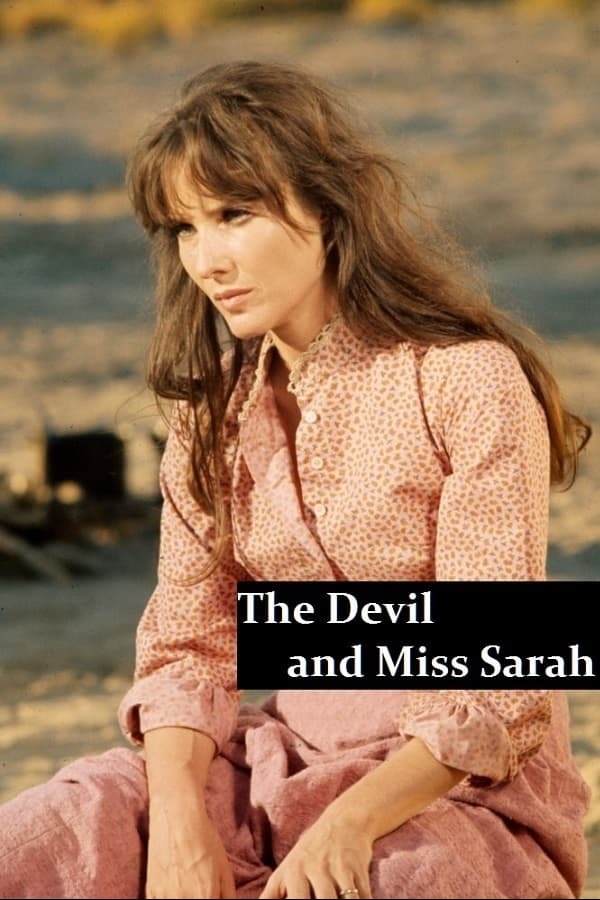
EDITOR’S NOTE: The Devil and Miss Sarahwas on the CBS Late Movie on February 24 and April 4, 1974.
Directed by Michael Caffey (who did a lot of TV, including the “Horror In the Heights” episode of Kolchak the Night Stalker) and written by Calvin Clements Jr. (whose career was also mostly in TV), The Devil and Miss Sarah has Gil Turner (James Drury), a farmer, escorting a criminal named Rankin (Gene Barry) to prison. Turner is bringing his wife Sarah (Janice Rule) along with him, which is a bad idea, because Rankin has occult powers and wants her.
Shot in the Utah desert, this has some great natural scenery and keeps the idea if the supernatural is real a mystery until the end. Sarah may or may not also have psychic powers, which means that she may see Rankin as a better partner than her husband. Or perhaps Gene Barry is so incredible in this it seems like he can dominate anyone.
A Manson-influenced Western about a Western outlaw who might be Satan. TV movies were bringing it in 1971.
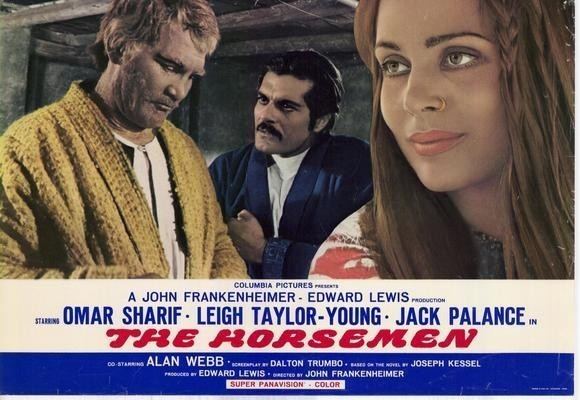
EDITOR’S NOTE: The Horsemen was on the CBS Late Movie on October 26, 1973; September 20, 1974 and June 11, 1976.
Uraz (Omar Sharif) is the son of Tursen (Jack Palance), a stable master and retired buzkashi player, a sport in which horse-mounted players attempt to place a goat or calf carcass in a goal. He has lost his honor when he breaks his leg in a game that his father has bet all of the family’s money on, which means he has to learn how to ride and play again, despite most of his leg.
Based on Joseph Kessel’s Les cavaliers, this was scripted by Dalton Trumbo and directed by John Frankenheimer, who loved the movie even if it wasn’t a financial success.
There’s a lot of animal violence in this, so be warned. I mean, it’s a game played with a dead animal, after all. The same game is played in Rambo III, in case you wondered. Like that movie, the Afghanistan of this film is long gone.
It’s a big Hollywood film about a sport and a place that I can imagine very few people were interested in, which makes me interested in it.
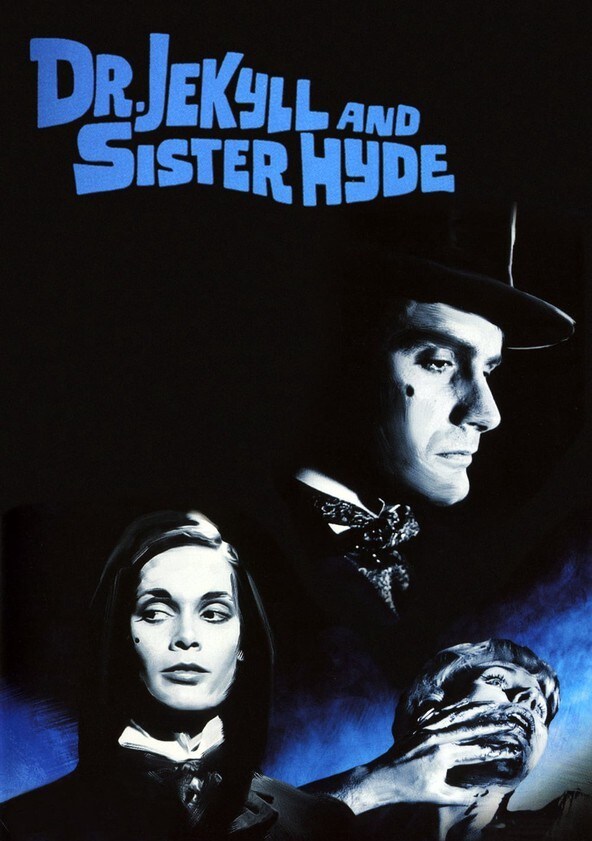
EDITOR’S NOTE: Dr. Jekyll and Sister Hyde was on the CBS Late Movie on February 8, 1974.
Hammer had already made two adaptions of Robert Louis Stevenson’s Strange Case of Dr. Jekyll and Mr. Hyde — The Ugly Duckling and The Two Faces of Dr. Jekyll. But what if they combined that story with the historical Jack the Ripper and Burke and Hare cases? And what if Jekyll turned into a female Hyde? Now we have a movie!
Dr. Henry Jekyll (Ralph Bates, Lust for a Vampire) has been trying to cure all known illnesses but his friend Professor Robertson (Gerald Sim, Dr. Phibes Rises Again) laughs that by the time his experiments are discovered and used, he’ll be long dead and unable to enjoy his achievements.
Jekyll then abandons his altruistic aims and starts looking for the elixir of life, which he feels uses female hormones that he takes from the bodies of women supplied by William Burke and William Hare, real life murderers that killed people and sold them to doctors for anatomy lessons. Never mind that those murders happened sixty years before the timeline of this film.
Meanwhile, Susan Spencer lives above him and they’re attracted to one another. However, he’s too absorbed by his work to do anything about it. Soon, he’s created a serum that not only changes his character, but transforms him into a gorgeous and amoral woman (Martine Beswick, who is in the first two Bond movies, plays the Queen of Evil in Seizure and was Xaviera Hollander in The Happy Hooker Goes to Hollywood) that he calls Mrs. Edwina Hyde. Susan instantly hates her, but her brother Howard (Lewis Fiander, Who Can Kill a Child?) falls for her.
Dr. Jekyll soon learns that his serum requires more female hormones than Burke and Hare can acquire for him. And when they’re finally caught, he’s forced to commit the crimes that the rest of London believes were those of Jack the Ripper. Jekyll hates what he has become, but Hyde loves it, even killing the Professor when he dares question her.
The male and female sides of his/her/its body all go to war with one another with Susan as the prize. Seriously, this is a movie that demands to be remade today.
Sadly, Caroline Munro was nearly Mrs. Hyde, but dropped out when she realized that the film required nudity. That said, Martine Beswick is pretty great in this. She was initially asked to do full frontal nudity and wouldn’t talk to director Roy Ward Baker (Asylum, The Vault of Horror) for a week.
EDITOR’S NOTE: Mongo’s Back In Town was on the CBS Late Movie on January 31 and October 10, 1973 and April 20, 1978.
Lieutenant Pete Tolstad, the character played by Telly Savalas in this made for TV movie, feels like the early version of Kojak before that show would air in 1973. Tolstad grew up in the same neighborhood that is now his beat. He’s never had a real Christmas. He just does his job.
Directed by Marvin J. Chomsky (Tank, Evel Knievel, Roots) and written by Herman Miller and based on the book by E. Richard Johnson. Johnson was a convicted armed robber and murderer who wrote all eleven of his books from his cell at Stillwater State Prison in Minnesota. He started writing to pass the time in prison and his novel Silver Street won the Mystery Writers of America’s Edgar Allan Poe Award for 1968 and the follow-up, which this movie is based on, was considered an even better book. Despite his success, he got into drugs while in prison. He escaped and went back into crime before being recaptured and stayed in jail until 1991.
Everyone is interested in the reasons why Mongo Nash (Joe Don Baker) is back in town and why he’s spending time with a young girl named Vikki (Sally Field) who has just come to town from West Virginia. Is he in town to do a hit for his brother Mike (Charles Cioffi)? Or does he just want left alone?
This has a great cast. Martin Sheen plays Tolstad’s partner Mike and Anne Francis is a gangster’s moll who Savalas has a flirty scene with. Baker is great and somehow makes a killer into someone that you feel some level of empathy for and the way he treats Vikki. Ah yes. He is a killer. On the way to the brutal ending, we have people get acid thrown in their faces and everyone is fair game for murder including kids.
Originally airing on CBS on December 10, 1971, this is also known as Steel Wreath, which is a strange title and probably one that makes more sense once Johnson and his books were forgotten. Perhaps they didn’t want people to think this was a Blazing Saddles sequel, which there was one that is forgotten and was a TV series.
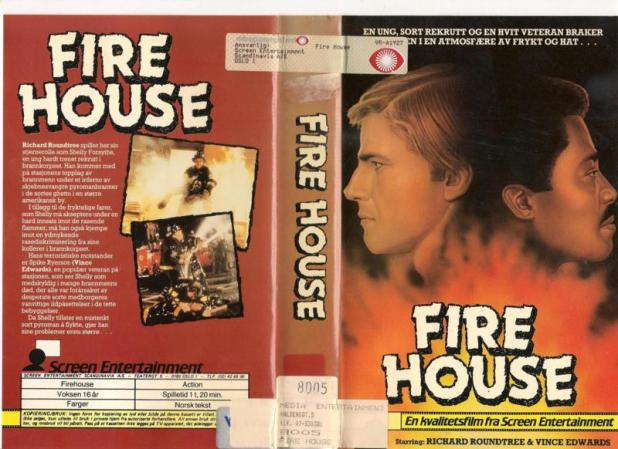
EDITOR’S NOTE: Firehouse was on the CBS Late Movie on March 25 and August 20, 1975.
Richard Roundtree — a star from Shaft making a TV movie a year later, was that a step back? — is Shelly Forsythe, a black firefighter bringing racial tensions to a firehouse. This is even worse when Spike Ryerson (Vince Edwards), the oldest firefighter, claims that an arsonist has to be black. The men include Val Avery as cook Sonny Caputo, Richard Jaeckel as Hank Myers, Michael Lerner as Ernie Bush and Andrew Duggan as Captain Jim Barr.
This was based on Report From Engine Company 82 by retired FDNYC firefighter Dennis Smith. Another thing you may catch — the firehouse for this movie would one day be the Ghostbusters’ building.
What’s strange is that this became a TV series with Richard Jaeckel the only cast member to appear in both the TV movie and the series. They dropped the black firefighter angle for the show when that’s the main reason we’re watching this.
To save money, most of the firefighting is newsreel footage. That said, the idea that Shelly has to fit in with racist co-workers, have the black community not think he’s an Uncle Tom and still not die in a fire are all great plot elements.
Firehouse was directed by Alex March (Serpico, Shane and Paper Moon — the TV shows) and written by Frank Cucci (The Andros Targets).
Herschell Gordon Lewis week (July 14 – 20) HG seemed to truly love packing theaters. He’s most famous for introducing gore to horror movies, but he’d fill any need that the audience had. He made every genre of exploitation __ – even kids movies! Gore movies would’ve happened eventually, but Herschell seemed to take joy in crafting gross-out shocks for unsuspecting cineasts. INTERESTING FACT! HG Lewis was a huge fan of Kentucky Fried Chicken and had them cater all of his productions. Col. Harland Sanders himself appeared in Lewis’ Blast Off Girls!
Sheldon Seymour is Herschell Gordon Lewis. Miss Nymphet’s Zap-In is Laugh-In. The difference is that this has nudity and the jokes aren’t as good. Then again, to younger people who never watched Laugh-In, this is going to seem strange. And really, it may only be important to hardcore fans of the Godfather of Gore.
The song “Miss Nymphet (Zap!)” by The Zaps, who are really Herschell’s son Robert, plays throughout the movie and you get jokes like this:
Go-Go Dancer #1: Do you know how to catch one of us topless dancers?
Go-Go Dancer #2: I’ll tell you. With a booby trap!
It’s also a lot like the cartoons that would be in a rip off of Playboy like Cavalier or Flirt.
Actresses in this include Dixie Donovan (Angelica: The Young Vixen), Luanne Roberts (Bonnie’s Kids), Phyllis Stengel (Take It Out In Trade), Julie Conners (Night of the Witches and the adult movie that nearly ruined Lash LaRue, Hard On the Trail), Bambi Allen (who plays Miss Nymphet; she was also in Lash of Lust), Mary Jane Shippen (Don’t Just Lay There) and Debbie Osborne (The Cult).
I’m going to watch all of Lewis’ movies, so sometimes you have to work your way through some rough ones. The rounder 1970s bodies helped.
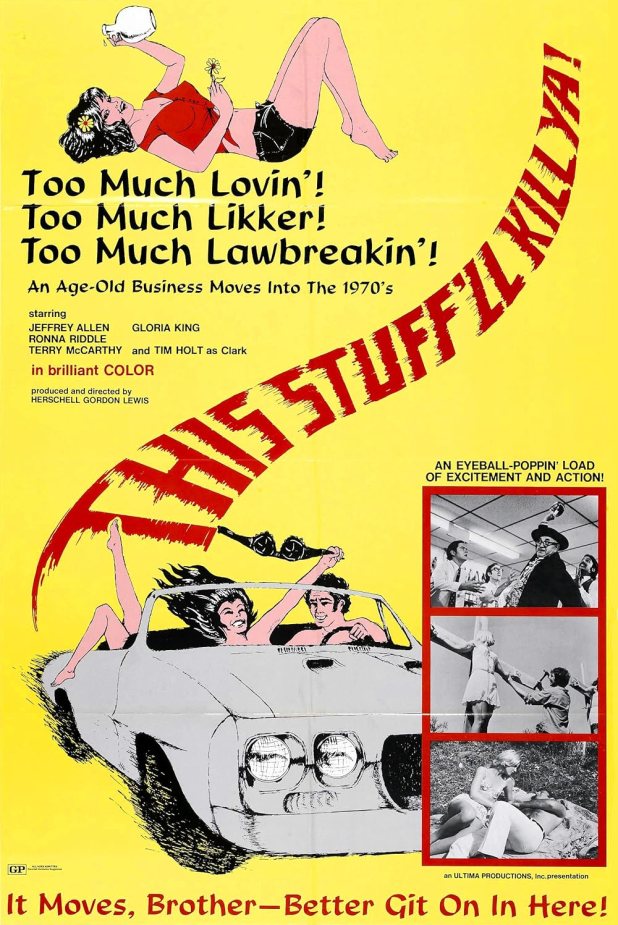
Herschell Gordon Lewis week (July 14 – 20) HG seemed to truly love packing theaters. He’s most famous for introducing gore to horror movies, but he’d fill any need that the audience had. He made every genre of exploitation __ – even kids movies! Gore movies would’ve happened eventually, but Herschell seemed to take joy in crafting gross-out shocks for unsuspecting cineasts. INTERESTING FACT! HG Lewis was a huge fan of Kentucky Fried Chicken and had them cater all of his productions. Col. Harland Sanders himself appeared in Lewis’ Blast Off Girls!
Reverend Roscoe Boone (Jeffrey Allen, who was the Mayor in Two Thousand Maniacs!) isn’t really a man of the cloth, but don’t tell the people in his deep southern town, who he rules over as he sells moonshine and keeps the law — Agent Colt (Tim Holt) and Markel (Prentis Smithson) — at bay by getting them wasted under threat of death and then taking compromising pictures of them with underage girls.
I mean, you can see why they follow him. He gets everyone in town drunk, gives them work and then is given to fiery sermons like “Corinthians done sayeth: “It is better to marry than to be aflame with passion.” Now, all you boys with passion get in line there.” And then all the young boys get to make out with the hottest women in town.
This is the kind of place where tourists like Sandy (Dana Demonbreun) and Jane (Joy Smothermon) come to visit and get crucified and one of the girls who set up the feds decides to tell the law that she lied, which leads to her getting stoned. There’s also a head that gets blown off that’s so brutal that I was like, “Oh yeah. This is a Herschell Gordon Lewis movie.”
It’s also Larry Drake’s first movie.
If you’re into scummy Southern movies with lots of blood and aberrant sexuality — and who isn’t — this will satisfy your urges. Kind of like moonshine, this stuff won’t kill you but enough might make you blind.
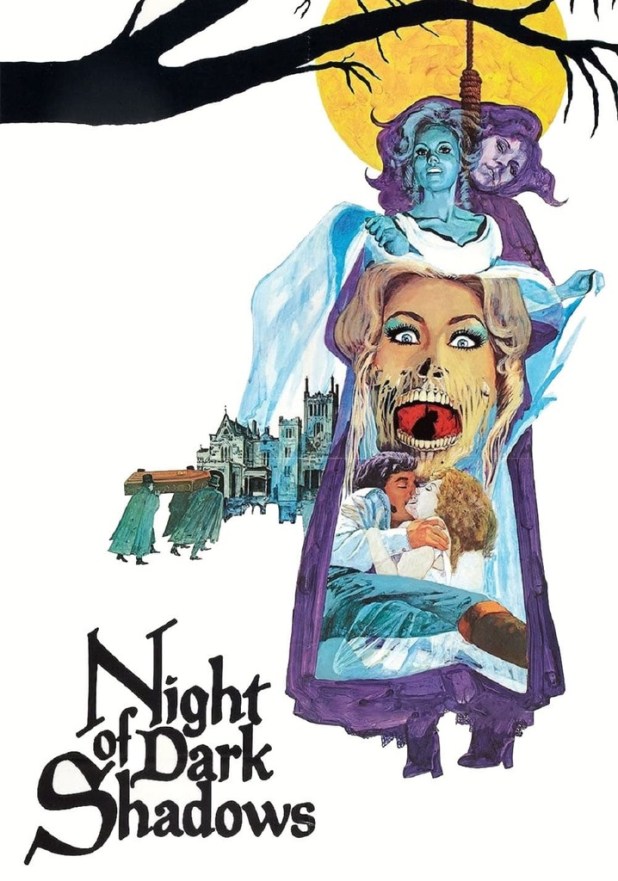
EDITOR’S NOTE: Night of Dark Shadows was on the CBS Late Movie on June 13, 1977.
After the success of 1970’s House of Dark Shadows, MGM wanted a sequel. The show was off the air and Curtis thought that this would be the perfect time to bring back Barnabas Collins, but Johnathan Frid was fearful of being typecast.
To his credit, Curtis didn’t recast the role and worked on an all-new story, originally called Curse of Dark Shadows. They even hired spiritualist Hans Holzer — yes, the guy who wrote one of the Amityville books — to be on set and loosely followed the parallel world sequence of the show, focusing on the popular Quentin Collins.
With just 24 hours notice, MGM forced Curtis to cut over 35 minutes from the movie, which makes it pretty incoherent. The film that was to be was much darker and more intense.
While this movie did fine, it didn’t have the magic or box office of the last one. Which is a real shame, because I love it.
Quentin Collins (David Selby, also of the Dark Shadows TV show) has arrived at Collinwood with his wife Tracy (Kate Jackson) and is mesmerized by the portrait of Angelique (Lara Parker, also reprising her role from the show).
John Karlen and Nancy Barrett show up as Alex and Claire Jenkins, two horror novelists who have moved into one of the guest houses. They’re about to learn just how crazy Collinwood can get, what with the housekeeper Carlotta (Grayson Hall, who played several Dark Shadows characters, but foremost amongst them Dr. Julia Hoffman) revealing that nearly everyone here is reincarnated from the past of the house, with herself as Sarah Castle and Quentin as Charles Collins, who once was the love of, yes, Angelique, who was hung as a witch. Seeing as how Charles was having an affair with her — the wife of his brother, no less — he was buried alive next to her corpse.
Hijinks, as they say, ensue. Hijinks like murder, possession, women hung in the trees and a girl holding a doll.
You also get Dark Shadows regulars Jim Storm as Gerard Stiles, Diana Millay (whose role as the phoenix-like Laura Collins was the first supernatural character on the show), Christopher Pennock as Gabriel Collins, Thayer David (who again, played many characters on the show) and Clarice Blackburn, who missed the last Dark Shadows film.
I spent years hunting this down on DVD and it was worth the effort. Perhaps the best viewing I’ve enjoyed of this film was in a rainy and foggy drive-in, late into the night. Does life get any better than that?
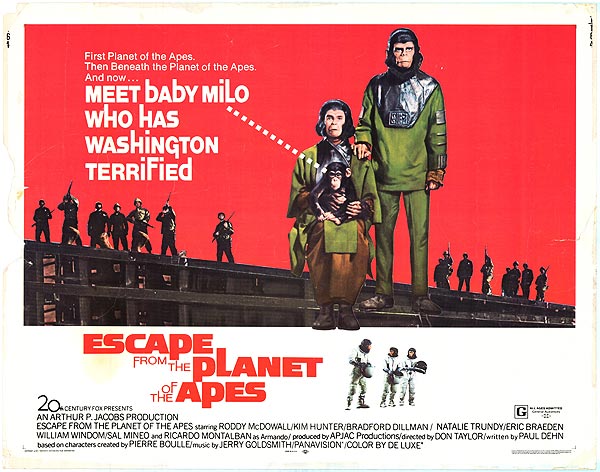
EDITOR’S NOTE: Escape from the Planet of the Apes was on the CBS Late Movie on September 6, 1977.
“Apes exist, Sequel required.”
With those words, sent in a telegram from producer Arthur P. Jacobs to writer Paul Dehn, a sequel was set in motion to Beneath the Planet of the Apes.
But hey — didn’t everyone die in a nuclear bomb blast at the end of that movie?
They sure did.
Doesn’t matter.
Dehn decided that Cornelius and Zira — along with an inventor ape named Milo — would go back in time with Taylor’s ship. He also consulted Pierre Boulle, writer of the original Planet of the Apes novel, to add more satire to the story. Originally titled Secret of the Planet of the Apes, the results are rather genius, as only three ape actors allowed for a smaller budget while selling director Don Taylor (Damien: The Omen II andThe Final Countdown) on the idea of making the film more humorous.
Cornelius (Roddy McDowall), Zira (Kim Hunter) and Dr. Milo (Sal Mineo!) have escaped the ruin of future Earth and landed back in 1973, where they are taken to the Los Angeles Zoo, where Dr. Stephanie Branton (Natalie Trundy, the wife of producer Jacobs and the only actor to portray every single race in the Apes universe) and Dr. Lewis Dixon (Bradford Dillman!) are set to examine them.
In private, the apes elect to not to let the humans know that they can speak. They also can’t tell them that, you know, they once dissected humans and that everyone else died in the Ape War. But man, those humans act so condescending to Zira and she flips out and shows them just how smart she is. And then she starts talking. And then, well, a mishap allows a zoo gorilla to kill Dr. Milo. Luckily — and in spite of this — Lewis ends up friends with the chimpanzees.
Meanwhile, a Presidential Commission has been formed to investigate the return of Taylor’s spaceship and determine what these apes are all about. Cornelius and Zira become celebrities over night and everyone loves them.
That’s not sitting well with President’s Science Advisor Dr. Otto Hasslein (Eric Braeden, Titanic, Colossus: The Forbin Project), who discovers that Zira is with child and therefore fears for the future of humanity. He gets her drunk — dude, she’s pregnant! — and she reveals all, which means that now it’s time for the government to really interrogate them. After some truth syrum, Zira reveals that yes, she has dissected humans before and yes, she knew Taylor before he died.
Hasslein takes his findings to the President (William Windom), who must agree with the council that Zira’s pregnancy is to be aborted — guess he’s not a Right to Lifer — and that they must both be sterilized. After his child is called a little monkey by an orderly, Cornelius goes wild and accidentally kills the man before they escape.
Branton and Dixon help the apes to escape, where they hid out in the circus run by Senor Armando (Ricardo Montalban!), where an ape named Heloise has just given birth. Zira also gives birth to a son, whom she names Milo in honor of their deceased friend.
Hasslein is more animal than the apes, tracking them to a shipyard. The couple do not want to be taken alive, which suits him just fine. He fires numerous shots into Zira and her baby to the horror of all watching. Cornelius kills him in retaliation before being shot by a sniper. The couple crawl toward each other, touching one another one more time before dying.
Meanwhile, at Armando’s circus, we learn that Zira switched children with Heloise and Milo has survived. As the ringmaster walks away, we hear his first words as he cries for his mother.
Somehow, each Apes film tops the previous one for total downer endings.
It could have been worse — Cornelius and Zira were originally going to be ripped apart by a pack of Doberman Pinschers!
James Bacon shows up here — the only actor to be in all five of the Apes films. He also would go on to write numerous books about Hollywood, including the Jackie Gleason biography How Sweet It Is: The Jackie Gleason Story. This is the only movie in the series where he plays a human being.
Detroit TV announcer — he was mostly on WXYZ-TV — Bill Bonds plays a TV newsman. John Randolph plays a councilman, a role he’d also play in the next film, and he’s in another monkey movie, the 1976 remake of King Kong. M. Emmet Walsh also makes an appearance. And Albert Salmi, who is in Superstition, is here as well.
Sal Mineo found the makeup process very uncomfortable and tiring. Kim Hunter would later say that she and Roddy McDowall had to hug Mineo a lot to console him. He had hoped that this movie would restart his career, as it did McDowall’s, but due to how much he hated the make-up, he was killed off earlier than originally planned. Escape from the Planet of the Apes would be Mineo’s final theatrical film before he was murdered on February 12, 1976 at the age of 37.
Bleeding Skull’s Top 50 (July 7 – 13) The middle-brow champions of low-brow horror, Bleeding Skull has picked out some of their favorites from the SWV catalog. They neglected to put I Drink Your Blood or EEGAH!on the list, but I think I can forgive them since they included Ship of Monsters.
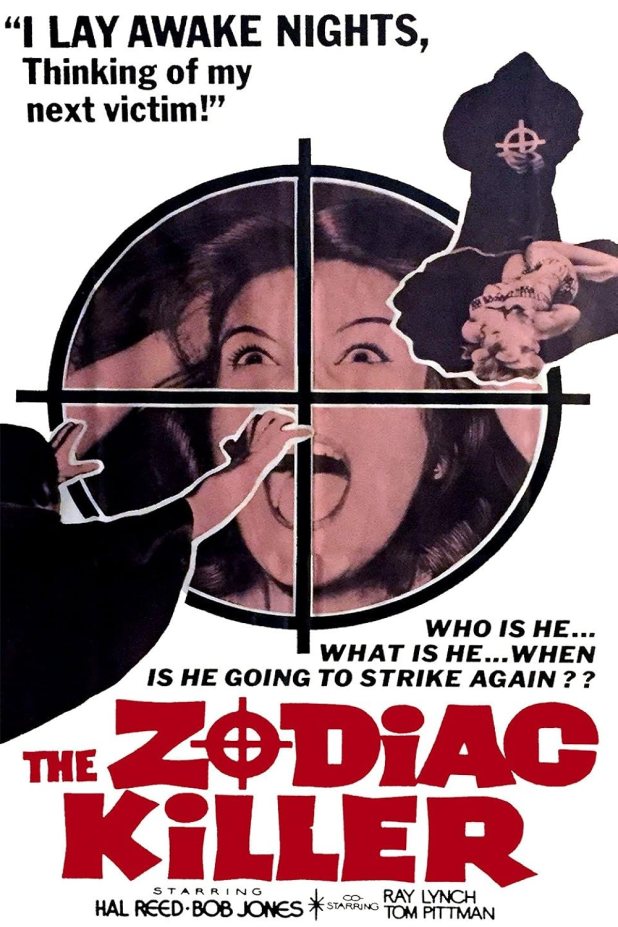
Zodiac Killer is just as much an attempt to catch the never arrested real-life Zodiac Killer as it was to cash in as an exploitation movie.
On its opening night on April 7, 1971 at the RKO Golden Gate Theater in San Francisco, audience members were asked to write their answers to the question “I think the Zodiac kills because …” and drop their entries into a large box. They were told that they could win a Kawasaki motorcycle, but they were also having their handwriting being tested by experts against the actual handwriting of the killer. Members of the cast were waiting to grab and interrogate anyone whose penmanship was suspect.
I don’t see David Fincher doing that.
In the first half of this movie, Grover (Bob Jones) bemoans his life. He’s a drunk and balding tow truck driver who can’t even see his daughter whenever he wants to. He takes her hostage and decides to tell the cops that he’s the Zodiac. She runs away and he gets the due process of being shot a whole bunch of times, his body falling into a swimming pool.
The truth, as shown in the second half, is that the Zodiac is Grover’s friend Jerry (Hal Reed). He’s a Satanist who hates humanity when he isn’t delivering their mail. He blames his crimes on the fact that his father is mentally ill, then his closing voiceover warns the audience that he will never been caught and that there are others just like him.
Along with Another Son of Sam, Zodiac Rapist and even Dirty Harry, the Zodiac was all over 70s cinema. This film’s director Tom Hanson — according to Mental Floss— “had found his niche as the owner of several Pizza Man franchises and a handful of Kentucky Fried Chicken locations.” He spent $13,000 of his money making this movie, which was less about making a good film and more about luring the Zodiac to the theater. He believes that he met the Zodiac at the urinal, when a man next to him said, “You know, real blood doesn’t come out like that.” As for his research, at least Hanson met with reporter Paul Avery, who also gave this quote that started some prints of this movie: “The motion picture you are about to see was conceived in June 1970. Its goal is not to win commercial awards but to create an “awareness of a present danger”, Zodiac is based on known facts. If some of the scenes, dialogue, and letters seem strange and unreal, remember – they happened. My life was threatened on October 28, 1970 by Zodiac. His victims have received no warnings. They were unsuspecting people like you.”
They may have missed the killer despite their plans, as co-writer Ray Cantrell was hiding inside a freezer to watch audience members. He nearly passed out and as he was being rescued, someone left a card that said, “I am the Zodiac, I was here.” No one was able to see who left that message.
There was a documentary called The Zodiac Killer Trap that discussed how Hanson spent years keeping up on the man who he met in the bathroom, who was still alive as of 2019.
As for the movie, it’s as good as $13,000 and amateur filmmaking will allow. It does have Doodles Weaver in an absolute freakout of a performance, ranting and snarling dialogue like “I like ’em plump and juicy and dumb!” A member of Spike Jones’s City Slickers band, a writer for Mad Magazine, the uncle of Sigourney Weaver and a frequent cameo and guest star actor, his full name was Winstead Sheffield Glenndenning Dixon Weaver. You’ll wonder how life led him to be in this movie.


 B&S About Movies
You must be logged in to post a comment.