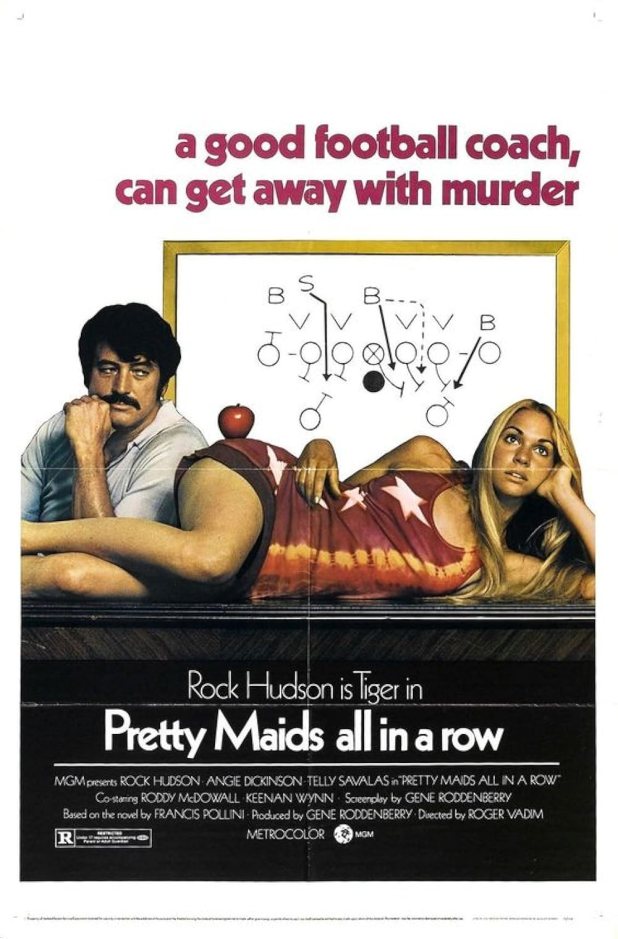
Based on Pretty Maids All in a Row by Francis Pollini, this combination of sexploitation, comedy and murder mystery — let’s just call it Giallo — was directed by Roger Vadim from a screenplay by producer Gene Roddenberry.
It was sold on the idea that eight new actresses were making their debut- all young and quite fetching. They were Brenda Sykes (Mandingo, Black Gunn), Joy Bang (Night of the Cobra Woman, Messiah of Evil), Gretchen Burrell (wife of Gram Parsons), Joanna Cameron (Isis), Aimée Eccles (Lovelines), June Fairchild (a member of the Gazzarri Dancers on the syndicated variety show Hollywood A Go-Go; she invented “The Statue Dance” with dancer Mimi Machu; she’s also in Up In Smoke, sniffing Ajam powder), Margaret Markov (Run, Angel, Run; The Hot Box) and Diane Sherry (Lana Lang in Superman).
Further sex sells came from a feature in the April 1970 issue of Playboy, which featured an interview with the director and a nine-page pictorial of stars Angie Dickinson, Burrell, Eccles, Markov and Playboy bunny Joyce Williams, who was also in the film (and Soylent Green). Maybe they should have told the teachers at University High School in West Los Angeles, who would later complain about how dirty — and violent, but this is America, so mostly dirty — the movie was.
Oceanfront High School has seen many of its most beautiful teens killed by a serial killer. Could it be Ponce de Leon Harper (John David Carson), who is surrounded by sexually available women all day and is being driven mad by them? Or football coach and guidance counselor Michael “Tiger” McDrew (Rock Hudson), who has probably slept with all of the school’s best-looking ladies by now? That’s what Detective Sam Surcher (Telly Savales) wants to know.
Tiger and Ponce strike up a friendship, as Tiger wants to get Ponce laid. After all, the kid claims that he has a constant erection. He conspires to set the student up with the new teacher, Betty Smith (Angie Dickinson). As this goes down — literally — more women are being killed every day. I mean, Ponce finds a dead body in the men’s room when all he wants to do is jerk off!
Vadim is well-known for his relationships with Brigitte Bardot and Jane Fonda and his movies. Perhaps having this many good-looking women on set at the same time—Roddenberry was no saint either, having affairs with Nichelle Nichols and Majel Barrett during Star Trek and supposedly harassing several others—just short-circuited his brain.
But hey, despite how all over the place this is, it has Keenan Wynn as a lawman, Roddy McDowall as the principal and Barbara Leigh as Tiger’s wife. Hudson plays his role well, a man who has won so many times that he starts to think that he can kill and escape the law. Maybe he does. James Doohan even shows up, getting a role from his old boss as one of Savales’ assistant detectives.
Quentin Tarantino included this in the 2012 Sight & Sound poll of the best movies of all time. I wouldn’t go that far, but it’s the type of movie that isn’t good, but is definitely entertaining.
Sergio Martino’s directorial efforts have run the gamut — from straight exploitation (Mondo Sex and Mountain of the Cannibal God, which features Stacy Keach and Ursula Andress, as well as real animal mutilation which we’d never endorse) to horror (Island of the Fishmen, which in addition to starring Barbara Bach and Joseph Cotten, was re-edited by Jim Wynorski and re-entitled Screamers), post-apocalyptic action (2019: After the Fall of New York and Hands of Steel, which is more Terminator rip off than Road Warrior), spaghetti westerns, crime dramas, war films, comedies and even Italian TV, where he’s worked for the last several decades. But this week we’re here to discuss his contributions to the world of giallo.
This is his first effort and the start of the ensemble case in which he’d use in his films. George Hilton would appear in four of his films, Ivan Rassimov in three and one of the queens of the giallo, Edwige Fenech, would star in three (in fact, she was married to Sergio’s brother, the late producer Luciano Martino, at one time).
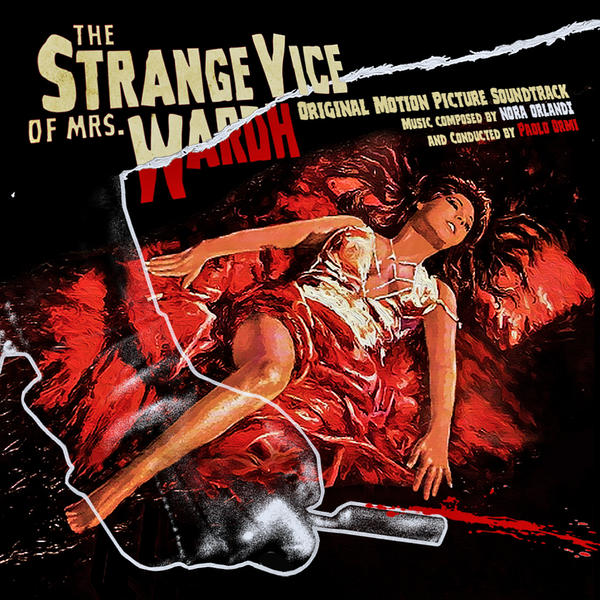
Wondering why this film isn’t just titled The Strange Vice of Mrs. Ward? Turns out a woman named Mrs. Ward sued before the release, claiming that the film would ruin her good reputation, so they changed the title. Yes, Italy, the country where you can make a movie called Zombi 2and have nothing to do with the original film still has legal settlements such as this. You can also find this movie under the titles Blade of the Ripper, Next! and The Next Victim.
Julie Wardh (Fenech) is the wealthy heir to a retailing company. But she’s also a fragile flower, back in Vienna, a city packed with memories and former lovers. She’s married to Neil (Alberto de Mendoza from Horror Express and A Lizard in a Woman’s Skin), a man so wealthy and powerful that he leaves for business the moment they land.
As Julie rides alone in the rain, her car is stopped by the police who are on the hunt for a killer. The sound of the wiper blades reminds her of the last time she was here, recalling a vicious fight between her and a lover who repeatedly slapped her around before they made love in the rain. There’s a gorgeous shot here at the end, where the lovers are to the left of the camera while rain descends on them, almost illuminating them and a sports card pushes into the right foreground. Compared to other giallo which seem content to merely ape Argento or seem like boring police procedurals, Martino aspires to art within his direction (which honestly is why this site is planning on a week of his films).
A green light and honking horns snap Julie from her reverie and she returns to her apartment, where she takes strange notice of a car. Her apartment has been left exactly as it was the last time she was here — it’s a white pop art explosion of metallic, green and blue lines contrasted with oval windows — and just as she’s getting ready to take a bath, the buzzer rings. A dozen roses with a note attached: The worst part of you is the best thing you have and will always be mine – Jean.
We cut to a party, where Caroll (Conchita Airoldi, who would go on to produce Cemetery Man) is trying to hook Julie up with her cousin George (George Hilton, All the Colors of the Dark, The Case of the Bloody Iris) as a catfight between two girls in paper dresses goes down. Tell you what — if I am to learn anything from giallo, it’s that every party in 1970’s Italy was packed with drugs, crazy music and the chance that anything from a fistfight to an orgy could happen at any minute. People had to be exhausted all the time. Jean (Ivan Rassimov from Planet of the Vampires, Your Vice is a Locked Door and Only I Have the Key, Eaten Alive!), the guy who sent the roses and was the man she remembered in the earlier flashback, is there extending a salute. This enrages Julie, who leaves the party, but he follows her into the street. He reminds her that she belongs to him, but she counters that she married Neil to escape him, which is cemented when Neil shows up and punches the dude. Jean just laughs, looking at both of them, knowing that he owns Julie body and soul.
This leads to a flashback where Jean pours champagne all over her, soaking her dress, then smashes the bottle of champagne, showering her in glass shards. He uses what’s left of the bottle to slice up her dress and skin before he takes her. Their coupling is a mix of pleasure and pain, covered in blood, that she had to escape. But did she want to?
So what then is Mrs. Wardh’s strange vice? Is it for men that are bad for her? Is it for pain and dominance? Or some combination of both? As we learn, she’s caught between three men — her husband, whose cool indifference and emotional (and physical) unavailability is just as cruel as her former lover Jean, who owns her to the point that she is nearly his again before Neil showed up to hit him. And the third side of this love rectangle (is there such a thing?) is George, who is the porridge to her Goldilocks — the just right combination of both. Yet there is a fifth side to this — making it a love pentagon (!?!) — with Julie wanting to be a good woman, true to her vows and not to her need to be beaten, bloodied and forced. She is torn between her desire and her need to fit into the moral code of the world. So much of giallo is based on this — created in a country where the Holy Seat of a religious empire sits smack dab in the middle of Rome. Religion and morality nearly shook hands with the sexual revolution and excesses of the pre-AIDS 1970s.
Ah, but let’s not forget that a proper giallo needs a murder, which this film delivers with a quick slash in the shower. That said — what strikes me about Martino is that unlike Argento, he cares more about the story and the characters than creating murder art set pieces. The conversation between Carol and Julie isn’t just words on a page, they’re vital clues into her mental state. Whereas Carol’s casual amorality is revealed, saying that the killer — who we just saw attack the showering girl — is taking out her competition, Julie worries about her values. She married Neil for security and protection, but not the monetary or physical kind. She wanted protection from herself, as she feels that her loss of control and willingness to submit to the violent impulses of men makes her a sinner.
George shows up to meet Julie and get to know her better. He even tells her that he loves to court women when their husbands are around, cuckolding them. Julie claims that that leaves her cold, while Carol claims that she’d bed him, family or not. They decide to go to lunch together, which seems to be more about George staring at Julie than sustenance. Julie demands that George take her to the bus station, but instead he takes her all over the countryside on his motorcycle (What is it with Fenech’s character and dudes that ride bikes? Is it the freedom that it represents?) while he wears white leather fringe, a look that is very 1971. He calls her the moment that she enters the house and she tells him that she likes him way too much, so she can never see him again. Of course, he’s already there and enters the front door before kissing her. She tries to get away, but he keeps telling her that he is in love with her. She begs him to not complicate her life, that she is not the girl he thinks she is. Their kiss is artfully compressed into a second kiss that occurs much later that same day — an intriguing way to show the passage of time and the growth of their relationship.
As they kiss in the dark, a car nearly hits them, which Julie is sure is Jean. She tells him to take her anywhere, which ends up being his apartment. The car returns and its driver watches from the window as Julie and George make love (or, more to the point, she knees him in the crotch while laying upon him, but whatever works for them, I guess).
Later, Julie gets more flowers from an anonymous admirer. Her husband asks who they are from and she wishes aloud that they came from him. There’s another note attached — “Your vice is a locked door and only I have the key.” She tells him that she realizes that diplomats only love other diplomats. He replies that she feels that he has always failed and wronged her. He asks if she is content. “I’m more than content,” comes her reply.
The black gloved killer is watching her and calls her to blackmail her, saying that he will tell her husband. She goes to talk to Carol and claims that it’s Jean. Carol responds that the killer’s last victim was “that whore at the party” and Jean couldn’t be the killer, as he doesn’t go after women like that. Carol embraces free love and says that if Julie is into George, then why should she have to hide it? Also: Carol just walks around her apartment naked (and also has a crazy cover up that is all black with red feathers) and Julie is just fine with it. Carol offers to go to where the blackmailer/killer wants her to drop off the money.
Julie nervously chainsmokes while watching a motorcycle race, a scene intercut with Carol going to meet the killer. To show the escalation of worry, Martino piles on the jump cuts and quick switches between the two women. Whereas Julie is trapped within her worry and the walls of her apartment, the carefree Carol is all alone within a huge park. Alone until the killer reveals himself, slashing her with a straight razor. Again — the killings are rather matter of fact in contrast to the set-ups in this film.
The police get involved, finally investigating Jean. They go to his apartment, which is covered with photos of naked women and exotic animals. Then, they interrogate him with her in attendance. It’s just an excuse for him to keep trying to seduce her and inform the police that Julie has a blood fetish, so she could be the killer, too. George has also been brought in for questioning, to which Jean says, “Now I know why my flowers have no effect on you.”
Neil arrives to take Julie home, but later George says that he wants to speak to her husband and take her away from the city. She says that she has to see this out, she has to discover who killed her best friend when it should have been her.
As Julie returns home, she finds herself in a dark parking garage. The headlines of a car cut into the inky blackness before she is nearly run over. She runs for the elevator, watching for the killer and the numbers of her floor to get closer. Yet the doors open to reveal the killer! Julie runs from him, even attempting to hit him with her car. She barely makes it inside the apartment, screaming at the door. Her husband lets her in but she’s in hysterics. There’s a lot of this scene that feels like it influenced Halloween 2‘s elevator scene. I’m not alone in feeling like that sequel is a giallo. Check out this awesome article from Bill at Groovy Doom to see what I mean.
Neil has had enough and decides to go to Jean’s house and confront him. He tells Julie that he will go alone, but she is afraid and rushes to be with him. They explore his dark house, finally finding Jean’s body in the tub. Julie is overcome and passes out in her husband’s arms. When they get outside, Jean’s car is gone and flowers have been left in the backseat with another poem. Neil throws the flowers down in disgust.
We cut to a dream sequence of George, a laughing Carol and Jean covered in blood, slapping her around. Her husband wakes her up and shows her the photo of the killer. She asks her husband to protect her, but he leaves. She calls and begs George to come get her. He promises to take her to Spain, a place that will make her forget the rest of the world (people continually promise this to Julie, such as Carol’s offer that a place will make her forget she’s on a diet or that an affair will make her forget her sadness).
Neil comes back home to learn that Julie has left. Meanwhile, the killer tries to attack another woman, who unmasks, disarms and stabs him. He makes one last attempt to kill her, but passes out from blood loss.
Meanwhile (!), George and Julie are spearfishing. The camera work here slows down, turning around our lovers (You can’t tell me that DePalma didn’t watch at least a few giallo, even though he claims to have only seen The Bird with the Crystal Plumage and has been dismissive of Argento’s work. Sure, all of his films and giallo betray the and of Hitchcock, but some of these films seem way too close). They discover that the killer has died, but George disappears and someone starts following Julie. She arrives back at their apartment to hear the sound of dripping water. We follow the sound to the bloody curtains of the tub as water and blood spill out. The camera begins to spin back and forth before she sees Jean’s dead body, screams and passes out. George arrives and tries to wake her up, but she’s catatonic. George finds the cause of Julie’s worry — rust had been dripping onto the floor, looking like blood.
Julie awakens and her mood gives way to madness. She’s sure someone is there and yet there is no one. As she realizes this, she attacks a wall and is chloroformed from behind by…Jean! George is rushing a doctor to see her, explaining her vice for blood that excites and repels her at the same time. But Jean is too busy dragging her to the kitchen, where he duct tapes the window shut. He opens a gas line and locks the door (using an ice cube?), leaving her to die. We hear her heart beating out as it’s cut with shots of the doctor and George rushing to her. She makes an attempt to stand but cannot. And it’s too late — Julie is dead.
Neil comes to see the police and blames George for what the police are classifying as a suicide. Jean waits in a secluded area for George, who greets him with a smile. He asks him for the money — turns out that they were in this together. Even after explaining that they both have an alibi, Jean asks again for the money. George shoots him and leaves a gun in his hand, making it look like a suicide.
Turns out that Neil and George were in on this too — Neil has paid off his debts and with Carol gone, George is the only heir to a fortune — much like Hitchcock’s Strangers on a Train. As they drive away laughing, Neil sees Julie on the side of the road and demands that Neil turn around. To their surprise, it is her — followed by the police. A chase leads them off the side of the road to their death. The doctor has saved her life and it seems like he’s fallen for her.
Wow. The Strange Vice of Mrs. Wardh was but the first of Martino’s giallo films, but it’s great. It kept me guessing until the end with none of the b roll travelogue footage and red herrings that plague so many other films in the genre. What a movie to spend the middle of the night into the morning with!
Here’s a drink recipe.
The Strange Cola of Mrs. Wardh (tweaked from this recipe)
1 1/2 oz. J&B Scotch
5 oz. cola
4 dashes Angostura Orange Bitters
An orange wedge
Put on your black leather gloves and use a switchblade to slice an orange wedge.
Fill a tall glass with ice and pour in the J&B and cola.
Add the bitters, then squeeze in the orange juice and use the rest of the wedge for a garnish.
Editor’s note: Cinematic Void will be playing this movie on Monday, January 13 at 7:00 p.m. at the Music Box Theater in Chicago, IL. You can get tickets here. For more information, visit Cinematic Void.
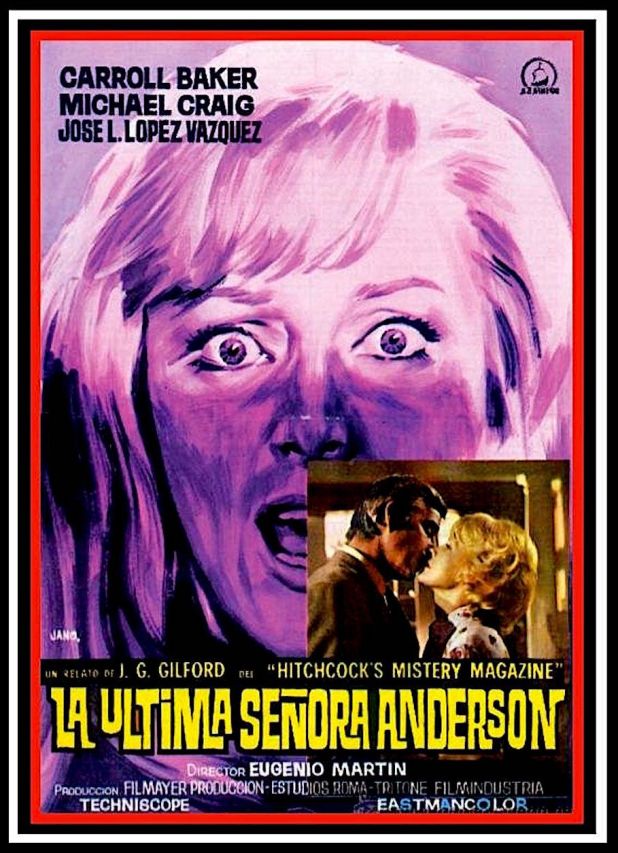
I loved this movie! It was such a madcap blast that it completely took me by surprise. Arthur Anderson (played by Michael Craig) is a wealthy Englishman whose two previous wives have died under mysterious circumstances—one in a car crash and the other after falling from a building. Now, his third wife drowns under questionable circumstances. Fortunately, his housekeeper’s testimony keeps him free and clear, although the police keep an eye on him.
On the very night he is acquitted, Julie Spencer (Carroll Baker) breaks into his house in a twist that feels like a giallo-style meet-cute, and she becomes his fourth wife. But is she trustworthy? What about him? Why do Arthur Anderson’sAnderson’s wives keep dying with such frequency? And will Inspector Dunphy (José Luis López Vázquez) be able to uncover the truth behind these mysterious deaths?
This movie cleverly borrows elements from Rebecca and Vertigo without being overly derivative. I also absolutely adore that when we first meet Julie, she’s sleeping in a tent inside an abandoned mansion—because that’s completely normal, right? And is that Marina Malfatti (from The Night Evelyn Came Out of the Grave, All the Colors of the Dark) lurking in the background, donning a cape as part of her casual rainy evening attire with sunglasses at night?
Exploring Spanish Giallo has been a fantastic journey for me. I’ve enjoyed delving into Eugenio Martín’s works, including Horror Express, as well as It Happened at Nightmare Inn. Plus, Carroll Baker starring in a Giallo is almost a genre in and out of itself.
While there’s no clear hero, I still enjoyed every minute. This film is called Death at the Deep End of the Swimming Pool and The Fourth Mrs. Anderson. It was only available on a Greek VHS before Severin released it. The package includes a trailer, a deleted scene, and an interview with Eugenio Martín biographer Carlos Aguilar, maintaining their consistently stellar presentation.
Alan J. Pakula took the paranoia at the start of the 1970s and made this film, as well as The Parallax View and All the President’s Men, movies shaped by and that shaped the zeitgeist. He didn’t stop making important films, as he’d gone on to make Sophie’s Choice, Presumed Innocent, The Pelican Brief and Dream Lover, which has some tones of Giallo.
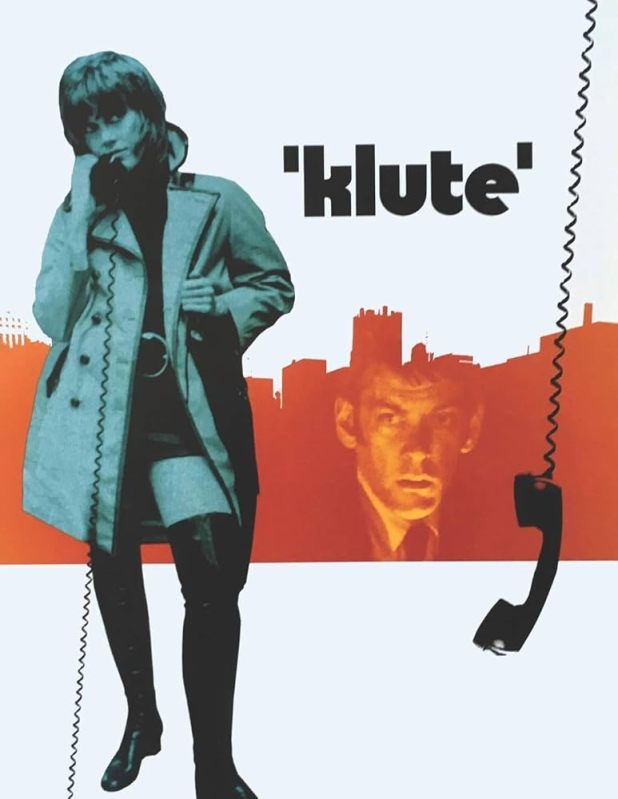
A chemical company executive has disappeared, and the only clue is obscene letters that were due to be sent to a call girl named Bree Daniels (Jane Fonda). The company hires a detective, John Klute (Donald Sutherland), to determine where the man has gone.
There’s a john who is so disturbed that two of his past clients have either committed suicide or become addicts. Bree had seen that man but can’t remember him. That is, once she finally opens up to Klute, who has been listening to her phone calls and following her, learning that she’s an actress who does sex work to pay her bills. One of the girls she knows, Arlyn Page (Dorothy Tristan), can tell Klute that his client may be the killer.
Fonda, a feminist, didn’t want to play this role. She wanted to drop out and ask Pakula to hire Faye Dunaway. She consulted with friends and, after some soul-searching, took on the role. Despite the controversy of her Vietnam protest, it became one of the best-known roles of her career, winning a Best Actress Oscar.
I like the end of this, as Bree keeps working everyone, saying that she’ll be back to see her therapist next week and that she would go mental living in a domestic world. Yet for all we see, Bree and Klute might be destined to be happy together. That’s a big win for a movie that follows a lot of Giallo beats and is filmed as if it’s surveillance footage. Sutherland and Fonda dated for a while; he was her date to the Oscars that year.
Bree’s apartment wasn’t real but was built on a sound stage. That said, Fonda did sleep overnight in it sometimes, and it even had a working toilet. She decorated the place as if Bree was a romance novel reader and had a cat. There’s also a hidden autographed photo of JFK. Fonda had a friend in Lee Strasberg’s private class who occasionally slept with the President, and in her head, she imagined that Bree did, too.
EDITOR’S NOTE: Cinematic Void will be playing this on Thursday, Jan. 23 at 7:30 PM at the Little Theater in Rochester, NY (tickets here). For more information, visit Cinematic Void.
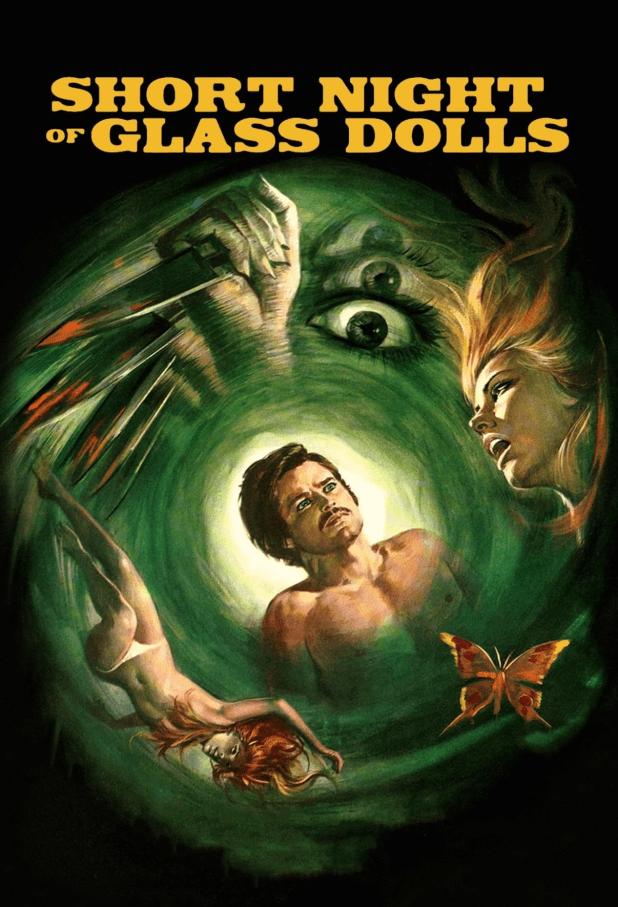
Gregory Moore (Jean Sorel, Perversion Story) has a problem. His body has been found in a park in Prague, but the American journalist is anything but dead. His heart is still beating and his mind is still able to replay the sinister events of the last few days, a story that started with the disappearance of his girlfriend Mira (Barbara Bach) and ended even more horribly than he could have imagined.
The debut movie from director Alan Lado, Short Night of Glass Dolls subverts the giallo genre to move slowly into the supernatural. The only other giallo Lado created was Who Saw Her Die?* which, much like this movie, doesn’t seem keen on following the Argento giallo formula like just about everyone else. Lado would also make the baffling Star Wars clone The Humanoid many years later.
Moore resolves to find Mira when the police can’t, so he joins forces with his co-workers Jessica (Ingrid Thulen, Salon Kitty) and Jack (Mario Adorf, The Bird with the Crystal Plumage). Never mind that he’s just had an affair with Jessica.
By the end of the film, we’re left wondering if our paralyzed narrator is really an unreliable one and whether or not he made his own girlfriend disappear. We needn’t feel that way for long. The truth is that she’s fallen into the claws of Klub 99, a black magic group made up of Prague’s social elite that uses the life force of the young and beautiful to stay powerful.
This is one dark giallo that feels like a swirling nightmare that the protagonist can’t wake from. Even when he’s moving and alive, he feels out of place, a man away from not just America, but from reality itself. The scene where he moves behind the audience and red curtain as they watch a man play piano is particularly striking as it separates him from everything else that is going on around him.
There’s only one on-screen murder and Lado really shows that he’s an artist here instead of a slavish follower of giallo convention. It reminds me of a much more downbeat All the Colors of the Dark where the cult is much more powerful. The end scene of the gallery watching the autopsy is a brutal finale.
*I guess you could also consider Last Stop on the Night Train to kind of, sort of be a giallo.
EDITOR’S NOTE: Cinematic Void will be playing this on Friday, Jan. 31 at 7:30 PM at the Little Theater in Rochester, NY (tickets here). For more information, visit Cinematic Void.
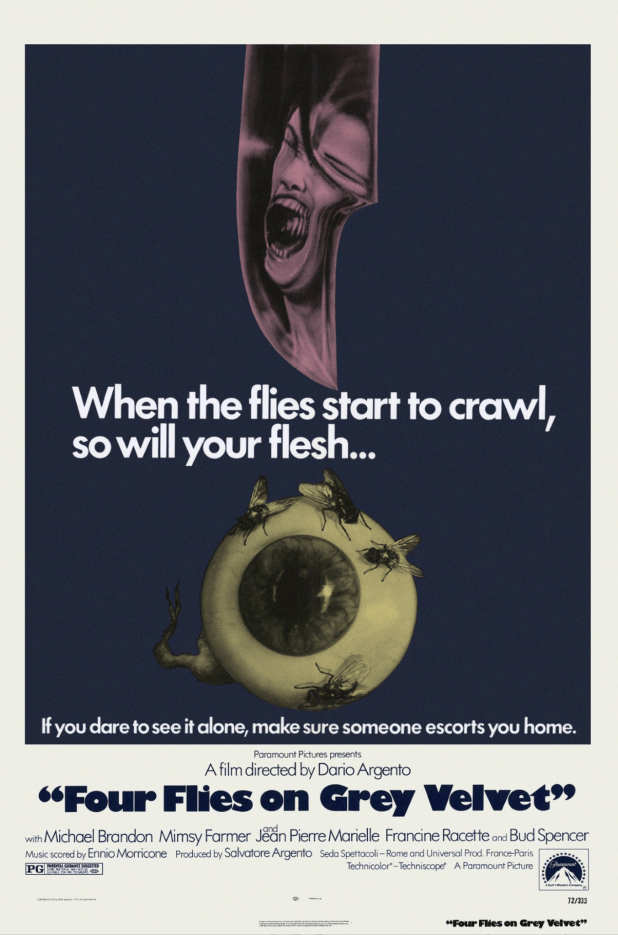
After The Bird with the Crystal Plumageand The Cat o’Nine Tails, Argento had one more movie left in his “Animal Trilogy.” Luigi Cozzi (Starcrash) would both write and assistant direct the film and the results are…interesting. It’s a lot funnier than his other giallo and was considered his swan song to the genre until his movie The Five Days failed at the box office.
Rock drummer Roberto Tobias is being stalked and as he finally catches up to his pursuer, the man pulls a knife. A struggle ensues and Roberto accidentally stabs the man while another masked figure laughs and takes photographs.
The next day, Roberto reads about the man’s death — Carlo Marosi — and gets a letter with a photograph of him murdering the man. He begins having reoccurring dreams that he’s being decapitated. Even worse, he wakes up to a masked man attacking him, who tells him that he won’t kill him because he isn’t finished with him.
Roberto’s wife Nina (Mimsy Farmer, Body Count, Autopsy) returns home and he confesses the murder to her and tells her that he can’t go to the police to stop the harassment. He does turn to his artistic friend “God” Godfrey (Bambino from They Call Me Trinity) and a con artist named the Professor (Oreste Lionello, The Case of the Bloody Iris and the Italian voice for Woody Allen) for help.
Whoever is behind Roberto’s stalking and harassment is a troubled soul who had a horrific childhood and spent some time in an insane asylum. Roberto’s maid Amelia knows who it is, but she pays for it with her life, as the killer uses a straight razor to slice her apart.
Later that night, Dalia (Francine Racette, Donald Sutherland’s wife, so well done Donald) comes to stay with Nina and Roberto, despite him wanting her not to be there. It also turns out that our hero never really killed Carlo, who has been working with his blackmailer, who dispatches him with razor wire.
Roberto then hires Arrosio, a flamboyant investigator who has never solved a case, but hopes that this is the one that he will solve. Amelia’s murder has been discovered and the cops are on the case, so Nina says that she’s leaving town, feeling unsafe in her own house.
It turns out that Dalia has always loved Roberto, so they have sex. As you do. Look, it’s a giallo. Other strange things are afoot, like Roberto’s cat getting kidnapped and beheaded, Nina getting an inheritance, strange photos of Nina and Dalia’s family and more nightmares.
That’s when giallo science intrudes: the killer was in a mental institution called Villa Rapidi, where they were considered dangerous until their father died. This knowledge — and discovering the killer’s identity and finally cracking a case — leads to Arrosio’s death.
Dalia then notices that Roberto and someone in a photo with his wife look quite similar. Just as she puts it all together, she’s stabbed and killed.
Ready for more giallo science? The police perform an optographical test that takes a photo of the retina to show the last image that Dalia saw before she died. Even Argento — a man who made a movie about a girl who can physically speak to insects and becomes friends with an orangutan — thought this idea was stupid until Carlo Rambaldi showed him how the special effect would look.
The last image that Dalia saw? Four flies on grey velvet. No one knows what this means.
Roberto waits for the killer to come for him but then Nina arrives. He tries to get her to leave because the killer is coming when he notices her necklace: a fly. As it swings, he sees it: four flies. In true giallo fashion, the killer is someone who we obviously didn’t ever consider.
A fight breaks out and she repeatedly shoots her husband as she explains how she was placed in the asylum by her abusive stepfather — who raised her as a man — and was only cured when the man died. When she met Roberto, what she felt wasn’t love, but the madness that her stepfather caused within her. She finally would get her revenge by using Roberto as the replacement for the man she couldn’t get back at.
Nina runs away as Godfrey arrives to save Roberto, but she rams the back of a truck. She’s decapitated as the car explodes.
Deep Purple almost did this movie (several members of the Beatles were considered for the role of Roberto), but their schedule didn’t allow it to happen. Ennio Morricone, who worked with Argento on The Bird with the Crystal Plumage worked on the film, but had a huge argument with the director about the score. Goblin would come in and work with Argento for the first time here. Morricone and Argento finally reconciled and worked together on The Stendhal Syndrome.
This film wasn’t commercially released for the home market until 2009, other than an incredibly hard-to-find French VHS version. That’s because the rights to this film in America are owned by Paramount Pictures, which had chosen not to release it. Shameless did put out a UK release that is all region a few years back.
This is one strange giallo. The ending car crash took twelve cars to get right and combined with the music in the scene, it’s really unsettling. This is also one of the first movies to use high speed cameras to shoot bullet time, years before Hong Kong movies and The Matrix. I love the killer’s rant at the end of the film, particularly because big chunks of it are still in Italian! This might be hard for you to find, but it’s worth tracking down.
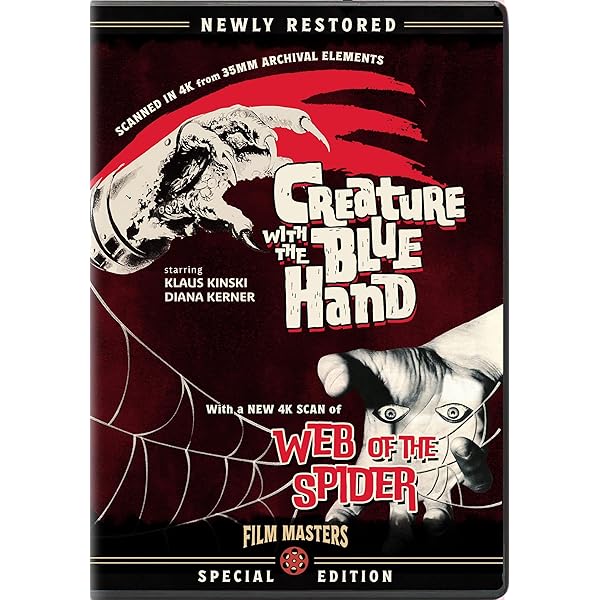
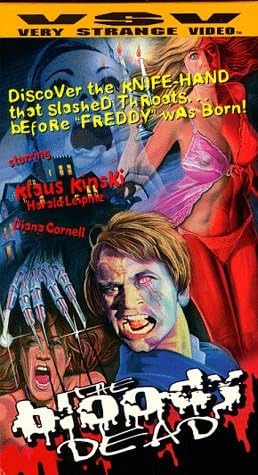
Film Masters has put together an exciting blu ray with Creature of the Blue Hand, scanned in 4K from 35 mm archival elements, a new 4K scan of Web of the Spider and The Bloody Dead. Bonus features include commentaries on both movies by Stephen Jones and Kim Newman; reimagined trailers for Creature of the Blue Hand and Web of the Spider; a trailer for Castle of Blood; new documentaries on Edgar Wallace and Klaus Kinski’s acting in the Rialto krimi movies; an archival commentary for The Bloody Dead by Sam Sherman; raw and behind the scenes footage for The Bloody Dead and a booklet with essays by Christopher Stewardson and Nick Clarke.
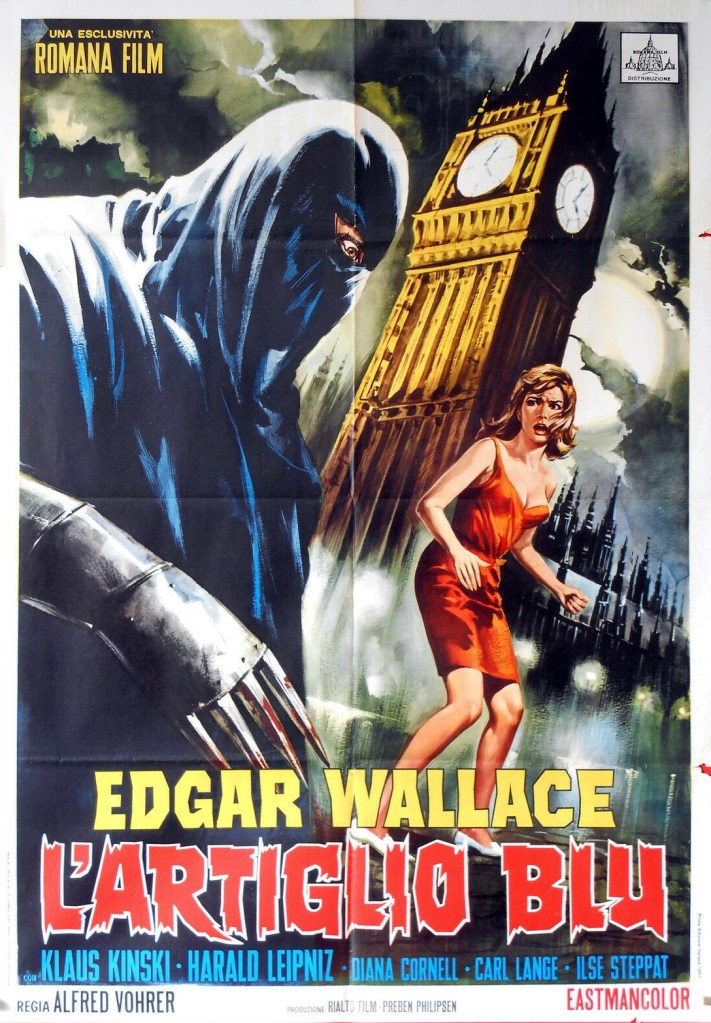
Creature With the Blue Hand (1967): Based on the Edgar Wallace novel The Blue Hand and part of a long-running series of krimi adaptations by Rialto Film, this was bought by New World Pictures and issued as a double feature in the U.S. with Beast of the Yellow Night. Man, how good was life then?
Klaus Kinski plays Dave Emerson, who chokes out a nurse and escapes from a mental hospital before running to the castle of his twin brother Richard — also Kinski — as a black robed killer roams the grounds and kills people with his astounding blue claw with razorblades on the fingers, like something out of a giallo. For example, oh, Death Walks at Midnight. Or A Nightmare On Elm Street, which came 17 years after this.
Director Alfred Vohrer keeps things moving and it all looks gorgeous if indebted to Mario Bava. That said, aren’t all movies made after him? There’s also an incredible insane asylum sequence, featuring rooms filled with mice, rats and one female patient who just strips all day and night. This is the kind of movie world where you just want to live inside it, except that, yeah, there’s a killer on the loose and the cops are as always ineffectual.
Coming out just three years before giallo would surpass the krimi while using many of the same ideas from Edgar Wallace, this film reminds me that I need to get deeper into watching these German detective movies.
Creature With the Blue Hand later re-edited in 1987 with new gore inserts by producer Sam Sherman for his company Independent International — wow, I love that so much — and released to home video as The Bloody Dead. The extra scenes — almost ten minutes of new footage — were directed by Warren F. Disbrow and his father Warren Disbrow Sr. You can learn more about that movie below.
Web of the Spider (1971): After Castle of Blood‘s disappointing box office, Antonio Margheriti felt he could remake the film in color and have it be more successful.
Edgar Allan Poe (Klaus Kinski) is our narrator and Kinski shows up for the beginning and the ending of the movie. He’s interviewed by Alan Foster (Anthony Franciosa), who challenges him as to the truth of his stories. This leads to a bed with Lord Blackwood (Enrico Osterman) about spending a night in his castle, a place where he soon meets Elisabeth (Michèle Mercier, Black Sabbath) and quickly falls into love — and bed — with her before she announces that she’s no longer alive.
There’s also Julia (Karin Field), William Perkins (Silvano Tranquilli) and Elisabeth’s husband,Dr. Carmus (Peter Carsten). The ghosts need his blood to come back to life, but Elisabeth helps him to escape, only for him to impale himself on the gate, dying just as Poe gets there.
I adore that the tagline of this is “Based on Edgar Allan Poe’s Night of the Living Dead.” He did write a poem “Spirits of the Dead” and the 1932 movie The Living Dead was based on Poe’s “The Black Cat” and “The System of Doctor Tarr and Professor Fether” as well as Robert Louis Stevenson’s The Suicide Club. But no, he has nothing to do with Romero’s movie.
I really like the soundtrack by Riz Ortolani but this can’t compare to the black and white — and yes, Barbara Steele appearance — in the original. That said, Kinski is awesome in every second he’s on screen, looking like a complete madman.
The Bloody Dead (1987): Warren F. Disbrow Jr. met Sam Sherman when he shot the interview footage for Drive-In Madness. That led to him being called to shoot new footage — 15 minutes worth — with Gene Reynolds and Tony Annunziata on remade asylum sets to make it appear that Creature With the Blue Hand wasn’t a movie made twenty years before as this was going to be released on VHS by Very Strange Video.
When this came out on DVD from Image Entertainment, Jim Arena wrote “”Sam needed to punch up the film with some gore to make the picture more appealing to modern-day audiences. That meant new scenes would have to be filmed. With a lucrative video distribution deal already on the table, Sam went to work and brought in associate Warren Disbrow to re-create the German asylum sets at his facilities in New Jersey. Hannibal Lector’s Silence of the Lambs institution cell recreation for 2002’s Red Dragon has been hailed for its precision, but Sherman and Disbrow’s attempt at duplicating Dr.Mangrove’s asylum, where most of the newly shot footage was intended to expand upon, is no less impressive. It is actually difficult to tell the difference between the two sets.”
Disbrow Sr. made a new version of the claw hand that the killer used and Ed French did the special effects. Other than the 15 minutes or so of new footage, this is almost the same exact movie, just with the added gore that late 80s audiences expected.
Thanks to the British Film Institute, there’s a list of films that played Scala. To celebrate the release of Severin’s new documentary, I’ll share a few of these movies every day. You can see the whole list on Letterboxd.
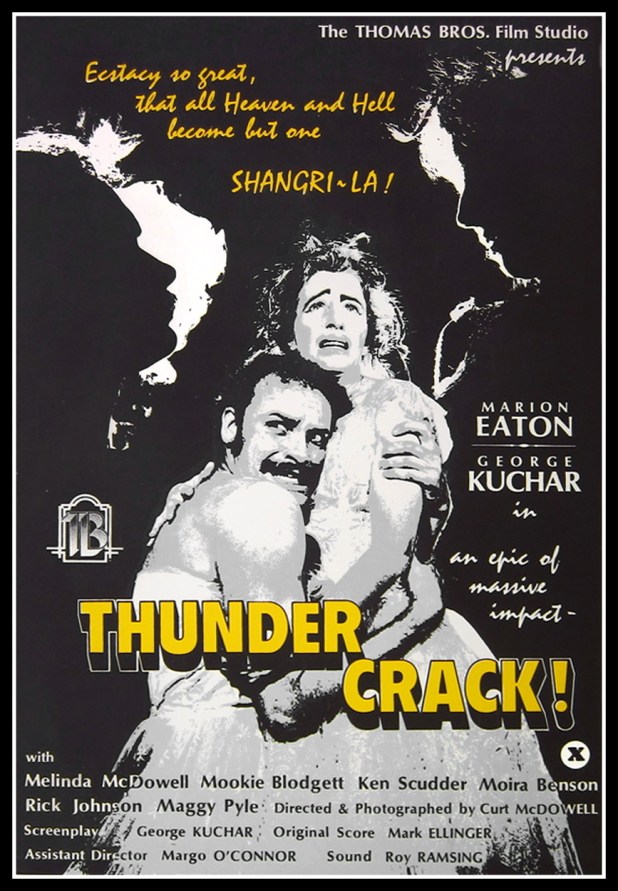
It was directed, shot and edited by Curt McDowell, the lover and student of George Kuchar — the writer of this movie — who described his work as the “prolific regurgitations of an enfant terrible.”
It’s an old dark house in the middle of a thunderstorm. We’ve seen it before, but we’ve never seen a place like Prairie Blossom. Willene Cassidy (Maggie Pyle) shows up in the middle of the night, paying a visit to the drunken Mrs. Gert Hammond (Marion Eaton), who pukes before we even get to know her. Taking pity on the woman, Willene — the wife of country star Simon Cassidy — gives her a bath and masturbates her. If this offends you, it’s best you stop watching this right now.
There’s more than one person seeking to get out of the rain. Chandler (Mookie Blodgett) is the widower of Sarah Lou Phillips, owner of the largest girdle factory in the United States. His wife has recently died as the result of a girdle fire at a cocktail party, falling into a swimming pool with her head on fire. Since then, he’s only slept with men, as women in girdles — nearly every woman in the world owns a House of Phillips brand girdle — he’d lose his erection as he remembers his wife ablaze. Luckily, Sash (Melinda McDowell) has no such underwear and is able to get him off.
Where is Mr. Hammond? He was turned into dust by a storm of locusts. Where is his son? He no longer exists.
When he did, he was a collector of sex toys, which are all over the large house, enabling all manner of sexual acts — real ones, mind you — such as Toydy (Rick Johnson) getting head from Roo (Moira Benson) to get the key to a locked room, but unable to perform until he watches Bond (Ken Scudder) and Willene get it on. Vegetables are also involved. And finally, there’s Bing (George Kuchar), who comes from the circus, a place where he accidentally made love to gorilla named Medusa who hates everyone. She’s in the car waiting for him. And oh yes, there’s a secret in the Prairie Blossom.
Buck Henry was a judge at Filmex, the Los Angeles Film Festival, and selected this as the first X-rated film allowed at that fest. Tons of people walked out. What’s strange is that McDowell was so broke when this came out that he worked as a janitor at The Roxie in San Francisco, where this played almost every Friday at 8 p.m. He married one of the owners, Robert Evans, who took control of his films after McDowell’s death.
How did this get made? Producers John and Charles Thomas were students of Kuchar and heirs to the Burger Chef empire. Two of the rooms of their house were used as the set.
At three hours and with a ten minute intermission, I was worried about this one, yet it won me over. There are numerous scenes that made me laugh at loud and almost every character gets a long and emotionally rich monologue, as well as a chance to get off. It feels like every fifty years or more after this was made that there’s something in it that will offend nearly everyone. I first read about it in my teenage years and it was so hard to find that it took me decades to finally see it. It’s a pleasure to let you know that it was well worth the wait.
A lot of the cast also shows up in Dan Caldwell’s Sip the Wine, another adult film that is about the world of making dirty movies in San Francisco. It may be IMDBS, but it’s said that Marta Kauffman and David Crane named Chandler Bing on Friends after two characters’ names in this.
Thanks to the British Film Institute, there’s a list of films that played Scala. To celebrate the release of Severin’s new documentary, I’ll share a few of these movies every day. You can see the whole list on Letterboxd.
Wilhelm Reich was one of the second generation of psychoanalysts after Sigmund Freud. His concept of muscular armour is part of body psychotherapy, Gestalt therapy, bioenergetic analysis and primal therapy; he came up with the phrase “the sexual revolution.” He also created Faraday cages that built up orgone energy, the energy of life and orgasms, that he claimed could cure cancer. The U.S. food and Drug Administration made them illegal and later burned six tons of his books, sending him to jail where he would die within a year. Freud said of his work, “We have here a Dr. Reich, a worthy but impetuous young man, passionately devoted to his hobby-horse, who now salutes in the genital orgasm the antidote to every neurosis.”
Reich also built cloudbusters that he said could make it rain and chased UFOs. Soon before he was to be released from jail, he died. He left instructions that there was to be no religious funeral, but that a record should be played of Schubert’s “Ave Maria” sung by Marian Anderson. His granite headstone reads “Wilhelm Reich, Born March 24, 1897, Died …”
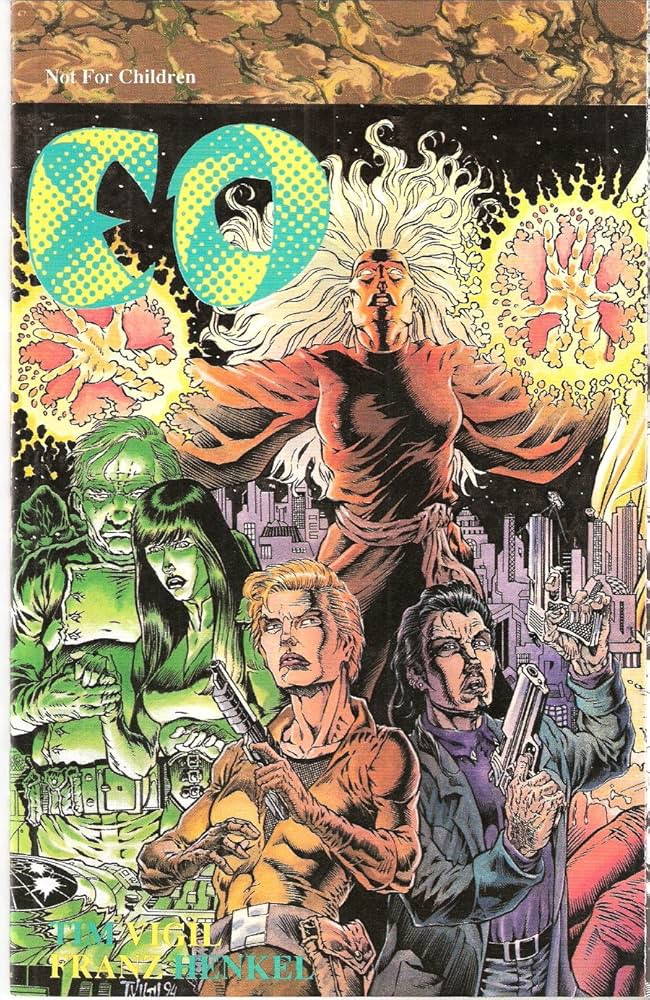
I discovered him by way of the Tim Vigil comic book EO.
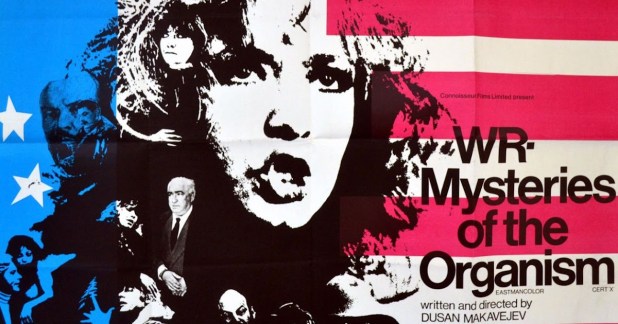
W.R.: Mysteries of the Organism, directed by Dušan Makavejev (Sweet Movie) was banned in Yugoslavia for sixteen years and when Makavejev spoke up about it, he was indicted on charges of derision toward the state, its agencies and representatives.
This feels like a cut and paste technique film. Documentary footage and clips from The Vow share the screen with Tuli Kupferberg of the band The Fugs singing “Kill for Peace” and “I’m Gonna Kill Myself Over Your Dead Body,” Betty Dodson drawing people masturbating, the Plaster Casters casting Jim Buckley of Screw magazine, scream therapy and a story where Milena (Milena Dravić) turns down the sexual advances of the worker class to obsess over Vladimir Ilyich (Ivica Vidović), an ice skater who is s symbol of Western corruption. After they finally make love, he beheads her.
Meanwhile, the scientists of 1971 are continuing the work of Reich.
Makavejev rails against Communism, American psychiatry, the buttoned up lack of sexuality in the world and anything that’s offensive, he finds it and shows it. Sweet Moviewould take this even further. This is more than a half century old and still feels like a firebomb being set off in public.
Thanks to the British Film Institute, there’s a list of films that played Scala. To celebrate the release of Severin’s new documentary, I’ll share a few of these movies every day. You can see the whole list on Letterboxd.
Partly adapted from the 1952 non-fiction book The Devils of Loudun by Aldous Huxley, which was turned into the play The Devils by John Whiting, United Artists had already given up on this movie after seeing how controversial Ken Russell’s screenplay was. Warner Brothers then took over but its rough sexual and violent nature, not to mention how it presented religion, led to major issues. It’s since been banned in several countries and was heavily edited for release in many countries, with several places never seeing its original uncut version.
Two scenes were cut and have rarely been shown, one where nude nuns sexually use a statue of Christ while Father Mignon watches and masturbates, as well as another that showed Sister Jeanne (Vanessa Redgrave) masturbating with the charred femur of Grandier (Oliver Reed) after he is set ablaze for his crimes.
As for Rusell, he said, “I was a devout Catholic and very secure in my faith. I knew I wasn’t making a pornographic film… although I am not a political creature, I always viewed The Devils as my one political film. To me, it was about brainwashing.”
Behind the very human — and at times occult and otherworldly — moments of the film, the dramatic narrative behind The Devils is Cardinal Richelieu working to influence Louis XIII and get him to stop the Protestants from rising up. However, Louis forbids Richelieufrom destroying the town of Loudun, having made a promise to its Governor to keep the town intact.
Whiole Loudun’s Governor has died, the town is now controlled by Urbain Grandier (Reed), who may be a popular man of God, but is also a man who has secretly married a woman. Meanwhile, Sister Jeanne des Anges, the deformed abbess of the local Ursuline convent who is sexually obsessed with Grandier, grows upset that the man she is in love with has not taken her.
The cardinal gets what he wants by accusing Grandier of witchcraft, bringing in Father Pierre Barre, a professional witch-hunter whose exorcisms are even more salacious than the crimes he has been sent to investigate. He unleashes a sexual firestorm amongst the nuns and a mockery of a trial that somehow finds Grandier convincing Barre that he is innocent. Yet it is too late. Despite his innocence, the town is destroyed.
How metal is this film? Ministry sampled it for their song “Golden Dawn” and other artists such as Belphegor and Skinny Puppy have also used dialogue from this movie.


 B&S About Movies
You must be logged in to post a comment.