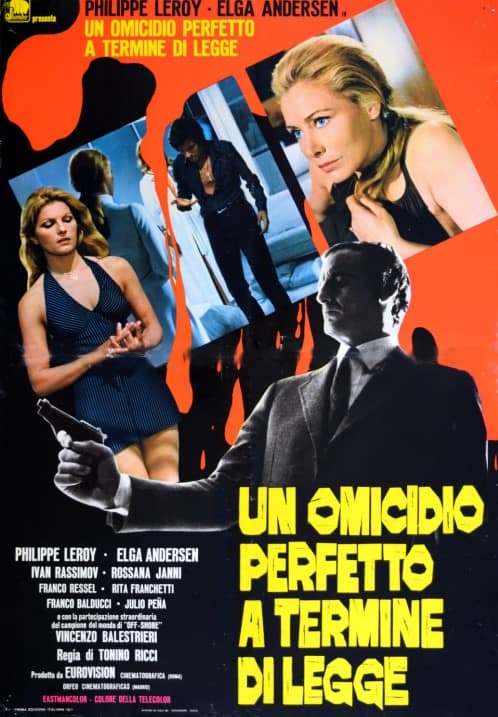
A Perfect Murder Under the Law is also known as Cross Current here in America. It’s directed by Tonino Ricci, who you may know from Rush, Panic or Encounters In the Deep. Story writer Aldo Crudo also was behind War of the Robotsand the ensuing script was written by José María Forqué and Arpad DeRiso (Death Steps In the Dark).
Marco (Phillipe Leroy, The Possessed, The Laughing Woman) is a rich man injured in a speedboat accident so rough that he needs brain surgery, which wipes his memory clean and makes him depend on his wife Monica (Elge Andersen, who retired from acting to explore the Andrea Doria wreck with her rich husband Peter R. Gimbel, who was the first diver to explore that doomed ship; together they made two documentaries The Mystery of the Andrea Doria and Andrea Doria: The Final Chapter; their ashes are now interred in the ship’s wreckage), business partner Tommy (Franco Ressel) and a girl named Terry (Rosanna Yanni, Count Dracula’s Great Love, Frankenstein’s Bloody Terror).
You know what happens next. Marco falls for Terry, Monica gets shot, Terry talks him into dumping her body but then he becomes convinced that he’s also killed his partner, the gardener and the gardener’s mother. Now they can be alone, right? Well, that’s when Monica shows up, back from the dead, which makes Terry drive his car right off a cliff.
We should have been clued in that something bad is about to happen because Marco’s business manager is played by Ivan Rassimov. He’s been behind the whole scheme, working with Monica to make the money while sleeping with Terry. This revelation upsets Monica, who kills them both.
See? A perfectly serviceable giallo. But wait…
Who is the black gloved person now following Monica?
Something Weird has made out lives so much richer, saving the strange, the smutty, the scary and everything in between. Working with the American Genre Film Archives, they created this mixtape of sheer lunacy which adds up the scare films of the past. You’ll never do drugs again until the next time to do drugs.
This blu ray has the following movies, all uncut and in 2K:
Beyond LSD (1967): This movie astounded me because instead of telling parents that their kids are maniacs, it tells them to listen to them because they’re going through some things. How is this even real?
Director Paul Burnford mainly made shorts and documentary films, like 1944’s Nostradamus IV and the 1943 blood transfusion ten-minute epic Brothers in Blood. He also directed the first movie in the Rusty series and an entry in the A Crime Does Not Pay series, Dark Shadows, which is about a psychiatrist matching wits with a killer.
In short — it’s less about drugs and more about how to treat your kids. It’s still relevant today.
The Bottle and the Throttle (1961, 1968): Narrated by Timothy Farrell, who was one of the two narrators and the psychiatrist in Glen or Glenda, as well Girl Gang,Pin-Down Girl, Dance Hall Racket, Test Tube Babies, The Violent Years, Jail Bait and many more. He was also a bailiff for the Los Angeles Marshal’s Department when he was acting in movies like Paris AfterMidnight, which was raided by the Los Angeles Vice Squad during filming.
A bunch of kids a drinking beach beers — Budweiser, Schlitz and Hamm’s — and Bill has had one too many. He ends up driving home and killing a child and breaking the back of her mother. Was it worth it?
Do you remember that wheel of how many drinks you had and how long until you sober up back in driver’s ed or health class? Man, I used to think of that all the time and here I am, now trying to gauge edibles which are magical and unpredictable lunacy when compared to whiskey.
The major difference between the 1961 and 1968 films is that the former is made with the help of the Culver City Police Department and the Culver City Unified School District while the latter is made with the West Covina Police Department. I’d like to think these organizations were scammed and paid twice for one movie.
“The little girl died on the way to the hospital and the mother will probably never walk again. No matter how your trial comes out, you’ll always have to live with those facts, won’t you Bill. A child dead. A mother crippled. Not a pleasant future to face at the age of 18.”
Pure nihilism.
Sidney Davis Productions also made The Dropout, Boys Beware (an anti-homosexual scare movie), the Ib Melchior-directed — yes, the guy who wrote Death Race 2000 and directed The Angry Red Planet — Keep Off the Grass, Skateboard Sense and LSD: Trip or Trap!
Curious Alice (1971): Dave Dixon, the Culture Czar, was the lead DJ of the legendary “Air Aces” on Detroit’s rock station WABX and the first person to play Sabbath, The Doors, Led Zeppelin and The Doors in the Motor City. Beyond co-writing Peter, Paul and Mary’s “I Dig Rock & Roll Music,” he co-wrote this animated film that explains drugs through Alice In Wonderland which is totally right on with the kids and four years after Jefferson Airplane did the same thing in “White Rabbit.”
The art in this movie is mind-boggling, however, and you’ll be entranced as Alice learns about LSD from the Mad Hatter, speed from the March Hare, heroin from the King of Hearts and barbituates from the Dormouse.
Made by the National Institute of Mental Health in 1971 and meant for use with ten-year-old students, if I had seen this before my teen years I would have done all the drugs in high school. The National Coordinating Council on Drug Education agreed, writing that viewers “may be intrigued by the fantasy world of drugs” after watching it.
The Distant Drummer (1970): A short-lived series of four 22-minute American documentary films that warned the kids about drugs, these were all directed by William Templeton (The Fallen Idol) and written by Don Peterson.
The first two movies in this series, A Movable Scene and A Movable Feast, were narrated by Robert Mitchum, who served 43 days at a California prison farm for possession of marijuana in 1948, a conviction that was overturned in 1951.
Here’s just a sample of Mitchum’s speech: “Thousands of snapshots on police station walls remain the only link between many of America’s most affluent families and the children who embodied their great expectations. Nearly everyone in the hippie community smokes marijuana — whether they call it pot, grass, hemp, gage, joint or mary jane — the marijuana is the basic background for the shared drug experience. The experience is shared to such an extent that roach pipes are always in demand — a roach is a marijuana butt and it requires some form of holder for those last few drags. The new generation, whether they are runaways or rebels-in-residence, use marijuana as a symbol of discontent with the basic values of the establishment. For some, there exists a social imperative beyond flaunting society’s rules — for these adventurers the mind-expanding drugs open a window on a whole new frontier…”
The other two parts, Bridge from No Place and Flowers ofDarkness, were narrated by Rod Steiger and Paul Newman.
Drugs, Drinking and Driving (1971): Herbert Moskowitz is now here to explain why you should never mix the three things in the title. I love that this movie has no issues with using the Mission: Impossible theme over and over and over, flaunting copyright law with each successive refrain.
This also seems pre-Jackass with a stunt where two drivers are each given drugs, one amphetamine and one barbituates, and then told to drive for 36 hours straight until they either pass out or wreck their cars.
LSD: Insight or Insanity (1967): “Now, everybody who takes it admits that there’s always the risk of a bad trip, a bummer, a freak-out, even a flip-out. But, why be lame, baby? Give yourself a real kick. Yes, a kick in the head!”
That’s Sal Mineo talking in this Max Miller-directed (the same dude who made the Sonny Bono anti-drug movie Marijuana) film which explains what LSD is, how it’s made and when people take it they jump in front of cars and take leaps off cliffs like Diane Linkletter out of the windows of the Shoreham Towers, blamed on LSD even if the last person who saw her alive — Edward Dunston — may have also was the last person to see actress Carol Wayne alive. Then again, both Dunstons could be different people and for some other reason, people seem to confuse them with David E. Durston, the man who taught us that Satan was an acidhead in I Drink Your Blood.
See, I may make some detours, but I always get you back on the road.
This ends with a Russian Roulette freakout and Mineo singing over the closing credits, which inform us that everyone in this movie was not an actor. You won’t be surprised.
LSD 25 (1967): Directed by David Parker and written by Hank Harrison — the father of Courtney Love — this movie is narrated by an LSD tab which proves that the creators of this may very well be getting high on their own supply.
“Today, you’re high. Tomorrow, you’re dead.”
Yes, LSD starts all happy explaining all the good things it does and by the end, your fingerprints can’t get out of any police database.
So go ahead and take that sugar cube. You’ll learn all the secrets of the infinite and then, you know, you won’t be able to tell anyone.
Because you’ll be dead.
Narcotics the Decision: Goofballs and Tea (1958): Written by Pittsburgh native Roger Emerson Garris, who was the story editor for the Sherlock Holmes TV series, this police training film is all about barbituates and marijuana. Yes, people once called drugs these words.
Narrated by Art Gilmore, who was on Dragnet and voiced the radio announcer on The Waltons, this movie lets kids know that it starts with sneaking their parent’s booze and ends up with you in jail, dead or worse. Avoid weed, avoid malt shops, avoid everything.
None for the Road (1957): Margaret Travis wrote 83 shorts that we know of, movies like The Other Fellow’s Feelings, Health: Your Clothing and Rowan and Martin on the Driveway One Fine Day, an industrial film for Phillips 66 Petroleum where the future Laugh-In stars run a gas station. This movie, too.
But the director? That’s Herk Harvey, who made around four hundred or more industrial films like Shake Hands with Danger. And one very important movie, Carnival of Souls.
Three men all use alcohol in different ways: not at all, a little and too much. They’re like the lab rats that we later see injected with alcohol, which sounds like a good way to spend a weekend. But wow, we’ve been warning people about drunk driving for 65 years and not everyone listens.
The Trip Back (1970): It’s no accident that an episode of Strangers With Candy was titled “The Trip Back.” Jerri Blank on that show is literally the star of this movie, Florrie Fisher, played for comic effect.
Fisher was married four times by the time she filmed this speech, first an arranged marriage, then to a pimp, then another drug addict and finally to a man she met via the mail. She credited her recovery to Synanon, which was originally established as a drug rehabilitation program and became one of the most dangerous and violent cults America had ever seen.
Wait, what?
Founded by Charles E. “Chuck” Dederich Sr., Synanon — a mix of togetherness (“syn”) with the unknown (“anon”) — was an alternative community centered on group truth-telling sessions called the “Synanon Game”, a form of attack therapy during which participants humiliated one another and exposed each other’s innermost weaknesses. There are theories that Dedereich was given LSD by Dr. Keith S. Dittman and Dr. Sidney Cohen, as well as encouraged to start Synanon as part of the CIA MK Ultra program.
Headquarted in a former beachfront hotel in Santa Monica called the Club Casa del Mar, women who joined Synanon had to shave their heads. Men were given forced vasectomies. Pregnant women were forced to abort their babies. Married couples were broken up and had to take new partners as the group became the Church of Synanon.
After Synanon’s transition into an alternate society in 1968, the game became a 72-hour ordeal for most members. The program of rehabilitation went from two years to a lifetime rehabilitation program, as they now preached that addicts would never truly be well enough to return to society.
Throughout this period, San Francisco area media covered the adult and child abuse caused by the church, but were often sued for libel by Synanon’s lawyers. If all of this sounds like Scientology, well…there was a group within the group called the Imperial Marines authorized to beat members into oblivion.
When NBC started reporting on the church in the late 70s, executives received hundreds of threats and Paul Morantz, a lawyer who had helped members escape, had a de-rattled rattlesnake placed in his mailbox. It bit him and put him in the hospital. A police search found a tape of Dederich speaking about Morantz, saying: “We’re not going to mess with the old-time, turn-the-other-cheek religious postures. Our religious posture is: Don’t mess with us. You can get killed dead, literally dead/ These are real threats. They are draining life’s blood from us, and expecting us to play by their silly rules. We will make the rules. I see nothing frightening about it. I am quite willing to break some lawyer’s legs, and next break his wife’s legs, and threaten to cut their child’s arm off. That is the end of that lawyer. That is a very satisfactory, humane way of transmitting information. I really do want an ear in a glass of alcohol on my desk.”
The teachings of Synanon influenced groups like CEDU, Daytop Village (the very place Nancy Reagan visited and became aware of the drug problem, which led to Just Say No), Phoenix House and those boot camps that always show up on daytime talk shows.
Back to Florrie Fisher.
An interview with David Susskind led to her appearing on The Mike Douglas Show, speaking at schools and an autobiography, The Lonely Trip Back. This film captures her speaking at a New York City high school, barraging the audience with a rambling dissertation on turning tricks, six of her marijuana friends all dying in the chair, jailhouse sapphic antics and shouting things like “I now know that I can’t smoke one stick of pot! I can’t take one snort of horse! I can’t take one needle of cocaine because I am an addictive personality! And that’s all I need is one of anything. Ya know I need one dress. If I happen to like this dress in tan, I buy the same dress in green and black and pink. This is the type of personality I am!”
Despite how horrible Synanon was for some, it worked for Florrie. Sadly, she died during the lecture tour she’s on in this movie due to liver cancer and kidney failure.
This movie is totally worth the price of this entire blu ray.
Users Are Losers (1971): Think drugs are for teens? This kid is saving up his milk money to pay for his habit, doing odd jobs and being incredibly thrifty just to get some marijuana. It made me think, parents are always on kids for throwing their money away, but this kid knows what he wants, works hard for it and then is selfless and shares what he gets with his friends.
Some kids also find one of their friends dead on a mattress and some young narc says, “If you blow pot, you’re blowing your future.” Get off my TV, kid.
Plus, you also get DRUG STORIES! NARCOTIC NIGHTMARES AND HALLUCINOGENIC HELLRIDES, a full-length mixtape from the AGFA team.
Now if you’ll excuse me, I must go blow some pot. Get toasty toast. Go clambaking. Fly Mexican Airlines. Run within an endless field. Walk the green ducks. Roll into the Backwoods. Be a ninja. Do some chiefing at the Rooney statue.
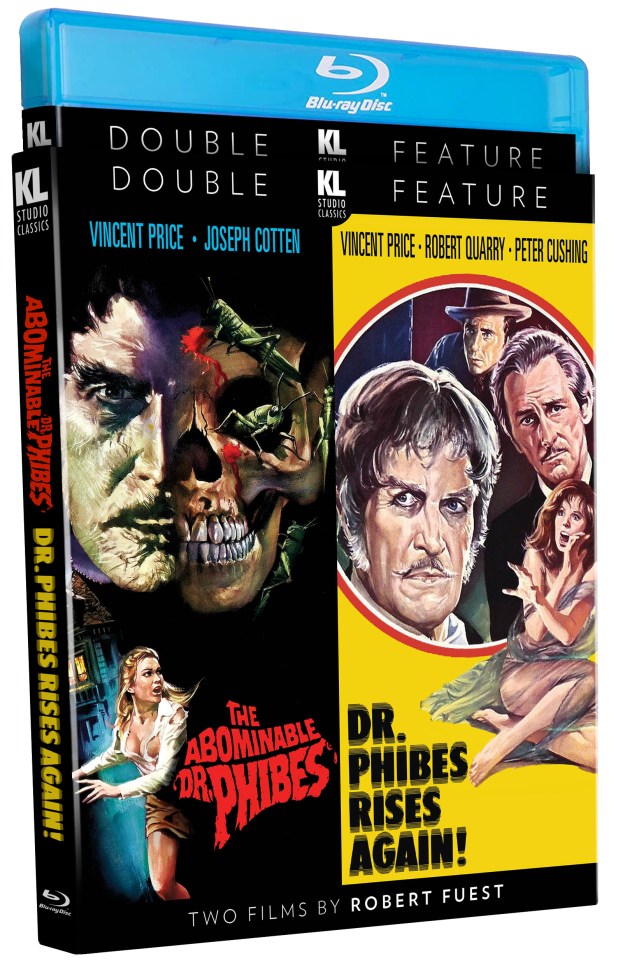
EDITOR’S NOTE: These articles originally were on the site on March 31, 2019 and April 1, 2019. These are two of my favorite movies and I’m so excited that Kino Lorber has released them on a double blu ray along with commentary tracks by director Robert Fuest, The Dr. Phibes Companion author Justin Humphreys and film historian Tim Lucas, as well as radio ads and trailers. You can get it from Kino Lorber. Honestly, this is a must buy.
The Abdominable Dr. Phibes (1971): Church of Satan founder Anton Szandor LaVey claimed that the main character in this Vincent Price film was based on him. Well, his name is Dr. Anton Phibes and he’s an organist, researcher, medical doctor, biblical scholar and ex-vaudevillian who has created a clockwork band of robot musicians to play old standards at his whim. Seeing as how nearly all of these things match up with LaVey, I can kind of see his point.
Director Robert Fuest started by designing sets. While working on the TV show The Avengers, he got excited about directing and ended up working on seven episodes of the original series and two of The New Avengers. Soon, he’d be working in film more and more, starting with 1967’s Just Like a Woman. Between the two Phibes films, And Soon the Darkness, The Final Programme and The Devil’s Rain!, he became known for dark-humored fantasy and inventive sets, several of which he designed himself.
This movie is one I can’t be quiet about. It’s one of the strangest and most delightful films I’ve ever seen.
Dr. Anton Phibes died in Switzerland, racing back home upon hearing the news that his beloved bridge Victoria (an uncredited Caroline Munro) had died during surgery. The truth is that Phibes has survived, scarred beyond belief and unable to speak, but alive. He uses all of the skills that he’s mastered to rebuild his face and approximate a human voice. Also, he may or may not be insane.
Phibes believes that the doctors who operated on his wife were incompetent and therefore must pay for their insolence. So he does what anyone else would do: visit the Biblical ten plagues of Egypt on every single one of them.
Phibes is, of course, played by Vincent Price. No one else could handle this role. Or this movie. There’s hardly any dialogue for the first ten minutes of the movie. Instead, there are long musical numbers of Phibes and his clockwork band playing old standards. In fact, Phibes doesn’t speak for the first 32 minutes of the movie. Anyone who asks questions like “Why?” and says things like “This movie makes no sense” will be dealt with accordingly.
After the first few murders, Inspector Trout gets on the case. He becomes Phibes’ main antagonist for this and the following film, trying to prove that all of these murders — the doctors and nurse who had been on the team of Dr. Vesalius (Joseph Cotten!) — are connected. Phibes then stays one step ahead of the police, murdering everyone with bees, snow, a unicorn statue, locusts and rats, sometimes even right next to where the cops have staked him out.
Dr. Phibes is assisted by the lovely Vulnavia. We’re never informed that she’s a robot, but in my opinion, she totally is. Both she and the doctor are the most fashion-forward of all revenge killers I’ve seen outside of Meiko Kaji and Christina Lindberg.
Writer William Goldstein wrote Vulnavia as another clockwork robot with a wind-up key in her neck. Fuest thought that Phibes demanded a more mobile assistant, so he made her human, yet one with a blank face and mechanical body movements. I still like to think that she’s a machine, particularly because she returns in the next film after her demise here. Also — Fuest rewrote nearly the entire script.
After killing off everyone else — sorry Terry-Thomas! — Phibes kidnaps Dr. Vesalius’ son and implants a key inside his heart that will unlock the boy. However, if the doctor doesn’t finish the surgery on his son in six minutes — the same amount of time he had spent trying to save Phibes’ wife — acid will rain down and kill both he and his boy.
Against all odds, Vesalius is successful. Vulnavia, in the middle of destroying Phibes’ clockwork orchestra, is sprayed by the acid and killed while the doctor himself replaces his blood with a special fluid and lies down to eternal sleep with his wife, happy that he has had his revenge.
If you’re interested, the ten plagues Phibes unleashes are:
1. Blood: He drains all of Dr. Longstreet’s blood
2. Frogs: He uses a mechanical frog mask to kill Dr. Hargreaves at a costume party
3. Bats: A more cinematic plague than lice from the Biblical plagues, Phibes uses these airborne rodents to kill Dr. Dunwoody
4. Rats: Again, better than flies, rats overwhelm Dr. Kitaj and cause his plane to crash
5. Pestilence: This one is a leap, but the unicorn head that kills Dr. Whitcombe qualifies
6: Boils: Professor Thornton is stung to death by bees
7. Hail: Dr. Hedgepath is frozen by an ice machine
8. Locusts: The nurse is devoured by them thanks to an ingenious trap
9. Darkness: Phibes joins his wife in eternal rest during a solar eclipse
10. Death of the firstborn: Phibes kidnaps and the son of Dr. Vesalius
I love that this movie appears lost in time. While set in the 1920’s, many of the songs weren’t released until the 1940’s. Also, Phibes has working robots and high technology, despite the era the film is set in.
There’s nothing quite like this movie. I encourage you to take the rest of the day off and savor it.
How does Phibes live up to being a Satanic film? In my opinion, Phibes embodies one of the nine Satanic statements to its utmost: Satan represents vengeance instead of turning the other cheek. The men and woman whose negligence led to the loss of Phibes’ wife were never punished. Phibes had to become their judge, jury and yes, destroyer.
On the other hand — or hoof, as it were — Phibes is the exact antithesis of the ninth Satanic sin, Lack of Aesthetics, which states that “an eye for beauty, for balance, is an essential Satanic tool and must be applied for greatest magical effectiveness. It’s not what’s supposed to be pleasing—it’s what is. Aesthetics is a personal thing, reflective of one’s own nature, but there are universally pleasing and harmonious configurations that should not be denied.” So much of what makes this film is that Phibes’ musical art is just as essential as his demented nature and abilities. Music is the core of his soul, not just revenge.
Another point of view comes from Draconis Blackthorne of the Sinister Screen: “This is an aesthetically-beauteous film, replete with Satanic architecture as well as ideology. Those who know will recognize these subtle and sometimes rather blatant displays. Obviously, to those familiar with the life of our Founder, there are several parallels between the Dr. Anton Phibes character and that of Dr. Anton LaVey – they even share the same first name, and certain propensities.”
Dr. Phibes Rises Again! (1972): The fact that this movie exists gives me hope. There are moments when life gets me down, when I wonder about my place in this world and if humanity is essentially horrible. Then I remember that great films like this exist and it makes me feel a lot better. You should do the same thing if you’re ever in an existential crisis.
Dr. Phibes is back, three years after he laid down in the darkness next to the corpse of his beloved wife. Now, however, he has learned that the secret of eternal life — held by a centuries-old man — is in Egypt. I don’t care why he’s back. I’d watch Dr. Phibes go grocery shopping!
Dr. Anton Phibes (Vincent Price) has in suspended animation in a sarcophagus alongside his wife Victoria Regina Phibes (Caroline Munro). When the moon aligns with the planets in a way not seen for two millennia, he returns, summoning the silent Vulnavia (thus confirming to me, at least, that she’s really one of his robots as she died in the last film; furthermore, she’s played by Valli Kemp, who took over for the pregnant Virginia North) to his side.
Phibes plans on taking his wife’s body with him to Egypt, where the River of Life promises her resurrection. As he emerges from his tomb, his house has been demolished and the safe that contained the map to the river lies empty. That’s because the map has been stolen by Darius Biederbeck, a man who is hundreds of years old thanks to a special elixir. He may also be every bit Phibes’ equal.
Darius is played by Robert Quarry, who American International Pictures was grooming to be Price’s replacement. There were tensions between the two on set, including a moment where Quarry was singing in his dressing room and challenged Price by saying, “You didn’t know I could sing did you?” Ever the wit, Vincent Price replied, “Well, I knew you couldn’t act.” Quarry would had already played Count Yorga in two films for AIP and would go on to be in The Deathmaster, where he played hippie vampire Khorda, but the AIP style had already fallen out of style. He’s also in tons of Fred Olen Ray films, like Evil Toons where he’s the uncredited voice of the demon.
Biederbeck wants eternal life for himself and his lover Diana (Fiona Lewis, Tintorera…Tiger Shark). Phibes and Vulnavia are on his trail, immediately entering his home, murdering his butler and stealing back the map. Everyone connected with Biederbeck comes to an ill end — Phibes places one inside a giant bottle and throws him overboard. That murder brings Inspector Trout back on the case, as he instantly recognizes that only one man could do something like that.
The rest of the film’s murders are based on Egyptian mythology versus Biblical plagues. Hawks and scorpions become his weapons, along with gusts of wind and bursts of sand. Phibes has also brought an army of clockwork men with him the desert to do his bidding.
Phibes finally exchanges Diana’s life for the key to the River of Life. As he floats the coffin containing his wife down the water, he beckons Vulnavia to join them. As his lover tries to comfort him, Biederbeck begs Phibes to take him with them. He begins to rapidly age and dies as Phibes loudly sings “Over the Rainbow,” which might be the best ending of any movie ever made.
There were plans for a whole bunch more of these films and the fact that they were never made saddens me to this day. I’ve heard that a third film would Phibes fighting Nazis. I’ve also heard that it’d be about the key to Olympus. Or Phibes going up against Dr. Vesalius’ son. Or Victoria Phibes herself coming back, just as sinister as her husband. There have been titles thrown around like Phibes Resurrectus, The Seven Fates of Dr. Phibes and The Brides of Dr. Phibes. There was even thought of Count Yorga facing off with Dr. Phibes, a fact which delights me to no end.
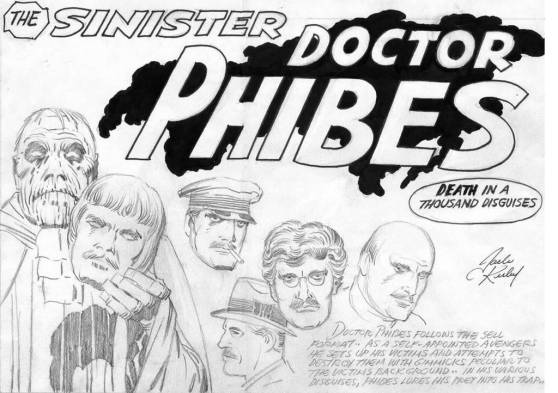
There was also a pitch for a TV series and what looked like an animated version, with Jack Kirby himself providing the pitch artwork!
Other ideas included Dr. Phibes in the Holy Land, The Son of Dr. Phibes (which would have pitted the doctor and his son against ecological terrorists), Phibes Resurrectus (which would have David Carradine as Phibes battling against Paul Williams, Orson Welles, Roddy McDowall, John Carradine and Donald Pleasence. The mind boggles at the thought, let me tell you!), a 1981 Dr. Phibes film where the WormwooInstitutete would have destroyed his wife’s body and then their strange members, including transvestite twins obsessed with economics and nuclear weaponry, fail to match wits with Phibes) and finally, Phibes was almost a role for Peter Sellers in a Pink Panther film where hed also play Clouseau and Fu Manchu. You can learn more about these at the Vincent Price Exhibit site.
There was also a story in 2013 that Johnny Depp was going to star in a Tim Burton directed remake. That obviously didn’t happen.
So much of this film fits into the same Satanic themes as the original. However, you can add in a few new wrinkles. One of the Eleven Satanic Rules of the Earth states “When walking in open territory, bother no one. If someone bothers you, ask him to stop. If he does not stop, destroy him.” All Phibes wished to do was take his wife to Egypt and bring her back to life. Once Biederbeck stole from him, his fate was sealed.
ABOUT THE AUTHOR: Herbert P. Caine is the pseudonym of a frustrated academic and genre movie fan in Pennsylvania. You can read his blog at https://imaginaryuniverseshpc.blogspot.com.
EDITOR’S NOTE: This is one of Sam’s favorite movies and he can and will take any opportunity to talk about it. Read his article about it.
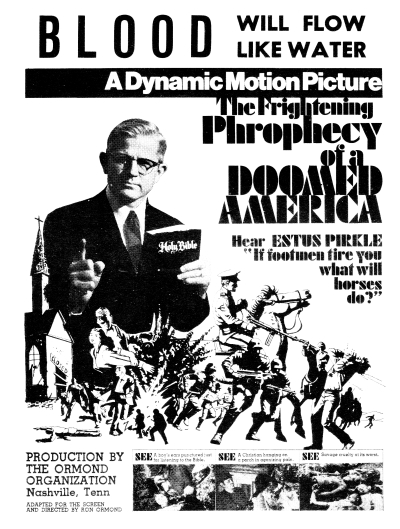
Exploitation films and fundamentalist sermons are two genres that generally do not intersect. Exploitation cinema deals in graphic sex and violence, the things fundamentalists generally most condemn in modern media. Apparently, no one told Mississippi Baptist preacher Rev. Estus Pirkle and exploitation director Ron Ormond, who combined their dubious talents during the early 1970s to make three religious propaganda films: If Footmen Tire You, What Will Horsemen Do?, The Burning Hell, and The Believer’s Heaven. The films reflect both Pirkle’s harsh interpretation of Christianity and Ormond’s background making sleazy movies.
Pirkle was a Baptist minister based in New Albany, Mississippi. He wanted to make a film adaption of his sermon “If Footmen Tire You, What Will Horsemen Do?” which warned that moral decline in the United States would inevitably lead to a Communist takeover. (The title was taken from a line in the Book of Jeremiah warning that the enemies of the present were nothing compared to the coming tribulations.) Fortunately for him, Ron Ormond had recently converted to evangelical Christianity after he and his family narrowly survived a plane crash in Nashville, Tennessee. Ormond had previously been known for directing Z-grade exploitation films such as Mesa of Lost Women, Untamed Mistressand The Girl from Tobacco Row, which featured the tag line “She was a preacher’s daughter, but wild as a peach orchard hog.” As luck would have it, this filmography was splendid preparation for a film adaptation of Pirkle’s lurid sermon.
If Footmen Tire You, What Will Horsemen Do? opens with men in military uniforms riding horses down a dirt road. As the credits end, Pirkle, in a voice over, claims he has sources to back up every atrocity story he relates in the film, but that the film transfers their setting to America in order to “emphasize that the same things can and will happen here, if they take over.” The film goes on to intersperse scenes of Pirkle preaching to his congregation at the Locust Grove Baptist Church with graphic depictions of Communists terrorizing Americans. There is also a sub-plot about an errant congregant named Judy, played by one Judy Creech, who is led back to the straight and narrow by Pirkle’s sermon.
The most memorable thing about this cinematic sermon is its sheer brutality, which would have earned it an R if not an X rating from the MPAA had it been submitted for a rating. At the very beginning, Pirkle warns that if America does not undergo a religious revival, his listeners can expect to see bodies piled up in the street, a warning the film reinforces by show us bloody corpses, including those of children, lining the sidewalk of small-town Mississippi. The film goes on to show such edifying sequences as a group of children being forced to murder their father by dropping him via rope onto pitchforks, complete with graphic shots of the father being impaled, bloody forks, and an obese commissar laughing his head off. Communist soldiers force their way into homes in order to rape women, and children caught listening to sermons have bamboo driven into their ears, which for some reason causes them to vomit. In the film’s memorable climax, a young boy, played by Greg Pirkle, Estus’s son and later a Congressional candidate, is beheaded by a commissar after refusing to trample on a picture of Jesus. The boy’s head is shown bouncing and rolling on the ground for at least five seconds, a shot that even today would likely earn the film an NC-17 rating.
The film’s overwhelming ineptitude, however, undermines its impact. It often fails at the basics of filmmaking, a mixture of Ormond’s incompetence and the very low budget. For example, the Communist soldiers’ uniforms have obviously fake armbands. Rather than the red and gold banner favored by most Communist countries of the time period, the armbands are just white cloth with a drawn-on hammer and sickle. Even more embarrassing are the scenes where people are machine gunned. According to Ormond and Pirkle, people struck by multiple bullets aren’t shaken by the impact; they just slowly drop to their knees on the ground, then lie down. The climactic beheading of a child becomes laughable when the commissar slips into an Arkansas accent and yells “You stupid little foo’!” when the boy refuses to renounce Christ.
Its impact also suffers from the ridiculousness of Pirkle’s arguments. Among the “footmen” Pirkle claims will lead to America being taken over by Communism are sex education, Saturday morning cartoons, declines in church attendance, and dancing, which Pirkle calls “the front door to adultery.” The film makes clear that Pirkle viewed these issues in hysterical terms. For example, Pirkle apparently believed that sex education consisted of a teacher encouraging elementary school children to engage in pre-marital sex and explaining the “seven erotic zones” in women. He similarly warns of the potential of cartoons to distract parents from reading their Bibles.
The disturbing thing is, Ormond actually toned down Pirkle’s hysterical tendencies for the film. In the audio recording of the original sermon, posted on YouTube, Pirkle goes on at much greater length about the dangers of the “footmen.” In one segment, he contrasts the virtuous content of the McGuffey Reader, a nineteenth-century teaching aid that he and his father grew up with, which consisted heavily of Bible stories, and the New Our New Friends reader being used in schools of his day He dismisses the latter as being full of “Jack and the Beanstalk stuff” while claiming that one of its stories, about a squirrel receiving a nut from a little boy in a white house, was meant to indoctrinate children into socialism. To put Pirkle’s rant into perspective, the New Our New Friends reader featured the well-known “Dick and Jane” stories. Ormond even apparently persuaded Pirkle to alter the delivery of his sermon; in the original recordings, the reverend’s voice often developed a shrill quality when he got excited.
The film does feature some interesting casting, with the Arkansas commissar being played by Cecil Scaife, who was actually an important figure in the history of rock music. Scaife was the National Sales and Promotion Manager for Sun Records, where helped to promote Elvis Presley, among others. Scaife seemingly turned religious later in life, becoming involved in the gospel music scene and participating in a failed effort to ban references to drug use in music. Other members of Scaife’s family, including his daughter La Quita, also appeared in the film. Later Pirkle-Ormond collaborations also featured some interesting, albeit less savory, cast members. The Burning Hell featured two guest preachers, Dr. Jack Hyles and Rev. Bob Gray. Dr. Jack Hyles was pastor of the First Baptist Church of Hammond, Indiana, and his tenure was notable for numerous scandals, including having an affair with the wife of another church official. Hyles was also notable for being very controlling of his congregation, to the point that his own daughter later denounced him as a cult leader. Rev. Bob Gray of the Trinity Baptist Church died while awaiting trial on charges of capital sexual battery on children in his congregation. In interviews with the police, he openly admitted to having French kissed young girls.
If Footmen Tire You, What Will Horses Do? can be found in a restored version on the website of artist Nicolas Winding Refn. That said, it might be worth watching the non-restored versions on YouTube, as the poor quality of the film stock in those versions fits the seedy atmosphere of the film.
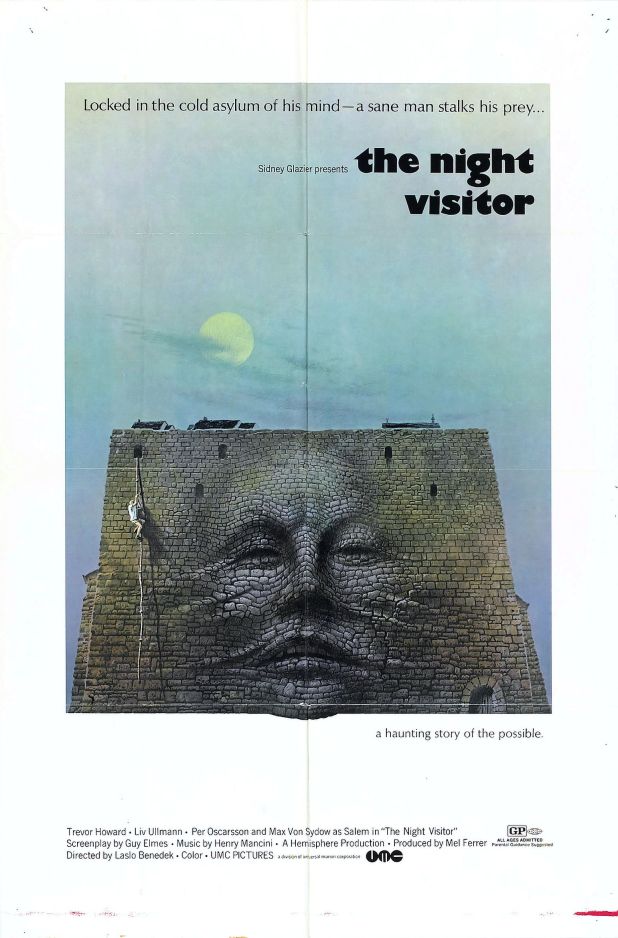
Salem (Max Von Sydow) has escaped a near-inescapable insane asylum, a place where he’s been trapped since being wrongly charged with killing a farmhand. Now he truly is deranged and is out for revenge on those he believes are guilty: his younger sisters Emma (Hanne Bork) and Ester (Liv Ullmann) and her husband Dr. Anton Jenks (Per Oscarsson), the man who accused Salem of the murder.
Beyond the fact that the villain is actually the hero of this, it has an incredible score by Henry Mancini that was made for synthesizer, 12 woodwinds, organ, two pianos and two harpsichords — with one tuned to be flat and add dissonance.
Originally entitled Salem Came to Supper and released again ten years later by 21st Century Film Corporation as Lunatic (before that company was bought and rebranded by Menahem Golan after the breakup of Cannon), this was directed by Laslo Benedek (who made the 1951 Death of a Salesman) and written by Guy Elmes, who adapted several Italian films for Western audiences.
Jess Franco made another Edgar Wallace movie, Sangre en mis zapatos, which was based on Sanders of the River. This is based on the story Keeper of the Stone, which is from the same book.
Prof. Walter Forrester (Ángel Menéndez) is a British scientist working in the Akasava jungle in South America who has disappeared and may have stolen a mysterious stone. His nephew Rex Forrester (Fred Williams) is looking for his uncle. But the real reason to watch this is British agent Jane Morgan (Soledad Miranda), who has a secret identity as the stripper wife of the British consul Irving Lambert (Alberto Dalbés), which seems pretty wild when you wrap your mind around it.
The sinister Dr. Andrew Thorrsen (Horst Tappert) and his perhaps even more nefarious wife (Ewa Strömberg) also get involved, Franco plays an evil agent and Howard Vernon gets blown up real good when he tries to steal the stone, which can turn people into zombies and metal to gold because, well, who knows. It’s all a device to get us to see just how wonderful Soledad could be as a spy.
Sadly, she’d die in an auto accident at the too soon age of 27 soon after this movie wrapped. I wasn’t even born yet and it still breaks my heart.
So yes, this is the same cast and crew as Vampyros Lesbos and pretty much the same story as Venus In Furs and Ms. Muerte, but look, if Soledad Miranda made a movie where all she did was eat soup, I’d watch it.
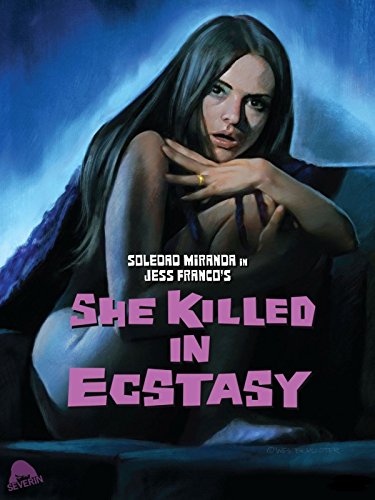
This time around, she’s Mrs. Johnson, the widow of a scientist who was doing some, well, perhaps unethical experiments with human embryos that led to a medical committee rejecting his work and leading to his depression and suicide. So she does what any of us would: she hunts and kills everyone that caused this to happen.
Yes, one by one, Prof. Jonathan Walker (Howard Vernon), Dr. Franklin Houston (Paul Muller), Dr. Doneen (director Jess Franco) and Dr. Crawford (Ewa Stromberg) are all part of her revenge, with a side of a love scene between Johnson and Crawford because there’s no way that Franco would have Miranda and Stromberg in the same movie and miss that.
Before this movie was even released, Miranda died as a result of major head and back trauma from a car crash. She left behind a son, a husband and thirty movies in ten years, as well as a hole in the life of Franco, as she’d been the muse behind some of his best films.
In this movie, she is the center of the world, a dark-eyed shadow of a woman destroyed yet willing to take that pain and give blow for blow, scorn for scorn, doom for doom — with interest compounded liberally.
At just 80 minutes and with some incredibly arty angles and a great soundtrack — something else this has in common with Vampyros Lesbos — this is prime Franco.
EDITOR’S NOTE: Nearly five years ago — August 22, 2017 — we talked about this movie on our site. Let’s bring it back from the grave as we unearth all this Franco all month long.
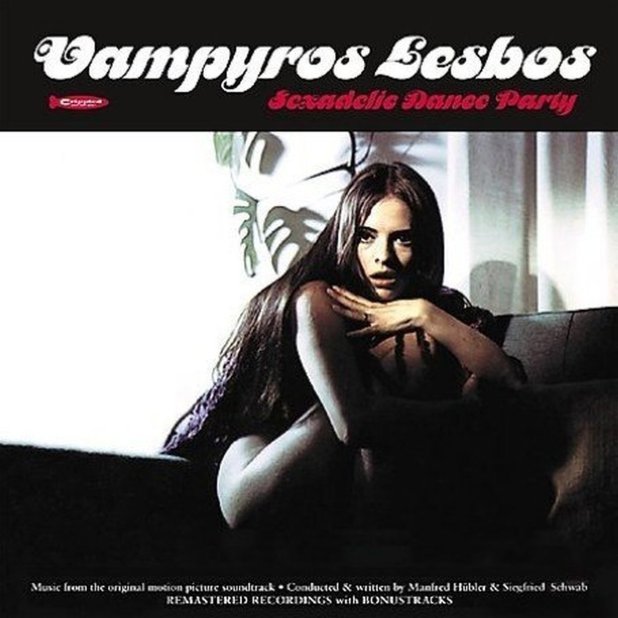
Sometimes, when you watch a horror film, you’re lied to by a title that promises you something that the film cannot or will not deliver. Not so with Jess Franco’s Vampyros Lesbos. Franco promises you lesbians and vampires and he delivers.
He also delivers plenty of late 60’s style and a space age jazz soundtrack that threatens to take over your mind. In fact, I had the soundtrack way before I had the movie, as it was re-released in the 1990s.
Countess Nadine Carody (the sublime and sadly departed Soledad Miranda) lives on a remote island where she puts on a seductive burlesque act every night that entices unwary women. Now, she has her eyes set on Linda, who starts dreaming of her.
Somehow, somewhere in all these lesbionic dreams, Linda finds Memmet torturing a young woman. It’s probably of worth to note that the director of the film, Franco, plays the torturer.
Then, Linda finds Nadine’s home, the former residence of Count Dracula. Linda gets dizzy off wine, the two women have sex and Nadine drinks from Linda’s neck. Upon awakening, Linda finds Nadine floating motionless in a pool and awakens screaming in a mental asylum.
That said — Nadine is alive and explains to her familiar, Morpho, how Dracula turned her. Now, she feels that she must turn Linda. Nadine keeps coming back to her, then reappearing in the mental hospital, so Dr. Seward (Dennis Price, Twins of Evil, Theater of Blood) explains that if she wants to defeat the curse, she must split a vampire’s head with an axe or pierce it with a pole.
Let me see if I can sum up the insanity of the next few minutes: Linda is kidnapped by Memmet. Dr. Seward wants to become a vampire, Nadine refuses and Morpho kills him. Memmet explains that all women who meet Nadine become insane, including his wife, so he must kill them all. Linda kills him with a saw, then returns to Nadine. Instead of giving her the blood she needs to survive, she stabs her in the eye, wanting to belong to no one. Morpho kills himself. And finally, Linda’s boyfriend tries to convince her that this was all a dream.
If you’re seeking a film that makes narrative sense, you should just leave this one on the shelf. If you’re seeking an erotic, psychedelic freak out with some amazing music, then you’ve found the right film. While some compare Franco to Ed Wood, in this film, he hit his high watermark with this one.
This is one of those films where you kind of have to put your own reading into it. Mine’s that Linda is bored by her life, by feeling that she needs a man to be complete and believes that Nadine’s free life could be her escape. However, she finds that she would still be a possession, so she destroys her to make her final escape, deciding that a life of boredom could be better than a life of constant feeding on others.
But who can say? Watch it for yourself. Or just listen to the music — this song is also featured in Tarantino’s Jackie Brown.
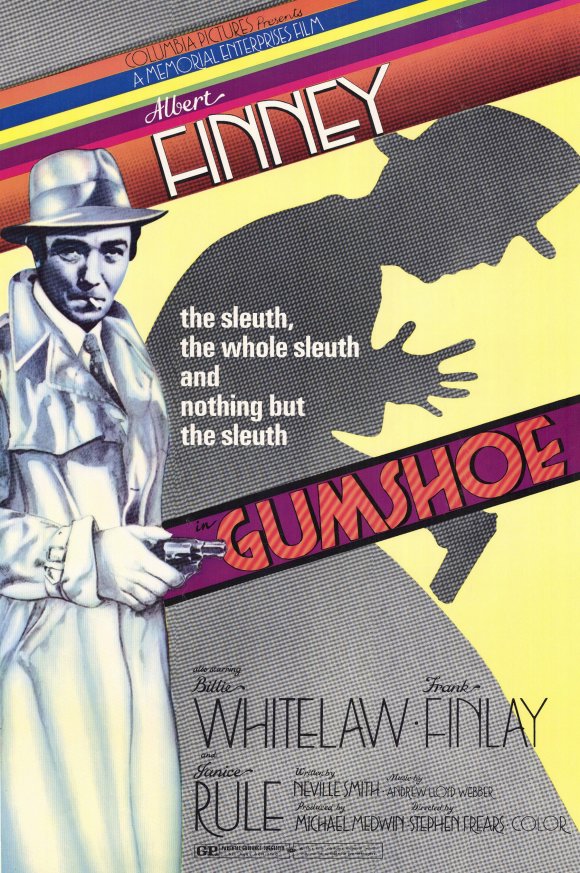
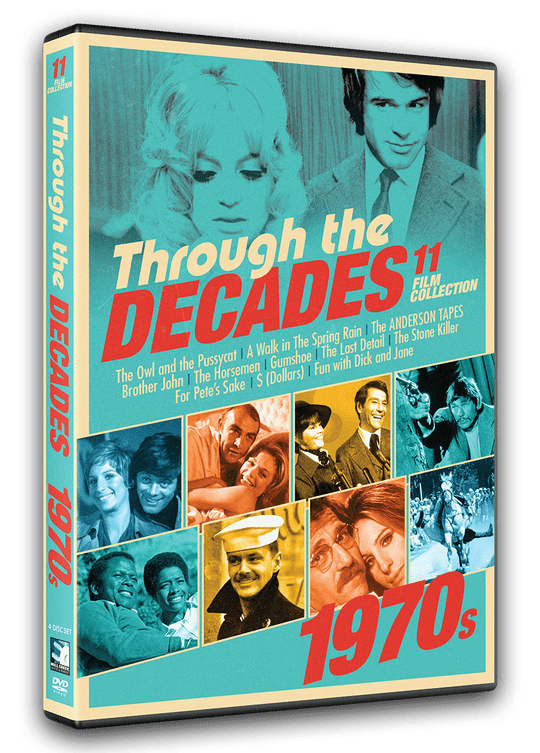
The Atlantis Bookshop is an esoteric bookshop that’s been the center of London’s occult scene since it opened in 1921. It’s where the “Father of Wicca” Gerald Gardner attended meetings of The Order of the Hidden Masters and the shop even published his first book. It continues to be a nexus point for magic users and is featured prominently in Gumshoe, a movie that has some magic of its own as Eddie Ginley (Albert Finney) dreams of escaping his bingo hall reality and becoming a detective like in the books he reads. When he places an ad for his detective services as a birthday joke, he discovers himself in the middle of an actual case that may involve his family.
Featuring the first music score for a film by Andrew Lloyd Webber, Gumshoe‘s drug scenes kept it from being released on video until 2009. It was the debut film of director Stephen Frears (The Grifters, Dangerous Liaisons, High Fidelity) and was written by Neville Smith, who also plays Arthur in this movie.
There was a big revival of hard boiled detective films and film noir at the start of the 70s and this film does a great job of showing how one man can become lost in the dream of what it would be like to live in their world.
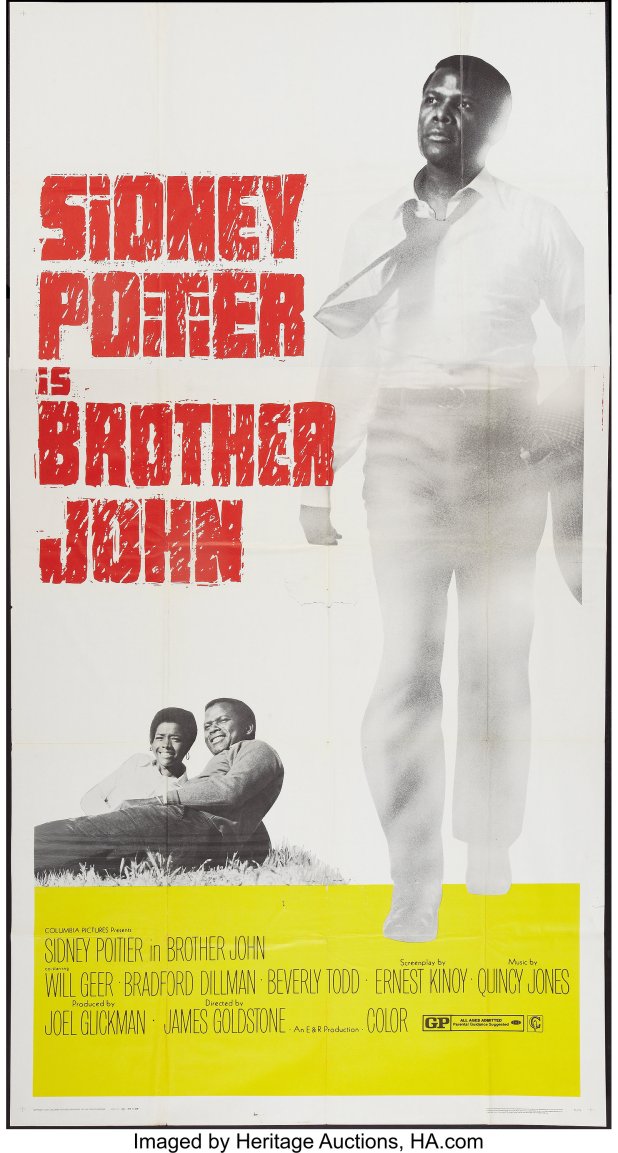
If racist white audiences were upset when Sidney Poitier retaliated and slapped back the plantation owner in In the Heat of the Night, they had to have had a meltdown when this time, a cop challenges him and he proceeds to complete emasculate the man without breaking a sweat.
Seriously, I was not prepared for this movie, a film in which Poitier plays a man of mystery who just may be the literal angel of death returning every time a family member dies in his small southern hometown when he isn’t showing up for moments of death and destruction all over the world.
This movie wasn’t well-considered when it came out and you know, I completely believe those critics were fools. Author Scott Woods wrote an essay, “Brother John: Reclaiming the Blackest Movie Ever,” in which he said, “In 1971 black people were fresh off several assassinations of people who stood firm in their interests and were starting to resign themselves to the reality that desegregation without enforceability was still segregation. Brother John did not beat what audiences it was able to muster over the head with its wisdom, but it was too much for people to transpose themselves into. Poitier perhaps did his job too well. Poitier wanted to do Brother John but America needed him to do Brother John . And then no one went to see it. Brother John has it all, and does all things well: civil rights, racism, classism, toxic masculinity, black love, house parties, homecooked funeral rites. You haven’t celebrated Black History Month properly until you’ve seen this film. Brother John is a perfect black film, both for its time and now, generating even more resonance as we walk every day in a world aflame with hate and neglect.”
It was written by Ernest Kinoy, who was a POW in World War II in the slave labor camp at Berga before making it back to America and becoming a writer for the radio shows Dimension X and X Minus One, eventually making his way to movies and TV, with Roots and the TV series The Defenders being his best-known scripts. Brother John was directed by James Goldstone, who was the director for episodes of Star Trek and The Outer Limits before working on movies like They Only Kill Their Masters, Rollercoaster and Jigsaw.





 B&S About Movies
You must be logged in to post a comment.