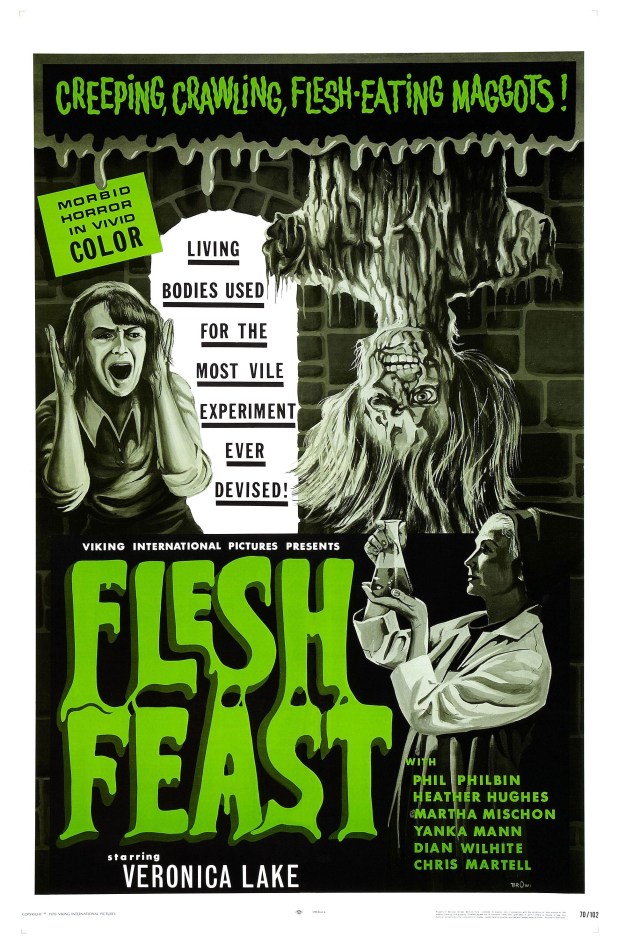
Shot in 1967 but unreleased until 1970, this was the first movie from Brad F. Grinter, the man who would later bless the world with Devil Rider!, Blood Freak and the way late in the game nudist films Never the Twain and Barely Proper *.
It’s also the last movie of Veronica Lake, whose peek-a-boo hairstyle made her Hollywood royalty before alcoholism took it all away.
So yeah — the star of I Wanted Wings and This Gun for Hire was living in a woman’s hotel in New York City by the 1960’s, getting arrested for public drunkenness and working as cocktail waitress under the name Connie de Toth. The New York Post outed her and fans were so upset they sent her money, which she returned to each of them. After writing Veronica: The Autobiography of VeronicaLake — in which she laughed off the idea that she was a sex symbol and said that she was more like a sex zombie — she took the money and invested in this shot-in-Florida Nazis back from the dead blast of weirdness. Sadly, she’d die in 1973 from all the liver damage that drinking brings on and most of her ashes were scattered off the coast of the Virgin Islands. I say most of, because in 2004, they found some of them at a New York City antique store.
Lake plays Dr. Elaine Frederick, a scientist who has developed flesh-eating maggots because, well, why not? She goes along with the reborn Third Reich just long enough to get revenge, because her mother was a political prisoner executed in Ravensbrück concentration camp Basically, she brings back Hitler just long enough to throw those skin chewing maggots right in Der Fuehrer’s face. And let’s face it, that’s the happy ending that we all want.
With a great name like Flesh Feast, this movie had one of those lives that we obsess over, playing double and triple bills as late as December 1983. Pretty good for a movie whose budget was so small that cooked rice doubled for the maggots.
*Seriously, Never the Twain came out in 1974 and Barely Proper was released in 1975. I really have to track down the first one, which is all about a real-life supernatural event where the spirit of Mark Twain possessed actor Ed Trostle at the 1974 Miss Nude World Pageant. It’s shot in the very same theater where there all happened.
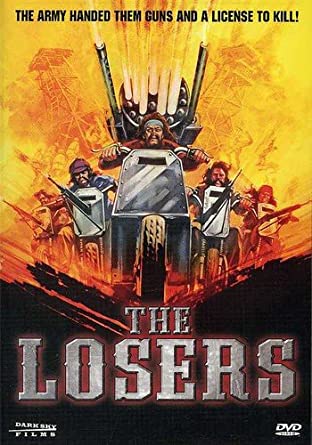
Also known as Nam Angels, this Jack Starrett-directed film (he also made Run, Angel, Run!, Race with the Devil and Hollywood Man, among others) has a great high concept: a biker gang called The Devil’s Advocates is sent to Cambodia to rescue an American diplomat because they are the only ones who can get the job done.
They’re led by a Vietnam vet — and the brother of the Army Major who has recruited them — Link Thomas, played by the always dependable William Smith. They’re under the orders of Captain Johnson (Bernie Hamilton, who was Captain Harold Dobey on Starsky and Hutch) and include fellow vets Duke (Adam Roarke from Dirty Mary, Crazy Larryand Frogs) and Dirty Denny, as well as Limpy (Paul Koslo, Vanishing Point) and Speed (Eugene Cornelius, who was Space in Run, Angel, Run!).
They head to Vietnam, but come on, we all know it’s the Philippines because the mechanic who works on their bikes, Diem-Nuc, is played by Vic Diaz. It doesn’t matter because by the time you start trying to figure out locations*, our heroes are doing wheelies and blowing things up with rocket launchers and machine guns while they do wheelies.
This movie does have some basis in reality. Sonny Barger, the Maximum Leader of the Hells Angels, sent LBJ a telegram offering the skills of his club in the Vietnam War. That inspired Alan Caillou, who originally wrote that The Losers would live. Starrett and Smith rewrote the script to the ending we know now.
If you watch Pulp Fiction, you can see a scene from this movie being watched by Butch’s girlfriend the day after his fight. When he asks what she is watching, she says, “A motorcycle movie, I’m not sure the name.”
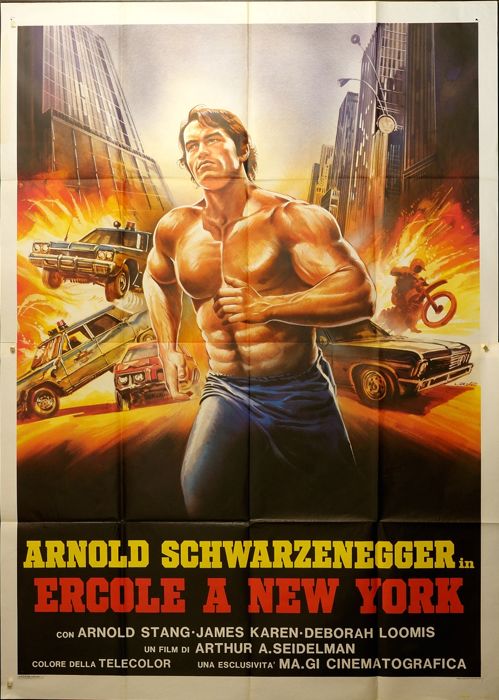
Whatever happened to the star of this movie, Arnold “Mr. Universe” Strong? Oh yeah. He grew up to be the greatest action star of all time, that’s what. But this movie is the very definition of starting small, as Arnold Schwarzenegger — 22 years old and laying brick with his lifting buddy Franco Columb — was told by his friend Reg Park (who took over for Steve Reeves in Hercules and the Captive Women) that he should shoot for his dream of being a movie star.
This wouldn’t do it.
It’s also the first film for director Arthur Allan Seidelman, who mainly did stage and TV work like the Nancy McKeon TV movie of the week Strange Voices.
If you ever wanted to see Hercules get sick of Mount Olympus and go to Earth, where he becomes a pro wrestler as well as best friends with a pretzel salesman named Pretzie (Arnold Stang, who between this movie, Ghost Dad, Dondi and Skidoo* has pretty much been in the very worst of the worst in film), well, then this movie fills out all of your boxes with a sharp number two pencil.
James Karen (Poltergeist, Return of the Living Dead) and Richard Herd (the Supreme Commander from V) show up, as does four-time Mr. Universe, one-time owner of the biggest escort service in California and later evangelist Dennis Tinerino.
Also, just to be a total anal retentive nerd, I want to mention that while Zeus, Nemesis, Eros, Pluto and Atlas are Greek gods, Hercules, Venus, Juno, Mercury and Neptune are the Roman versions, while Samson — who is kind of, sort of Hercules’ brother in this — comes from The Bible.
Barry Mahon was shot down over Germany and escaped — and was recaptured — at Stalag Luft III before being freed by Patton’s 3rd Army. Once he got back to the U.S., he became the personal pilot and later the manager for Errol Flynn. Then, he learned how to use computers to predict the future box office for films, which does not explain how he made movies like Cuban Rebel Girls, Fanny Hill Meets Dr. Erotico, The Wonderful Land of Oz and Santa’s Christmas Elf (Named Calvin).
Have you ever gone to an amusement park and they put on plays for the kids that are too worn out or too young for the rides? Yeah, this is like watching one of those for over an hour, with special effects that live up to neither of those two words. This is what I do with my free time. I sit and watch these movies and laugh like a maniac, then tell an uncaring and oh so cold world why they should be as passionate about total junk as I am.
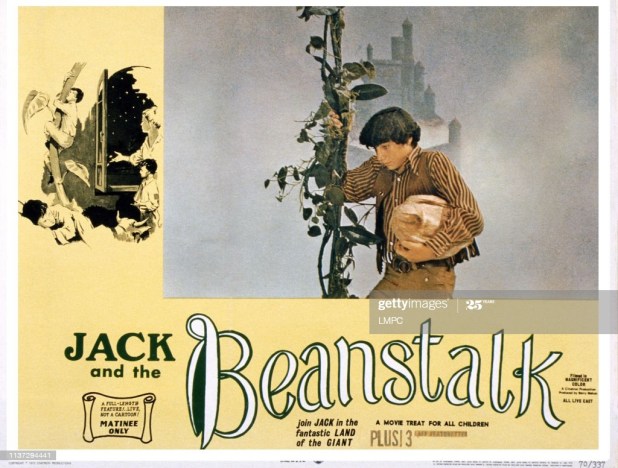
Depending on how lucky — or unlucky — you were, you would have seen either Thumbelina or this movie within perhaps the most maniacal film ever made, 1972’s Santa Claus and the Ice Cream Bunny. Why? What does Jack or Thumbelina have to do with the holidays? More to the point, what does a bunny? Perhaps even more pressing is this question: What is an ice cream bunny?
This was a movie for kids, which leads to so many more questions. Why does it have hip 1970’s slang? Why is it set in the present instead of the past, like every other version of this story? Why is Jack’s family more like Cinderella’s? Why does the giant sing the same song at least three — or a billion, it seems — times?
They used to let kids go to all day matinees of movies exactly like this, which some parents must have thought was some kind of reward. Imagine working hard all week at school and being gifted the magical wonder of this movie, which probably made no sense fifty years ago and even less today.
That said, I’ve thought about this movie way more than I will any film that will be released in 2020. Barry Mahon is kind of that way, equally fraught with wonder and madness, pain and pleasure. I’m brave enough to attempt to watch everything he ever made, so if you’re stupid as well, I hope you’ll join me.
Rita Hayworth spent the last few years of her life not knowing who she was anymore, painting when she did, and mostly staring out her window at Central Park. She died with many people thinking that alcoholism had robbed her of her career when the truth was Alzheimer’s had impacted her final years and back then, the world didn’t understand that disease at all.
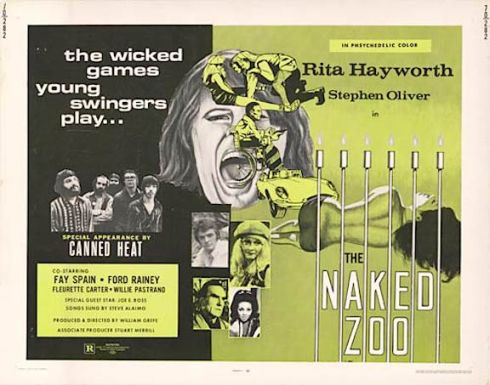
Before she slipped away, she made a movie with William Gréfe, which blows my mind, and that movie is 1970’s The Naked Zoo, which was originally called The Grove, named for Coconut Grove, a former artist’s colony in Miami.
So how did Gréfe — the maker of movies like Sting of Death and Whiskey Mountain — get a big star like Hayworth into a movie made for just $250,000? Well, her agent originally wanted all of that cash, but they were able to make a deal for $50,000 for two weeks of shooting. Her parts were shot in a deserted house near the Pirate’s World theme park (of my dreams, as well as movies like Santa and the Ice Cream Bunnyand Musical Mutiny).
Once known as “The Great American Love Goddess,” Hayworth’s life was filled with men who wanted her to be the seductive woman she was in films only to learn that she was a real person. Or, perhaps even worse, men who only sought to control her, like first husband Edward Charles Judson, a twice her age businessman who remade her into a sex symbol that he could buy and sell to Hollywood. Her marriages to Orson Welles, Prince Aly Khan, Dick Haymes and James Hill were also marked with mental and physical abuse, with only Welles not outright beating and humiliating her in public*.
By 1972 — two years after this film — her health and mental state was so bad that she had to read her lines one at a time while making The Wrath of God. She was to be in Tales That Witness Madness, but left the set before she appearing in one scene.
Back to Willian Gréfe. He had hoped to make a movie closer to The Graduate, but you know, as seen through the Florida drive-in movie haze of sex, drugs and crime. And still, this was edited by its distributor, with cuts made to add a masturbation scene and the band Canned Heat playing at a party. Those scenes were filmed by Barry Mahon, pretty much making this movie a team-up of Florida’s two top exploitation experts.
The film itself concerns Hayworth playing Mrs. Golden, a rich woman who lives with her cockolder, wheelchair-bound husband Harry (Ford Rainey, Dr. Mixter from Halloween II!). She sleeps with an author named Terry Shaw (Steve Oliver from Peyton Place) and when her husband finds out — and tries to gun them down — Terry stops him, but despite the death of the old man being in self-defense, Mrs. Golden starts blackmailing him.
That’s really the whole story, although there’s also plenty of party scenes and romance between Terry and Nadine (Fleurette Carter, who was also in The Hookers) and Pauline (Fay Spain, Dragstrip Girl).
You can get this as part of the He Came from the Swamp box set that Arrow Video has just released. Diabolik DVD has it for sale now.
*Welles would say, a day before her death, that she was “one of the dearest and sweetest women that ever lived.
Day 18: Resurrectionist: Watch something that came out on a reissues label
Courtesy of AIP Studios’ Witchfinder General (1968), everyone knows of the exploits of British witch-hunter Matthew Hopkins (as portrayed by Vincent Price) and his fictionalized counterparts in Count Christian von Meruh and Lord Cumberland (as portrayed by Udo Keir and Herbert Lom) in Mark of the Devil (1970) and Mark of the Devil II (1973). And now you’ll learn of the even bloodier exploits of Witchfinder Inquisitor Boblig von Edelstat.
Witchcraft was born during Europe’s transition from the Dark to the Middle Ages. For over five hundred years, fueled by ignorance and religious paranoia, governments decreed their countries be cleansed of evil and immorality. Thus, through armies funded by churches, soldiers hunted down the witches who carried the pestilence. Entire villages were laid waste, in acts analogous to the social cleansings committed by the third world countries of modern society. In fact, the acts committed by Witch Hunters in the name of the Lord surpassed the body count of modern day serial killers. Thus, the witch hunts led by General Cromwell and Matthew Hopkins begat McCarthy’s Red Scare in the nineteen-fifties. And the witch hunts begat the gathering of Japanese-Americans during World War II, and the Nazi regime shipping Jews, Pols, and Slavs on trains to their deaths. And the burning of witches at the stake begat African-Americans tormented with religious symbols wrapped in gas soak rags. The brutal truth of the world’s current sociopolitical system: these same hunts and killings, based in ignorance, continue. In today’s world of light and knowledge, men continue to invest in fear, ignorance, and greed. Will man ever be capable of conquering the delusions, the urges, and the ugliness? When will witchcraft disappear from our society?
Born in Austria-Hungary, Czech Republic filmmaker Otakar Vavra ranks alongside Denmark’s Carl Theodor Dreyer (1928’s The Passion of Joan of Arc and 1932’s Vampyr) as a first-rate director with a career that is, sadly, outside of their respective homelands (and the most discriminating, international film aficionadi), fading from our celluloid memories. Vavra’s IMDb page, while cataloging his oeuvre in full, the individual pages for those films are barren; not only are no plots or synopses offered, there’s no user or critic reviews.
Vavra is the cinematic equivalent of Polish futurologist and sci-fi writer Stanislaw Lem (Solaris, The Astronauts, The Magellan Nebula*): for as many of Lem’s books that have seen English adaptation, many never will—and many of us will never experience all—if any at all—of Vavra’s films. Across his 53 directing and 56 writing credits from the early ’30s up until his 2011 death, less than twenty of his films have expanded outside of Europe into the English-domestic marketplace. Some made the transition to the VHS format and later DVD format, but most have not been honored with digital preservation.
After three shorts, Vavra made his feature film debut as a director with the comedy Camel Through the Eye of the Needle (1937) and followed with the drama Virginity (1937). He closed out the 1930s with his two best-known and revered films: the historical dramas The Merry Wives (1938; hailed by the U.S. film trade Variety) and the working class-morality tale The Magic House (1939). Prior to those directing efforts, he wrote seven screenplays: the most notable of those is the comedy Three Men in the Snow (1936); the film’s homeland success initiated his directing career. His career culminated with a teaching position at Prague’s Film and TV School of the Academy of Performing Arts, a position he held since the 1950s. He was awarded the Czech Lion in 2001 and a presidential Metal of Merit in 2004 for his contributions to Czech cinema.
His other widely-distributed, directorial works include:
The Masked Lover (1940) — a romantic comedy concerning a Czech General
Enchanted (1942) — a romantic comedy
I’ll Be Right Over (1942) — a slapstick comedy
Happy Journey (1943) — a romantic comedy
Rozina, the Love Child (1945) — a historical drama
Against All (1957) — a historical war drama; part of the “Hussite Trilogy,” which are three of the most expensive Czech films ever made, with Against All as the most expensive at 25 million Czech Koruna (1.2 million U.S.)
August Sunday (1961) — a comedy
Night Guest (1961) — a drama
Golden Queen (1965) — a psychological drama
Romance for Bugle (1967) — a drama that won the Special Silver Prize at the 5th Moscow International Film Festival
Days of Betrayal (1973) — a historical war drama that won a honorary diploma at the 8th Moscow International Film Festival
Sokolovo (1974) — A Soviet co-production about the ’43 Battle of Sokolovo
The Liberation of Prague (1977) — a historical war drama; the third of a trilogy that began with Days of Betrayal and preceded by Sokolovo
Dark Sun (1980) — a crime drama that serves as Vavra’s rare foray into sci-fi that serves as a remake of his own 1948 film Krakatit
The Wanderings of Jan Amos (1983) — a biographical drama about 17th century Christian crusader Jan Amos Comenius
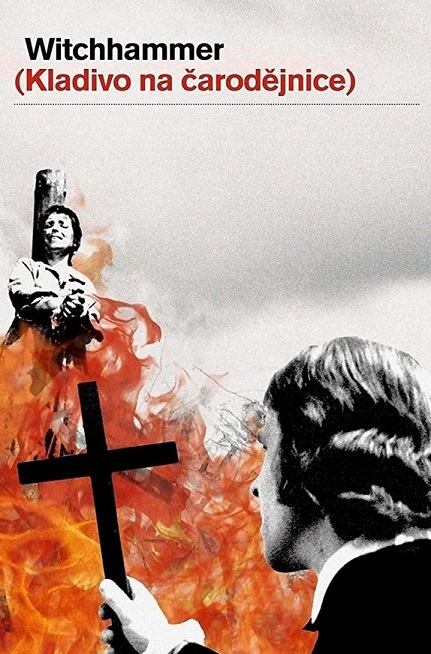
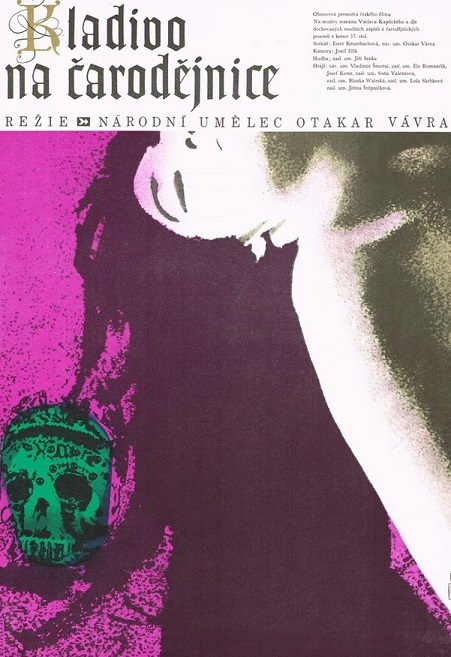
And that brings us to Vavra’s lone foray into the horror genre, a historical-drama concerned with the brutal inquisition of witches during the medieval era—a film that is heralded as Vara’s chef-d’œuvre and won several awards at Argentina’s Mar del Plata International Film Festival in 1970. One of those wins was for cinematographer Josef Illik who, after watching Witchhammer, you’ll wonder why Illik’s name is not as revered in international film circles as Hungarian-American cinematographer Vilmos Zsigmond (Deliverance, Close Encounters of the Third Kind).
Based on the best-selling Czech history novel Kladivo na čarodějnice (1963) by Vaclav Kaplicky, the 17th century tale chronicles the real-life, human rights atrocities of the North Moravia Witch Trails of the 1670s by Witchfinder Inquisitor Boblig von Edelstat in which 100 people were murdered. The book’s main protagonist, Priest Josef Lautner (Kryštof Lautner in the film), is a cleric who tries to help his people, but soon falls victim to the trails for opposing “God’s Law.” The book is heralded as an important to literary lesson of man’s ills in political-based paranoia and political prosecution on-level with Arthur Miller’s The Crucible (1953) (required high school reading; at least it was for me).
The resulting film adapted by Vavra was banned, ironically, not for its graphic nature, but for Vavra adapting the film as an acidic allegory to the Communist show trails that rocked Czechoslovakia in the 1950s. While the film was banned from showing by the Czechoslovakian government, it was accepted by the international marketplace as a cinematic masterpiece.
The atrocities began with an altar boy observing and reporting a destitute old woman hiding the bread given out during Holy Communion—a theft that she admits to, with the intend to feed it to her barren cow to re-enable its milk production. The indiscretion of hoarding holy bread, according to Witchfinder Inquistor Edelstadt, smacks of “witchcraft,” as based on his interpretation of the Catholic treatise The Malleus Maleficarum, aka Hammer of Witches (thus, the film’s title). The thumbscrews and other torture devices are dispatched in quick succession—and a young priest who opposes the trails soon finds himself among the wrongly executed.
Even if you’ve watched the admittedly more sensationalistic, West German-produced Mark of the Devil, aka Witches Tortured til They Bleed (1970), its sequel Mark of the Devil II, aka Witches Are Violated and Tortured to Death (1973), and the more reserved, Gothic-slanted AIP film that inspired its production: Michael Reeves’s Witchfinder General, aka The Conqueror Worm (1968), you’re not going to be prepared for this horrifying lesson in the absolute corruption of power. We won’t sugarcoat: Witchhammer, as was Pier Pasolini’s Salo, or the 120 Days of Sodom, isn’t pleasant (Pasolini’s film even more so), but it is an exquisite example of perfection in cinema.
You can watch Witchhammer on You Tube, but there’s a far superior, superb DVD rip available on the European F Share TV free-with-ads VOD platform. There’s an account sign-in viewable trailer on You Tube (due to graphic content). DVDs are readily available in the online marketplace at a wide variety of eRetailers or you can buy direct from Arrow Video.
Other classic witchcraft films to supplement your viewing of Witchhamer are the Sweden-Denmark co-production Haxen (1922) and Carl Theodor Dreyer’s own forgotten classic, Day of Wrath (1943). We also examine the life of another Middle Ages’ serial killer of the von Edelstat variety, Gilles de Rais, and his inspiration behind two films by Spain’s Paul Naschy: Panic Beats and Horror Rises from the Tomb.
About the Author: You can learn more about the writings of R.D Francis on Facebook.He also writes for B&S About Moviesand publishes on Medium.
The Warner Archive is the gift that keeps on giving, because before it started making burn on demand DVDs, this movie has such a limited release that few people had seen it. I know I’d been hunting for it for years, as it perfectly hits on so many of the things that I adore. It has elements of the Eurospy genre, an overwhelming amount of cameos and as it was a lost film for some time, the feel of being a cult film.
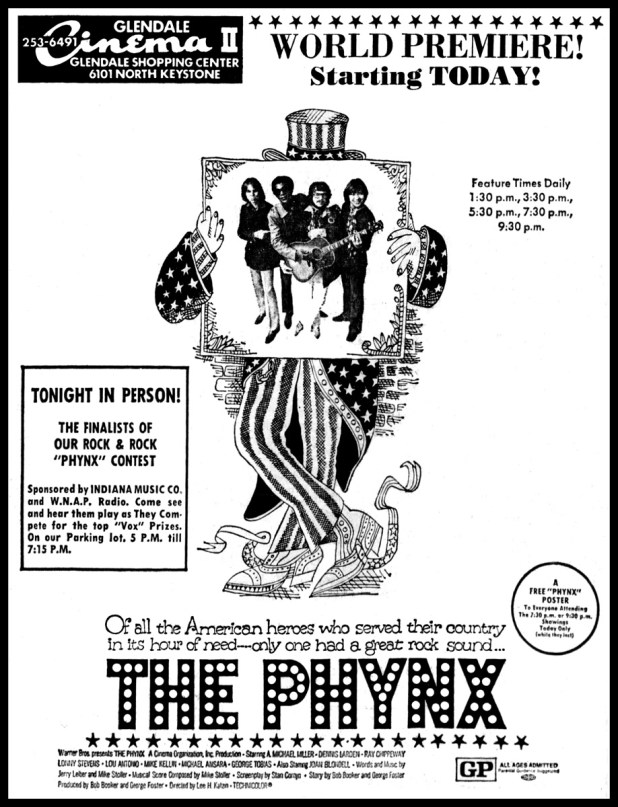
The Phynx are a manufactured band — kind of like The Monkees — made up of A. “Michael” Miller, Ray Chipperway, Dennis Larden and Lonny Stevens. They’re trained in all manner of espionage and rock ‘n roll, including meeting Dick Clark, record industry emissary James Brown and being taught how to have soul by Richard Pryor.
At once an indictment of the system and the product of the very hand that it is biting, The Phynx occupies the same weird space as Skidoo, i.e. big budget Hollywood films trying desperately to reach out to the long-haired hippy audience, yet fairly to understand them on a near monumental level. Much like that film — or the beach films of just a half-decade hence, which seems like several lifetimes ago — this stars plenty of Old Hollywood former A-listers. Why this would reach “the kids” is beyond me, but this film has more of them than any movie this side of Won Ton Ton: The Dog Who Saved Hollywood.
All of those celebs of the past have been kidnapped by the Albanian government to make some kind of message to capitalist swine. Amongst their number, you’ll discover Patty of the Andrews Sisters (one wonders where Laverne and Maxene were), Tarzan star Johnny Weissmuller and his Jane (Maureen O’Sullivan), Cheyenne star Clint Walker (who we love for Killdozer!, Scream of the Wolf and Snowbeast), Rudy Vallee, gossip queen Rona Barett, Edgar Bergen and Charlie McCarthy, Busby Berkeley, Xavier Cugat (with chihuahua), Cass Daley, Roy Rogers’ sidekick Andy, Devine Fritz Feld (whose claim to fame was the popping sound he could make with his mouth; he also shows up in the aforementioned Michael Winner canine opus), Leo Gorcey, John Hart (who replaced Clayton Moore as The Lone Ranger, here in character) and Jay Silverheels (also in Tonto character), Huntz Hall, Louis Hayward, George Jessel, Ruby Keeler, Patsy Kelly (one of Hollywood’s first out lesbians), Dorothy Lamour, Guy Lombardo, Trini “If I Had a Hammer” Lopez, boxer Joe Louis, Marilyn Maxwell (who “dated” Rock Hudson), Butterfly McQueen (Prissy from Gone with the Wind), Pat O’Brien and Colonel Sanders (!).
Harold “Oddjob” Sakata is also on hand, as well as Lou Antonio (Cool Hand Luke), Mike Kellin (Mel from Sleepaway Camp), Michael Ansara (It’s Alive), George Tobias (Abner from Bewitched), Joan Blondell, Martha Raye, Pat McCormick (Big Enos from Smokey and the Bandit), Warhol superstar Ultra Violet, Susan Bernard (December 1966 Playboy Playmate of the Month and one of the stars of Faster, Pussycat! Kill! Kill!; she’s also the mother of Near Dark‘s Joshua John Miller), Sally Struthers as the band’s number one fan and Rich Little as the voice of Richard Nixon.
Lee H. Katzin (who mostly worked in TV, including the made for TV film What Ever Happened to Aunt Alice?) directed this, working with Robert McKimson for the animated portions. It was written by Bob Booker (who produced and wrote The Paul Lynde Halloween Special) and George Foster with a screenplay by Stan Cornyn. It’s the only script he’d ever write, as he was better known as the head of the Creative Services department of Warner Brothers Records, where he wrote Grammy-winning liner notes (for two Sinatra albums, “Strangers In the Night” and “Sinatra at the Sands”; he also wrote the song “The Meaning of Christmas” and was an innovator when it comes to what would one day be known as the DVD format).
This is the only film where Johnny Weismiller says, “Me Tarzan; You Jane.” So there’s some more trivia for you, which is — sadly — more interesting than this film. Yet it’s worth a watch to see the transition between the La-La Land of old and the new movement of art that would last just a few years before the blockbuster made itself known. I know someone that brought up to me how fortunate we were that Star Wars kicked all these old Catskills and vaudeville-era people out of films and into TV, because what they made was so hacky. The gall of this person upset me to a degree where it has since colored every interaction that I have had with them. I have a warm place in my heart for these bloated failures as the Man tried to reach the youth culture. They may be a mess, but they’re my mess.
ABOUT THE AUTHOR: Mark Rochester is a librarian. Mad about movies and books and film soundtracks. His favorite film is The Private Life of Sherlock Holmes.
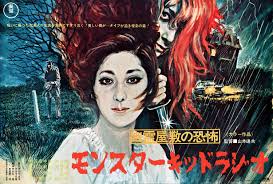
Released by Toho (the Japanese Studio that brought us Godzilla!), The Vampire Doll (1970), or to give the film its full title, Legacy of Dracula: The Vampire Doll, was the first of a three-part series of Japanese vampire movies (known as the Bloodthirsty Trilogy) which was followed by Lake of Dracula (1971) and Evil of Dracula (1974). Director of all three of the otherwise unrelated films was Michio Yamamoto, who before taking up directing in 1969, was the Assistant Director on films such as Kurosawa’s Throne of Blood (1957) and Samurai Assassin (1965), starring Toshirô Mifune.
Set in modern-day Japan, The Vampire Doll follows Keiko (Kayo Matsuo) and her fiancé, Hiroshi (Akira Nakao), trying to unravel the mystery behind Keiko’s missing brother, Kazuhiko (Atsuo Nakamura) and the recent death of Kazuhiko’s girlfriend, Yuko Nonomura (Yukiko Kobayashi). Western audiences may not recognize most of the cast, with only Kayo Matsuo (the supreme Ninja in Shogun Assassin (1980)), Atsuo Nakamura (Lin Chung in the 70’s TV series The Water Margin) and Jun Usami (Tora! Tora! Tora! (1970)) providing the likely exceptions, but they will recognize many of its tropes and distinct plot influences from Gothic British and Italian horror movies and its touches of Mario Bava, Psycho (1960) and the Edgar Allan Poe adaptations from the 60’s made by Roger Corman. For this reason, the Bloodthirsty Trilogy is often held up as Toho’s answer to the horror films made by the British Hammer studio (1957-).
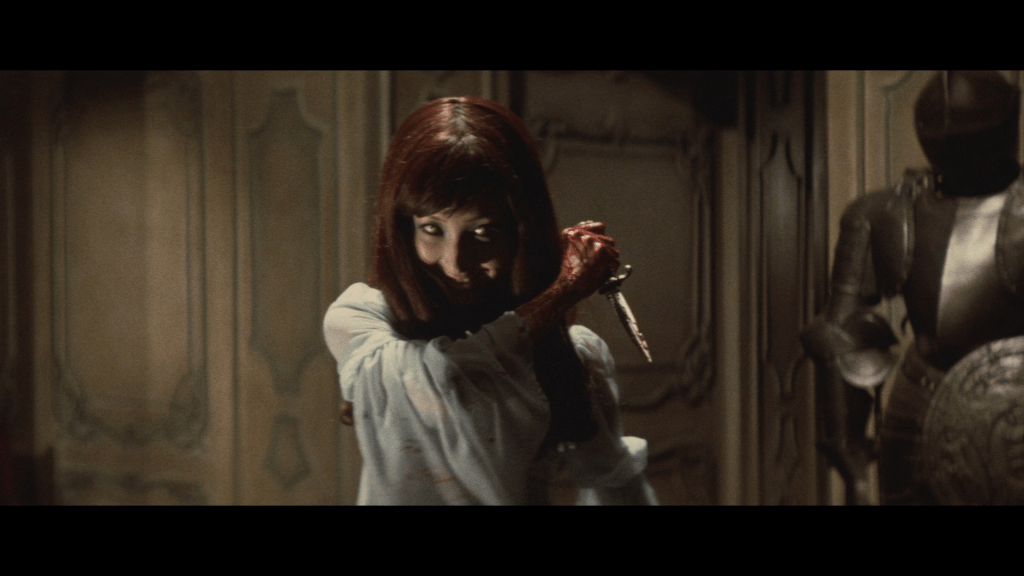
The setting for much of The Vampire Doll is the fabulous Nonomura mansion – an old, huge Western-style home with a spiral staircase (the scene where Yuko’s mother descends the staircase is straight out of many a Hammer vampire movie), creepy, dark basement, secret doorways, strange cries in the night and even a mute butler called Genzo (who attacks all the guests whenever he gets a chance). The interior design of the house is superb and it is atmospherically, beautifully lit, with some rooms disarmingly bright and welcoming and others so dark with only the characters within lit at all. Some of the interior shots (by Kazutami Hara), especially the ornate shadows cast by flashes of lightning on the brown walls are among the things I enjoyed most about this film. Also impressive is the genuinely scary make-up and look of Yuko Nonomura, who with her green-yellow eyes, long dark hair and pale blue-white dress is more like an Onryō (“vengeful spirit”), a vindictive ghost from Japanese folklore (and movies), instead of one of Hammer’s busty vamps. Horror fans will also appreciate that this film is scarier and a bit less melodramatic than most Hammer films – the blood looks like blood, not like red paint, with the blood-letting scene at the end as realistic as it is spectacular. It is also eerie and atmospheric in places, has a number of genuinely creepy characters, a couple of good jump scares and a disconcerting jump cut out of a (?) dream sequence.
On my list of not so good things about the film are the performances, some of which are a little uneven, and the soundtrack which at times is overbearing and jarring to no positive effect. The middle section of the film, which focuses on the sleuthing and snooping of Keiko and Hiroshi, is a little slow and some of the plot devices (e.g. Hiroshi letting Keiko go back to the Nonomura mansion alone) are unbelievable. It is also very obvious where their snooping is leading. Or so we think ! More intriguing and unusual are the twists and plot lines in the last third of the movie involving the mysterious Dr. Yamaguchi (Jun Usami), Yukio being hypnotized, and maybe not even being dead at all, and her ’empty’ grave – ok, they may be a bit confusing, and you may want to rewind and watch that last section again to take it all in, but you won’t mind, as many of the best moments are in the last quarter of the movie where Yamamoto takes the story away from traditional Western vampire themes and into the realms of the Japanese supernatural. And what makes this film worth watching, regardless of its flaws, is that despite its obvious Western influences it still has its own distinct and vivid style. As such I found it to be an interesting and entertaining Japanese take on the vampire movie.
Michio Yamamoto was the assistant director on Throne of Blood and second unit on the Mifune film Shogun Assassin before creating a trilogy of bloodsucker thrills for Toho*, the same studio that gifted us with Godzilla. It comes in the wake of Hammer’s Technicolor remakes of classic horror films like Horror of Dracula, a movie which was a big deal in Japan. In fact, the original ending — complete with a much grislier ending for Christopher Lee — was found in the Land of the Rising Son.
According to this article by Michael Crandol, “Although there appears to be no truth to the rumour that Hammer routinely prepared a “Japanese cut” of each film that included extra bits of gore, the filmmakers were likely aware that scenes which would not make it past the United Kingdom censors would be able to be retained in the Japanese release.”
He goes on to explain how the gothic Hammer mood is incredibly similar to the kaiki eiga, which some take to mean horror films but which truly means strange films. Yamamoto takes the feel of these movies and translates them to a Japanese sensibility, but fans of British horror need not fret: there is much to love here beyond simple pastiche.
After a six month business trip, Kazuhiko goes to visit his girlfriend Yuko (Yukiko Kobayashi, Destroy All Monsters) at her lonely country home. However, her mother later tells everyone that her daughter has already died in a car accident. That makes sense, because the last time we saw Kazuhiko, he was following Yuko to a grave with her name on it.
Why did Kazuhiko go there? That’s what his sister Keiko (Kayo Matsuo, Lone Wolf and Cub: Baby Cart at the River Styx) and her fiancee Hiroshi (Akira Nakao, Commander Takaki Aso in the 1990’s Godzilla films and Premier Hayato Igarashi in Godzilla Tokyo S.O.S.) want to know.
The truth? Spoilers, but Yuko’s family history is beyond insane, with her father murdering numerous people, impregnating her mother against her will and refusing to just let his daughter die.
This is a brightly hued masterpiece that would be the perfect side dish between a serving of some Lee and Cushing films.
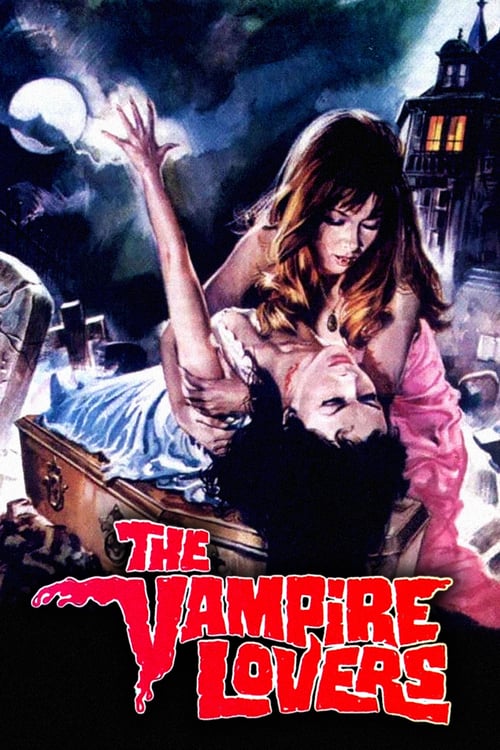
If the past Hammer films seem bloody but chaste to you, by 1970 these films made the leap to the Karnestein Trilogy, replete nudity, sex and lesbianism. Offshoots — outright rip-offs is too mean — of the story of Carmilla, blame American-International Pictures, who wanted more explicit content to take advantage of the relaxed morals of the time.
We start in Styria, where a gorgeous blonde in just a nightgown (Kristen Lindholm, who is in all three of the trilogy) shows up in a graveyard where she’s decapitated by Baron Hartog (Douglas Wilmer, Nayland Smith in the British Fu Manchu movies), a vampire destroying man out to kill every bloodsucker for what they did to his sister.
Years later, Marcilla (Ingrid Pitt!) comes to stay in the home of distant relative General Spielsdor (Peter Cushing). She soon causes nightmares for his niece Laura (Pippa Steel, who sadly died from cancer way too young at 44) and eventually her attentions give the girl a gradual illness that claims her life.
Now known as Carmilla, Pitt continues seducing women like Madeline Smith from Theatre of Bloodby sucking blood directly from their hearts. She’s helped by Governess Mademoiselle Perrodot (Kate O’Mara, who played Joan Collins’ sister on Dynasty, which is casting I approve of) and kills everyone who suspects them as an unexplained man in black watches.
Finally, the General and Baron trap her in her castle and lop off her head, because all of this murder — and probably the fact that she was stealing so many wives — is too much for them to take. That’s when they learn that her true name is Countess Mircalla Karnstein and the portrait on the wall is no longer a gorgeous woman, but a fanged skull.
Look for vampire actor Ferdy Mayne as a doctor. He played Count von Krolock in The Fearless Vampire Killers, Dracula in Freddie Francis’ The Vampire Happening and, of course, God in Night Train to Terror.


 B&S About Movies
You must be logged in to post a comment.