Janie (1970)

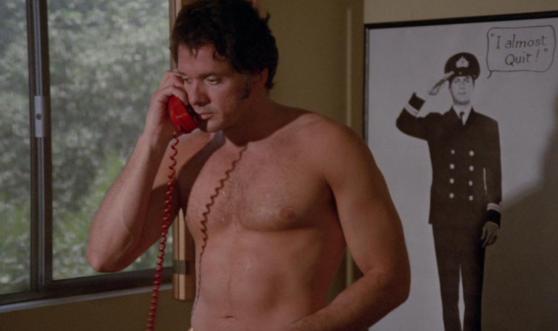
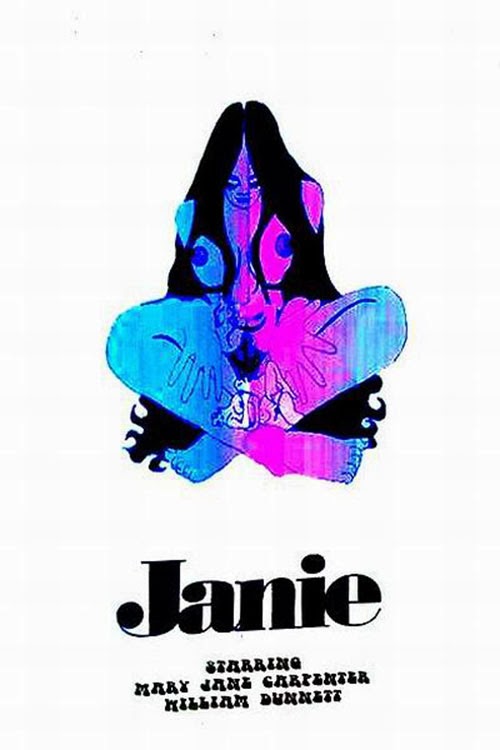
Man, Roberta Findlay made some incredibly scummy movies. This is just another example of his style, a movie in which Janie (Mary Jane Carpenter, Sex Family RobinsonHow to Succeed with SexDouble Initiation) tells her daddy — who yes, she’s sleeping with — about all the people that she’s killed. After each murder, she makes love to herself as shes covered with blood.

This movie is fuzzy and scuzzy and the audio is all over the place and the music is way too loud and everything looks like a mess and yet, it’s exactly right. Roberta directed most of this, although some credit Jack Bravman (Zombie NightmareNight of the Dribbler and the producer of the Findlay’s Snuff).

Everyone has on outfits that Robert Crumb would be crazy for and Roberta does the borderline maniac narration for the nudie cutie gone slasher footage that we watch, where sound rarely matches up with voices. This is a dirty movie with no sex, a film that promises titilation and only delivers strangeness.

I would compare this movie to something else, but there really isn’t anything else like it. Man, Roberta Findlay inspires me more and more with each of her films I see, because she was out there in the 60’s and 70’s making mindbending pieces of trashy art even if she had to use a man’s name to make it happen.

The other night, I had a tooth infection and the only way I could sleep was to lie my face on a heating pad until it felt like it was scalding my flesh and I fell asleep finally, fitfully, and when I awoke I was totally covered in sweat and afraid from the dreams that I had. That’s exactly what watching this movie is like, so beware.

Chariots of the Gods (1970)

Chariots of the Gods

In the alternate universe that was 1970, the German film Erinnerungen an die Zukunft (based on Erich von Däniken’s book Chariots of the Gods?) made $26 million at the box office and was nominated for an Academy Award for Best Documentary Feature.

The film starts by discussing how native tribes found cargo from planes and began worshipping the flying machines as gods, which is probably how our ancestors saw ancient occupants of interplanetary craft.

Director Harald Reinl did movies in just about every popular German genre, from Edgar Wallace krimini, Karl May Westerns (both of these genres infuenced Italian giallo and westerns),mountain films, Heimatfilms (“hometown” rural movies), German war films and sequels to the Dr. Mabuse, Jerry Cotton and Kommissar X films.

In fact, his life ended like a krimini, as his wife, the former actress Daniela Maria Delis, stabbed him in their retirement home.

But let’s get back to the aliens that came down from the sky and turned cavemen into human beings.

As mondos stopped shocking people in the 70’s, the final place they could get audiences was to declare the Nazca Lines and crystal skulls and pyramids as not examples of our ancestors’ genius, but instead proof that aliens came down to earth like the fallen angels from the Lost Books of the Bible — look for it on Glenn Danzig’s bookshelves — and made us. There were so many versions of this movie, but this would be the one where it all gets going.

You can watch this on YouTube.

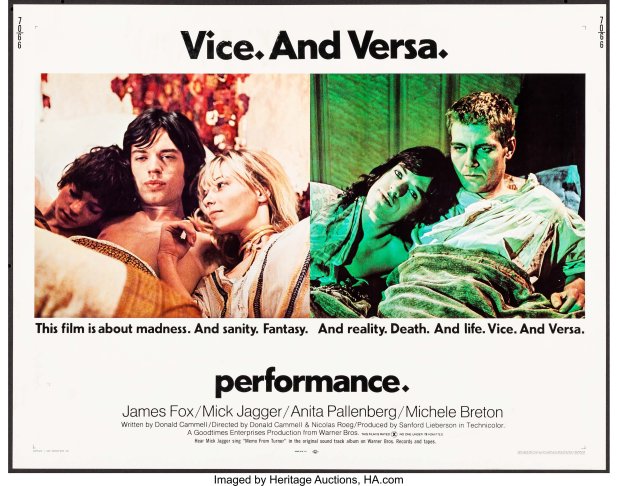
Performance (1970)

Donald Cammell was raised in a home “filled with magicians, metaphysicians, spiritualists and demons” and spent his childhood bouncing on the knee of “the wickedest man in the world” Aleister Crowley. Originally a painter, he became a screenwriter before meeting the Rolling Stones through Anita Pallenberg.

Performance was supposed to be a light-hearted swinging ’60s romp, but it ended up being what John Simon of New York Magazine called “the most vile film ever made.” It’s the story of two men*, Chas (James Fox), a brutal street thug, and Turner (Mick Jagger), a rock star who has gone into hiding.

Chas was a member of an East London gang, a man of violence who is prized for his ability to get money for his employer Harry Flowers. However, his complicated past with another gangster and that man’s murder has ostracized him from the gang and put him on the run and into the orbit of Turner and his two women, Pherber (Pallenberg) and Lucy (Michèle Breton).

By the end of the film, fuelled by drugs, cross-cutting techniques, a disjointed narrative and no small amount of magic, the two men have switched identities, with Chas displaying Turner’s face and Turner, well, not having a face any longer.

Warner Brothers thought that with Jagger in the movie they getting a Rolling Stones movie that young people could go see. Instead, they got a movie filled with drugs, sex, violence and ideas about cross-dressing and sex transforming identity that would still be dangerous half a century later.

The behind the scenes events — the house in Lowndes Square used in the film was investigated for drugs, Keith Richards was outside in a car fuming because Jagger and Anita were really having sex, Fox stopped acting for fifteen years to become an evangelical Christian — are just as interesting as the film, but the movie itself is astounding.

It was almost unreleased, as a Warner exec would complain, “Even the bathwater was dirty” and the wife of one of them would throw up at the premiere. Ken Hyman, the leader of Warner Brothers, decided that “no amount of editing, re-looping or re-scheduling would cover up the fact that the picture ultimately made no sense.” The film was shelved for two years until Hyman left and even then, the movie was re-edited and the Cockney accents were redubbed.

Time has been kind to Performance, a movie that points out the juxtaposition between the violent lives of East End with the rock and roll world of London. “A Memo to Turner” predates music videos. Bands from Coil to Big Audio Dynamite and Happy Mondays all referenced or sampled the movie while it’s been an influence on so many directors.

As for Cammell, he struggled against the mainstream after this movie — and with Marlon Brando, who kept asking him to write films and then deciding not to make them — before making Demon Seed, a film that deals with transformative sexuality, just like Performance. He’d make White of the Eye and Wild Side before killing himself with a shotgun. Kevin Macdonald (co-director of the story of his life, Donald Cammell: The Ultimate Performance), said “He didn’t kill himself because of years of failure. He killed himself because he had always wanted to kill himself.”

I held back watching this for years, because I wanted to make sure that I was ready for it. I needed to be prepared for this film, to not use it as wallpaper or background noise. It deserved more than that. And I’m glad I waited. It was worth it.

*It’s directed by two men as well, Cammell and Nicolas Roeg, who would go on to make Don’t Look NowThe Man Who Fell to Earth and The Witches.

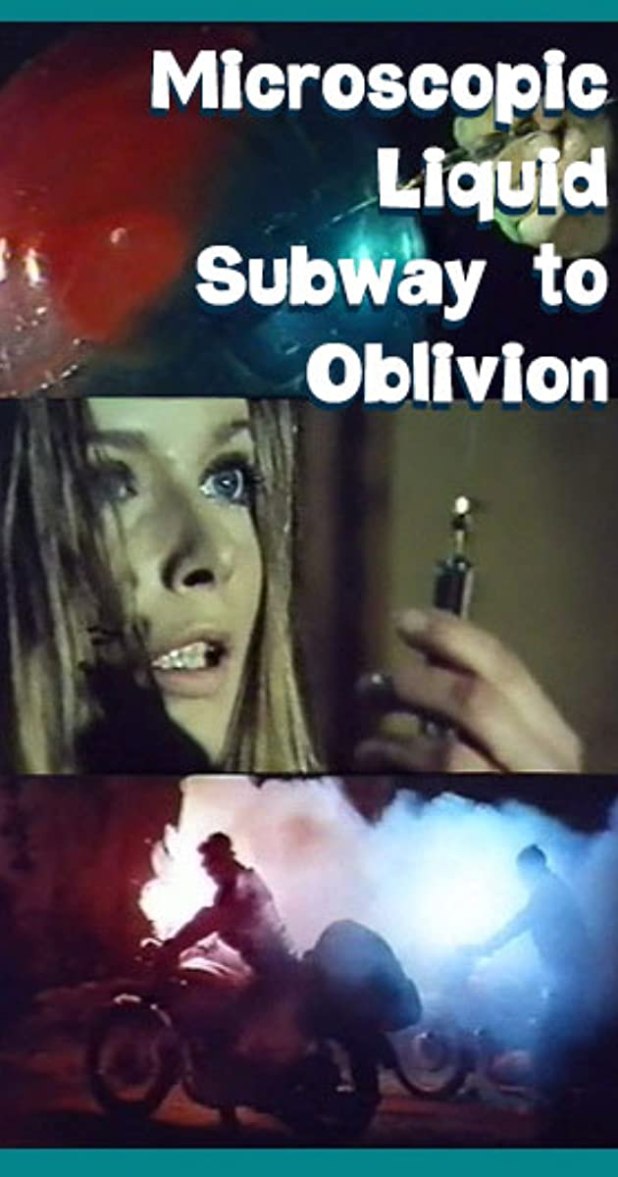
Microscopic Liquid Subway to Oblivion (1970)

As drug use gets out of control at a small college, one of the professors (Alex Rebar, The Incredible Melting Man himself and the writer of Demented and To All a Goodnight, as well as a contributing writer to Beyond the Door.

This starts off just right — a crazy theme, trippy visuals and Ewa Aulin (CandyDeath Laid an Egg) getting her groove on — before Dr. John, worried that the college’s reputation is being tarnished by all the drug use, particularly when one of his fellow professors takes one of those Dragnet acid trips and thinks he can fly.

The scheming professor decides to work with one of the nerdier kids to take a heroin addict named Billy (Carlo De Mejo, The House by the CemeteryThe Other Hell) and appoints himself the troubled youth’s personal savior. But then his wife — there’s Ewa Aulin — decides to try some of the horse for herself and things get out of hand.

Billy decides that this would the perfect time to test the masculinity of his captor and try to cuck him, which seems to be a bad idea when white knighting teacher takes you against your will. I mean, this is a movie with the line, “Elizabeth, have you ever seen your husband’s penis? John, have you ever seen your own penis?”

With a title like this one and Aulin appearing, along with De Mejo, it’s easy to think that this is a giallo. To be honest, even this movie has no idea what it is.

To be fair, this movie is a total mess, but a fascinating one. It was directed by a man named John Shadow, who some thought was Joe D’Amato — if only! — but it turns out that he was married to Aulin for four years and had a son together named Shawn. He used his own money to produce this movie and it ended up playing nowhere in the world.

Seriously, Shadow is a conspiracy figure. According to IMDB, in spite of numerous newspaper and magazine articles, photos, discographies, interviews with Aulin, the existence of their Swiss-born son, people think that Shadow was really Italian producer Roberto Loyola (I mean, on IMDB, he’s listed as using the name John Shadow to write Pieces and to direct Tales of Canterbury, a movie that D’Amato was also thought to have made). I mean, Shadow even wrote the songs for this movie and people still think he’s Loyola.

These are the strange mysteries that this somewhat lost movie has swirling around it. As they say, the story of the movie is better than the movie itself. To add to the occult nature of this one, the copy I found is a beat up Greek VHS* that was uploaded to YouTube and is well-nigh unwatchable. And yet, I watched it just the same.

*According to Oblivion DVD, there are only two copies of this movie left in existence.

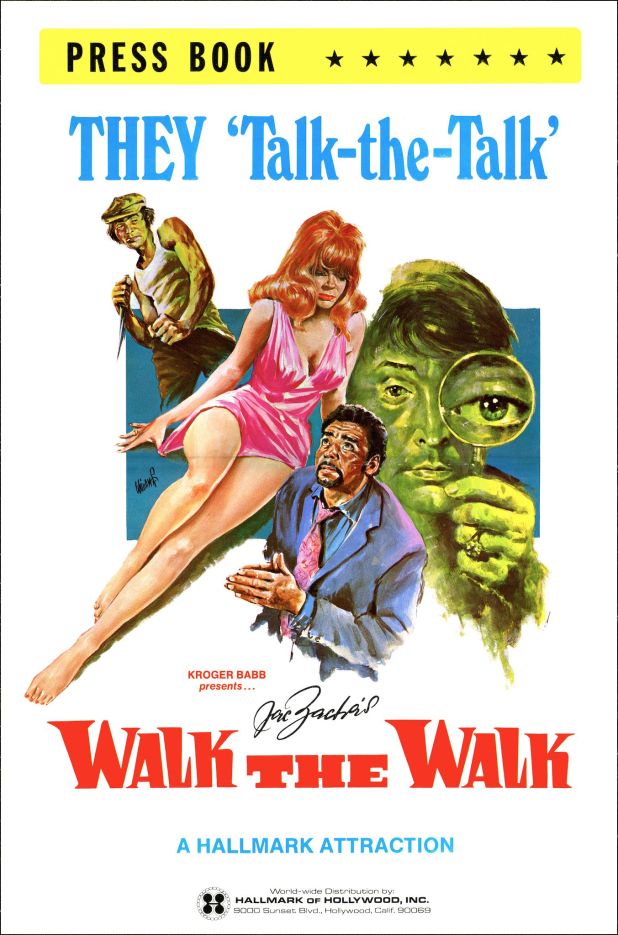
Walk the Walk (1970)

This film starts with a title card that says, “America’s Fearless Showman Kroger Babb.”

No matter what happens after that, I love this movie.

Bernie Hamilton, who was Capt. Harold Dobey on Starsky and Hutch, as well as appearing in Scream Blacula ScreamThe Swimmer and Luis Buñuel’s The Young One, is Mike, a black theology student dealing with addiction.

Writer, actor and producer Jac Zacha had aspirations here, but the film falters. Supposedly, there was a cut opening where he explained how this was the true story of his life. Maybe he wanted to take that out after, you know, there’s that scene when a woman goes off a cliff. Beyond being as convincing as a falling in a Fulci movie, this movie would implicate him in a death.

One of the actors in here, Eric Weston, would go on to write and direct Evilspeak.

You can watch this on the amazing ByNWR site.

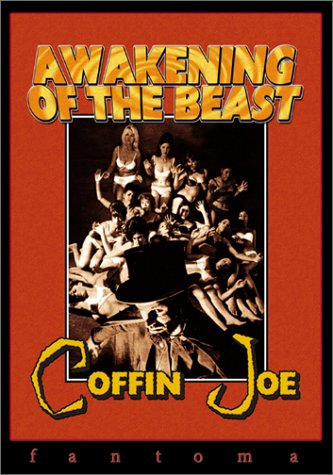
O Despertar da Besta (1970)

José Mojica Marins directed movies for six years before making At Midnight I’ll Take Your Soul, the first appearance of Brazil’s national boogeyman, Zé do Caixão, or Coffin Joe.

Joe is a man with no morals but a devotion to Nietzschian philosophies and absolute hatred for religion with the goal of achieving immortality through the birth of a perfect son. And while he does not believe in the supernatural, he often finds himself walking through visions of the otherworld.

Coffin Joe came to Marins — the man who would often be referred to as the character interchangeably — in a very magic way. “In a dream saw a figure dragging me to a cemetery. Soon he left me in front of a headstone, there were two dates of my birth and my death. People at home were very frightened, called a priest because they thought I was possessed. I woke up screaming, and at that time decided to do a movie unlike anything I had done. He was born at that moment the character would become a legend: Coffin Joe. The character began to take shape in my mind and in my life. The cemetery gave me the name, completed the costume of Joe the cover of voodoo and black hat, which was the symbol of a classic brand of cigarettes. He would be a mortician.”

Awakening of the Beast begins in black and white, as a series of vignettes of the ways that drug users debase themselves are shown in lurid, sweaty detail. A TV panel debates the idea that sexual perversion is caused by the use of illegal drugs, with more stories that illustrate this point. The TV show needs an expert on depravity, so they ask Marins to appear on the show.

Afterward, the doctor who conducted the experiment doses four volunteers and asks for them to stare at a poster of The Strange World of Coffin Joe. Supposedly Marins didn’t know much about using drugs, but he intended this movie to speak against the fact that the uses of drugs are treated worse than the suppliers and that the Brazilian film industry saw him as no better than a long-nailed drug dealer.

The acid trip that follows is highlighted by Coffin Joe, ranting against anyone and everyone. Of course, this film was banned by the very establishment it rails against. So basically, Coffin Joe is a self-fulfilling prophecy; the maniac attacking belief structures created by an artist who only believes in the power of film.

“My world is strange, but it’s worthy to all those who want to accept it, and never corrupt as some want to portray it. Because it’s made up, my friend, of strange people, though none are stranger than you!”

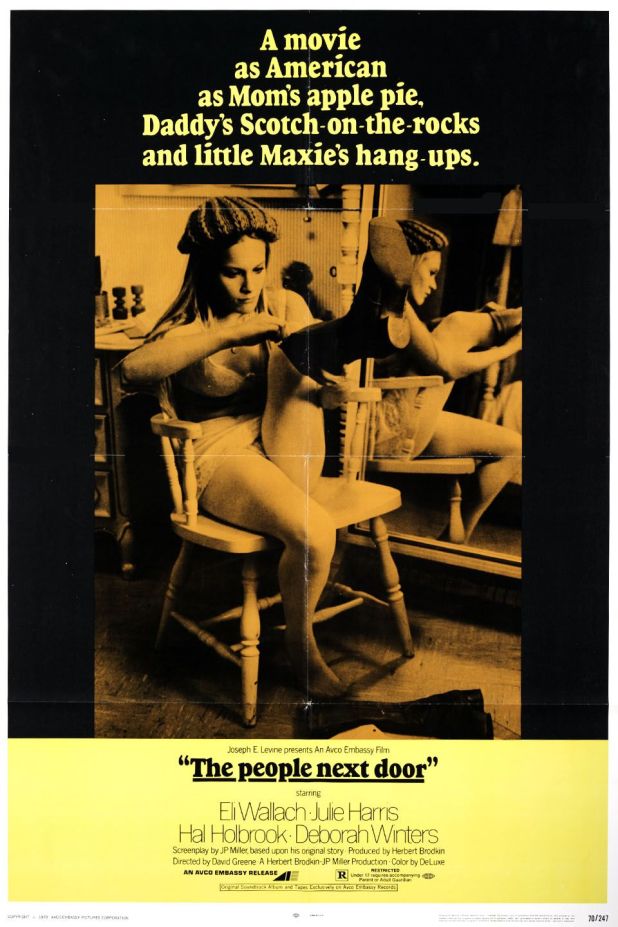
The People Next Door (1970)

David Greene was behind a lot of my favorite TV movies, like RootsRich ManPoor Man; Madame Sin and the remake of Whatever Happened to Baby Jane? He also made I Start Counting and The Shuttered Room.

Arthur and Gerrie Mason (Eli Wallach and Julie Harris) realize that their marriage isn’t perfect and struggle to fix it as their daughter Maxie fights drug addiction. Arthur catches her in bed with a biker, high on cocaine, and immediately believes that his rock star son Artie (Stephen McHattie) who gave her the drugs, but it turns out that its the nerd next door.

Roger Ebert said that The People Next Door was “the best movie so far about parents, kids and drugs, and probably the best we’re likely to get (considering Hollywood’s recent tendency to exploit the drug culture for “youth movies”).”

This has a decent cast, with Hal Holbrook, Cloris Leachman and Rue McClanahan all showing up, along with Rutanya Alda as a nurse.

It didn’t make me want to stop doing drugs, but your viewing may change your habits.

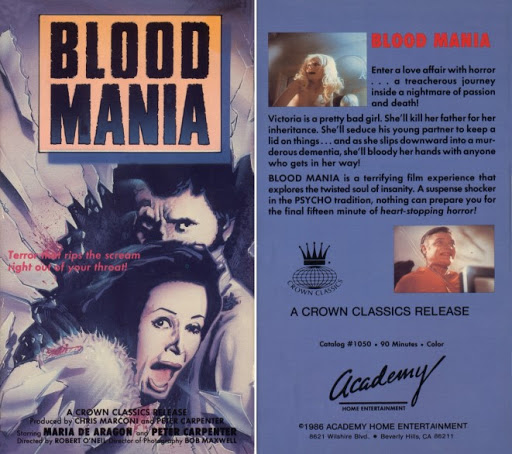
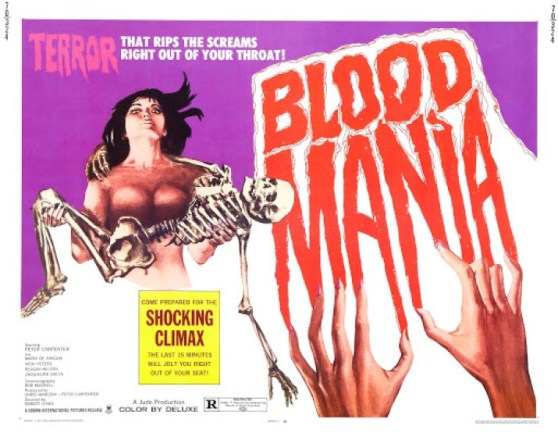
GOREHOUSE GREATS: Blood Mania (1970)

ABOUT THE AUTHOR: Eric Wrazen is a Technical Director and Sound Designer for live theatre, specializing in the genre of horror, and is the Technical Director the Festival de la Bête Noire – a horror theatre festival held every February in Montreal, Canada. You can see Eric as an occasional host and performer on Bête Noire’s Screaming Sunday Variety Hour on Facebook live. An avid movie and music fanatic since an early age, this is Eric’s first foray into movie reviewing.

(From Wikipedia) Blood Mania is a 1970 American horror film written by Peter Carpenter and Tony Crechales and directed by Robert Vincent O’Neil, and starring Carpenter, Maria De Aragon, Vicki Peters, Reagan Wilson, Jacqueline Dalya, and Alex Rocco. The film stars Carpenter as a doctor whose mistress, an heiress, murders her terminally ill father to help him pay off a debt.

If there is one thing that can be said about Blood Mania, it’s that it’s a movie. 

You really have to hand to Mill Creek Entertainment. “Gore House Greats” is an amazing title for a movie collection. Likewise, Blood Mania is an amazing title for a movie. Unfortunately, in the case of Blood Mania, it is neither gory, nor that bloody. There’s a little bit of mania, so I guess they get points for that. 

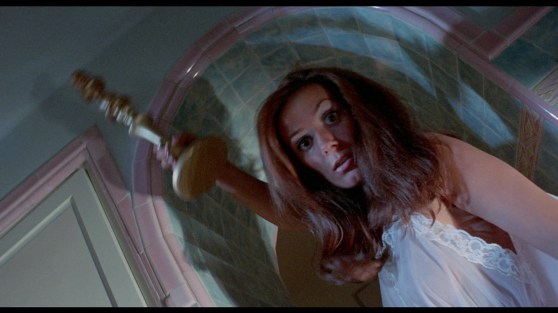
The opening sequence for Blood Mania is a freaky dream sequence depicting the stalking of a hippie babe in a peekaboo nightie over the sounds of a budget version of the Velvet Underground detuning and abusing their instruments. OK. So far so great!

Sadly, the rest of the movie doesn’t come anywhere near this level of freakiness and fun.

A more apt title for Blood Mania would have been “Worlds Dumbest Doctor” or possibly, “Victoria, The Crazy Bitch”. Either of these is a better indicator of the easy, sleazy melodrama you are about to witness.

Briefly (and without spoilers) Bloody Mania follows the sordid tale of Dr. Craig Cooper, one hunky hunk of burning physician as he beds babes of varying levels of wealth in order to bang his way out of a bad debt. Even this synopsis makes Bloody Mania sound more interesting than it actually is. In reality, this movie is closer to a soap opera with a little nudity thrown in to keep things sleazy.

I feel that this movie would have been better pitched as a Russ Meyer or Doris Wishman style sexploitation flick. There’s plenty of sex and it includes a plethora of sexploitation’s favorite tropes like nymphomania, blackmail, abortion, lesbians, and drugs. It also uses a bunch of classic sexploitation tricks used to fill out the running time when there isn’t enough plot to fill 90 minutes. A fair portion of Blood Mania consists of people driving around, frolicking on the beach, or visiting an amusement park. This is the kind of movie that “fast forward” was invented for.

Blood Mania isn’t a good movie, nor is it a “so bad it’s good” movie. But it is a movie. And I guess for Mill Creek Entertainment – that counts for something.

Hey, we love this film so much that Bill Van Ryn of the Groovy Doom/Drive-In Asylum collective gave us his take Blood Mania, again, for Mill Creek’s Gorehouse Greats box set.

Update: July 21, 2021: We’ve also previously reviewed Peter’s work in his forth and final film — which he, as with Blood Mania, wrote and produced — Point of Terror. And, thanks to frequent reader and uber Peter Carpenter fan, librarian Mike Perkins (thus his awesome research), we learned of this new blog entry from B&S About Movies’ friend Mike Justice, on his The Eerie Midnight Night Detective Agency blog regarding Peter Carpenter’s life and all-too-short career. Strap it on, it’s a great read.

And, surf over to this really cool Flickr posting from Mike Perkins, featuring early photos of Peter. And, there’s no stopping Mr. Perkins’s fandom, as he also honored Peter by not only having Peter’s IMDb page updated with correct information, he created an all-new Find A Grave entry for Peter. Did you know that Peter’s real name was Nathaniel Joseph? Or that he was in the Air Force? We do now, thanks to Mike Perkins’s hard work.

Yeah, we love our readers! Thanks for contributing to B&S About Movies, Mr. Perkins! (Yeah, we love you too, Justice.) And we love it when our readers reinforce and uplift our passions in honoring the actors and filmmakers of our youth. You gotta fight for the ’cause!
GOREHOUSE GREATS: Blood Mania (1970)

ABOUT THE AUTHOR: Bill Van Ryn is the creator of Groovy Doom and publisher and editor of Drive-In Asylum. I’m always so happy when he gets the opportunity to write something for us.

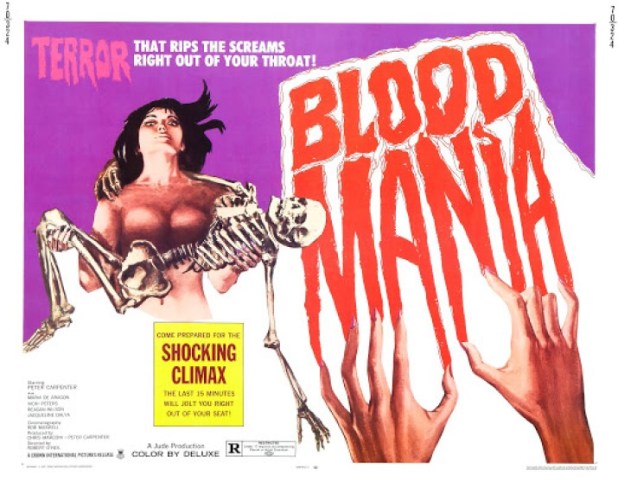
So let’s say you’re a kid in the later 1970s, and you’re really into watching scary movies on late night TV. You can’t get away with that very easily at home, but when you visit your grandparents on the weekend, they go to bed early and don’t really care if you stay up and watch TV. When you’re there, you try and see anything marked “-THRILLER” in the TV Guide. On one dark night Saturday night, you stay up late to watch a movie called “Blood Mania”. With a title like that, it’s going to be really scary, you just know it. The opening credits are a weird montage containing slow-motion shots of a woman in a nightgown running from some unidentified horror. This is interrupted by an animated piece where the word “BLOOD” – in large, gruesome red letters – is attacked by a pair of cartoon hands, which claw at the letters until they say “BLOOD MANIA”. There is a terrifying scream that makes your hair stand on end. You don’t realize it yet, but this movie has just shown you everything that is possibly of interest to an 8-year-old monster kid, and it won’t be very long before the TV is turned off and you’re asleep.

This may have been the experience of anybody who happened to watch “Blood Mania” as a child, because it’s one of the talkiest things you could hope to see. The shocks in the film are mostly of the daytime drama variety, so kids would probably check out of this movie very early on. This is probably a good thing too, because during the course of the story we are confronted with situations such as cheating on one’s romantic partner, a hopelessly dysfunctional family of estranged people, a woman who is willing to murder her invalid father for a little bit of money, a ruthless blackmail scheme, the use of amyl nitrate for kicks in bed, and repressed trauma linked to incestuous abuse. 

Revisiting it as an adult, however, I appreciated it in a totally different way. Director Robert Vincent O’Neil (Angel, Wonder Women) finds an absolutely glacial pace for this movie, but it is such a visually compelling experience that you don’t seem to mind. Back in the days of turntables, sometimes you might have played one of your 45 rpm records on 33 1/3, just to hear what it would sound like slowed down, and “Blood Mania” is the visual equivalent of just that. I’m a sucker for any movie that emulates Bava’s colored lighting, but the set – a Los Angeles mansion that was once the home of Bela Lugosi – is just as wonderful. 

Blood Mania was co-written by lead actor Peter Carpenter, one of two films (Point of Terror is the other) that were created by Carpenter with producer Chris Marconi.  Carpenter had been selected by Russ Meyer for a small role in Vixen! after Carpenter’s girlfriend included a photo with him as part of her audition materials. A role alongside Dyanne Thorne in 1970’s softcore drama Love Me Like I Do followed, and this two-film package with Marconi undoubtedly represented a bid for establishing himself as a working actor – a commodity, even. A career never manifested, and Carpenter disappeared. Despite rumors that he vanished because he died, he actually simply left the movie business, although he did pass away at the too-young age of 56.

Carpenter plays a shady doctor named Cooper, who is being blackmailed for providing illegal abortions. The sex-starved daughter of one of his patients offers to help him with his ‘tax problems’, and after he beds down with her to consummate the deal, she kills her father, expecting to inherit his estate. When her younger sister appears for the reading of their father’s will, however, things don’t turn out quite the way Victoria had hoped, and all three of their lives quickly begin to unravel. 

Although made in the United States, Blood Mania sure does have the feel of a European film, in part because of its sumptuous look, but also because of its dreamlike atmosphere. Its horror film approach to soap opera material felt like a cheat the first time I saw it, but that’s what actually appealed to me in the long run. Like the Sisters of Mercy doing a Dolly Parton cover version, the result is something a little unexpected and marvelous. Although it does appear on Mill Creek compilations, there is also an incredible 2017 blu ray restoration by Vinegar Syndrome out there that blew my mind when I saw it.

Hey, we love this film so much that Eric Wrazen of the Festival de la Bête Noire collective gave us his take Blood Mania, again, for Mill Creek’s Gorehouse Greats box set.

***

Update: July 21, 2021: We’ve also previously reviewed Peter’s work in his forth and final film — which he, as with Blood Mania, wrote and produced — Point of Terror. And, thanks to frequent reader and uber Peter Carpenter fan, librarian Mike Perkins (thus his awesome research), we learned of this new blog entry from B&S About Movies’ friend Mike Justice, on his The Eerie Midnight Night Detective Agency blog regarding Peter Carpenter’s life and all-too-short career. Strap it on, it’s a great read.

And, surf over to this really cool Flickr posting from Mike Perkins, featuring early photos of Peter. And, there’s no stopping Mr. Perkins’s fandom, as he also honored Peter by not only having Peter’s IMDb page updated with correct information, he created an all-new Find A Grave entry for Peter. Did you know that Peter’s real name was Nathaniel Joseph? Or that he was in the Air Force? We do now, thanks to Mike Perkins’s hard work.

Yeah, we love our readers! Thanks for contributing to B&S About Movies, Mr. Perkins! (Yeah, we love you too, Justice.) And we love it when our readers reinforce and uplift our passions in honoring the actors and filmmakers of our youth. You gotta fight for the ’cause!
Queens of Evil (1970)

Man, Ray Lovelock can’t catch a break. Of the films I’ve seen him in, he never makes it to the final frame. Then again, he also gets nearly every girl that gets put in front of him, so while his final luck isn’t always great, he does fine along the way.

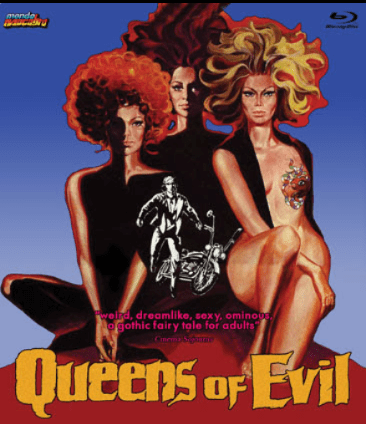
Queens of Evil AKA La Regine is a 70s occult-infused end of the hippy movement sun-drenched nightmare of a film that will find its way into my blu ray player multiple times this year. Lovelock is David, a motorcyclist who searching for answers until he meets a man in a Rolls Royce who has a flat. That old man pays back David’s selfless act by stabbing one of our protagonist’s tires. A chase ensues and the rich driver crashes his car and dies. David, fearing the inevitable legal issues, runs right into a dark forest.

He awakes to three gorgeous women named Liv (Haydée Politoff, Interrabang), Samantha (Silvia Monti, A Lizard In a Woman’s Skin) and Bibiana (Evelyn Stewart, The Whip and the Body) all watching him. They live in a huge house in the woods that is filled with impossible angles and gigantic full wall photos of their faces. They’re also given to serving huge meals and conducting rituals in the night.

This is the kind of movie where three women tell a guy that they have a ritual to attend in the middle of a lake to meet with the fish, then pulling hundreds of them and he’s like, “Nope. Nothing strange at all.”

Of course, he sleeps with every single of them before things descend into madness, filled with dream sequences, dragons painted onto nude flesh, a sinister party and finally a feminist-driven decimation, followed by time lapse flowers sprouting from a shallow grave. In a word — incredible.

Director Tonino Cervi somehow made a film in which three strange women seduced and are seduced by one man not sleaze at all, but instead strangely innocent and totally infused with the fantastic. He also produced one of the weirdest — imagine what that entails — Italian horror films, Il Nido del Ragno (The Spider Labyrinth).

The new Mondo Macabro release of this film is, as is par for the course for this company, wonderful. Beyond the brand new 4k transfer, there’s an archival interview with Lovelock (who also sang two songs in this), audio commentary by Kat Ellinger and Samm Deighan, alternative scenes and the option to watch this dubbed in English or in the original Italian with subtitles.

You can get it from Mondo Macabro (their site is currently being worked on, so head to Diabolik DVD).