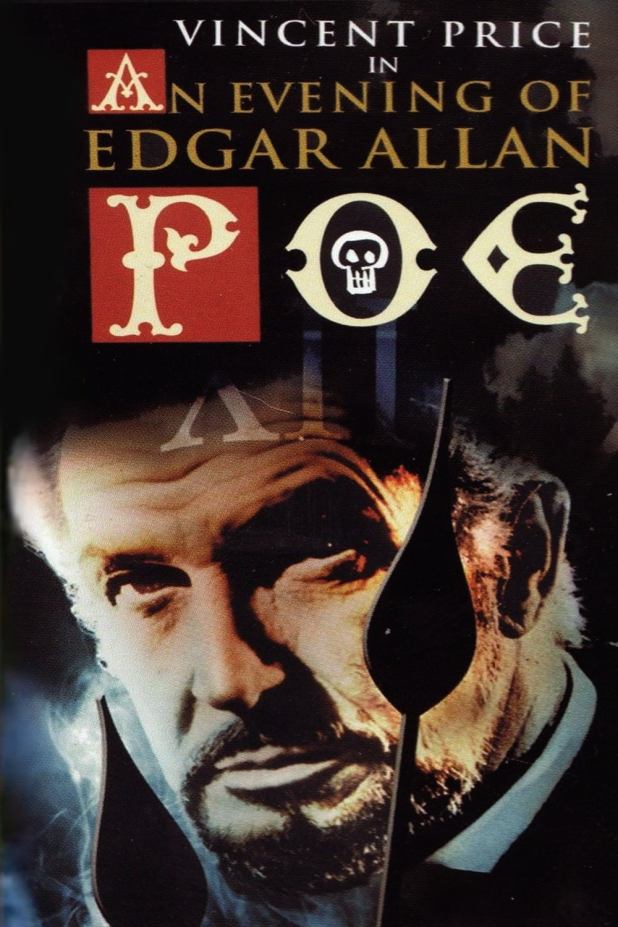
I love Vincent Price and stand against anyone who dislikes how hammy he was. But hey, if you feel that way, perhaps you should avoid An Evening of Edgar Allan Poe, which features Price all alone on the stage — with props and outfits that change with every story — matched with only music by Les Baxter, recorded at the same time and with the same orchestra as Cry of the Banshee.
Produced by Samuel Z. Arkoff and Kenneth Johnson (who wrote, produced and directed this; you may know him from creating The Incredible Hulk TV series, as well as The Bionic Woman and V), this is an opportunity to see Price go wild telling the stories “The Tell-Tale Heart,” “The Sphinx,” “The Cask of Amontillado” and “The Pit and the Pendulum.”
The really cool thing about this is that it seems like every single story was shot in one take, which speaks to Price’s ability as an actor as well as his endurance, as he really goes full Vincent Price on every one of these stories.
EDITOR’S NOTE: We originally reviewed this on August 19, 2020. Seeing as how Arrow Video has included it as part of their Vengeance Trails box set, we’ve updated our review and provided some information about this set. Phil Bailey also reviewed this for on site on August 20, 2020.
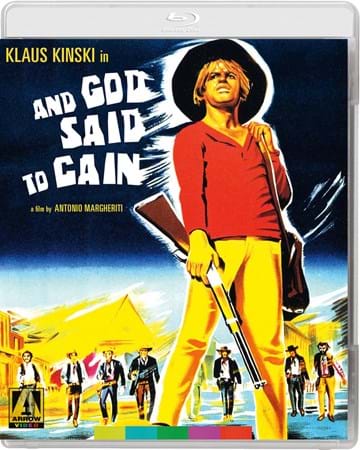
Gary Hamilton (Klaus Kinski!) is released from ten years of hard labor with a pardon for a crime he didn’t commit, so he does what any insane character played by Kinski would do. He sets out to kill everyone who ever did him wrong.
Kinski wants Acombar, his former friend who set him up, dead. He has to go through the man’s son (Antonio Cantafora, Baron Blood) to do it, as well as Acombar’s wife Maria, who was once his lover. He’s helped by the people of the town who hate his enemy, as well as his knowledge of the Native American burial grounds.
This is less Western than horror film, with Kinski’s character nearly a ghost, continually followed by gusts of winds and tolling bells as he returns to get his bloody vengeance.
Upon seeing this again on the new Arrow blu ray release, it feels like a totally new film. I’d always loved this one — I’ve watched it at least three times in the last year — but this as a revelation. The scene where Kinski explains his hatred to the priest is transcendent: “Day after day, they convinced me that my place was inside. Life outside has no more meaning for me. Now it’s only revenge.”
There’s also the moment when the storm opens up on the town as Kinski opens fire on everyone. Every other man is hesitant, worried as to what happens next. Their enemy has become death itself.
While there are similarities to another Margheriti film Vengeance, this is very nearly a remake of Salvatore Rosso’s A Stranger in Paso Bravo, which was made just a year before. This one, however, is unafraid to let the gruesome side of violence be seen. The original story for both was written by Eduardo Manzanos Brochero, but the screenwriter for this was Giovanni Addessi, who also produced the movie.
There aren’t many horror Italian westerns, but if there were hundreds, this would still be the best (and you can also put Django the Bastard up there, too). Also — the theme song to this movie — “Rocks, Blood and Sand” by Don Powell — is beyond fabulous.
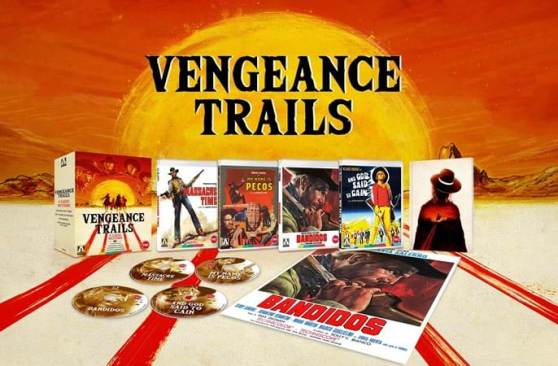
Arrow Video’s Vengeance Trails box set has 2K restorations of this movie, as well as My Name is Pecos, Massacre Time and Bandidos, as well as a collector’s booklet featuring new writing by author and critic Howard Hughes plus a double-sided poster featuring newly commissioned artwork by Gilles Vranckx. And God Said to Cain has new commentary by author and critic Howard Hughes, a new documentary featuring a new interview with Fabio Melelli and a new audio interview with actress Marcella Michelangeli, plus a new interview with actor Antonio Cantafora. You can order this from MVD.
It’s also available on the ARROW player. Head over to ARROW to start your 30 day free trial (subscriptions are available for $4.99 monthly or $49.99 yearly). ARROW is available in the US, Canada and the UK on the following Apps/devices: Roku (all Roku sticks, boxes, devices, etc), Apple TV & iOS devices, Android TV and mobile devices , Fire TV (all Amazon Fire TV Sticks, boxes, etc), and on all web browsers at https://www.arrow-player.com.
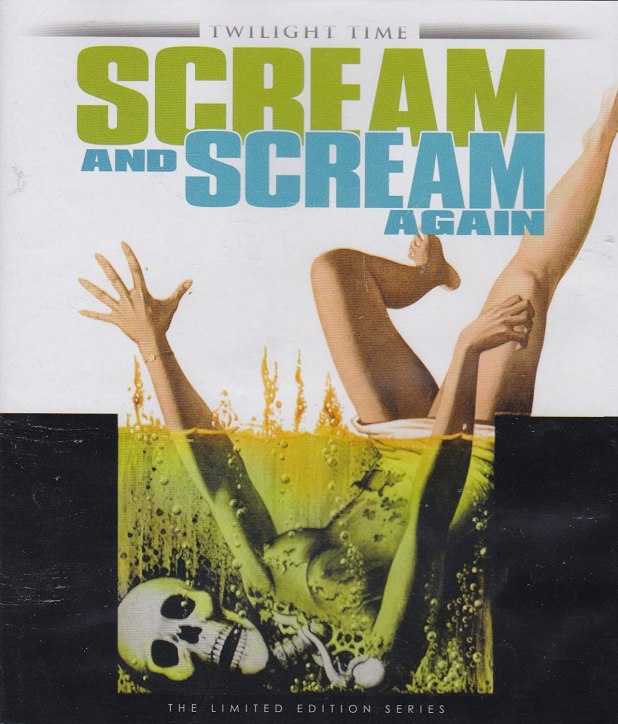
Based on the novel The Disorientated Man by Peter Saxon*, this Amicus film boasts the best line-up potentially ever in a horror film. It features the iconic Christopher Lee, the legendary Peter Cushing, and the master of macabre Vincent Price, all delivering stellar performances.
The film opens with a man jogging, collapsing, and waking up in a hospital, missing his leg. He screams, and then the same scream repeats as he loses every appendage. Meanwhile, an Eastern European spy named Konratz (played by Marshall Jones, Cry of the Banshee) is on a killing spree, targeting his superiors, including Cushing. In another subplot, someone is killing young women in London, and it appears that Keith (Michael Gothard) is the murderer, a blood-drinking super-strong weirdo.
Price shows up as the sinister Dr. Browning, and it all ends up being a conspiracy movie that owes a fair deal to Invasion of the Body Snatchers. However, that movie didn’t end with much of its cast falling into acid.
According to Lee, the villains of this movie were going to be revealed as aliens, but that was cut out for some reason, leaving a lot of the movie unexplained.
William Wyler is the most nominated director in Academy Awards history, as well as the only director in Academy history to direct three Best Picture-winning films (for which he also won Best Director*), for directing thirty-six Oscar-nomimated performers and for being the director of more Best Picture nominees than anyone else.
For his final movie, he decided on a script by Jesse Hill Ford and Stirling Silliphant that was in turn based on Ford’s 1965 novel The Liberation of Lord Byron Jones. While a work of fiction, it was based on an actual event that had happened in Humboldt, Tennessee, where Ford lived. This movie did him no favors in that town**. Silliphant’s life may not have been so turbulent, but he did write The SIlent Flute with Bruce Lee, as well as the film he won an Oscar for writing, In the Heat of the Night.
The titular L.B. Jones (Roscoe Lee Browne) is a wealthy funeral director in Tennessee looking for a lawyer to represent him in his divorce from his much younger wife Emma (Lola Falana), who is having an affair with police officer Willie Joe Worth (Anthony Zerbe) which has left her with child.
The problem is that Jones is black and Worth is white.
Worth begs Emma not to contest the divorce, but she wants to keep living the moneyed life she has become accustomed to. Worth ends up beating her and then works with his partner Stanley Bumpas (Arch Johnson) to arrest Jones after he refuses to drop his case. Yet the man becomes shocked at what he’s done and at how cold Bumpas is as he goes about making the crime look like black-on-black crime.
Worth is willing to goto jail, but the crime is covered up by attorney Oman Hedgepath (Lee J. Cobb), but justice somewhat wins out, as Sonny Boy Mosby (Yaphet Kottot) gets revenge for a beating he endured by killing Bumpas. Hedgepath loses the love of his family, with his nephew Steve (Lee Majors) leaving the firm and taking his wife Nella (Barbara Hershey in one of first roles) away from all of this madness.
There is a major moment in film history here. This film marks the first time that a black man killed a white man on screen in an American movie.It was also the debut of both Falana and Brenda Sykes. And it has blood the color of an Italian horror movie.
*Mrs. Miniver, The Best Years of Our Lives and Ben-Hur.
**Ford dealth with numerous threats, mainly from white residents of Humboldt, when it came to this story and the ensuring movie, as well as his second book,The Feast of St. Barnabas. When black players were barred from the high school football team post-integraton, Ford’s son, the team captain, began to receive death threats of his own. This may be the reason why Ford shot a 19-year-old black soldier, Pvt. George Henry Doaks Jr., when he saw the man’s car in his private driveway and believed he was someone out to hurt his son. In a strange moment of fate, Doaks’ female companion was related to the woman who had served as the basis for this story. He was initially indicted on a charge of first degree murder but, in what could be cruel irony, he benefitted from the same Southern justice he had written against. All along, he claimed that he had fired his rifle and not aimed, hoping to scare off the car. The incident pretty much ruined his life and he never finished another novel. His life took him on a journey from liberal to far right conservative, writing for the USA Today, in which he defended Oliver North and complained about the ACLU. After a book of his letters was published and he went through open heart surgery, he grew depresse and shot himself in 1996.
Lionel E. Seigel (who wrote many-a-episodes of The Six Million Dollar Man and The Bionic Woman) provided Lee with his third TV movie leading-man role (after 1970’s The Liberation of L.B Jones). Produced by Paramount Pictures for ABC-TV, this is Lee in one of his rare appearances as a heavy, despicable character (that, in my mind as I review his work this week, it seems he didn’t repeat until 1990’s The Cover Girl Murders for the USA Network). Behind the lens is Jud Taylor, which perks up a Trekkies ears (sorry), for his direction of several episodes of Star Trek: TOS; he also gave us many-a-great TV movie, The Disappearance of Flight 412, in particular.
Robert Conrad (he of our Mill Creek fave, Assassin) and Lee Majors star as Eddie and Larry (Eddie’s the nutjob; Larry’s the misguided ne’er do well) who botch a kidnapping by accidentally killing their victim. So, as a consolation, they kidnap three nuns (Jane Wyatt, Carol Lynley, and Lois Nettleton) stranded on a California desert highway. Lee gets second thoughts when he makes an emotional connection with the Nuns and decides to help them escape the crazed clutches of Eddie.
Yes, that’s the same Carol Lynley from the disaster box office bonanza that was The Poseidon Adventure (and The Shape of Things to Come) and Jane Wyatt was, in fact, Spock’s mom. Also look out for an early role from Gregory Sierra (TV’s Sanford and Son and Barney Miller, but always loved around here as Verger from Beneath the Planet of the Apes!) as the cop on the case.
You can watch the full movie on You Tube. It made it to DVD and overseas TV via a deal between CBS-TV and Paramount Studio in the early 2000s.
About the Author: You can learn more about the writings of R.D Francis on Facebook.He also writes for B&S About Movies.
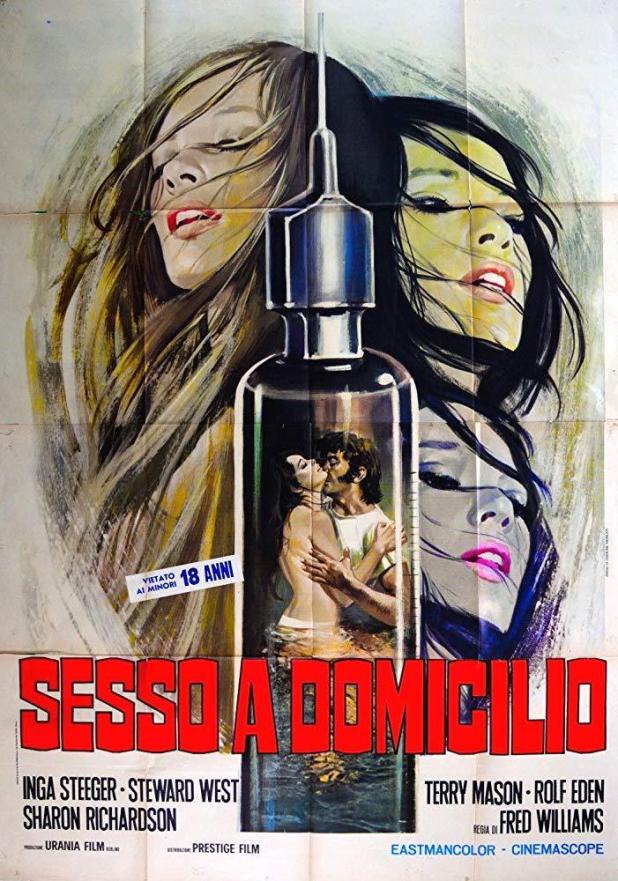
Erwin C. Dietrich has some amazingly titled movies on his IMDB director list, including She Devils of the SS, Stewardesses Report, Caged Women and the absolute ripoff title The Devil in Miss Jonas. He’s one of three directors for this movie, who also include Peter Baumgartner (he shot most of Dietrich’s films and also was the cinematographer on Code Name: Wild Geese) and Jack Hill*. That’s right — the Jack Hill, director of Spider Baby and Switchblade Sisters.
Vicki (Ingrid Steeger, who would go on to be in all manner of European exploitation movies) hooks up with the rock star of her dreams, who leaves her after a night of aardvarking and rug use. She decides to grab her girlfriend and look for him across Europe, dealing with devil worshippers and bikers** along the way.
This starts off as a really lighthearted romp and gets dark, real dark, sixties dark by the end of it all. Man, I thought this was going to be a bit of the slap and a tickle and it ended up smacking me right across the face.
*Roger Corman was originally going to produce this and have Hill direct, but he pulled out and Hill’s involvement was limited. However, this was still sold in Europe as a Roger Corman film and there had to be legal proceedings to change that.
*Dietrich messed up when dealing with the Hells Angels. One of their girls was nude in this and she wasn’t happy with how she looked. They told the director to cut her scene out, he refused and ended up having to pay them off to stop threatening theaters that showed this.
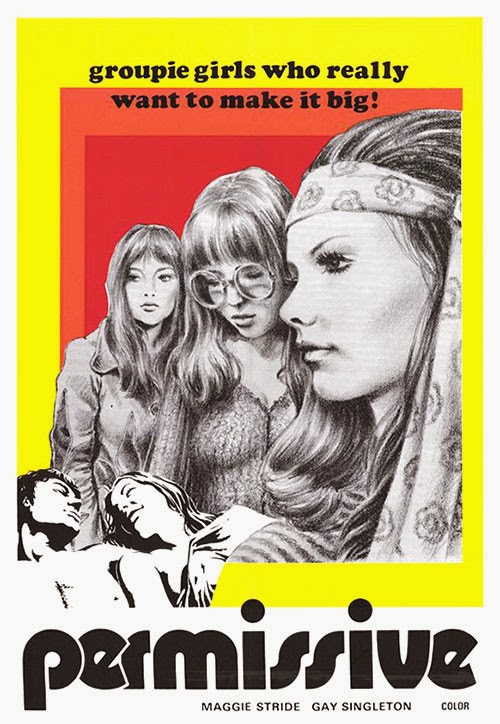
Lindsay Shonteff may be better known for his James Bond homages than the rest of the films he’s made, but this 1970 groupie saga shouldn’t be passed by. Made in the year after his kinda sorta British giallo Night After Night After Night, this film tells the story of Suzy and Fiona, groupies for the band Forever More*.
With a director like Shonteff at the helm and a title like Permissive, you’d expect this to be a fun sex comedy about just how awesome it is to sleep wth bands. But no, it’s nothing of the sort, just a long dark crawl through boredom and addiction to anything, like moving up the ladder of sleeping with a band.
If anything, I learned in this movie that being a groupie pretty much means driving your best friend to suicide.
As for the director, he pretty much remade this movie as his next film, The Yes Girls, without the music angle.
*Forever More was a real band. Their members appear in the film in other roles and not as themselves, which is strange enough. One of their members, Alan Gorrie, was also in Average White Band. You can also hear other bands of this era like Titus Groan and Comus.
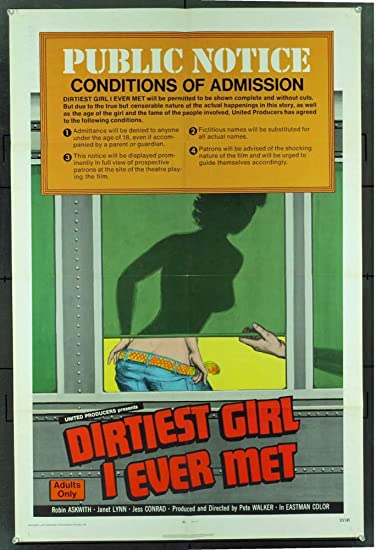
According to the opening credits, “this story is true but actual names and places are fictitious.” That’s because Pete Walker read a story in the tabloid News of the World and got inspired. And unlike movies of this era like Permissive and More, the degenerate lifestyle he envisioned wasn’t tragic.
Joe (Robin Askwith, the Confessions of… series) and Carol (Janet Lynn*, Twins of Evil) have left behind their small town for swinging London, where Joe fails to even find the simplest of jobs and she quickly becomes a model.
Before you can open the newspaper to Page 3, Carol’s involved in the scummier side of entertainment — the photoshoot for a dirty magazine was shot in Mayfair photographer Philip O. Stearn’s studio and the stills were in the July 1970 issue — with dirty old men all wanting a piece of our heroine.
There’s some great casting here, with Stubby Kaye (the owner of Acme in Who Framed Roger Rabbit?), Harry Baird (The Four of the Apocalypse), Chris Sandford (who was also in Walker’s Die Screaming, Marianne), radio DJ Pete Murray, Carry On star Eric Barker, Pearl Hackney (who was in four Walker films, including Four Dimensions of Greta, Tiffany Jones and Schizo) and Martin Wyldeck (Walker really liked using the same actors, as he also was in several of his movies).
This never gets as dirty as the American title — The Dirtiest Girl I Ever Met — promises. It exists in a different time of sexuality, where Robin Askwith’s butt and innuendo is enough. But man, all those scenes of old men licking their lips in slow motion makes me realize that Walker really was made to be a horror director.
*Susan George was originally considered for this movie.
EDITOR’S NOTE: We watched this Barry Mahon movie on December 2, 2020 and this week of the auteur’s films — is he one? — gives us an excuse to bring it back.
Barry Mahon was shot down over Germany and escaped — and was recaptured — at Stalag Luft III before being freed by Patton’s 3rd Army. Once he got back to the U.S., he became the personal pilot and later the manager for Errol Flynn. Then, he learned how to use computers to predict the future box office for films, which does not explain how he made movies like Cuban Rebel Girls, Fanny Hill Meets Dr. Erotico, The Wonderful Land of Oz and Santa’s Christmas Elf (Named Calvin).
Have you ever gone to an amusement park and they put on plays for the kids that are too worn out or too young for the rides? Yeah, this is like watching one of those for over an hour, with special effects that live up to neither of those two words. This is what I do with my free time. I sit and watch these movies and laugh like a maniac, then tell an uncaring and oh so cold world why they should be as passionate about total junk as I am.
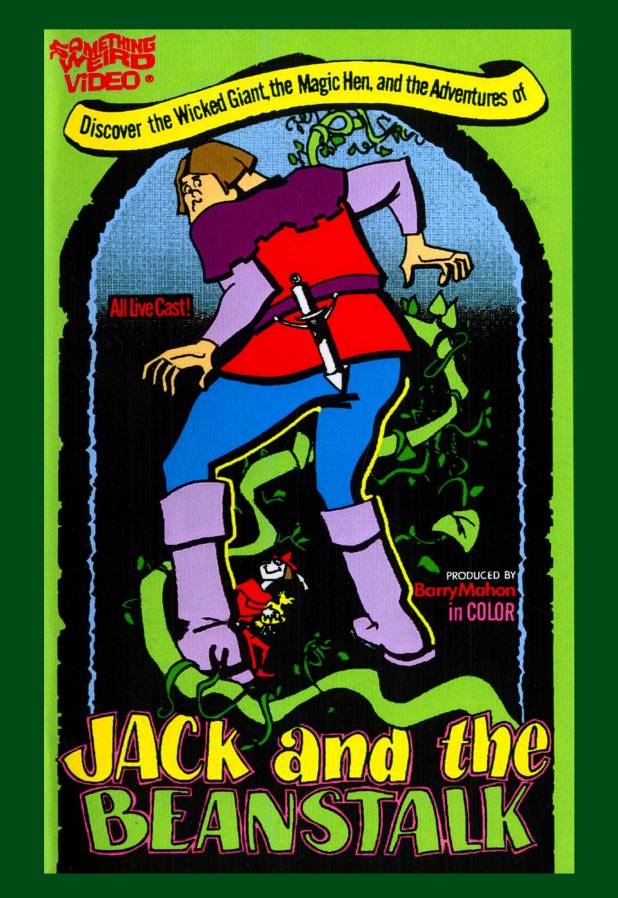
Depending on how lucky — or unlucky — you were, you would have seen either Thumbelina or this movie within perhaps the most maniacal film ever made, 1972’s Santa Claus and the Ice Cream Bunny. Why? What does Jack or Thumbelina have to do with the holidays? More to the point, what does a bunny? Perhaps even more pressing is this question: What is an ice cream bunny?
This was a movie for kids, which leads to so many more questions. Why does it have hip 1970’s slang? Why is it set in the present instead of the past, like every other version of this story? Why is Jack’s family more like Cinderella’s? Why does the giant sing the same song at least three — or a billion, it seems — times?
They used to let kids go to all day matinees of movies exactly like this, which some parents must have thought was some kind of reward. Imagine working hard all week at school and being gifted the magical wonder of this movie, which probably made no sense fifty years ago and even less today.
That said, I’ve thought about this movie way more than I will any film that will be released in 2020. Barry Mahon is kind of that way, equally fraught with wonder and madness, pain and pleasure. I’m brave enough to attempt to watch everything he ever made, so if you’re stupid as well, I hope you’ll join me.
EDITOR’S NOTE: Obviously, our love for Barry Mahon did not start this week. Here’s one of his non-nude films that we covered back on July 19, 2020.
Barry Mahon is magic. And madness, too.
After volunteering for the Canadian Royal Air Force before America entered World War II, then getting shot down, imprisoned and escaping Stalag Luft III before getting captured again, then being saved by Patton’s 3rd Army and then becoming Errol Flynn’s personal pilot and manager, Mahon’s life was already crazy. Then he started making movies like Rocket Attack U.S.A., Cuban Rebel Girls and Fanny Hill Meets Dr. Erotico.
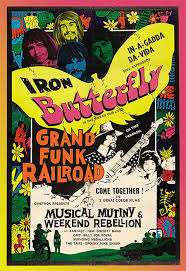
That’s all before Barry set up shop at Dania, Florida’s Pirates World theme park and started throwing concerts when he wasn’t making some of the most ludicrous movies — and I mean that as a compliment — ever made, like The Wonderful Land of Oz and perhaps his finest world, Santa and the Ice Cream Bunny.
I’ve been hunting for this movie, where a pirate’s ghost convinces the staff of the park to put on a free concert, for literally years and years. I found it. And it pleases me to no end. In fact, it is my happening and it freaks me out.
Local bands Grit, New Society and the Fantasy are happy to play for free, but Iron Butterfly is mad that this is a free show and because they aren’t getting paid, they storm off. Luckily, a rich hippy pays them to play “In-a-Gadda-Da-Vida.” I have no idea what we’re supposed to learn from this.
Facts: There are more dune buggies in this than a Filipino post-apocalyptic film. There’s a garbage truck that says, “You are what you eat.” “In-A-Gadda-Da-Vida” is sixteen minutes long and was probably better with a fistful of narcotics. The pirate also disappears when this show is over.
I have no idea why this was made or who it was made for. I can only dream that I could have gone to Pirates World because everyone — Bowie, Sabbath, Alice Cooper, The Doors, Led Zep and Frank Zappa to name a few — played there. I hate theme parks but I love this place. Other than dying at Action Park in a blaze of blood, guts and thunder, it’s the only place of its ilk that I will ever be able to stomach.



 B&S About Movies
You must be logged in to post a comment.