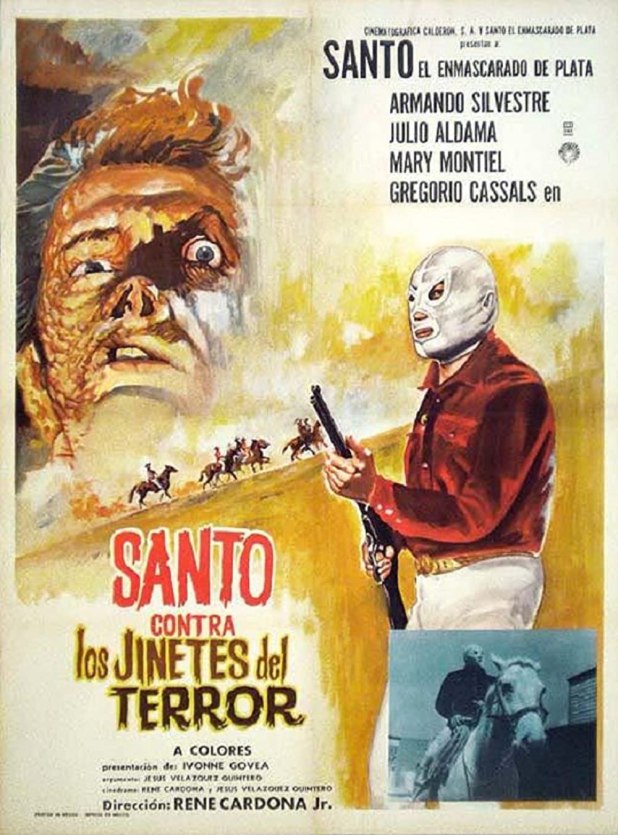
Santo vs. the Riders of Terror is a straight-up western except, you know, Santo is in it. It concerns a gang of lepers that has escaped an insane asylum and start to rob farms and attack people. Now, they’ve joined a gang of outlaws and that’s when the lawman Darío calls on the man in the silver mask. The strange thing is that the lepers are portrayed as sympathetic and simply on the wrong side of luck.
Santo eventually kills the gang, rescues the town and informs the lepers that a new drug will change their lives. Seems like a pretty neat wrap-up, all things considered and would be strange for any other film, but at this point, we’ve already seen Santo battle vampires, go back in time and battle Satan himself.
This was written by Murciélago Velázquez, who started as a wrestler and actor before writing films himself. Perhaps his best is El Mundo de los Vampiros. If he and René Cardona were still alive today, I’d ask how Santo went back in time to be in a cowboy movie and why they decided to go all Peckinpah with the squibs.
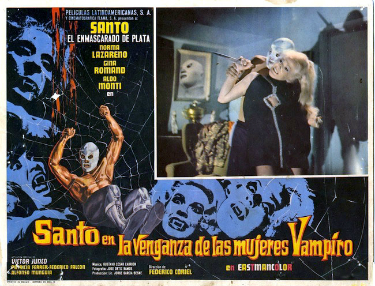
After we watch the vampire Mayra get staked while in her coffin, the action movies to present Day Mexico and Dr. Brancov and his men take her coffin and bring it back to his lab. There, they use human blood to bring the queen of the vampires back to infernal life. You know whose blood they’re going to use? Go-go dancers.
This movie is already better than anything that will be release in our lifetimes.
One of Santo’s ancestors is the one who stopped Mayra last time, so she’s out to kill our hero before he can kill her, including slipping his opponent brass knuckles, trying to cloud his mind while he wrestles and even stabbing him while he sleeps.
This is the kind of movie that can have a disco be a hunting group for vampires, a Satanic sacrifice and a monster in the depths of a mad scientists lab one scene after the other. Trust me, lucha movies will ruin your ability to enjoy any other film drama, much less Merchant Ivory films.
Also: not even the first* or second ** or third time*** that Santo fought vampires!
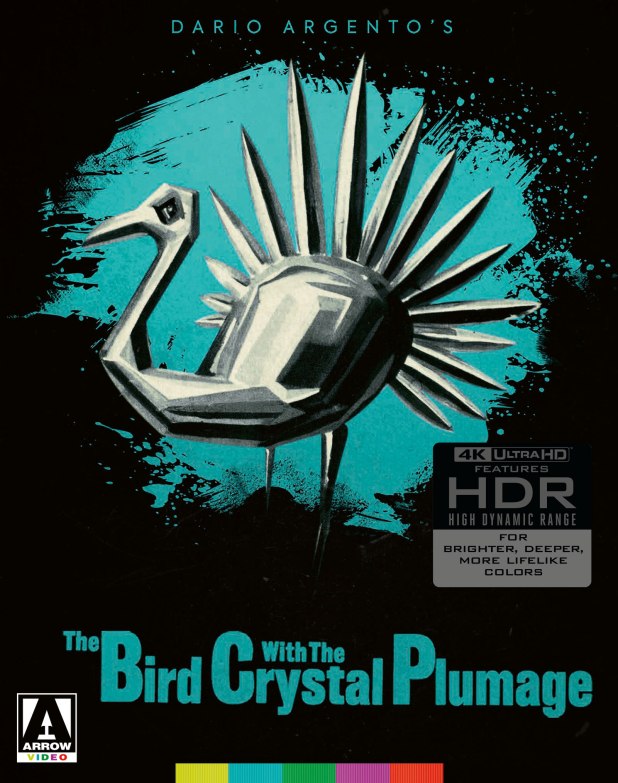
EDITOR’S NOTE: We originally covered this giallo masterwork back on March 26, 2019. Now that Arrow Video has released a UHD edition of this film, it’s time we look back on it and talk about this expanded version.
Other than the films of Mario Bava (Blood and Black Lace, The Girl Who Knew Too Much), there’s no other film that has no influenced the giallo. In fact, the most well-known version of the form starts right here with Dario Argento’s 1970 directorial debut. Until this movie, he’d been a journalist and had helped write Leone’s Once Upon a Time in the West.
Sam Dalmas (Tony Musante) is an American writer suffering from an inability to write. He’s gone to Rome to recover, along with his British model girlfriend (yes, everyone in giallo can score a gorgeous girl like Suzy Kendall). Just as he decides to return home, he witnesses a black-gloved man attacking a girl inside an art gallery. Desperate to save her, he can only watch, helpless and trapped between two mechanical doors as she wordlessly begs for help.
The woman is Monica Ranier and she’s gallery owner’s wife. She survives the attack, but the police think Sam may have had something to do with the crime, so they keep his passport so he can’t leave the country. What they’re not letting on is that a serial killer has been wiping out young women for weeks and that Sam is the only witness. That said — he’s haunted by what he’s survived and his memory isn’t working well, meaning that he’s missing a vital clue that could solve the crime.
As you can see, the foreign stranger who must become a detective, the missing pieces of memory, the black-clad killer — it’s everything that every post-1970 giallo would pay tribute to (perhaps rip off is the better term).
Another Argento trope shows up here for the first time. It’s the idea that art itself can cause violence. In this film, it’s a painting that shows a raincoat-clad man murdering a woman.
Soon, Sam is getting menacing calls from the killer and Julia is attacked by the black-clad maniac. The police isolate a sound in the background of the killer’s conversations, the call of a rare Siberian “bird with the crystal plumage.” There’s only one in Rome, which gets the police closer to the identity of who is wearing those black gloves (in truth, it’s Argento’s hands). It’s worth noting that the species of bird the film refers to as “Hornitus Nevalis” doesn’t really exist. The bird in the film is actually a Grey Crowned Crane.
Alberto, Monica’s art gallery husband, tries to kill her, finally revealing that he has been behind the attacks. Ah — but this is a giallo. Mistaken identity is the main trick of its trade. And even though this film was made nearly fifty years ago, I’d rather you get the opportunity to learn for yourself who the killer really is.
I may have mentioned before that my parents saw this movie before I was born and hated it to a degree that any time a movie didn’t make any sense, they would always bring up “that weird movie with the bird that makes the noises.” Who knew I would grow up to love Argento so much? It’s one of those cruel ironies that would show up in his movies. I really wonder if my obsession with giallo and movies that are difficult to understand is really me just rebelling.
An uncredited adaptation of Fredric Brown’s novel The Screaming Mimi, this film was thought of as career suicide by actress Eva Renzi. And the producer of the film wanted to remove Argento as the director. However, when Argento’s father Salvatore Argento went to speak to the man, he noticed that the executive’s secretary was all shaken up. He asked her what was wrong and she mentioned that she was still terrified from watching the film. Salvatore asked her to tell her boss why she was so upset and that’s what convinced the man to keep Dario on board.
The results of all this toil and worry? A movie that played for three and a half years in one Milan theater and led to copycats (and lizards and spiders and flies and ducklings and butterflies and so on) for decades. Argento would go on to film the rest of his so-called Animal Trilogy with The Cat O’Nine Tails and Four Flies on Grey Velvet, then Deep Red before moving into more supernatural films like Suspiria and Inferno.
The first global UHD release of this film from Arrow Video is packed with everything you expect from this prestige label. First up is the 4K restoration from the original negative by Arrow Films that come on a 4K (2160p) UHD Blu-ray presentation in Dolby Vision. It features audio commentary by Troy Howarth, author of So Deadly, So Perverse: 50 Years of Italian Giallo Films and also has an interview with author and critic Kat Ellinger exploring the film’s themes, a visual essay on the cinema of Dario Argento by Alexanda Heller-Nicholas and interviews with Argento and actors Gildo Di Marco and Eva Renzi. Plus, you get the original Italian and international theatrical trailers, the 2017 Texas Frightmare trailer, an illustrated collector’s booklet featuring writing on the film by Howard Hughes and Jack Seabrook and a new essay by Rachael Nisbet, a fold-out double-sided poster featuring original and newly commissioned artwork by Obviously Creative, six double-sided, postcard-sized lobby card reproduction artcards and limited edition packaging with a reversible sleeve featuring originally and newly commissioned artwork by Obviously Creative. Whew! You can get it from MVD.
It’s also available on the ARROW player. Head over to ARROW to start your 30 day free trial (subscriptions are available for $4.99 monthly or $49.99 yearly). ARROW is available in the US, Canada and the UK on the following Apps/devices: Roku (all Roku sticks, boxes, devices, etc), Apple TV & iOS devices, Android TV and mobile devices , Fire TV (all Amazon Fire TV Sticks, boxes, etc), and on all web browsers at https://www.arrow-player.com.
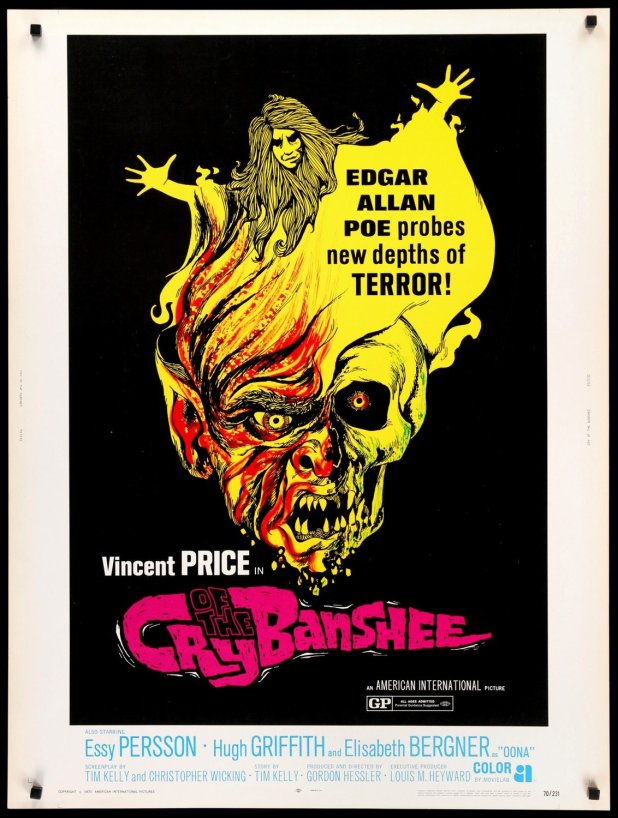
That poem is Edgar Allan Poe’s “The Bells,” which sets the tone for this unique movie, the last of the American-International Pictures Poe movies. Directed by Gordon Hessler, this film, unlike its predecessors, had nothing to do with the Baltimorean author, offering a fresh take on the horror genre.
According to Peter Fuller on Spooky Isles, AIP promoted this movie as the hundredth film that its star, Vincent Price, was in. The truth is that it was probably his seventy-sixth. Undaunted, AIP did the same publicity for his next movie, The Abominable Dr. Phibes.
This movie is a visual treat — it was shot in the Grim’s Dyke House, the same location as Curse of the Crimson Altar and The Devil Rides Out. The film opens with an incredibly excellent animation by Terry Gilliam, a visual masterpiece that, unfortunately, was cut from the American print, leaving the audience captivated from the start.
If you enjoyed Vincent Price’s portrayal as a witch hunter in Witchfinder General, you’re in for a treat! In this film, he plays the role of Lord Edward Whitman, a character who has taken it upon himself to rid England of every witch. His relentless pursuit leads to the disruption of Black Masses and the death of many witches, until one of them, Oona, possesses his loyal servant Roderick, complicating his mission.
The movie also inspired a band to name themselves Siouxie and the Banshees. Perhaps you’ve heard of them?
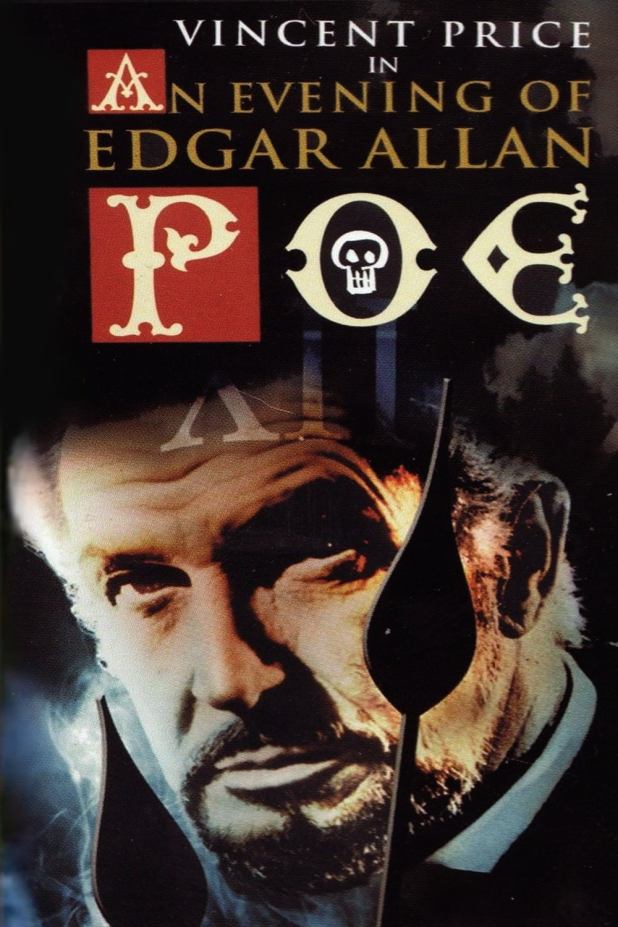
I love Vincent Price and stand against anyone who dislikes how hammy he was. But hey, if you feel that way, perhaps you should avoid An Evening of Edgar Allan Poe, which features Price all alone on the stage — with props and outfits that change with every story — matched with only music by Les Baxter, recorded at the same time and with the same orchestra as Cry of the Banshee.
Produced by Samuel Z. Arkoff and Kenneth Johnson (who wrote, produced and directed this; you may know him from creating The Incredible Hulk TV series, as well as The Bionic Woman and V), this is an opportunity to see Price go wild telling the stories “The Tell-Tale Heart,” “The Sphinx,” “The Cask of Amontillado” and “The Pit and the Pendulum.”
The really cool thing about this is that it seems like every single story was shot in one take, which speaks to Price’s ability as an actor as well as his endurance, as he really goes full Vincent Price on every one of these stories.
EDITOR’S NOTE: We originally reviewed this on August 19, 2020. Seeing as how Arrow Video has included it as part of their Vengeance Trails box set, we’ve updated our review and provided some information about this set. Phil Bailey also reviewed this for on site on August 20, 2020.
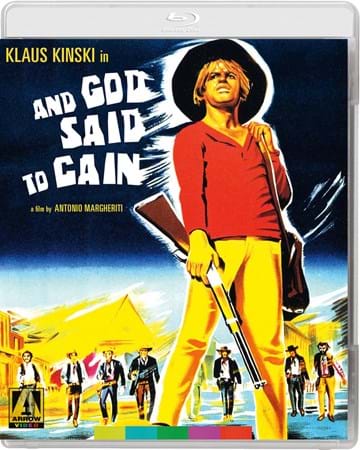
Gary Hamilton (Klaus Kinski!) is released from ten years of hard labor with a pardon for a crime he didn’t commit, so he does what any insane character played by Kinski would do. He sets out to kill everyone who ever did him wrong.
Kinski wants Acombar, his former friend who set him up, dead. He has to go through the man’s son (Antonio Cantafora, Baron Blood) to do it, as well as Acombar’s wife Maria, who was once his lover. He’s helped by the people of the town who hate his enemy, as well as his knowledge of the Native American burial grounds.
This is less Western than horror film, with Kinski’s character nearly a ghost, continually followed by gusts of winds and tolling bells as he returns to get his bloody vengeance.
Upon seeing this again on the new Arrow blu ray release, it feels like a totally new film. I’d always loved this one — I’ve watched it at least three times in the last year — but this as a revelation. The scene where Kinski explains his hatred to the priest is transcendent: “Day after day, they convinced me that my place was inside. Life outside has no more meaning for me. Now it’s only revenge.”
There’s also the moment when the storm opens up on the town as Kinski opens fire on everyone. Every other man is hesitant, worried as to what happens next. Their enemy has become death itself.
While there are similarities to another Margheriti film Vengeance, this is very nearly a remake of Salvatore Rosso’s A Stranger in Paso Bravo, which was made just a year before. This one, however, is unafraid to let the gruesome side of violence be seen. The original story for both was written by Eduardo Manzanos Brochero, but the screenwriter for this was Giovanni Addessi, who also produced the movie.
There aren’t many horror Italian westerns, but if there were hundreds, this would still be the best (and you can also put Django the Bastard up there, too). Also — the theme song to this movie — “Rocks, Blood and Sand” by Don Powell — is beyond fabulous.
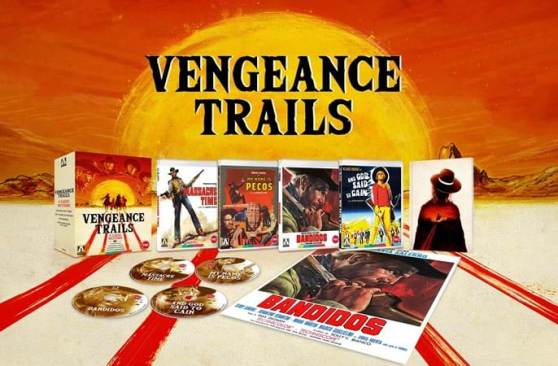
Arrow Video’s Vengeance Trails box set has 2K restorations of this movie, as well as My Name is Pecos, Massacre Time and Bandidos, as well as a collector’s booklet featuring new writing by author and critic Howard Hughes plus a double-sided poster featuring newly commissioned artwork by Gilles Vranckx. And God Said to Cain has new commentary by author and critic Howard Hughes, a new documentary featuring a new interview with Fabio Melelli and a new audio interview with actress Marcella Michelangeli, plus a new interview with actor Antonio Cantafora. You can order this from MVD.
It’s also available on the ARROW player. Head over to ARROW to start your 30 day free trial (subscriptions are available for $4.99 monthly or $49.99 yearly). ARROW is available in the US, Canada and the UK on the following Apps/devices: Roku (all Roku sticks, boxes, devices, etc), Apple TV & iOS devices, Android TV and mobile devices , Fire TV (all Amazon Fire TV Sticks, boxes, etc), and on all web browsers at https://www.arrow-player.com.
Based on the novel The Disorientated Man by Peter Saxon*, this Amicus film boasts the best line-up potentially ever in a horror film. It features the iconic Christopher Lee, the legendary Peter Cushing, and the master of macabre Vincent Price, all delivering stellar performances.
The film opens with a man jogging, collapsing, and waking up in a hospital, missing his leg. He screams, and then the same scream repeats as he loses every appendage. Meanwhile, an Eastern European spy named Konratz (played by Marshall Jones, Cry of the Banshee) is on a killing spree, targeting his superiors, including Cushing. In another subplot, someone is killing young women in London, and it appears that Keith (Michael Gothard) is the murderer, a blood-drinking super-strong weirdo.
Price shows up as the sinister Dr. Browning, and it all ends up being a conspiracy movie that owes a fair deal to Invasion of the Body Snatchers. However, that movie didn’t end with much of its cast falling into acid.
According to Lee, the villains of this movie were going to be revealed as aliens, but that was cut out for some reason, leaving a lot of the movie unexplained.
William Wyler is the most nominated director in Academy Awards history, as well as the only director in Academy history to direct three Best Picture-winning films (for which he also won Best Director*), for directing thirty-six Oscar-nomimated performers and for being the director of more Best Picture nominees than anyone else.
For his final movie, he decided on a script by Jesse Hill Ford and Stirling Silliphant that was in turn based on Ford’s 1965 novel The Liberation of Lord Byron Jones. While a work of fiction, it was based on an actual event that had happened in Humboldt, Tennessee, where Ford lived. This movie did him no favors in that town**. Silliphant’s life may not have been so turbulent, but he did write The SIlent Flute with Bruce Lee, as well as the film he won an Oscar for writing, In the Heat of the Night.
The titular L.B. Jones (Roscoe Lee Browne) is a wealthy funeral director in Tennessee looking for a lawyer to represent him in his divorce from his much younger wife Emma (Lola Falana), who is having an affair with police officer Willie Joe Worth (Anthony Zerbe) which has left her with child.
The problem is that Jones is black and Worth is white.
Worth begs Emma not to contest the divorce, but she wants to keep living the moneyed life she has become accustomed to. Worth ends up beating her and then works with his partner Stanley Bumpas (Arch Johnson) to arrest Jones after he refuses to drop his case. Yet the man becomes shocked at what he’s done and at how cold Bumpas is as he goes about making the crime look like black-on-black crime.
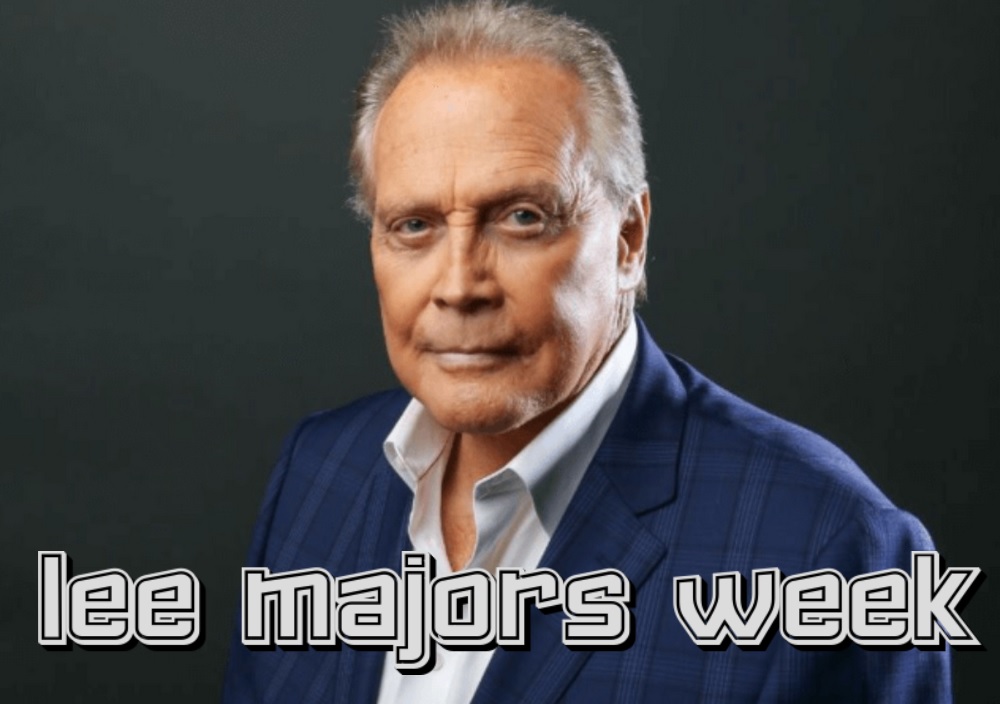
Worth is willing to goto jail, but the crime is covered up by attorney Oman Hedgepath (Lee J. Cobb), but justice somewhat wins out, as Sonny Boy Mosby (Yaphet Kottot) gets revenge for a beating he endured by killing Bumpas. Hedgepath loses the love of his family, with his nephew Steve (Lee Majors) leaving the firm and taking his wife Nella (Barbara Hershey in one of first roles) away from all of this madness.
There is a major moment in film history here. This film marks the first time that a black man killed a white man on screen in an American movie.It was also the debut of both Falana and Brenda Sykes. And it has blood the color of an Italian horror movie.
*Mrs. Miniver, The Best Years of Our Lives and Ben-Hur.
**Ford dealth with numerous threats, mainly from white residents of Humboldt, when it came to this story and the ensuring movie, as well as his second book,The Feast of St. Barnabas. When black players were barred from the high school football team post-integraton, Ford’s son, the team captain, began to receive death threats of his own. This may be the reason why Ford shot a 19-year-old black soldier, Pvt. George Henry Doaks Jr., when he saw the man’s car in his private driveway and believed he was someone out to hurt his son. In a strange moment of fate, Doaks’ female companion was related to the woman who had served as the basis for this story. He was initially indicted on a charge of first degree murder but, in what could be cruel irony, he benefitted from the same Southern justice he had written against. All along, he claimed that he had fired his rifle and not aimed, hoping to scare off the car. The incident pretty much ruined his life and he never finished another novel. His life took him on a journey from liberal to far right conservative, writing for the USA Today, in which he defended Oliver North and complained about the ACLU. After a book of his letters was published and he went through open heart surgery, he grew depresse and shot himself in 1996.
Lionel E. Seigel (who wrote many-a-episodes of The Six Million Dollar Man and The Bionic Woman) provided Lee with his third TV movie leading-man role (after 1970’s The Liberation of L.B Jones). Produced by Paramount Pictures for ABC-TV, this is Lee in one of his rare appearances as a heavy, despicable character (that, in my mind as I review his work this week, it seems he didn’t repeat until 1990’s The Cover Girl Murders for the USA Network). Behind the lens is Jud Taylor, which perks up a Trekkies ears (sorry), for his direction of several episodes of Star Trek: TOS; he also gave us many-a-great TV movie, The Disappearance of Flight 412, in particular.
Robert Conrad (he of our Mill Creek fave, Assassin) and Lee Majors star as Eddie and Larry (Eddie’s the nutjob; Larry’s the misguided ne’er do well) who botch a kidnapping by accidentally killing their victim. So, as a consolation, they kidnap three nuns (Jane Wyatt, Carol Lynley, and Lois Nettleton) stranded on a California desert highway. Lee gets second thoughts when he makes an emotional connection with the Nuns and decides to help them escape the crazed clutches of Eddie.
Yes, that’s the same Carol Lynley from the disaster box office bonanza that was The Poseidon Adventure (and The Shape of Things to Come) and Jane Wyatt was, in fact, Spock’s mom. Also look out for an early role from Gregory Sierra (TV’s Sanford and Son and Barney Miller, but always loved around here as Verger from Beneath the Planet of the Apes!) as the cop on the case.
You can watch the full movie on You Tube. It made it to DVD and overseas TV via a deal between CBS-TV and Paramount Studio in the early 2000s.
About the Author: You can learn more about the writings of R.D Francis on Facebook.He also writes for B&S About Movies.
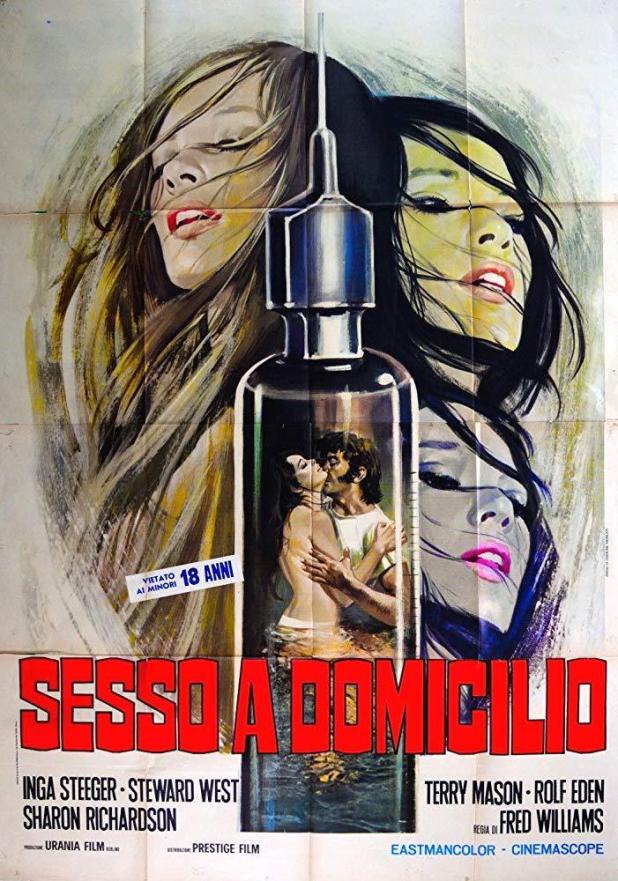
Erwin C. Dietrich has some amazingly titled movies on his IMDB director list, including She Devils of the SS, Stewardesses Report, Caged Women and the absolute ripoff title The Devil in Miss Jonas. He’s one of three directors for this movie, who also include Peter Baumgartner (he shot most of Dietrich’s films and also was the cinematographer on Code Name: Wild Geese) and Jack Hill*. That’s right — the Jack Hill, director of Spider Baby and Switchblade Sisters.
Vicki (Ingrid Steeger, who would go on to be in all manner of European exploitation movies) hooks up with the rock star of her dreams, who leaves her after a night of aardvarking and rug use. She decides to grab her girlfriend and look for him across Europe, dealing with devil worshippers and bikers** along the way.
This starts off as a really lighthearted romp and gets dark, real dark, sixties dark by the end of it all. Man, I thought this was going to be a bit of the slap and a tickle and it ended up smacking me right across the face.
*Roger Corman was originally going to produce this and have Hill direct, but he pulled out and Hill’s involvement was limited. However, this was still sold in Europe as a Roger Corman film and there had to be legal proceedings to change that.
*Dietrich messed up when dealing with the Hells Angels. One of their girls was nude in this and she wasn’t happy with how she looked. They told the director to cut her scene out, he refused and ended up having to pay them off to stop threatening theaters that showed this.



 B&S About Movies
You must be logged in to post a comment.