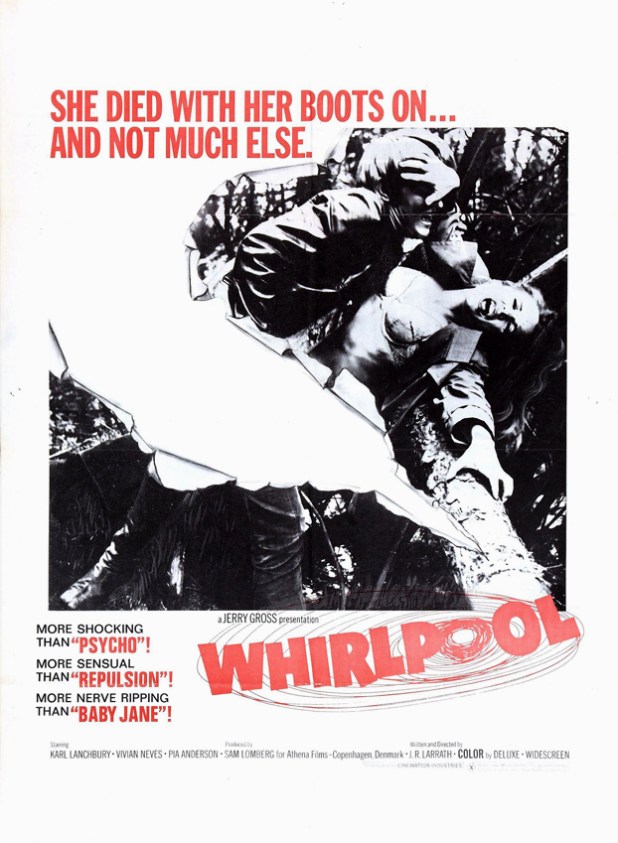
Whirlpool (1970)

She died with her boots on — and not much else.

Yes, José Ramón Larraz didn’t do anything subtle, huh?

Sarah (Pia Andersson) is a woman of a certain age living in the countryside of London with another shutterbug named Theo (Karl Lanchbury) in a relationship that has them refer to one another as aunt and nephew. Sara invites a model named Tulia (Vivian Neves) to stay with them and be photographed; the very first session goes poorly as Tulia sees a hooded figure spying on her. She shares that this same thing happened when her friend Rhonda (Johanna Hegger) stayed at the house and that something was wrong with the lake.

That night, everyone gets drunk, the ladies get naked and Theo and Tulia make love whole Sarah looks at photos of Rhonda when what she really wanted was a threesome. Things get stranger when Mr. Field comes looking for evidence of Rhonda and Theo sets him up to nearly assault Tulia while he films it.

Of course, all is soon forgiven and that menage a trois ends up happening. Moments later, Mr. Field is stabbed to death by Theo, who follows that up by confessing to Tulia that he’s a sadist as she stares at photos of Rhonda being abused by multiple men. She tries to run through the woods but he catches up to her and snuffs her out.

In case you wonder why Roger Ebert said that this movie had “particularly grisly sort of violence, photographed for its own sake and deliberately relishing in its ugliness. It made me awfully uneasy,” it would be because this movie is, well, shocking and brutal at almost every opportunity.

As you can imagine, this movie was cut to pieces when it first played in England. Also released as Perversion FlashFlash Light and She Died with Her Boots On, this feels like the first version of Larraz’s superior Symptoms. That said — it’s still pretty effective.
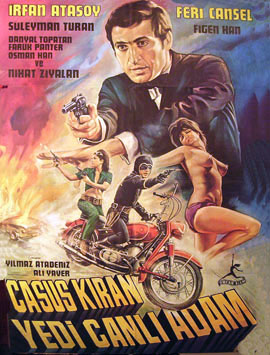
Casus Kıran: 7 Canlı Adam (1970)

Spy Smasher: The Man with Seven Lives is Turkish remix remake ripoff of Fawcett Comic superhero Spy Smasher, who was created by Captain Marvel’s creative team of Bill Parker and C. C. Beck in Whiz Comics #2. Alongside the Big Red Cheese, Spy Smasher’s battles with the Mask, the America-Smasher, the Angel and the Blitzys made Whiz Comics incredibly popular. They even had a cross-over in issues 16-18 where the Mask made Spy Smasher evil and the two heroes fought. After the war ended, he became Crime Smasher for one issue and disappeared until DC Comics purchased the remnants of Fawcett. He was part of the Squadron of Justice along with Bulletman, Bulletgirl, Ibis the Invincible, Mister Scarlet and Pinky the Whiz Kid.

The original character — there’s a female version in the DCU now — also appeared in a William Witney-directed serial, Spy Smasher, which was the inspiration for this film. And, if you can’t tell by the title and year it was released, this also has a fair amount of Eurospy influence — which shows up as this movie liberally borrows from the score for On Her Majesty’s Secret Service.

A sequel to 1968’s Casus Kiran (Spy Smasher), this adventure has foreign delegates coming to Turkey to set up a series of nuclear missile bases. However, someone is killing these important people one after another, so Murat from the Turkish Police seeks out the assistance of Casus Kıran, his just as deadly wife Feri (Feri Cansel) and the Sherlock Holmes cosplayer comic relief Bitik (Ahmet Danyal Topatan) to stop the killing and save Turkey.

The hero is played by Irfan Atasoy, who not only acted in this, but produced and distributed it. After watching so many Turkish remixes of superheroes, I get a bit confused, but the fact that the costume here looks less like Spy Smasher and more like the superhero in Demir Pençe (Korsan Adam) is not helping at all.

It’s amazing to me that while Spy Smasher went from one of the most popular comic book heroes ever to being one of the most obscure in a few decades — Fawcett chose to settle a decades-long lawsuit with DC and went out of business — there were still movies being made on the other side of the world about him.

You can watch this on YouTube.

Junesploitation 2022: La morte risale a ieri sera (1970)

June 23: Junesploitation’s topic of the day — as suggested by F This Movie— is gialo! We’re excited to tackle a different genre every day, so check back and see what’s next.

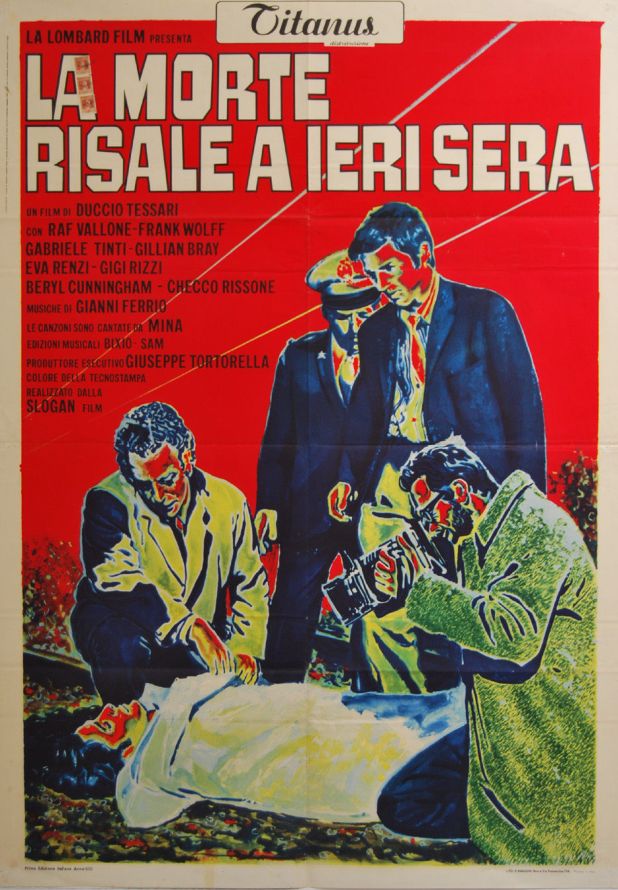
Death Occurred Last Night (also known as Death Took Place Last Night and Horror Came out of the Fog) was based on the Giorgio Scerbanenco novel Milanesi Ammazzano al Sabato (The Milanese Kill on Saturdays) and was directed by Duccio Tessari, who co-wrote A Fistful of Dollars before making his name with A Pistol for Ringo and The Return of Ringo. More to the interest of those who love black gloves and switchblades, he made The Bloodstained Butterfly and Puzzle. He co-wrote the script with Biagio Proietti, who was also the writer of The Killer Reserved Nine Seats and Fulci’s The Black Cat. Tessari even wrote the lyrics to two of the songs in this movie!

Avanzio Berzaghi (Raf Vallone) has come to Milan to find his runaway daughter and works to solve the case himself — much like an Italy proto-Hardcore — at the very same time that detective Duca Lamberti (Frank Wolff) — a character who also appears in the movies Caliber 9 and Cran d’arrêt — and his partner Mascaranti (Gabriele Tinti, husband of Laura Gemser) investigate the seamier side of the city. They finally find her body in a field, burned beyond all recognition. Now, all Berzaghi has left is seeking out revenge that will never be enough.

The film also shows flashbacks of Berzaghi’s relationship with his daughter Donatella (Gillian Bray), a three-year-old child in the body of a fully grown woman with the needs that go with the physical maturity of a twenty-five-year-old. As she lusts after nearly every man she sees, her father had intended to keep her locked up after the death of his wife, but that plan obviously fails.

A cross between giallo and poliziottecschi — each of the two storylines takes each of the genre to heart and then meet at the end — this is a film that doesn’t take its cues from Argento — it was made the same year as The Bird With the Crystal Plumage — and emerges as a unique take on the form with an even more unique soundtrack by Gianni Ferrio which doesn’t sound like any other giallo score — it doesn’t sound like any other music from a film at all — and often puts people off on this movie. Not me.

Speaking of Bird, Lamberti’s wife is played by Eva Renzi, who is so important to Argento’s film. She’s incredible here, not just the most fashionable person in the movie, but her relationship with her policeman husband is one of equal standing.

Want to discover some more giallo? Check out my list of three hundred plus psychosexual murder movies right here.

Arizona si scatenò… e li fece fuori tutt (1970)

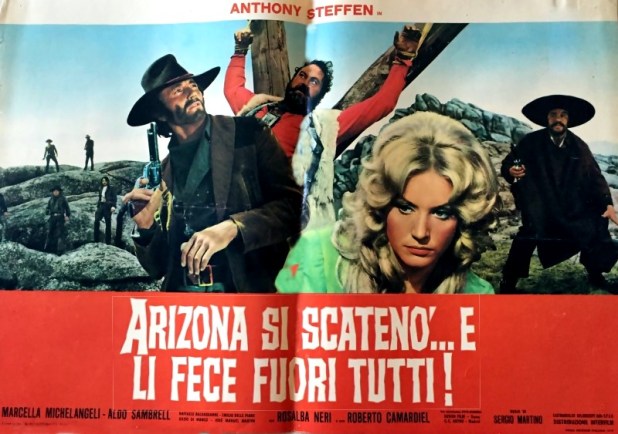
Arizona si scatenò… e li fece fuori tutt means Arizona Went Wild…and Took Them All Out. It was released in the U.S. as Arizona Colt Returns and it’s a sequel nearly in name only, as Anthony Steffen takes over for Giuliano Gemma, changing the character from a cocky rogue to a near Eastwood Man with No Name. Only sidekick Double Whiskey (Roberto Camardiel) is on hand to remind us of the first movie.

At the start of the story, Arizona and Double Whiskey are living in peace. Then, he learns that there’s a price on his head, so he fakes his death. While in town doing that — as if it were another daily errand — Arizona is asked by a landowner named Moreno (José Manuel Martin) to rescue his daughter Paloma (Rosalba Neri, who was killed in the first movie) from Keene (Aldo Sambrell), an old enemy who of course is the one who set him up. Arizona refuses the job, as he just wants to settle down with his girlfriend Sheena (Marcella Michelangeli). However, Keene makes his mind up for him when he captures Double Whiskey.

It’s time for the hero to live up to his theme song: “I think I’m gonna get my gun. I think I’m gonna shoot someone. Bang bang.” The bad guys even crucify him on an X and dunk him in water, but nothing is going to stop Arizona.

This was the first non-documentary movie directed by Sergio Martino. He’d direct The Strange Vice of Mrs. Wardh the next year and be remembered for an incredible four year run of giallo films. I’d rank him as close to Argento and Fulci as it gets for his films, which span several genre.

You can watch this on YouTube.


Roy Colt & Winchester Jack (1970)

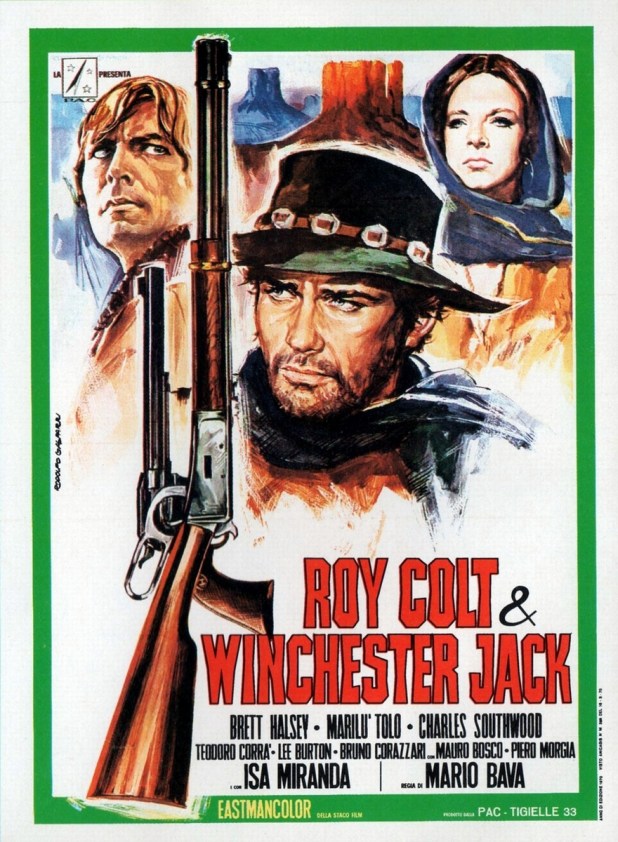
Roy Colt & Winchester Jack was producer Mario Bregni’s reward for Mario Bava after the director rescued Five Dolls for an August Moon. But by 1970, the Italian western genre had done just about everything that it could after nearly hundreds of movies had been released in the wake of Django and Sergio Leone’s films. That’s why Bava approached the only western he was officially credited with directing, although he helped with Two Guns and a CowardSavage GringoMinnesota Clay and The Road to Fort Alamo.

After working with Brett Halsey, who plays Roy Colt, on Four Times That Night, Bava felt comfortable including him in the idea that while the script by Mario di Nardo (RiccoYeti: Giant of the 20th Century) wasn’t great, they could totally have fun with it.

Colt and Winchester Jack (Charles Southwood) aren’t great at being criminals, so Colt moves to Carson City and becomes the sheriff. The townspeople like him so much that they give him a treasure map that leads to a fortune in gold. That same map finds its way to Jack, who leads a gang to get it first.

Both men are in love with Manila (Marilù Tolo), a Native American prostitute, and who can blame them? Tolo doesn’t get mentioned in the same breath as Edwige Fenech or Barbara Bouchet, but if she’d appeared in more giallo and horror, other than The DoubleMy Dear Killer and Shadows Unseen. She was also the only woman that fashion designer Valentino claims that he ever loved.

You might forget that this is a Bava film as it has little of his trademark visuals, other than some matte paintings of rock formations. And then there’s a scene where you see the sun rising through the eyes of a skull and you say, “Oh yeah, this was directed by Bava.”

Cold Sweat (1970)

Based on the Richard Matheson novel Ride the NightmareCold Sweat has Joe Moran — an American in France played by Charles Bronson — dealing with his wife and kids being taken by former associates that he once double-crossed.

Directed by James Bond director Terence Young from a script by Dorothea Bennett, Shimon Wincelberg and noir master Jo Eisinger, it shows just how quiet of a life Martin is living along with his wife Fabienne (Liv Ullmann) and daughter Michèle. But ten years ago, he’d been part of a gang with Katanga (Jean Topart), Ross (James Mason), his girl Moria (Jill Ireland), Whitey (Michel Constantin dubbed by David Hess) and Fausto (Luigi Pistilli) show back up and ruin his life.

Yeah, like Bronson is going to take that.

Liv Ullmann later complained that Bronson was rude to her and her daughter during the filming. When her daughter wandered over to his lunch table, Bronson brought her back and said, “Please keep your child to yourself.”

I grew up not far from Bronson and my dad always told me when we went to dinner, when and if we did, that the men in the bars had just come out of the mills and mines and just wanted some quiet. “They aren’t here to listen to you be stupid,” he said, and I get it. Bronson got it. And now Liv Ullmann’s kid got it.

You can watch this on Tubi.

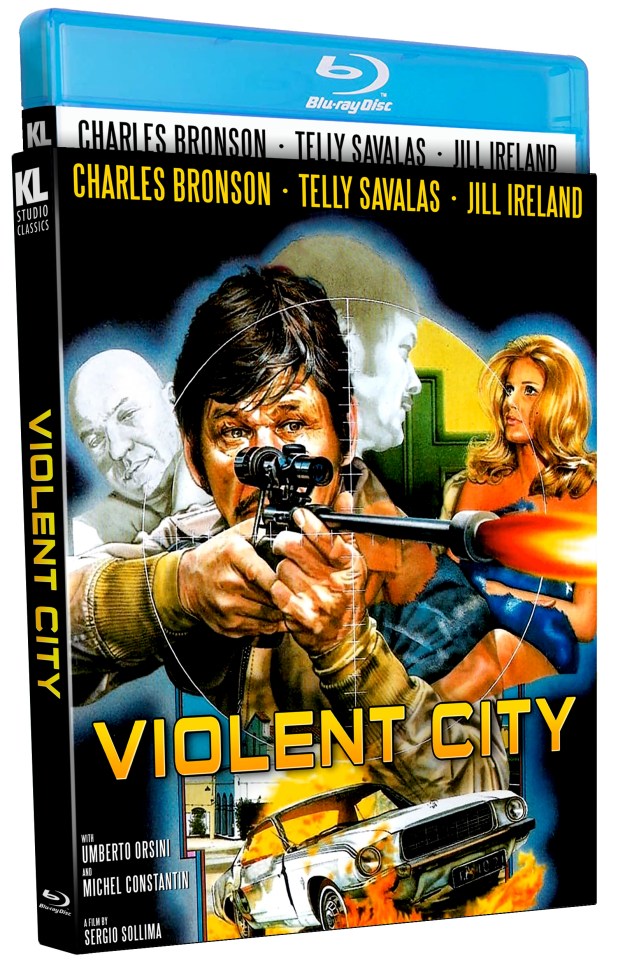
KINO LORBER BLU RAY RELEASE: Violent City (1970)

Director Sergio Sollima is mainly known for westerns such as Run Man RunFace to Face and The Big Gundown, the Eurospy movies Agent 3S3: Passport to HellAgent 3S3: Massacre In the Sun and Requiem for a Secret Agent and the pirate movies SandokanLa tigre è ancora viva: Sandokan alla riscossa! and The Black Corsair

With Violent City, co-written with Swept Away director Lina Wertmüller, he was originally upset that it was going to be a traditional gangster story. He did, however, say that “we had the chance to shoot in the U.S., and I would do whatever it took to do that.” So he worked with Wertmüller to create the non-linear way that the story would be told. He also worked with Telly Savalas, who plays the main villain in a movie of bad people, to bring out the humor in his role. As for Bronson, he found him uncommunicative while his wife Jill Ireland was the exact opposite, which is probably why they worked so well together.

He said that in the end, the movie was a lot like his westerns and all about “the encounter and struggle between the individual and the society which is all around him, and the way he reacts to it.”

During a vacation, Jeff Heston (Bronson) and his lover Vanessa (Ireland) are attacked by killers sent by an old business associate who Vanessa has seemingly left Jeff for. He’s jailed and refuses to name her, even if he receives a lower sentence. As soon as he’s released, crime lord Al Weber (Savalas) wants him to work for him, but he claims he’s retired, which is a lie, as he kills the man who set him up in the very next scene.

Of course, Vanessa has been married to Weber all along and even though Jeff wants revenge on her, he can’t kill her. Weber even tells him that his love for her will be his undoing, that she’s the one pulling the strings, but Jeff’s critical flaw is in thinking that she can’t be such a person.

The movie had two major American releases, with the first distributed as Violent City by International Co-Productions and the second wide release distributed by United Artists as The Family, complete with a logo using the same font as The Godfather and a tagline that shouted
The Godfather Gave You an Offer You Couldn’t Refuse. The Family Gives You No Alternative.”

If this was to be strictly an Italian film, Tony Musante and Florinda Bolkan would have been the leads. There was also an attempt to make the movie with Jon Voight and Sharon Tate.

This is a moody and dark film that predates the poliziotteschi films while boasting a strong soundtrack by the master, Ennio Morricone. It also has a stark ending that I’ve been thinking over again and again in the days since I’ve watched the film.

The Kino Lorber blu ray release of Violent City has a 2K restoration of the movie in English and Italian with optional English subtitles, new commentary by Paul Talbot, author of the BRONSON’S LOOSE! books, as well as an interview with director and co-writer Sergio Sollima, trailers, TV spots and a second disc with a 4K restoration of Citta Violenta, an HD master of the American version The Family and a series of Bronson trailers. You can order it directly from Kino Lorber.

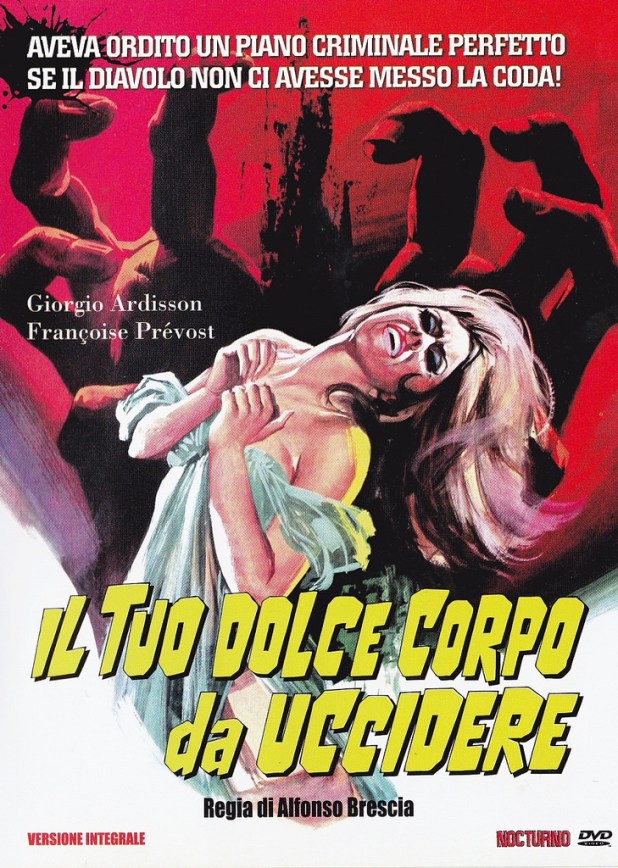
Il tuo dolce corpo da uccidere (1970)

Known as Your Sweet Body to Kill and A Suitcase for a Corpse, this was directed by Alfonso Brescia, who made the absolutely wild movies The Beast In Space and Iron WarriorClive Ardington (George Ardisson, Eyes Behind the Stars) has long dreamed of killing his wife Diana (Françoise Prévost), who abuses him verbally any chance that she gets and uses his money to bankroll the clinic of her lover Franz (Eduardo Fajardo). He can’t divorce her — the scandal would ruin his political aspirations — so he comes up with a plan: present an official letter claiming that Franz was part of the German enemy during World War II, then get him to murder Diana, hack her to bits and leave her in two suitcases.

Clive intends to dump the suitcases in an acid pit, but he has to fly there, which means that the suitcases are leaking all over the airport, which adds a bit of comedy to the proceedings. Even more — while one case has his dead wife in it, the other does not. Soon, Clive is being blackmailed, so his dream of escaping his life doesn’t look like it’s going to happen.

Can giallo be funny? This movie says si.

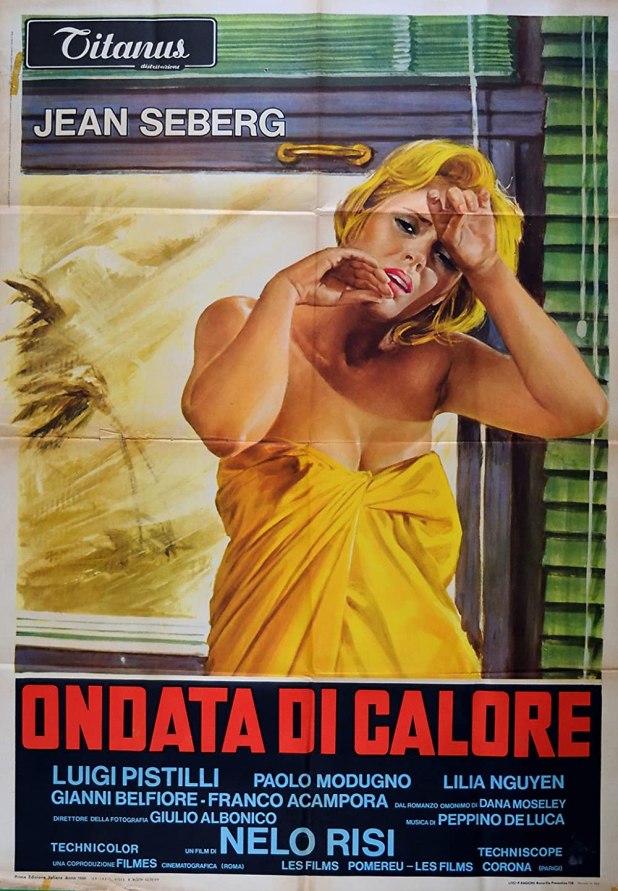
Ondata di calor (1970)

Based on Dana Moseley’s Dead of Summer, this movie fits into one of the many subcatagories of the giallo which I ineloquently refer to as women slowly going insane. Maybe F-giallo is a better term?

I thought that the gorgeous and doomed Jean Seberg only made one giallo, The Corruption of Chris Miller. She gives a truly once-in-a-career performance here as Joyce Grasse, a woman left all alone in a fabulous apartment in Morocco. As a sandstorm rages outside her windows and a man keeps staring into the windows, she listens to messages from her husband and gradually slides into depression, her only companion — before the maid arrives — is a blow up doll she finds in her husband’s room. Does it look a bit too much like her?

After watching her neighbors have sex, she decides that she should seduce a nieghbor boy, which ends awkwardly as he runs from her. As her sanity gets more fragile, a doctor (Luigi Pistilli, A Bay of BloodYour Vice Is a Locked Room and Only I Have the Key) appears.

Director Neio Risi purposefully made this movie one that doesn’t tell you anything. Is Joyce insane? Is she trapped in a world of her own making? Has she killed her husband? Why are men both fascinated and frightened by her? Was her husband more interested in the young boys he met in this foreign country than her?

For some, this movie would be slow moving. I watched it as a hang out film, seeing Seberg fall apart over the running time, as she sits and stares into space and just lies there and listens to “Crimson and Clover.” The transfer I saw had massive audio issues, warping all of the dialogue and sound design, which somehow made this even more haunting, so as she searched for Tommy James and the Shondells to remind her of what love is, the voice came back as if from the void, vibrating and angry and maybe even afraid.

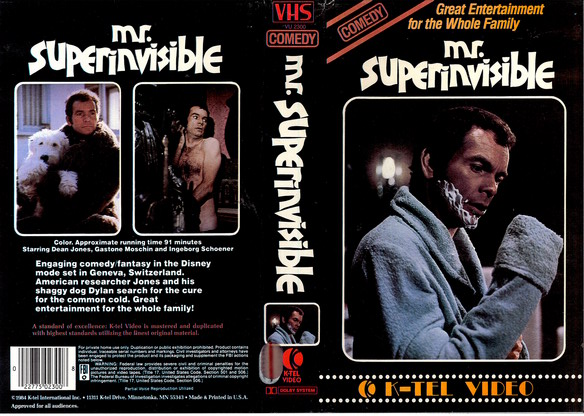
L’inafferrabile invincibile Mr. Invisibile (1970)

Antonio Margheriti — the man who directed And God Said to Cain and Yor: Hunter from the Future — also made a Dean Jones Invisible Man movie, which blows what’s left of my mind. Want me to go even further? This was released in U.S. theaters by K-Tel.

Yes, it’s a Disney superhero movie, basically, but made in Italian and therefore things like an actor doing Peter Lorre for 1970s kids years past that being something they’d get it is exactly what I expect. And yes, that actor doing it is Luciano Pigozzi, Pag from Yor.

K-Tel started playing this in U.S. theaters in 1973 and kept pushing it past 1975 in matinees that offered the chance to win the dog — a stuffed one — if you attended. I can’t even imagine how much 1973 parents hated their kids to drop them off and be assaulted by this.

Jones is Peter Denwell, trying to solve the mystery of why people get a cold, when his research is stolen and he must use an Indian formula to turn invisible. There are also moments where this formula stops working and Jones is naked. This is, again, a movie for children.

The same year Jones’ co-star Ingeborg Schöner made this, she’d also be in Mark of the Devil, which is really the kind of juxtaposition I can get behind.