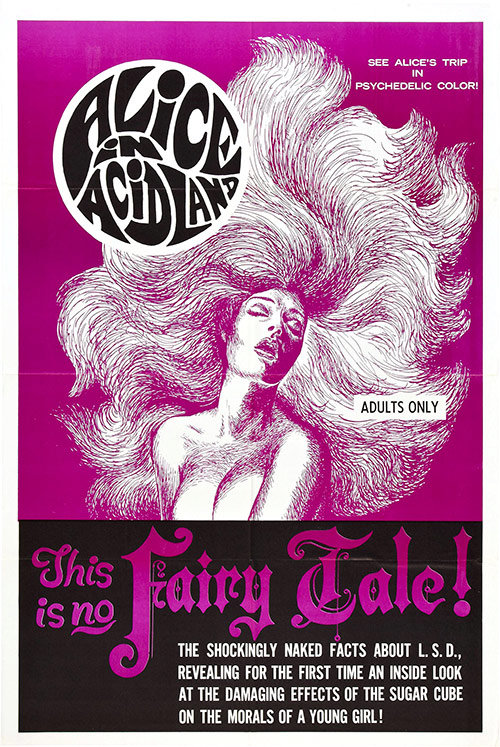
Rescued by Something Weird, Alice In Acidland starts as a nudie cutie before its black and white sequences go full color once that acid gets dropped.
Alice (Sheri Jackson, The Babysitter, Love Camp 7) is a good college girl who goes to a party with her not-so-good friend Kathy (Janice Kelly, Run, Swinger, Run!) being thrown by their French teacher Frieda (Julia Blackburn, The Ramrodder). What follows are baths, nudity, sex, more drugs, orgies, more nudity, more sex and more drugs for an hour and a few extra minutes. None of the sex is hardcore, but mainly the titilation that pre-Deep Throat films usually end up having.
Donn Greer, who directed and produced this, also is the narrator, saying things like, “Removing her clothes, Alice changed into a costume more befitting her new personality. She now belonged to another society, another world. A world of Pot, LSD and Free Love. Alice Trenton, as her father knew her, was dead. Long Live Alice. She had now become a wild and provocative twinight hippie. Complete with the Indian beads and moccasins.” and “Here was her chance to prove that she belonged in the sex-for-pleasure inner circle, and prove it she did.”
This was written by Gertrude Steen, which has to be a Greer pen name.
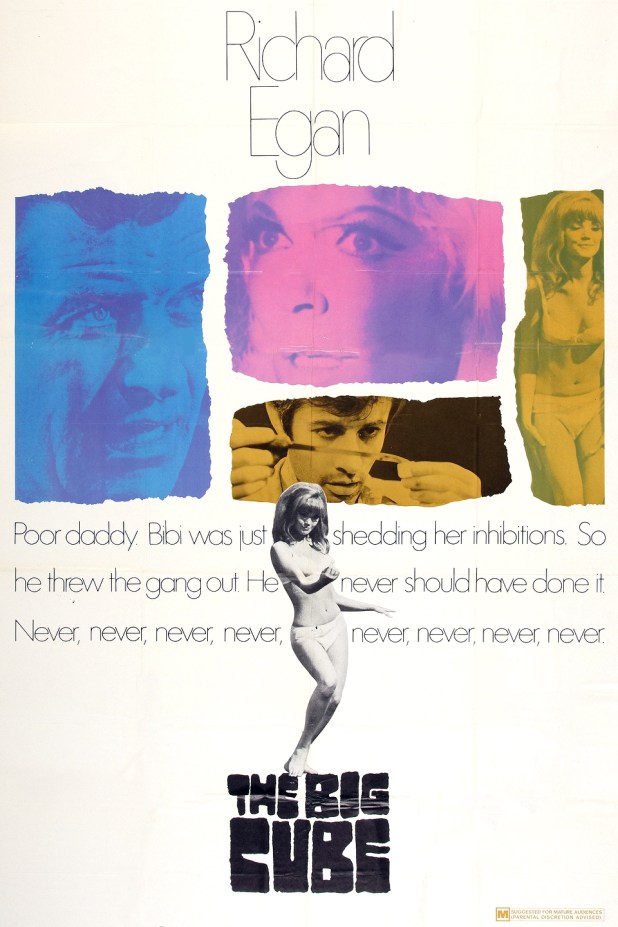
The Big Cube presents the hippies as the bad guys and the establishment — Lana Turner! — as the ones having to deal with their conniving ways. This is one of the few films where the stepmother is the one dealing with the machinations of her stepdaughter and not the other way around.
Turner plays stage actress Adriana Roman, who has retired after marrying the wealthy Charles Winthrop (Dan O’Herlihy!). His daughter Lisa doesn’t trust her new mother and after a speedboat accident kills Charles, all hell breaks loose.
It turns out that Lisa’s new man Johnny Allen (George Chakiris, yet another West Side Story actor in a drug week movie!) wasn’t trusted by her father, who laid out rules in his will that if Lisa marries Johnny, she gets nothing. Now that Adriana is the executor, the blame falls on her.
There’s only one way to fix things: dose the old lady with LSD in her sedatives and a gaslighting campaign that puts her in the funny farm.
By the end of this all, Johnny has left Lisa for her best friend, Lisa has confessed her sins to her playwright friend Frederick and Adriana now believes that her husband is still alive.
This feels like a drug movie made by people who have only seen other drug movies, which kind of makes it awesome. Its squareness moves straight into the realm of camp, which is pretty much where my sensibilities lie.
This movie wants to be a Reefer Madness warning about acid and ends up being the kind of movie that ends up in a box set with Trog. Such is life.
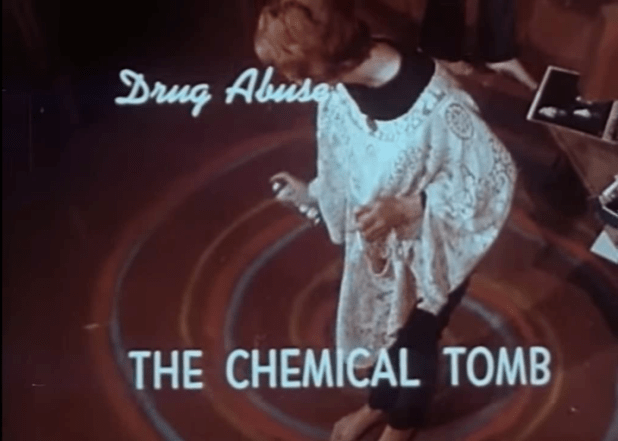
Drug Abuse: The Chemical Tomb is one of the worst examples of anti-drug PSAs that I have ever seen. It lacks the drama of films like Reefer Madness and Narcotics: Pit of Despair, while including all of the monotonous sermonizing. It is reminiscent of the worst educational films we were shown in school as children.
Unlike the aforementioned films, The Chemical Tomb does not feature any central figure the viewer can focus on. There are no promising college students or high schoolers ruining their lives through using the demon weed, popping pills, or injecting heroin. After a brief opening speech over some footage of hippies about how the youth of the 1960s had the chance to change the world (spoiler alert: they didn’t take it), we are treated to a fifteen-minute-long lecture from Dr. John T. Burroughs, an official with the Los Angeles County District Attorney’s office, about the effects of drugs, with the main focuses being marijuana and speed.
The film cannot even scaremonger properly. When Dr. Burroughs discusses the dangerous effects of some drugs, it still fails to be interesting. For example, when talking about speed, he warns about the depressing lows that can follow a speed high, which can even lead to suicide. However, to illustrate his point, the film only shows a young woman sitting in a dark living room doing nothing. A Reefer Madness-style mental breakdown would have been a good insert here.
If offered the chance to watch Drug Abuse: The Chemical Tomb, just say no.
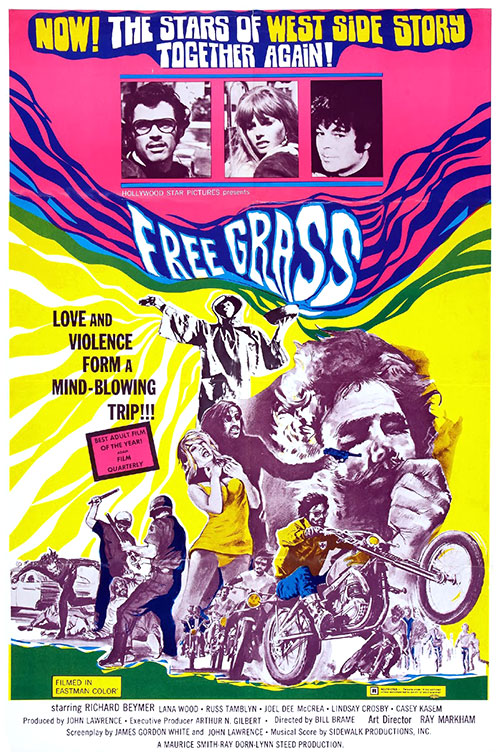
Richard Beymer’s (Tony from West Side Story and Benjamin Horne from Twin Peaks) Dean has fallen in love with Lana Wood’s (her sister was in West Side Story, too) character Karen. But they’ve both run afoul of a gang they’ve tried to help bring marijuana across the murder. The leader of that gang? Link, played by one-time Jet (yes, more West Side Story) and now full-time biker and drug movie star Russ Tamblyn (and Twins Peaks as Dr. Lawrence Jacoby).
Dean gets dosed, nearly set on fire and has his girl kidnapped. Also, Tamblyn’s gang has Warren Finnerty (Easy Rider) and Casey Kasem (!) in it. This is the kind of movie that introduces Tamblyn as he shoots up. Then, Karen asks Dean if he wants to trip and a scene that’s already been wild with women dancing with snakes and swirling colored lights gets even crazier, which is what I’m watching these movies for. Can you trip like I do?
Look, even if this movie was bad — and it’s not, it’s pretty fun if disjointed — it’s a movie that has Casey Kasem as a copkiller, music from California Spectrum and The Boston Tea Party, enough strobing effects to make you think you’re flashing back and direction by Bill Brame (The Cycle Savages) and John Lawrence (who co-wrote The Incredible 2-Headed Transplant).
Somehow, this movie was re-released twenty years later, with scenes slowed down, added nudity and, for some reason, a disco soundtrack.
Screenwriter James Gordon Wright was also behind Ten Violent Women, The Tormentors, both The Thing with Two Heads and The Incredible 2-Headed Transplant, The Hellcats, The Devil’s 8, Bigfootand The Mini-Skirt Mob. Beyond co-writing from Lawrence, he also had some uncredited assistance from Gerald Wilson (Chato’s Land, Firepower).
Finally, I absolutely love that Robert Beck got a credit for psychedelic lighting on this. He was also the special psychedelic effects producer on The Trip and did the effects for The Psychedelics and Blood of the Iron Maiden, a movie where John Carradine and a murder-minded director feed acid to starlets before killing them on film, so he was making a living showing the straights what LSD was all about, man. Ah, 1969. You were an amazing time.
Oh Mimsy Farmer. I have watched you by menaced by the camera of Lucio Fulci in The Black Catand Ruggero Deodato in Body Count, saw you deal with supersonic air travel in The Concorde Affair, wowed by racecar drivers in Hot Rods to Hell and The Wild Racers, ride with bikers in Devil’s Angels and get involved in giallo intrigue in Four Flies on Grey Velvet, The Perfume of the Lady in Black and Autopsy. So when some folks watch this and wonder, how could the hero have gotten into heroin because he was so in love with a girl, I just say, “Well, she was Mimsy Farmer. I’ve done much dumber things for much less breathtaking women.”
That protagonist is Stefan (Klaus Grünberg, The Grand Duel), a German college student who is taking a break and hitchhiking to Paris, where he gambles, robs a bank and meets the free-spirited Estelle (Farmer), following her to Ibiza and down the path of drug addiction.
The villain who provides the heroin to Estelle isn’t just any bad guy. He’s a former Nazi named Dr. Ernesto Wolf. Stefan thinks that he’s saved Estelle from him, but he’s only doomed himself to addiction when he believes that by doing the same drugs as her, he can hold on to her love.
Honestly, I feel like I’ve lived enough of this movie, trying to save unsavable women when really I should have worked on myself. This is not an easy admission to make. It’s none of their fault and all of mine, thinking that being a better person and making lives better really means love when all it means is misplaced devotion.
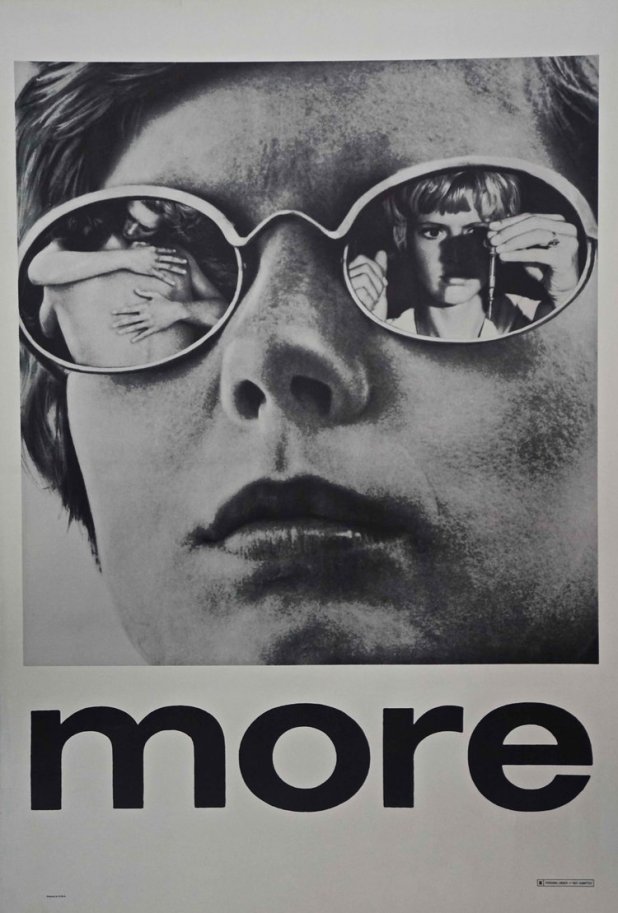
Roger Ebert had a great review of this movie, summed up best by this last line: “The message seems to be: Sure, speed kills, but what a way to go.”
More was the debut feature of Barbet Schroeder, who would go on to make Single White Female and another film that somewhat romanticizes self-destruction, Barfly. Here’s an interesting fact: those are all real drugs in the scenes showing Stefan and Estelle using marijuana, heroin and LSD.
This film also has a soundtrack by Pink Floyd, which was released as More and includes “The Nile Song,” “Cirrus Minor” and “Cymbaline.” The music only shows up in natural moments, overheard when cars have on their radios or when Estelle puts on a record. The band would work with Schroeder again — who is also the leader of France in Mars Attacks! — on his movie The Valley (Obscured by Clouds).
ABOUT THE AUTHOR: Robert Freese contributes to many different magazines, zines and websites such as Videoscope, Rue Morgue, Drive-in Asylum, Grindhouse Purgatory, Horror and Sons and Lunchmeat VHS. (His most recent piece, about the 80’s video distributor Super Video, can be found here). He also co-hosts the Two Librarians Walk into a Shelf podcast so he has an excuse to expose library patrons to ninja and slasher films.
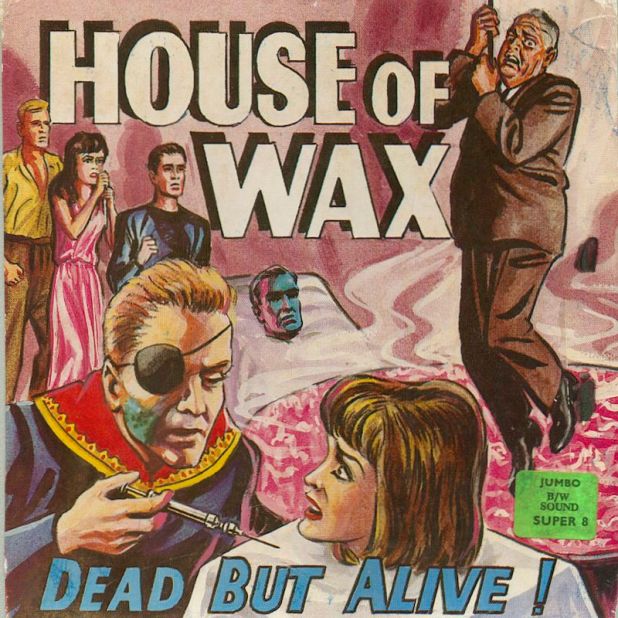
Our story begins at a posh Hollywood soiree where head of Paragon International Pictures Max Black announces the start of a new movie starring hot young talents, Tony Deen and Marie Morgan, as well as their engagement.
After the party, on his way home, a shadowy figure assaults Deen and injects him with a concoction that puts him in a state of suspended animation. We are then whisked to the Movieland Wax Museum, where tour guide Nick walks patrons from one famous display to another.
Detectives Haskell and Carver arrive to ask curator Vincent Renard about the recent disappearances of other Paragon stars. Renard doesn’t have any information that can help their investigation, but he agrees it is weird that each one of them disappeared shortly before the unveiling of his newest display dedicated to those same Paragon stars.
We learn in a flashback that at another Paragon party, Marie Morgan told Max Black she was quitting the business to marry Renard, who, at the time, was Paragon’s top make-up artist. Enraged, Black throws a drink into Renard’s face just as he lights a cigarette. Renard’s head bursts into flames. He staggers blindly outside and jumps into the pool. Authorities write it off as an accident. The “accident” leaves Renard disfigured and missing an eye.
Renard reconnects with Marie, regardless that Max does not want her associating with him any longer, and eventually convinces her to “pose” for him.
You don’t have to be the savviest horror film fan to connect all the dots here, but Nightmare in Wax is still a total delight. If you were a kid when you first saw it, it no doubt scared the snot out of you. The premise of a madman injecting his victims with an agent that renders them motionless, then keeps them docile with hypnotism, is potent nightmare fuel. But just like quicksand, another terrifying concern that blossomed in many of us in our adolescence, the premise of such an outlandish plan disintegrates into itself when adult logic is applied. (I mean, certainly some sounds would be coming from their bodies, escaping gases, stuff like that, right? Possibly, tears running out of their never blinking eyes and maybe some kind of skin discoloration as they go longer without actual food and water, but I’m being a killjoy now.)
In and of itself, Nightmare in Wax succeeds because it was produced only to creep out drive-ins patrons looking for some cheap thrills, and then later the same viewers surfing for late night TV chills. It’s a fine example of exploitation that runs with its absurd premise and delivers the required thrills fans of such an entertainment desire. It is not really gratuitous in any way as its most gruesome moments are suggested, keeping the proceedings in PG rated territory but not dulling their impact to shock and disgust. It exists and delivers on the same level as the Creepy and Eerie horror comic magazines that were popular at the time. Never really scary, but blackly fun and offering simple morality tales for a young audience. It offers just the right amount of gruesome entertainment for a fun night at the drive-in with friends.
Cameron Mitchell stars as Renard and he is absolutely wonderful. This is the Cameron Mitchell fans most love: the crazy, cackling, carrying around a dead body and talking insanely to it during a high-speed police chase to the pier in Santa Monica Cameron Mitchell. (For myself, I love this Mitchell performance more than his similar psycho role in The Toolbox Murders.)
Anne Helm is great as Marie, but she fails to make Marie completely sympathetic, especially since she only agrees to pose for Renard if he gives her a bust of Tony Deen, who she is still madly in love with. (When he finally has her trapped, there is a bit of joy on the part of the audience when Renard cackles, “If I can’t have you the right way, I will have you another way.”) Berry Kroeger had been making pictures since the early forties and is perfect as the slimy little toad Max Black. (You do feel joy when Renard is torturing the creep.)
There is a slew of familiar faces in the cast, among them Al Adamson regulars Scott Brady as Detective Haskell and John “Bud” Cardos, looking an awful lot like Sam Rockwell, as Detective Carver. Hollis Morrison is a hoot as Nick, especially when he thinks he is hallucinating. Morrison worked throughout the sixties but tapped-out soon after this film with a final appearance on the TV show McCloud. This was one of character actor Virgil Frye’s earlier films and Ken Osborne appears briefly as a bartender, following up with appearances in Blood of Dracula’s Castle, Five Bloody Graves, and Hell’s Bloody Devils before directing the outstanding western Cain’s Cutthroats in 1970.
Written by a true master of exploitation, Rex Carlton delivered a gruesomely good ride that exploits the premise for all it is worth. Carlton also wrote the film that was released on a double bill with Nightmare in Wax, Blood of Dracula’s Castle, a film as equally fun. The two films ran together as an amazingly successful double feature for years. Carlton, unfortunately, did not live to enjoy the success of the films he wrote. He took his own life soon after Sam Sherman and Al Adamson lost the rights to Blood of Dracula’s Castle, some speculating that he owed the wrong people money for a loan to get the films made. (Posthumously, the two films raked in an amazing pile of dough for distributor Crown International Pictures, and they played multiple double bills, triple features and dusk to dawn shows well into the seventies. Another Sherman/Adamson film he scripted, The Fakers, went on to theatrical success as Hell’s Bloody Devils. Earlier in his career, Carlton wrote the absolutely bonkers exploitation classic The Brain that Wouldn’t Die.)
Director Bud Townsend began his career in TV and then moved into features. He continued making films released by Crown International Pictures well into the eighties. From a historical perspective, the film offers a glimpse of the long lamented Movieland Wax Museum as it existed just prior to being sold to Six Flags. It depicts a moment in time that will forever exist in this film. Quaint as wax museums may seem to some, when they are gone there is definitely a sense of loss by those of us who enjoy such activities as posing for pictures with wax effigies of stars and characters from the past. More than living up to its title, Nightmare in Wax is a darn fine spook-show. It’s cheap and clunky, but it just might creep you out a bit. If anything, Cameron Mitchell’s over the top performance makes it more than worth a watch. The Gorehouse Greats Collection presents the film in a widescreen format and is by far the best copy I’ve seen available, between other budget releases and streaming.
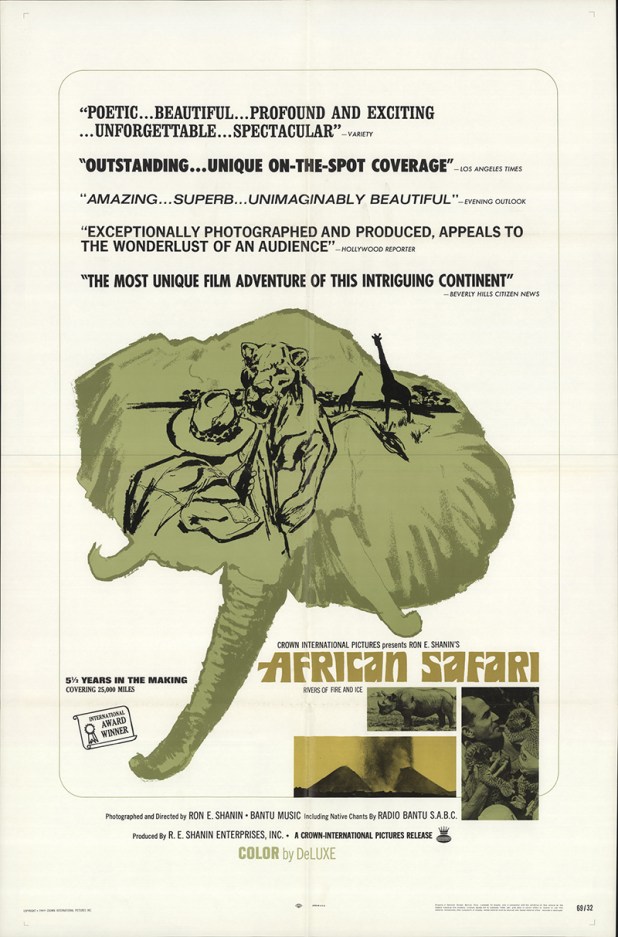
Animal collector Ron Shanin, the writer/director/cinematographer/producer of this movie, wanders the world to show the world what it’s like to search for the world’s biggest and most dangerous animals.
Filmed in 1962, but unreleased until 1969 or so, it is narrated by Michael Rye, who is just pretending to be Shanin. He was also the voice of the narrator for the video game Dragon’s Lair, Green Lantern on the Super Friends and Super Powers cartoons and Magneto for several of the 1980’s Marvel cartoons.
Of course, no mondo would be complete without interacting with the natives and it coming off as very cringe worthy. This is by no means a Goodbye Uncle Tom moment, but just be warned if this is your first time into these type of movies (it’s actually a fine start, but go slow and don’t jump right into the Italian side of mondo right after this unless you want to be truly shocked and awed, OK?).
Why this is on a Mill Creek collection is beyond me, other than Crown International Pictures was like, if you buy one of our movies, you get all of these other ones. It had a pretty cool title and you’d be forgiven if you thought that it was a peblum movie.
You just never know when it comes to Mill Creek sets. We first reviewed this bike-racing flick on March 7, 2020, because we just enjoy digging up ’70s drive-in junk. Then we revisited it August 4, 2020, when the film popped up as part of Mill Creek’s Savage Cinema set, a box set which we reviewed in full.
Yep. Mill Creek “goes green” once again, as they also include the film on their B-Movie Blast 50-Film pack. Ah, but those scamps at Mill Creek changed it up: now they’ve included the film under its alternate title of Five the Hard Way . . . and we, at first, though they included, but mistitled, Gordon Parks’s blaxploitation actioner Three the Hard Way. But this isn’t a blaxplotation picture. So, while there’s no Fred Williamson, we do get a Ross Hagen and Micheal Pataki fix in the bargain.
But, after watching, we still don’t know what a “sidehacker” is.
Well, we do, actually, as Sidehackers is part of the late ’60s fascination with bikers, a genre that got its start — to an extent — with Motorpsycho (1965) and featured the likes of The Wild Angels (1966) and hit its peak with Easy Rider (1969). However, that didn’t stop low-budget studios from pumpin’ out more biker flicks into the mid-’70s,with the blaxploitation genre offering their takes on the genre with The Black Six and Darktown Strutters (both 1974).
Sidehackers, however, isn’t mention within the biker genre, as we are not dealing with any Hell’s Angels or Satan’s Sadist or Born Losers, here, but legit motorcycle racers — sidecar motocross racing, in particular. Yes. If you ever wondered if there was a movie made about the obscure sport of sidecar motocross, well, the fine folks at Crown International gave you one. And much like Don Simpson and Jerry Bruckheimer indulging Tom Cruise’s love of stock car racing into a movie with Days of Thunder (1990), Crown indulged Ross Hagen’s love of the sport.
As with most racing movies — a trend that carried out to the likes of the sort-of-apoc “death sport” rip Ground Rules (1997) — we have a mechanic — who is also a “sidehacker,” as well — who wants to be a racer behind-the-handlebars, in this case, Rommel, played by producer Ross Hagen.
Now, every race flick must have a villain; Tom Cruise had Michael Rooker, right? Here, our villain, J.C, played by the always welcomed Michael Pataki, who excels at dickdom when he needs to, is abusive to his girlfriend, his crew, and his gang. And as in every Fabian or Frankie Avalon stock car flick (1966’s Fireball 500, for one; 1967’s Thunder Alley, for two), the bad driver’s girl goes “femme fatale” and pines for the good racer.
So, how do you get even when your “woman” makes you look bad: beat the hell out of her and blame her crush; so J.C’s gang comes after our man Rommel and his woman, Rita (Diane McBain, who we reviewed in Wicked Wicked, but she did the racing flick thing with Elvis in Spinout; yep, she’s in Thunder Alley, too).
That’s pretty much the movie. But what raises Sidehackers above all of those Elvis, Fabian, and Frankie Avalon racing flicks is that there’s no stock footage, here: all the racing was shot specifically for the film.
So, yeah. What we have here is a stock car racing flick, just with sidecar motocross racing. But even with the original-to-the-film racing footage, we’d still — as in the somewhat similar Rollerball (without the ball, natch) — we’d wish there was more sport and less romantic drama.
And what’s this all have to do with Goldie Hawn?
Goldie’s husband, former Broadway dancer Gus Trikonis — who appeared as one of the “Sharks” in West Side Story (1961) — made his directing debut with the film. He’d go onto direct the always great Richard Crenna in The Evil (1978), as well as giving us the hicksploitation romp Moonshine County Express (1977), the nasty-scuzzy country fallen star romp Nashville Girl (1976), and one of the more successful movies-based on songs, Take This Job and Shove It (1981). He and Hagen would also go against the grain and break the mold with the only film — ever — dedicated to the illegal “sport” of cockfighting: Supercock (1975). Okay, well, two: we can’t forget Monte Hellman of Two-Lane Blacktop fame (1971) made one: Cockfighter (1974) for Roger Corman.
So, there. Now you know about the two films made about cockfighting — by way of the only movie made about motocross sidecar racing.
As we dig through the credits, we notice that Robert Tessler — a stuntman who formed Stunts Unlimited with Hal Needham, and made his acting debut in Tom Laughlin’s own biker flick, The Born Losers (1967), and appeared in Burt Reynolds’s football flick, The Longest Yard (1974) — appears. Also keep your eyes open for B-movie warhorse Hoke Howell (Humanoids from the Deep, 1980). Screenwriter Tony Huston went “biker” again with Outlaw Riders (1971), but previously gave us the female-centric biker flick, Hellcats (1968).
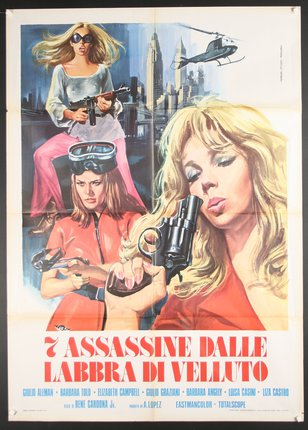
Danger…! Women in Action is all about René Cardona Jr. trying whatever it takes to entertain you and take your money. Starting with 1964’s Las Hijas de Elena, the son of the director of movies* like Santa Claus, Survive! and Zindy the Swamp Boy would direct 99 films of his own — someday, I’ll write a song called “44 Lines About 99 René Cardona Jr. Films” — that are some of the most berserk movies I’ve seen, such as Guyana: Cult of the Damned, Tintorera: Killer Shark and Night of 1000 Cats.
The sequel to 1967’s SOS Conspiracion Bikini, this adventure finds Alex Dinamo (Julio Alemán, who also played the superhero Rocambole) and the mostly female agents of Secret Organizational Service (S.O.S.) — which is pretty woke for a Eurospy movie, as even the top brass of this spy group seem to be women — stop terrorists from destroying oil fields, damaging manufacturing and even poisoning Miami’s drinking water.
Alma Delia Fuentes (Dr. Satan), Elsa Cárdenas (who was in The Mummies of Guanajuato as well as The Wild Bunch and Giant), Amadee Chabot (a former Ms. California 1964 who was in the Matt Helm movies Murderer’s Row and The Silencers, as well as Agente 00 Sexy, the Santo as a spy movie El Tesoro de Moctezuma, the Capulina and Chespirito as spies caper Operación Carambola, the Nick Adams as fake Bond flick Los Asesinos and the strange and wonderful Las Sicodélicas; she has all the qualifications to be a Bond girl yet sadly only appeared in the movies inspired by 007**), Barbara Angely (Chanoc and Click, Fotógrafo de Modelos), Nadia Milton (Santo vs. the Head Hunters) and Jessica Munguía (who was in 1966’s Santo movie Profanadores de Tumbas, which is also called Grave Robbers and has nothing to do with Ladrones de Tumbas, which is also known as Grave Robbers in the U.S.) all appear in this film.
One of the few other male agents is S.O.S. Agent Jack (César del Campo, who can boast of being in a magical art film like Luis Buñuel’s The Exterminating Angel and several Santo films), who is known as El Hombre de la Mano Dorada (The Man with the Golden Hand), which is genius, as it combines one Bond book title (The Man with the Golden Gun) and does Goldfinger three fingers and a thumb better.
Also, because this is one of René Jr.’s movies, look for an extended scene of SCUBA diving with a gorgeous woman coming up against a shark. The dude knew what his audience wanted, you know?
*The Cardona bloodline continued with René Cardona III, who has kept up the maniac zeal of his forebearers with stalwart entries such as Vacaciones de Terrorand Pesadilla Fatale. He also acts in several movies, including playing the aforementioned Zindy for his grandfather, in Cyclone and Bermuda Trianglefor his father and Cementerio de Terror for another second-generation director, Rubén Galindo Jr.
**She no longer plays a secret agent, but is a Century 21 agent.
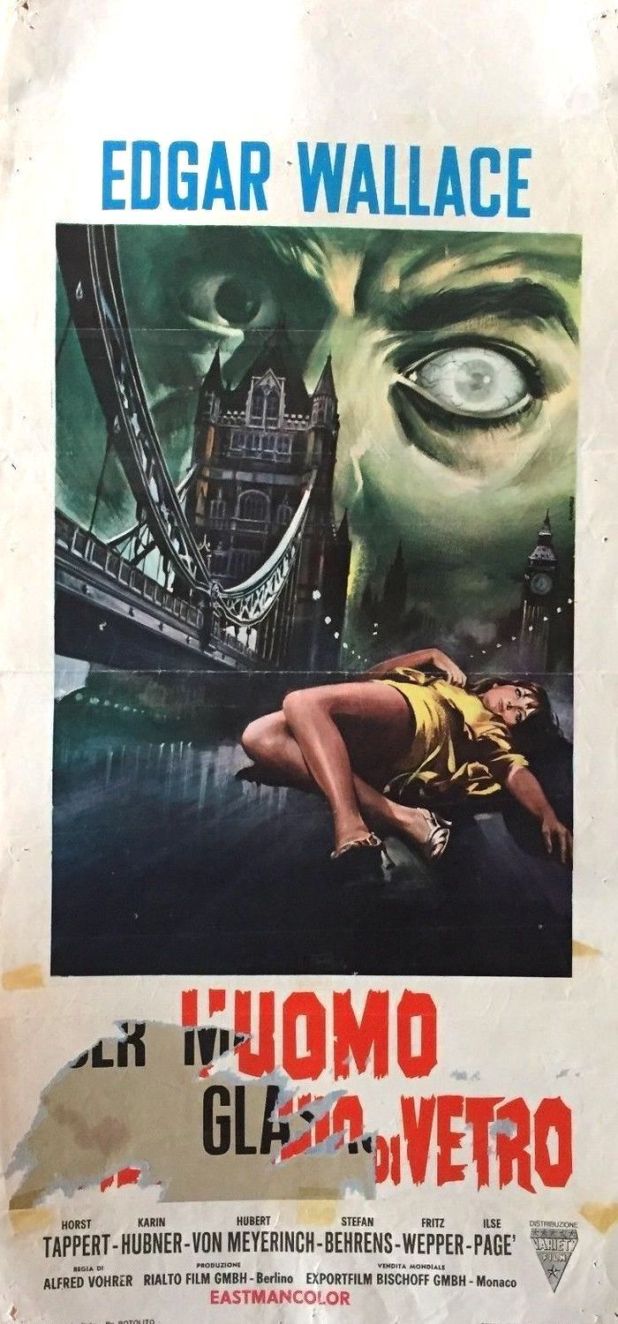
One of Rialto Film’s long-running series of Edgar Wallace films — one of the fathers of the giallo — this Alfred Vohrer (Dead Eyes of London, Creature with the Blue Hand) film predates Argento reimagining the form and instead feels very visually like Bava’s Blood and Black Lace without Bava’s camera gymnastics.
In the English dubbed version, the film starts with Wallace’s name appearing on the screen and a voice saying, “Good evening. This is Edgar Wallace speaking.” That’s a real scary moment, because at this point, Wallace had been dead for 37 years.
There’s a poisoned cat mask — I know, right!?! — and a pool hall turning into a battle royal, as well as a woman menaced by a blowtorch — yeah, that kind of stuff didn’t just start in the 1980’s, Siskel and Ebert — and a maniacal dummy named Snookie. Plus, it’s all set to some bouncy jazz!
I wouldn’t trust any single person in this movie. It’s literally all a pit of vipers. Well, maybe you can trust Scotland Yard. But every actor, carnie, gangster and moll in this — I thought you knew what a wretched hive of scum and villany was, but then I watched this movie!


 B&S About Movies
You must be logged in to post a comment.