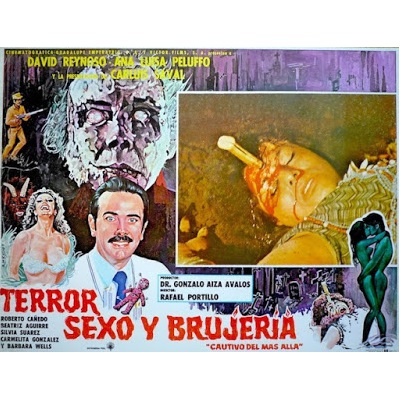
Terror, Sexo Y Brujeria (1968 and 1984)

This is a movie that raises so many questions.

Here’s the first: Why did I list it as being made in 1968 and 1984?

That’s because it was originally Cautivo del Mas Allá (Captives of the Beyond) when it came out in the late 60’s.

In that movie, Rafael Portillo (who made the Aztec Mummy films, as well as the mummy parts of Face of the Screaming Werewolf) told the story of Vicki, who wants to be gorgeous, so a witch gets her to strip for Satan, who gives her the power of being a vedette dancer.

For some reason, Portillo decided to grab all the footage from that movie — which is more a romantic story with supernatural elements — to make a gore movie about Satan. You know, movies like this are exactly why we have a web site.

So let me see if I can make sense of this one.

Vicki (Ana Luisa Peluffo, who was one of the first Mexican actresses to appear nude, she’s also in El Violador Infernal, one of the most mental movies I’ve ever seen) is in love with Ricardo (Gonzalo Aiza, who also produced this movie, and strangely it is the only movie or movies that he ever appeared in*), who only has eyes for Barbara (Barbara Wells, who didn’t do much more than appear in John Candy’s Summer Rental and an episode of Lassie).

That’s when Vicki does what any of us would do. She sells her soul to the devil, who makes her man soft with any woman not named Vicki, which seems like a pretty dark bargain. They aardvark, but then a private dick shows up to say that she’s on the left hand path, which ends up with her stabbing poor Ricardo in the throat.

This is when all the new footage shows up, as there’s a funeral and Ricardo’s brother Carlos tells his brother’s ghost that he will avenge his death, so brother and possesses brother and sleeps with his Satanic sister-in-law, which seems like something people search for in late October on Pornhub. Then, Carlos kills her and has to go to court to argue the occult reasons why this all went down.

For some reason, Ricardo also shows up as a zombie that rips out people’s innards after a firing squad shoots his brother dead — after that court case — and has the sound effect of Vincent Price’s laughter.

This came out as Terror, Sexo y Brujería (Terror, Sex and Witchcraft), which is one of the best titles of all time, in theaters and Narco Satanico on VHS, which is also a great name.
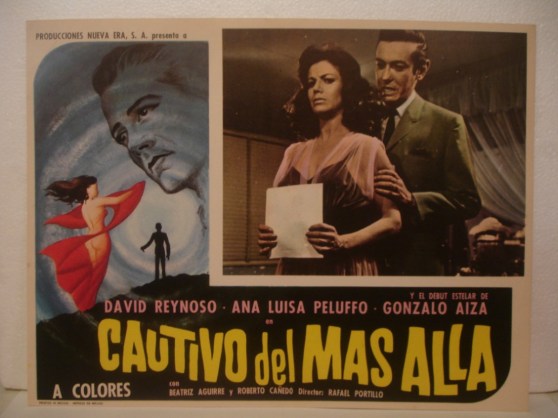
Some of this movie will bore you into submission with long courtroom scenes, but stay with it. There will be moments of Satan in a Ben Cooper mask wandering a cemetery with fog all around him, as well as glowing graves, extreme gore and a mariachi band that has been dubbed to play synth.

Adding to the confusion of this film is that there are times — within minutes — where two different actors play the same character and time moves back and forth until you are confused beyond belief. The editing also has ADD, so there are times when you’ll just get flashes of things that have nothing to do with what is happening on screen or eyes getting superimposed over the footage, as if they forgot a layer or to delete something, but Photoshop and non-linear editing didn’t really exist in 1968 or 1984.

You know how some people get their doctorates by writing their thesis about ways that they plan on bettering the world? Mine is going to concern this film, explaining how two movies, made sixteen years apart, can use the same footage and tell two similar yet wildly different stories that bridge the gap between Mexico’s ripoff cinema of the late 60’s, which was still influenced by Universal movies from three decades before, and the VHS films of the 80’s, which saw Mexican filmmakers create Fulci-esque films with no filter whatsoever.

*This is a complete mystery to me, as well as the awesome The Bloody Pit of Horror site, which discusses whether this role is played by Gonzalo Aiza — as listed sometimes in the credits — or Carluis Saval, the name used on the 1984 version for Carlos, who looks exactly the same as Ricardo. Plus, is the producer Dr. Gonzalo Aiza Avalos the same person? What’s the story with Film-Mex Productions, who bought all this footage and hired the original director to make a remix? Was it all a front for Avalos to make himself or his son or whoever a star? And why is David Reynoso, who plays an attorney in this movie, holding a machine gun on the VHS cover art?
La Cámara del Terror (1968)

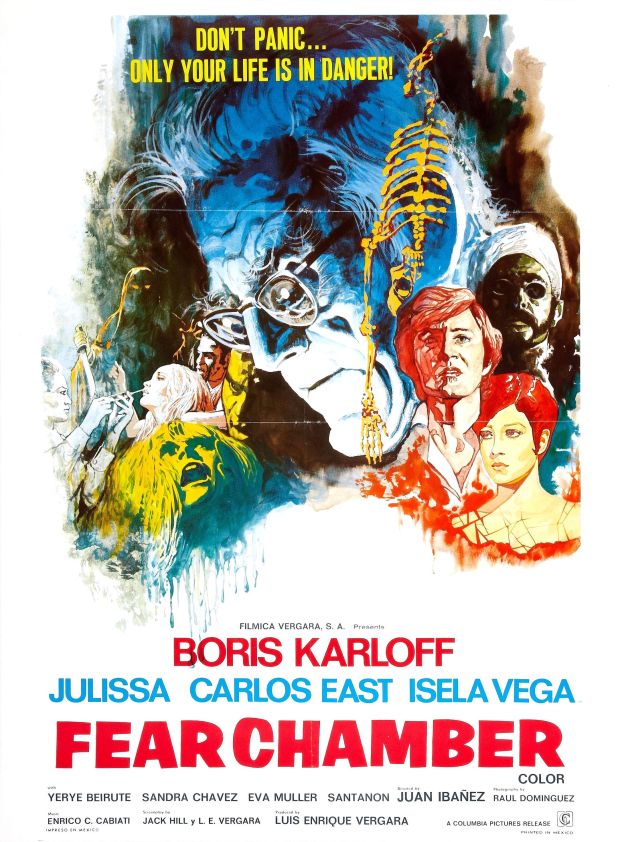
Known as Fear Chamber — as well as Chamber of Fear, The Torture Chamber and Torture Zone — this is another of the four movies that Boris Karloff made for Juan Ibáñez, with Jack Hill directing his segments.

In this strange little film, scientists discover a living rock beneath a volcano that feeds off the fear of young women. So instead of leaving well enough alone and saying, “This seems like a bad idea,” they create a fear chamber — yes, it’s right there in the title — to create the energy the rock needs from girls frightened out of their minds.

Karloff is obviously in bad health, even appearing lying in bed in some scenes. No matter — his role as Dr. Mantell is a bonkers one, as he even puts his own daughter into danger, facing off with the rock god who has obsessed him. I mean, of course he’d create a haunted house filled with strange people and vaguely Satanic ceremonies in order to keep studying his rock formation find, right?

Julissa, who plays Karloff’s daughter, also appears in two more of Hill/Ibáñez films, House of Evil and Isle of the Snake People, which is somehow even weirder than this one. This also has Isela Vega in it, who was in El Macho Bionico and Bring Me the Head of Alfredo Garcia, plus Yerye Beirute from The Body Snatcher and Santanón, a small size actor who is in plenty of memorable big roles in films like Santo and Blue Demon Against the Monsters and El Gato con Botas.

I’ve read so many people saying that Targets should have been Karloff’s last film. They might not understand that he was a working actor and the fact that he was able to keep working and in demand for roles right up until the end is the real testiment to his career.

You can watch this on YouTube.

Im Banne des Unheimlichen (1968)

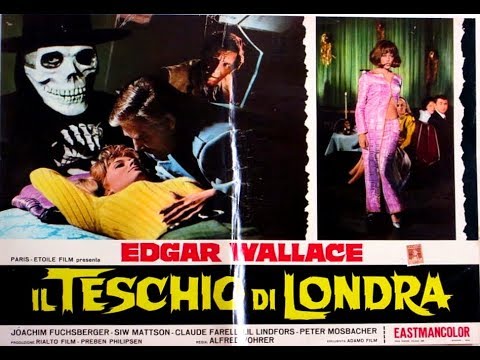
The translation of the German title to this film — Under the Spell of the Uncanny — is way cooler than The Zombie Walks and The Hand of Power**, the other titles for this Edgar Wallace adaption. No matter — this movie looks cool as hell, a Blood and Black Lace influenced pre-giallo with a delightful skull-faced killer named The Laughing Corpse* who even has his very own poison filled scorpion ring.

There’s one bonkers scene that would never be in a movie made in 2020, where the hero repeatedly tries to look up the skirt of a gorgeous librarian, who is played by Ewa Strömberg. She of course would catch the eye of noted pervert Jess Franco, who would cast her in Vampyros Lesbos and She Killed In Ecstasy.

As for the movie itself, Scotland Yard’s Inspector Higgins takes on a case that starts with a man laughing from the inside of his own coffin and gets even stranger with the deaths of nearly everyone who know that man, all from the scorpion ring of that dashing masked killer.

The credits for this really shout mod while the heroes shout old school, but you know, I pretty much loved all of it. I haven’t really explored the Wallace adaptions, but the last two I’ve watched her been more than entertaining.

This is one of the few giallo I’ve seen where the killer uses a machine gun. Also, there’s a guy with green skin and no one makes a single mention of it, so 1968 Germany was way woke early.

*The voice of The Laughing Skull came directly from director Alfred Vohrer.

**That’s the title of the book that this was based on.

You can watch this on YouTube.

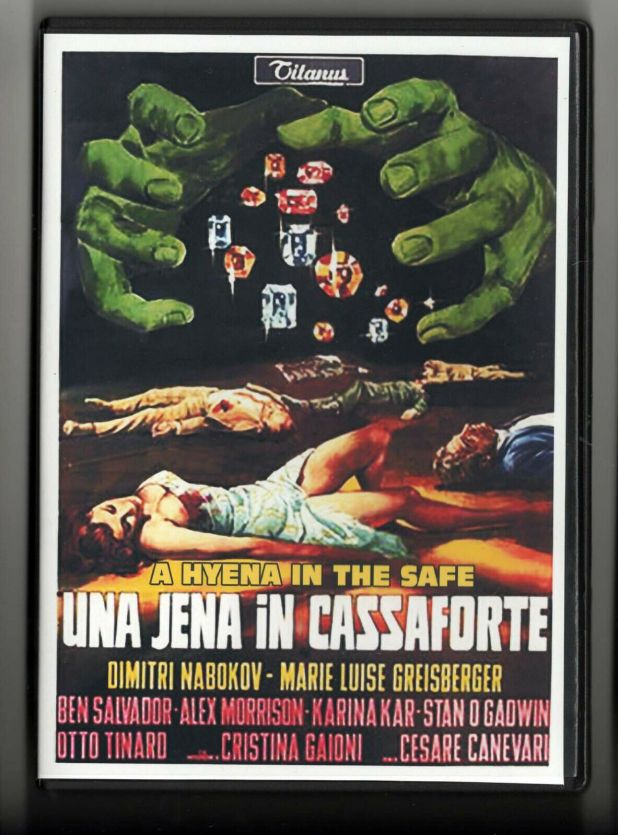
Una Iena In Cassaforte (1968)

A Hyena In the Bank Vault might have the best looking fashions I’ve ever seen in a giallo. Oh man, glitter eyeshadow, furs, striped suits, insane patterns — I’m in love.

Four thieves — Klaus from Germany, Albert (Sandro Pizzochero, So Sweet, So Dead), from France, Juan from Spain and Carina from Tangiers — have met up in what they think is an isolated castle to split up some diamonds. That said, their dead boss’s wife Anna is throwing a party. Complicating matters further, all five keys must be used at the same time to open the vault, so everyone has to keep getting along, even when Albert’s new girlfriend Jeanine annoys everyone. And when people start getting killed, how will anyone get their reward?

Cesare Canevari is probably better known for his scummy side, with movies like A Man for Emmanuelle, Killing of the Flesh and The Gestapo’s Last Orgy on his resume.

I kind of love these kinds of pre-Argento giallo that haven’t started aping his style and instead are all over the place in influence. This is the kind of movie that I wished had showed up in Vinegar Syndrome’s last Forgotten Gialli set, because I want more people to see it. It’s got the brightest colors, the furriest upholstery, the most theatrical makeup and a soundtrack that swings. It is, well, everything.

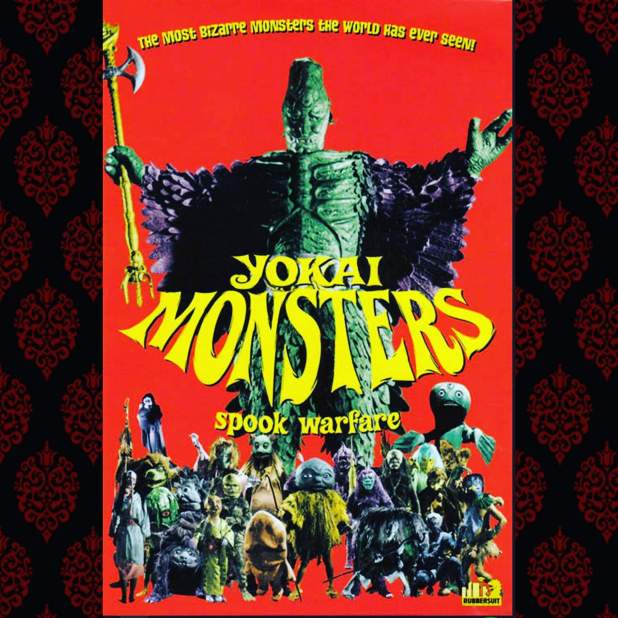
Yokai Monsters: Spook Warfare (1968)

1968 saw the release of Yokai Monsters: 100 Monsters, but just seven months later, director Kuroda Yoshiyuki (Daimajin, several Zatoichi films) made this sequel, which takes the main ideas of presenting Japan’s native monsters, perhaps finds some inspiration from the manga GeGeGe no Kitaro and the story of Momotaro, take a strong shot of national Japanese pride and remembers that no one cares about the humans in the story. We’re here to see monsters. And oh man, are we gonna get them!

In the Babylonian city of Ur, the body of the great monster Daimon lies amongst the ruins. That is, until some treasure hunters rouse him from his dark sleep, which leads to him flying to Japan, vampirically taking over the body of samurai Lord Hyogo Isobe.

As Isobe, Daimon goes wild, burning all the religious altars, killing the family dog and even rousing a kappa — a “river child” turtle creature who loves to wrestle — from his slumber in the river. Hurt in combat with the much stronger Daimon, the kappa begins his quest to unite the yokai and stop the foul beast.

Soon, the kappa meets Kasa-obake (a one-legged umbrella with eyes), Futakuchi-onna (a two-mouthed cursed woman), Rokurokubi (a long-necked woman who often appears in the more adult kaiden stories), Nuppeppo (a clay creature who resembles a blob of meat) and Abura-sumashi (a wise ghost of a human who once stole oil). They tell him that according to coloring books and field guides, no such yokai exists.

Meanwhile, Daimon has stopped his attempted exorcism and responded by killing the parents of several children. As his men hunt for the surviving kids, they hide in the yokai shrine. Soon, the monsters realize the kappa was telling the truth and join him in battle, which ends up involving nearly every single monster from across Japan.

Takashi Miike remade this movie in 2005 as The Great Yokai War, which also features Kitaro creator Mizuki in a cameo.

Seriously, this movie took a bad day and made anything seem possible. This is pure joy on film.

You can watch this on YouTube.

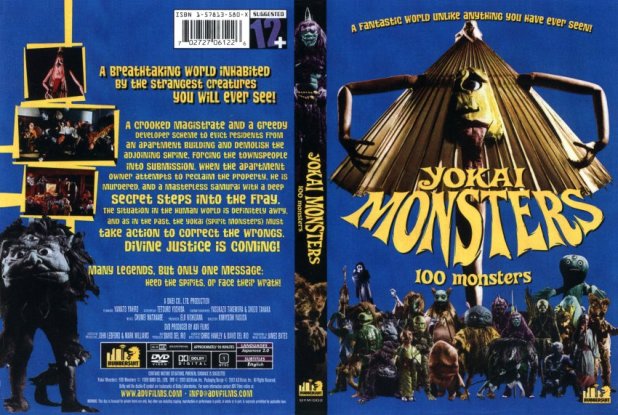
Yokai Monsters: 100 Monsters (1968)

Daiei could produce a masterpiece like Akira Kurosawa’s Rashomon while still putting out movies that featured Gamera, Zatoichi, Daimajin and the Yokai Monsters, who are based on the monsters of Japanese folklore. They may be evil creatures who cause great misfortune and harm or — quite the opposite — could  also be beings that bring good fortune to those who meet them.

Much like the aforementioned films like Gamera and Daimajin, this is a tokusatsu film that uses practical effects, including actors in costumes, puppets and animation to tell the story.

That story is really about a rich landowner, who wants to tear down a local shrine to build a brothel. He cheaps out and after telling the stories of the yokai, neglects to pay for the ceremony to keep them out. They soon go wild in the town, partying down as they arrive with sake.

Known in Japan as Yokai Hyaku Monogatari, this was directed by Kimiyoshi Yasuda, who made six of the Zatoichi movies. It suffers the sin of some Godzilla movies, in that we don’t really care about the humans. We just want the monsters. And we’ve been promised a hundred of them!

The following film, Yokai Monsters: Spook Warfare, came out the same year and realizes this issue and instead fills nearly every moment of the movie with monster after monster. This is good. That movie is great.

You can watch this on YouTube.

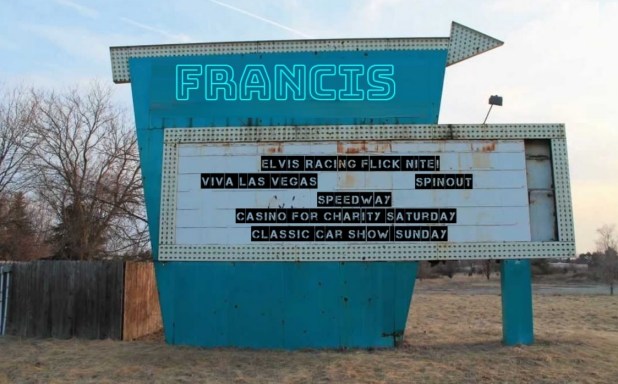
Drive-In Friday: Elvis Racing Nite!

Hopefully you joined us — and enjoyed — our “Fast and Furious Week” tribute during the first week of August as we honored the Universal franchise, along with its ripoffs and knockoffs, and the obscure and off-beat, rubber-burning drive-in epics from the ’50s through the ’80s that influenced the those films.

And guess what?

That 40-plus film blowout still wasn’t enough . . . as one car flick skidded into another, then another . . . and before we knew it, we had another 40-plus reviews. So, to get you ready for our second “Fast and Furious Week Redux” to run from Sunday, December 6, to Saturday, December 12, we’re rollin’ out Elvis’s car racing trilogy.

Facts are facts: Elvis flicks served us heaping helpings of cheesy camp starring “The King of Rock ‘n’ Roll” in a wide array of professions. He was a convict, a boxer, a cowboy, a riverboat captain, a helicopter pilot, and a cowboy — who always found the time to sway his hips and sing his latest hits for a bevy of skintight, carpi-panted ladies. And road racing, be it stock cars, Grand Prix or road rally racers, was a hot sport in the ’60s. So why not place Elvis in a flame retardant suit, strap on a helmet, and slip him into a cockpit?

Viva Las Vegas (1964)

The best and most popular of Elvis’s race excursions was his role as Lucky Jackson. He’s a down-and-out waiter and aspiring racer who dreams, schemes, and parties with Rusty Martin (Ann-Margret) as he gathers up the cash to buy a new engine for his cherished Elva Mk VI Maserati so he can enter the First Annual Las Vegas Grand Prix. His man competition is mean ol’ Count Elmo Mancini and his Ferrari 250 GT. And Yep. That’s good ‘ol Uncle Charlie (William Demarest) from the iconic ’60s TV series My Three Sons as Ann’s pop.

And get this: the music and dance scenes were choreographed by David Winters . . . yes, the very same David Winters who gave us — wow, it’s not even a Star Wars dropping — the Battlestar Galatica pile that is 1988’s Space Mutiny.

Only on B&S About Movies, baby.

Spinout (1966)

Poor Elvis. Col. Tom Parker never let The King rest. But in Col. Tom’s defense: he was a master at keeping Elvis in the spotlight while he was overseas serving in the military. After Viva Las Vegas, we got seven more films within a two year period: Kissin’ Cousins, Roustabout, Girl Happy, Tickle Me, Harum Scarum, Frankie and Johnny, and Paradise, Hawaiian Style.

This time out, El is Mike McCoy, a band leader moonlighting as a race car driver who must decide between breaking up with Cynthia Foxhugh (Shelley Fabares) or lose her father’s sponsorship for the big race. This time, El’s trades out his Elva Mk VI for a Cobra 427. And keep your eyes peeled for the eye pleasing ski n’ snow bunnies that are Diane McBain — who’s determined to steal Mike from Cindy — and crushed on by his band’s female drummer, played Deborah Walley.

Speedway (1968)

MGM went all out for El’s third and final race flick, casting NASCAR stars Richard Petty, Buddy Baker, Tiny Lund, and Cale Yarbrough in cameos — to help us forget we’re watching a film comprised of stock footage with El process-shot onto the race track. This time out, El is Steve Grayson, a stock racer who only has eyes for IRS Agent Susan Jacks (Nancy Sinatra) and sees his career going up in smoke thanks to bad bookkeeping courtesy of his manager’s gambling addiction. And keep your eyes open for Bill Bixby and ’60s drive-in warhorse Ross Hagan in support roles.

“We gotta win this race, Elvis!”

We’ll see you bright and early, 9 AM, on Monday, December 6th as we roll out a week of over 40 more road rippin’ and rubber burnin’ flicks, as well as a “Drive-In Friday” tribute to Drag Racing documentaries, as part of our “Fast and Furious Week” round up of reviews.

Flicks not starring Elvis . . . but about Elvis.

About the Author: You can learn more about the writings of R.D Francis on Facebook. He also writes for B&S About Movies.

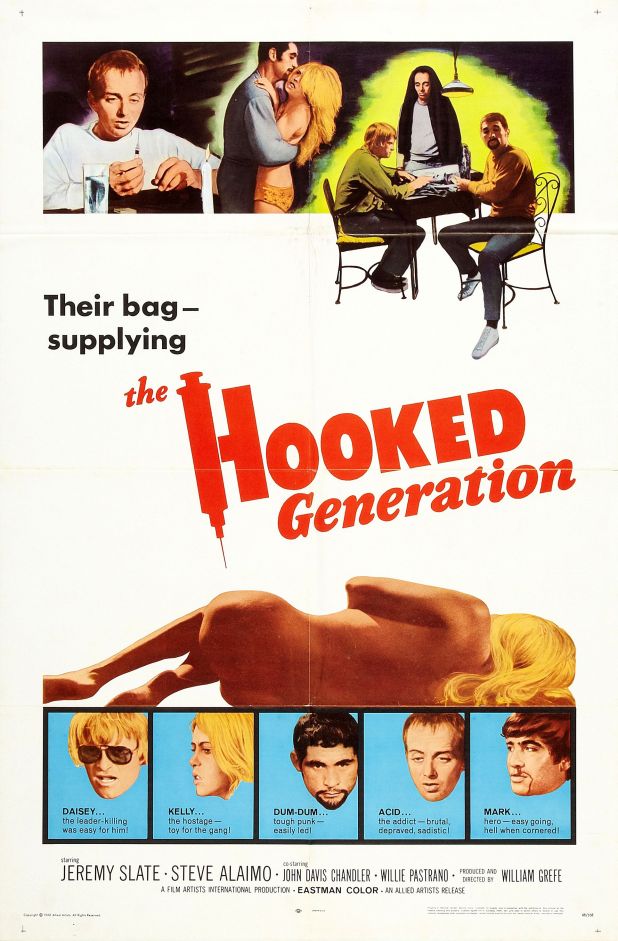
WILLIAM GREFE WEEK: The Hooked Generation (1968)

The films that William Grefé made in Florida feel sweaty and messy and filled with menace, just like the Sunshine State itself, the kind of place that could give you both the Happiest Place on Earth and bands like Deicide and, well, Creed.

This time around, Grefé is telling us the story of a group of three drug pushers who are no longer content to kidnap people and assault women. No, they’re in for the big score, killing their Cuban drug suppliers, an act that puts them on a one-way ticket to the kind of horrible end that can only be found in a regional drive-in movie.

Daisy (Jeremy Slate, The Born LosersTrue Grit), Acid (John Davis Chandle, who is also in Grefé’s Mako: The Jaws of Death and Whiskey Mountain, as well as playing the lead bad guy in Adventures In Babysitting) and Dum Dum (Willie Pastrano, who Grefé hired for The Wild Rebels and The Naked Zoo) are absolute scumbags that spend the majority of this movie doing horrible things and talking as much as they can to pad things out.

Look for William Kerwin — who you may know from Herschell Gordon Lewis movies — shows up as an FBI agent.

This movie can be found on the new Arrow Video He Came from the Swamp set that you can grab from Diabolik DVD.

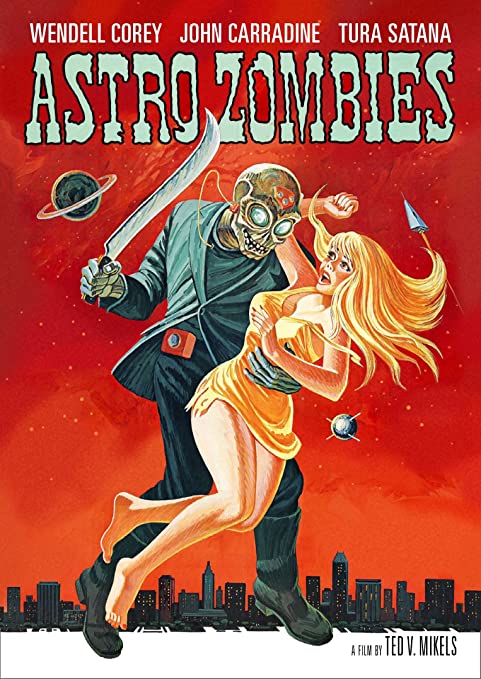
Astro-Zombies (1968)

Look, if you’re going to do the work to make unliving body parts into unstoppable killers, do not make them stoppable by giving them the weakness of having a flashlight shined into their brains.

Ah, who cares! We should all dream for a life like Ted V. Mikels, who lived in a literal castle in Las Vegas, partying hard with his Castle Girls. The craziest of lives — in fact, many of his films — seem downright boring compared to his real life.

Working alongside Wayne M. Rogers — yes, the guy from M*A*S*H* — Mikels made this Cold War opus that also features John Carradine (who made 10% of the film’s budget) and an army led by Tura Satana, which is one I would definitely serve in.

Carradine plays Dr. DeMarco, who is using his Astro-Zombies to get revenge against everyone who called him mad by, well, being absolutely mad.

Shot on short ends at Peter Falk’s house, this film was often said to be amongst the worst ever made by critics. Well, it reached one impressionable youth in Lodi, New Jersey. Glenn Danzig’s band The Misfits would introduce this movie to their fans with the song of the same name, featuring the lyrics, “With just a touch of my burning hand / I’m gonna live my life to to destroy your world / Prime directive, exterminate / The whole fuckin’ race.”

You can watch this on Amazon Prime.

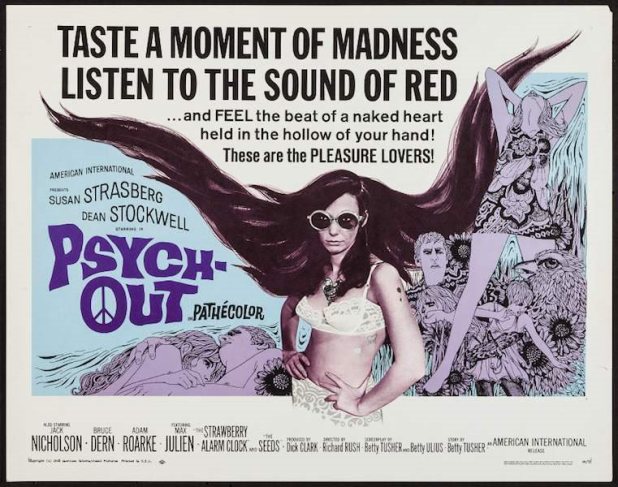
Psych-Out (1968)

Dude, Richard Rush has sure made some disparate movies. There’s Thunder AlleyHells Angels on Wheels and The Stunt Man, then there’s Air America and Color of Night. But he also made this, which reminds me that if I was alive in 1968, I would have died young.

Jenny (Susan Strasberg) is a deaf girl looking for her brother Steve, who left behind a note that said, “Jess Saes: God is alive and well and living in a sugar cube.” That leads her to Haight-Ashbury and the band Mumblin’ Jim, led by Stoney (Jack Nicholson).

Henry Jaglom, who wrote My Lunches With Orson: Conversations Between Henry Jaglom and Orson Welles, is an artist that does the band’s posters. When they go to see him, he’s so messed up on 2,5-Dimethoxy-4-methylamphetamine that he thinks everyone is the living dead and threatens them with a saw. But that’s where Jenny sees some of her brother’s art and learns that he’s become a traveling preacher known as The Seeker. Dave (Dean Stockwell), who left the band, offers to help them find him, but everyone nearly dies in the junkyard when the gang — look for John “Bud” Cardos — attack.

The Seeker shows up and yep, he’s Bruce Dern. He reveals that Jenny was beaten so badly by their mother that she had a stroke and went deaf. He wants to be clean from drugs when they meet. Meanwhile, his sister is caught between Stoney and Dave.

This movie ends as all hippy films must, in death and fire, as Stoney sets his shrine ablaze and Dave saves a tripping Jenny from a car coming right at her by sacrificing himself, remarking that he hopes death will be a good trip as he dies.

Dick Clark produced this and like a true square, he wanted the drug message to show how wrong it was to get hooked. Ah, I’m being mean.

Let’s be nice — the stunts and special effects are by Gary Kent, whose adventures make up the documentary Danger God. The Strawberry Alarm Clock, The Seeds and The Storybook made most of the music in this and the concert scenes are worth watching the entire film. Plus, Garry Marshall plays an undercover cop!