Barry Mahon may struggle to make a decent movie at times, but he’s always great at coming up with titles that make me grab his films.
This time, he’s telling “the startling story of a girl who would do anything with anybody at anytime.” “A young girl alone…marked for death by the crime syndicate!” “The exciting story of Laura…a call-girl!”
Despite their lurid titles and rampant nudity, Mahon’s films are the very antithesis of sexiness. Instead, Lauren (Gretchen Rudolph*, My Body Hungers) goes out of control, from bad teen to someone using drugs and selling sex. Then, you know, as these things happen, a sniper starts shooting at her.
Bob Strong, who is in this, is better known for writing the song “I Hear Wedding Bells,” which is in the movies Breaking Up and Grumpier Old Men. He appears alongside several women who show up in more than one Mahon film, like Susan Evans (she played Fanny Hill in more than one of his movies) and Janice Kelly.
Oh yeah! Keith McConnell is in this and his career stretches from 50’s adventure movies and TV to exploitation like this and ending his acting career as Lord Cavendish in one of the first adult — well, softcore — movies I ever saw, Young Lady Chatterley II.
There are moments in A Good Time with a Bad Girl where you’d be fooled into thinking that Barry Mahon is eschewing the typical nudie cutie movies that he always makes — when he isn’t making roughies — and filming something really personal: the idea that when a middle-aged man finally goes through with the affair he always wanted with a teenage girl that real life can’t mentally or physically live up to his fantasy.
Then there’s a really long sequence where a girl gets a backrub with that kind of 1960’s massage device that looks like a laser gun.
A millionaire falls for a girl with no morals — she’s the one getting the massage we mentioned above — but all she does is giggle, say groovy and read comic books. Other than being much younger than his wife, it’s hard to see the obsession. That said, perhaps that’s exactly the point this movie makes in spite of itself.
Oh yeah, one more time about that massage. That’s John Beck as the cowboy. He was in Rollerball, Sleeper and Audrey Rose.
I would never recommend that anyone watch this movie, but I certainly wouldn’t tell you to miss it. I’m weird that way.
Barry Mahon’s movies often have no plot, just women being whatever he thinks women are. This time, however, it’s all about a female detective named Busty Brown* (Laurie Dane’s only role) as she helps an Asian shopkeeper keep his daughter (Lotus Lee) from dancing nude in a go-go bar for one of his rivals. Of course, it’s against her will and Busty must protect her innocence.
The incredibly woke thing — for 1967 — is that the Asian male sidekick is presented as a sex symbol and has scenes where he makes love — seriously, this movie is near PG-13 in its 2021 level of sleaze — to white women, which had to seem groundbreaking or upsetting depending on your levels of racism in 1967.
“She broke the case with every weapon she had available!” sure sounds better than “Barry Mahon made this movie in only two days!”
Directed by Roger Corman, written by Jack Nicholson and released by American-International Pictures, The Trip cost $100,000 to make and brought in $6 million dollars. Hollywood was listening, because within the next year, movies for the love generation were all over the place*.
In fact, seven years after this movie, AIP’s Samuel Z. Arkoff said, “Everybody else picked it up; and as late as last year they were still coming out with dope pictures. And there isn’t one single company that made a buck on dope pictures. The young people had turned off.”
You know what makes Paul Groves (Peter Fonda) try LSD? He gets his heart broken by his wife (Susan Strasberg) and joins John (Bruce Dern) to take his first trip. He runs in fear from John as the trip over takes him, wandering through a nightmare world of sex, death, commercialism and mental transformation.
Corman took LSD himself to understand what it should look like on film, which ends up being quick edits, paint on nude women and small people trying to frighten the viewer.
While you can see the International Submarine Band, with Gram Parsons on vocals, the music in the movie comes from The Electric Flag. Music is a big part of this movie, as Dern’s line “Turn off your mind, relax, and float downstream” comes directly from The Beatles “Tomorrow Never Knows.”
Other folks to look out for include Salli Sachse (How to Stuff a Wild Bikini, Wild in the Streets), Judy Lang (Count Yorga), Luana Anders (The Pit and the Pendulum), Dick Miller (I mean, it is a Corman movie after all), Michael Nader (so many beach movies), Michael Blodgett (Lance Rock from Beyond the Valley of the Dolls), Sunset Strip tastemake and KROQ DJ Rodney Bingenheimer, Peter Bogdanovich, Randee Lynne Jensen (so many bikers movies), Joyce Mandel (Return of the Ultra Vixens) and Angelo Rossitto (everything from Freaks to playing The Master in Mad Max Beyond Thunderdome).
The Trip attempts to film the unfilmable and for that, we should celebrate it.
*For example, the next year, Peter Fonda, Dennis Hopper, Jack Nicholson and Luana Anders would all appear in Easy Rider.
Narcotics: Pit of Despair is an over-the-top yet at times effective anti-drug short from 1967 tracing the fortunes of a hapless college student who quickly declines from Lawrence Welk Show extra to pot smoker to straight-up junkie in a matter of a few weeks. It has some genuinely scary scenes, but ultimately suffers from a cliché script and an unconvincing plot.
The short follows the adventures of John, a young college student played by Kevin Tighe of Emergency, who is facing the normal issues of a sixties college student: bad grades, his struggle to stay on the track team, and neglectful parents. He naturally turns for guidance to the campus drug dealer, Pete, played by Gerald LeRoy at the beginning of an illustrious career consisting entirely of this role. Pete invites him to a party where, rather than just selling him drugs, he and his girlfriend go through a convoluted scheme to manipulate him into smoking pot.
The sequence where John is first introduced to drugs is key to what is wrong with this and so many other anti-drug films. In the world of Narcotics: Pit of Despair, a drug dealer isn’t simply a criminal engaged in illicit commerce; he is a straight-up hunter of souls who entraps his victims like a spider. After having his girlfriend feign interest in John, they lure him into a back room where people are smoking marijuana, then pressure him into smoking a joint himself. From there, it is a “natural” progression to injecting heroin. No self-respecting drug dealer is going to go through this much effort to get one customer. The introduction to drugs is likely to be much more casual, quite possibly by a friend rather than a drug dealer.
This scene is further undermined by the fact that the film has no dialogue, relying entirely on a narrator. Aside from the overall weakness of narration for moving a plot along, the narrator’s script is beyond hackneyed, with laughable attempts at mimicking “hip” youth lingo. The narrator’s flat delivery of lines like “Shake this square world and blast off for kicksville” undermines any attempt to take the material seriously.
In spite of these major flaws, the film does have one strong scene. Shortly after being introduced to heroin, John is forced to go cold turkey. The sequence is truly disturbing, with John thrashing on a bed from withdrawal. His fellow drug addicts bind and gag him to the bed so that he won’t attract police attention. Scenes like this show the actual dangers of drugs, and it would be better if more PSAs featured them. The film also ends on a dark note, reminding viewers of how easily addicts can slip back into drug use.
Narcotics: Pit of Despair can be found for free on both YouTube and the Internet Archive. However, the prints are not in good condition, featuring missing frames and scenes where the sound taps out.
ABOUT THE AUTHOR: Jennifer Upton is an American (non-werewolf) writer/editor in London. She currently works as a ghostwriter of personal memoirs for Story Terrace London and writes for several blogs on topics as diverse as film history, punk rock, women’s issues, and international politics. For links to her work, please visit https://www.jennuptonwriter.com or send her a Tweet @Jennxldn
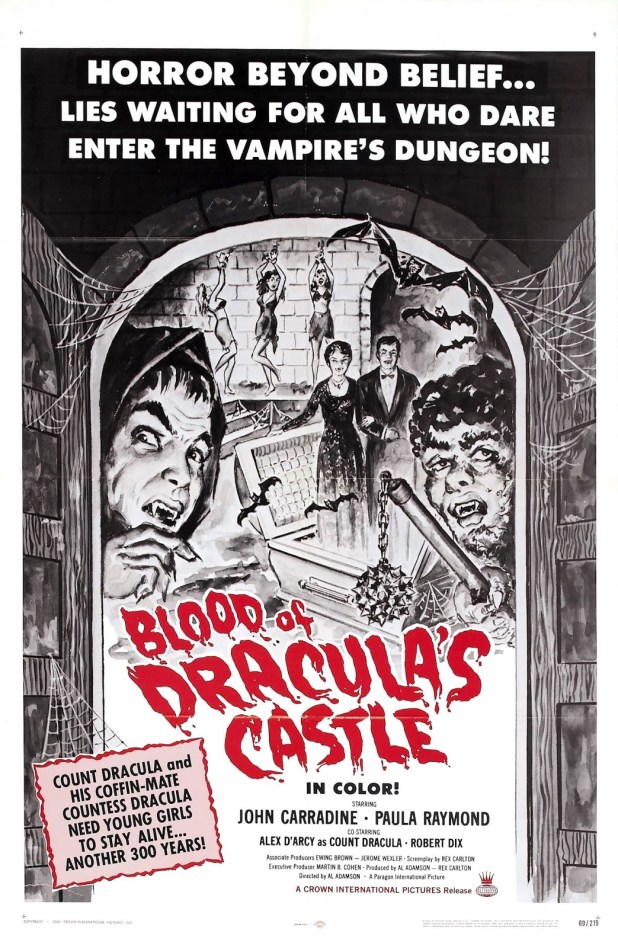
Blood of Dracula’s Castle (1967) is truly a boring film, even for Al Adamson, who is not known for making great films. The most exciting bit of action in this movie was the scene-stealing walrus in the opening scene shot at the old Marineland in Palos Verdes, California. That walrus puts in a more energetic better performance than any of the human actors.
The story concerns Mrs. and Mrs. Count Dracula, who have essentially retired as “The Townsends” to a castle in the California desert (Falcon Rock Castle Antelope Valley, California.)
Now free from a life of killing villagers in Europe their new life is one of leisure. There’s no more hunting for these two elites! Their new bougie diet consists mostly of bloody cocktails prepared for them by their butler George played by John Carradine, a priest in a cult who worships Luna the Moon God along with the Townsends.
The blood comes from the various girls kept chained in the basement, most of whom are collected from the nearby highway and brought home by their deformed Igor-like caretaker Mango played by Ray Young. A tall stunt actor better known as the boulder-throwing half of The Kroft Supershow staple Bigfoot and Wildboy (1976.)
The Townsends and also have a strange relationship with a local serial killer named Johnny (Robert Dix). Although how he came to be close with the Townsend’s is never explored, they seem to have a reciprocal relationship. One in which he brings them victims for promised initiation into vampirehood. In the alternate television version (yes, there are two versions of this snorefest – both available online) Johnny is a werewolf.
After escaping from a mental institution, Johnny kills a few people just for the hell of it on the way home to the castle. Here, the added werewolf scenes actually make sense. Somewhat. In the original version Johnny mentions repeatedly how he can’t control his murderous urges when there’s a full moon. The problem with the new inserts lies in the fact that they were clearly shot years later. The hairstyle and wardrobe of the victim places it squarely in the ‘70s and the electronic music bears no resemblance to the music in the rest of the film.
One would think that a police pursuit of a serial killer/werewolf would be exciting. It isn’t. That’s the problem with this movie. Even when things happen it doesn’t feel like it. There’s an utter lethargy to the acting, camera placement and editing. During the chase, the screen direction is completely off and there is very little foley to bring the soundtrack to life.
Once reunited, the Townsends, Johnny, George and Mango now have a new problem to contend with. They must find a new place to live. Sadly, after a nice, calm, sixty-year tenancy, their 108-year-old landlord has died, leaving the castle to his nephew. The new landlord – a photographer named Glenn Cannon and his perpetually complaining model fiancé Liz decide they’re going to live there.
When they show up to inspect the place, instead of chaos, we are treated to a series of long civil discussions between the characters. Most disappointing of all is that the vampires never do anything. They’re far too spoiled and sophisticated. Count Townsend (played by Horrors of Spider Island star Alex D’arcy) is so nonchalant that at one point he tells a potential victim, “Oh, no. We won’t kill you. We need your blood,” with the calm tone of a man making small talk. They don’t even fight when Glenn ties them up in the finale. They’re far too used to being looked after by their staff to do anything as vulgar as defend themselves. If the Howell’s on Gilligan’s Island were vampires, this is exactly how they’d behave. The effect is equally as comical. However, they don’t go as gently into the ether as one might think. After sacrificing a girl on the beach to Luna, aging and turning to dust when the morning sun shines through the window, two bats emerge from the vampires’ fancy party clothes and fly off. Perhaps to rent another castle somewhere else and start over. George and Johnny are dispatched by our heroes.Glenn saves Liz. Mango gets shot, axed and thrown off a cliff. It should be exciting. It isn’t.
Editor’s Note: We reviewed this early Harry Dean Stanton flick on March 13, 2020, as part of its inclusion on Mill Creek’s Explosive Cinema 12-pack. It’s back as part of its inclusion on Mill Creek’s B-Movie Blast 50-film pack.
Lots of Henry Farrell’s stories got turned into movies. Hush…Hush, Sweet Charlotte, Such A Gorgeous Kid Like Me, How Awful About Allan, The House That Would Not Die, What’s the Matter with Helen?, The Eyes of Charles Sand and, most famously, What Ever Happened to Baby Jane?
His first book, The Hostage, was turned in to this low budget Crown International film, which was directed by Russell S. Doughten Jr., who would go on to executive produced the entire A Thief In the Night series of Christian pre-millenial madness. God bless you, Mr. Doughten, for all you have given to me.
A kid named Davey Cleaves sneaks on to a moving truck driven by the bonkers man named Bull (Don Kelly, a TV star who died young as this is his final movie) and his partner Eddie (a very young Harry Dean Stanton).
John Carradine shows up, as he does at least seventeen times a week in movies that I watch, as does Ann Doran, whose career started in the silent era.
This was the first movie ever shot in Iowa. What a joy for the state when a drunken John Carradine was arrested in Des Moines, as he was disturbing the peace by loudly acting out various Shakespeare plays.
You can watch this on Tubi. Or You Tube. Or turn to the Mill Creek Explosive Cinema set that we’ve been covering all week.
Back in the day, the concert industry wasn’t a Live Nation money pit. And there was no MTV. There wasn’t even a Midnight Special. Or a Don Kirshner’s Rock Concert. Or ABC-TV’s In Concert, produced by Don (read our “Exploring: The Movies of Don Kirshner” feature for more on Don’s TV and film exploits).
No, for back in those pre-cable and World Wide Web days of yore, in order to see all of those music stars of the radio, you went to the drive-in. You know the films: Alan Freed’s Mr. Rock and Roll and Rock, Rock, Rock in particular, films that had nary a plot and were padded with musical performances — which were the whole point of the films in the first place: for record labels to promote their artists. And since not everyone had TVs yet, the more accessible movie theater was the next best thing. Oh, yes. These flicks were performance-padded rock concerts that masqueraded as dramatic-comedy narratives . . . well, in reality, aren’t they just rock documentaries?
So, just like Alan Freed gathering up the kids and the artists for a big show in those films, here we have a Hollywood studio wanting to jump on the Elvis-inspired country music crazy and make a movie. So they send out Colonel Feetlebaum (Doodles Weaver . . . Oh, you’ll know his face when you see it; we reviewed his exploitative work in Hot Rod Gang, Trucker’s Women . . . and that’s just two of his 150 TV and film credits) to round up Marty Robbins (who produced this as a vanity showcase) along with Webb Pierce, Waylon Jennings, Bill Anderson, Porter Wagoner, and Dottie West. Of course, no county film is complete without Johnny Cash (in his second film: he made his dramatic acting debut in 1961’s Five Minutes to Live, aka the more sensational Door to Door Maniac; he followed up Road to Nashville with 1971’s A Gunfight). Oh, and did you know this is Marty Robbins’s second bow on Mill Creek’s B-Movie Blast 50-Film pack? And did you know he raced stock cars? Marty did, and he made a film about it (with John Ashley of Blood Island fame), Hell on Wheels, which, if you’re keeping track of our Mill Creek Mania at B&S, that flick is also on their Savage Cinema set.
Oh, the brains behind it all: Will Zens, he who gave such drive-in delights as The Starfighters (1964), the aforementioned Hell On Wheels and Trucker’s Women, as well as the redneck romps Hot Summer in Barefoot County and Redneck Miller.
The cinematographer on this? The legend that Kevin Smith eloquently referred to as “a stubborn old cuss,” aka “ornery old cuss” (depending on the story-version regarding their mutual exploits on Jersey Girl): Vilmos Zsigmond. Cuss or no, ornery or not . . . just wow, there’s so many B&S films Vilmos has done (Psycho a Go Go, for one), as he worked his way up to Deliverance (with Burt Reynolds), Scarecrow (with Richard Lynch and Al Pacino), The Deer Hunter (Robert DeNiro), and Close Encounters of the Third Kind.
Editor’s Note: This review originally ran on August 6, 2020, a part of our reviews for Mill Creek’s Savage Cinema 12-Movie collection. We’re bringing it back as part of Mill Creek’s B-Movie Blast 50-Film pack.
The Savage Cinema set from Mill Creek just keeps on rolling this week, bringing to us not only some NASCAR, but former racer turned country star Marty Robbins, who sang “El Paso” and “Honkytonk Man.”
Three brothers — stock car driver Marty (Robbins playing himself), mechanic Del (John Ashley, the man from Blood Island) and revenue agent Steve — all have their issues. Marty is trying to be a star, Del wants to be Marty and Steve is busting some moonshiners.
Del tries to out do his brother to prove himself to his girlfriend Sue (Gigi Perrau, The Cool and the Crazy) and the gang ends up almost killing them all. Meanwhile, Connie Smith and the Stonemans play a whole mess of songs.
The entire film was independently made in Nashville, Tennessee. John Ashley told Trash Compactor, “Marty was a terrific fellow and a great singer, and I was a big fan of his. He was a stock car racer, loved stock cars, and the producers had put this thing together. They said to me that this was going to be his motion picture debut, and they needed me to play his brother and basically carry the movie. So I went down there for six or seven weeks.”
This was directed by Will Zens, who also made Trucker’s Womanand Hot Summer in BarefootCounty, two Joe Bob Briggs-approved redneck movies.
EDITOR’S NOTE: This review originally ran on August 8, 2020, as we watched the Savage Cinema box set. Then we brought it back on November 22, 2020, as part of our “William Grefe Week.” And Mill Creek, never to let a cool film die, has brought it back as part of their B-Movie Blast 50-Film pack.
William Grefe came right out of the Florida swamps and demanded that you watch his films. He was second unit on I Eat Your Skin before unleashing films like Mako: The Jaws of Death, Death Curse of Tartu and Stanley, a movie in which a young man menaces Alex Rocco and Marcia Knight with snakes.
Rod Tillman (Steve Alaimo, whose life took him from being in the Redcoats, whose song “Mashed Potatoes” hit #75 on the Hot 100, hosting Dick Clark’s Where the ActionIs and even owning TK Records, who dabbled in the Miami bass scene) is a stock car racer out of cash. He sells everything he owns and enters Swinger’s Paradise where he does nothing if not swing. Actually, that’s where he meets Satan’s Angels, a biker gang who needs a getaway driver for a con they have in mind.
They are Banjo (Willie Pastrano, who held the unified world light heavyweight boxing titles (WBA, WBC, The Ring) from 1963 until 1965), Fats (Jeff Gillen, yes, Jeff from Children Shouldn’t Play With Dead Things and the director of Deranged: Confessions of a Necrophile, as well as Santa Claus in A Christmas Story), Linda (Bobbie Byers, the voice of Johnny Sokko in Voyage Into Space) and Jester (John Vella, who played for the Oakland Raiders).
The cops try and get Rod on their side too, but he’s all into Linda, who claims she doesn’t do the crimes for the financial prize, but for the kicks. It all ends up in a lighthouse shootout between the cops, the bikers and our hero, who is caught between both sides.
Featuring real-life members of the Hell’s Angels and a Tampa garage rock band known as The Birdwatchers — you know, for the kids — this movie is probably amongst the best on this set. It also has, I can assure you, motorcycles in it.
You can either watch this on YouTube or see the Mystery Science Theater 3000 version on Tubi.




 B&S About Movies
You must be logged in to post a comment.