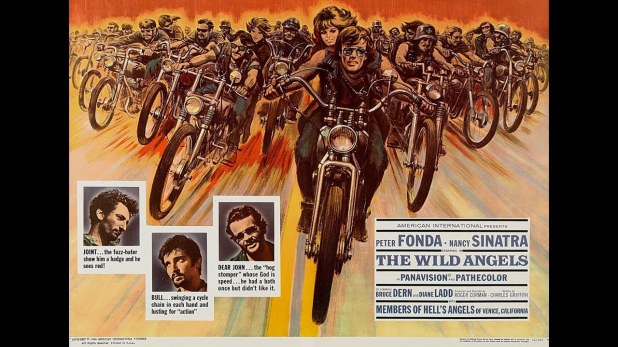
The Wild Angels earned $7 million on a budget of $360,000, making it the highest-grossing low-budget film of its era. Not bad for a movie that had script issues between Roger Corman and Charles B. Griffith, as well as numerous re-writes by Peter Bogdanovich. Plus, the US State Department tried to prevent the film from being shown in Venice on the grounds that it “did not show America the way it is.”
And yet the Hells Angels brought a $5 million defamation lawsuit against Corman for how they were portrayed in this movie, which really makes me want to be a biker. Maybe they didn’t notice while they were acting as extras, each getting paid $35 per day for their cooperation and $20 per day for their motorcycles.
It’s also the first movie that Peter Fonda would be associated with the counter-culture and motorcycles. While promoting The Trip and autographing astill from this movie showing he and Bruce Dern on one motorcycle, the actor came up with the concept for Easy Rider.
It’s also a movie packed with taglines that shove you into the theater like “Their credo is violence…their God is hate…and they call themselves The Wild Angels” and “The most terrifying film of your time!”
Heavenly Blues (Fonda) shouts, “We wanna be free! We wanna be free to do what we wanna do. We wanna be free to ride! We wanna be free to ride our machines without being hassled by The Man. And we wanna get loaded. And we wanna have a good time. And that’s what we’re gonna do. We are gonna have a good time. We are gonna have a party.” That opening is at the beginning of Primal Scream’s “Loaded,” which informs so much of Edgar Wright’s The World’s End.
This episodic film moves from trying to find Joe “Loser” Kearns’ (Dern) stolen motorcycle to the gang evading the police to plan the Loser’s funeral and how Blues, Loser’s girl Gayesh (Diane Ladd) and Blues’ lover Mike (Nancy Sinatra) are pulled along as the gang disintegrates as a final party descends into madness.
The close of this movie, as Blues shovels dirt onto the grave of his best friend and says, “There’s nowhere to go,” is exactly why I keep coming back to Corman movies, which have such a heart and something to say in the midst of the mayhem and carny edge that get you into the theater.
We also have this movie to thank for Laura Dern, as the daughter of Dern and Ladd was conceived while this movie was being made.
ABOUT THE AUTHOR: Clinton Rawls is an instructor at the Lamar Institute of Technology where he teaches courses on the humanities, art history, and film appreciation. As a labor of love, he translates foreign language and unofficial James Bond comics into English for the first time on his website, Comics Royale. Drop him a line and enjoy more 007 adventures!
Note: You can see also read’s Sam’s take which was posted on September 6, 2021.
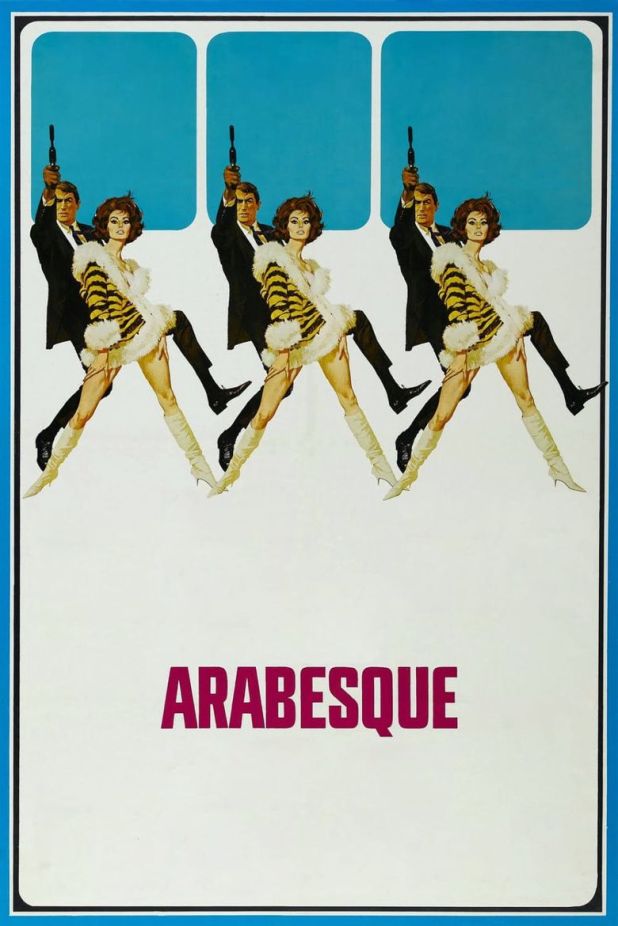
Hitchcock. Even today the name looms large. An auteur so iconic the label “Hitchcockian” still carries weight. Many filmmakers have created their own riffs on the Master of Suspense: Martin Scorsese (Shutter Island, The Key to Reserva), Brian De Palma (Obsession, Dressed to Kill, Body Double), even Mel Brooks (High Anxiety), but few have been as successful as the great Stanley Donen with back-to-back films Charade and Arabesque. While Charade is more highly regarded, Arabesque (1966) is a sumptuous visual feast which remixes Hitchcock’s tropes with a nod to the sixties spy craze and an eye toward the future.
Hitchcock rarely concerned himself with plot, preferring instead thematic tensions and cinematic devices, but his films can easily be summed up in a sentence. “The wrong man, accused of a crime he didn’t commit, goes on the run to prove his innocence,” could apply to The 39 Steps, Saboteur, The Wrong Man, Frenzy, and of course, North by Northwest. So little was Hitchcock preoccupied with the specifics of plot that he used the term “MacGuffin” as a catch-all for whatever moves the story along. Would a heist film be any different if the money were diamonds instead? Would it matter if the villain in a superhero movie wanted a bioweapon or nukes? Not really.
However, a Hitchcock film still makes sense and the same cannot quite be said about Arabesque, though it hardly matters. From the beginning, Donen and cinematographer Christopher Challis show us a man subjected to an eye exam where the lighting and camera angles shift so wildly it assaults the viewers’ senses. Just like the random letters one recites to an optometrist, the words in this film are meaningless. Donen makes his game plan clear when Gregory Peck, lecturing on Egyptian hieroglyphics to apathetic university students, awakens them by shouting, “Sex!” Strap yourself in, adjust your eyes, ignore the plot, and if you get bored… Sophia Loren!
Donen began his career as a dancer and choreographer, and those skills aid him well here. The performers hit their marks, allowing dozens of marvelous visual compositions to dazzle the eye. Like a stage performer, Loren moves gracefully through the scenery, framed within hypnotic designs and illuminated by a spotlight. Characters are distorted in reflections, and the filmmakers give us frames within frames to the point that a simple two-shot or close-up might seem base if not for the star power of Peck and Loren. Challis’s work is a testament to the power of widescreen filmmaking. Throughout the fifties and sixties, Hollywood deployed several gimmicks to compete with television: Cinerama, Cinemascope, 3D, even Smell-O-Vision all sought to peel audiences away from the typically flat, rote imagery on their TV sets. Arabesque makes the most of its Technicolor Panavision frame with dizzying delight. Eventually television would influence films for the worse as close-ups dominated coverage and more movies were shot in aspect rations that would translate well to pan-and-scan. Arabesque is a relic of a time when filmmakers had a bigger canvas to play with, and they did not waste it.
Both this and North by Northwest feature an ordinary man swept up in international intrigue with a beautiful double agent. Along the way, our hero is drugged and left for dead, and framed for murder in plain sight. Even Hitchcock’s celebrated crop-duster sequence is referenced as our heroes are victimized by a wrecking ball and later by farm combines in an alfalfa field, though the helicopter finale and romantic denouement on a gondola owe just as much to From Russia With Love. Where the film fails in comparison to Hitchcock is Alan Badel’s villain who, while a bit quirky, never conveys the icy menace as only James Mason could. In addition, Peck doesn’t have much of an arc but he’s along for the ride like the rest of us, and it’s refreshing to see him exercise his comedy chops. If you want more Hitchcock callbacks, Donen presents a scene at the racetrack courtesy of Notorious. The press conference assassination is reminiscent of Foreign Correspondent. And Peck’s surreal, drugged-out nightmare must have given him flashbacks to Spellbound.
Where Donen bests Hitchcock is in his willingness to film on location. The drugging scene feels dangerous as cars whiz past Peck mimicking a matador on a busy highway. The hallucinogenic visuals, wide-angle shots, double exposures, and trippy editing prove more effective than Cary Grant in front of a rear projection screen ever could. Loren is likewise in complete control, shifting wildly from femme fatale to damsel to action hero to love interest without ever feeling out of place. By the time the film turns into a political assassination thriller and the heroes hijack a news van to look for clues on grainy monitors, we’re reminded this was made in between the Kennedy assassinations. For a moment, the romantic lightness takes on an eerie solemnity as we witness a film made at the crossroads of history. It’s incredible to think not even a decade later, Alan Pakula’s The Parallax View would remix some of these plot elements and cinematic devices while ditching romance and spectacle for something altogether more cynical.
Unfortunately, the title is apt for all the wrong reasons. There are no Arabians in this film, only actors in brownface. The MacGuffin is an Egyptian cipher. No exotic locations in the Middle East nor Islamic architecture contribute to art design. Even the title sequence by Bond series regular Maurice Binder is mod optical illusions rather than the titular curvilinear designs. The film is in the style of the Arabs; it puts the “esque” in Arabesque.
Criticism aside, Arabesque is a terrific watch with one foot in the past, one in the present, and one in the future. Maybe a three-footed creature doesn’t make a lot of sense, but neither does the plot. Style over substance? Definitely. But when you’ve got such style, sometimes that’s all you need.
Arabesque is available on Blu-Ray from Kino Lorber.
When a general’s son is taken hostage as ransom to free a bandit leader, the general’s daughter Golden Swallow (Cheng Pei-pei, who Western audiences may recognize as Jade Fox from Crouching Tiger, Hidden Dragon) goes to rescue her brother and battle the bandit gang. She’s protected by a drunk named Fan Da-Pei (Yueh Hua), who is really Drunken Cat, a secret martial arts master, who saves her from a poison dart.
The bandits have worked their way into a monastery led by an evil abbot named Liao Kung (Yeung Chi-hing), who once helped Fan Da-Pei to be accepted into the school that taught them both their martial arts skills. As a result, the hero doesn’t want to battle him. He also believes that there’s no way their battle won’t end in death.
Director King Hu also made A Touch of Zen, which is an essential Hong Kong film. There’s an urban legend that Jackie Chan is rumored to play one of the child singers at the beginning of the film, but Pei-Pei Cheng has stated that he is not in the movie.
I’m really excited that Arrow is releasing so many Shaw Brothers movies. I love that I can finally own high quality versions of these films and watch them over and over again.
The Arrow Video blu ray release of Come Drink With Me has a 1080p blu ray of the movie with uncompressed Mandarin and English original mono audio, plus optional English subtitles. There’s also new audio commentary by film critic and historian Tony Rayns and interviews with Cheng Pei-pei, Yueh Hua and Chen Hung-lieh, filmed by Frédéric Ambroisine in 2003, as well as a Q&A with Cheng. It also features Cinema Hong Kong: Swordfighting, a documentary on the history of the wuxia genre and Shaw Brothers’ contributions to it that has interviews with Cheng Pei-pei, Gordon Liu, Lau Kar-leung, John Woo, Sammo Hung, Kara Hui, David Chiang and others. Plus, you get an image gallery, the original theatrical trailer, the trailer for the sequel Golden Swallow, a reversible sleeve featuring original and newly commissioned artwork by Tony Stella and an illustrated collector’s booklet featuring new writing on the film by Anne Billson and a 2010 essay by George Chun Han Wang about the relationship between director King Hu and producer Run Run Shaw. You can get it from Arrow Video or MVD.
Come Drink With Me is also on this month’s Arrow Player selections. Head over to ARROW to start your 30-day free trial. Subscriptions are available for $4.99 monthly or $49.99 yearly. ARROW is available in the US, Canada, the UK and Ireland on the following Apps/devices: Roku (all Roku sticks, boxes, devices, etc), Apple TV & iOS devices, Android TV and mobile devices, Fire TV (all Amazon Fire TV Sticks, boxes, etc), and on all web browsers at https://www.arrow-player.com.
EDITOR’S NOTE: We originally watched this movie on May 14, 2021 and are happy to bring it back for this month of all things Franco.
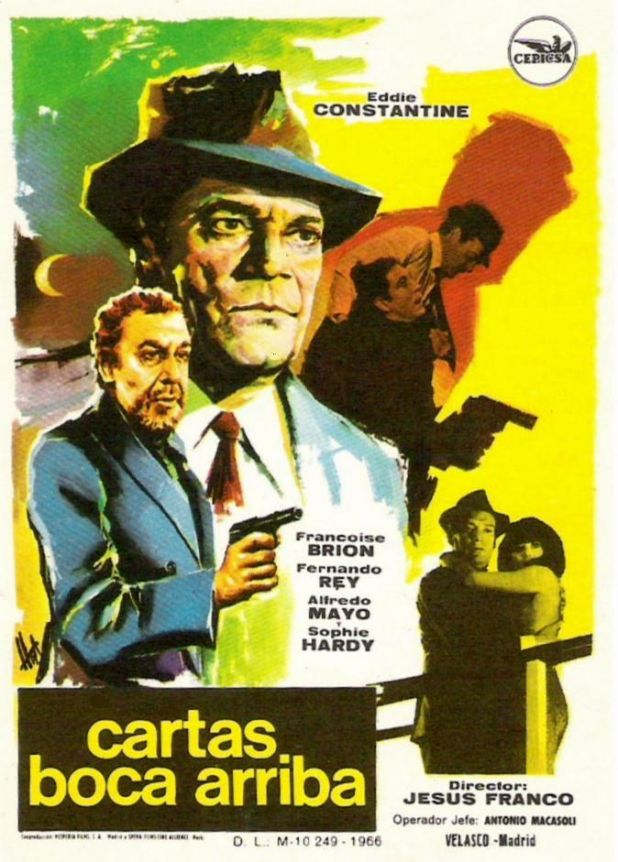
You know, there are times when you get the Jess Franco who is obsessed with sex and times when you get the jazz-loving, Old Hollywood fan Jess Franco and this would be the latter.
This Eurospy affair stars Eddie Constantine as Al Pereira*, who is hunting down a series of bronze-skinned and horned-rim glasses-wearing killer robots commanded by Lady Cecilia Addington Courtney (Françoise Brion, probably the only person to be in movies like Le Divorce and Otto Preminger’s Rosebud, as well as a Franco film) who is using computers to destroy Europe.
So yeah, Jess shows up playing jazz piano, but don’t worry. Plenty of BDSM and mind control lurk right around the corner, instead of appearing full frontal and center. Perhaps the strangest thing about this movie is that it was shot in color and released in black and white. And that it’s nothing like the Franco movies that people dislike his movies harp on.
*Franco would return to the character in the films Les Ebranlées, Downtown, Botas Negras, Látigo de Cuero, Camino Solitario, Al Pereira vs. the Alligator Ladies and Revenge of the Alligator Ladies.
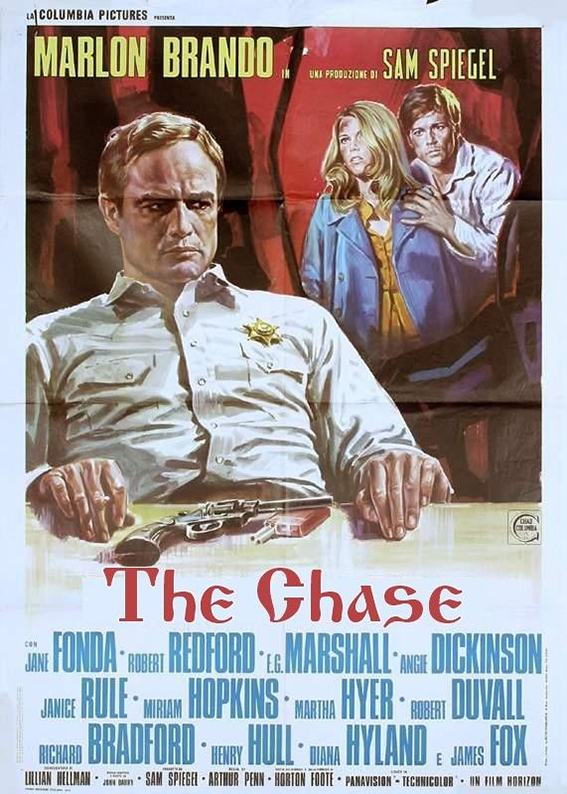
The second Horton Foote adaption on Mill Creek’s new Through the Decades: 1960s Collection — the other is Baby the Rain Must Fall — this Arthur Penn-directed, Lillian Hellman-written movie is even darker than that film, which I didn’t think was possible.
Anna (Jane Fonda) is married to Bubber (Robert Redford), who is currently in jail. She’s still in love with Jake (James Fox), the rich son of the man who runs Tarl County, Val Rogers (E.G. Marshall). And, yes, the best friend of Bubber.
Sheriff Calder (Marlon Brando) believes that Bubber is innocent of his crimes, but when he breaks out, the entire town starts drinking and arguing over when he’ll come back and what will happen. It gets so bad that Calder is brutally beaten by a gang that feels he hasn’t acted to stop Bubber, but he’s saved at the last minute by his wife Ruby (Angie Dickinson).
Everything builds to an inferno — literally — as the vigilantes set a junkyard that Bubber is hiding in ablaze as his wife and best friend attempt to rescue him.
Hill wasn’t happy with the movie, saying “Everything in that film was a letdown, and I’m sure every director has gone through the same experience at least once. It’s a shame because it could have been a great film.” At one point, Penn was asked if he’d like to re-edit the film back to his original vision, but the experience had too many painful memories, such as producer Sam Spiegel refusing him final cut.
Paul Williams wasn’t either, as three months of work led to two lines getting into the actual movie.
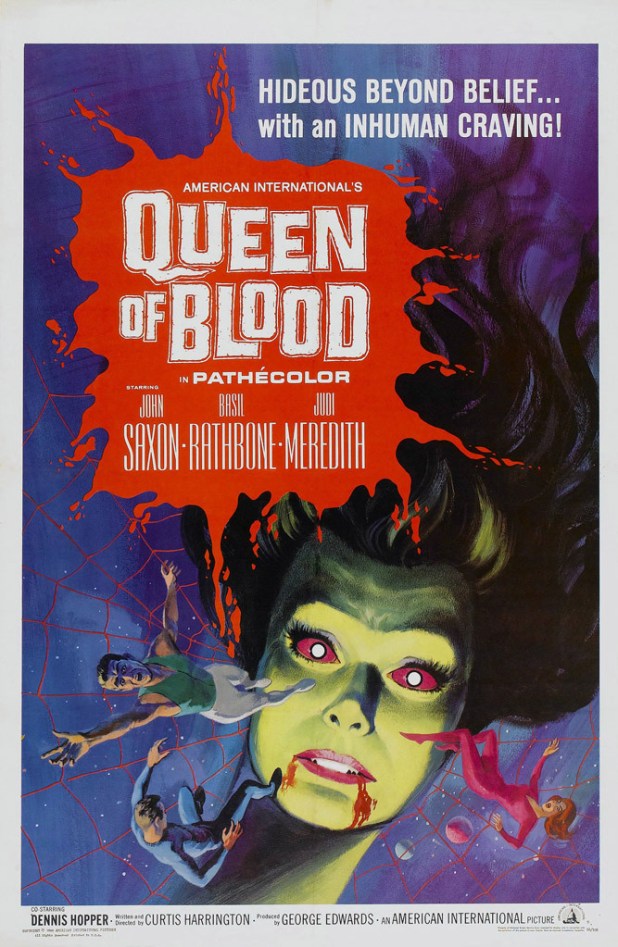
Based on the screenplay for the Russian movie Mechte Navstrechu (A Dream Come True) and using the special effects footage from that film and Nebo Zovyot (Battle Beyond the Sun), this American-International Pictures release, directed by Curtis Harrington, had to have some kind of influence on Alien, right?
Harrington agreed, saying that Ridley Scott’s movie was a “greatly enhanced, expensive and elaborate” take on Queen of Blood.
This movie believes — and it made sense at the time — that by 1990 man would be traveling in space and have united to form the International Institute of Space Technology. Astronaut Laura James (Judi Meredith) hears strange signals from space, messages that Dr. Farraday (Basil Rathbone) believes are from an alien race sending an ambassador to Earth, yet the ship has crashed on Mars.
The ship Oceano is sent to rescue the ambassador but only one dead alien is on board. They decide that a rescue ship must have picked up the crew, but when they follow what they think is the rescue ship, they find only one being on board, a green-skinned alien (Florence Marly, who made a short sequel to this movie called Space Boy! and is also in The Astrologer) and several eggs.
She refuses to eat food, won’t let them take a blood sample and when left alone with an astronaut named Paul (Dennis Hopper), she hypnotizes him and drains his blood. Soon, she takes over most of the male crewmembers and plans on making her way to our planet, with only Laura and Allan Brenner (John Saxon) left to oppose her.
This would be the first movie that Harrington would work with George Edwards (as a line producer for this movie). They met when Edwards produced a stage production of Tennessee Williams’ The Garden District and this movie impressed Universal enough that they hired Harrington and Edwards to make Games.
Sakura Nishi has been sent to a field hospital in Tientsin, the frontline of Japan’s war with the Chinese during the Second Sino-Japanese war.
It’s a losing battle filled with amputation after amputation, as well as soldiers that are emotionally and physically ruined, even going so far as to assault her when she’s one of the few people who can help them. Yet even in this hell — and with the Chinese troops coming to kill everyone — she finds herself giving herself to a man with no arms, trapped in a hospital as he can’t return to Japan and his wife and the public who can never know just how badly the war is actually faring and falling in love with head surgeon Dr. Okabe, who has found himself addicted to morphine.
Even when the man who attacked her comes back injured, Nishi begs Okabe to give him precious blood, but supplies are so low that hardly anyone can be given drugs or fluids. Everyone is chopped into pieces, with Nishi often holding them down so that the bonesaw can do its horrible work. Piles of severed appendages and bodies waiting to be burned prove that this field hospital is just slowing down the inevitable, just as the battles with the Chinese will soon destroy them all.
RedAngel is a brutal film. It’s a punch in the face, a kick to the stomach and a hit to the brain and the people that should see it and be moved and changed by it never will.
As for you, you can grab the new Arrow Video release of Red Angel, which has new audio commentary by Japanese cinema scholar David Desser, a new video essay by Jonathan Rosenbaum, a newly filmed introduction by Japanese cinema expert Tony Rayns, a trailer and image gallery. You can get it from MVD.
I Dream of Jeannie was created and produced by Sidney Sheldon* and it seems like for a long time, he was the only person that believed in it. He originally wanted the first season to film in color — it was one of only two shows on NBC at the time not in color, but special photographic effects employed to achieve Jeannie’s magic weren’t technologically advanced enough to be in a full range of colors yet — but NBC did not want to pay it.
It was $400 an episode.
The network and Screen Gems didn’t think the show would make it to a second season. But Sheldon saw that ABC’s Bewitched was a success and bet on the show.
He was right. It was in the top 30 shows for almost every year that it was on before becoming a syndication powerhouse.
In the pilot episode, “The Lady in the Bottle”, astronaut USAF Captain Tony Nelson (Larry Hagman) lands his one-man capsule Stardust One on a deserted island in the South Pacific. While wandering the beach, Tony notices a strange bottle** that moves by itself. When he rubs it, smoke and a genie (Barbara Eden) pop out.
Tony’s first wish is to be able to understand her, then for a helicopter to rescue him. Jeannie, who has been trapped in the bottle for 2,000 years, falls in love with him and follows Tony back home where she soon breaks up his engagement with his commanding general’s daughter, Melissa. It seems like this was a storyline being set up for the long game, but Sheldon realized that this romantic triangle didn’t have much rope.
Tony keeps Jeannie in her bottle until he realizes she needs a life of her own, which is mostly her using her genie powers to try and make his life better. He worries that if anyone finds out that she exists that he won’t get to be part of NASA, but his worries lead him to being investigated by psychiatrist U.S. Air Force Colonel Dr. Alfred Bellows (Hayden Rorke) with the only person — at first — that knows his secret being Major Roger Healey (Bill Daly).
Unlike many of the sitcoms of the era, I Dream of Jeannie had multipart story arcs (which were created to serve as backgrounds for national contests). For example, nobody knew when Jeannie’s birthday was and the guessing game led to a contest, with the answer being April 1. There was also a four-episode event where Jeannie was locked in a safe on the moon and fans had to guess the combination to save her and another where Tony was replaced and had to be found. But there are also several long storylines, like Jeannie’s evil sister also named Jeannie, Jeannie’s ever-changing origin story which includes Eden’s first husband Michael Ansara as the Blue Djinn, Jeannie taking over the crown of her home country Basenji and so many more.
Supposedly, Hagman was so hard to work with that the producers seriously considered replacing him with Darren McGavin. They even wrote out a story with Tony losing Jeannie and McGavin finding her, but it never ended up happening. In her 2011 book Jeannie Out of the Bottle, Eden wrote, “Larry himself has made no secret about the fact he was taking drugs and drinking too much through many of the I Dream of Jeannie years and that he has regrets about how that impacted him.”
When there were two TV movies in the 80s, Hagman didn’t return. In I Dream of Jeannie… Fifteen Years Later his role was played by Wayne Rogers and as he’s on a space mission in I Still Dream of Jeannie, he’s simply written out and Hagman’s Dallas co-star Ken Kercheval took over as Jeannie’s master. There was also a cartoon called Jeannie that aired from 1973 to 1975 that had Julie McWhirter (who in addition to being the voice in so many cartoons is also the wife of Rick Dees) play Jeannie, “Curly” Joe Besser as Babu a genie in training and Mark Hamill as Corey Anders, a high school student.
Eden has also gone on the record as saying that she never connected with another actor in the same way as she did with Hagman. They’d reunite for the 1971 TV movie A Howling in the Woods.
Why did the show end? It was still near the top thirty after all. Well, Eden believes that there were enough episodes for syndication already and the ratings had gone down after Jeannie and Nelson got married in season 5. No one except for the network wanted that and it eliminated the romantic tension of the show.
I grew up watching this show multiple times a day, often paired with its one-time rival Bewitched. Just going back through these — the original 8 episodes with Paul Frees narration instead of the theme song are a revelation — has made the end of the year doldrums so much better.
You can get all 139 episodes on the Mill Creek I Dream of Jeannie The Complete Series blu ray set. You’ll get hours and hours of fun for a really great price at Deep Discount.
*Sheldon was inspired by the movie The Brass Bottle, which has Tony Randall’s character get a genie played by Burl Ives. Randall’s girlfriend was played by Eden.
**The bottle is actually a special Christmas 1964 Jim Beam liquor decanter containing “Beam’s Choice” bourbon whiskey. How weird is that?
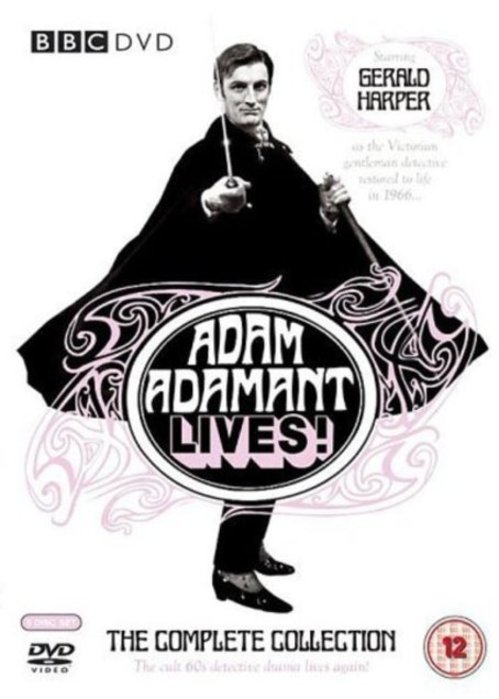
Before Austin Powers was a thing — way before — Edwardian adventurer and gentleman Adam Adamant woke up from a long sleep in 1966 and joined Georgina Jones on a series of adventures. That said, this series also has a dandy gentleman with a hidden sword and a gorgeous and capable female partner three years after The Avengers, but hey — it’s still pretty awesome.
Lured into a trap in the hopes of rescuing the love of his life Louise, The Face had finally trapped his nemesis in a gigantic block of ice. Hiding his identity behind a leather mask and a sinister whisper of a voice, The Face gave Adam one last wish. Ever the gentleman, he asked to see Louise before death. Imagine how he felt when he learned that she was really in league with his archenemy! The last words that he hears — and that haunt him every time he’s unconscious in the episodes — is “So clever, but oh so vulnerable.”
Sixty-four years later — hmm, I wonder if there’s a synchronistic Beatles reference afoot — the building is Adam is buried inside is destroyed and he comes back to life. After running from a hospital and collapsing on the street, he’s rescued by Georgina, who has read all of the stories of his life and wants to be part of his new cases.
Gerald Harper played Adam, while Georgina was a role for Ann Holloway in the now lost pilot and Juliet Harmer in the series. I’ve always found it amusing that Adam constantly believes that Georgina has to be a boy based on the way that she carries herself, while he remains quite the fancy gentleman. Adamant’s manservant, a former music hall artist named William E. Simms, was played by Jack May who is in Night After Night After Nightand Trog.
By the second season of this show — created by many of the men that originated Dr. Who like Donald Cotton, Richard Harris and Sydney Newman (who oversaw the team that came up with The Avengers) — The Face had come back, freezing himself right after Adam and watched over within his ice tomb by Louise.
Only 29 episodes were made and sadly just 17 remain. I wish there were more and I’d love to see this come back as something new, but then people would just think it was stealing from Agent Powers. I was happy to learn that in 2020, Big Finish put out two audiobooks with new adventures. They’ve also put out audio tales of The Avengers, Blake’s 7, Dan Dare, Dr. Who, Dark Shadows, The Prisoner, Space:1999, Terrahawks and many more.
While on vacation in Europe, Roger Corman kept working. He made a $20,000 deal to distribute an as-yet unproduced Yugoslavian Eurospy — Eastern Eurospy? — called Operation: Titian.
Part of the deal was that William Campbell and Patrick Magee would have roles. Plus, Corman would be involved so that the film made sense to Americans, installing Francis Ford Coppola as script supervisor. However, the results were confusing and unreleasable, but they did air on TV in a reduced form as Portrait In Terror.
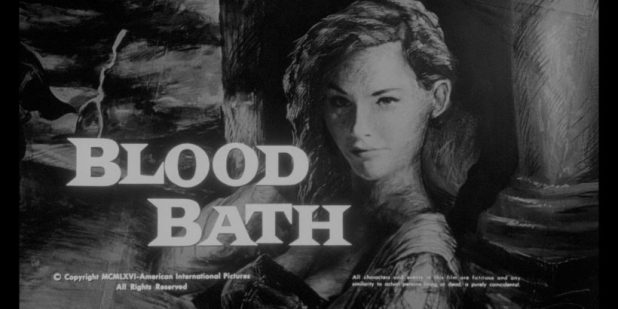
A year or so later, Corman asked Jack Hill to see if he could fix the film. Instead of a spy movie, new footage would be added that made this movie about an artist who kills his models and uses their bodies as sculptures, which sounds a lot like Color Me Blood Redor Corman’s A Bucket of Blood. Campbell asked for more money to come back for these reshoots, which went over with Corman about as well as you’d think. Now called Blood Bath, Corman still disliked the end product.
Enter Stephanie Rothman, who would one day make The Student Nurses and The Velvet Vampire. Now, the antagonist would become a vampire at night and as Campbell wouldn’t come back for free, the character is played by someone else when he transforms at night. This is what American-International Pictures released in theaters along with Curtis Harrington’s Queen of Blood, which Saunders co-produced.
Wait — there’s more. Corman added six minutes of Linda Saunders from Petticoat Junction dancing on a beach and retitled the movie Track of the Vampire.
Anyways, Antonio Sordi is the name of the bad guy and he basically kills women so that he can cover them in wax. Since his vampire and human appearances are so different, he’s never been caught until he falls for Dorian (Saunders), who is an avant garde dancer. There are some wild scenes where she keeps trying to get him to go all the way and that means murder for him, so he keeps running away. Finally, he gives in to his bloodlust — thinking that she’s Meliza, a long-lost love whose breakup drove him to this life (they’re both played by Saunders, so cut him some slack). It’s at that point that all of his wax figures come to life and treat him like Frank Zito.
Look for Sid Haid as a beatnik whose facial hair keeps changing due to all the reshoots and re-edits. Man, what a crazy history and a goofy film.




 B&S About Movies
You must be logged in to post a comment.