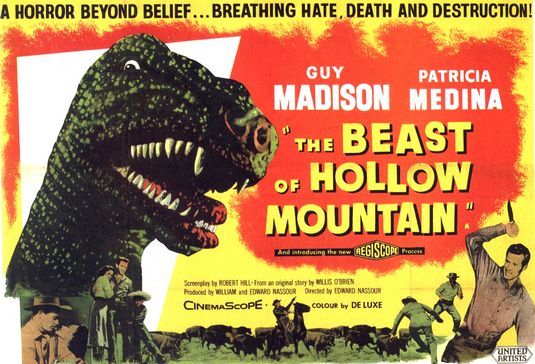
CHILLER THEATER MONTH: The Beast of Hollow Mountain (1956)

EDITOR’S NOTE: The Beast of Hollow Mountain was first on Chiller Theater on Sunday, December 1, 1963 at 11:10 p.m. It also aired on February 22, 1964 and July 31, 1965.

Filmed in both English and Spanish at Churubusco Studios in Mexico City, the American version of this Willis O’Brien (the animator of King Kong) was called The Beast of Hollow Mountain while the Mexican one was named La Bestia de la Montaña.

Cowboys and dinosaurs seem like a pretty natural combination. In this one, Jimmy Ryan (Guy Madison, who played Wild Bill Hickock on TV’s The Adventures of Wild Bill Hickok) finds out that some real life giant lizards are eating all his cattle.

You know how I always complain about movies showing the monster too soon? This waits nearly an hour before you see the dinosaur. That’s having patience. Oh yeah — don’t get attached to the little kid who has an abusive father.

O’Brien also wrote another unproduced script from this concept called The Valley of the Mists, which would later be made as The Valley of Gwangi by Ray Harryhausen, in case you can’t get enough stop-motion monsters.

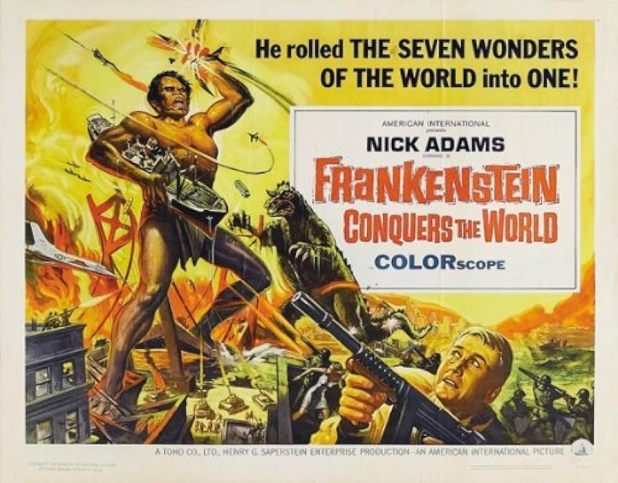
CHILLER THEATER MONTH: Frankenstein Conquers the World (1965)

EDITOR’S NOTE: Frankenstein Conquers the World was first on Chiller Theater on Saturday, October 12, 1968 at 11:20 PM. It also aired on January 31, 1970 and January 9, 1971.

Furankenshutain tai Chitei Kaijū Baragon (Frankenstein vs. Subterranean Monster Baragon) was directed by Ishirō Honda with special effects by Eiji Tsuburaya. It was released in the U.S. by American-International Pictures as Frankenstein Conquers the World.

Toho had always been interested in a movie about Frankenstein’s Monsters, even hoping to have him in a sequel to The Human Vapor in which Mizuno would revive the legendary monster to help him save his dead girlfriend Fujichiyo.

That didn’t happen.

In 1962, Toho purchased a script from an independent producer from America named John Beck called King Kong vs. Prometheus. Willis O’Brien was the real writing and the movie was to be called King Kong vs. Frankenstein. This was how Toho ended up working with RKO so that they could create the meta King Kong vs. Godzilla.

Two years later, Henry Saperstein wanted to co-produce Frankenstein vs. Godzilla with his company United Productions of America. In this idea, the heart of the original Frankenstein’s Monster would become radioactive and cause him to grow to the size of a kaiju. Toho chose to make Mothra vs. Godzilla as they didn’t like the logistics of the story and yet they came back to it in 1965.

I’m so happy that they did.

Nazi officers found the living heart of the Frankenstein Monster from send it on an Imperial Japanese Navy ship to a research facility in Hiroshima for further experimentation just in time for America to drop Little Boy.

Fifteen years later, that heart has grown into a feral child that eats small animals. He’s studied by Dr. James Bowen (Nick Adams) and his assistants Dr. Sueko Togami (Kumi Mizuno) and Dr. Ken’ichiro Kawaji (Tadao Takashima). They save him from a crowd of villagers and notice that the boy can’t be stopped by radiation. They soon figure out that he’s the Frankenstein Monster when they chop off his hand and it grows back.

As always in kaiju movies, one scientist does the wrong thing and the media causes the monster to go nuts. At least it battles and defeats Baragon just in time to get swallowed up by the ground. Of course, he could still be alive. Actually, he totally is and becomes two monsters in time for War of the Gargantuas, which may be my favorite kaiju film.

When I would watch this movie as a kid, I would get super hyperactive. If the extra ending that Harry Saperstein had been included where Frankenstein fought an octopus, I probably would have broken every chair in my parent’s house.

In Germany, this was a big deal. Released as Frankenstein: Terror with an Ape-Face, it’s the reason why every Godzilla — and even Kamen Rider — movie was released as a Frankenstein movie and had it explained in the dubbing that the monsters had been made by Dr. Frankenstein.

Note to self: Frankenstein is a kaijin, not a kaiju, which is a giant human not a giant monster.

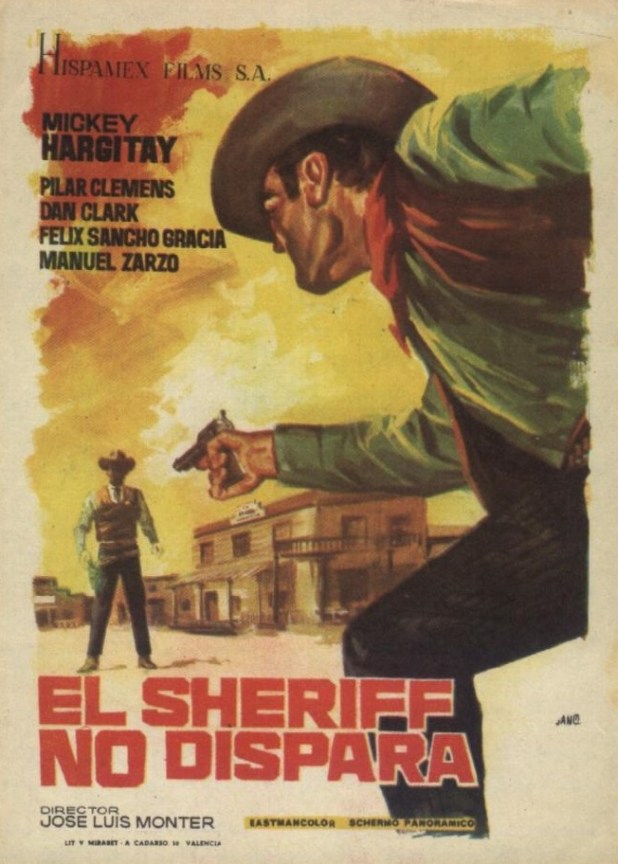
THE FILMS OF RENATO POLSELLI: The Sheriff Won’t Shoot (1965)

In the interview with Jay Slater that I have been referring to throughout my discussion of the films of Renato Polselli, this is mentioned as the director trying his hands at a Western: “Lo sceriffo che non spara tells of a muscular sheriff (played by Polselli regular Mickey Hargitay) who doesn’t need bullets to rid his town of villains — his brawn will suffice. Polselli is keen to point out that he directed the entire movie and it was not co-directed with Roberto Montero. Apparently, as the film was an Italian and Spanish co-production, the Spaniards asked if they could have one of their directors credited. The Spanish producers felt that it would make financial common sense if it was credited to an Italian and a Spaniard — therefore Montero’s name was plastered on the credits as co-director. Like most Italian directors who worked in the horror and western genres, Polselli discarded his own name and adopted a pseudonym. “I thought Ralph Brown sounded better to an American than Renato Polselli. Besides, they dislike Italian names — too much tongue-twisting for them! This is why us Italians used pseudonyms for all our Spaghetti Westerns. We did our best to fool them!”

Lo sceriffo che non spara was the first film Polselli made with Mickey “Mr. Universe’ Hargitay.” Polselli is eager to spill the beans on Hargitay. “When I came to direct Delirio caldo, the producer called me to say that an actor was wandering around Rome looking for work. I convinced the producer that Hargitay was my ideal choice and even fooled him into thinking he was an American. I remember one night I introduced Hargitay to the producer. As the producer thought Hargitay was American, he spoke in English and Hargitay had to apologize and say “I’m sorry, I don’t speak a word of English!” He was very strong, but hardly a bodybuilder like you see him in the films. He once boasted he could rip a Yellow Pages book in half — and he did!”

Jim Day (Dan Clark AKA Marco Mariani) was once the fastest gun in the Italian West until he accidentally shot his father. He’s hung up his guns and still his father-in-law makes him the sheriff of Richmond. Then, his brother Alanb (Hargitay) is in town, making shady deals with that very same father-in-law, who soon rips him and his gang off for $100,000 grand. Making things even worse is that Jim also takes up with his brother’s wife, Desiree Vermont (Aïché Nana AKA Nana Aslanoglu, a Turkish belly dancer who was also in Images In a ConventPorno MondoA…For Assassin and Due occhi per uccidere. Solvi Stubing also appears as the orphaned daughter of the last sheriff. She’s also in Strip Nude for Your KillerDeported Women of the SS Special Section and Special Agent Super Dragon.

Polselli used the name Lionel A. Prestol, while production manager Nello Vanin is Bruno Vani, who often served that job under Polselli. 

It’s a pretty basic Western with none of the insane touches that Polselli would later add to his filmmaking. But if we must be a completist, we must finish all the films, correct?

THE FILMS OF ANDY MILLIGAN: Vapors (1965)

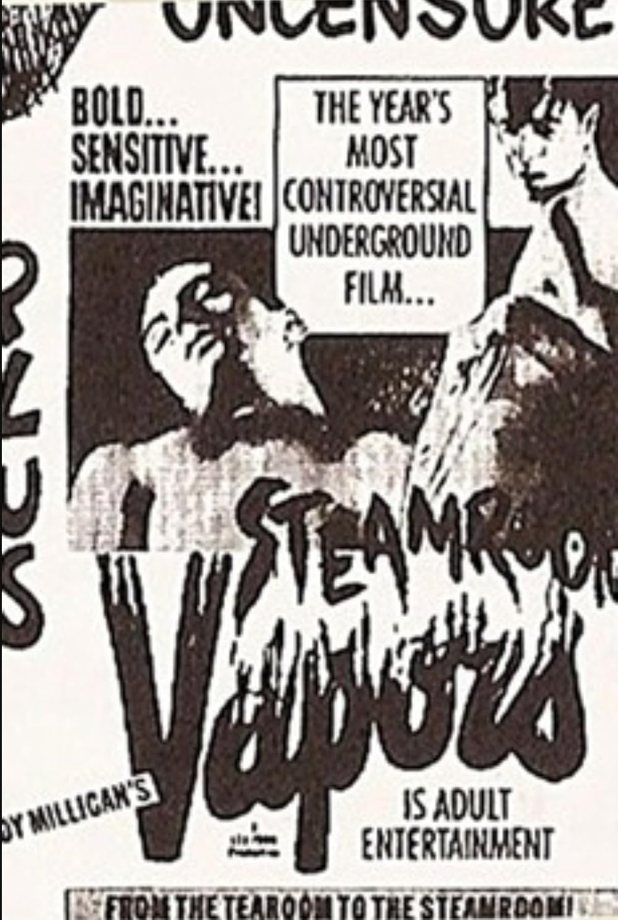
Vapors was Andy Milligan’s first official film. It was first released as an underground gay film in selected art houses in 1965 and to the general public in 1967. Today, it could really play anywhere, not in adults only theaters.

Directed by Milligan and written by Hope Stansbury, all of the interior shots were filmed in a vacant apartment floor on 199 Prince Street in Manhattan, the same apartment building where Milligan lived. The clerk scene was shot in a candy store and the opening exterior shot of the bathhouse was filmed outside the actual St. Marks Bathhouse on 6 St. Marks Place in the East Village, a location famous at the time for hookups when gay sex was illegal in New York City. Keep in mind this was just over fifty years ago.

The entire movie takes place inside the St. Marks Baths, as a young man named Thomas sits on a bed and observes the other men and their personalities. He’s joined by an older man named Mr. Jaffe  They get pasty their opening lies — Thomas is not a frequent visitor, Jaffe is not a first-timer — and begin to discuss their lives. Jaffe has been married for 19 years and wants nothing to do with his wife any longer. Sixteen years ago, their son drowned and life has never been the same. He sees something of his son in Thomas and has to leave, but promises to send him a gift. The loudness of the baths continues as a paper sunflower arrives for Thomas, who cries upon Mr. Thomas leaving, but is soon greeted by another man who disrobes for anonymous sex with the young man.

This movie feels like a place that I am invading and not just because I am a heterosexual. It’s because Milligan has so completely created a privacy between these two men that only they should share and we’re just as bad as that peeping tom looking through a hole in the wall. It’s fascinating to see this movie, one free from murder and the supernatural, and see where Milligan’s movies went after this.

You can watch this on YouTube.

CBS LATE MOVIE MONTH: Signpost to Murder (1965)

EDITOR’S NOTE: Signpost to Murder was on the CBS Late Movie on February 23, June 22, 1972, and July 20, 1973.

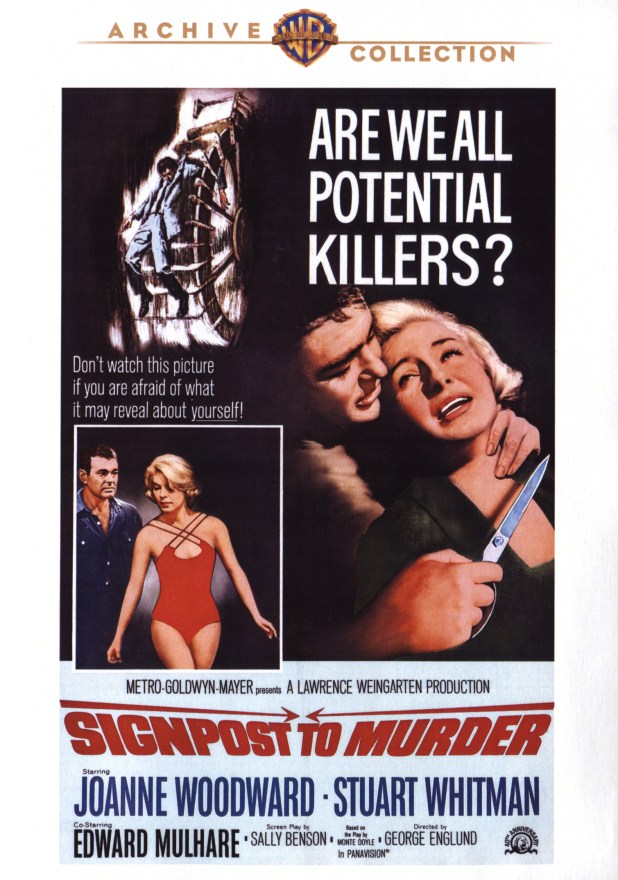
“Are we all potential killers?” What a great tagline! That idea is the basis for this film, directed by George Englund (A Christmas to RememberZachariahThe Vegas Strip War) and written by Sally Benson (Viva Las VegasThe Singing Nun) and Monte Doyle.

Alex Forrester (Stuart Whitman) is a mental patient who killed his wife ten years ago and has been rehabilitated in an asylum. He feels that way, at least, but no one else does. So he takes matters into his own hands, unmercifully beats his therapist, Dr. Fleming (Edward Mulhare), and runs into the foggy night. Maybe that doctor shouldn’t have told him about an old law that gives a new trial to escapees who elude capture for two weeks.

Who would come up with such a law?

He goes to the house he’s stared at for ten years from his cell and hides there as Molly Thomas (Joanne Woodward) waits for her husband to return from a business trip.

He easily kidnaps the woman but is shocked by what he finds outside the house: a dead body, throat slit, stuck in the water wheel. Who killed this man? Was it him? Why can’t he remember? And when the body disappears, who took it?

Even as the police and the local clergyman (Alan Napier, Alfred from TV’s Batman) come to the house to search for Molly’s husband’s body or comfort her, she starts to fall for Alex. As you can imagine, this movie is utterly ridiculous in the best of ways and throws twists and turns at the viewer.

Do you know who loved it? India. While the movie started as a stage play, they re-adapted it into another stage play, Dhummas, which was made into three different movies — in Gujarati, Marathi and Hindi — all starring Sarita Joshi. It was also made as Ittefaq in 1969 and was remade as Ittefaq in 2017.

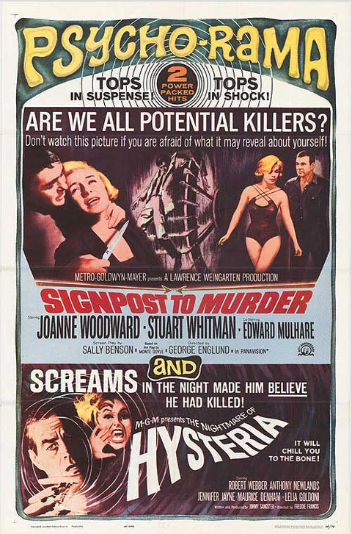
MGM also released this as a Psycho-Rama double feature with Hysteria. The poster for it makes me want to watch both movies again.

Junesploitation: 002 Operazione Luna (1965)

June 17: Junesploitation’s topic of the day — as suggested by F This Movie— is Lucio Fulci! We’re excited to tackle a different genre every day, so check back and see what’s next.

The only bad thing about being a Lucio Fulci fan is that you eventually start to run out of first watches of his movies. Once you’ve even entered into the post-80s high and learned to love movies like Voices from Beyond, Sodoma’s GhostTouch of DeathThe Sweet House of Horror and Demonia (and more) the only way out is backward. That’s when you start to watch the movies that Fulci created before he was only known for gore, quality films like Perversion StoryDon’t Torture A Duckling and A Lizard in a Woman’s Skin are waiting for you.

Before that, Fulci went to medical school and decided, upon graduation, that there was more money in movies than in treating patients. After apprenticing at Centro Sperimentale, he directed documentaries and worked as an assistant director and screenwriter in the Italian comedy genre throughout the 50s. He apprenticed under famous Italian comedy director Steno and eventually became known for a series of movies starring Franco Franchi and Ciccio Ingrassia.

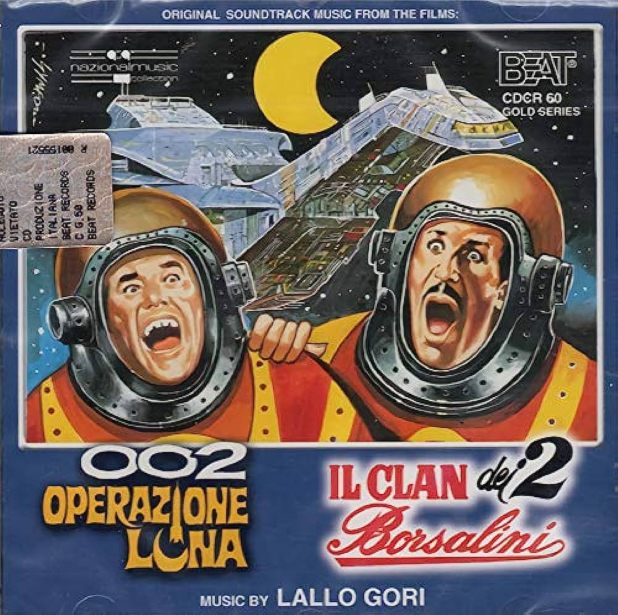
A sequel to Oh! Those Most Secret Agents!, this follows almost the same plot as that movie. Franco and Ciccio get confused for cosmonauts Colonel Paradowsky and Major Borovin, which makes sense as the comedy team plays both roles. The Italians are used to take the place of the two missing Russians who have gone missing in the cold void of space, so they land the rocket so the space race can be lost by America. Then the Russians come back and hijinks ensue.

Mónica Randal from The Witches Mountain, Linda Sini (who would also be in Fulci’s Massacre Time and Don’t Torture A Duckling), Maria Silva (Tombs of the Blind Dead), Francesca Romana Coluzzi (Marisa Mell’s body double in Danger: Diabolik! as well as Giovannona Long-Thigh and Fulci’s Dracula In the Provinces; she’s also Red Sonja‘s mother) liven things up.

Fulci said that this movie and The Two Parachutists were both filmed in just seven weeks.

While this has a 002 in the title, it is not a Eurospy movie. It’s also one of only two science fiction movies Fulci would make, along with Warriors of the Year 2072.

VIDEO ARCHIVES WEEK: The Foolkiller (1965)

VIDEO ARCHIVES NOTES: This movie was discussed on the January 31, 2023 episode of the Video Archives podcast and can be found on their site here.

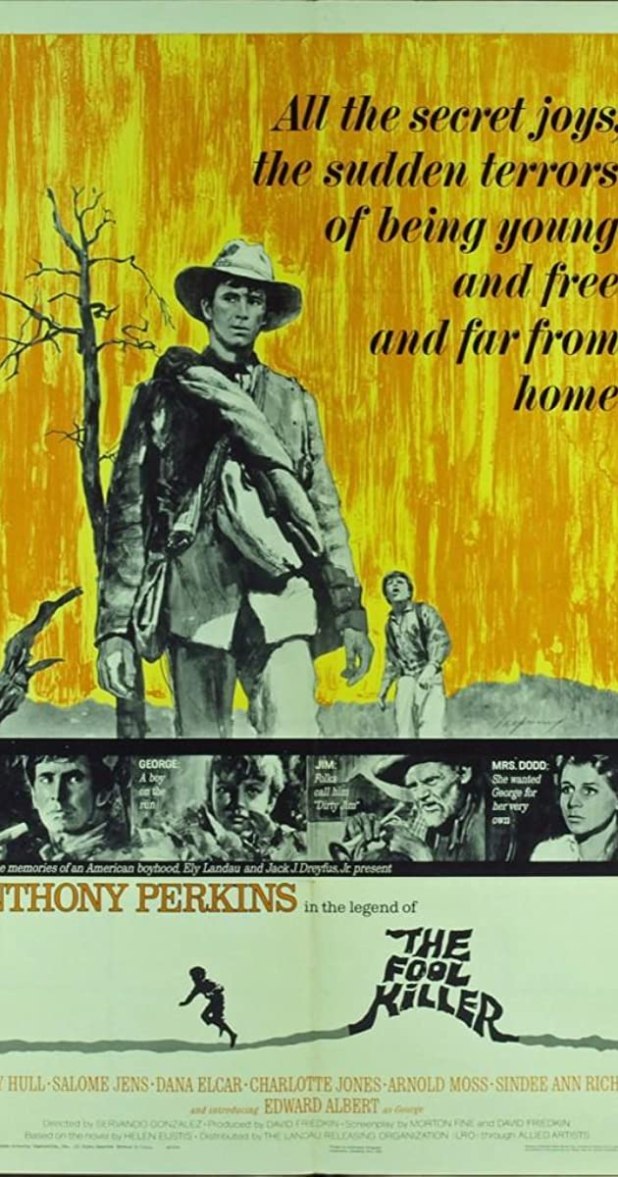
Servando González directed one of the wildest films I’ve ever seen, El Escapulario, which somehow unites multiple genres and countries of cinema, as well as being folk horror by way of Mexican Catholicism.

Here, somehow, he’s in America and making an adaption of the novel of the same name by Helen Eustis. And, to quote Joe Dante, he’s making the most Night of the Hunter movie that is not Night of the Hunter.

Working from a script by Morton S. Fine (who wrote a lot of TV, as well as The Greek Tycoon) and David Friedkin (who worked with Fine on the show Frontier), González leads George Mellish (Edward Albert) through the desolate post-Civil War landscape of America. After being beat — again — by his foster parents, George has taken for the open dusty road, a place where he meets Dirty Jim (Henry Hull). Jim tells him of a gigantic axe-carrying killer called The Foolkiller who just may be Milo (Anthony Perkins), a man that he meets as he wanders Tennessee.

George thinks he deserves all the slaps and strikes his foster parents have given him. After all, they quote the Bible the whole time. But after hearing that his foolishness — playing with dandelions is nearly a capital offense — is so strong, he wonders if he’s destined to be a victim of the Foolkiller’s blade.

As our protagonist and Milo travel, we see that they both have scars from the figurative and literal wars they’ve fought. There’s also a tent revival which is awe-inspiring in its ferocity, as Reverend Spotts (Arnold Moss) snarls, spits and nearly explodes as he convinces George to make the altar call and drop to his knees before the Lord to stay out of the pits of Hell.

Mexican directors never got the chance to make American movies, but this is much closer to a regional film, shot in Knoxville, that somehow got Tony Perkins on board and gave González the opportunity to make a dark fairy tale of childhood, pain and belief.

VIDEO ARCHIVES WEEK: The Loved One (1965)

VIDEO ARCHIVES NOTES: This movie was discussed on the December 20, 2022 episode of the Video Archives podcast and can be found on their site here.

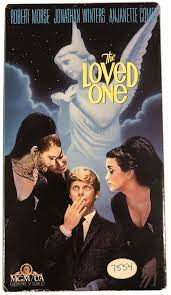
Based on The Loved One: An Anglo-American Tragedy — a novella, as Quentin Tarantino would remind us — by Evelyn Waugh and The American Way of Death by Jessica Mitford, this was directed by Tony Richardson from a script by Terry Southern and Christopher Isherwood.

Richardson was coming off Tom Jones, Southern Dr. Strangelove and Isherwood had just written one of his best-regarded novels, A Single Man

This is the point of success where creatives can do anything they want.

What they made is “The motion picture with something to offend everyone!”

Dennis Barlow (Robert Morse)  wins an airline ticket from England to America and decides to visit his uncle, Hollywood production staffer Sir Francis Hinsley (John Gielgud). After thirty years of service, he’s fired by his boss D.J. Jr. (Roddy McDowall) and hangs himself.

This is a comedy.

Dennis spends the inheritance his uncle left him on a fancy funeral at Whispering Glades cemetery, a place where he meets and falls in love with Aimee Thanatogenos (Anjanette Comer, The Baby), a cosmetic mortuary worker who was named for radio revivalist Aimee Semple McPherson and who is also the object of affection from the embalmer known as Mr. Joyboy (Rod Steiger).

Whispering Glades is overwhelming, the kind of place where Tab Hunter and Liberace are your tour guides, taking you through the gravestones. It’s owned by Reverend Wilbur Glenworthy (Jonathan Winters), who puts on a holy act but is really just a man who knows how to make money.

Meanwhile, Dennis works for Happier Hunting Grounds, which is owned by Wilbur’s brother Henry (also Winters). He wants to win over Aimee, but all he knows are stolen poems and he works a job at a place she finds sacrilegious. She also lives in a house in near-constant danger of falling off a cliff.

There’s also boy genius Gunther Fry (Paul Williams), who is sending the corpses of pets into space as his first astronauts. This kind of plan is something the Reverend wants to get in on, as he dreams of making more money running a retirement home and needs to get rid of all the bodies in the ground.

By the end, everything that Aimee believed in is a lie. She hooks herself up to an embalming machine as a result. Not even Dennis, her beloved boss, her guru (Lionel Stander) or Mr. Joyboy give her the solace or the advice that she is looking for. Her body is sent into space as Dennis flies home first class.

Waugh’s book came up when he visited Hollywood in 1947. Metro-Goldwyn-Mayer offered him a six-figure deal for Brideshead Revisited, but he wanted control that the studio wouldn’t give him. While there, he became fascinated by the American funeral industry, which led to him writing an article about Forest Lawn cemetery — where this was filmed — and its founder Dr. Hubert Eaton. Then, he wrote The Loved One.

By all accounts, he hated that this movie was being made. He definitely died before he saw it, as he unexpectedly died three days after its premiere in London, which he did not attend. When this was shown for studio execs, many were so offended that they walked out in the middle.

That was what Richardson wanted.

However, he did not want to offend Waugh.

In his memoirs, Richardson claimed to be a great admirer of the writer and had been upset by how much he hated the movie. He said it was all over a misunderstanding, as he had been quoted as saying the novel was “thin and dated.” He further upset the author by hiring his literary rival Isherwood to work on the script.

I forgot so many more people in this, like Dana Andrews, Milton Berle, James Coburn, Barbara Nichols, Bernie Kopell, Joy Harmon and Jamie Farr. It’s just people upon people, kind of like It’s a Mad, Mad, Mad, Mad World. Sadly, Ruth Gordon and Jayne Mansfield’s parts ended up cut from the film.

And I didn’t even mention Mr. Joyboy’s mother.

APRIL MOVIE THON 2: I Saw What You Did (1965)

April 1: New boss, same as the old boss — Start the month off with something that’s April Fool’s in nature.

I Saw What You Did had William Castle screaming on posters “This is a motion picture about UXORICIDE!” and installing seatbelts in theater seats. But he had the best gimmick of all: Joan Crawford.

Libby Mannering (Andi Garrett), her younger sister Tess (Sharyl Locke) and Kit Austin (Sara Lane) spend the day

Steve Marak (John Ireland), a man who had just murdered his wife Judith (Joyce Meadows) pramk phone call people. It’s all good fun saying, “I saw what you did” to random people before caller ID until you get Steve Marak (John Ireland). After all, he’s just killed his wife Judith (Joyce Meadows). He shares a party line — yes, back in the 1960s several people shared the same phone line — with Amy (Crawford), his neighbor who has always loved him. She hears the conversation as he invites the girls to his address as he plans to wipe them out.

In the confusion when the girls visit, Marak gets their home address, making this a really tense near home invasion movie. It’s also wild in how it can in some scenes be a comedy and in others intense.

Crawford did four days of work on this movie, making $50,000. Her doctors had to sign a statement saying that she was healthy enough to appear as she had just left the set of Hush…Hush, Sweet Charlotte. She’d next appear in DellaTrog and Berserk before appearing in some TV roles and retiring.

In 1988, there was a TV movie directed by Fred Walton that starred Robert and David Carradine as well as Tammy Lauren and Shawnee Smith.

JEAN ROLLIN-UARY: The Far Country (1965)

A couple becomes lost around the rubble, bricks and suddenly closing in maze of buildings in a place they have never been that becomes more confusing and also much more confining within just sixteen minutes of running time, but just like that idea of a second in the afterlife being thousands of years in our human experience, that sixteen minutes gives director and writer Jean Rollin time to stretch out and drug our your brain and create a rough pass at a movie that goes even further and gets so much more right, The Iron Rose.

Things would get better, as well as more obtuse and at the same time more layered. That said, the discordant jazz, black and white cinematography and idea that language doesn’t work any longer are powerful and sets us up for something that will grow and fester.