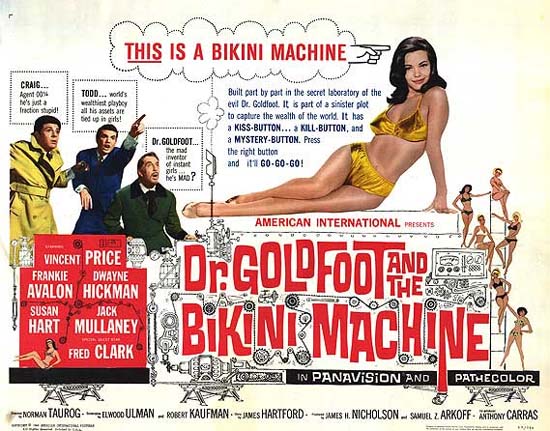
Dr. Goldfoot and the Bikini Machine (1965)

I don’t know if much media was considered meta in 1965, but this film definitely fits the bill. Somehow it combines everything American-International Pictures did best — Edgar Allan Poe movies, beach films and movies that appealed to the teenage zeitgeist — and mashes and mixes them up into one overall satisfying piece of ridiculousness.

It all started with AIP president James H. Nicholson looking for a way to show off contract player Susan Hart, who would become his wife. It went through plenty of drafts before Norman Taurog (who had made movies with Martin and Lewis, Elvis Presley and was the youngest director to win an Oscar when hs film Skippy was honored in 1931; Damien Chazelle has since beaten him out when La La Land won in 2017) came on board. While most AIP films had slender budgets, this one had over a million dollars to spend. That said, it also recycled plenty of their famous props and sets, but to great effect.

Originally, the film was to be a musical, but the script got rewritten to the displeasure of Price. Susan Hart would say, “One of the best scenes I’ve seen on film was Vincent Prince singing about the bikini machine – it was excellent. And I was told it was taken out because Sam Arkoff thought that Vincent Price looked too fey. But his character was fey! By taking that particular scene out, I believe they took the explanation and the meat out of that picture.” 

Honestly, there isn’t much story. Price plays Dr. Goldfoot, who has an army of female robots who seduce, marry and murder men — after taking their money, of course. The femme fatales include Deanna Lund (Land of the GiantsElves and nearly the wife of Larry King), China Lee (Mort Sahl’s wife who had been a Playboy Playmate for the month of August 1964 ; she also shows up in What’s Up Tiger Lily?), Sue Hamilton (Playboy Playmate of the Month for April 1965; also the first Playmate to have breast implants, as well as be under five foot tall), Marianna Gaba (Playboy Playmate of the Month September 1959), Nicholson’s daughter’s Luree and Laura and Alberta Nelson (who often played a motorcycle girl named Puss in the AIP beach movies).

Speaking of that motorcycle gang, their leader Eric Von Zipper (Harvey Lembeck) shows up. And so does Annette Funicello for the briefest of moments. And Frankie Avalon and Dwayne Hickman just switch their names from Ski Party and play the same parts. Other beach party cameos include one-time Gidget Deborah Walley and Aron Kincaid.

The movie also boasts a Claymation title sequence by Gumby creator Art Clokey, a title song by The Supremes and a reappearance of the set from The Pit and the Pendulum.

There’s also a scene where Goldfoot shows off his ancestor’s portraits, which include Price AIP roles like Verden Fell from The Tomb of Ligeia and Roderick Usher from House of Usher. And the missles that supposedly wipe out the evil doctor at the end were lifted from Mothra vs. Godzilla, which AIP had released as Godzilla vs. The Thing. Due to a lawsuit by Eon Productions, this movie was titled Dr G. and the Bikini Machine in England. It did modest business everywhere but Italy, where it was a major success. That would lead to a sequel, Dr. Goldfoot and the Girl Bombs, which would be directed by Mario Bava.

There was also a TV special that aired in the place of Shindig! on November 18, 1965 on ABC. The Wild Weird World of Dr. Goldfoot featured Vincent Price, Tommy Kirk and Susan Hart, along with the songs that were cut from this film’s release. Through the magic of the internet, you can watch it right now. 
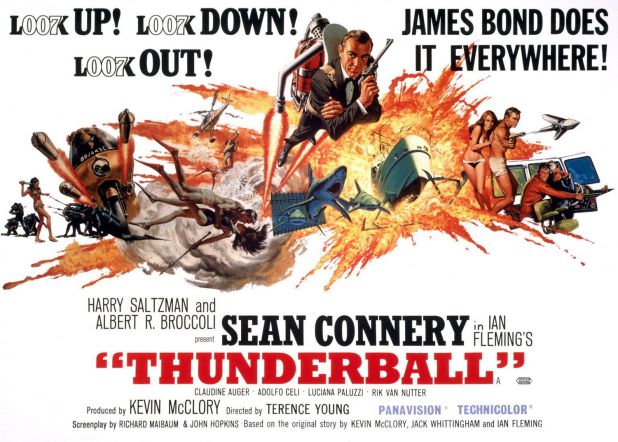
Thunderball (1965)

Here’s where things get messy.

Thunderball would have been the first Bond film, if not for all the lawsuits.

Yes — back in 1958, Ian Fleming was already planning a James Bond movie.

Fleming and a young writer and director named Kevin McClory wrote a script that had many working titles — SPECTRE, James Bond of the Secret Service and Longitude 78 West — but mainly concerned spying and an underwater battle. McClory’s first film, The Boy and the Bridge, bombed and somewhere along the way Fleming grew disenchanted with the script and the author.

Not disenchanted enough that he didn’t turn said script into his next James Bond novel.  By November of 1963, the case was in court. It lasted three weeks, with a pause after Fleming had a heart attack. The end result? McClory got the literary and film rights for the screenplay, while Fleming could publish the novel, as long as he stated that it was based on a screen treatment by Kevin McClory, Jack Whittingham and the Author. Fleming would die nine months later.

The legal issues would find their way to Bond producers Broccoli and Saltzman, who were faced with the fact that McClory retained screen rights to the novel’s story, plot, and characters. This could have allowed McClory to make his own series of Bond films — more on that later — and is the reason why so many of the licensed properties, like Victory Games’ RPG, didn’t have SPECTRE.

Guy Hamilton — citing creative burnout — stepped away from the series. And Terence Young, who directed the first two films, stepped back in.

Bond starts this film by punching out the widow of a SPECTRE agent at her husband’s funeral. Surprise — the man was never dead and 007 chases him with his Aston-Martin and a jetpack, which was a practical effect. That said, Connery and several of the stuntmen were nearly killed by sharks while making this, just in case you’re wondering why CGI works.

SPECTRE isn’t having any of this, so Number One Blofeld (still Anthony Dawson in disguise) and Number Two Emilio Largo (Adolfo Celi, who used this movie to basically have a career in the Eurospy field; he’s in OK Connery and Danger: Diabolik, two of the better films in this genre as well as tons of giallo) decide to steal some nukes and blow up the world real good unless they get paid $100 million pounds.

Miss France Monde and first runner-up in the 1958 Miss World contest Claudine Auger plays Largo’s mistress Domino. She — of course — ends up with Bond. Auger would later appear with two of her fellow Bond girls (Barbara Bouchet and Barbara Bach) in Black Belly of the Tarantula.

There’s all manner of SCUBA action in this one, some of it coordinated by Ricuo Browing. There’s also a ship called the Disco Volante, an exceedingly long running time and a battle at the end that seems to go on forever.

On SPECTRE’s side:

  • Assassin Fiona Volpe is played by Luciana Paluzzi (The Green Slime, Jess Franco’s 99 Women,  A Black Veil for Lisa)
  • Agent Number Four is Guy Doleman, who was also in the Michael Caine-starring Harry Palmer series; he was also the first Number Two on The Prisoner.
  • Vargas is Largo’s main henchman; he’s killed off with a spear gun.
  • SPECTRE Number Five, who planned the Great Train Robbery, is played by Phillip Stone, Alex’s dad in A Clockwork Orange.

On Bond’s side:

  • Felix Leiter is played by a new actor in this one, Rik Van Nutter, who was once married to Anita Ekberg.
  • The doomed Paula Caplan is played by Martine Beswick, who was also Zora in Dr. No; she also played the titular roles in Dr. Jekyll and Sister Hyde and The Happy Hooker Goes Hollywood.
  • Molly Peters plays a doctor who saves Bond’s life; she’s also the first woman to take her clothes off in the series.
  • French spy Madame La Porte is played by Maryse Guy Mitsouko, who appears in the Eurospy films Agent 077 – Mission Bloody MaryCode Name: JaguarZ7 Operation Rembrandt, Furia a Marrakec and Bob Fleming: Mission Casablanca.
  • There’s also a scene where all the 00 agents are gathered, but we don’t get to see much of them. They would be 002 John Bill Fairbanks, the unnamed 003 through 005, 006 Alec Trevalyan and several others who aren’t named. Of them, only Bond and 008 don’t die all the time.

The theme song for this movie was originally going to be Shirley Bassey’s “Mr. Kiss Kiss, Bang Bang,” whose title was taken from the Italian nickname for 007. That track was too short, so it was re-recorded with Dionne Warwick. And then the producers worried that the name of the movie wasn’t in the lyrics, so they got Tom Jones to sing the theme. Jones wanted to impress them so much that he held the last note so long that he passed out.

Johnny Cash sent in a song. It wasn’t used.

This is the first Bond movie where the ladies are nude in the opening credits and the actual actor — Connery of course — appears in the gun barrel sequence. It’s also the biggest blockbuster in Bond history, making $141 million in 1965, which would be worth $1.16 billion today.

As for the legal battles, they would continue long past the release of Thunderball.

In 1976, McClory planned to produce an original James Bond film — called either Warhead, Warhead 8 or James Bond of the Secret Service — but United Artists and Fleming’s estate sued. McClory won two different trials and licensed the rights to Jack Schwartzman for Never Say Never Again.

Speaking of that film — the script is insane. As written by Sean Connery, spy writer Len Deighton (who wrote those aforementioned Michael Caine Harry Palmer films) and McClory, it involves Blofeld, the Bermuda Triangle, sharks with nukes strapped to their heads, an underwater kingdom called Arkos and Bond only showing up for three scenes.

A few decades later, McClory resurfaced with plans to make Warhead 2000 A.D. with Sony, who ended up settling with MGM/United Artists. He also worked with Sony in 1999 to try and get the rights for all past Bond films, but this suit was thrown out as it was decided that McClory had “waited too long.”

A decade or so later — and after McClory’s death — MGM, Danjaq and his estate came to an amicable conclusion over nearly half a century of legal and business disputes.

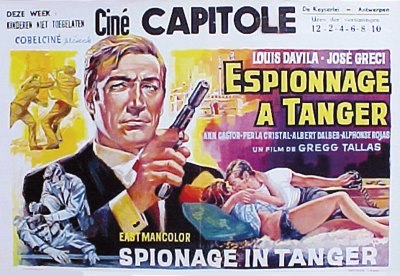
Espionage In Tangiers (1965)

Mike Murphy is Agent S 077, which has absolutely nothing to do with Bond. But you know what’s great about this movie? It’s directed by Greg Tallas, who would someday make The Nightmare Never Ends, which was then edited into Night Train to Terror.

That fact is more interesting than this movie.

Jose Greci, who was the Virgin Mary in Ben-Hur, shows up here in one of her many Eurospy roles (she’s also in Operation Poker, Last Man to Kill and Special Code: Assignment Lost Formula). And hey! It’s Perla Cristal from The Corruption of Chris Miller, Naschy’s The Fury of the Wolfman and Franco’s The Awful Dr. Orloff!

In Europe, this was known as Marc Mato, agente S. 077 and it was a big success. Time has not been kind to this film, however. There’s a laser beam, as there usually is, but I’ve never seen a movie where the hero is saved from a bullet to the chest because that’s where he carries his Bible.

You can watch this on Amazon Prime and Tubi.

Gamera (1965)

I’ll come clean. As a kid, I liked Gamera more than Godzilla. Sure, Daiei Film Studios was just following the success of Toho’s kaiju superstar, but I always felt a kinship to a monster who could just withdraw into his shell. Gamera was, after all, a friend to all children. And man, I wanted to be his best pal.

Originally released on November 27, 1965 in Japan, a re-edited version with new footage was released the following year in the U.S. as Gammera the Invincible. It was the only movie in the series to get a theatrical release in this country.

Over the Arctic, a nuke blows up and awakens a prehistoric giant turtle that just so happens to have big tusks. That’s Gamera, but he’s no friend to anyone at this point.  He can also breathe fire, which he does to blow up an American jet real good.

These scientists that he battles are pretty much morons. They’re smart enough to come up with freeze bombs, but they think that if they get him on his back, he’ll die of starvation. So Gamera just pulls all his arms and legs inside his shell and starts spinning around like a UFO.

This movie will also teach you that turtles are not even. They’re just turtles.

Back to those scientists. A whole bunch of Russian, Japanese and American ones invent this thing called Z Plan. You know what it is? They put Gamera in the nose cone of a missile and send him to Mars, all excited about how their scientific ways have triumphed over idealogy.

It’s a crock of turtle shit.

You know what’s really awesome? This movie was originally going to be called Dai Gunju Nezura (The Great Rat Swarm), but all of the real rats that were going to run over the miniature city got fleas.

This is the only Gamera movie where he doesn’t fight another monster and also the singular black and white film in the series. He’s also a good guy in every movie after this.

You can watch this at the Internet Archive and imagine a young Sam losing his mind screaming, jumping all over the TV room, so happy to see a turtle fly.

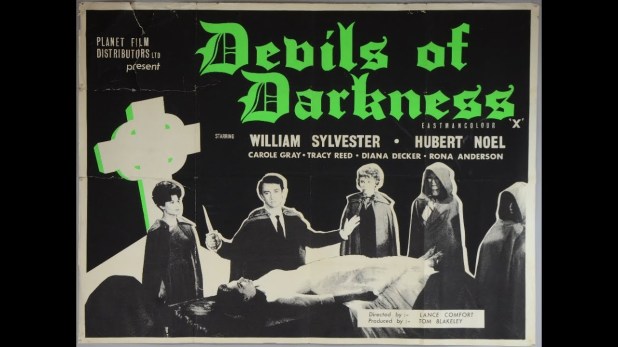
Devils of Darkness (1965)

Director Lance Comfort lived on the fringes of British B-movies, with this effort being one of his last films. I found it on one of those old 20th Century Fox Midnite Movies double disks which are always so much fun.

Hubert Noel, who somehow shows up in both The Little Girl Who Lives Down the Lane and Cathy’s Curse, plays a French nobleman who ends up not only being a vampire, but a Satanic vampire!

Paul Baxter (William Sylvester, Gorgo) is on vacation with three friends who are all killed by Count Sinistre on All Soul’s Night. So he then does what you or I would — he heads back to England, finds a talisman belonging to the Satanic sucker and gets a whole bunch more of his friends killed.

Look for Tracy Reed (the mistress of General Buck in Dr. Strangelove), Carole Gray (Curse of the Fly), Victor Brooks (Cover Girl Killer) and Marianne Stone (Whoever Slew Auntie Roo? and the Carry On movies).

This is a rare modern vampire movie for the UK, so it has that going for it.

Fun In Ballooland (1965)

Joseph M. Sonneborn Jr. has exactly one credit as a director and producer. It’s this movie. One wonders if he had been kept from ever coming near a camera again after this, as this is the kind of movie that will test your resolve and perhaps, even make you question your existence.

It was written by Dorothy Brown Green, who unconfirmed sources claim is also the narrator of the most insidious Christmas movie of all time, Santa and the Ice Cream Bunny.

While this movie is 52 minutes long, only 15 minutes of it take place in Balloonland, where we meet young Sonny. He’s ended up there after his mother read him a bedtime story and he fell asleep. Now, he’s inside a world filled with giant balloon people and animals.

Then, we watch a Thanksgiving parade somewhere in Pennsylvania that seems to go on forever.

If you ever wanted to watch a befuddled child wander through the warehouse of what one only imagines is a parade float company. From trying to get a prince and princess balloon to kiss to meeting the king of the sea to getting to be the sheriff of Ballonland, that’s the extent of the storyline. Once Sonny fires his gun, we leave. Perhaps this is a statement on the way guns allowed the west to be tamed. It could be an indictment on the Second Amendment. Or probably just sloppy filmmaking.

Whoever is doing the talking — most think it’s Dorothy Brown Green — remains bored for most of the film, until certain balloons show up and she becomes so fervently intrigued by them that you may wonder what drugs were being passed around Ballonland.

Mike Nelson of Rifftrax has said that this is his favorite movie they’ve ever done. Take that and understand just how frighteningly inane, insane and intense this movie gets. These are the Christmas films that I truly love, movies that make you wonder if you are even on the same plane of consciousness that you started on. They are drugs on video.

You know, since it’s Christmas, why not just watch the whole movie right here? You can also watch the Rifftrax version for free on Tubi.

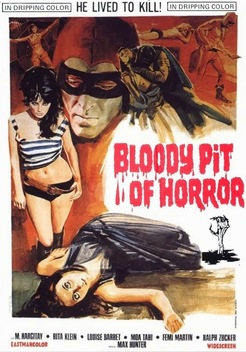
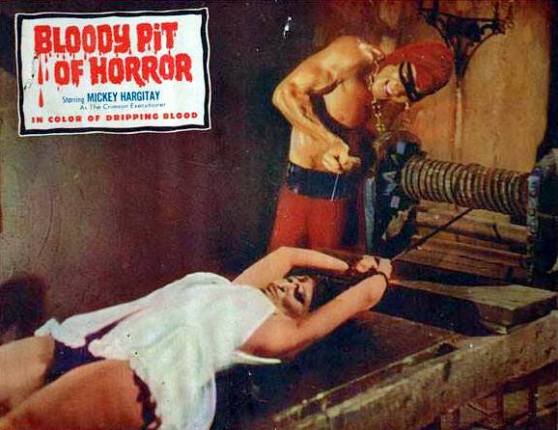
PURE TERROR MONTH: Bloody Pit of Horror (1965)

ABOUT THE AUTHOR: Robert Constant says, “I was born and raised in Hollywood, CA.  Went to live in Spain when I was 23 and stayed 10 years, managing an art gallery.  Came back to LA in 1992 and worked at an animation studio as a PA for awhile then worked buying and selling vintage clothes.  In 1996 I landed a gig as an assistant costume designer for an indie film and fucking loved it!  My first day on set I felt right at home.  I went on to do costume design/styling on indie/low budget films until 2005.  I worked with Fred Olen Ray, Jim Wynorski, Roger Corman, Playboy Channel Mystique films.  In 2005 I became a makeup artist and worked on House, Ugly Betty, Brothers & Sisters, Brooklyn 99 and day-checked on a lot of shows.  I did display design for the Hollywood Casino chain for a few years and in 2016 I moved to Chicago and now work as a server in a restaurant…a whole new branch of show business!  It’s my retirement job and I like it.  But I am really interested in writing about film and would like to do more and improve my skills.  

This is a simple enough horror film, but it has several elements that make it stand out. It is charming and camp, with some strong horror at the end. It was made in 1965 by director Domenico Massimo Pupillo, credited as Max Hunter, and produced by Francesco Merli and Ralph Zucker, who also played Dermot the photographer. The director is well known for another gothic horror film, Terror Creatures from the Grave, which is mostly fun for Barbara Steele and Luciano Pigozzi, the creepy servant. Two of the actors in Bloody Pit of Horror are in Terror Creatures: Walter Bigari/Walter Brandi (Walter Brandt) who plays Rick and Alfredo Rizzo (Alfred Rice) who plays Daniel Parks. I warn you that all the names of the Italian cast and crew were anglicized which makes attribution difficult, but I love that kind of research. 

The exteriors of the film were shot at Balsorano Castle in Abruzzo, a beautiful place. The interiors were shot at the Palazzo Borghese in Artena. Even with the obvious low budget it is pretty spectacular looking. It was filmed in “Psychovision”. 

The film opens as a flashback to the days of The Crimson Executioner, a nobleman who was a violent sadist with sociopathic mania regarding superiority and moral and physical righteousness. We see him condemned to death by some unspecified tribunal and put into a sort of Iron Maiden, but male shaped so an Iron Madman. The door is slammed shut and we hear his screams. 

The modern-day film opens as a commedia sexy all’italiana. Producer Daniel Parks arrives at an old castle with his crew of models, cameraman and Rick, the writer. They are there to shoot “girly show” book cover art for pulp fiction novels. The doors are locked so they break in and wander around looking for locations inside. They are quickly apprehended by a muscled servant man with tight clothes and a forbidding demeanor. Producer Parks claims ignorance that anyone inhabited the castle and wheedles to be taken to the owner to do some business about renting the space for a day. This finally occurs and after a lot of chafing and arguing the owner, having seen the face of Parks’ secretary Edith, changes his mind and allows them to shoot but forbids access to certain parts of the house. 

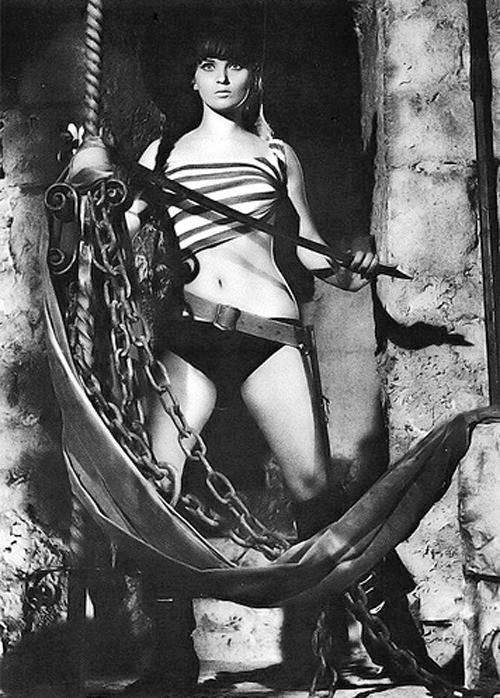
Now we have the cheesecake and I like it a lot. Very cute mid-century Italian flirtiness. The four models, billed as the Cover Girls get ready for the shoot. Femi Benussi plays Annie and it was her first film role. She went on to become a big star of the Commedia Sexy sub-genre and also played Lucia in Strip Nude for Your Killer. Moa-Tahi plays Kinojo. A beautiful and exotic actress, her death scene in this film is a great piece of low budget artifice, as she is caught in a huge and very nicely constructed spider web and the spider which bites her is a great piece of practical effects. I love to see what can be done with no money. The other two girls are cute and sassy. They go through several scenes of the photo shoot, all charming and very campy. But Suzy, one of the models, and Raul, another male of the party, go into the forbidden areas and start making out. They are caught by the owner of the castle and all hell begins to break loose. 

I am not going to detail the film any more because I want people to see it. I will say that the owner of the castle clearly has come to identify with the Crimson Executioner and has the same psycho feelings of great moral and physical godlike qualities. He is played by none other than Mickey Hargitay, in his first film role. He is an exceptional physical actor. He is all too often thought of as a “musclehead” as I read from one reviewer, but bodybuilding was a sport he came to after he had already been part of a famous acrobatic team as a young boy, a championship speed skater and a football player. In the final scenes in the torture chamber, as he cavorts around finishing off the hapless members of the poor photo shoot, he is so graceful and has a fierce presence. It made me think of rock star videos such as Billy Idol’s “Dancing With Myself,” except much more powerful. Some critics have called the film homoerotic, due no doubt to the Crimson Executioner’s obsession with physical perfection. But at several points in the film he exhibits disgust for mere mortal love and lust. I think this film is a study in narcissism and its relation to extreme sociopathy. 

PURE TERROR MONTH: Evil Brain from Outer Space (1965)

About the Author: Paul Andolina is one of my favorite people to talk movies with. If you like his stuff, check out his site Wrestling with Film

Evil Brain from Outer Space is a science fiction film from 1965. It happens to be a couple of the Japanese Super Giant films that have been hacked up and spliced together to make one English dubbed film. It’s an odd movie about a group of aliens who send one of their own to earth to stop the brain of the evil mutant Balazar from destroying humanity. 

Special effects films and television shows are big in Japan and they have been since Godzilla roared onto screens. The Super Giant series from the late 50’s is a bunch of stand-alone films that are about the deeds of a man named Giant of Steel or as he is known in EBfOS Star Man. Star Man is a superhero basically and he wears some pretty nifty lycra outfits, he looks like a luchador that forgot his mask at home.

Evil Brain sees Star Man coming to earth to stop a few evil doctor/scientists who are in league with the evil extraterrestrial brain of Balazar. There is a hawk that hangs out with one of these doctors and a one-legged man who serves the other. There are some pretty awesome mutants who fight Star Man in this film as well. One looks like a chupacabra from the black lagoon and has strange tendril-like fingers and makes some weird noises, if I had seen this a child I would have been scared of him immediately. I actually said out loud, “WTF is that?” while watching the movie. He is by far my favorite part of the film. The other mutant is a long-haired demon lady who doesn’t quite know how to put on her lipstick. She jumps around and scratches the air while making demonic cat noises. There are also some generic henchmen mutants as well.

I would love to see the Super Giant serials in Japanese with English subtitles but I’m not sure they can live up to the insanity that is this film. It seems longer than it is because there is too much jibber-jabber. Honestly would love to see Star Man just mess up some mutants and forgo the plot altogether. If you like psychotronic films this is definitely the one for you. I have no idea what they were thinking when they pieced this bad boy together. I’d like to believe there was some acid involved and a whole lotta pot. It is in black and white but it still is a lot of fun. 

If you have any interest in the Tokasatsu trend in Japan and want to see an earlier effort you can’t get much better than Evil Brain from Outer Space.

PURE TERROR MONTH: The Embalmer (1965)

ABOUT THE AUTHOR: An American living in London, Jennifer Upton is a freelance writer for International publishers Story Terrace and others. In addition, she has a blog where she frequently writes about horror and sci-fi called Womanycom.

The Embalmer (1965), aka Il Mostro di Venezia is a slow burner that fits somewhere in between the horror sub-genres of early Italian Giallo and the Italian gothic films of the 1960s. It is part murder mystery and part an exercise in atmosphere. 

Several young women have disappeared into the canals of Venice. A visual signifier freeze-frame appears for each victim at the moment the killer chooses them. He then stalks them from the nighttime canals in a scuba suit and pounces once they are alone. He drowns them and takes them through a series of tunnels underneath the city to his abandoned Monastery laboratory lair. Once inside, he skulks around in a monastic Skeletor costume. 

Although his origins are never explained, he’s a mad scientist who has invented a new form of embalming fluid to preserve the dead women’s beauty for all eternity. After the procedure, he stands them up into glass display cases like dolls and talks to them. 

Meanwhile, above ground, handsome newspaper reporter Andrea (Luigi Martocci– billed hilariously as “Gin Mart”) coordinates with the police to uncover information. When a group of visiting schoolgirls arrives and one of them falls victim to the maniac, Andrea becomes deeply involved in trying to solve the mystery. 

In a typical Giallo, the identity and the motives of the killer would become clear at the film’s conclusion. The Embalmer’s thin script falls short. When Andrea finally pulls the killer’s skeleton mask off by in the final chase sequence, it’s just a guy. It’s not someone we’ve even seen before anywhere else in the film and we never find out who he is or why he did what he did before being shot by the police. 

One characteristic of films from this period of Italian cinema is that they often looked and sounded a decade older than they were. This film is no exception. The black and white photography, jazzy soundtrack, long dance sequences and lack of gore place it in stark contrast with the exciting horror films coming from Hammer studios and Herschell Gordon Lewis during the same period. There’s even a ‘50s-style Italian Elvis. Not at all reflective of the beatnik La Dolce Vita culture prevalent in Italy in 1965. 

The acting is average – made worse by a poor English-language dub with some questionable translation. In one scene, there’s a woman dancing at a nightclub who claims to be 42 years old. She’s a minimum of 70. Her dance moves are groovy regardless. 

These shortcomings aside, the film contains some interesting set-pieces. In the best one, the killer, dressed in his robe and skeleton mask, hides out among the preserved corpses of the deceased monks in his underwater monastery. He enjoys a distinct advantage over Andrea when he comes snooping around with only a flashlight as a single source of light. The gag is so good, it’s used twice. 

Setting the film in Venice adds an immeasurable amount of production value for a film with such an obviously small budget. The night streets are deserted, the throngs of tourists having returned to their cruise-ships parked offshore. It’s a city easy to get lost in with its web of narrow shadowed alleys. During the day, the film goes to great lengths to show the beauty of the Venice and nearby Murano with its artisan glass merchants. Without this bonus, the film would be just okay. As it stands it’s basically par and recommended only for those die-hard fans of ‘60s Italian Giallo cinema. 

PURE TERROR MONTH: Terror-Creatures from the Grave (1965)

Massimo Pupillo is mainly known for three horror films: Terror-Creatures from the Grave, Bloody Pit of Horror and La vendetta di Lady Morgan. Afterward, he claimed to be done with horror forever before making Django Kills Softly and the mondo Love: The Great Unknown. He claimed to be disgusted by his films and went into television. He may or may not be dead, as some claim that happened in 1999. There’s no evidence, though. There was some confusion when the producer of this movie, Ralph Zucker, died. Pupillo had given up the directing credit for this film and let Zucker take credit. His Americanized credits list him as Max Hunter on other movies.

Luciano Pigozzi plays one of the servants. I am duty-bound to report that he would go on to play Pag in Yor Hunter from the Future.

The main reason to watch this is Barbara Steele. The producers were aware of this, as she’s on every poster. This is yet another role where she’s an unfaithful wife, but I think if you were married to her, you’d probably let her do anything she wished.

In this one, an attorney arrives at a castle to settle the estate of its recently deceased owner, whose spirit is still roaming the cobwebbed halls of the castle and summoning the spirits of plague sufferers. And then, as usually happens, people start to die.

Beyond watching this on the Pure Terror set, you can also discover the best possible release on Severin’s Nightmare Castle set, which also features this movie and Castle of Blood.