Private Crimes (1993)

Businessman Marco Pierboni (Joe Kloenne) is killed in his garden, but his body is found near his factory. Meanwhile, a young woman named Sandra Durani (Vittoria Belvedere) disappears, just as a series of anonymous letters start to hint that there is some kind of a conspiracy. Journalist Nicole Venturi (Edwige Fenech), Sandra’s mother, starts to investigate the case with  Andrea Baresi (Manuel Bandera) and police inspector Stefano Avanza (Ray Lovelock) and soon finds the body of her daughter near the bank of a river and soon finds a third body, Sandra’s friend Paolo Roversi (Lorenzo Flaherty).

Welcome to Private Crimes, a four part/six hour television miniseries co-produced by Fenech, directed by Sergio Martino nearly a quarter decade after they worked together on some of the classics of giallo (The Strange Vice of Mrs. Wardh, Your Vice Is a Locked Room and Only I Have the KeyAll the Colors of the Dark) and written by Laura Toscano and Franco Marotta.

I think it’s really interesting that the synth score by Natale Massara sounds so much like Twin Peaks and this all feels like an Italian version of that. I don’t say that as if it’s being ripped off, just that it has the flavor of it.

The main draw for this — being Sergio Martino — is Fenech. Not only does she look as fashionable as you’d hope, she also really gets the chance to show some dramatic acting range, as she’s going through increasingly more threatening letters and trying to solve the case while dealing the loss of her daughter. Because the miniseries has more time than your average movie, it gives her time to explore the character. She also has a fabulous white cat that she seems to take everywhere with her.

I kind of like the idea of Martino watching David Lynch and giggling at how much he’s enjoying it.

You can get this from Severin.

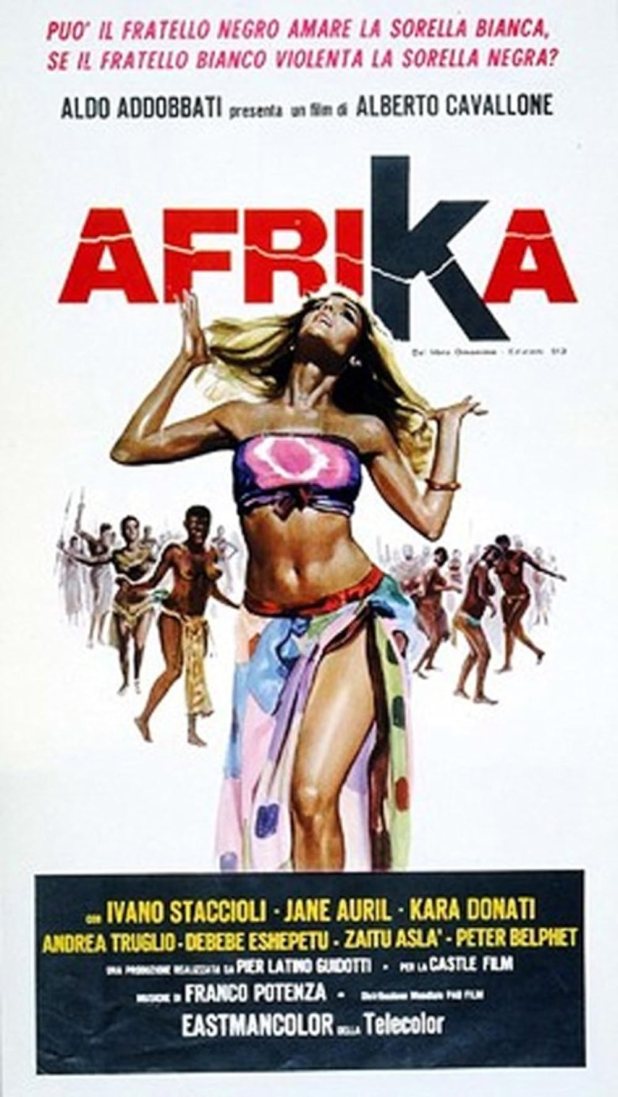
Afrika (1973)

Afrika is a rarely discussed giallo directed and written by Alberto Cavallone (Soffio Erotico) and one of the few where homosexuality is explored outside of a comedy character.

Professor Philippe Stone (Ivano Staccioli) is in the middle of being in love with his wife (Jane Avril) and his attraction to young men like his secretary Frank (Andrea Traglia), who he has made a part of his family. Frank even becomes a woman, but Stone ends up cutting him out of his life, which causes the now her to kill herself with the help of his sister (Kara Donati). You feel for Frank because of he/she lived a life filled with horrible moments, like being assaulted by two men and a woman when he was just a teenager. He’s just looking for love from the older European, but much like how the white man colonized Africa but really stripped it for its resources, that’s what is happening to him/her.

At the end, the police simply say, “Let’s close this squalid story as the suicide of an abandoned woman. We don’t say a word about everything else.”

Cavallone said, “It wasn’t a film that the public could like… and in fact it didn’t like it.” He also said in another interview, “I wanted to talk about Africa and homosexuality. I was interested in exploring the problem, trying to make people understand this type of relationship, which was seen at the time as a taboo relationship. And above all I was interested in making an African story in which Africa could be a backdrop to bring the characters closer together. The whites in an Africa that had now decolonized were the soldiers of General Custer.”

Finally, a word on how the movie was horrific to make: “Working in Ethiopia was a nightmare, my operator and I were put in a security cell several times. “

To make Italian male audiences not feel so weird about this confrontation with male love, there are numerous scenes of Avril nude, including her dancing with an African tribe. To remind us all this is an Italian movie, there is a scene of soldiers killing two women and real footage of cattle being slaughtered.

TUBI ORIGINAL: Prepare to Die (2023)

Years ago, Blaine Richtefield (Lorenzo Lamas) killed Diego Padilla’s (Ryan Padilla in the present, Andres F. Croci-Valdes in the past) father and mother over their farm, which was the last place he needed to own all of the land in a Texas town. He’s saved by Richtefield’s driver Silas and sent to China to be raised by Silas’ father Bingwen Hsing (Craig Ng) alongside that man’s daughter Xin Yi (Alyssa Leanne So in the present, Brylee Hsu in the past). The older man trains the boy in martial arts and tells him that Silas saved him because he reminds him of the daughter, Catherine, that he could not save.

Directed by Jose Montesinos (Five Star Murder), who co-wrote the script with Jacob David Smith, Prepare to Die has Diego sailing back to America to confront Richtefield and get revenge. He has to start fighting from the minute he’s on the boat as two men to rob him, He nearly kills one of them when one throws his mother’s necklace overboard.

Meanwhile, Richtefield and his henchman Ryan Fruitwood (Quentin “Rampage” Jackson) have an entire storage locker full of women under their control, just to show you what horrible people they are. He also has the law on his side in the form of the sheriff (Michael Madsen).

Diego comes to town and goes to a bar where he plays pool against William Freeman (Rylan Williams) which turns into a fight against two of Richtefield’s henchmen. He gets outside and even more are waiting, which causes Diego to come outside and watch. When he learns that Richtefield is involved, he saves Freeman. He loses his cool and starts choking the life out of one of them before the cops arrive. They also meet up with Bianca (Paula Rae-Taylor), who tries to steal Freeman’s truck because it has Richtefield’s name on it. That’s when it comes out that he used to be his boss. She’s been trying to find her sister, who is one of the girls kidnapped by Richtefield.

They also run into James Swiftwater (Andrew Pinon), whose land they are staying on. He makes sure that no one sneaks around Richtefield’s land. Nobody likes working for the guy but they are all forced to. Swiftwater claims that Freeman brought drugs into his community and cost his brother his life. Freeman is trying to make amends, as he lost his sister too. Everyone has made mistakes working for one bad person in the middle of it all.

Of course, it all comes down to Richtefield fighting one on one with Diego, as well as everyone getting the revenge they want. Not everyone makes it out alive which makes it weird when everyone goes and eat afterward, as if someone major in the cast didn’t just die and they didn’t just kill so many people. I mean, I’ve never had to get bloody revenge before, so perhaps it does make you hungry.

You can watch this on Tubi.

Los ojos de Julia (2010)

Directed by Guillem Morales, who wrote the story with Oriol Paulo and produced by Guillermo Del Toro, Julia’s Eyes isn’t an Italian movie made in the 60s or 70s, yet it has the giallo in its heart.

This starts with a blind woman named Sara (Belén Rueda) being haunted by an unseen presence. She decides that she has to hang herself to escape her life, but changes her mind at the last minute. As she prepares to get down, someone kicks the chair out from under her. As this happens, her twin siser Julie (also Belén Rueda) senses her death.

Sara and Julia both have the same degenerative eye disease, as Julia is slowly losing her sight. She tells her unbelieving husband Isaac (Lluís Homar) that her sister, whose eye surgery didn’t save her vision, couldn’t have killed herself.

As a giallo heroine, Julia must investigate the case herself. She meets her sister’s neighbor Soledad (Julia Gutiérrez Caba), a blind woman who tells her that everyone will leave her, including her husband, as her son Angel (Pablo Derqui) did to her. She also tells her that her sister had a boyfriend, which leads her to a hotel where a janitor named Créspulo (Joan Dalmau) tells her that men in the shadows are watching her and are tired of being ignored.

Things get worse. Isaac disappears and Créspulo is killed. When the police take Julia, whose eyesight is nearly lost, home they discover Isaac has also hung himself, leaving behind a suicide note stating that he had been in an affair with Sara. As surgeons work to repair her eyesight, Julia now must move into her dead sister’s apartment and attempt to keep her eyes bandaged for two weeks, which is how long the donor eyes will take to adjust to her body. She will have an assistant, Ivan (Dani Codina) to take care of her and ensure that she doesn’t remove her bandages.

Days before she gets to see again, someone breaks in and drugs her. She barely fights him off and learns from a neighbor’s daughter that that man was Ivan. She also says that he was the one who ruined Sara’s operation, kidnapped Isaac and forced him to write the note before killing him and has an entire room filled with photos of Julia and her sister. She tears off the bandages to find that the room that she is in is definitely filled with those photos and the young girl is dead.

Obviously, spoiler warning from here on out.

Ivan is really Angel, who killed and replaced the assistant. He believes that only blind women can love him, as they depend on him for their care. Soledad appears and shows that she is not blind, so Angel goes all Lucio Fulci and attacks her eyes with a needle. The police arrive just in time for Julia to find him in the dark, at which point he slices his own throat.

Julia’s vision lasts just long enough to come to the morgue, where they have been keeping her husband’s body, and say goodbye. The eyes that were donated to her were his, and now as teh result of Angel, no longer work.

Remade in 2022 as the Hindi movie BlurrJulia’s Eyes has enough of the past while looking — well, you know what I mean — bravely to the now and beyond. It’s a thrilling movie and one that I hope more people watch.

You can watch Julia’s Eyes on Tubi.

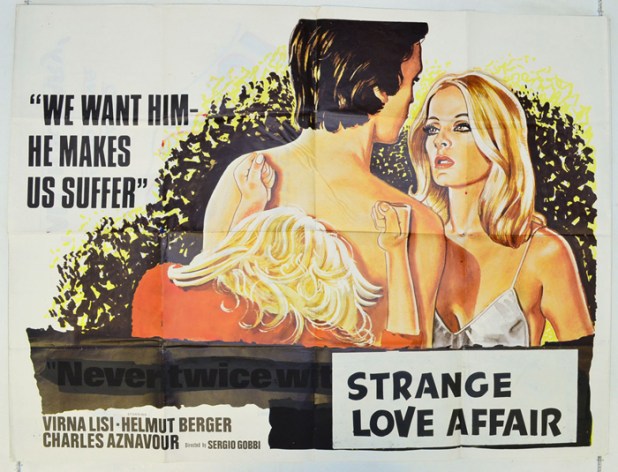
Love Me Strangely (1971)

Also known as Il bel mostro, A Strange Love Affair, Two Girls in My Bed and A Handsome MonsterLove Me Strangely is based on the novel Un beau monstre by Dominique Fabre. It was directed by Sergio Gobbi, who wrote the script with Dominique Fabre and André and Georges Tabet.

The antagonist for everyone in this movie is Alain Revent (Helmut Berger), a man who dominates women so horribly that when his wife can’t find something he’s hidden from her, she dives out a window. Along with another horrible man, Dino (Alain Nourey), they begin to psychological destroy his second wife,  Nathalie (Virna Lisi). By the time a police officer named Leroy (Charles Aznavour) gets involved, they’ve already driven her to anoerxia.

Helmut Berger is well-known for roles where he destroys women and with this movie and Bluebeard, Lisi gets put into the role of victim. There a line in the novel that this movie comes from, “Taking a woman without destroying her is not really possessing her,” that sums up its villain. Can the police officer save her? Does she even want to be saved? Much like The Strange Vice of Mrs. Wardh, so many heroines of 60s and 70s European films could be saved if they just came out and admitted that they liked consensual BDSM and got on with their lives instead of constantly looking for cruel men.

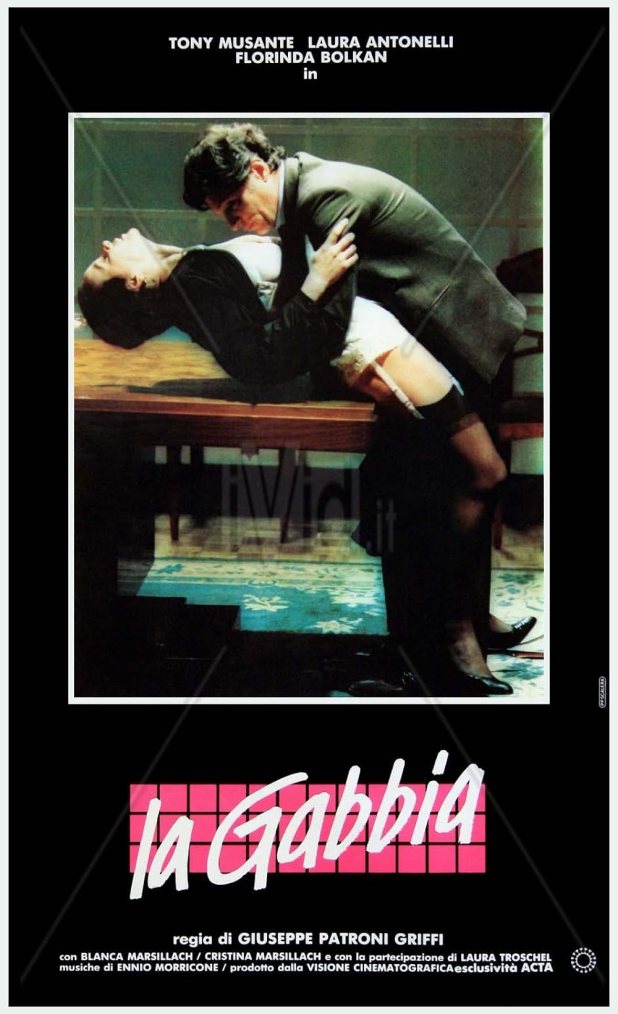
La Gabbia (1985)

La Gabbia (The Trap) is based on a story called L’Occhio, which was written by filmmaker Francesco Barilli (The Perfume of the Lady In BlackHotel Fear), who was trying to direct the movie himself. He couldn’t get producers to pay for the film unless Shelley Winters was in the lead. He sold the idea to Giuseppe Patroni Griffi, who also made Identikit.

The screenplay was written by Concha Hombria, Roberto Leoni and Alberto Silvestri, along with Lucio Fulci, who didn’t direct as he was coming back from hepatitis.

Barilli is quoted in Troy Howarth’s Splintered Visions: Lucio Fulci and his Films as saying, “Lets’ talk frankly here, that movie sucks…” Fulci used profanity when asked about Griffi, who he felt stole his chance to direct this movie. He ended up directing The Devil’s Honey, which is pretty much what this movie could have been.

That said, this does have an Ennio Morricone score, so that helps.

Michael Parker (Tony Musante) is an American in Italy who is dating Hélène (Florinda Bolkan). 15 years ago, he dated Marie (Laura Antonelli), who has finally found him again. Amazingly, she’s his girlfriend’s landlady. What are the chances? He thinks they can just have a quick affair, but she won’t let him go. In fact, she puts him in a cage. And to make things even weirder, her daughter Jacqueline (Blanca Marsillach) soon falls in love with him.

When Hélène returns, she can no longer find him. She’s used to him wandering from woman to woman, but he always comes back. As for Marie, Michael once taught her the ways of love and then left. She never found a man who satisfied her in the same way and now, she refuses to even let him go to the bathroom outside of her sight. Also: Jacqueline could be his daughter.

Made in the brief time before giallo would become the erotic thriller, this has Michael being held so close to his girlfriend, finally paying for his years of seducing women and leaving them alone. Of course, I would rather have seen what Fulci had done with this movie. Or Barilli, come to think of it.

You can watch this on YouTube.

Cattive inclinazioni (2003)

In the streets of Rome, a serial killer is using a set square to murder women, including a teacher named Grazia Scanetti inside her apartment. Policewoman Rita Facino (Mirca Viola, Miss Italia 1987 and the winner of the Miss Hair Look, Miss Computer and Miss Platea awards) is on the case, but there are many red herrings, as you can imagine. When Rita tries to explain that no one knows who the killer is, Visconti (Antonio Petrocelli), the district attorney, doesn’t listen to her.

There’s also a painter in the same building as the killer, Mirta Valenti (Florinda Bolkan, who is the reason I watched this) who is inspired by the murders and starts painting dead women with set squares stabbed into their necks. She also hires a sex worker named Donatella (Elisabetta Rocchetti) to kill her, claiming that she has cancer, but in truth she’s killing her hated housekeeper Laura.

Then there’s singer named Nicole Cardente (Eva Robins from Tenebre) who works with her manager and girlfriend Otilla (Elisabetta Cavallotti) to pretend to get death threats from the killer and then kills Otilia when she starts an affair with a man named Premio (Guido Berti) and makes it looks like the work of the killer, framing Premio, who is shot by the police who as always are blundering in the dark.

So we know who killed victim two and three, but who killed the teacher? And what does Franco Nero playing an unhoused man have to do with any of this?

This movie was directed by Pierfrancesco Campanella, who wrote the story with Gianluca Curti and Enzo Gallo. Salvatore Ferraro , who was on trial after he was accused of aiding in the murder of a student named Marta Russo, was a technical consultant, which got this movie some negative press. But any publicity, you know…

This was an attempt to make a movie that looked to the thirty-year-past world of giallo. In no way is it anywhere close to even the lowest level 70s giallo, but it does have some nice gore effects. It’s not as bad as some reviews will say, but I think you need to be obsessed with the genre to enjoy this.

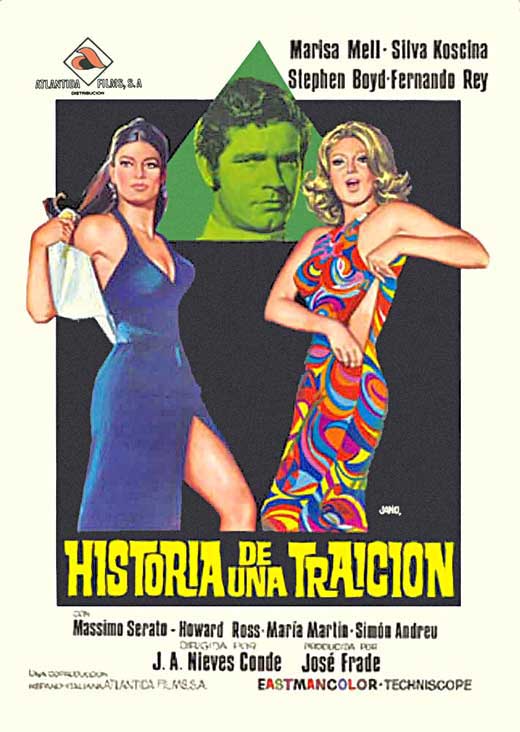
The Great Swindle (1971)

Also known as Historia de una traición (Story of a Betrayal), Nel buio del terrore (In the Darkness of Terror) and Diabolicamente sole con il delitto (Diabolically Alone with the Crime), this was sold in the U.S. as The Great Swindle and the posters hint that it’s similar to The Sting. As you can imagine, outside of having characters using one another for money, it has nothing to do with that movie.

Directed by José Antonio Nieves Conde, who also made Marta a few months earlier with stars Stephen Boyd and Marisa Mell. This was the movie where they began they love affair. In the book Coverlove, Mell said of Boyd, who had avoided her attempts to seduce him the first time they worked together, “He was just so awesome in his passion, his tenderness and his masculinity that I completely lost my head. Finally I asked him the reason why he was now changed so completely after he had been so dismissive before. He was thoughtful, “In the beginning you were too aggressive. I was just at the end of a difficult and desperate love affair. Mentally I was destroyed, and I just wanted to be left alone. I also felt an incredibly dangerous woman in you. To engage with you would mean to never get away from you. That’s why I had completely shut down.””

I’ve mentioned before in the Marta article that their love was so destructive that they needed an exorcism. Mell speaks on this, saying, “Our demon was our passion. We were, as it is in San Vicino custom, made to wear a broad iron ring around the neck. We humbly bowed and prayed. The priest blessed us that we might be “pure.” He celebrated the prescribed ritual for exorcism. It was kind of a supernatural experience. Perhaps you smile today over such hocus-pocus. At that time I felt is was not ridiculous, although I see myself as a clear-headed woman. But my connection to Stephen just had something very mystical, inscrutable in itself, and he felt the same way. Sometimes love is like a deadly disease, sometimes it makes you feel that you are damned for all eternity. Trying to explain the reasons for this is impossible. There are things in our lives that are too high for our philosophy.

Stephen and I returned to Rome, but we did not feel absolved. The demon of passion was still living in us.”

When you watch this movie, know that this drama was going on behind the scenes.

Mell plays Carla, a high class call girl who purrs at one point that she was never made to be anyone’s servant. She finds one of the girls she used to work the street with — back in the old, tougher, darker days — Lola (Sylva Koscina) working as a maid in a hotel she’s staying in. She tells her that she isn’t made for this life and helps to introduce her to the world of being paid by men just for moments of their time.

Her best client is Luis (Fernando Rey), but in the time when she isn’t charging for her love, she starts to develop feelings for a painter named Arturo (Stephen Boyd). In a reverse of their actual relationship, the first evening that he meets her — he’s soaked for being in the rain, she lets him in and he immediately starts drinking her expensive liquor and tries to get in her bed — she rebuffs his advances. A few days later, he saves her from jumping off a cliff and they end up together.

Yet Carla and Lola are more than friends, as they have had a long-time love that is rekindled by finding each other once again. The problem comes when Carla introduces Lola to Luis, who suddenly forgets her. Weeks later, as she’s surrounded by newspapers, Carla learns that Luis died in an airplane crash. And that’s when Lola comes back. Arturo suggests that they frame her for Luis’ death, except that while Lola loves Carla, Arturo soon falls for Lola too. Everybody wants everybody and yet their need for money outweighs everything. Not everyone is going to survive this.

This movie may put some off by the way that it has flashbacks within scenes, but I truly adored every moment of it. Every single room the characters appear in is beyond incredible and I counted more than ten costume changes for Mell in less than twenty minutes. Nearly everyone is impossibly gorgeous and the twists and turns keep you wondering. This is not all that easy of a film to find but it rewards those who seek it.

You can watch this on Vimeo.

SOURCES: Stephen Boyd Blog

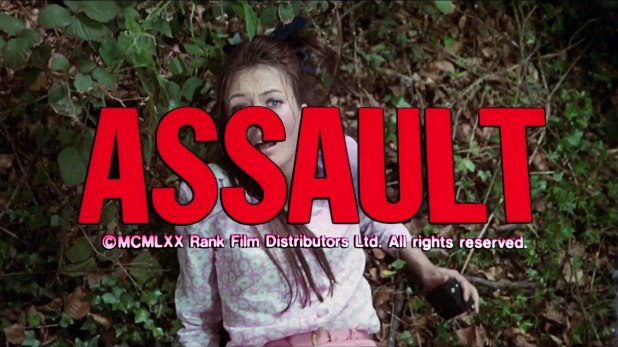
Assault (1971)

Yes, I know, this isn’t an Italian movie, so some think it can’t be a giallo. It may also be closer to a slasher. But seeing as how Suzy Kendall is in it, let’s consider it.

Also known in the U.S. as the more giallo-feeling title In the Devil’s Garden, this starts as Tessa Hurst (Lesley Anne-Down) being attacked and raped. The act damages her so much that she loses her voice and is placed under the care of Dr. Greg Lomax (James Laurenson).

When a second student named Susan (Anabel Littledale) is assaulted and murdered, art teacher Julie West (Kendall) decides that she will offer herself as bait for the killer with help from a reporter (Freddie Jones). She’s pretty brave, because whoever did it seems to have glowing red eyes and looks like some kind of demonic force as it carries away Susan’s body.

Based on The Ravine by Kendal Young (actually Canadian writer Phyllis Bretty Young), this was directed by Sidney Hayers (Deadly StrangersBurn Witch Burn) and written by John Kruse. It was produced by Carry On… producer Peter Rogers and the school was also the setting for Carry on Camping.

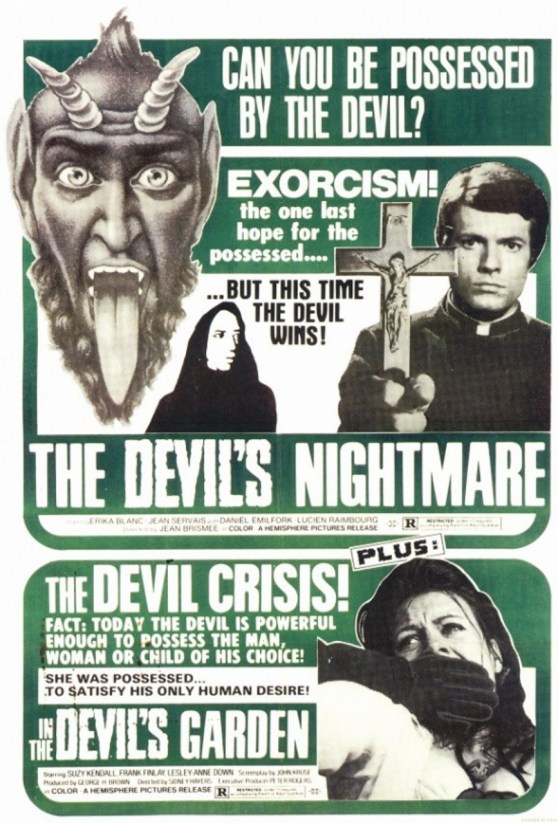
Speaking of alternate titles, when this played in the U.S. as In the Devil’s Garden, it was as part of a double feature with The Devil’s Nightmare and billed as a Devil Double Feature.

When it played on American TV, it was under the title Tower of Terror, which refers to the electrical title where the assaults happen.

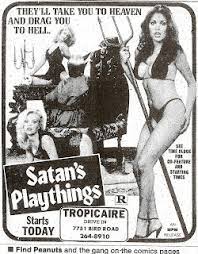
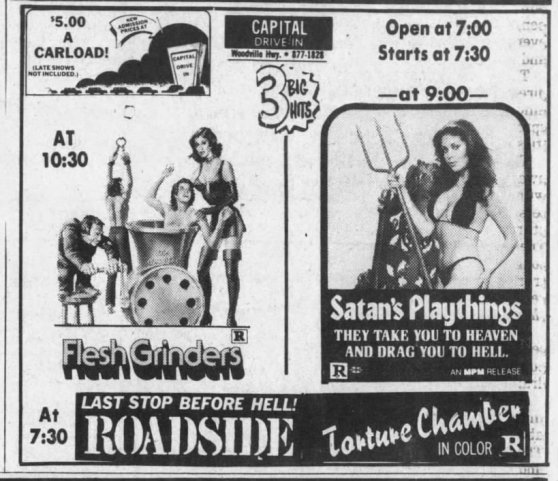
Even stranger, in 1980 — nine years after it was made and years after it aired on TV — it came back to drive-ins as Satan’s Playthings along with an ad campaign that promises three women who are under the thrall of Lucifer.

If that’s not enough, it also played as Molested and The Creepers.

You can watch this on YouTube.

What the Peeper Saw (1972)

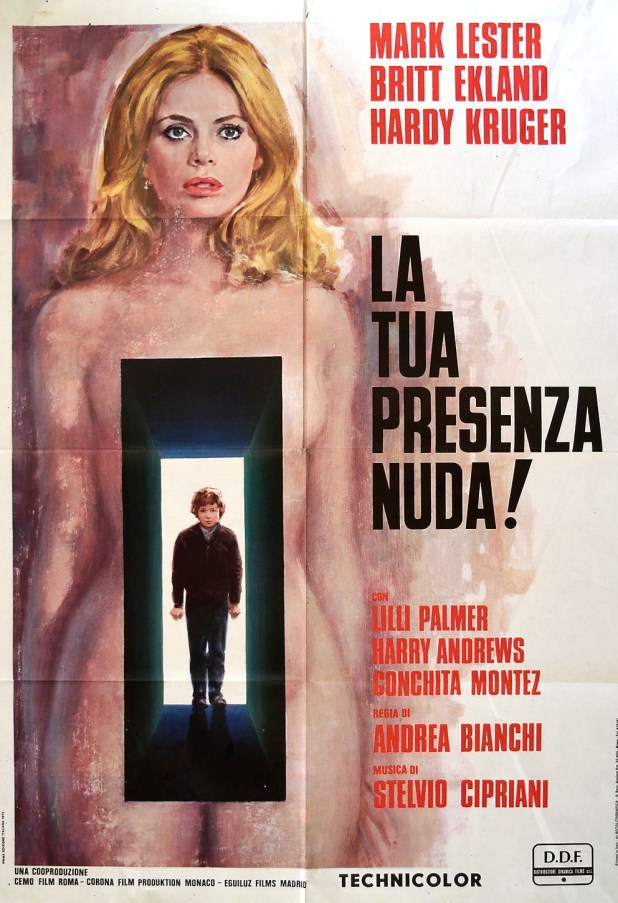
Elise (Britt Ekland) is the much younger second wife of Paul (Hardy Krüger), who married her soon after the loss of Sarah from drowning in a tub. Three months into their honeymoon of a marriage, she’s surprised by his 12-year-old son Marcus (Mark Lester, the star of Oliver), who claims that he’s left school early due to a chickenpox epidemic. The film wastes no time letting us know that not only is Marcus weird, he may also be a criminal sociopath.

After their first meeting, in which Marcus confesses to stealing money from his father, Elise looks through the child’s room and soon learns from the headmaster (Harry Andrews) that he was kicked out of school for stalking, creating sexual drawings and killing numerous small animals. She’s obviously worried and Paul just says that his son needs to get over the death of his mother.

That’s when this movie gets weird, as you wonder if Paul just doesn’t care that his son is a lunatic or if he’s just as much of a mentally ill person. Why wouldn’t he tell his new wife that the house they’re attending a party at used to be his and the place where Sarah died? Elise isn’t all that mentally set either, as she’s convinced to strip nude for Marcus if he’ll reveal the truth about killing his mother after she finds a hole above her bed and figures out that he’s been watching her.

That’s when Dr. Viorne (Lilli Palmer), who owns that house where Sarah died, listens to Elise’s concerns. She turns it around on her and accuses her of trying to seduce Marcus, as well as killing the family dog, a crime that was definitely committed by the young man. Elise loses her mind and tries to kill the boy before she’s put in a mental hospital where she dreams of being torn to pieces by the dog, as well as her killing Marcus and making love to him — not the same dream, this isn’t a Joe D’Amato movie — while Paul watches.

Marcus has, of course, been planning this all along. He asks Elise, when they are finally alone, if she wants to have an affair as his father is now too old to satisfy her. She kisses him passionately before…well, that would give up the ending, right? You really need to see this for yourself. The last ten minutes go for it and just unleash everything that could upset people about this movie.

This was directed by James Kelley, who also directed and wrote The Beast In the Cellar, and Andrea Bianchi, the maniac who made Cry of a ProstituteStrip Nude for Your KillerMalabimba and Burial Ground. It was written by Bautista Lacasa Nebot, Erich Kröhnke, Trevor Preston and Bianchi, so was supposedly brought in by another lunatic, producer Harry Alan Towers,  to add more exploitative scenes to the film.