Editor’s note: Cinematic Void will be playing this movie on Monday, January 13 at 7:00 p.m. at the Music Box Theater in Chicago, IL. You can get tickets here. For more information, visit Cinematic Void.
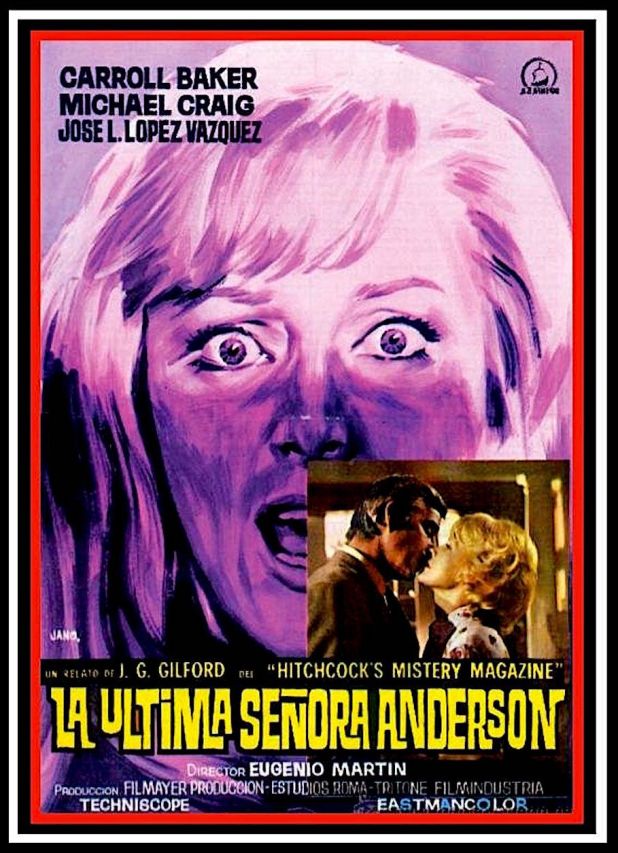
I loved this movie! It was such a madcap blast that it completely took me by surprise. Arthur Anderson (played by Michael Craig) is a wealthy Englishman whose two previous wives have died under mysterious circumstances—one in a car crash and the other after falling from a building. Now, his third wife drowns under questionable circumstances. Fortunately, his housekeeper’s testimony keeps him free and clear, although the police keep an eye on him.
On the very night he is acquitted, Julie Spencer (Carroll Baker) breaks into his house in a twist that feels like a giallo-style meet-cute, and she becomes his fourth wife. But is she trustworthy? What about him? Why do Arthur Anderson’sAnderson’s wives keep dying with such frequency? And will Inspector Dunphy (José Luis López Vázquez) be able to uncover the truth behind these mysterious deaths?
This movie cleverly borrows elements from Rebecca and Vertigo without being overly derivative. I also absolutely adore that when we first meet Julie, she’s sleeping in a tent inside an abandoned mansion—because that’s completely normal, right? And is that Marina Malfatti (from The Night Evelyn Came Out of the Grave, All the Colors of the Dark) lurking in the background, donning a cape as part of her casual rainy evening attire with sunglasses at night?
Exploring Spanish Giallo has been a fantastic journey for me. I’ve enjoyed delving into Eugenio Martín’s works, including Horror Express, as well as It Happened at Nightmare Inn. Plus, Carroll Baker starring in a Giallo is almost a genre in and out of itself.
While there’s no clear hero, I still enjoyed every minute. This film is called Death at the Deep End of the Swimming Pool and The Fourth Mrs. Anderson. It was only available on a Greek VHS before Severin released it. The package includes a trailer, a deleted scene, and an interview with Eugenio Martín biographer Carlos Aguilar, maintaining their consistently stellar presentation.
Want to see one of the drink recipes from a past show? We have you covered.
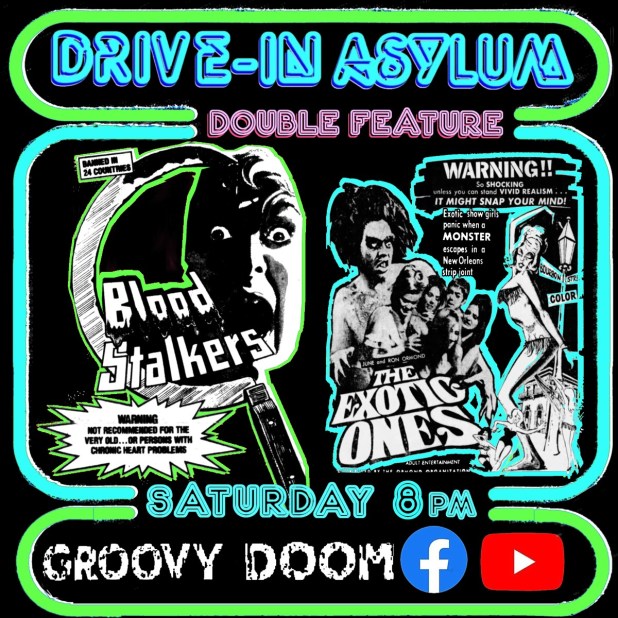
We’ll start the show with Blood Stalkers, a 1976 regional horror film where two couples make the wrong vacation plans and end up stalked by backwoods maniacs. You can watch it on YouTube and Tubi.
Each week, we watch movies, discuss them with our online chat room, look at each film’s ad campaign, and have a themed mixed drink. Here’s the first one.
The Night Daniel Died
1.5 oz. Malibu
1 oz. vanilla vodka
2 oz. pineapple juice
1 oz. half and half
1 oz. lime juice
Add all of your ingredients to a cocktail shaker filled with ice. Shake until chilled.
Strain into a glass and savor.
Up next, we’re welcoming Ron Ormond into our lives with The Exotic Ones, a movie that combines gore, music, and girls. You can download it from the Internet Archive.
For this movie, we’re making a tribute to its swamp thing.
Sleepy LaBeef
2 oz. Chambord
1 oz. Midori
1 oz. Malibu
2 oz. pineapple juice
2 oz. cranberry juice
Pour Chambord as the first layer over crushed ice, then layer Midori over it.
Mix your Malibu and juices in a shaker, then carefully pour it over the layers. Stir to create a marbled texture.
We’re so excited to get back to watching movies with you!
Alan J. Pakula took the paranoia at the start of the 1970s and made this film, as well as The Parallax View and All the President’s Men, movies shaped by and that shaped the zeitgeist. He didn’t stop making important films, as he’d gone on to make Sophie’s Choice, Presumed Innocent, The Pelican Brief and Dream Lover, which has some tones of Giallo.
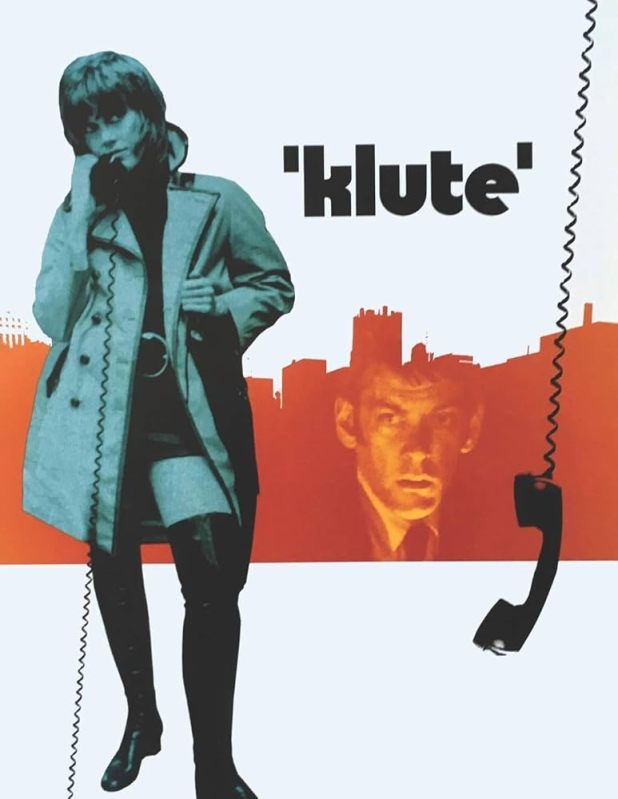
A chemical company executive has disappeared, and the only clue is obscene letters that were due to be sent to a call girl named Bree Daniels (Jane Fonda). The company hires a detective, John Klute (Donald Sutherland), to determine where the man has gone.
There’s a john who is so disturbed that two of his past clients have either committed suicide or become addicts. Bree had seen that man but can’t remember him. That is, once she finally opens up to Klute, who has been listening to her phone calls and following her, learning that she’s an actress who does sex work to pay her bills. One of the girls she knows, Arlyn Page (Dorothy Tristan), can tell Klute that his client may be the killer.
Fonda, a feminist, didn’t want to play this role. She wanted to drop out and ask Pakula to hire Faye Dunaway. She consulted with friends and, after some soul-searching, took on the role. Despite the controversy of her Vietnam protest, it became one of the best-known roles of her career, winning a Best Actress Oscar.
I like the end of this, as Bree keeps working everyone, saying that she’ll be back to see her therapist next week and that she would go mental living in a domestic world. Yet for all we see, Bree and Klute might be destined to be happy together. That’s a big win for a movie that follows a lot of Giallo beats and is filmed as if it’s surveillance footage. Sutherland and Fonda dated for a while; he was her date to the Oscars that year.
Bree’s apartment wasn’t real but was built on a sound stage. That said, Fonda did sleep overnight in it sometimes, and it even had a working toilet. She decorated the place as if Bree was a romance novel reader and had a cat. There’s also a hidden autographed photo of JFK. Fonda had a friend in Lee Strasberg’s private class who occasionally slept with the President, and in her head, she imagined that Bree did, too.
Editor’s note: Cinematic Void will be playing this movie on January 18 at 7:30 PM ET at The Sie Film Center in Denver and will be co-hosted by Theresa Mercado of Scream Screen and Keith Garcia, Artistic Director – Sie FilmCenter. You can get tickets here. For more information, visit Cinematic Void.
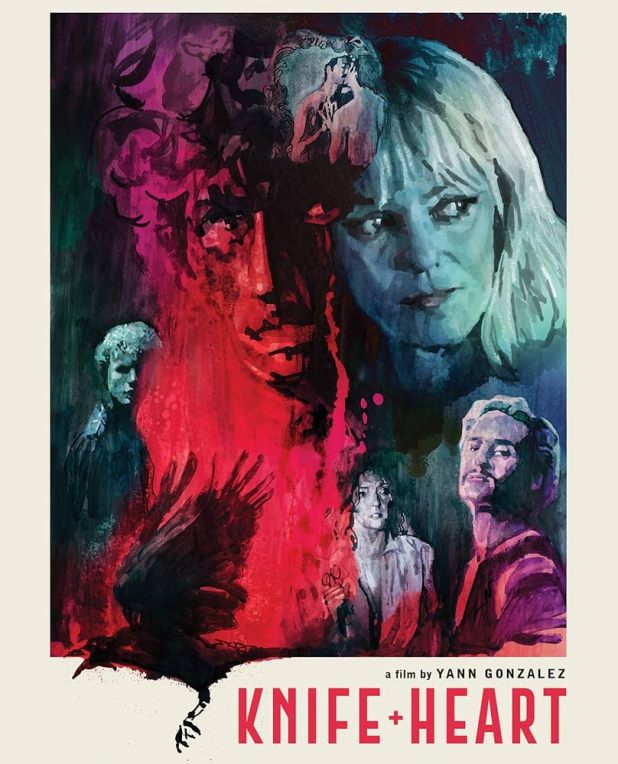
Knife + Heart is a true anomaly when it comes to Giallo. It’s from France, a country more given to fantastique films than Giallo, although movies like The Night Caller, Without Apparent Motive, and The Night Under the Throat exist. And its victims aren’t gorgeous women but the actors of the gay porn industry, changing the psychosexual dynamics of the form.
Instead of featuring the sounds of a band like Goblin or a score by Morricone or Orlandi, Knife + Heart has music by Anthony Gonzalez of M83, director Yann Gonzalez’s brother.
A young man is killed by a masked man whose very sex conceals his murder weapon to open the film. Then, we meet Anne (Vanessa Paradis), an adult film director recently abandoned by her girlfriend and editor, Lois. The man killed in the opening was the star of several of her films; now she must find an actor to take his place. That leads her to Nans, who agrees to be in her movie despite identifying as a straight man.
The new film — Homocidal — will be her version of the murders, which continue targeting members of her cast. The police either can’t — or won’t — help. But the movie finished, and as the group celebrates its completion with a picnic, the killer strikes again, just as Anne pretty much assaults Lois in an attempt to get her back.
The true killer is a man whose father caught him making love to another man. He killed his lover and castrated his son, who was also burned in a fire before being brought back from the dead by a blind crow — the fact that this movie isn’t called Call of the Blind Crow speaks to its non-Italian origins — and seeing one of Anne’s movies brought his memories back.
This being a giallo, there’s also a bird expert with a disfigured hand that looks like he has, quite literally, chicken fingers. Plus, the entire end of the movie is explained via voiceover. The fact that so much of this movie is given to style over substance means it lives up to the film that inspired it.
While the murders are in your face, the sex is nearly hidden from view. Anne is an intriguing protagonist — drunken and bitter instead of the normal virginal giallo and slasher ingenues that save the day. She instead brings the killer closer with each scene that she directs.
Back when they were child chess prodigies, David Willerman (Charles Bailey-Gates) and Peter Sanderson (Christopher Lambert) had a significant match. This match, which ended with Peter victorious and David stabbing him with a pen, had a profound impact on both their lives. It led to Peter’s father leaving and his mother committing suicide, and David’s obsession with his chess board, which he kept in the group homes and orphanages he grew up in.
When Peter grows up, he ascends to the status of a chess grandmaster and becomes a widower, left to raise his daughter, Erica (Katharine Isabelle), alone. The plot thickens when his latest lover, Debi (Kehli O’Byrne, Ginger Snaps), is discovered dead. The police, led by Police Captain Frank Sedman (Tom Skeritt), Detective Andy Wagner (Daniel Baldwin), and psychologist Kathy Sheppard (Diane Lane), launch an investigation, with Peter as the prime suspect. However, the mystery deepens as David, the potential missing link, enters the picture.
Directed by Swiss-born Carl Schenkel and written by Brad Mirman (Body of Evidence), this film, a part of the Giallo genre, features all of Peter’s lovers showing up with their faces painted like clowns and drained of blood. It also takes a page out of The Cat o’ Nine Tails by having Peter’s daughter Erica being best friends with his blind coach, who is played by Ferdy Maine (the devil from Night Train to Terror).
I always wonder how the Giallo police work. In this example, Sheppard goes from psychoanalyzing Peter to being a skewered queen. See, I can make sex jokes about anything! But seriously, defund the Giallo police. Sleeping with a suspect? Well, they were married in real life at the time.
It’s not the best Giallo-adjacent movie I’ve seen, but it’s not the worst. I did like how excited Lambert was when he won at Battle Chess.
EDITOR’S NOTE: Cinematic Void will be playing this on Saturday, Jan. 18 at midnight at the Coolidge Theater in Brookline, MA (tickets here). For more information, visit Cinematic Void.
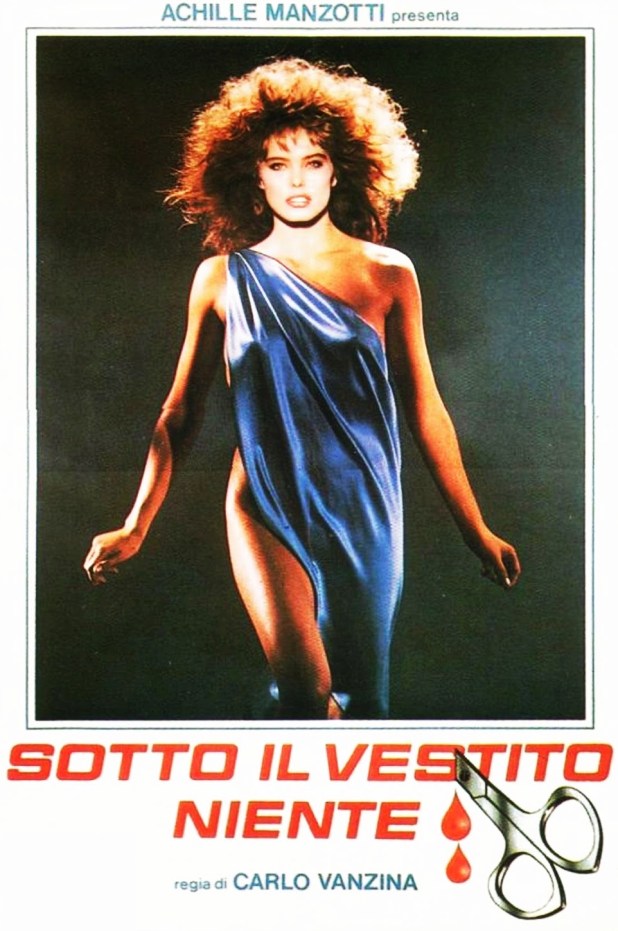
Initially intended for Michelangelo Antonioni, this film had the potential to be another Blow-Up. However, Carlo Vanzina and Enrico Vanzina created it with only a limited connection to the novel that inspired the title. The book, written by fashion journalist Paolo Pietroni under the pseudonym Marco Parma, generated significant controversy upon its release for naming prominent figures in Italy’s fashion industry.
The plot of this film, unlike any other, revolves around a serial killer prowling the streets of Milan, targeting glamorous models with a deadly pair of scissors, a weapon suggested by the renowned writer Franco Ferrini, known for his collaborations with Dario Argento. The initial choice of a gun as the killer’s weapon was quickly discarded, as it didn’t quite fit the unique essence of the Giallo genre.
Meanwhile, Yellowstone Park ranger Bob Crane (played by Tom Schanley) senses that his sister Jessica (Nicola Perring) is in distress. His journey takes him across the world, where he unexpectedly finds himself mingling with the rich and famous. Can he rescue her, or will he find himself in the crosshairs of the killer? And will Donald Pleasence ever turn down a film role?
One thing is certain: Barbara (Renée Simonsen), a model and friend of Jessica’s, is interested in Bob, but there are hints that she might also be obsessed with Jessica.
I often think about the connection between Dario Argento and Brian De Palma. This movie shares similarities with its murder scenes set in Italy and its modern American methods of death, which are reminiscent of the drill in Body Double and the psychic elements in Sisters.
Unlike many Giallo films, this one made a significant impact in Italy, sparking a small wave of comeback films set in the fashion world and the sequel Too Beautiful to Die. While I prefer that sequel and certainly think it surpasses the third film, the Vanzina brothers’ The Last Fashion Show, I’ve come to appreciate this film over time.
Never forget that this has one of the most amazing moments in Italian exploitation movies: Donald Pleasence going to town on a Wendy’s salad bar.
The sixth season premiered on HBO on October 31, 1984, with “Only Skin Deep” — along with “Let the Punishment Fit the Crime” and “Whirlpool” — an episode directed by William Malone (feardotcom, Scared to Death) and written by Dick Beebe, who also worked with Malone on House On Haunted Hill.
Carl (Peter Onorati) is a woman-beating loser who shows up at a party knowing an ex will be there and makes a scene, as everyone knew he would, before meeting a masked woman named Molly (Sherrie Rose, Mary Jo from American Rickshaw), who says that she is dressed as “a synthetic shield with a corpse inside.” She takes Carl home, but that’s probably not a good idea for either of them.
“Hmm, I see your raise and I call! Bleed ’em and weep! Spades beat hearts every time. Oh, hello creeps. So glad you could join me for my weekly game. My deal! Hacks and chokers are wild. Are you in? Good. So’s the man in tonight’s terror tale, except his game is relationships. It’s a ghoulish little gamble I call “Only Skin Deep.””
The night of wild passion they share takes away Carl’s anger, but it won’t last, as she wants nothing to do with him afterward. He soon learns that attacking her is the worst thing he could have done, as she has no true face. Soon, he doesn’t have one of his own.
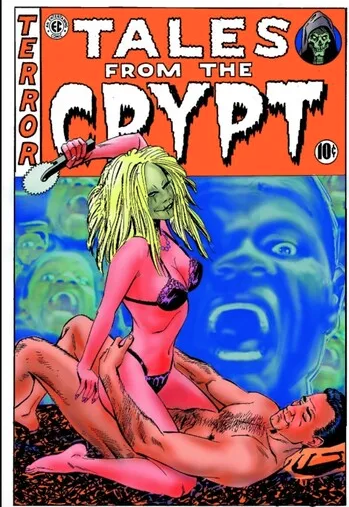
This episode was based on “Only Skin Deep!” from Tales from the Crypt #38, written by Al Feldstein and William Gaines and drawn by Reed Crandall. The comic is very different, as Herbert and Suzanne meet yearly at Mardi Gras. One year, Herbert becomes tired of being separated from her for a whole year and asks him to marry her. Suzanne still refuses to remove her witch mask, even after she marries him and they consummate their relationship. Then, when he tries to remove the mask himself, he rips off her face and watches her slowly die. Good Lord! Choke…
In the final part of my interview with Johannes Grenzfurthner, we discuss his new film, Solvent, in more depth.
B & S About Movies: What else shaped Solvent from your own life?
Johannes Grenzfurthner: There are moments in the film that are direct quotes or anecdotes from my life. For example, the story about my grandmother is true. I went to see E.T. with her, and she was so overwhelmed.
(Editor’s note: In the film, the character Bartholdi recalls seeing E.T. with his grandmother. Flabbergasted by the movie, she tries to make sense of it, saying: “Spielberg. Hmmm. A Jew.”)
She wasn’t anti-Semitic in the way we typically think of it—she hated Hitler, often cursed him because her brother died in the war, and she never forgave him for that. But she was born in 1923 and grew up in an era saturated with Nazi propaganda. Like most kids at the time, she was part of the Nazi youth organizations—it was mandatory. While she never openly spoke badly about Jewish people or subscribed to Nazi ideology, there was still a residue of that indoctrination in her thinking. When we saw E.T. back in 1982, she was genuinely fascinated but completely baffled. It was probably the first science fiction movie she’d ever seen in a cinema. She had grown up on films from the ’40s and ’50s that aired on Austrian television—none of them were anything like E.T., she tried to make sense of it, and her explanation was, “Spielberg… he’s Jewish. Maybe that’s why it’s so strange.”
It’s such a weird anecdote, but I felt it perfectly captured the ambivalence of that generation’s thinking. Even when they weren’t openly hateful, there was still this ingrained framework of “otherness” and attempts to rationalize anything unfamiliar through those old, biased lenses.
I included it in the film because it reflects something larger: the lingering traces of ideology, the subtle ways it persists. Especially now—with Austria’s far-right gaining traction again, and looking at things like Trump’s election—it feels like history is echoing back to us. We’re literally in the 2020s, but it feels disturbingly like the 1920s all over again.
B&S: My dad was an art teacher. Kids in class would make pottery of swastikas. They didn’t know what it meant they were being rebellious. And my father would make a point to break every single one of them. He told me you can’t ever let that happen again.
He had a stroke and one of the hardest things to deal with was his memory loss, explaining where America was heading every day. He learned about January 6th and the riots months after it happened; it broke his dementia for a bit. I had to explain to him several times how we got here. And I always thought, “What was it like to be in Nazi Germany as things slowly progressed?” I worry that I know now.
With your different background and learning about it in school, what do you think? How could we be doing this all over again?
Johannes: There are so many ways to look at it, but I think, fundamentally, it always comes down to economics. People are afraid. They can’t afford things. And fear—especially economic fear—makes them vulnerable to manipulation.
I’ve heard people mocking voters, saying things like, “Oh, you’re choosing your candidate because of the price of eggs?” But for some people, the price of eggs is survival. That kind of mockery is incredibly classist. If you’re struggling to put food on the table, fascism feels like an abstract concept—it’s not what you’re thinking about when you’re hungry or when your family’s future is uncertain.
In German, we have a saying: “First you think about what you’re eating, then you think about morality.” And it rings true. For many people, politics boils down to economics. Take rural areas, or places devastated by mill closures or other industries disappearing. When people are desperate, they’ll vote for whoever promises relief, no matter the long-term consequences.
It was the same in the 1920s. The economy was in shambles, and people were suffering. They voted for the person who promised them bread, not realizing that meant voting for the person who would later send them off to war. That next step—what fascism truly entails—is something most people don’t think about when their immediate needs are so overwhelming.
That’s why, at my core, I’m such a neo-Marxist. If you don’t take the economic realities of people seriously, you’ve already lost the fight. The root of so much political instability, and even fascism, is tied to economics. Addressing that fear is the only way to truly counteract it.
B&S: As you said, I live in the Rust Belt, and we’ve barely recovered from the 1980s steel mill closures. But if somebody with power says I’m going to bring steel and coal back, you will vote for that if that’s your dream. But if you know the industry, you know that the heyday of steel and coal in Western Pennsylvania can’t come back. It’s a different world. So you set up people to vote for you because of a promise you can’t deliver, and when these disenfranchised people are energized and disenfranchised again, what happens?
Johannes: Yes! I even have a Pittsburgh story about Solvent. So, I came across this review on Letterboxd from a user called Porridge MD. It stuck with me because of how the movie resonated with him and what he decided to do afterward. He starts by describing this little dive bar where he likes to hang out—classic working-class vibe. You shoot some pool, have a drink, chat with the regulars. Among the crowd, there’s this one guy, a skinhead type with Nordic runes tattooed on his arm. And, you know, it’s clear what kind of ideology he subscribes to. Most of the time, this guy talks about football or whatever, but every so often, he starts spouting Holocaust denial nonsense—stuff like “the gas chambers never existed.” Porridge MD said he usually ignored the guy because… well, America, right? Bars like that sometimes let people like him stick around. But after watching Solvent, something changed. The next time he saw the guy, he walked right up to him and said, “The biggest traitor is the Holocaust denier. He insults the cunning of the German people.” That’s a quote by the Nazi character in my film. And apparently, the guy’s face just crumpled. Like he’d been hit by a bazooka. Porridge MD gave the film five stars, saying, “Cheers to you!” That’s the kind of thing that gives you goosebumps as a filmmaker. The idea that something you created can spark that kind of subversive reaction in someone—that’s just lovely.
B&S: Back to movies, we’re not getting the end of the world we wanted.
Johannes: A few years ago, I made a documentary called Traceroute. You can find it on Vimeo-On-Demand. It’s essentially a political nerd road trip—I traveled from the West Coast to the East Coast of the U.S., visiting locations and meeting people who influenced me as a nerd. One of the stops was the Monroeville Mall in Pittsburgh, famous because of Dawn of the Dead.
I even did an interview with a researcher in the parking lot there until security kicked us out. That was an experience. (laughs)
In the film, I talked about this idea that people are obsessed with end-of-the-world scenarios. Zombies, nukes, alien invasions—we love these big, dramatic collapses. But the truth is, the world doesn’t really end. It just keeps getting worse, incrementally, bit by bit. We’re like the proverbial frog in the pot, with the water heating up slowly.
I think people are waiting for this defining moment, this boom, where everything collapses in one go. But that’s not how it works. Instead, we’re already living through constant, rolling apocalypses. Look at 9/11. Symbolically, for many Americans, that was the end-of-the-world moment. It doesn’t get more hardcore than that, at least in a symbolic sense.
What’s the next step? A city being nuked? Sure, that’s possible. But honestly, the way things unfold is rarely as cinematic as we’d like to imagine. It’s more subtle, more pervasive. The real apocalypse is just this endless decline—the systems we rely on slowly breaking down, society eroding, while we all hope for a clear moment of resolution that will never come.
B&S: What movies influenced your nerd life?
Johannes: After makingMasking Threshold, I was invited by Letterboxd to create a list of films that influenced me. I welcomed the challenge. I am a nerd for “lists.” But when I sat down, it was pretty overwhelming. Every movie I’ve ever watched has shaped how I view film and the world. Some films are, for various reasons, enormously present in my memory.Poltergeist, for example, because I first saw it when I was 9, alone on late-night television in our dark living room while my parents and friends had a BBQ outside. I felt I was dying of fear throughout the entire experience. OrRoboCop, because as a 12-year-old nerd in a shabby theater in my Austrian hometown, it kindled my interest in politics, technology and toxic waste that melts your face off. I didn’t include those films (and moments) in my compilation because they feel too big and too dominating. Instead, I chose films that, for whatever biochemical reason, my brain goes back to when it is wandering, digesting and scheming.
Thanks to Johannes for spending so much time discussing his films with me. I can’t wait to see what he makes next. Please take the time to experience his work; it’s quite amazing.
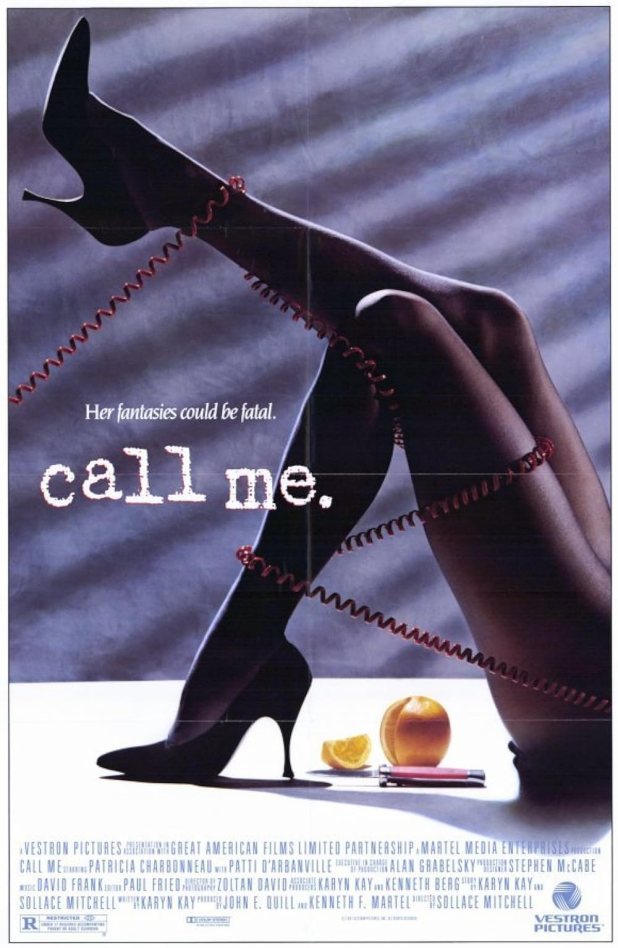
Directed and co-written by Sollace Mitchell (with Karyn Kay), this is the story of Anna (Patricia Charbonneau), a newspaper writer who feels a distance from her live-in author lover, Alex (Sam Freed), who is only excited about getting to writer about fast food.
One evening, she thinks she’s received a dirty phone call from him, the spice she’s looking for in her life. Instead, she’s in a dive bar waiting to meet a stranger, running away and accidentally watching two criminals, Jellybean (Stephen McHattie) and Switchblade (Steve Buscemi) too closely. They think she has their money. She has no idea who they are, much less the heavy-breathing caller who keeps dialing her almost every night.
Every man around Anna is a milquetoast that still wants to control her. So when she gets caught in the world of dead cops and someone who calls her in the middle of the night, telling her to make love to herself with an orange that gets juices all over her thighs, can you blame her when she whispers, “Push orange slices into my cunt with your tongue” and asks the caller to penetrate his own orange before realizing her lame boyfriend has been watching all along?
Anna is also pretty dumb, I must confess. Is her life so bereft of thrills that all she has are phone calls? She’s gorgeous. She doesn’t even need a boyfriend, as she has a career. Maybe she’s co-dependent, as her friend Cori (Patti D’Arbanville) calls out:
Anna: Cori, I’m not the only woman who gets obscene phone calls.
Cori: No, but you’re the only one I know who talks to them.
I wanted this to be closer to either a Giallo or a movie that let Anna finally explore her kink with someone less dull than her lame best male friend. I want her to have more. I want her to be smarter. I want her, in short, to explore her wants.
As a sad aside, co-writer Karyn Kay died way too young, at 63, killed by her 19-year-old son Henry Wachtel. After her career in Hollywood, she’d started teaching Creative Writing at LaGuardia, a New York City performing arts school. In this article on Crime Reads, the author shares her real-life experience of having Kay as a teacher. It’s worth a read.
If you’re interested, Anna gives her phone number in this movie: 212-627-2363.




 B&S About Movies
You must be logged in to post a comment.