KO-FI SUPPORTER: End Play (1976)

EDITOR’S NOTE: Today’s movie is brought to you by Eddie R., who subscribed at the Big B&S’er tier.

Would you like me to write about the movies of your choice? It’s simple!

  1. Visit Ko-Fi.
  2. Join as a monthly member for just $1. That makes you a Little B&S’er.
  3. As a Medium B&S’er at just $3 a month, if you pick a movie or a director, I’ll write about them for you. In fact, I’ll do one for each month you subscribe and even dedicate the post to you.
  4. For $5 a month, you basically get some major power. As a Big B&S’er, I’ll write an entire week on any subject you’d like. Every month, if you’d like.

Thanks for picking this, Eddie R. It was very much a blind spot!

Janine Talbot (Delvene Delaney in her only full-length theatrical role, but she’d go on to be a TV game show presenter) is hitchhiking through Australia, but please — spoilers all over this — don’t get to know her. Whoever has picked her up, she instantly begins to make love to them, even calling out how quick they’re moving, but not stopping them. Then, without warning, she’s dead.

Was it merchant sailor Mark Gifford (John Waters, a child star who was on the Aussie TV show Play School for twenty years; since then, he’s done a one-man show about John Lennon), who has disposed of the body? Or perhaps his brother, Robert (George Mallaby, mostly known for playing a police officer on Homicide, The Box and Cop Shop in Australia; he also owned the first hazelnut farm Down Under; sadly, Mallaby spent the last four years of his life in a wheelchair after a series of strokes), a tense young man confined to a wheelchair?

These adopted brothers spend most of the movie literally at war with one another, mainly because they’re both in love with their cousin, Margaret (Belinda Giblin, who was on the Australian TV show Sons and Daughters). Despite the fact that Robert doesn’t have use of his legs, he’s really rough on his brother, who the police suspect in a series of hitchhiker murders beyond the one we’ve seen in the opening of this film.

Based on Russell Braddon’s novel, which was set in England, this was directed and written by Tim Burstall as a two-lead, single-location film that could be done on a budget while he prepped the film Eliza Fraser (which also stars Waters and Mallaby). He may be better known for movies like StorkAlvin Purple and Attack Force Z, at least in the U.S.

There are so many issues here: Robert is about to get worse, losing the use of his arms, so his brother will be fully in charge of him. And yet he despises Mark, who has taken his girlfriend from him. Most of the film is a menacing battle of emotions between the two men, but by the end, things get awfully bloody. And as always, things may not be as they seem when it comes to who the killer is, despite this seemingly telling us who the guilty man is right at the beginning. After all, the poster says that this is a filmin the Hitchcock tradition.”

Between this, Road Games and Fair Game, my personal vision of Australia is a lawless land where women are constantly in danger of being murdered. Or being killed and then dressed up and kept in someone’s house before it’s taken to a theater and placed in a seat to watch a ripoff of A Clockwork Orange. If you look, Delaney is both blinking and breathing when she should be deceased, but don’t let that distract you from this movie.

End Play works because it messes with the previously called out Hitchcock tradition,it claims to follow. By showing us a disposal of a body early on, it tricks the audience into a false sense of moral superiority. We think we know who the monster is. The film then spends 90 minutes making us second-guess exactly who the villain is, as well as the mental stability of both men.

What should we call Australian giallo? Down Under Sunburnt Gothic? Moscato Giallo?

You can watch this on Tubi.

Soul Robbers from Outer Space (2009)

Jerry Williams also directed Catnado, so know that going in.

Space queen Fiona (Leslie Rogers) is the force behind Channel D, which is my dream channel, because it airs nothing but Debbie Rochon movies. The bad part of that is that Channel D is also draining the soul of anyone who watches it. Or maybe robbing them, which better ties into the title.

Conrad Brooks from Plan 9 from Outer Space is in this. That makes sense, as the original title of that movie was Grave Robbers From Out of Space.

Debbie Rochon is as well, which you would figure, given that so much of the movie is about her.

If you told me this movie was made in the 1990s, not 2009, I would believe you.

You can watch this on YouTube.

Tales from the Darkside S2 E7: The Devil’s Advocate (1985)

Three Pittsburgh-centric episodes in a row, starting with Tom Savini directing, then John Harrison and now Michael Gornick behind the camera. The director of Creepshow 2, as well as episodes of this show and Monsters, also has the pedigree of being written by George Romero.

Luther Mandrake (Jerrt Stiller) is the kind of burned-out shock jock that horror movies are made about. He starts off mid-rant, late for his show, The Devil’s Advocate, and angry that the cops dared to question him after someone was found dead in his car. Mandrake has the midnight to 4 AM shift, the Art Bell time, the middle of the darkness when only crazy people are listening and even weirder people are calling in. 

Mandrake hasn’t had it easy: his mother died in a plane crash, his father died in a picket line, his wife is in a coma, and his son just died, the victim of a drunk driver. One of his callers — from Pittsburgh — reacts by calling him the devil, all as Mandrake begins to turn into a wolf. Before too long, callers from across time appear, complaining about President Wilson and World War II. That’s because — shudder — he’s become the devil’s advocate for real, broadcasting from hell, as he’d already killed himself in his car, and that’s the body the police found.

Still’s son, Ben, did his own version of this on his Fox show, presenting “Low Budget Tales of Horror.” Jerry would dress as a wolf again in the Monsters episode “One Wolf’s Family.” That brings the Pittsburgh connection full circle, because that one was directed by Jon Thomas, who worked as a sound mixer on many Romero projects.

B & S About Movies podcast Episode 124: Yinzer Giallo

I love Pittsburgh — a Rick Sebak doc will move me to tears in seconds — and I adore giallo. So together? Well, that’s like putting fries on a salad, which is pretty much Allegheny County’s major contribution to the world of cuisine. This is a list cataloging the movies that I deem to be Yinzer Giallo.

You can listen to the show on Spotify.

The show is also available on Apple Podcasts, iHeartRadio, Amazon Podcasts, Podchaser and Google Podcasts

Important links:

Theme song: Strip Search by Neal Gardner.

Donate to our ⁠⁠⁠⁠⁠⁠⁠⁠⁠⁠⁠⁠⁠⁠⁠⁠⁠⁠⁠⁠⁠⁠⁠⁠ko-fi page⁠⁠⁠⁠⁠⁠⁠⁠⁠⁠⁠⁠⁠⁠⁠⁠⁠⁠⁠⁠⁠⁠⁠

Mr. Ice Cream Man (1991-1996?)


“Mr. Ice Cream Man or call me Master P

I got that 2 for 3, call me if you need some D

Me and my little brother Silkk, we be ballin’

Got this thang sewed up from Texas to New Orleans”

No, this is not a Master P song.

Nor is it the Clint Howard-starring, Norman Apstein-directed (really Paul Norman, director of adult films like Bi and Beyond before making straight adult and being married to Celete and Tori Welles) direct-to-video film Ice Cream Man.

The film is truly the singular vision of Mack Hail, who didn’t just write, direct and star, but also reportedly handled much of the production legwork in Las Vegas. His performance as the titular killer is less maniacal slasher and more deeply awkward neighbor, which contributes to the film’s uncanny, dreamlike quality. The dialogue often feels improvised or captured in single takes, giving it a raw, voyeuristic energy common in Las Vegas regional filmmaking of that period.

66 minutes of missing children, it feels shot on video and may have a great stalking beginning with an ice cream truck following some little fellers, but then when we get to the movie, you may – if you’re me – wonder if you’ve seen too many slashers as you watch this.

Ice Cream Man was abandoned by his mother outside a liquor store as a child, so that’s why he’s become a child taking and killing machine. There’s also a PG feel to this, despite the stranger-danger elements and off-screen kills. I say boo and hiss to this, as we’re watching slashers because we’re creepy people who need to see murder set pieces.

If you grew up in the 90s, this has the brands, the colors and the rememberberries that you want. Somehow, in the world of this movie, boys and girls can stay at the same slumber party, and obviously, neither Pepsi nor Coke paid to be in this, but as we all know, many slashers have shots of brand soda because, well, to be honest, I don’t get it myself. What if Shashta or RC Cola wanted to escape the soft drink basement and their strategy was to be in off-brand slashers?

This may have been made between 1991 and 1996 and wasn’t released until the 2000s. It’s better directed than it has any right to be and that’s because Hail used actual locations rather than sets. The opening stalking sequence utilizes the wide, sun-bleached Las Vegas suburban streets to create a sense of exposure and isolation that higher-budget films often miss.

You can watch this on YouTube.

Buckethead Secret Recipe (2005)

Brian Patrick Carroll, known as Buckethead, has released more than 600 albums and 300 live bootlegs. Where most know him is from his brief time with Guns ‘n Roses. Between 2000 and 2004, Buckethead was a lead guitarist of the band, playing on Chinese Democracy and touring wih them.

Inspired by Halloween 4: The Return of Michael Myers, Buckethead never takes off his mask, as well as the KFC bucket on his head that says FUNERAL. As he ate chicken one night, he said “I was eating it, and I put the mask on and then the bucket on my head. I went to the mirror. I just said, Buckethead. That’s Buckethead right there. It was just one of those things. After that, I wanted to be that thing all the time.”

Since then, he has stayed in character, often communicating through a hand puppet named “Herbie” or simply letting his fingers do the talking at a speed that defies human anatomy.

This DVD serves as a chaotic time capsule, celebrating 13 years of the artist’s most formative and bizarre moments. Eschewing high-definition gloss, the footage is presented in a grainy, SOV (Shot-On-Video) style that feels like a cursed VHS tape found in the basement of an abandoned amusement park.

The appeal of Buckethead is binary. If you are a fan, this collection is a holy relic of The Coop. If you aren’t initiated into his world of nunchucks, robot dancing, and 12-minute experimental shred-fests, this DVD will likely leave you deeply disturbed and utterly confused.

You can watch this on YouTube.

Quarantine Cannibal (2025)

The film positions the pandemic not just as a health crisis, but as the ultimate permission slip. When Jimmy (director, writer and everything else Timothy J. Gray) loses his job, the social contract expires. The accidental death of his neighbor’s dog acts as a gateway snack, a moral crossing that convinces him that in a world that’s stopping, he can finally start.

Jimmy then kills and eats several people, many of whom are also Timothy J. Gray. If you’re someone who doesn’t deal well with SOV or pandemic cinema, filmed by a small crew of sometimes just one person, this may not be the movie to start with.

One of the most surreal elements of the film is Gray playing almost every role. This creates a bizarre atmosphere where Jimmy isn’t just killing strangers; he is essentially harvesting different versions of himself. Is Jimmy actually killing neighbors, or is this a psychological manifestation of his own self-loathing and isolation?

Knowing Gray is often the only person behind and in front of the camera adds a layer of genuine madness to the performance. You aren’t just watching a character lose it; you’re watching a filmmaker work through the logistics of a one-man gore-fest.

You can get this from Janice Click.

WEIRD WEDNESDAY: Horror Express (1972)

While many “Euro-horror” films of the 70s feel like fever dreams, Horror Express (originally titled Pánico en el Transiberiano) is a remarkably tight, imaginative, and eerie locked-room mystery. It’s a film where the science is baffling, the religion is terrifying, and the mustache on Christopher Lee is legendary as he played Professor Sir Alexander Saxton — or is that Sir Professor — a British anthropologist taking the Trans-Siberian Express from Shanghai to Moscow. He’s not alone. He has the frozen remains of a caveman he found in Manchuria, which he believes are the missing link. Peter Cushing plays his rival, Dr. Wells, who is also on board.

The creature, however, isn’t just a caveman. It’s a vessel for an ancient, formless extraterrestrial that absorbs memories and knowledge through its victims’ eyes, leaving them with milky-white orbs and smooth brains. As the body count rises, the train becomes a claustrophobic pressure cooker involving a Russian Count and Countess, a mad monk named Pujardov and an alien that eventually decides a zombie uprising is the best way to catch its ride home.

Captain Kazan (Telly Savalas) is able to stop it for some time, but Pujardov believes that the alien is Satan and pledges his soul to it, allowing himself to be possessed. Then, it raises all of the past victims as zombies.

Phillip Yordan supposedly made this movie because he had bought the miniature train from the film Nicholas and Alexandra. Director Eugenio Martín said,  “He came up with the idea of writing a script just so he would be able to use this prop. Now, at that time, Phil was in the habit of buying up loads of short stories to adapt into screenplays, and the story for Horror Express was originally based on a tale written by a little-known American scriptwriter and playwright.”

However, producer Bernard Gordon, who also worked with Martin and Savalas on Pancho Villa, claimed that the train was made for that movie.

Lee and Cushing were the big draw for this movie, but Cushing nearly quit, as this was made during the first holiday season since the loss of his wife, Helen. According to an article by Ted Newsome, “Hollywood Exile: Bernard Gordon, Sci Fi’s Secret Screenwriter,” Lee fixed this by placing Cushing at ease, “talking to his old friend about some of their previous work together; Cushing changed his mind and stayed on.” It’s also said that he suffered from night terrors, so Lee would sleep in the same bed as him.

If you grew up watching this on late-night TV or a $5 bargain-bin VHS, you likely remember it as incredibly dark and muddy. This was less an artistic choice and more a legal hostage situation. Because the U.S. distributor, Scotia International, came up $50,000 short on the budget payment, the original camera negative was impounded in Spain. For decades, American audiences were watching bootleg quality prints struck from the workprint, obscuring the film’s actually quite handsome cinematography.

Of all the great things about this movie, the fact that they can look inside a caveman’s mind and see dinosaurs is the most charming.

Also: As we all know, Phillip Yordan also made the best train movie of all time, Night Train to Terror.

You can watch this on YouTube.

WEIRD WEDNESDAY: Hooch (1977)

“It’s illegal…it’s immoral…and it’s so damned good!”

In the 1970s—hell, well into the late 80s—my grandfather drove an El Camino. He kept that beast in working condition long after most had been reclaimed by the earth, even if it eventually became more Bondo and black primer than actual Chevrolet steel. He loved that car with a religious fervor, so he’d be thrilled to see Eddie Joe Rodgers (Gil Gerard, TV’s Buck Rogers) tear-assing through the North Carolina backwoods, delivering moonshine in that same iconic silhouette.

In the grease-stained world of old-time bootleggers, Eddie Joe is a dangerous anomaly: a “go-getter.” He’s too fast, too bold, and he’s cutting into the established margins. He’s such a disruption to the local ecosystem that the reigning kingpin, Old Bill (William T. Hicks, the ubiquitous face of the Earl Owensby cinematic universe, which is very much a real thing), decides to break the sacred code of the hills. Instead of a local hit, Bill invites the “big city” mob—led by a young, menacing Danny Aiello—into town to liquidate the competition.

Sure, the sheriff (Mike Allen) would like to do something about it, but seeing how Eddie Joe is sleeping with both Old Bill’s daughter, Jamie Sue (Melody Rogers, who would go on to be Zack Morris’ mom) and his daughter, Ginnie (Erika Fox), does he even want to?

Director Edward Mann had an interesting career. He started as a cartoonist, syndicated for decades, and was a force in the cultural growth of Woodstock. He’d go on to direct and write several movies, including Island of TerrorCauldron of BloodThe MutationsHallucination Generation and Seizure. 

The talent behind the camera is just as eclectic as the cast. Director Edward Mann had a career trajectory that defies logic. He was a syndicated cartoonist for decades and a pivotal figure in the cultural explosion of Woodstock. His filmography reads like a fever dream of cult cinema: Island of Terror, The Mutations, and Hallucination Generation.

Then there’s Gil Gerard, who didn’t just star in this. He co-wrote it. Gerard’s real life was a masterclass in “faking it ’til you make it.” After dropping out of college, he somehow bluffed his way into becoming an industrial chemist and a regional VP. When the firm asked for his Master’s degree, he didn’t confess; he just moved to NYC to drive a taxi and act. This film — which he also co-produced — served as his auteur-style calling card for Hollywood, leading him straight to the 25th Century as Buck Rogers. 

When I was a kid, he and Connie Sellecca were a power couple before she left Gil for John Tesh. 15-year-old me never got over that and also doesn’t understand that she didn’t marry Tesh until five years later, which still doesn’t explain me being irrationally mad at the composer of “Roundball Rock.”

The deputy in this is Worth Keeter, who would go on to make plenty of movies of his own, like Unmasking the Idol, Living Legend: The King of Rock and RollSnapdragon, and so many episodes of Power Rangers. Of course, this was made in Shelby, NC, at Earl Owensby Studios.

IMDbs often lazily claims that The Dukes of Hazzard remade this. That’s a total fabrication. While they share the same DNA of fast cars and corrupt lawmen, they are simply two different branches of the hicksploitation tree (they’re likely thinking of Moonrunners).

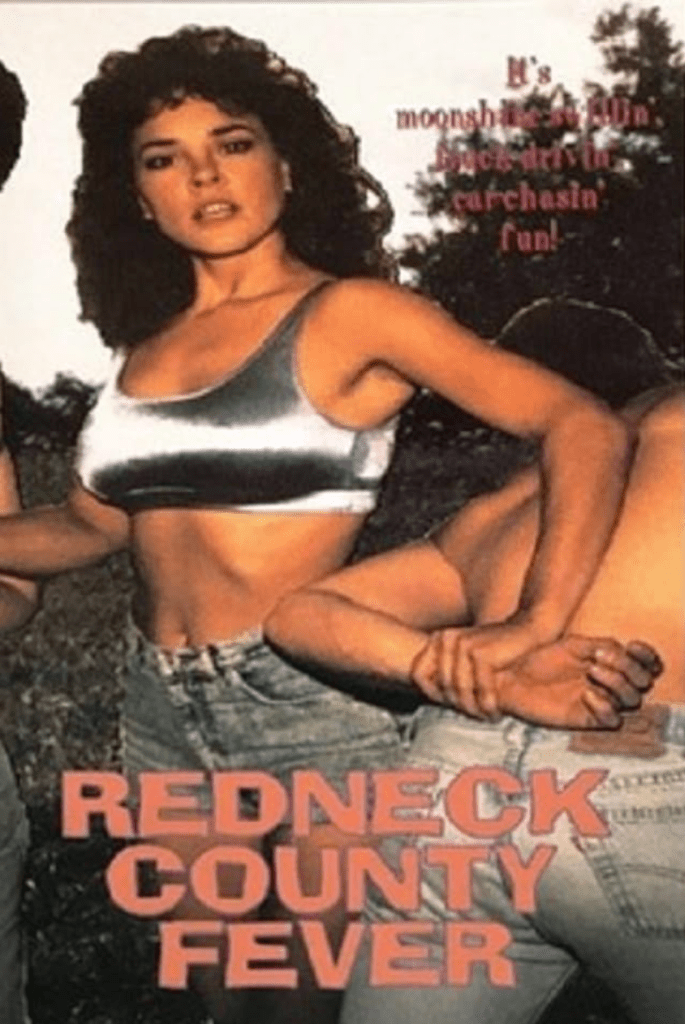
This is an entirely grittier, weirder beast. It’s at once Gerard making a movie where he writes, acts, sings and romances, while also being a hicksploitation film with authentic regional accents and a story perfect for the drive-ins that it would play at. I mean, how can you not appreciate a movie where a character asks her stuffed bear for romantic advice, only for the scene to veer into some of the most uncomfortable teddy bear intimacy ever committed to celluloid?

You can watch this on The Cave of Forgotten Films.

WEIRD WEDNESDAY Hollywood High (1976)

“If that’s Charles Bronson, ask him if his tallywacker wants some poontang!”

For that line alone, I stayed with this movie.

If you ever wondered what Grease would look like if it were shot in a weekend by people who primarily worked in the adult industry, Patrick Wright’s Hollywood High is your answer. Wright, a man usually cast asLarge Truck Driver #2in exploitation flicks, takes the director’s chair here to deliver a disjointed, sun-drenched, and largely topless day in the life of the most delinquent students in Tinseltown.

Jan (Susanne Severeid, Don’t Answer the Phone) Candy (Sherry Hardin, Ten Violent Women), Monica (Rae Sperling) and Bebe (Marcy Albrecht) spend most of this movie topless and smoking the stickiest of the icky with Frasier Mendoza, hooking up with the Fenz (Kevin Mead; guess who he’s supposed to be) and Buzz (Joseph Butcher, not far removed from playing the latter side of Bigfoot and Wildboy), hanging out with sex symbol of the past June East (yes, Mae West, but played by Marla Winters), having classes with stereotype teachers like the mincing Mr. Flowers (Hy Pyke, Grandpa from Hack-O-Lantern) and the overly horny Miss Crotch (Kress Hytes) when they’re not being chased by a cop, who they eventually hit with a watermelon and take his pants off, revealing that he’s wearing lingerie.

Turner Classic Movies notes the existence of an unrelated 30-minute television pilot, also debuting in 1977, for a prospective series. It featured Annie Potts and aired as part of NBC’s Comedy Time.  It also spawned an unrelated sequel (Hollywood High 2), proving that there is always a market for teens in trouble as long as the cast remains unencumbered by shirts.

For the film historians hiding among the exploitation fans, there is one genuine highlight: a crisp, 1970s shot of the Cinerama Dome in its prime. It’s a brief moment of architectural dignity in a movie that otherwise features people stealing pants and smoking out of makeshift bongs.

You can watch this on Tubi.