WEIRD WEDNESDAY: Bloodthirsty Butchers (1970)

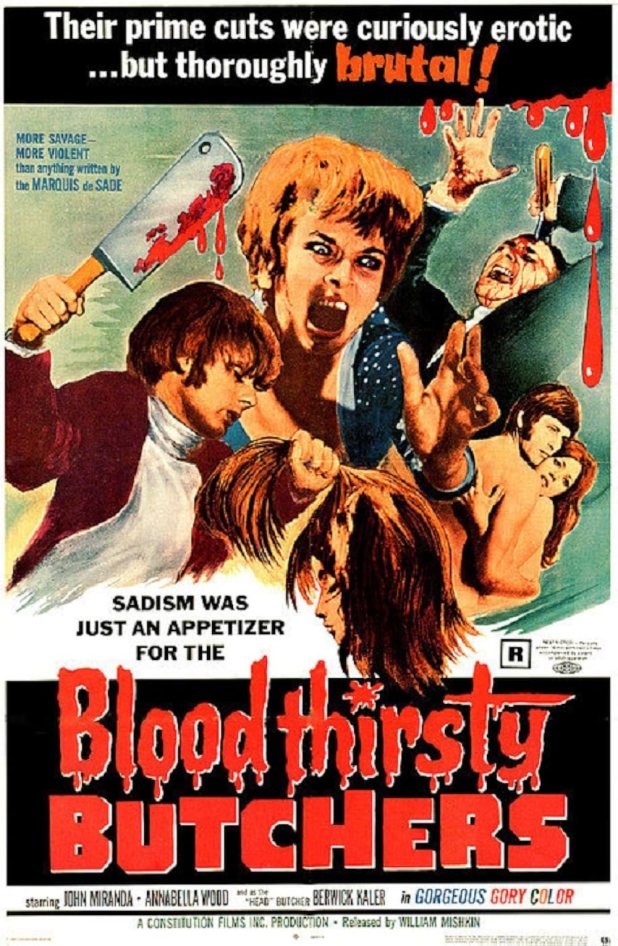
Released as a double feature with Torture Dungeon, Bloodthirsty Butchers finds Andy Milligan making another one of the classics. Sweeney Todd, to be exact.

Sweeney Todd (John Miranda) and Maggie Lovett (Jane Hilary) come together to kill off their customers, steal their money and valuables, and give the bodies to Tobias Ragg (Berwick Kaler) for disposal. After a few kills, they start getting way into murder, so they decide to start using the bodies to make meat pies, including one that has a woman’s entire breast in it.

Shot in London, this actually feels like it could be in its period, unlike the New York City Milligan movies, where you can see modern buildings and hear the traffic. Milligan made five movies in 1970 alone — Torture DungeonNightbirdsGuru the Mad Monk and The Body Beneath are the other films — and it’s pretty wild that he was doing so much so often. Then again, to the casual viewer, these movies are overly melodramatic films made by a lunatic who can’t even use a tripod, but to those who love these movies, well, they’re also excessively melodramatic films made by a lunatic who can’t even use a tripod. Perspective is important.

TV Guide said that Bloodthirsty Butchers was a “gory and typically cheap retelling of the Sweeney Todd legend.” One star.

I may have ranked it much higher.

You can watch this on Tubi.

WEIRD WEDNESDAY: Blood Rage (1987)

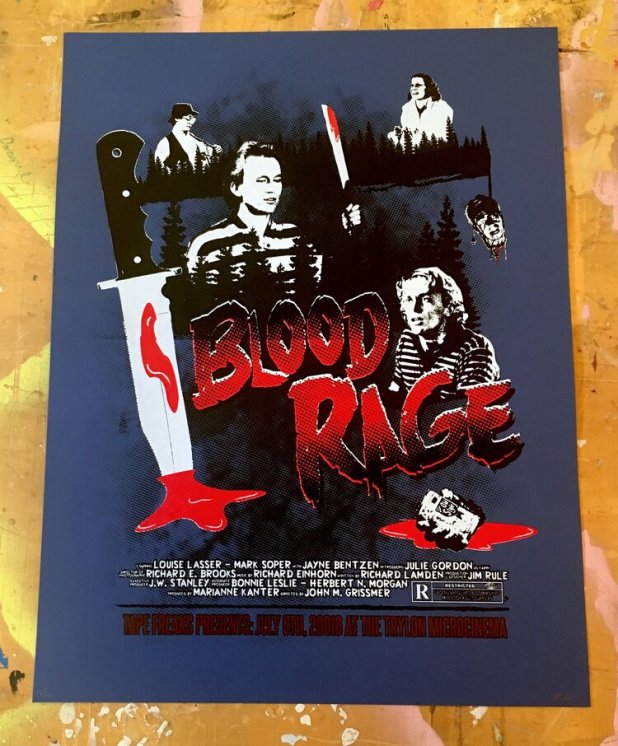
Identical blonde twins Todd and Terry are at the drive-in with their mother, who is making out with her boyfriend in the front seat. Seeing so many people having sex — including his mom — from the back seat flips out Terry, who starts killing people with a hatchet. He smears the blood all over his brother, because that’s how forensics worked in the 1980s, and he escapes scot free. That’s how Blood Rage — one of the few films to be set on Thanksgiving — begins.

Ten years later, Terry (Mark Soper in a dual role) lives with his mother (Mary Hartman, Mary Hartman star Louise Lasser). On the night of Thanksgiving, Mom reveals that she’s about to marry Brad. We also learn that Todd has escaped from the mental hospital. Terry doubles down to keep his brother locked up by killing Brad by chopping off his right hand — which still clutches a can of Old Style — before splitting his head in half with a machete.

Todd’s doctor and her assistant are looking for him, but run into Terry, who stabs and dismembers both of them before hooking up with new neighbor Andrea who is planning a house party.

Meanwhile, Mom is freaking out learning that Todd is getting closer, but Terry is the one we should be worried about. He’s on a real tear, wiping out all sorts of people, like a tennis-playing couple. All manner of mistaken identity occurs, ending with a swimming pool battle between the twin brothers, and Mom kills Terry when she really wanted to kill Todd. And oh yeah — her incestual relationship with her son is revealed as the reason for his insanity. She blows her brains out and Todd just stands there as the police close in.

This movie is also Nightmare at Shadow Woods, with none of the gore left. You should avoid that one as the real reason to enjoy this — I mean, unless you enjoy 1980s films about incest — is the rampant gore.

Come for Ted Raimi, condom salesman. Stay for hatchets to the face and a doctor’s assistant sliced in half, as well as rampant synth music from Richard Einhorn, who also scored Shock Waves and Don’t Go in the House. It was directed by John Grissmer, who was also behind 1973’s The Bride (Last House on Massacre Street).

You can get the art on this post at Tim Monsters!

WEIRD WEDNESDAY: The Black Six (1973)

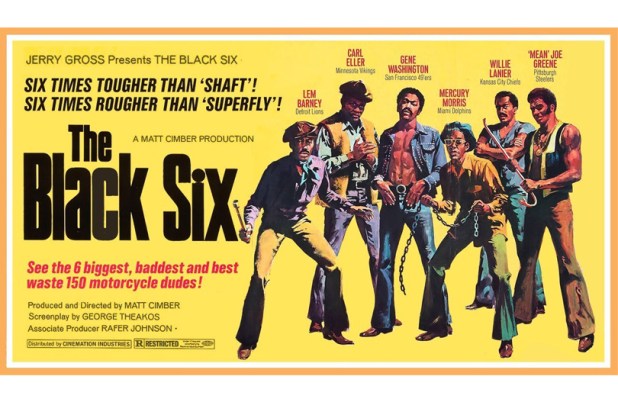
Matt Cimber has pretty much lived a life—he was married to Jayne Mansfield, he created the Gorgeous Ladies of Wrestling, and he directed movies like ButterflyThe Witch Who Came from the Sea and Hundra, amongst others. In 1973, he convinced six currently playing NFL stars to appear in a black version of the biker film. The results? Amazing.

The Black Six is made up of six All-Pro NFL stars:

  • Gene Washington, San Francisco 49ers (who was also in Cimber’s Lady Cocoa and Airport ’75)
  • Willie Lanier, Kansas City Chiefs (who is in the NFL Hall of Fame and was named to the NFL 75th Anniversary All-Time Team)
  • Carl Eller, Minnesota Vikings (an NFL Hall of Famer who went on to found substance abuse clinics)
  • Mercury Morris, Miami Dolphins (a Pittsburgh native who was drafted to West Texas State, the alma mater of tons of pro wrestlers, including Tully Blanchard, Stan Hansen, Ted DiBiase, Dusty Rhodes and both Funk brothers to name but a few)
  • Lem Barney, Detroit Lions (an NFL Hall of Famer who sang backup on Marvin Gaye’s “What’s Going On” and played himself in Paper Lion)
  • Joe Greene, Pittsburgh Steelers (one of my hometown heroes, Greene is probably one of the greatest — if not the greatest — Steelers ever. He  appeared in a famous Coke commercial, as well as Fighting Back: The Rocky Bleier Story and Smokey and the Bandit II and is also an NFL Hall of Famer)

Washington already had some acting experience, so he stars as Bubba Daniels, a Vietnam War vet who returns home to find that his brother has been killed by a white supremacist biker gang. Their leader, Thor, is played by Ben Davidson, an avid real-life biker who played for the Oakland Raiders. You can also see him in M*A*S*H*Conan the Barbarian and as Porter the Bouncer in Behind the Green Door.

Bubba and his gang — the Black Six — decide to avenge that death, which leads to battles with racist townies, uncaring police and Thor’s gang. The final battle ends with Thor blowing up his own bike to kill them all or so it would seem. According to Mercury M, orris’ book Against the Grain, the players protested that ending — guess they didn’t realize that nearly every biker movie ends with the heroes getting killed — so that’s why the movie ends with the title card that says “Honky, look out…Hassle a brother, and the Black 6 will return!” 

It’s all pretty depressing stuff, to be honest. But you can say that for nearly all biker and blaxploitation cinema. It’s still amazing to be that at one point, the NFL didn’t have the control that it does today and that six of its biggest stars could go off and make a movie together.

You can watch this on Tubi.

WEIRD WEDNESDAY: Black Heat (1976)

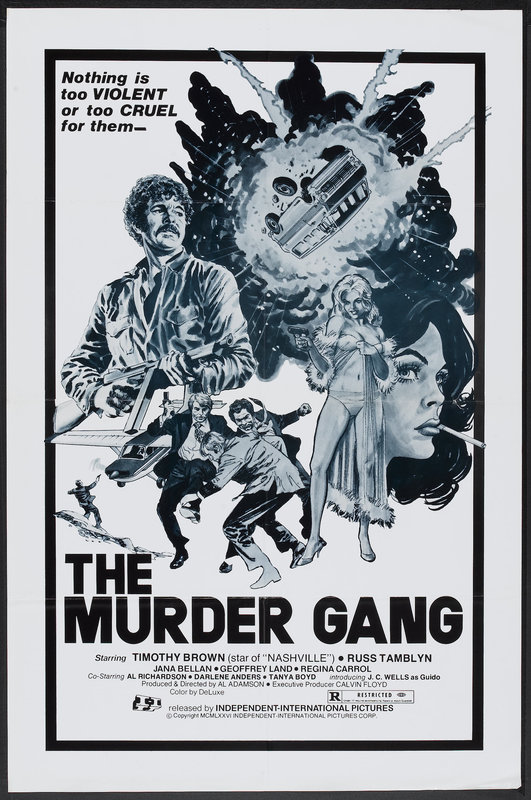
Tim Brown played football and acted, but because of the success of Jim Brown, who did the same things, he had to change his name to Timothy Brown. He stars in this as “Kicks” Carter, a Vegas cop fighting Ziggy’s (Russ Tamblyn) gang. He has to get revenge for his partner’s death and handle TV reporter Stephanie Adams (Tanya Boyd). Also, fight gun runners and save women from a house of ill repute. That’s a lot of work.

Directed by Al Adamson and written by John D’Amato, Sheldon Lee and Budd Donnelly, this is also known as The Murder Gang and Girl’s Hotel.

Regina Carroll shows up—well, she was Adamson’s wife—and so do Jana Bellan (Mary Lou from Sixpack Annie) and Adamson stock player Geoffrey Land. It seems like Tamblyn is having a lot of fun being an absolute lunatic, and he makes this worth watching.

WEIRD WEDNESDAY: The Black Gestapo (1975)

Lee Frost was behind some strange films like Race With the Devil, Love Camp 7, Chain Gang Women and The Thing with Two Heads. None of those films will prepare you for this one. After all, how does one prepare for a movie where an army of black men gets inspired by the wrong side of World War II and becomes the new master race?

General Ahmed (Rod Perry of TV’s S.W.A.T.) starts a People’s Army to protect the black people of Watts. Still, after chasing the drug dealers out of town, his second-in-command, Colonel Kojah (Charles Robinson, who played Fabulous from Sugar Hill and would go on to be Mac on TV’s Night Court), takes over, turning the group into a fascist paramilitary outfit that controls every racket in town.

With a concept like that, you’d hope that the film itself would be more out of control. Sadly, it isn’t. That said, Uschi Digard shows up, and really, that’s worth seeing the film in the first place. Comparing the Black Panthers to the Third Reich and castration are things that you don’t see in movies any longer. I’d argue that this is the lone movie that combines both.

You can watch this on Tubi.

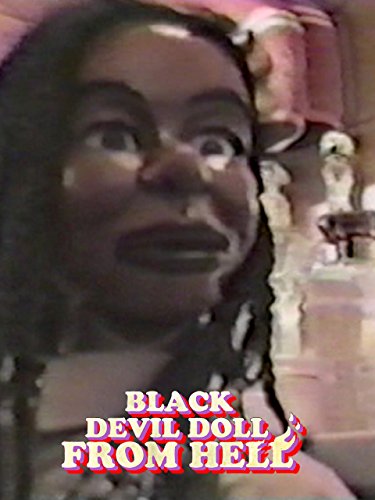
WEIRD WEDNESDAY: Black Devil Doll from Hell (1984)

Chester Novell Turner made this movie and Tales from the QuadeaD Zone.

It is enough.

He had been writing horror stories, doing home remodeling and attending a filmmaking correspondence course. Home video cameras had democratized movie making, and you can make fun of Turner’s films, but what have you done?

Well, people thought Turner died until 2013, when Massacre Video tracked him down and got permission to release his films.

With his girlfriend at the time, Shirley L. Jones, in the lead role, Turner pressed record and made some art, if by art you mean a movie in which a Rick James devil doll has sex with a woman, ruining her for other men, even when his head falls off mid-romping. A doll bought in a hobby shop with a tongue made from latex and a coat hanger, operated by Turner’s nephew.

This isn’t the kind of movie with fleeting sex scenes. These go on so long that they go from gratuitous to just plain demented, and there’s never really been anything else like it. What if Amelia hadn’t run from her Zuni fetish doll and spread for him? This is that. I can’t believe it either, but here it is, ready for you to be upset about. Or enjoy. Maybe somewhere in the middle?

Check out Jennifer Upton’s review.

You can buy this from Massacre Video for $10, but you should spend twice that on this one.

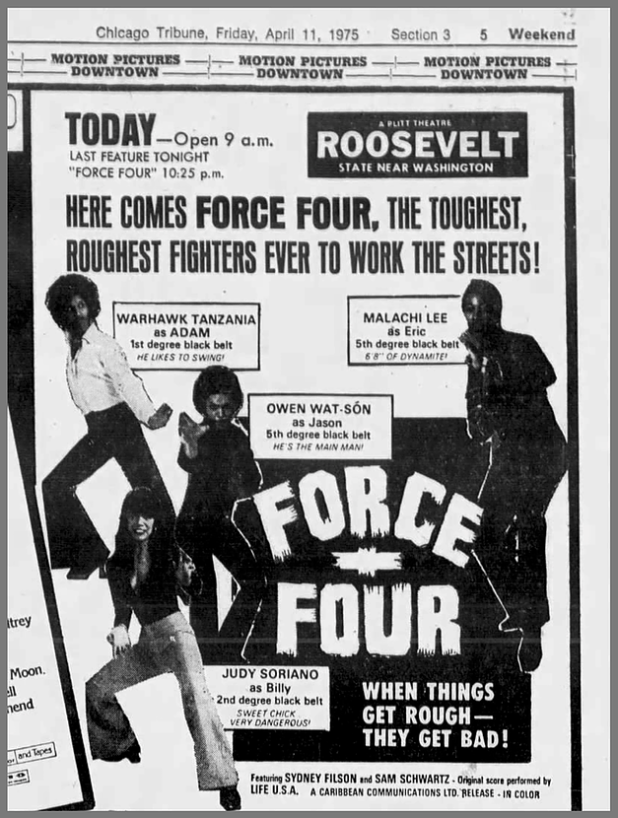
WEIRD WEDNESDAY: Black Force (1975)

Jason (Owen Watson, a two-tour Navy SEAL who was dojo brothers with Ron Van Cleff; his wife Sydney Filson is also in this), Billy (Judie Soriano), Adam (the best-named action hero ever, Warhawk Tanzania, who you may remember from Devil’s Express) and Eric (Professor Malachi Lee, an Isshin Ryu from the dojo of Master Ed McGrath; at 6’7″ he could hit a spinning kick without spinning; sadly he died the year this was made) are Force Four, the other name for this movie, or more to the point four butt kickers who come up against the evil Z (Sam Schwartz), who has stolen a voodoo icon of some sort. Whatever, we’re here for the fights, which have punches and kicks missing by quite a few inches, but again, who cares?

Directed by Michael Fink, who also made another Owen Watson movie, Velvet Smooth, and written by Leonard Michaels, who wrote those two Fink/Wilson movies as well as The Men’s Club, and Janice Weber, this is all about the funk from Life, USA. Which is life, really.

The credits also tell us that all of the kung fu is real: “All martial arts sequences in this film are authentic. No attempt has been made to enhance or alter actual fights by the use of special effects or trick photography. A slow-motion camera was used to capture certain techniques.” This should be no surprise because this looks as clumsy as can be.

The outfits are good, though.

You can watch this on Tubi.

WEIRD WEDNESDAY: Black Cobra (1975)

Do you think that when Jack Palance bounded to the stage, ready to do one-arm pushups and accept his Best Supporting Oscar for City Slickers after being nominated for Sudden Far and Shane, that he had a flashback and said to himself, “I’m in the A list tonight, but man, how can it compare to being in a movie where Laura Gemser dances with snakes?”

Seriously, the man who would become a star again at the age of 73 has a wealth of roles in aberrant movies in his past, but playing Judas Carmichael in a Joe D’Amato movie may be the pinnacle. Or the pit.

Gemser plays Eva, a snake dancer who obsesses Judas, because he has a snake collection at home — as you do — and he wants to show it to her. So she finally gives in and moves in with him while confining her horizontal dancing to the ladies — including Candy (Ziggy Zanger, who Gemser would go on to appear in Black EmanuelleWhite Emanuelle with, along with Nieves Navarro, and just writing that sentence made me a little faint). Judas’ brother Jules (Gabriele Tinti) wants Candy all for himself, so he messes around with the snakes with her — which seems ill-advised — and she gets killed by a mamba. And then he doubles up and kills off Eva’s lover Gerri (Michele Starck, Forever Emmanuelle) and ends up taking Eva from his brother!

Of course, that’s not the end of matters. Eva’s more devious than she looks. And so is Judas. I mean, if your mom names you Judas any time in a year that doesn’t have BC in it, you’re not going to turn out all that great.

Bruno Mattei edited this movie — a fact that makes me love it so much more — and it was also called Emmanuelle And The Deadly Black CobraHot Pants and finally and most awesomely Emmanuelle Goes Japanese, which makes no sense for a movie set in Hong Kong.

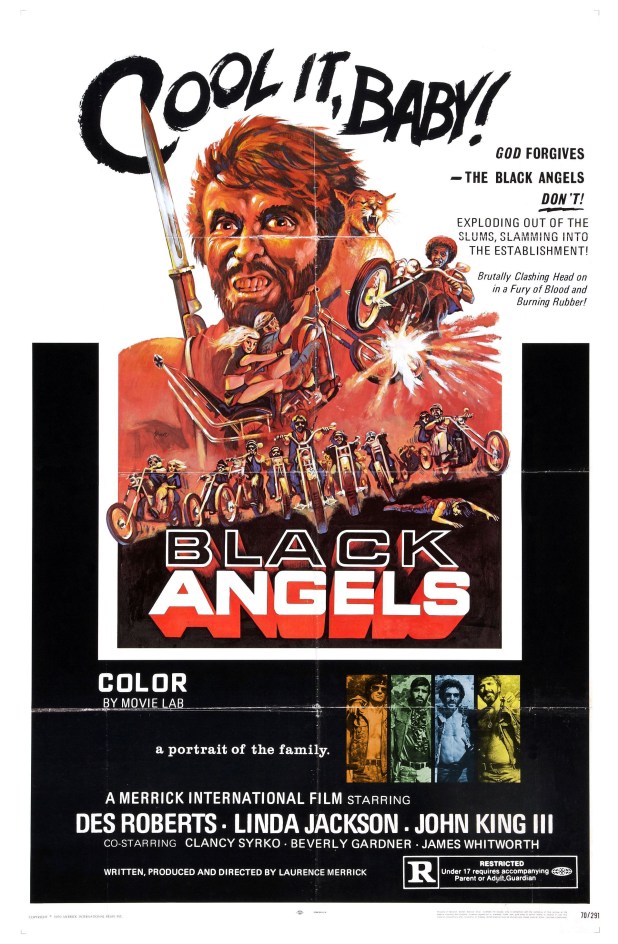
WEIRD WEDNESDAY: Black Angels (1970)

Satan’s Serpents and The Choppers are happy to coexist, but the cops start pushing racial tensions between them in the hopes that the two biker gangs will wipe one another off the face of the planet. Any wars these gangs had before this were about turf, not the color of their skin. But Lt. Harper (Clancy Syrko) hates bikers, and there you go.

What sets this beyond other biker films is that there’s a pet racoon who smokes weed, a mountain lion, snakes used to kill people, bikers pissing all over one another, screaming stuff like “It’s champagne! I just blessed you with my golden shower!” and people have names like Chainer (he has a chain) and Knifer (because he has a knife). They’re named like off-brand GI Joe lines, like America’s Defense and The Corps, used to name the bad guys. There’s also a go-go dancer who doesn’t let a full-on brawl stop the dance.

Mostly, people ride bikes. If you like to see people ride bikes, that’s good news. People ride lots of bikes.

This was directed and written by Laurence Merrick, who also made Guess What Happened to Count Dracula? and Manson. He was killed by a stalker in 1977.

Also known as Black Bikers from Hell.

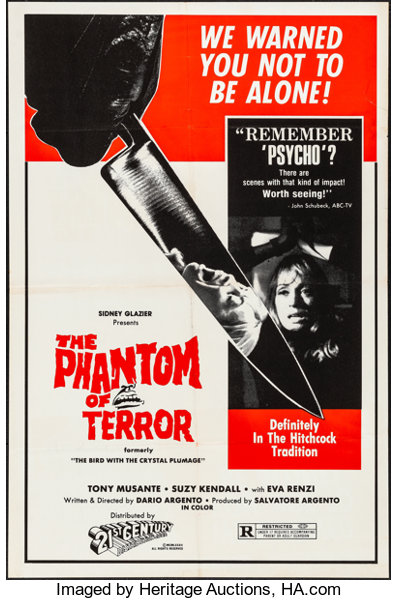
WEIRD WEDNESDAY: The Bird with the Crystal Plumage (1970)

Aside from Mario Bava’s influential films, such as Blood and Black LaceThe Girl Who Knew Too Much, no other movie has left as indelible a mark on the Giallo genre as Dario Argento’s 1970 directorial debut. Before this, Argento was a journalist who contributed to the screenplay of Sergio Leone’s Once Upon a Time in the West.

The title of the film, The Bird with the Crystal Plumage, is a metaphor for the protagonist’s predicament. Just as the bird is trapped by the beauty of the crystal plumage, Sam is trapped by the beauty of the art gallery and the mystery it holds. This metaphorical title sets the tone for the film and its exploration of the relationship between art and violence. In the film, Sam Dalmas (played by Tony Musante) is an American writer struggling with writer’s block. He travels to Rome for a change of scenery, accompanied by his British model girlfriend, played by Suzy Kendall. Just as he decides to return home, he witnesses a black-gloved man attacking a woman inside an art gallery. Desperate to save her, he finds himself helpless, trapped between two mechanical doors as the woman silently pleads for help.

The woman, Monica Ranier, is the gallery owner’s wife. Although she survives the attack, the police suspect Sam may be involved in the crime and confiscate his passport to prevent him from leaving the country. Unbeknownst to them, a serial killer has been targeting young women for weeks, and Sam is the only witness. Haunted by the attack, Sam’s memory is unreliable, leaving him without a crucial clue that could solve the case, adding a layer of suspense to the narrative.

This film introduces several tropes that would become hallmarks of the genre: the foreign stranger turned detective, the gaps in memory, and the black-clad killer—elements that later Giallo films would pay homage to. These elements, along with Argento’s unique visual style and use of suspense, would go on to influence a generation of filmmakers and shape the Giallo genre as we know it today.

Another recurring theme in Argento’s work appears for the first time here: the notion that art can incite violence. In this instance, a painting depicting a raincoat-clad man murdering a woman plays a significant role.

As the story unfolds, Sam receives menacing phone calls from the killer, and the masked assailant attacks Julia. The police manage to isolate a sound in the background of the killer’s conversations—the call of a rare Siberian bird. This bird, a Grey Crowned Crane, plays a significant role in the film’s narrative, serving as a clue that brings the police closer to unraveling the mystery. The film’s use of this rare bird as a plot device is a testament to Argento’s skill as a storyteller and his ability to create tension and suspense.

Alberto, Monica’s husband and the owner of the art gallery, ultimately attempts to kill her, revealing that he orchestrated the attacks. However, in true giallo fashion, mistaken identity is a crucial plot twist. Even though this film was made nearly fifty years ago, I won’t spoil the reveal of the real killer.

I recall my parents seeing this movie before I was born and disliking it so much that they would mention “that weird movie with the bird that makes the noises” whenever they encountered a confusing film. Ironically, I grew to love Argento’s work. My fascination with Giallo and difficult-to-understand films is a form of rebellion against their opinions.

This film, an uncredited adaptation of Fredric Brown’s novel *The Screaming Mimi*, was initially considered a career misstep by actress Eva Renzi. The film’s producer even wanted to replace Argento as director. However, when Argento’s father, Salvatore, spoke with the producer, he noticed that the executive’s secretary appeared shaken. When he asked her what was wrong, she revealed she was still terrified from watching the film. Salvatore convinced her to explain her fear to her boss, ultimately leading to Argento staying as director.

The outcome of this struggle? It is a film that played in one theater in Milan for three and a half years, leading to countless imitators—and inspired many elements in films featuring lizards, spiders, flies, ducklings, butterflies, and more—for decades to come. Argento would later continue his so-called Animal Trilogy with The Cat O’Nine Tails and Four Flies on Grey Velvet, then Deep Red before moving into more supernatural films like Suspiria and Inferno.