This Life, I am a flower pot (2018)

If there was ever a film that definitively proves film is a universal art form that defies the roughly 6,500 languages in our world, it is this 38th directing effort from Chun-Ku Lu: This Life, I am a flower pot.

Unknown in the United States, outside of the most discriminating martial arts connoisseur, director Chun-Ku Lu is a respected, major star in China and the Pacific Rim territories with 80-odd combined credits as a writer, actor, and director. He’s best known to U.S audiences for his work during the martial arts heyday of ‘70s cinema for The Black Dragon’s Revenge, along with the popular ‘80s video rentals Bastard Swordsman (1983) and its sequel: Return of the Bastard Swordsman (1984).

After a 20-year retirement from the business in the late ‘90s, Chun-Ku Lu returns with this touching, beautifully-shot drama about a single mother and her portly, young son who leave Taiwan to live in the U.S. The title of this Mandarin language short out of Taiwan is pronounced Zhè bèizi, wǒ shì huā pén, which is also understood as: This world is a small bonsai.

Even without subtitles, this voiceover-related story is easy to digest by understanding the universal symbolism of the art of bonsai: a minimalist approach practiced in Zen Buddhism where one strives for peace, harmony, and balance; a maintaining and ordering of thoughts, so as to remove clutter from one’s life; an art that teaches man—like trees—must fight against the elements of nature (and his unbalanced fellow man).

The voiceover is provided—it seems—by Jimmy, who tells the story of how he and his mother left Taiwan for a better life in the United States. Of course, in their new land, they are “Guizi”: a xenophobic slang in their language to describe a foreigner. Jimmy quickly becomes the target of bullies; his mother is also a “ghost man”: one who lives an invisible existence, in her case, as a janitor, to provide for Jimmy; she can provide him only the simplest of birthdays (in Buddhism the candle represents the aware, enlightened mind). The receipt of a small wooden box—with three gold symbols—for his birthday from a relative in Taiwan becomes the catalyst for the next phase of young Jimmy’s life.

The Canadian cinematographer behind this stunner is Jimmy Wu. Relatively new to the film world, Wu made his debut three years ago with the 2017 Canadian-Chinese language short, The Molecule. He’s since shot seven shorts, served as an Assistant Camera and 2nd Assistant Camera on eight more, produced two, and has also composed music for the 2017 surrealistic, animated comedy, Love Ninja. You can view Wu’s superb reel featuring scenes from those projects on his You Tube page.

The bright lights of Hollywood aren’t far behind for Wu: we’ll be seeing more from him very soon. You can watch his and Chun-Ku Lu’s This Life, I am a flower pot in its entirety on You Tube (also embedded below).

Disclaimer: This movie wasn’t sent to us by its production company or PR department. We discovered the movie all on our own—courtesy of its Chun-Ku Lu connection—and genuinely enjoyed the movie.

About the Author: You can read the music and film reviews of R.D Francis on Medium and learn more about his work on Facebook. He also writes for B&S About Movies.

Tales From Six Feet Under (2020)

Nicholas Michael Jacobs, the director of Night and Urban Fears is back, this time with an anthology film that follows a character named The Visitor through a graveyard as he tells the story of how three people died.

This time, he has a $1,500 budget, which is about $500 more than last time. Let’s get into it.

As you may have guessed from Nicholas’ films, he loves extended sequences where people do menial tasks while swearing and being stalked. This movie opens with another of those and at this point, three movies in, I’m actually excited when these things happen.

He’s also gone a bit meta here, as long stretches of the film have him wondering exactly what movie he should make. Perhaps these are the kinds of discussions that should be thought of before the movie is made. I mean, I’m nineteen minutes in and the movie has mostly been an autobiographical story of Nicholas cleaning his basement and dealing with the unknown while trying to make a movie.

That said — his movies do get better each time. They still aren’t any good, but there’s forward progress.

This movie is up on Amazon Prime today, so if you have any interest in seeing it, go for it. I can only imagine how people that have never seen one of Nicholas’ films before will react.

DISCLAIMER: Nicholas sent this to us himself, so you have to appreciate that he’s a go-getter.

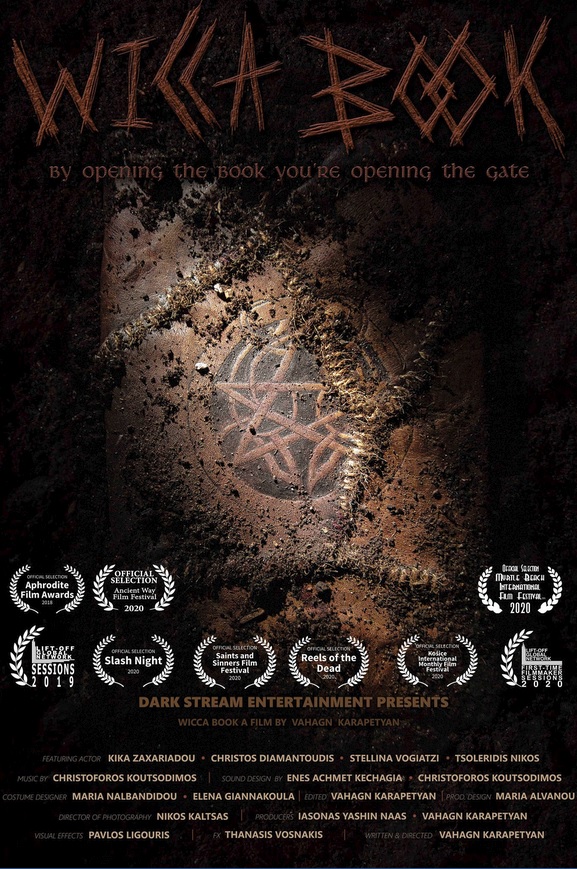
Wicca Book (2020)

In the late ‘90s, Robert Altman (M.A.S.H, Nashville, Quintet) transitioned into television with an innovative approach to the anthology-narrative format: Gun, which aired on the ABC-TV network. Each unrelated episode—with new plots and characters for each story—followed a .45 semi-automatic pistol on its travels from person to person.

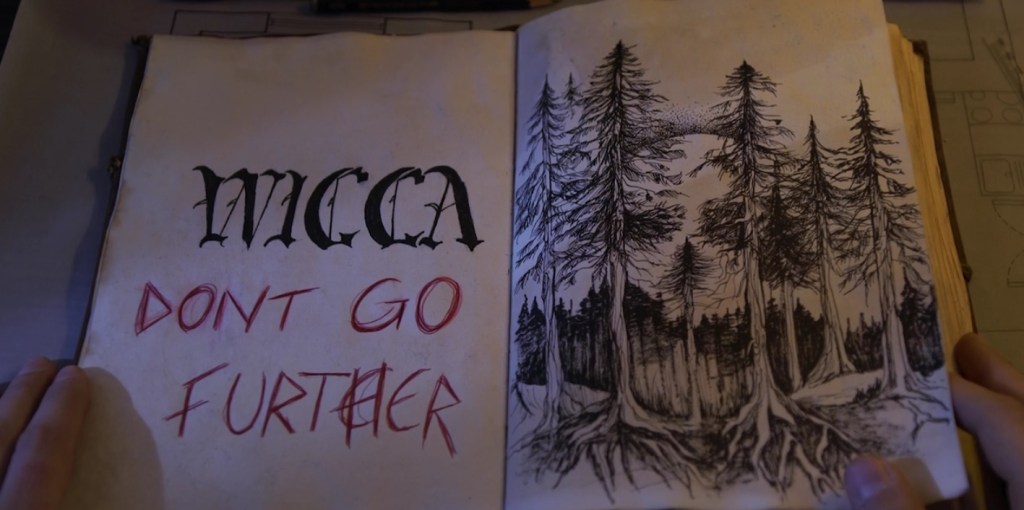
In Wicca Book, writer-director Vahagn Karapetyan’s seventh short film, we have an intelligent amalgamation of the Altman concept plopped into the Sam Raimi universe—unfolding as a Hieronymus Bosch, medieval triptych: a garden of Greek horror centered on an ancient grimoire (convincing-beautifully crafted by artist Maria Alvanou) that passes from owner to owner. However, while there’s a Raimi connection via an ancient text (that Raimi pinched wholesale from 1970’s Equinox; sans the Dave Allen and Jim Danforth creatures), make no mistake: There’s no Bruce Campbell hammy buffoonery: a Rob Zombie-styled, Dario Argento homage snared in Karapetyan’s fisheye lens.

Film, at its core, is a visual medium. It’s an art form based in “showing” and not “telling”; for film is 90% visual and 10% dialog (and the stage is the reverse). Images tell the story though props, an actor’s body language and, most importantly: that your actors are not skilled in the craft of acting—but “being.” This is an art at which Karapetyan and his actors excel: there’s no dialog across his film’s 22-minute run time. While, at first glance, Wicca Book may be a bit longer than a short film should be, in this case, there’s not one superfluous frame on screen: every minute is artistically warranted. It’s masterfully edited.

In addition to a film’s dialog-barren image, music can also induce emotion in those frames. And all of the film disciplines are at their finest in Wicca Book as Karapetyan formulated a solid, celluloid-symbiotic relationship between cinematography Nick Kaltsas, Foley artist Enes Achmet Kechargia, and musician Christoforos Koutsodimos. He proves you do not need any title card preambles or voiceover prologues—or any dialog—to bring on the fear and dread.

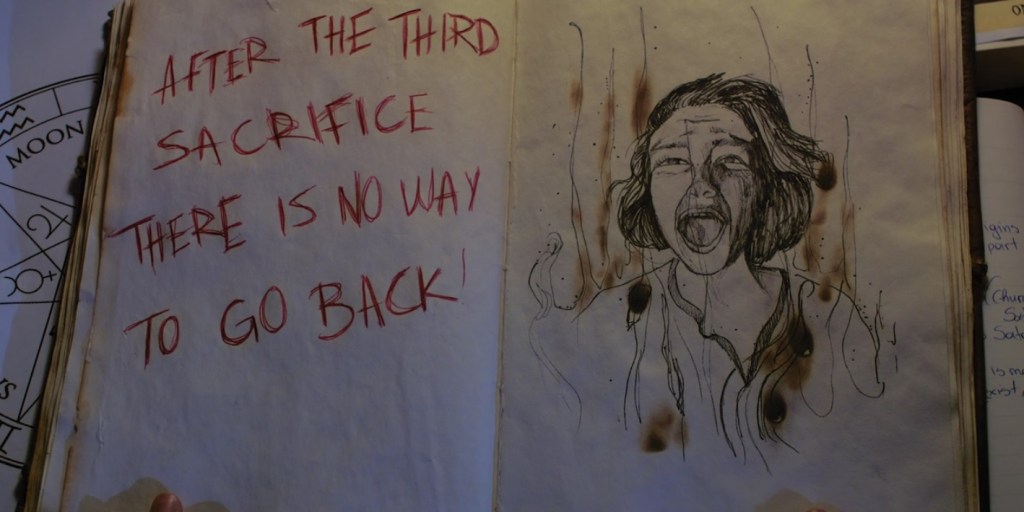
And the terror unfolds in the triptych’s first panel: A frantic knock and doorbell ring at the apartment door of a young architectural student (Christos Diamantoudis) reveals the ancient text stuffed in a plastic garbage bag with a note saying, “It’s yours.” And as he turns the pages, it seems the book was written especially for him. And, it seems, the cries of children rise from its pages. He tries to destroy it; the pages won’t tear or burn. Then something presses at the front door; it wants in . . . . And he becomes one of book’s ink-scratched pages.

In the longer, second panel: The now unbound demon comes to the dreams of Mia, a young archeological student (Kika Zachariadou), and inspires her to discover the book while spelunking. Upon opening the book, her name appears in blood on her bathroom mirror and, the book instructs her to “give it away.” Then we learn the truth: Mia was the frantic knock and doorbell ring opening the film; she passed the book onto the architectural student. But it was a trick: By giving the book away, not only will she sacrifice the receiver: she’ll transform into a witch. So, to save them both, she breaks into his apartment, steals the book, and tries to return the book from where it came. As she runs from the apartment, she runs into her neighbor: the book’s instructed third sacrifice is complete. Mia will become a witch, after all.

The Bosch garden rots in the third panel of this supernatural triptych, as Mia returns to the cave (with an inspired POV shovel-in-the-dirt shot) for a final knife-wielding showdown with The Devil. . . .

Wicca Book is a horror film of old, not of the modern film world that wobbles on the crutches of shock-scares and motion-captured, CGI-grafted gore. This is a film that reminds of Gloria Katz and Willard Huyck’s feature film debut, 1973’s Messiah of Evil (a movie so good, we reviewed it three times: HERE, HERE, and HERE), L.Q Jones’s Brotherhood of Satan, and Burt I. Gordon’s Necromancy. Wicca Book is a classic, shot-in-camera ‘70s-styled suspense-horror flick, like those Dan Curtis ‘70s U.S TV movies of old (shameless plug: check out our Exploring: Dan Curtis featurette). (Also, please note that there’s neither reference of nor an appearance of Hieronymus Bosch’s medieval triptych in the film: that is my personal interpretation of the film’s narrative structure.)

While attending Aristotle University, Karapetyan, an Armenian director and writer based in Greece, wrote a thesis paper: “How a Traditional Myth Becomes a Horror Film,” so he knows his material. While I haven’t seen Karapetyan’s six previous horror shorts, based on what I’ve seen with Wicca Book, I wait in anticipation for his first international English language feature film, Go Dark, currently in its pre-production stages. I also believe all of the parts are there for Wicca Book to be expanded into a feature film as well.

Referring to my comment regarding the runtime: 30-minute programs are actually 17 to 22-minutes in length. Once you add commercials, you have a half-hour program; so again, the length works in that regard and Wicca Book could become a television series. Another goal is to turn Wicca Book into a web-series, using elements of time travel to explore the book’s birth in 16th century New England and how the book came to be in the cave explored by Mia. The concept—in any form—is exciting and worth following its development.

It may take some time, but Vahagn Karapetyan is on his way to becoming a voice in Euro-horror. And all good things take time. Wicca Book is currently under the wing of Film Freeway, so let’s hope it comes to a U.S film festival sometime soon near you. It’s worth the price of admission. You can learn more about the film at Darkstream Entertainment on Facebook and Vahagn Films on Facebook.

About the Author: You can read the music and film reviews of R.D Francis on Medium and learn more about his work on Facebook. He also writes for B&S About Movies.
Disclaimer: This movie was sent to us by its PR company and, as you know, that has no bearing on our review.

Nightfire (2020)

What a happy, accidental discovery—considering B&S About Movies is in the midst of its “James Bond Month” extravaganza.

Filmed in the popular cinematic location of Verona, Italy, one of the locations for the 2008 James Bond entry, Quantum of Solace, Nightfire is a timely story about the plight of the Ukrainian people and the United States’ involvement in that country’s conflict.

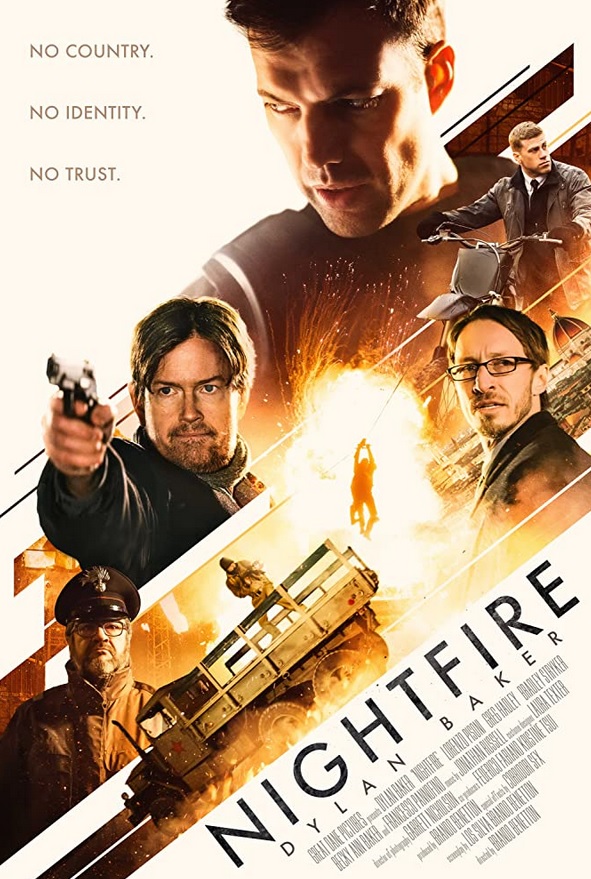
At the Sokov Military Base, located 32 miles from the Ukrainian border of the country of Belarus, the mission of CIA operatives Carter (Lorenzo Pisoni; guest star on U.S TV’s The Good Wife, Law & Order: SVU, and Elementary) and Ross (Greg Hadley; new to the scene and very good here) to retrieve two military chips containing top-secret content goes awry when they compromise their mission objective to rescue Olivetti, an international political prisoner. And Carter comes to discover it’s never about the freedom of a country and its citizens: it’s always about greed. And no one is who they say they are.

The marquee name here is the-you-watch-anything-he’s-in Dylan Baker, as Olivetti. Dating back to his support role in Steve Martin’s Planes, Trains & Automobiles, you’ve come to know Baker as he delivered the goods countless times on U.S television series, such as Law & Order: TOS and the Chicago P.D./Fire franchise, along with his starring roles on Blindspot, The Good Wife, and Homeland—and his role as Dr. Curt Conners in Sam Raimi’s Spider-Man franchise. The cast is rounded out by Bradley Stryker (guest roles on TV’s Arrow, Cold Case, and CSI:NY) and Becky Ann Baker (star of HBO’s Girls, as well as The Blacklist and Hunters).

Nightfire is the fifth student-short production by French-born writer-director Brando Benetton and, considering this is a college thesis project shot on a low budget in 14 days—the quality is of an astounding, major studio quality. That quality comes courtesy of the production’s use of Red Epic Dragon cameras and the implementation of non-CGI practical effects. The car chases and real explosions are masterfully executed by the Corridori Brothers—you know their work; nothing too exciting: just films like the The Italian Job, Mission: Impossible III, and Spectre (the team also worked on maestro Dario Argento’s Do You Like Hitchock? and Giallo). Considering the 45-minute runtime, the spy action-thriller adventures of Lorenzo Pisoni’s Agent Carter can easily be picked up by a major U.S television or grittier cable network and expanded into an hour-long drama. If not, there’s definitely a feature film in its experimental, truncated frames.

Benetton is currently working as a Second Assistant Director on a very intriguing feature film—his first feature—currently in post-production. Voodoo MacBeth concerns the young and arrogant Orson Welles staging the first all-black production of Shakespeare’s Macbeth in 1936 Harlem.

You can learn more about Nightfire and the career of Brando Benetton courtesy of a three-minute behind the scenes vignette on the Vimeo page of Great Dane Productions. You can watch Nightfire as an Amazon Prime and Hulu stream beginning May 1. It has since become available on the free-with-ads steam service, Tubi. Benetton has since worked as a first assistant director on the indie drama Voodoo Macbeth and thriller, The Summond (both 2021).

Disclaimer: This movie was sent to us by its PR company and, as you know, that has no bearing on our review.

About the Author: You can read the music and film reviews of R.D Francis on Medium and learn more about his work on Facebook. He also writes for B&S About Movies.
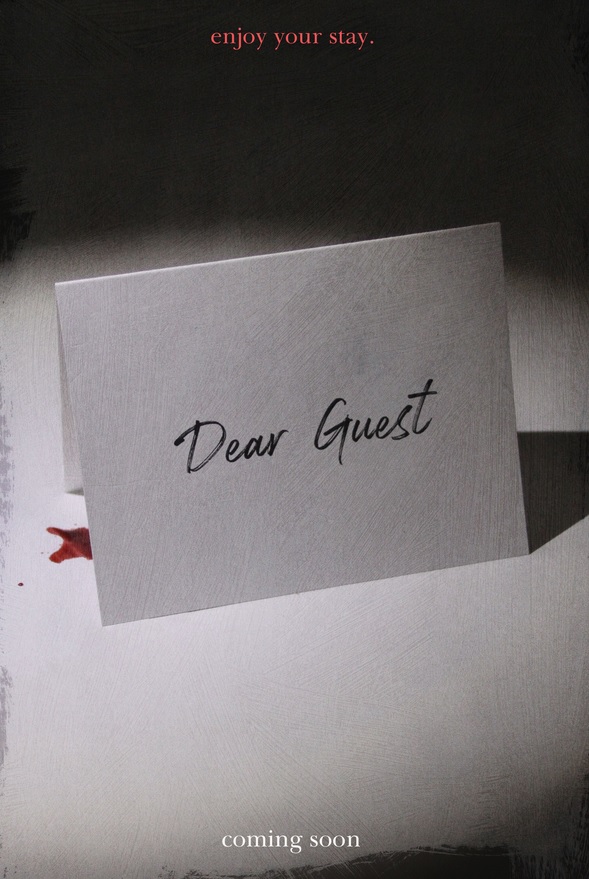
Dear Guest (2020)

I’ve long since surpassed my Hollywood-mainstream film attendances with my affection for the new breed cultivated in film festivals: I love going to film festivals, seeing short films, and acting in short films: the camaraderie of the indie environs is pure electric. It’s oxygen. It’s life.

I got my start in the entertainment industry by way of radio broadcasting, where I was able to support indie-labeled bands and unsigned local musicians. And that affection for the independent spirit carried over as I started acting in indie shorts (I even supplied props, wardrobes, and “roadied” them). And watching a film like Dear Guest makes me jealous, and nostalgic at the same time, as none of my writer-directors possessed the skills of Megan Freels Johnson.

I appreciate that Johnson understands the concept of a short film. Short films should be just that: short. Dear Guest is well-written and edited, and gives us full-character arcs and development in the space of 10 minutes: exactly as a short film should. No, this won’t turn into a college thesis on the craft of screenwriting, and act structure, and etc., but take my word for it: Megan Freels Johnson knows her stuff—and a bag o’ chips.

Currently making the rounds at a film festival near you, Dear Guest is a psychological noir-thriller of the Alfred Hitchcock-cum-Twilight Zone variety—with a twist of Polanksi (and one more of our favorite writer-directors)—where nothing is at it seems.

The “dear guests” are Maria and Jules (Ashley Bell of The Last Exorcism and Noureen DeWulf of NBC-TV’s currently-airing Good Girls), a couple who checks into a beautifully furnished rental for a long-awaited vacation, only to discover they’ve walked into an elaborate mouse-trap tended by its anonymous host.

“I’m so happy I made you take time off work,” kisses Maria.

“You didn’t make me,” scowls Jules.

Uh, oh. Maria needs a rethink . . . in more ways than one. This vaycay is going off the rails, one way or another.

Then, as Jules goes off to check out the bedroom and put away their bags—she vanishes. Then the front door to the house is locked—from the outside. And a plain white “Dear Guest” place card appears in the empty bedroom—with a riddle held within its crease.

Jules discovers she’s a game piece and she needs to follow the clues: such as that theatrical one-sheet for Ann-Margret’s The Swinger . . . and that Hot Wheels car on the floor. . . . Maria’s been kidnapped, bound and gagged in the garage, inside a car . . . and the card is rigged to go up in flames.

As the couple tries to escape, another card appears on the rear kitchen door—with bullet-soundproof glass, and the house is covered in it. What will happen during the next three days, discloses the place card.

When the camera slowly zooms—in conjunction with the ambient tinkles of a xylophone backed by ominous strings—on that stoic, poolside griffin through the prison-like wrought iron fence . . . wow. That’s a pure—and welcomed—Dan Curtis vibe, he the master of ‘70s psychological and supernatural thriller TV movies. And we should know: we waxed nostalgic for a whole week over his resume (shamless plug: check out our last month’s Exploring: Dan Curtis featurette roundup).

Here’s to hoping the plans to expand this chiller into a feature film come to fruition, as we want more. And that is exactly what a short film should do: leave you wanting more. . . .

You’ll also remember Ashley Bell from her guest appearance on a rerun of CSI: Crime Scene Investigations (I’m currently binging on it) and Showtime’s United States of Tara. You’ll also recognize Noureen DeWulf from her role as “Lacey” on Fox-TV’s Anger Management and her support roles in the theatricals Ghosts of Girlfriends Past and The Backup Plan. The point: you know the acting in Dear Guest is top-notch.

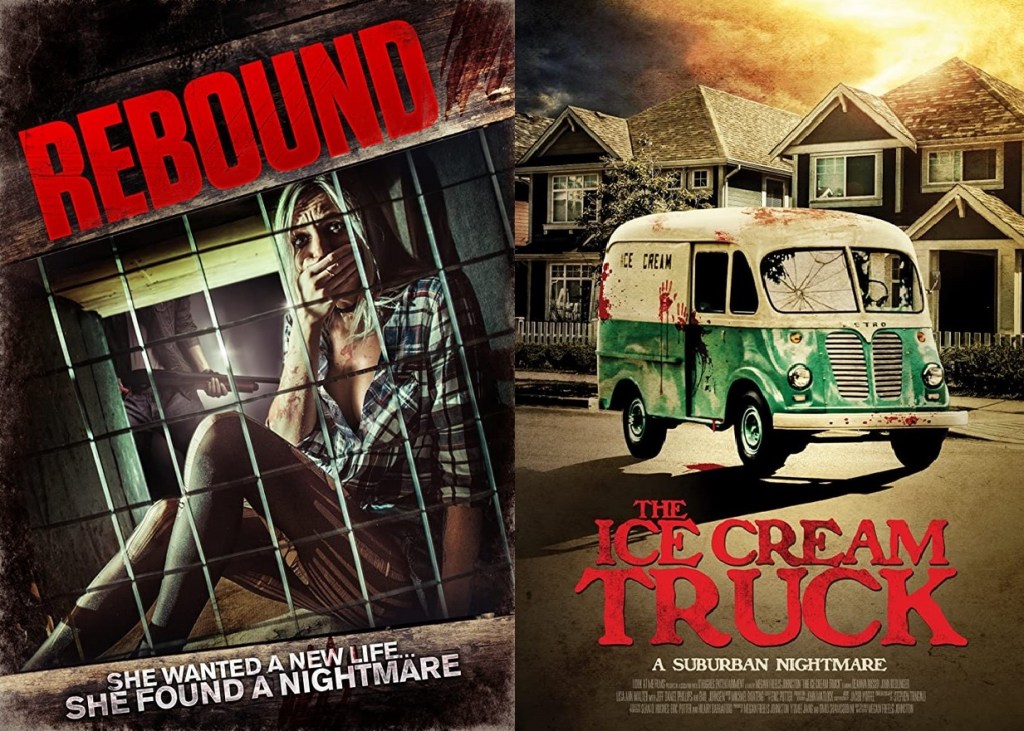
You can watch Megan Freels Johnson’s feature film writing and directing debut, 2014’s Rebound, for free—via a legal stream with limited commercials—on TubiTv and Vudu, or via your Amazon Prime, iTunes, and Google Play accounts. Her follow up to Rebound, 2017’s The Ice Cream Truck, is also available on the TubiTv and Vudu platforms, as well as Amazon Prime, iTunes, Google Play, and You Tube Movies.

Johnson’s third and fourth feature films in her horror oeuvre, Hunting Season and Asking for It, are currently in pre-production. And Hunting Season sounds really good, as any movie with Bruce Davison, from the horror classic Willard, usually is (and we get Meadow Soprano, aka Jamie-Lynn Sigler, in the bargain): Deanna Russo of The Ice Cream Truck stars as a young woman on a weekend getaway with her new boyfriend, only to discover “hunting season” is all year round. Who’s the cat and who’s the mouse? Who’s the hunter and who’s the prey?

I have to admit: I wasn’t aware of Johnson’s work until writing this review for Dear Guest, so I’m going to let you go. It looks like I’ve got some movies to watch.

Oh wait! Sorry, but we have to click bait you with another shameless plug before you go. (Send your complaints to Megan: she’s the one making movies about ice cream.) So, when you get a chance, check our B&S reviews for one of my favorite films, Clint Howard’s Ice Cream Man, and Sam’s, Santa and the Ice Cream Bunny.

Okay. Now class is dismissed. See you on Monday. Beware the Ice Cream Man, kids.

About the Author: You can read the music and film reviews of R.D Francis on Medium and learn more about his work on Facebook. He also writes for B&S About Movies.
Disclaimer: This movie was sent to us by its PR company and, as you know, that has no bearing on our review.

Urban Fears (2019)

The byline for this movie states: “Most horror stories take place in suburban areas, but these three teenagers are about to realize that those are not the only places where these things happen.”

Nicholas Michael Jacobs also directed Night, a movie that features long shots of people getting ready. This one starts with nearly ten minutes of a guy going through drawers while being barely audible.

There are three stories here. In Sundown, a young man waits for a partner to help in break in to a house. That man no shows, so he heads home — leading to that overly long looking through stuff moment we discussed — and gets chased by a killer. Inanimate is about an evil doll made of human skin — as well as a lengthy laundry sequence — and the final story is all about the chain email that cursed the babysitting in the opening story. Finally, the bad guys from each segment all fight one another at the end.

Supposedly, Jacobs is in his early twenties and I already see an improvement from Night. Here’s to his next film — and the one after that — as he continues to grow. Hopefully, he gets more than $1,000 for his next budget.

You can watch Urban Fears on Amazon Prime.

DISCLAIMER: This movie was sent to us by its director.

Occurrence at Mills Creek (2019)

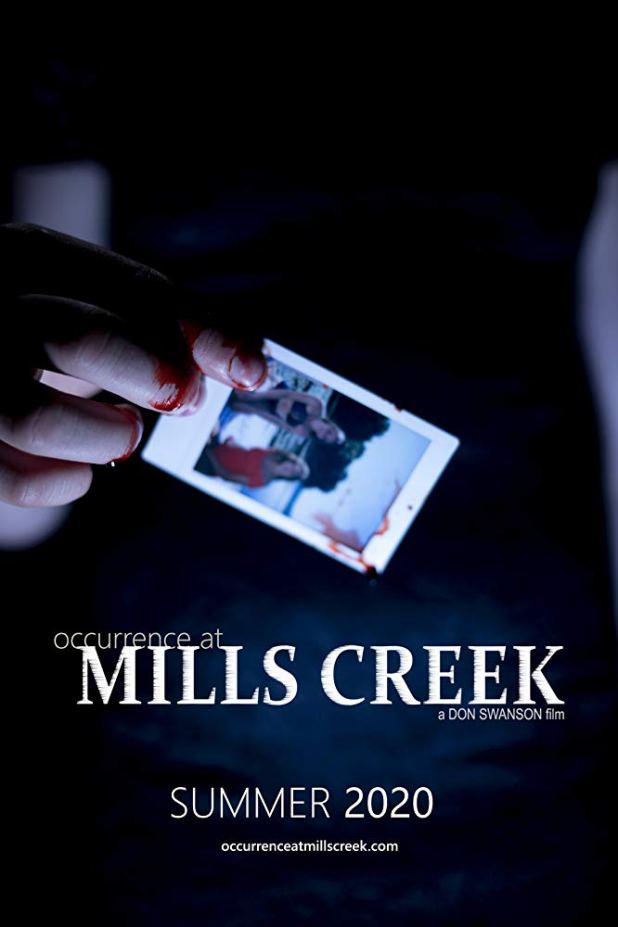
Clara, a young woman burdened by guilt following the deaths of her mother and sister, has her reality shatter in this new movie, that will take an already complete short film to the next level. It’s directed by Don Swanson, who was also behind A Wish for Giants, which we reviewed last year.

There are plenty of stars in the film, including Betsy Lynn George of Billy Idol’s “Cradle of Love” music video and her daughter Ava Psoras as Clara. Lynda Marnoni from George Romero’s Season of the Witch and The Crazies, Mia Zanotti (who appeared on NBC’s The Voice) and the Langshaw Twins from Furious 7, as well as A Wish for Giants stars Alexa Mechling, Joe Fishel and JP Edwards.

From the short movie that was sent to me, this appears like it’s going to be pretty interesting and not fit into any neat box, which is great. I’m looking forward to see what happens next.

You can learn more at the official site.

2019 Scarecrow Psychotronic Challenge: Day 24: Pink Plastic Flamingos (2017) and Project Skyborn (2014)

Day 24 Short Attention Span Theatre: Watch some shorts or anthology things

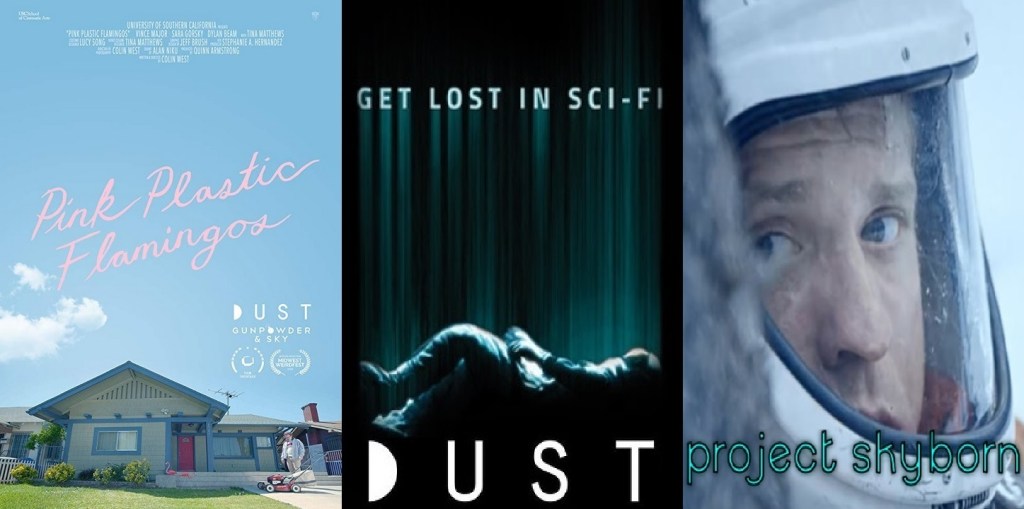
This 24th day of Scarecrow Video of Seattle’s Psychotronic October Scarecrow Challenge of 31 movies in 31 days is tailor made for the binge-watchable sci-fi films at DUST (make your own anthology film!). Their portal features science fiction shorts from emerging filmmakers obsessed with aliens, robots, space exploration, technology, and the human experience in space.

There are so many great films that rival the imagination and budgets of most bloated Hollywood productions to be enjoyed on DUST. But I chose to review two films that eschew dialog. Films that successfully use subtext over dialog is an art form not easily mastered. And these two films are magna cum laude.

Writer/directors Colin West, of Pink Plastic Flamingos, and Marko Slavanic, of Project Skyborn, understand the pitfalls of including more dialogue than is necessary to convey a story. They understand that films conveying a tale with images and not words make for a more lasting impact.

Think about the perpetual jaw-drop you experienced with 2001: A Space Odyssey (1968). Or being mesmerized by Albert Lamorisse’s The Red Balloon (1956) and Jean-Jacques Annaud’s Quest for Fire (1981) and The Bear (1988). Or the captivation experienced with Kim Ki-duk’s 3 Iron (2004) and Moebius (2013).

Such are these two films.

Pink Plastic Flamingos

In my September 2019 “Post Apoc Month” reviews for the European dystopian dramas Kamikaze ’89 (1982) and Docteur M (1990), we discussed the detriment of technological controls against humanity.

That human-technological dependence on our phones and its related apps—that we use to complete the mundane tasks of ordering food, deciding what food we need to restock the fridge, or cleaning our floors (an iRobot Roomba makes an appearance in the film)—is addressed with Colin West’s sixth film. West, however, goes deeper with his technological statement: it’s also a satire on the drudgery of the domesticated housewife and the human-emotional disconnect.

Pink Plastic Flamingos is comedic tale about a man, his family . . . and his robot. George (Vince Major) hates daily chores. He hates mowing the lawn. Even making sure his daughter, Emma (Dylan Beam), is safe and secure in the car gets on his nerves. He hates any social obligation, even to his own wife, Marilyn (Sara Gorsky).

And how dare she leave a note for him to do the dishes. Then, with the foot bump of a Roomba (that speaks the film’s only “dialog”: a foretelling, “Caution”), George has an “aha” moment to rid him of these bothersome tasks.

So with a lawn mower, a computer, and car parts from his garage out steps a Futurama-by-way-of-Tony-Stark solution to all of his problems. Now he can relax in a lawn chair with a Styro-cooler and lounge at the pool.

And all is well until the robot takes over his life. And he loses is wife and daughter to the more attentive robot.

Technology: Be careful what you wish for.

Project Skyborn

The purpose of film is to suspend your disbelief and engage your mind. Such a film is the sci-fi actioner, Project Skyborn. As with Anton Doiron’s inventive, sci-fi-on-a-budget space pleasure cruise that is Space Trucker Bruce, Project Skyborn is a case of giving a filmmaker an easily eBay-acquired flight suit, a few feet of 25mm flexible electrical conduit, some hose-band clamps, and two Thermos flasks and you get a film that rivals any Matt Damon or Brad Pitt astroromp.

In this Oblivion meets Hunger Games mind bender, Astronaut 42 (William Buchanan, U.S TV’s NCIS “Devil’s Triad”) wakes up in a snowy, wooded landscape—possibly a moon of a distant planet. He’s been airdropped into a virtual reality game zone, equipped with a technologically-advanced rifle and a photograph. And the rifle’s on-display timer is counting down. And he’s just been acquired in a mysterious opponent’s crosshairs. Then an electronic voice advises how much “breathable oxygen” his suit has left. The first shot rings out. . . .

You can visit with Colin West and Marko Slavanic at their respective websites for more information about their films.

DUST is always looking for content. The future awaits at Facebook, Watch Dust, and DUST You Tube for science fiction filmmakers with fully completed, ready to watch films.

And speaking of anthologies: DUST edited an hour long “anthology” with a collection of recent sci-fi shorts from their library: Time is a Place, Telepathy, Atoms of Uncontrollable Silence, Falling Apart, Again, and The Two of Us.

Cockpit: The Rule of Engagement

Sara Gorsky of Pink Plastic Flamingos will soon star alongside Ronnie Cox (1972’s Deliverance, In the Line of Duty: The F.B.I Murders) in Demon Star, the feature film that grew from the award-winning short, Cockpit: The Rule of Engagement. You can learn more about the films of writer/director Jesse Griffith at Griffith Pictures You Tube.

 About the Author: You can read the music and film reviews of R.D Francis on Medium and learn more about his works on Facebook. He also writes for B&S Movies.


Banner Image by R.D Francis. Pink Plastic Flamingos image courtesy of Colin West. Center image courtesy Facebook DUST; manipulated by R.D Francis. Project Skyborn image is not an official poster; manipulation by R.D Francis based from still courtesy of Marko Slavanic; text courtesy of PicFont.

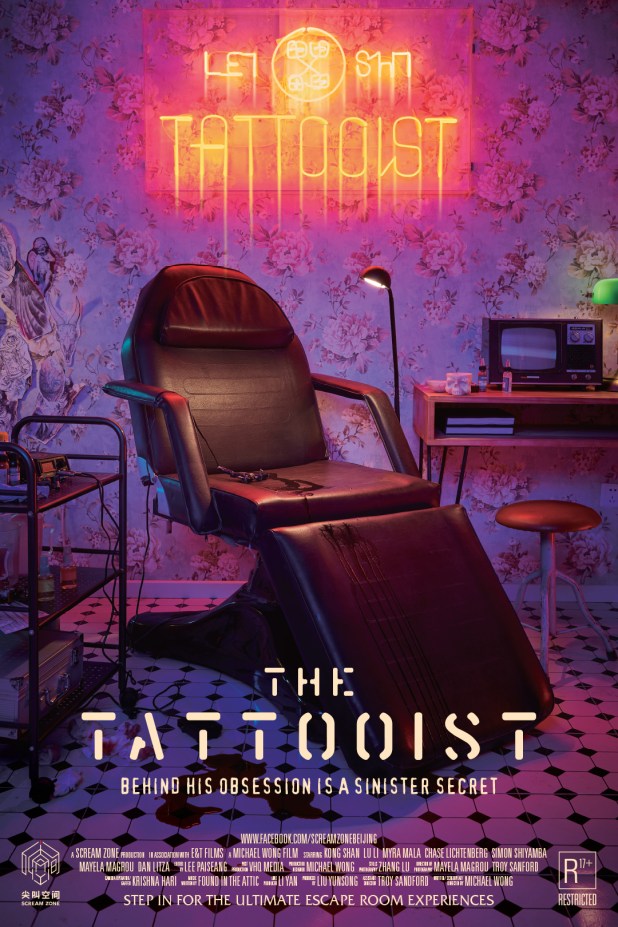
The Tattooist (2018)

We first met Michael Wong when he sent us his film The Story of 90 Coins. Now, he returns with what he’s calling a micro short, which lasts a little over a minute and appears to be the trailer for what could be quite an interesting horror film.

Wong shot everything at the Scream Zone Escape Room in Beijing, using real tattooists and Troy’s Team Action, a professional stunt team who also supported behind the scenes as cinematographers as well as acting as the camera operator, gaffer and assistant director.

I’m interested in seeing more and I really love the shot of The Tattooist doing his weird dance at the end.

Check it out right here:

We’ve since heard from Micheal Wong with an update on the progress of The Tattooist. It was a winner at Canada’s Bloody Horror International Film Festival, the Horrorhaus Film Festival in LA, and Canada’s Terror in the Bay Film Festival, as well as multiple wins at the Diabolical Horror Film Festival, and a nominee at the Vancouver Badass Film Festival.

You can learn more about the film and Michael Wong’s career at the film’s official Facebook page. Michael is a filmmaker to watch for — and we look forward to his next offering. And when that film comes, you’ll hear about it, first, at B&S About Movies, your celluloid Pittsburgh to Beijing connection.

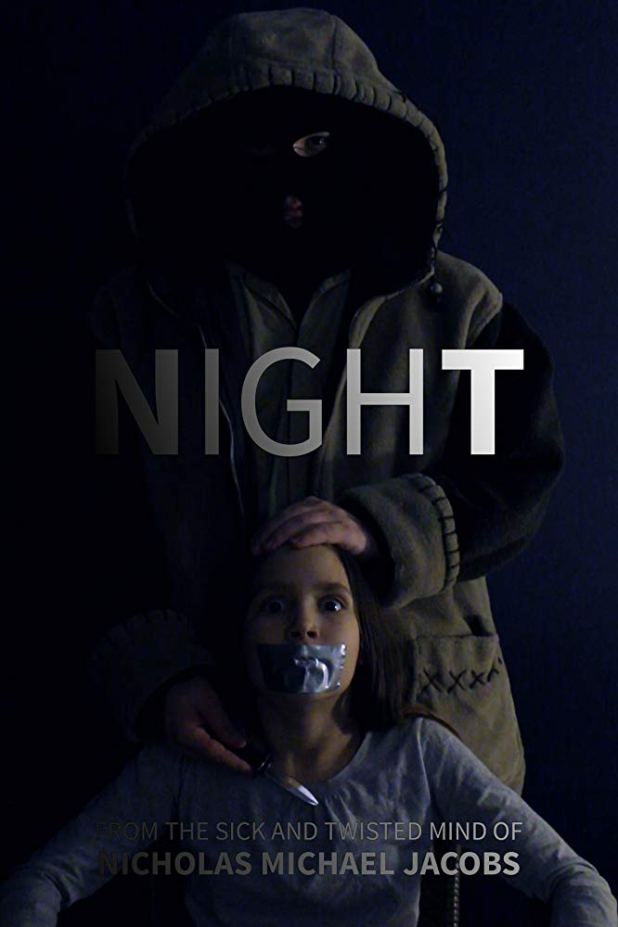
Night (2019)

Director, actor and writer Nicholas Michael Jacobs sent me his latest film via email, which goes live on Amazon Prime Video on March 23. Night is all about a crazed man who kidnaps women and broadcasts himself torturing and murdering them for an audience of paying viewers online.

The movie starts with three minutes of the main character, Adam Audrey, getting ready. You can barely see him and everything is in shadow. That’s followed by nearly five minutes of him following a girl and kidnapping her before the opening credits.

What follows is forty-five some odd moments of Adam taking phone calls telling him not to do this any longer, going live several times as he berates his viewers for not being creative and then taking money from them to do horrible things to the girl, then the girl talking to him in an attempt to try and reach him before they go live again.

Basically, if you want to see a guy tie a girl up to a chair, slice her with a knife and call her a bitch for nearly an hour, then Night would probably be for you. I was hoping that its long single shots would be leading up to something more. As indefensible as most people find Maniac and The New York Ripper, there are moments that aspire to art. There’s little to none of this here.

That said if you want to hear someone say, “Anybody else out there? Any more requests?” ad nauseum while a locked off shot of a girl bleeding in a chair runs, then by all means, when this comes out in a few days, you’ll have something to watch.

Even the credits take forever — over five minutes of a slow crawl — with only four people acting in the film and Nicholas Michael Jacobs name up there several times.

I get what this movie was going for, but at no moment does it hold any surprises or say anything different. I gave it the time it needed to do so and even the end isn’t so much of a twist as much of a “when are they going to get to that” moment. I hate being negative about a film, as it takes time, effort and energy to create one and I applaud everyone that worked on this for doing so.

DISCLAIMER: We were sent this movie by its director, but that doesn’t impact our review.