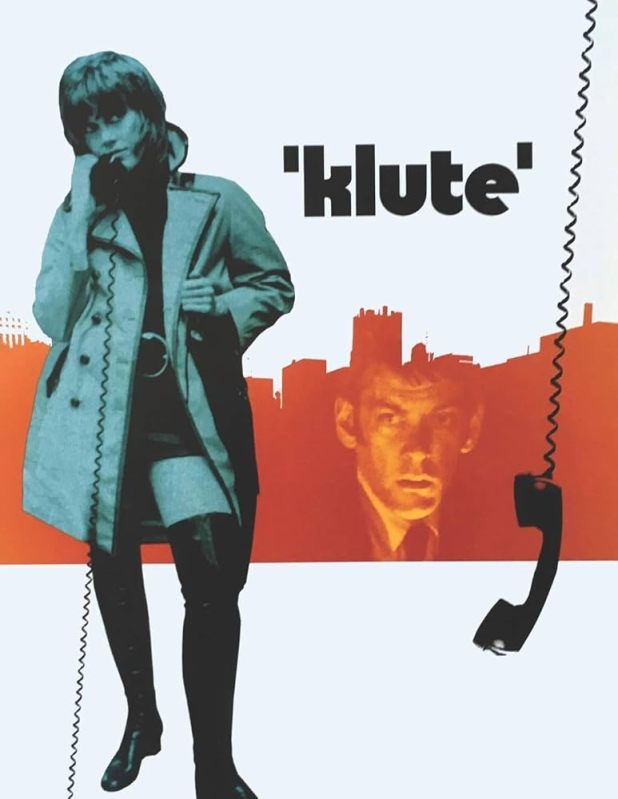
Alan J. Pakula took the paranoia at the start of the 1970s and made this film, as well as The Parallax View and All the President’s Men, movies shaped by and that shaped the zeitgeist. He didn’t stop making important films, as he’d gone on to make Sophie’s Choice, Presumed Innocent, The Pelican Brief and Dream Lover, which has some tones of Giallo.
A chemical company executive has disappeared, and the only clue is obscene letters that were due to be sent to a call girl named Bree Daniels (Jane Fonda). The company hires a detective, John Klute (Donald Sutherland), to determine where the man has gone.
There’s a john who is so disturbed that two of his past clients have either committed suicide or become addicts. Bree had seen that man but can’t remember him. That is, once she finally opens up to Klute, who has been listening to her phone calls and following her, learning that she’s an actress who does sex work to pay her bills. One of the girls she knows, Arlyn Page (Dorothy Tristan), can tell Klute that his client may be the killer.
Fonda, a feminist, didn’t want to play this role. She wanted to drop out and ask Pakula to hire Faye Dunaway. She consulted with friends and, after some soul-searching, took on the role. Despite the controversy of her Vietnam protest, it became one of the best-known roles of her career, winning a Best Actress Oscar.
I like the end of this, as Bree keeps working everyone, saying that she’ll be back to see her therapist next week and that she would go mental living in a domestic world. Yet for all we see, Bree and Klute might be destined to be happy together. That’s a big win for a movie that follows a lot of Giallo beats and is filmed as if it’s surveillance footage. Sutherland and Fonda dated for a while; he was her date to the Oscars that year.
Bree’s apartment wasn’t real but was built on a sound stage. That said, Fonda did sleep overnight in it sometimes, and it even had a working toilet. She decorated the place as if Bree was a romance novel reader and had a cat. There’s also a hidden autographed photo of JFK. Fonda had a friend in Lee Strasberg’s private class who occasionally slept with the President, and in her head, she imagined that Bree did, too.
Editor’s note: Cinematic Void will be playing this movie on January 18 at 7:30 PM ET at The Sie Film Center in Denver and will be co-hosted by Theresa Mercado of Scream Screen and Keith Garcia, Artistic Director – Sie FilmCenter. You can get tickets here. For more information, visit Cinematic Void.
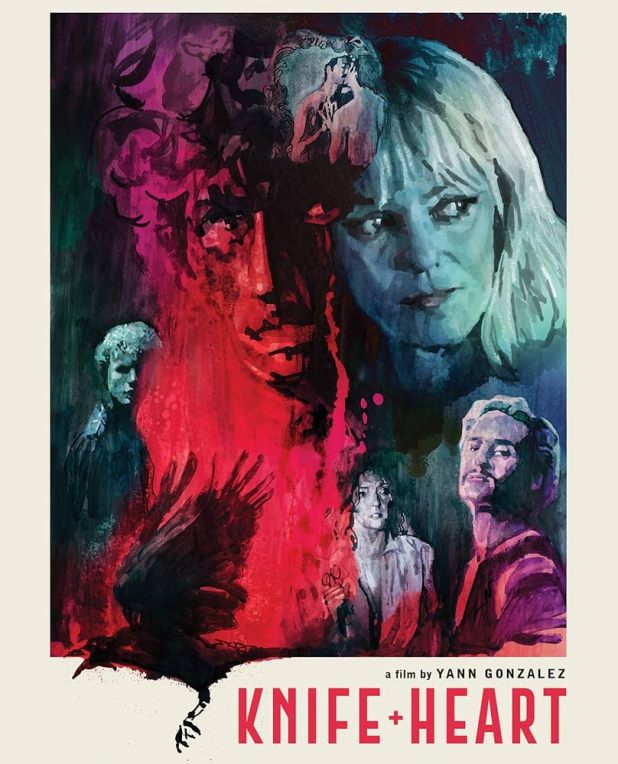
Knife + Heart is a true anomaly when it comes to Giallo. It’s from France, a country more given to fantastique films than Giallo, although movies like The Night Caller, Without Apparent Motive, and The Night Under the Throat exist. And its victims aren’t gorgeous women but the actors of the gay porn industry, changing the psychosexual dynamics of the form.
Instead of featuring the sounds of a band like Goblin or a score by Morricone or Orlandi, Knife + Heart has music by Anthony Gonzalez of M83, director Yann Gonzalez’s brother.
A young man is killed by a masked man whose very sex conceals his murder weapon to open the film. Then, we meet Anne (Vanessa Paradis), an adult film director recently abandoned by her girlfriend and editor, Lois. The man killed in the opening was the star of several of her films; now she must find an actor to take his place. That leads her to Nans, who agrees to be in her movie despite identifying as a straight man.
The new film — Homocidal — will be her version of the murders, which continue targeting members of her cast. The police either can’t — or won’t — help. But the movie finished, and as the group celebrates its completion with a picnic, the killer strikes again, just as Anne pretty much assaults Lois in an attempt to get her back.
The true killer is a man whose father caught him making love to another man. He killed his lover and castrated his son, who was also burned in a fire before being brought back from the dead by a blind crow — the fact that this movie isn’t called Call of the Blind Crow speaks to its non-Italian origins — and seeing one of Anne’s movies brought his memories back.
This being a giallo, there’s also a bird expert with a disfigured hand that looks like he has, quite literally, chicken fingers. Plus, the entire end of the movie is explained via voiceover. The fact that so much of this movie is given to style over substance means it lives up to the film that inspired it.
While the murders are in your face, the sex is nearly hidden from view. Anne is an intriguing protagonist — drunken and bitter instead of the normal virginal giallo and slasher ingenues that save the day. She instead brings the killer closer with each scene that she directs.
Back when they were child chess prodigies, David Willerman (Charles Bailey-Gates) and Peter Sanderson (Christopher Lambert) had a significant match. This match, which ended with Peter victorious and David stabbing him with a pen, had a profound impact on both their lives. It led to Peter’s father leaving and his mother committing suicide, and David’s obsession with his chess board, which he kept in the group homes and orphanages he grew up in.
When Peter grows up, he ascends to the status of a chess grandmaster and becomes a widower, left to raise his daughter, Erica (Katharine Isabelle), alone. The plot thickens when his latest lover, Debi (Kehli O’Byrne, Ginger Snaps), is discovered dead. The police, led by Police Captain Frank Sedman (Tom Skeritt), Detective Andy Wagner (Daniel Baldwin), and psychologist Kathy Sheppard (Diane Lane), launch an investigation, with Peter as the prime suspect. However, the mystery deepens as David, the potential missing link, enters the picture.
Directed by Swiss-born Carl Schenkel and written by Brad Mirman (Body of Evidence), this film, a part of the Giallo genre, features all of Peter’s lovers showing up with their faces painted like clowns and drained of blood. It also takes a page out of The Cat o’ Nine Tails by having Peter’s daughter Erica being best friends with his blind coach, who is played by Ferdy Maine (the devil from Night Train to Terror).
I always wonder how the Giallo police work. In this example, Sheppard goes from psychoanalyzing Peter to being a skewered queen. See, I can make sex jokes about anything! But seriously, defund the Giallo police. Sleeping with a suspect? Well, they were married in real life at the time.
It’s not the best Giallo-adjacent movie I’ve seen, but it’s not the worst. I did like how excited Lambert was when he won at Battle Chess.
EDITOR’S NOTE: Cinematic Void will be playing this on Saturday, Jan. 18 at midnight at the Coolidge Theater in Brookline, MA (tickets here). For more information, visit Cinematic Void.
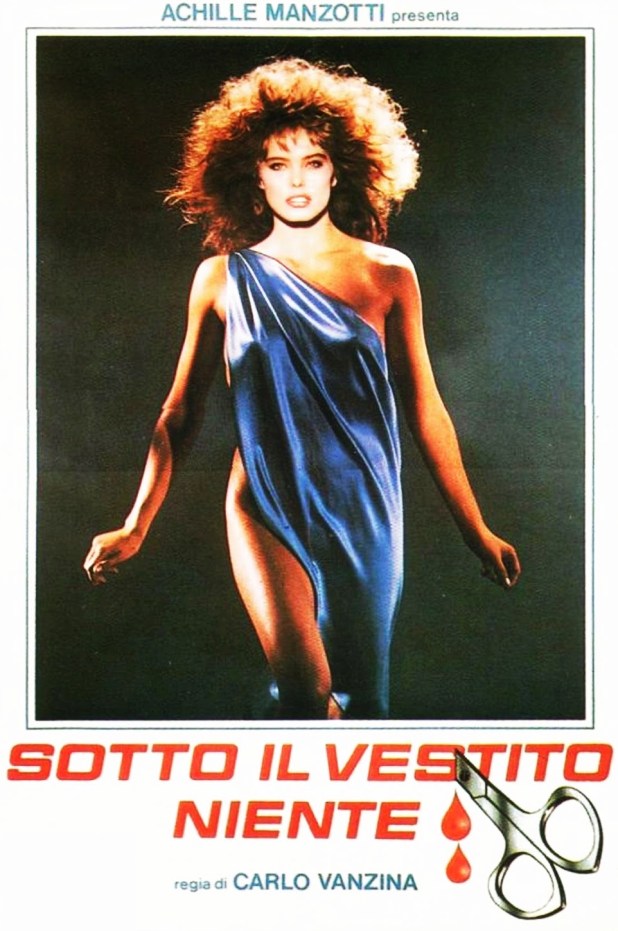
Initially intended for Michelangelo Antonioni, this film had the potential to be another Blow-Up. However, Carlo Vanzina and Enrico Vanzina created it with only a limited connection to the novel that inspired the title. The book, written by fashion journalist Paolo Pietroni under the pseudonym Marco Parma, generated significant controversy upon its release for naming prominent figures in Italy’s fashion industry.
The plot of this film, unlike any other, revolves around a serial killer prowling the streets of Milan, targeting glamorous models with a deadly pair of scissors, a weapon suggested by the renowned writer Franco Ferrini, known for his collaborations with Dario Argento. The initial choice of a gun as the killer’s weapon was quickly discarded, as it didn’t quite fit the unique essence of the Giallo genre.
Meanwhile, Yellowstone Park ranger Bob Crane (played by Tom Schanley) senses that his sister Jessica (Nicola Perring) is in distress. His journey takes him across the world, where he unexpectedly finds himself mingling with the rich and famous. Can he rescue her, or will he find himself in the crosshairs of the killer? And will Donald Pleasence ever turn down a film role?
One thing is certain: Barbara (Renée Simonsen), a model and friend of Jessica’s, is interested in Bob, but there are hints that she might also be obsessed with Jessica.
I often think about the connection between Dario Argento and Brian De Palma. This movie shares similarities with its murder scenes set in Italy and its modern American methods of death, which are reminiscent of the drill in Body Double and the psychic elements in Sisters.
Unlike many Giallo films, this one made a significant impact in Italy, sparking a small wave of comeback films set in the fashion world and the sequel Too Beautiful to Die. While I prefer that sequel and certainly think it surpasses the third film, the Vanzina brothers’ The Last Fashion Show, I’ve come to appreciate this film over time.
Never forget that this has one of the most amazing moments in Italian exploitation movies: Donald Pleasence going to town on a Wendy’s salad bar.
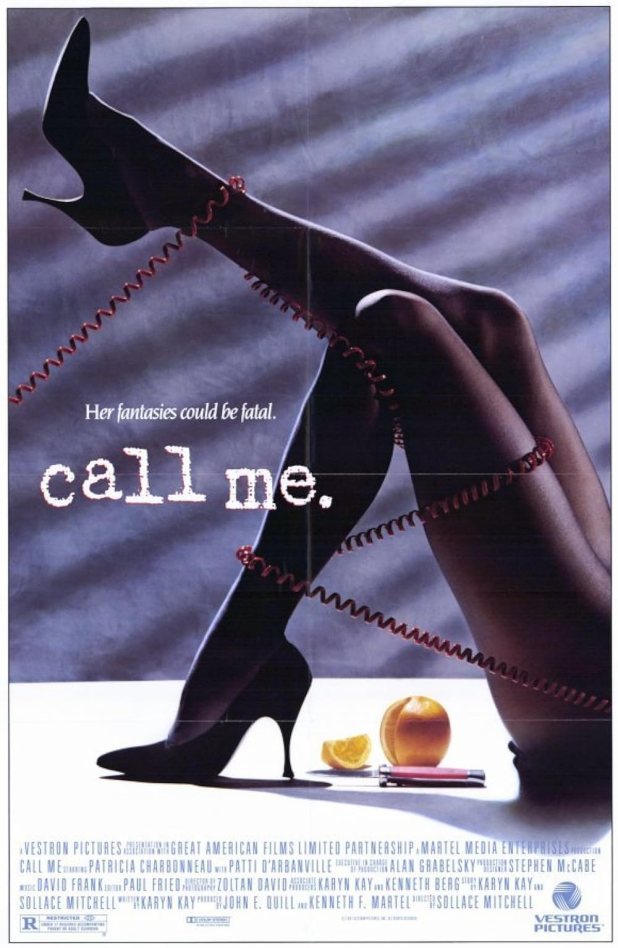
Directed and co-written by Sollace Mitchell (with Karyn Kay), this is the story of Anna (Patricia Charbonneau), a newspaper writer who feels a distance from her live-in author lover, Alex (Sam Freed), who is only excited about getting to writer about fast food.
One evening, she thinks she’s received a dirty phone call from him, the spice she’s looking for in her life. Instead, she’s in a dive bar waiting to meet a stranger, running away and accidentally watching two criminals, Jellybean (Stephen McHattie) and Switchblade (Steve Buscemi) too closely. They think she has their money. She has no idea who they are, much less the heavy-breathing caller who keeps dialing her almost every night.
Every man around Anna is a milquetoast that still wants to control her. So when she gets caught in the world of dead cops and someone who calls her in the middle of the night, telling her to make love to herself with an orange that gets juices all over her thighs, can you blame her when she whispers, “Push orange slices into my cunt with your tongue” and asks the caller to penetrate his own orange before realizing her lame boyfriend has been watching all along?
Anna is also pretty dumb, I must confess. Is her life so bereft of thrills that all she has are phone calls? She’s gorgeous. She doesn’t even need a boyfriend, as she has a career. Maybe she’s co-dependent, as her friend Cori (Patti D’Arbanville) calls out:
Anna: Cori, I’m not the only woman who gets obscene phone calls.
Cori: No, but you’re the only one I know who talks to them.
I wanted this to be closer to either a Giallo or a movie that let Anna finally explore her kink with someone less dull than her lame best male friend. I want her to have more. I want her to be smarter. I want her, in short, to explore her wants.
As a sad aside, co-writer Karyn Kay died way too young, at 63, killed by her 19-year-old son Henry Wachtel. After her career in Hollywood, she’d started teaching Creative Writing at LaGuardia, a New York City performing arts school. In this article on Crime Reads, the author shares her real-life experience of having Kay as a teacher. It’s worth a read.
If you’re interested, Anna gives her phone number in this movie: 212-627-2363.
EDITOR’S NOTE: Cinematic Void will be playing this on Thursday, Jan. 23 at 7:30 PM at the Little Theater in Rochester, NY (tickets here). For more information, visit Cinematic Void.
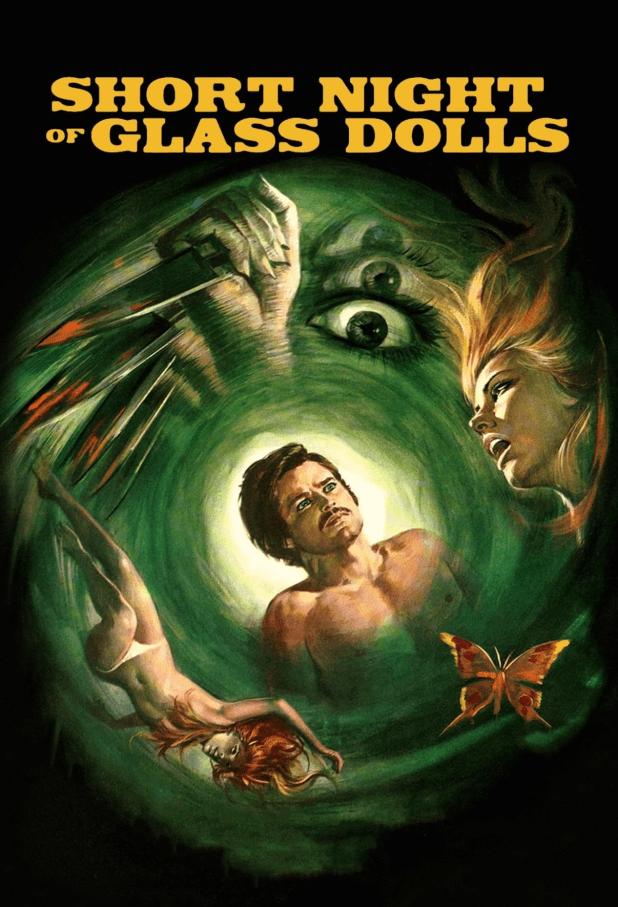
Gregory Moore (Jean Sorel, Perversion Story) has a problem. His body has been found in a park in Prague, but the American journalist is anything but dead. His heart is still beating and his mind is still able to replay the sinister events of the last few days, a story that started with the disappearance of his girlfriend Mira (Barbara Bach) and ended even more horribly than he could have imagined.
The debut movie from director Alan Lado, Short Night of Glass Dolls subverts the giallo genre to move slowly into the supernatural. The only other giallo Lado created was Who Saw Her Die?* which, much like this movie, doesn’t seem keen on following the Argento giallo formula like just about everyone else. Lado would also make the baffling Star Wars clone The Humanoid many years later.
Moore resolves to find Mira when the police can’t, so he joins forces with his co-workers Jessica (Ingrid Thulen, Salon Kitty) and Jack (Mario Adorf, The Bird with the Crystal Plumage). Never mind that he’s just had an affair with Jessica.
By the end of the film, we’re left wondering if our paralyzed narrator is really an unreliable one and whether or not he made his own girlfriend disappear. We needn’t feel that way for long. The truth is that she’s fallen into the claws of Klub 99, a black magic group made up of Prague’s social elite that uses the life force of the young and beautiful to stay powerful.
This is one dark giallo that feels like a swirling nightmare that the protagonist can’t wake from. Even when he’s moving and alive, he feels out of place, a man away from not just America, but from reality itself. The scene where he moves behind the audience and red curtain as they watch a man play piano is particularly striking as it separates him from everything else that is going on around him.
There’s only one on-screen murder and Lado really shows that he’s an artist here instead of a slavish follower of giallo convention. It reminds me of a much more downbeat All the Colors of the Dark where the cult is much more powerful. The end scene of the gallery watching the autopsy is a brutal finale.
*I guess you could also consider Last Stop on the Night Train to kind of, sort of be a giallo.
ABOUT THE AUTHOR: Jennifer Upton is an American (non-werewolf) writer/editor in London. She currently works as a freelance ghostwriter of personal memoirs and writes for several blogs on topics as diverse as film history, punk rock, women’s issues, and international politics. For links to her work, please visit https://www.jennuptonwriter.com or send her a Tweet @Jennxldn
It’s an exceptionally difficult task for audiences to buy a ticket to a Dracula film, walk in, sit down and watch it with a completely open mind. Nosferatuis an expressionist Dracula film the same as its 1922 unauthorized namesake, based on the Bram Stoker novel that has been adapted into as many successful plays and films as anything Shakespeare ever wrote. Everyone has their favorite film version. Robert Eggers’ version will no doubt become the favorite for a lot of younger film enthusiasts the same way my favorite version is the 1992 Francis Ford Coppola film I saw at age 20. This new version ticks all the boxes in terms of the younger generations’ favorite themes including power imbalance, the need to earn, childhood trauma and gender roles.
The first half hour of the film is excellent. Every frame is a work of art. A perfect depiction of a young man willing to engage in a job he doesn’t want to do because he needs the money. Eggers’ is a master at casting actors whose faces etch across the screen like the ancient lithographs in old books about witchcraft and demonology. Nicholas Hoult does a great job as the earnest but insecure Thomas Hutter a.k.a Jonathan Harker. Yes, his accent is better than Keanu’s.
The scenes in Count Orlok’s castle are creepy, and beautifully designed, infused with a sense of dreadful inevitability. Bill Skarsgard’s Orlok is damned creepy, physically monstrous, and rips out toddlers’ throats. Box ticked.
The scenes in Orlok’s castle are very engaging. Hutter is clearly under the count’s supernatural influence, even going so far as to take communal wine and bread. He’s in an isolated place, doing a thankless job. The prey in a predator’s game on its territory. If he executes his duties successfully, he’ll have a secure financial future for himself and his new bride, Ellen (Lily-Rose Depp).
Ellen is a victim of childhood trauma. While the link between Vlad and Mina is explained clearly in Coppola’s version as a case of reincarnation, here it’s simply that Ellen was a horny teenager with dark sexual fantasies. Liking sex opened her psyche to the darkness, giving Orlok the opportunity to psychically molest her. Why he chose her, when there were no doubt countless other horny teenagers wandering around during Orlok’s thousand-year existence is never explained. Nor are his origins explained. Ellen was simply the perfect victim and now Orlok wants her as his bride. He was probably lonely since Eggers removed the other vampire brides present in almost all previous adaptations.
Ellen’s adulthood “melancholy” only disappears when her new husband is by her side. Why? Is it because Hutter is Ellen’s new sexual outlet? One sanctioned by the ring on her finger? Is it because traumatized women need protecting? The answers to all these questions are mute because…atmosphere. But hey! Did you notice that the Hutters use candles while their wealthier friends the Hardings use gas lamps? That’s the level of macro filmmaking we’re dealing with here.
Orlok begins visiting Ellen, who is now staying with the Hardings.
Orlock comes to her in her dreams bringing Ellen to fits of shaking, eye-rolling and spitting worthy of a ‘70s Italian Exorcist clone. Fortunately, Ms. Depp has the acting chops to pull it off.
Thomas escapes Orlok’s castle, finds refuge with some healing nuns, grabs a horse and starts the journey home. A six-week landlocked journey from Carpathia to Germany. Meanwhile, Orlok ships himself all the way around Europe by boat when he could have just hired some gypsies to bring his coffin in a caravan in six weeks. Why bother showing all the detail involving Thomas Hutter’s journey back and forth by land only to have the count go by boat? Because it was in Bram Stoker’s book, you say? The book that took place in Carfax Abbey in London? It made sense when the story moved from Carpathia to London. Carpathia to Germany by boat? Not so much. Granted, rail was only about a decade old in 1838 when the movie takes place, but still. It’s an oversight in the 1922 version that remains here. I did enjoy seeing a bit more of what went down on the ship and the chaos that ensued from “the plague ship” when it finally docks in northern Germany filled with cute little rats.
When the Hardings begin to grow annoyed with Ellen’s nightly fits, they call on Dr. Sievers (Ralph Ineson) and Dr. — what was his name? — Oh, Hell. I’ll just call him Van Helsing, played by Willem Dafoe. I didn’t care for this version of these characters. Sievers seems to dismiss Ellen as a hysterical female. If he truly believes this, why even bother to seek out his mentor? Dafoe’s Van Helsing, while appropriately strange, was granted no real authority in the proceedings. He doesn’t know how to defeat the vampire. He can only guess. Why is he even there if he can’t help? I mean, come on! When Peter Cushing showed up, we knew we were in good hands. When Anthony Hopkins gave an order to give Lucy a transfusion, the other men listened and obeyed.
Dafoe’s character’s sole purpose in the film seems to be to tell Ellen that she, simply by virtue of being a normal female with normal sexual desires, can save everyone by allowing her attacker to attack her again. Because the whole thing was her fault to begin with. It was at this point where I seriously began to consider why Robert Eggers chose to retain the outdated sexist themes of the 1922 version. Does he hate women? It was the exact opposite of the way I felt when Mina decapitated Prince Vlad in the ’92 version. My suspicion was vindicated when the lights came up and the woman sat behind me declared to her companion, “This movie is a warning to never marry any woman. Ever.”
Nosferatu is a film that tells you that Ellen is the hero, while showing you quite the opposite. In fact, Eggers often ignores the golden rule of “show, don’t tell” on every major plot point in this film. In the 1992 version, we didn’t need to be told that Mina was the hero. We could see it with our own eyes through her actions. It improved on the original, more traditional Universal and Hammer versions. Here, there’s a lot of dialogue about Ellen being the hero but, in the end, she dies along with her assailant, sacrificing herself for the greater good, as in the original 1922 film. Even though it was her husband’s fault for selling the count a piece of real estate. She warned him not to go, but Thomas did it anyway and the only self-reflective scene in the movie is when Ellen tells him off for doing it.
For all my complaints, I am a Drac enthusiast. Nosferatu is worthy of a second viewing, if only for the wonderful visuals, sound design, set design and overall atmosphere. Sometimes good atmosphere is all an audience needs to carry them through, although I have a feeling it won’t play as well at home as it did on a giant IMAX screen. It’s a technical triumph with a cold, hollow script. Like a decent cover version of an old favorite song. A song with a melody that’s so good, it’s nearly impossible to screw it up.
(Editor’s note: Jenn sent me this note later: “I forgot to mention in my Nosferatu review the really long vampire schlong in IMAX.”)
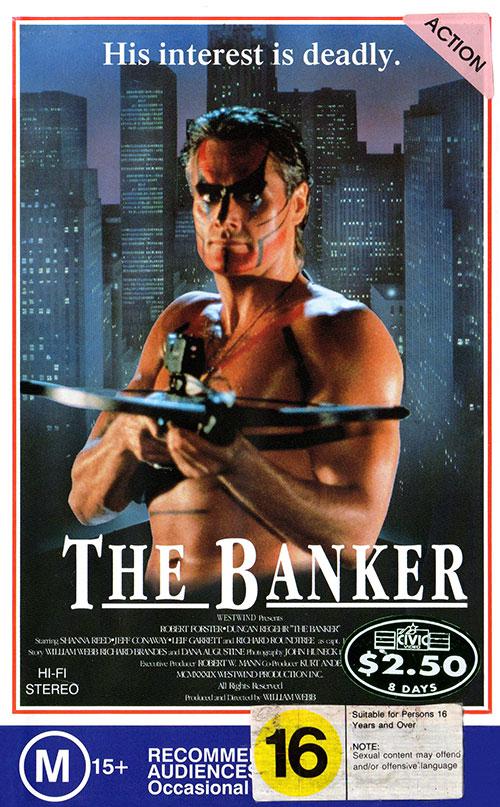
Spaulding Osbourne is a super-wealthy businessman played by Duncan Regehr, who you may know as Dracula from The Monster Squad. He’s come to Los Angeles with a crossbow, a penchant for murdering call girls and the need to paint his face as well as a South American symbol in their blood. His next victim might be Sharon (Shanna Reed), a news reporter on his trail, but not if her ex-husband, Sgt. Dan Jefferson (Robert Forster) can help it.
You read that right. In an American Giallo, Robert Forster is hunting the hunter in the urban jungle. This doesn’t stop there with the wild casting, as Richard Roundtree plays Dan’s captain, and Jeff Conaway and Leif Garrett appear as the pimps who supply Osbourne with the sex workers he needs for his laser-sighted Most Dangerous Game.
Directed by Willaim Web, who also made the beloved Party Line — at the same time! — and written by Dana Augustine and Richard Brandes (Devil In the Flesh), this starts with a Teri Weigel sex scene, which was definitely for the foreign investors.
Forster is the whole reason I watch this. His character has crawled into a bottle since his wife left. He doesn’t have a house. Instead, he lives in his nephew’s treehouse. And he’s mad at everyone around him. This is only topped by the killer’s rituals, which include painting up while watching an entire wall of TVs playing footage of volcanos and sharks.
This isn’t great, but it’s perfect if you watch it before the drunken blackout in the hours between pure darkness and early light.
EDITOR’S NOTE: Cinematic Void will be playing this Saturday, January 11 at 7 p.m. at the Sie Film Center in Denver, CO. (tickets here). It will be hosted by Keith Garcia, Sie FilmCenter Artistic Director.For more information, visit Cinematic Void.
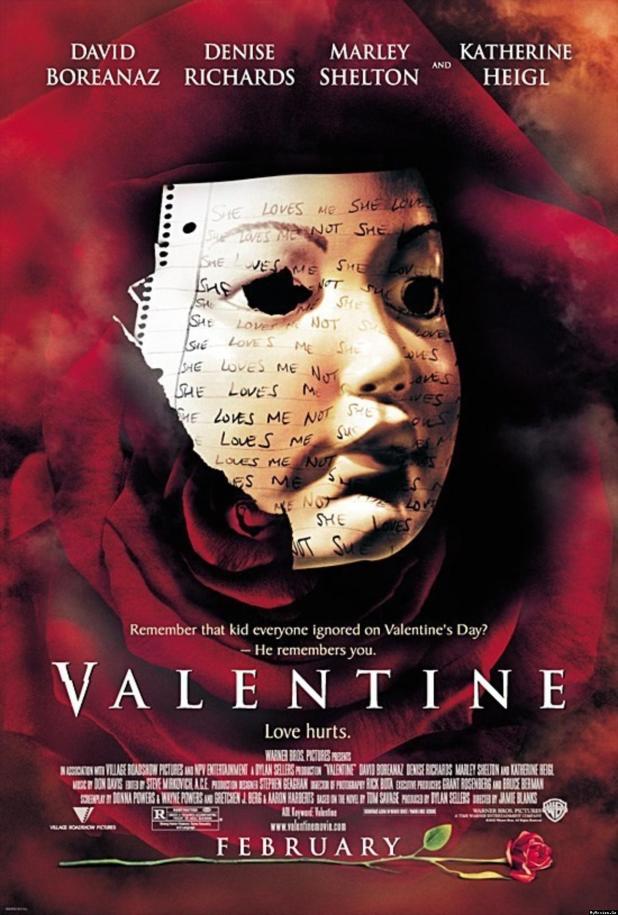
Valentine is a post-Scream slasher that feels closer to a giallo than an American slasher at times, with elaborate death sequences and a masked killer who wears the face of Cupid. It’s packed with the hottest actors of the early 2000’s and directed by Australian Jamie Blanks, who also made Urban Legendand remade Long Weekend in 2008.
The movie starts at a St. Valentine’s Day dance in 1988. Jeremy Melton, the school geek, asks four different girls to dance. Three of them — Shelley, Lily and Paige — instantly reject him while Kate at least gives him a break and says, “Maybe later.”
He finally hooks up with Dorothy, an overweight girl, and they make out in the bleachers. A bully finds them and everyone starts to laugh at the two of them until she claims that he is raping her. This removes Jeremy from school and their lives.
One by one, these girls are stalked and killed. Shelley is now Katherine Heigl and a UCLA med student. After getting a Valentine in her locker, a killer in a trench coat and Cupid mask stalks her and slices her throat. As she dies, his nose begins to bleed. I’m assuming that the people who made this hoped that none of us had ever seen Alone in the Dark.
At her funeral, Kate (Marley Shelton, Grindhouse), Lily (Jessica Cauffiel, Legally Blonde), Paige (Denise Richards), and Dorothy (Jessica Capshaw, daughter of Kate) are questioned by the police. They all get the same Valentines, like the one Dorothy gets that goes so far as to say, “Roses are red, Violets are blue, They’ll need dental records to identify you.” She’s no longer heavy and is part of the in crowd, with a boyfriend named Campbell — who may or may not be a con artist but is definitely a giallo-style red herring.
Lily gets chocolates, but they’re filled with maggots. And at the exhibit of Lily’s boyfriend Max (Johnny Whitworth, AJ from Empire Records), Lily is chased by the killer through the exhibits until she is shot multiple times with arrows — ala the real Saint Valentine — and falls to her death inside a dumpster.
They all realize that the initials on the cars are JM, which means that the killer could be Jeremy Melton. Dorothy admits her lie that sent Jeremy to reform school. It’s at this point that the lead cop, Detective Leon Vaughn (Fulvio Cecere, whose movie 350 Days is all about the life of a pro wrestler) hits on Paige and she strongly rebuffs him.
Kate’s neighbor breaks into her apartment as he has been stealing her panties and is killed with an iron. And as Dorothy plans a huge party, Campbell is killed with an ax. Her friends all assume that he has simply dumped her as she’s still the fat girl in their eyes. Of course, if she listened to Ruthie, Campbell’s crazy ex, she’d know the truth. But she gets brutally killed at the party in a kill that’s reminiscent of Deep Red.
At the party itself, Paige is electrocuted in a hot tub and the power cuts out. Dorothy and Kate begin to argue over who the killer’s identity, with Kate saying that its the mysterious Campbell, while Dorothy accuses Adam (David Boreanaz of TV’s Angel), Kate’s alcoholic ne’er do well boyfriend. They then learn that Lily never made it to California and that she may be dead. After a call from Detective Vaughn, they start to investigate further. As they worry about their safety, they try to call him back but get no answer. Suddenly, they hear a ringtone and follow the sound of it until they find his severed head outside the house.
Kate is absolutely convinced that Adam is Jeremy and runs back inside the house to find him waiting for her. He asks her to dance, but she gets freaked out and runs from him — right into the corpses of Paige and Ruthie. That’s when the Cupid killer runs right into her but is shot by Adam. The mask falls off to reveal Dorothy.
Adam finds it in his heart to forgive Kate, explaining how if you have enough childhood trauma, like how Dorothy dealt with the abuse of being overweight, that anger can stay with you and cause violence. They wait for the police to arrive as he embraces her, telling her that he always loved her. She closes her eyes and we notice that his nose has begun to bleed.
There are plenty of red herrings along the way, like Dorothy’s cherub necklace that could point to her as the killer. And then there’s the fact that that necklace really belonged to Ruthie. But after that gets dealt with, it’s pretty obvious who our killer is.
I liked how each of the murders ends up corresponding to the horrible things that the girls said to Jeremy at the dance, like Paige’s claim that she’d “rather be boiled alive” actually ends up happening.
It’s also refreshing that the women in this, by and large, are aware of how men try to use them and respond in modern ways, such as Paige shutting down the main detective.
Valentine isn’t the best movie you’ll watch, but you can get it for $3 at most streaming sites and for around $2 or less at most used DVD stores. That’s a decent enough price to spend — it goes down as easily as a Valentine’s chocolate but won’t stay with you much longer than a summer fling.
When you see the phrases neo-noir or erotic thriller, read them as Giallo. Isn’t that what it all is, anyway? And who thought that one day, we’d have Jim Belushi as the protagonist of a psychosexual murder movie?
Director Andy Wolk would one day make The Christmas Shoes, but for now, he’s putting this together from a script by Jim Piddock, who has been in a lot of Christopher Guest’s films as an actor but wrote this and two episodes of Silk Stalkings before being the writer of Tooth Fairy.
Belushi is Jack Dobson, a Palm Beach homicide cop who we initially find flat on his back, dead from a gunshot wound to the chest. His narration takes us back to one evening that shows off just how smooth Jack is, defending a waitress from a rude customer and then immediately taking her back to his place, where he plays some smooth jazz before waking her up to coffee in bed. This movie wants you to know two things: Belushi fucks. And Belushi fucks good.
Along with his partner, Detective Steve Frayn (Tony Goldwyn), Jack is trying to figure out who is sending him lipstick-sealed threats. Is it meant for his brother Michael (William Russ), who is running for office? And is Jack so on the make that he’s willing to potentially sleep with his brother’s wife, Susan (Victoria Bass), his partner’s wife, Beth (Faye Grant), and definitely get horizontal and Belushi-sweaty with femme fatale Ellen Schofield (Lorraine Bracco)? This movie also wants you to know that every old man in Palm Beach has a filthy mouth, and they all have something to say about how badly they want to schtup Ellen, even if she rode her last husband into a heart attack.
Ellen also sleeps with Steve, even though Steve loves his wife. Everybody is getting with everybody in Palm Beach, which may as well be Rome. Women connected to Jack keep dying, their faces covered with lipstick — yay, Traces of Red! — which his brother reveals is something his first-grade teacher used to do to him before she would rape him. This is a wild departure for the Giallo, not just making its male protagonist vulnerable but seemingly switching him to the villain.
Or maybe not.
Despite being shot by his partner — it looked like he was about to choke out Steve’s wife — it’s soon revealed that the big brother was the one doing all the killing. And hey! There’s Belushi, looking like he just smoked one of his weed strains like Oreoz — they’re from the streets — or Rewrite. His brother grabs his gun and blows his brains out, ending on a downer note.
Despite being in theaters for a few days, this did big business on home video. Maybe it’s because Belushi wore all his own ties, and people recognized him not just as a fuckable prince of a man but as a sartorial style icon. You know, we should be nicer to him. And by that, I should be nicer to him. For all the horrible things on Twitter, I’ve learned that he’s a pretty chill person — growing all that weed will do that — and the more I think about it, the more good roles in movies by great directors he’s been in. He may need a Tarantino casting intervention so that he can complete this late-career reevaluation.
So yeah. Belushi in a Giallo, complete with an investigation into a misworking printer and trying to figure out a shade of lipstick and a certain perfume. Who knew?




 B&S About Movies
You must be logged in to post a comment.