Sizzlin’ Summer of Side-Splitters 2025: National Lampoon: Lemmings (1973)

June 16-22 SNL Week: Saturday Night Live is celebrating 50 years on the air, can NBC last for another 50 years??

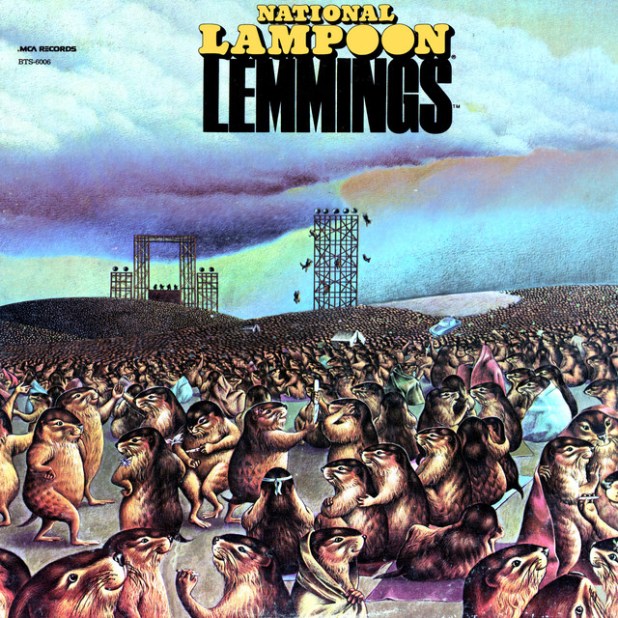
The magazine National Lampoon did a stage show that came out of the radio show. Directed by Tony Hendra, Michael Keady and Sean Kelly and written by Hendra, Kelly, David Axelrod, John Belushi, Chevy Chase, John Belushi, Rhonda Coullet, Christopher Guest, Paul Jacobs, Harold Ramis, Anne Beatts, John Boni, Garry Goodrow, Douglas Kenney, P.J. O’Rourke, Alice Playten and Henry Beard, just from that sentence you’ve already figured out that a lot of SNL people started here.

Starting at The Village Gate on January 25, 1973, this ran for 350 shows. It begins with Belushi coming out to welcome the audience to the Woodshuck Festival: Three Days of Peace, Love and Death. Then, Paul Jacobs from Neverland Express does “Lemmings Lament,” sounding just like David Crosby. Christopher Guest is Dylan singing “Positively Wall Street,” Chevy Chase does John Danver on “Colorado,” Rhonda Coullet is Joan Baez singing “Pull the Tregroes, Negroes” (which has a much worse title); Belushi does Joe Cocker, Guest is James Taylor and there’s even a band named Megadeath years before Megadeth.

Supposedly, this was filmed for HBO — which started in November 1972 — but the tapes were lost.

Most of the acts in this are dead or your parents’ music now. Yet in 1973, this was really going after them and started careers. It’s too bad that Chevy Chase ended up being Chevy Chase.

Sizzlin’ Summer of Side-Splitters 2025: Stuart Saves His Family (1995)

June 16-22 SNL Week: Saturday Night Live is celebrating 50 years on the air, can NBC last for another 50 years??

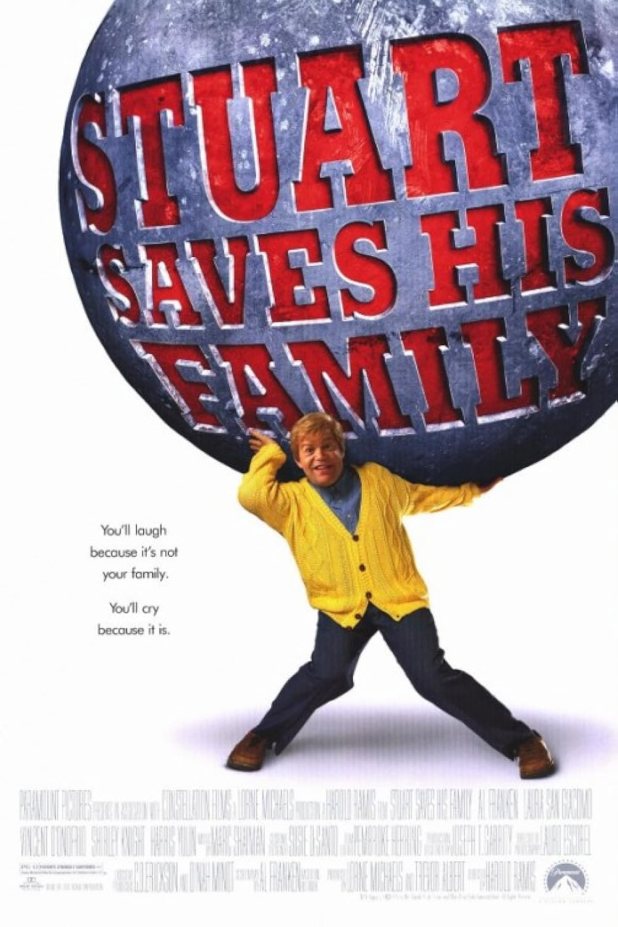
How does a character who was in short sketches get to be in a movie? Ask nearly everyone in the 1990s who had a recurring Saturday Night Live character.

Al Franken created and played the character Stuart Smalley, basing it on people he met in Al-Anon as he went through it to support his wife. First appearing on February 9, 1991, Stuart shared on his public access show how he was a member of many 12-step groups. He became popular enough to have a book, I’m Good Enough, I’m Smart Enough, and Doggone It, People Like Me!: Daily Affirmations by Stuart Smalley. This led Harold Ramis to get with Franken and push for a film.

By the way, in Live From New York—an Uncensored History of Saturday Night Live, Franken says that he wanted Mike Myers to play the part, but when they did the read-through, it only worked when he did it, as he wrote it in his voice. Robert Smigel suggested he do the part. He also admitted that he would always be around when Lorne Michaels picked the sketches to make sure Stuart got on.

In the film, Stuart loses his show. He has to come back home for a funeral, facing off with his dysfunctional family of brother Donnie (Vincent D’Onofrio), sister Jodie (Lesley Boone), mom (Shirley Knight), and dad (Harris Yulin). There’s also a battle over where the body will be buried between Dad and his cousins, Ray (Joe Flaherty) and Denise (Robin Duke). By the end, you will be sure of why Stuart has needed all of this therapy, but at least he becomes famous for his self-help and ends up with a good friend, Julia (Laura San Giacomo, always perfect).

Sadly, despite Gene Siskel calling it “smart and hip” and Roger Ebert calling out that “it has more courage than a lot of serious films,” it made under a million at the box office. Stuart would return one more time to the show and cried, yelling, “You didn’t want ‘funny and poignant. You wanted Dumb….and Dumber….and Dumber….and Dumber!” He would also return in 2004 when Al Gore hosted.

This movie’s failure did exactly what Stuart worked to fix. It put Al Franken into a depression. At least it made more than It’s Pat, which grossed $60,000. It’s a sweet film with a good heart and way better than it should be.

JUNESPLOITATION: Ragazzi del Juke-Box (1959)

June 17: Junesploitation’s topic of the day — as suggested by F This Movie— is Lucio Fulci!

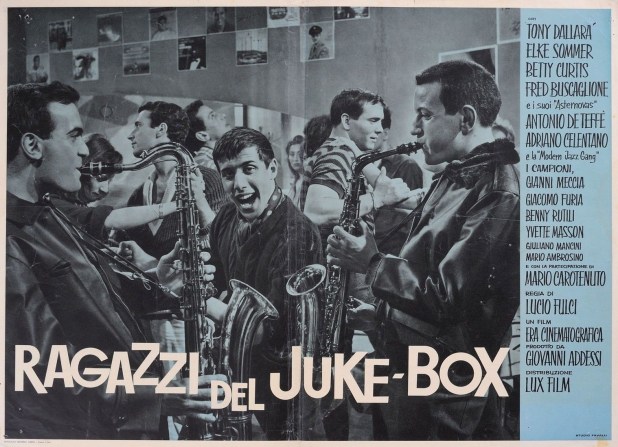
This is 39 of 57 movies directed by Lucio Fulci, so I have made my way through all of his genre films and am now in the comedy and musical movies. Like 1960’s Urlatori alla SbarraThe Jukebox Kids is a musicarello, and Fulci was the first director — with this movie — to make just such a movie.

I Ladri, the first movie Fulci made, flopped. His career was on the line, so this populist film is what emerged. Record company owner Commander Cesari (Mario Carotenuto) and his granddaughter Guilia Cesari (Elke Sommer) are at odds over what music to release. He likes the classics, she loves rock and roll. He goes to jail, she goes out to the nightclubs and starts to sign bands to release; it’s very similar to Urlatori alla Sbarra, but you know Italy. Fin che la barca va, lasciala andare.

You get to see and hear Adriano Celentano and the Modern Jazz Gang,  I Campioni, Fred Buscaglione and his Asternovas, Betty Curtis, Tony Dallara, Gianni Meccia, Ornella Vanoni and more. Plus, Anthony Steffen years before he was an Italian Western star and Fulci himself showing up as a talent show boss.

Basically, Scopitones — a type of jukebox featuring a 16 mm film component; the Italian versions were called Cinebox — with a story between all the songs. It’s funny because the screamers, as these artists were called, were looked down on by adults and said to be so rebellious. Today, they seem quaint. So does the way Fulci shot them. No zooms. No throwing up entrails. Everyone’s eyes are safe.

You can watch this on YouTube.

Sizzlin’ Summer of Side-Splitters 2025: Blues Brothers 2000 (1998)

June 16-22 SNL Week: Saturday Night Live is celebrating 50 years on the air, can NBC last for another 50 years??

I have a love/hate relationship with Saturday Night Live. Maybe because it’s me coming from Pittsburgh, because that’s one of the few places where it didn’t air live, because Chiller Theater was such a big deal. Or maybe it’s because I would switch back and forth to the Youngstown affiliate — WMFJ 21 — and watch some of the original cast. I was so into comedy as a kid that while Steve Martin, Dan Aykroyd, Bill Murray, John Belushi (I mean, he dressed as Godzilla!) and others made me laugh, I was raised on Monty PythonSCTVBenny Hill and Dave Allen At Large, so SNL gradually impressed me less and less while also obsessing me. I couldn’t stay away from its pull for long. Soon, I was watching it every week, finding every movie its cast found their way into and deifying several of the Not Ready for Prime Time Players (and then hating them when they weren’t who I wanted them to really be).

Over the years, I’ve read just about every book and seen every documentary, and I am frankly at odds with how the show is made. Does it have to be live? Why do they write it in such an insane way, staying up all night? Why does it keep getting worse as comedy gets better? Why is there a messiah cult around Lorne Michaels and the casts of this show that is not shared by other groups he worked with, like the Kids in the Hall?

I also love Dan Aykroyd without reservation, despite his white man appreciation for Chicago blues — I get it, I love Willie Dixon and Howlin’ Wolf too — going out of control and getting commodified into the House of Blues and in movies like this, which I blame for scenes where Anthony Michael Hall acts black and an entire club doesn’t stimp him but instead accepts him. But hey, he was Fred Garvin, Male Prostitute, so I will forever love him. Plus, he believes everything in Ghostbusters and initially wrote it under the name Ghost Smashers and Ivan Reitman said,  “It was set in the future…and it took place on a number of different planets or dimensional planes. And it was all action. There was very little character work in it. The Ghostbusters were catching ghosts on the very first page — and doing it on every single page after that — without respite, just one sort of supernatural phenomenon after another. By the 10th page, I was exhausted. By the 40th or 50th page — however many there were — I was counting the budget in hundreds of millions of dollars.” So fuck yeah, Dan Aykroyd, despite this movie.

I’m getting to it.

I also love the myth of The Blues Brothers, a movie made in chaos, fueled by cocaine, that movie theater owners didn’t want to run because it was too black. According to All the Right Moves, “…Mann Theatres (a major cinema chain at the time) then announced they wouldn’t be showing The Blues Brothers in all of their theatres. Owner Ted Mann believed that white people wouldn’t be interested in such a film, explaining his reasons to Landis: “It’s mainly because of the musical artists you have. Not only are they black. They are out of fashion.” This led to The Blues Brothers opening in less than 600 theatres across the U.S., less than half the amount a big-budget movie could usually expect.”

But don’t feel bad. “Despite this setback, it still managed to make $57 million at the domestic box office, and proved even more successful overseas, grossing $58 million.”

It was the kind of movie that my grandfather would watch over and over on HBO, gleeful at the scenes where the Nazis died, joyous at the cars exploding all over the screen, a movie totally not made for him but one that entertained him just the same, he telling all of us in the room to get ready for another part, giving us play by play of what was happening in his raptuous love of a film that was probably only equalled by The Bad Lieutenant and Terminator 2, the only movie — and thing — I ever saw that made that tough old steelworking man cry.

Seriously, a car blew up on him once, and his back had no skin. He barely registered it. I also once saw him get stabbed in the arm, and he took the steak knife out and kept eating breakfast.

I tell you all this to say that I want the sequel to succeed, but it falls victim to all the problems of the first movie, almost karmically being the recipient of that movie’s excesses.

There’s no Belushi, to start. Not even Jim, who couldn’t fit this into his schedule. Instead, we get John Goodman, who I also like very much, as the new member of the band. This is not an even trade.

It’s dedicated to the cast members who died: Belushi, Cab Calloway, John Candy and Junior Wells. While nice to mention, this is what we call a downer.

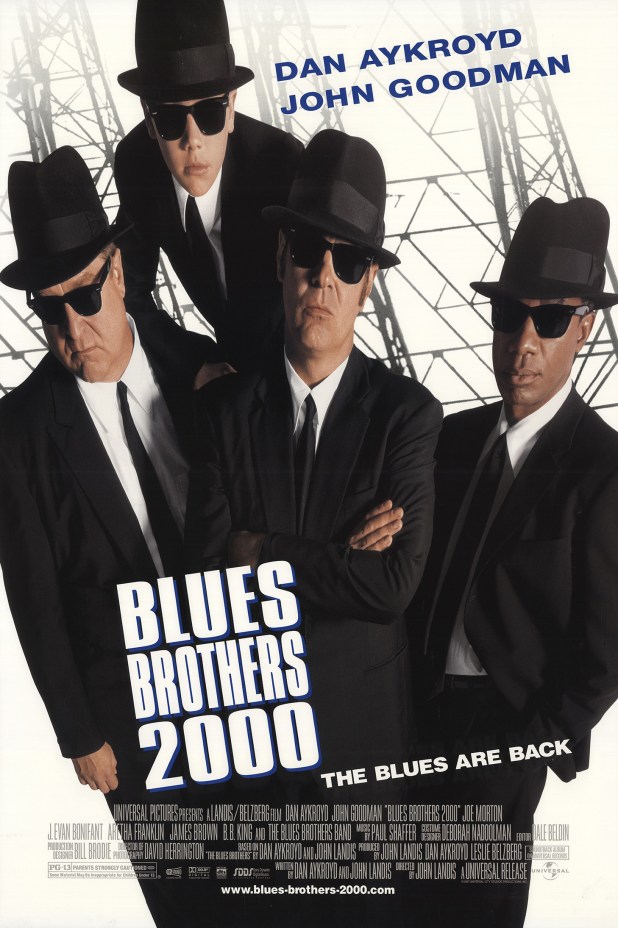
Anyways, Elwood (Aykroyd) is finally let out of jail, 18 years later, only to learn his brother is dead and no one is there to pick him up. He’s finally given a ride by Matara, who works for his old drummer, Willie Hall. This starts the movie’s idea of getting the band back together, as well as Elwood mentoring a kid named Buster (J. Evan Bonifant) at the suggestion of Mother Mary Stigmata. By the end, we have The Blues Brothers Band, which includes Joe Morton as Curtis’ son Commander Cabel Chamberlain,  Steve “The Colonel” Cropper, Donald “Duck” Dunn, Willie “Too Big” Hall, Tom “Bones” Malone, Lou “Blue Lou” Marini, Matt “Guitar” Murphy and Alan “Mr. Fabulous” Rubin in a battle of the bands against Queen Moussette’s (Erykah Badu) The Louisiana Gator Boys, who are Jeff “Skunk” Baxter, Gary U.S. Bonds, Eric Clapton, Clarence Clemons, Jack DeJohnette, Bo Diddley, Jon Faddis, Isaac Hayes, Dr. John, B. B. King, Tommy “Pipes” McDonnell, Charlie Musselwhite, Billy Preston, Lou Rawls, Joshua Redman, Paul Shaffer, Koko Taylor, Travis Tritt, Jimmie Vaughan, Grover Washington Jr., Willie Weeks and Steve Winwood.

So yeah, it’s a 63-car pileup—more than the first movie and everything else—but it also has Blues Traveler in it.

Anyways, director John Landis said to the A.V. Club, “We’d always intended for a sequel with John, but of course when he passed away, it was obvious we weren’t going to do it. But Danny had been performing with John Goodman and Jimmy Belushi and the band, and he said, “You know, this is great, because this music is recognized now—let’s do a movie.” I said, “Great, sure, okay,” and we wrote what I thought was a terrific script. Then Universal Studios eviscerated it. That was a strange experience, because the first thing they said was that it had to be PG, which meant they couldn’t use profanity, which is basically cutting the Blues Brothers’ nuts off. The first movie is an R-rated film, but there’s no nudity or violence in it. It’s just the language. Then they said, “You have to have a child, you have to have…” The bottom line was that the only way that movie was going to get made was to agree with everything they said. You know the difference between a brown-nose and a shithead? Depth perception. That’s the only time I never really fought with the studio, because they didn’t really want to make it. So we did every single thing they said. By the time we’d done that, the script was kind of homogenized and uninteresting. Danny said, “It’s about the music. It’s just about the music, John, so don’t worry about it. We’ll get the best people, and we’ll make a great album, and get these people on film. We have to document these people.” It’s interesting because, as much as I make fun of Danny, three or four of those guys have passed away since we made that movie. People say, “Okay, you’ve got Aretha Franklin, Ray Charles, James Brown, Cab Calloway, and John Lee Hooker in The Blues Brothers—who’s in Blues Brothers 2000?” The answer? Everyone else. The first movie has five musical numbers, and the second movie has 18.”

He also killed Vic Morrow and made Max Landis, so what the fuck does he know?

A few years ago, Jim Belushi told Cinema Blend that Aykroyd — who makes a marijuana blend with him called Blues Brothers — is constantly pitching new sequel ideas: “Actually, you know, he’s always got ideas. I mean, he’s got this whole thing about, you know, ‘I find Jake’s brother in Albania, you know. I found out there was another brother, a Blues Brother. And I go to Albania and I find him and I bring him out. He doesn’t speak English.’ I mean, he’s got all kinds of ideas. The Blues Sisters, he wants to do one with the Blues Brothers but Blues Sisters. You know, he’s a creative son of a gun.”

There was also a Nintendo 64 game made. It didn’t come out until two years after this, and it made $32 million on a $30 million budget.

At least Paul Schaffer, the guy who got the original band together, finally got to play with them.
JUNESPLOITATION: Up the Academy (1980)

June 16: Junesploitation’s topic of the day — as suggested by F This Movie— is ‘80s Comedy!

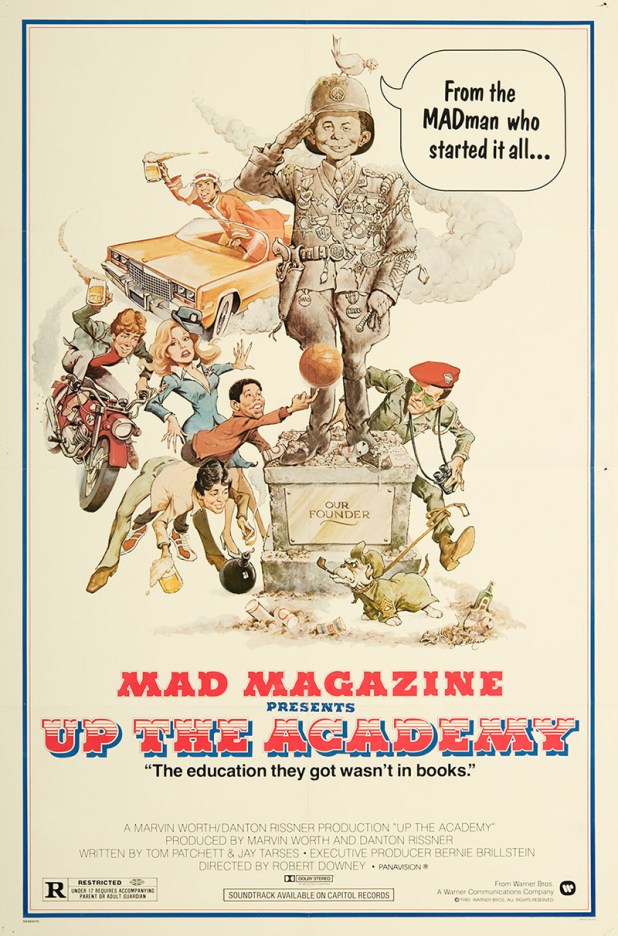
In 1980, 8-year-old Sam was all in on MAD Magazine—every issue. It’s how I saw so many R-rated movies, as I couldn’t go to the theater but could read them as redone by Mort Drucker. Imagine my joy when the Usual Gang of Idiots decided to make a movie, just like those new kids, the National Lampoon.

A note: MAD has the humor of old school Jewish comedy, teaching me words like schmuck while the Lampoon was rich kids who went to an Ivy League school and did drugs. Also: Oversimplification can be funny.

Publisher William Gaines — yes, the same guy who did Tales from the Crypt — told The Comics Journal, “What happened is that we had a contract with Warner Brothers to put out a MAD movie. It’s like four years old now. They came up with a script that we didn’t like, and then they came up with a script using our scriptwriters that they didn’t like, but meanwhile they threw this script onto our desk … Although there were many things in it that I thought were offensive and should be removed, generally, I liked the script. And I thought, “Well, in addition to a MAD movie, there’s nothing wrong with having something like Lampoon did with Animal House.” Animal House was “Lampoon Presents” and really had nothing to do with the magazine; it was just using their name, and it was a good movie, and it was very successful, and it made Lampoon a lot of money. I guess. So we were going to do the same thing. “MAD Magazine Completely Disassociates Itself from Up the Academy“. But that was too long for them; they couldn’t think in that many words. They put the damn thing out without all the deletions they had promised to make, which means they’re liars. I’m talking about one of my sister companies [laughter] … And there we were connected with it, and there wasn’t much we could do about it. I paid Warner Bros. 30 grand to take MAD‘s name off for television. So, for $30,000, we got out of being associated with it on Home Box Office. It won’t say “MAD Magazine Presents,” and Alfred E. Neuman won’t be in it. And it was well worth $30,000.”

It is quite like many other sex comedies that came after the men of Delta House. Chooch (Ralph Macchio) is the youngest son of an organized crime family; El-Hashid “Hash” Amier Jr. (Tommy Citera) is the son of an oil sheik; Eisenhower “Ike” MacArthur (Wendell Brown) is the son of a faith healer who keeps marrying young wives and Hash keeps schtupping them (see, I did learn from MAD!). Oliver Holt (Hutch Parker) has a governor for a father and just wants to sleep with his girlfriend Candy (Stacy Nelkin, who is Ellie Grimbridge, and if you get that, welcome to the site), except his father doesn’t want a teen pregnancy getting in the way of his re-election.

Chooch wants to go straight, so enter new recruit, Rodney Ververgaert (Harry Teinowitz), who likes to make things explode.

They’re all being brutalized by Major Vaughn Liceman (Ron Leibman, the Emmy and Tony-winning actor who asked for his name to be removed from this movie; he was also married to Linda Lavin and Jessica Walter, which is pretty good when you think about it), your typical bad guy in a teen sex comedy.

Candy ends up getting sent to military school as well, so Liceman sets the couple up and takes pictures of them in the act while demanding that he gets to sleep with Candy to protect Oliver’s father’s election. There’s also a snobs vs. slobs soccer game, Tom Poston playing the most stereotypical mincing gay character ever, Antonio “Huggy Bear” Fargas as a coach, and the mind-blowing Barbara Bach, Lady Starke as Bliss, the teacher every boy in school wants.

Also, it’s not good. It’s aggressively bad.

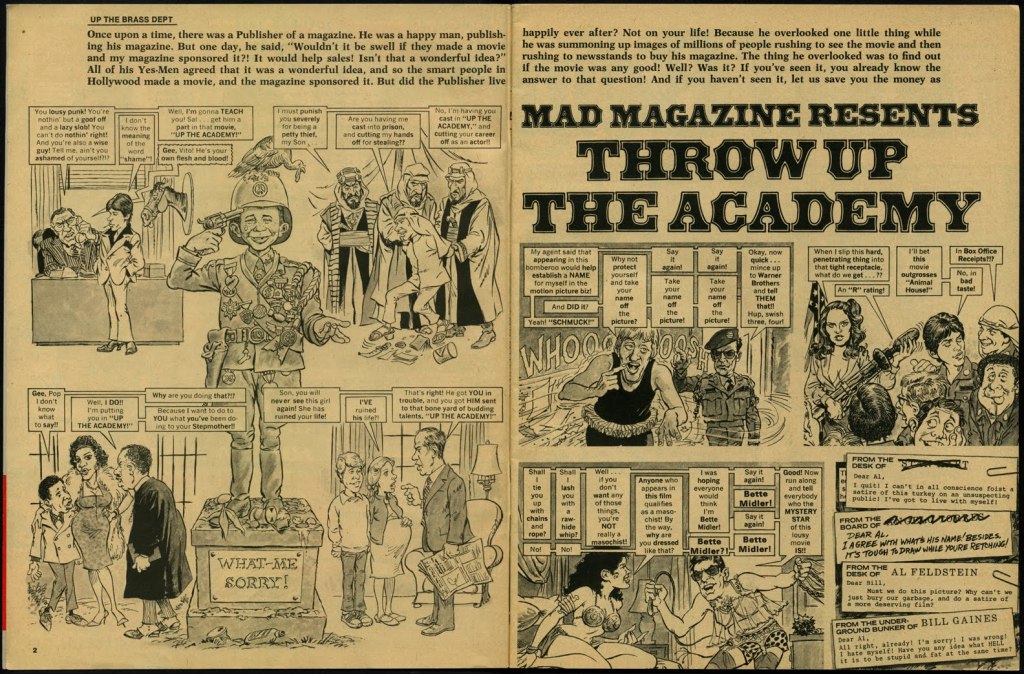
Directed by Robert Downey Sr., who said it was “one of the worst fucking things in history,” and written by Tom Patchett and Jay Tarses, it was so bad that MAD skipped a letters column to present MAD Magazine Resents Throw Up the Academy, which called out Leibman taking his name off the movie, the fact that actors had to have been pubished by being in it and just two pages of the writers, artists and editors being so mad about the movie that they all quit.

Here’s just a sample of this hit piece:

“Once upon a time, there was a Publisher of a magazine. He was a happy man, publishing his magazine. But one day, he said, “Wouldn’t it be swell if they made a movie and my magazine sponsored it?! It would help sales! Isn’t that a wonderful idea?” All of his Yes-Men agreed that it was a wonderful idea, and so the smart people in Hollywood made a movie, and the magazine sponsored it. But did the Publisher live happily ever after? Not on your life! He overlooked one little thing while summoning images of millions of people rushing to see the movie and then rushing to newsstands to buy his magazine. The thing he overlooked was to find out if the movie was any good! Well? Was it? If you’ve seen it, you already know the answer to that question!”

I had never seen a magazine hype something and then apologize. It really was a big deal to my young brain.

It also has a terrifying real-life Alfred E. Newman, designed by Rick Baker. I can only compare this, as the end of the movie, to taking a painful shit and then wiping, only to find blood all over the toilet paper.

Yes, Rev. MacArthur, Ike’s dad, is played by King Coleman, the man who sang “(Do The) Mashed Potatoes.”

At least the soundtrack is good, filled with stuff like The Stooges’ “Gimme Danger” and “Night Theme,” Blondie’s “One Way Or Another” and “X Offender,” The Kinks’ “Yes Sir, No Sir,” Lou Reed’s “Street Hassle,” The Modern Lovers’ “Roadrunner,” David Johansen’s “Girls,” Nick Lowe’s “Heart of the City” and Cheap Trick’s “Surrender.” There’s no reason to have that many great songs in a film this fecund.

You can download this from the Internet Archive.

JUNESPLOITATION: Woman Revenger (1981)

June 15: Junesploitation’s topic of the day — as suggested by F This Movie— is Revenge! 

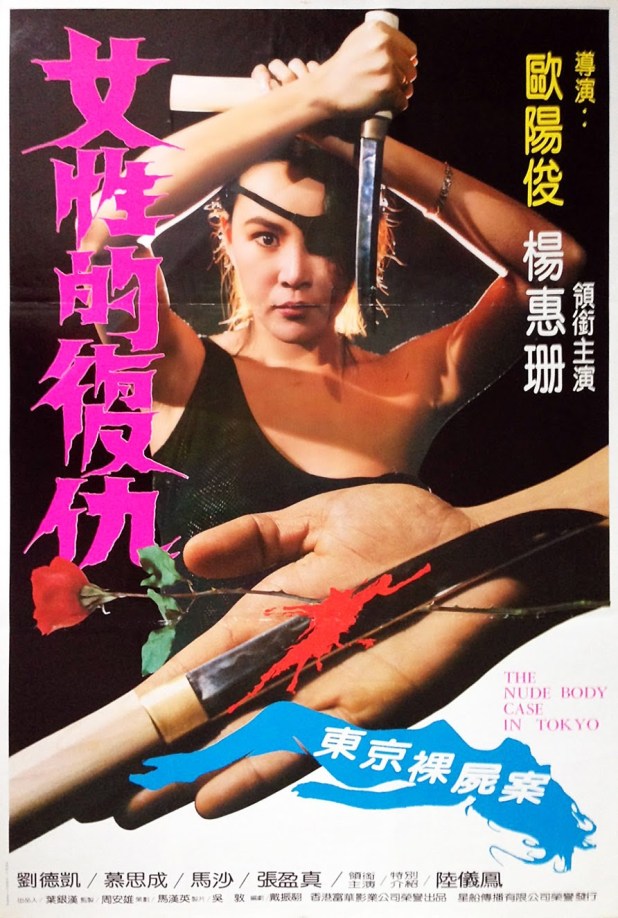
Nu xing de fu chou (New Type Revenge) AKA The Nude Body Case In Tokyo is a 1981 Taiwanese movie directed by Yang-Ming Tsai (Phoenix the RaiderThe Legend of Broken Sword) and written by Chen Kuo Tai and Chen-hsiang Tai. Sure, it’s a revenge-o-matic, but it’s also a Taiwan Black Movie, so called because it takes real life and goes hard in its depiction of a woman done wrong going for blood.

Ling (Elsa Yeung) is a dance instructor who has learned that her best friend Meihua has been killed in Japan. To add more pain, Meihua’s sister Meifeng is tied up in this, forced into prostitution to pay for the cocaine she’s stolen. Ling saves her, at the cost of her eye, making her into the Frigga of this film.

This is also wildly unfocused and padded, which I loved, because it includes Ling going to watch a KISS band play in the park and attend a sumo match. How this advances the plot is unknown, but then this goes for broke by having Yakuza gangsters torture women by crucifying them upside down before covering them with ants. After all this lunacy, Ling gets all of their victims together for the eye for an eye that they need. Literally.

You will believe that sexy gymnasts can obliterate evil men. This is how it should be.

You can download this from the Internet Archive. You can also watch it on the TaiwanPlus site.

JUNESPLOITATION: Treasure: In Search of the Golden Horse (1984)

June 14: Junesploitation’s topic of the day — as suggested by F This Movie— is Free Space!

In August of 1979, Kit Williams published Masquerade, a book that had clues to the location of a jewelled golden hare that Williams had created and hidden somewhere in Britain. He had been challenged by publisher Tom Maschler to create an illustrated book that did something no one else had before. He made sixteen detailed paintings of the story of Jack Hare, who is taking a treasure from the Moon to the Sun. He loses the treasure, and the reader is asked to help him find it.

In a box that said, “I am the keeper of the jewel of Masquerade, which lies waiting safe inside me for you or eternity,” he buried a gold rabbit pendant with celebrity witness Bamber Gascoigne.

He said, “If I was to spend two years on the sixteen paintings for Masquerade I wanted them to mean something. I recalled how, as a child, I had come across “treasure hunts” in which the puzzles were not exciting nor the treasure worth finding. So I decided to make a real treasure, of gold, bury it in the ground and paint real puzzles to lead people to it. The key was to be Catherine of Aragon’s Cross at Ampthill, near Bedford, casting a shadow like the pointer of a sundial.”

Three years later, Williams received a letter containing a sketch with the solution from a man named Ken Thomas, whom the writer soon realized had made a lucky guess. After he was given the prize, physics teachers Mike Barker and John Rousseau wrote in with their answer, but had not found the prize. That’s because the rabbit’s box went unnoticed in the dirt they dug up; Thomas saw it and lucked into winning. According to Wikipedia, “It was later found that Thompson had not solved the puzzle and had guessed the hare’s location using insider knowledge obtained from a former acquaintance of Williams.”

Ken Thomas was really Dugald Thompson, and his business partner, John Guard, was the boyfriend of Veronica Robertson, who had previously been Williams’s girlfriend. Guard allegedly convinced Robertson to help him win the contest because he wanted the money donated to animal rights causes.

William wrote a sequel, The Bee on the Comb, and a video game, Hareraiser, with a jewel as a prize that was never found. Other books like this — this was a big success — included The Piper of Dreams, The Secret, The Golden Key, The Key to the KingdomOn the Trail of the Golden OwlThe Merlin Mystery, Forest Fenn’s The Thrill of the Chase: A Memoir and the movie/book we are talking about today, Treasure: In Search of the Golden Horse.

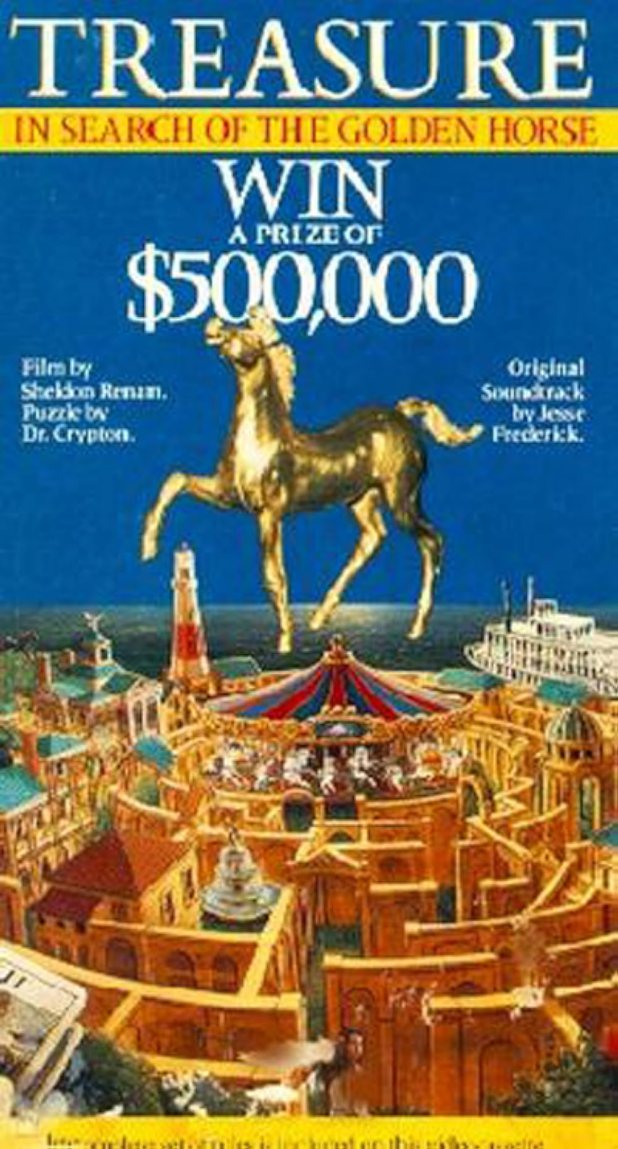
Published by Intravision, there was a movie directed by the man who came up with the idea, Sheldon Renan, and a book illustrated by Jean-Francois Podevin and published by Warner Books. A gold horse was the prize in this contest designed by Paul “Dr. Crypton” Hoffman, who was the president and editor-in-chief of Discovery magazine, president and publisher of Encyclopedia Britannica and the man who made the treasure map for Romancing the Stone.

Renan wrote the first book about underground movies, An Introduction to the American Underground Film and “The Blue Mouse and The Movie Experience,” an influential Film Comment article about how the Blue Mouse Theater in Portland went from Hollywood movies to grindhouse films. Wildly, he also directed The Killing of America, wrote Lambada and has been a speechwriter for every CEO of Xerox since 1990.

While IMDB says that cinematographer Hilyard John Brown (also a cameraman on This Is Spinal Tap and Solomon King) came up with the idea of a film with treasure — but “opted out of working on the film because director Sheldon Renan wanted a lot of helicopter shooting, and Brown had had too many close calls in helicopters” — every other article I have found says that this was Renan’s project.

You know who did shoot this? Hanania Baer, who was also the cinematographer for American NinjaMasters of the UniverseErnest Scared StupidNight PatrolBreakin’ 2Ninja 3UFOs Are Real and so many more, and Dennis Matsuda, a cameraman on HotlinePoltergeistRaising Arizona and Stand By Your Man.

The movie is about a girl (Dory Dean) trying to find her father and her lost horse, Treasure (Galahas). She’s helped by Mr. Maps (Elisha Cook Jr., Mr. Nicklas in Rosemary’s Baby), a blacksmith (John Melanson, who was an actual blacksmith and is also the Man with the Black Gloves), a sushi chef (Yasumasa Adachi), Mr. Night Music (Herman Sherman), Dream Dancers and the Ghost Party, all narrated by Richard Lynch. Yes, Richard Lynch, who says things like “The city. It was no place to find a horse. Not her horse. She knew that roads that started in the city led in all directions. How could she leave the city and find the right direction?”

This came out during the early console video game era, and there was also going to be a Colecovision game. A silver horse was buried and is still there, as the puzzle to find it never got made.

My dad was obsessed with this book, staring at it in B. Dalton and wondering how to solve it. We couldn’t afford it, so he would sit on the floor and draw sketches of it. No one won, and the prize money was given to Big Brothers and Big Sisters. Seven months after the contest was over, Nick Boone and Anthony Castaneda discovered where the horse was with the Captain Nemo solution.

You can watch this on YouTube.

JUNESPLOITATION: Rose Blood: A Friday the 13th Fan Film (2021)

June 13: Junesploitation’s topic of the day — as suggested by F This Movie— is Friday the 13th! 

We’re decades away from the last official Friday the 13th movie, and we’ll see numerous Michael Myers reimaginings before we ever get back to Crystal Lake. Thank all the fan movies that are working to fill this space, especially good ones like this.

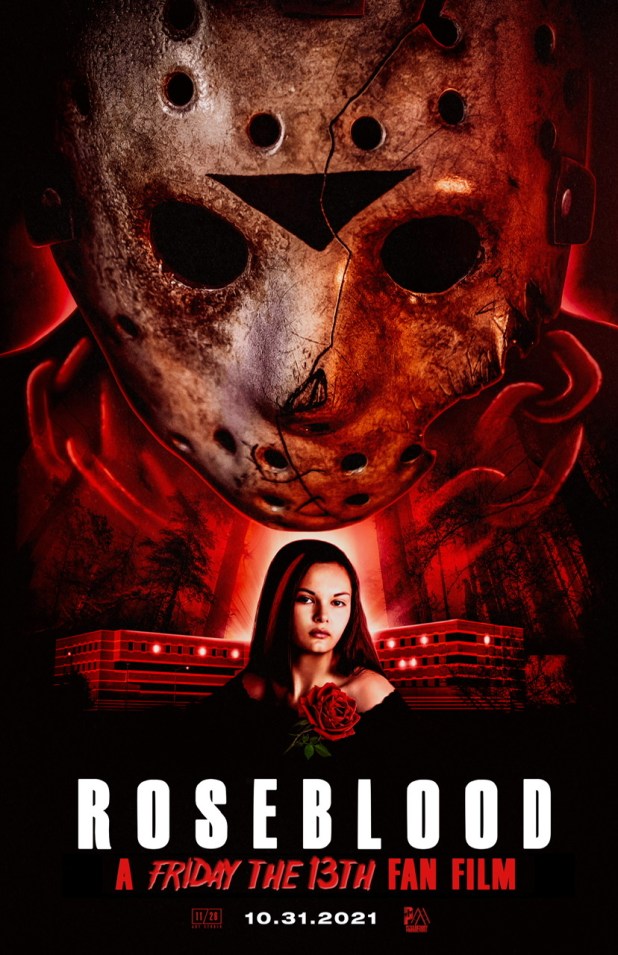
Until Horror Inc. and Victor Miller settle the lawsuit—or whatever has kept Jason dead for 16 years—we can thank director and writer Peter Anthony for this movie.

A direct sequel to Friday the 13th Part VII: The New Blood, this finds Tina Shepherd (Lar Park-Lincoln, reprising the role, at some points in the story; Jessica Hottman is the younger version) kept as a prisoner in the Crystal Lake Research Facility, being studied by General Brackbower (Anthony) and his team of scientists, which includes The Duke (Jequient Broaden), who is obviously Creighton Duke. There’s also a team of mercenaries — FAAST (Forward Assault Anomaly Strike Team) — on hand to guard new prisoner Rose (Sanae Loutsis), who is even more powerful than Tina.

The goal of the military is to use Rose’s power to bring back Jason Voorhees and make him a soldier for the U.S. Army. That takes the first hour of the movie, so if you’re not patient, you may dislike this. If you’re a fan of the series, you’ll love it, as it’s filled with moments from 7, 8, 9 and Jason X.

At the close, there’s a fan service moment that you’re either going to love or hate. I loved the whatever can happen will happen notion of all this, as well as the inventive kills that transform the movie from psychic girl movie back to a Jason movie. It’s well done, and this was worlds better than I had ever imagined it could be. It doesn’t look like a fan film. Instead, it looks better than most microbudget horror movies that I watch.

You can watch this on YouTube. You can also buy it here.

JUNESPLOITATION: Battle Royale High School (1987)

June 12: Junesploitation’s topic of the day — as suggested by F This Movie— is Cartoons!

Back in the pre-Internet days of buying fifth-generation VHS dubs at conventions, Battle Royale High School was one of the first anime I owned. There were no subs or dubs—just demons and karate while wearing a Tiger Mask.

Based on the Shin’ichi Kuruma manga Majinden (Legend of the Demons), this starts with high school asskicker Riki Hyōdo, who loves to fight. He’s also the chosen body for Lord Byōdo, demon king of the Dark Realm, who comes to Earth to challenge him. There’s also Space-Time Continuum Inspector Zankan, a robotic man who has come to protect reality from the demon, and Toshimitsu Yūki, a student who knows how to fight these dark creatures.

They all face Fairy Master Kain, who has started to take over the bodies of students and attack others, like Megumi Koyama, who is in love with Riki.

As you can imagine, a 50-minute adaptation of a long-running manga leaves a ton out. Director and writer Ichirô Itano worked on tons of famous anime, including Fist of the North Star, Violence Jack, Tekkaman BladeGantz and started as an in-between artist on stuff like Galaxy Express 999 and Farewell to Space Battleship Yamato: Warriors of Love before graduating to being an animator on Mobile Suit Gundam. Today, he designs kaiju for anime like SSSS.Dynazenon and SSSS.Gridman.

This is the kind of movie that has a woman explode all over the hero, then he rebuilds her from a gore-filled mess and says, “Nice tits.” You can only guess how much 15-year-old me loved this.

You can watch this on YouTube.

WEIRD WEDNESDAY: The Bird with the Crystal Plumage (1970)

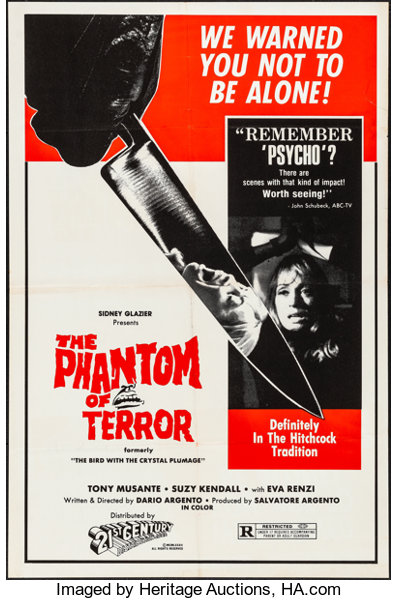
Aside from Mario Bava’s influential films, such as Blood and Black LaceThe Girl Who Knew Too Much, no other movie has left as indelible a mark on the Giallo genre as Dario Argento’s 1970 directorial debut. Before this, Argento was a journalist who contributed to the screenplay of Sergio Leone’s Once Upon a Time in the West.

The title of the film, The Bird with the Crystal Plumage, is a metaphor for the protagonist’s predicament. Just as the bird is trapped by the beauty of the crystal plumage, Sam is trapped by the beauty of the art gallery and the mystery it holds. This metaphorical title sets the tone for the film and its exploration of the relationship between art and violence. In the film, Sam Dalmas (played by Tony Musante) is an American writer struggling with writer’s block. He travels to Rome for a change of scenery, accompanied by his British model girlfriend, played by Suzy Kendall. Just as he decides to return home, he witnesses a black-gloved man attacking a woman inside an art gallery. Desperate to save her, he finds himself helpless, trapped between two mechanical doors as the woman silently pleads for help.

The woman, Monica Ranier, is the gallery owner’s wife. Although she survives the attack, the police suspect Sam may be involved in the crime and confiscate his passport to prevent him from leaving the country. Unbeknownst to them, a serial killer has been targeting young women for weeks, and Sam is the only witness. Haunted by the attack, Sam’s memory is unreliable, leaving him without a crucial clue that could solve the case, adding a layer of suspense to the narrative.

This film introduces several tropes that would become hallmarks of the genre: the foreign stranger turned detective, the gaps in memory, and the black-clad killer—elements that later Giallo films would pay homage to. These elements, along with Argento’s unique visual style and use of suspense, would go on to influence a generation of filmmakers and shape the Giallo genre as we know it today.

Another recurring theme in Argento’s work appears for the first time here: the notion that art can incite violence. In this instance, a painting depicting a raincoat-clad man murdering a woman plays a significant role.

As the story unfolds, Sam receives menacing phone calls from the killer, and the masked assailant attacks Julia. The police manage to isolate a sound in the background of the killer’s conversations—the call of a rare Siberian bird. This bird, a Grey Crowned Crane, plays a significant role in the film’s narrative, serving as a clue that brings the police closer to unraveling the mystery. The film’s use of this rare bird as a plot device is a testament to Argento’s skill as a storyteller and his ability to create tension and suspense.

Alberto, Monica’s husband and the owner of the art gallery, ultimately attempts to kill her, revealing that he orchestrated the attacks. However, in true giallo fashion, mistaken identity is a crucial plot twist. Even though this film was made nearly fifty years ago, I won’t spoil the reveal of the real killer.

I recall my parents seeing this movie before I was born and disliking it so much that they would mention “that weird movie with the bird that makes the noises” whenever they encountered a confusing film. Ironically, I grew to love Argento’s work. My fascination with Giallo and difficult-to-understand films is a form of rebellion against their opinions.

This film, an uncredited adaptation of Fredric Brown’s novel *The Screaming Mimi*, was initially considered a career misstep by actress Eva Renzi. The film’s producer even wanted to replace Argento as director. However, when Argento’s father, Salvatore, spoke with the producer, he noticed that the executive’s secretary appeared shaken. When he asked her what was wrong, she revealed she was still terrified from watching the film. Salvatore convinced her to explain her fear to her boss, ultimately leading to Argento staying as director.

The outcome of this struggle? It is a film that played in one theater in Milan for three and a half years, leading to countless imitators—and inspired many elements in films featuring lizards, spiders, flies, ducklings, butterflies, and more—for decades to come. Argento would later continue his so-called Animal Trilogy with The Cat O’Nine Tails and Four Flies on Grey Velvet, then Deep Red before moving into more supernatural films like Suspiria and Inferno.