APRIL MOVIE THON 3: The Giant of Marathon (1959)

April 25: Bava Forever: Bava died on this day 44 years ago. Let’s watch his movies.

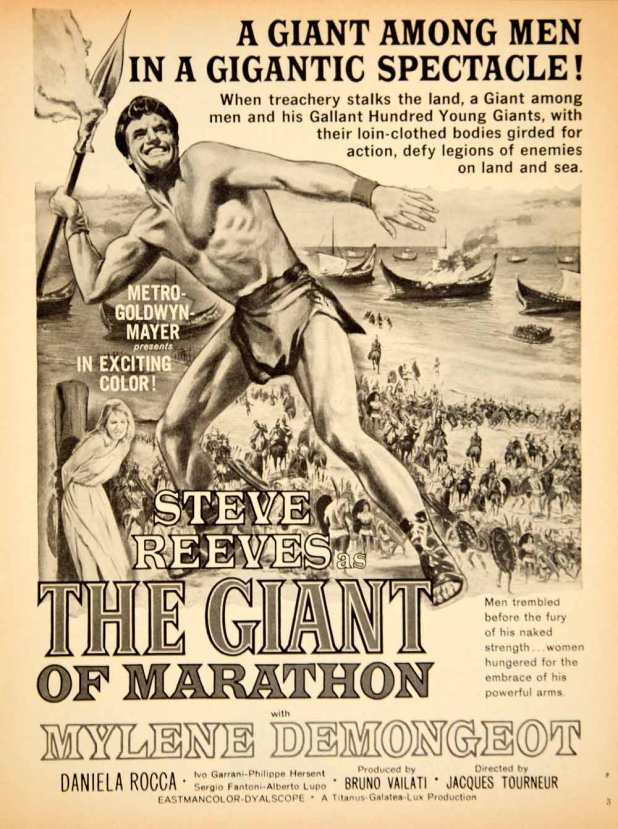
How amazing that this is a movie co-directed by two masters of moody horror — Jacques Tourneur (Night of the DemonCat People, The Leopard Man) and Mario Bava.

A co-production between Italy’s Titanus and Galatea Film and France’s Lux Compagnie Cinematographique de France and Societe Cinematographique Lyre, this is the story of Persian armies attacking Greece, which is defended by Olympic hero and commander of the Sacred Guard Phillippides (Steve Reeves).

To keep Phillippides from his duty, a conspiracy tires to marry him off to Charis (Daniela Roca, Caltiki – The Immortal Monster) but he is already in love with Andromeda (Mylène Demongeot).

After all this drama, Darius (Daniele Vargas, Eyeball) the kind of the Persians is marching his gigantic army on Greece, which can only be saved if our hero can talk the Spartans into helping him.

A few days before this movie was due to play theaters, major scenes had to be reshot when the editor discovered that several extras were smoking cigarettes on camera. Bruno Vailati also directed some scenes. He’s listed as the AD, but some claim that Tourneur left most of the directing to his assistant.

As a reward for Bava saving them the embarrassment of this movie having modern technology appear in it, he was rewarded with the chance to make his own project and direct it, which was Black Sunday.

There’s some great underwater camerawork in this and Bava elevates it beyond simple sword and sandal moviemaking, the same that he would later do on Hercules In the Haunted World.

Of course, I’ve seen too many movies, so I’ve reviewed it twice.

You can watch this on YouTube.

APRIL MOVIE THON 3: Return to Oz (1985)

April 24: Think of the Children — Pick a movie that was controversial for how potentially damaging that it would be to the children who are our future.

In 1954, Walt Disney Productions bought the film rights to thirteen of L. Frank Baum’s Oz books — all of the remaining books other than The Wizard of Oz — for their TV series DisneylandThe Rainbow Road to Oz was planned and it would have featured many of the Mouseketeers, including Darlene Gillespie as Dorothy Gale, Annette Funicello as Princess Ozma, Bobby Burgess as the Scarecrow, Jimmie Dodd as the Cowardly Lion, Doreen Tracey as the Patchwork Girl, Tommy Kirk as the son of the Wicked Witch of the West and Kevin Corcoran.

The songs “Patches,””The Oz-Kan Hop” and “The Rainbow Road to Oz” were previewed on September 11, 1957 on the Disneyland show’s fourth anniversary. A few months later, the project was cancelled, either because Walt Disney was unhappy with it, the actors couldn’t carry a real movie or the budget had grown too large. The rest of the songs would finally be part of the 1969 Disneyland Records album The Cowardly Lion of Oz.

Roger Ebert called William Murch “the most respected film editor and sound designer in the modern cinema.” After working on the sound of movies such as THX-1138The Godfather and American Graffiti, he edited The Conversation and Apocalypse Now (he also won an Oscar for the sound mix) before suggesting that Disney make their Oz movie in 1980. As they were about to lose the rights, Disney took him up on his offer and selected him to direct and write along with Gill Dennis.

It would be the only movie Murch ever directed (he did do one episode of Star Wars: The Clone Wars, “The General”) as he would go back to editing, working on The Unbearable Lightness of Being and the restoration of Touch of Evil. He also won Oscars for sound and editing for The English Patient and editing for JuliaCold MountainThe Godfather Part III and Ghost.

Murch based this movie on the second and third Oz books, The Marvelous Land of Oz and Ozma of Oz, along with elements of the book and stage play of  Tik-Tok of Oz. He also used parts of the book Wisconsin Death Trip — yes, this gets that dark — and went as far away from the original movie as he could. The main goal was to be more faithful to the books than the 1939 movie which is why this is a cult film and not a success.

It was not an easy film to make.

Filming was to be shot 75% on location but a switch in Disney leadership led to the budget — which had already gone from $20 to $28 million — pushed the movie to Elstree Studios and the Salisbury Plain, where temperatures were so cold that lead actress Fairuza Balk would cry from the cold but never complain.

At some point, original cameraman Freddie Francis quit, frustrated by working with Murch.

A few weeks later, Disney was unhappy with the footage they had seen and fired Murch, who said that he felt “…what the soul feels after it’s left the body after a car accident — pain but tremendous relief.”

Then his friends Steven Spielberg, George Lucas and Francis Ford Coppola spoke up for him and informed Disney that they wouldn’t be all that friendly with the studio if Murch couldn’t finish his movie. Lucas also promised that he would replace Murch if the director had any problems.

Dorothy Gale (Balk was picked from thousands of actresses and said even getting to audition for the movie was a huge deal) has been taken to a sanitarium by  Aunt Em (Piper Laurie, yes, Carrie‘s mother was Auntie Em) and Uncle Henry (Matt Clark) because she won’t stop talking about Oz. If you had been to Oz and it was in color and you lived in black and white and had friends like a talking lion and fought winged monkeys, would you ever stop? But to stop her from her delusions — or reality, as it were — Dr. Worley (Nicol Williamson, Merlin from Excalibur) and Nurse Wilson (Jean Marsh, the co-creator of Upstairs, Downstairs) plan on sending Dorothy to electroshock therapy.

This movie already upset me as Toto runs out to join Dorothy as she’s taken away and she silently mouths the words “Go home. Please go home.” He howls in abject sadness.

Lightning takes out the power and a young girl helps Dorothy escape down a river, where Dorothy floats away on a chicken coop. She wakes up in Oz with a chicken named Billina (Mak Wilson, voiced by Denise Bryer) who can talk. They learn that the Yellow Brick Road has been destroyed and all her friends the Tin Man (Deep Roy!), the Cowardly Lion (Johann Kraus from Hellboy II: The Golden Army) have been transformed into stone. She’s attacked by The Wheelers, but saved by Tik-Tok (played by Michael Sundin and Tim Rose — who was Howard the Duck and Admiral Ackbar — as well as being voiced by Sean Barrett, whose voice is also in Labyrinth and The Dark Crystal) — a mechanical man — who told her that the King of Oz, the Scarecrow, had told him to wait for her.

They go to Princess Mombi (also Marsh), who collects peoples’ heads. They barely escape and discover that the Nome King (also Williamson) has taken the Scarecrow (Justin Case). As they ran through the Deadly Desert, they meet a new friend in Jack Pumpkinhead (played by Stewart Harvey-Wilson, voiced by Brian Henson) and the Gump (played by Stephen Norrington — the directed of Death MachineBlade and The League of Extraordinary Gentlemen — and voiced by Lyle Conway, who designed the Blob effects in The Blob), whose head is used to fly them to the mountain of the Nome King, where the big bad transforms everyone but Dorothy into ornaments. She saves everyone by guessing that they are all the green ornaments, then gets her ruby slippers back — MGM owned the rights to those and they aren’t in the original story, but Disney wanted them and paid huge for it — and wishes everyone back to Oz.

Everyone from Oz wants Dorothy to rule their world, but she wants to go home. She meets the rightful ruler, Princess Ozma (Emma Ridley), who was the girl who helped her to escape. As she goes back to Oz, Auntie Em tells her that the mental ward burned down and only Worley died while his nurse was jailed for their horrible operations on young women. When she gets to her room, she can see Ozma and Billina in her mirror.

Harlan Ellison said, ““It ain’t Judy Garland. It ain’t hip-hop. But it’s in the tradition of the original Oz books.”

Neil Gaiman, years before he wrote Sandman, reviewed the movie for Imagine magazine and said that it was “Terrifying and visionary, funny and exciting, Return to Oz is one of the very best fantasy films I’ve ever seen.”

Other critics — and audiences — were not as kind. It’s a movie that none were prepared for, thinking it would have the same wonder as the movie they had seen on TV so many times without knowing the original stories.

The film wasn’t a financial success. But it was nominated for a Best Visual Effects Academy Award but lost to Cocoon. The nomination was given to Claymation master Will Vinton, Ian Wingrove, Zoran Perisic and Michael Lloyd.

As for those books, they were created by L. Frank Baum and illustrator W. W. Denslow. Two years after The Wonderful Wizard of Oz was published, a stage play — The Wizard of Oz: Fred R. Hamlin’s Musical Extravaganza — was a big success. Baum wanted to make another play and wrote the book The Marvelous Land of Oz and a stage adaption, The Woggle-Bug. Actors David C. Montgomery and Fred Stone, who played the Tin Man and Scarecrow, had become big stars and didn’t want to appear in a new play while still in the original. They were not in the second play and critics thought that the author was ripping himself off. The play flopped before it even got to Broadway.

Baum and Denslow tried a new story with Dot and Tot of Merryland, which was not popular and caused the break-up of their partnership. Baum would work with John R. Neill after but never liked his artwork and was angry when the artist  published The Oz Toy Book: Cut-outs for the Kiddies without asking.

Throughout his career, Baum would try to write new books — such as The Life and Adventures of Santa Claus, which was made into a special by Rankin-Bass and Queen Zixi of Ix, which was made as a movie by the Oz Film Manufacturing Company — fail and say that children demanded new Oz books. He also claimed that he had discovered an island in California where he was going to live and have a theme park, but after The Woggle-Bug was a bomb, he never spoke of it again.

Baum loved theater for his entire life and often threw money into it, losing big time. One of biggest failures would be The Fairylogue and Radio-Plays, a combination film, slideshow, live play and spoken word travelogue of Oz by Baum. He lost so much money that he had to sell the royalties to many of his books to the M.A. Donahue Company, who in turn published cheap copies and took out ads saying that their books were better than his new ones. He declared bankruptcy but before that, he gave his wife most of property to his wife Maud, which saved much of their money.

He even started a film company, the aforementioned The Oz Film Manufacturing Company. They made four shorts — A Box of BanditsThe Country Circus, The Magic Bon Bons and In Dreamy Jungleland — and released four films, The Patchwork Girl of Oz, The Magic Cloak of Oz and His Majesty, the Scarecrow of Oz. and The Last Egyptian. One film was announced, The Gray Nun of Belgium, and may have never been released.

The Patchwork Girl of Oz was a major failure as well. It poisoned the box office for any Oz films to follow and even caused The Oz Film Manufacturing Company to change its name to Dramatic Feature Films. One of the few good things is that it was where producer/director Hal Roach and comedian Harold Lloyd met, starting a team that would work together for many years.

It took until 1925 before anyone would try to make another Oz movie. Larry Semon directed, wrote, produced and starred as a farmhand and the Scarecrow in The Wizard of Oz. That movie is so different from the book that the Tin Man betrays Dorothy. It also starred Dorothy Dwan, Semon’s fiancee, as Dorothy, making it a vanity project. Sadly, it failed as well. Chadwick Pictures, who produced the movie, went bankrupt and its released handled by Monogram after. As for Semon, he never recovered and died three years later. Variety said of his take on The Wizard of Oz, “This screen disaster caused Mr. Semon no end of worry and repeated efforts to recoup only added to his discomfiture. Last March he filed a voluntary petition in bankruptcy, listing debts at nearly $500,000. Ceaseless worry undermined his health making him an easy victim of pneumonia.”

$500,000 in 1928 is $91 million today.

It’s crazy because we always think that The Wizard of Oz is such a major success, but the truth is that even the 1939 movie was a box office bomb. It earned $2,048,000 in the U.S. and $969,000 worldwide, which ended up losing MGM$1,145,000. It wasn’t a financial success until it was re-released in 1949.

The Wiz also lost $10 million nearly forty years later.

I tell you about all this failure to say that everyone who calls Return to Oz a bomb and a failure has to realize that it shares that legacy with nearly every other Oz movie. It was brave enough to be different and unexpected and therefore, paid the price of years of being a punchline.

I’d never watched it until now as a result and was so surprised by how much I loved it.

In 2013, Disney tried again and the Sam Raimi-directed Oz the Great and Powerful ended up being a success.

I’ll get around to watching that some day.

APRIL MOVIE THON 3: 2012 (2009)

April 22: Earth Day Ends Here — Instead of celebrating a holiday created by a murderer, share an end of the world disaster movie with us. But seriously, treat the planet right!

Director and writer Roland Emmerich said, “I always wanted to do a biblical flood movie, but I never felt I had the hook. I first read about the Earth’s crust displacement theory in Graham Hancock’s Fingerprints of the Gods.”

In that book, Hancock states that a civilization near Antarctica left “fingerprints” in Ancient Egypt and other civilizations, such as the Olmec,s Aztecs and Mayans. Hancock believed that in 10,450 BC, a major pole shift took place that brought Antarctica closer to the South Pole, causing global destruction and sinking Atlantis. This is based on the Charles Hapgood’s theory of Earth Crustal Displacement, which has no geological experts supporting it, as the model that they follow is plate tectonics. There’s also a strange — well, isn’t there always — strange racist bent, as there is no way — according to the author — that “jungle-dwelling Indians” could not possibly come up with a sophisticated calendar and it had to be an master white race who taught them.

That same book also inspired Emerich’s 10,000 B.C.

This starts in 2009, as geologist Adrian Helmsley (Chiwetel Ejiofor) and astrophysicist Satnam Tsurutani (Jimi Mistry) determine that a new type of neutrino from a solar flare is heating the Earth’s core. Adrian alerts White House Chief of Staff Carl Anheuser (Oliver Platt) and President Thomas Wilson (Danny Glover), who start a plan to save humanity without warning them and causing a panic.

By the next year, forty-six nations are building nine arks in the highest point of the world, in the Himalayas, to be able to survive a new flood. Any major artifacts are stored in secure locations while the people in the mountains start to work on the arks, like Tenzin (Chin Han), the brother of Buddhist monk Nima (Osric Chau). The money comes from rich people, like Yuri Karpov (Zlatko Burić), a rich Russian who plans on saving his girlfriend Tamara Jikan (Beatrice Rosen) and his twin sons Alec and Oleg (Alexandre Haussmann and Philippe Haussmann).

Former science fiction writer Jackson Curtis (Jon Cusack) works for Yuri as his chauffeur.  The call to board the arks comes in, just as Jackson returns from a vacation with his kids Noah and Lilly (Liam James and Morgan Lily), getting them back to his ex-wife Kate (Amanda Peet) and her new husband, Gordon (Tom McCarthy). Having met conspiracy radio talk show host Charlie Frost (Woody Harrelson) on the vacation — as well as Adrian, who has read his book — Jackson starts to believe that the Earth is doomed, a fact that is told to him by the Russian twins.

Jackson gets to his family with no time to spare as all of California falls to an earthquake as he races to the airport and Gordon gets the plane off the ground as the runway cracks and falls. Trying to get Charlie to find out where the arks are, he decides to stay and watch Yellowstone’s supervolcano, which kills him.

Nearly all of the rest of the world has died other than Carl, Adrian, First Daughter Laura (Thadiwe Newton), the Russians and Jackson and family, who all make it to the Himalayans and only Yuri and his boys have tickets, stranding Tamara, who is taken in by Jackson and family, who meet Nima, and all of their families try to break into one of the arks.

Nearly everyone after everyone died dies — I have a major problem with Tamara dying as she’s treated as an afterthought throughout the whole movie and her sacrifice is treated as nothing, with no one sad — and Jackson and his ex-wife reconcile and Adrian and Laura get together as the arks make it safely away from the flood.

There’s an alternate ending where Adrian’s father Harry (Blu Mankuma) and his jazz singer partner Tony Delgado (George Segal) survive. It’s pretty much a return to 70s disaster movies and I like that.

How it was marketed was controversial. There was a website for the Institute for Human Continuity, along with Jackson’s  book Farewell Atlantis and radio broadcasts from Charlie Frost, as well as his site This Is the End. Visitors could also register to get a ticket on the arks. NASA’s David Morrison was upset by this, as he got a thousand or more letters from worried people thinking the site was real. He said, “I’ve even had cases of teenagers writing to me saying they are contemplating suicide because they don’t want to see the world end. I think when you lie on the internet and scare children to make a buck, that is ethically wrong.”

It also had a new commercial placement that had never been done before. Called a roadblock campaign, it showed the thrilling two-minute escape from the earthquake scene — it’s the best part of the movie — on 450 American commercial television networks, local English-language and Spanish-language stations and 89 cable outlets at some point between 10:50 and 11:00 P.M. 90% of all households watching ad-supported TV — 110 million viewers — saw the commercial.

The whole idea of 2012 being the end of the world is supposed to have come from the Mayan calendar. But nope. They found a series of astronomical alignments that would happen in 2012, which only happened every 640,000 years, as the sun would line up with the center of the Milky Way on the day it would be lowest on the horizon. Versions of this alignment happen every December, to be honest. And while the Mayan Calendar ended in 2012, they didn’t see it as the end of the world.

Emmerich claimed, “I said to myself that I’ll do one more disaster movie, but it has to end all disaster movies. So I packed everything in.” Then he made Independence Day: Resurgence and Moonfall.

APRIL MOVIE THON 3: The Kiss (1988)

April 21: Fashion Day — A movie all about fashion that you will critique.

Pen Densham had a cool path to directing. He left school at fifteen to be a photographer and shoot The Rolling Stones, then moved from England to Canada to direct commercials and documentaries with Marshall McLuhan. He then formed found Insight Productions with John Watson and earned 70 international award for their movies, including two Oscar nominations. One of the movies they made, If Wishes Were Horses, was called “The best film of any length shown on Canadian TV.”

It brought him to the attention of Norman Jewison who got him to Hollywood. He and Watson started  Trilogy Entertainment Group, serving as creative consultants on movies like Footloose and Rocky II before becoming big successes with Robin Hood: Prince of Thieves. They also produced the new versions of The Outer Limits and The Twilight Zone, as well as Poltergeist: The Legacy in the 1990s and 2000s.

He also directed two movies, The Zoo Gang and what we’re here to talk about today, The Kiss.

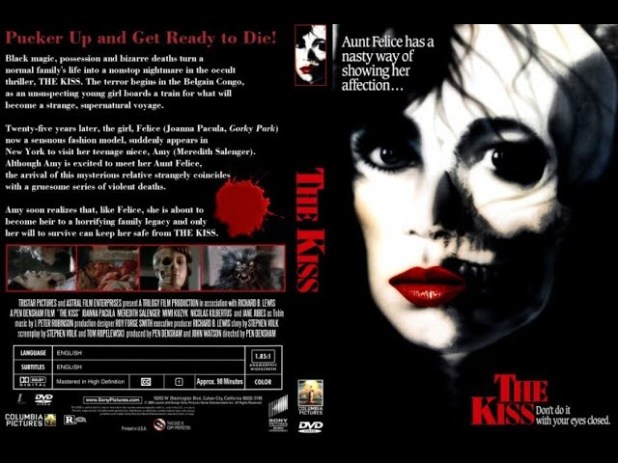
Felice Dunbar (former model Joanna Pacula) and her sister Hillary (Pamela Collyer) are totally living the start of The Parent Trap. Felice is to live with her aunt (Céline Lomez) and Hillary with her father. As they take a train away from the Belgian Congo, her aunt — wearing a serpent medallion — attacks the young girl. The lights go out as she kisses her, blood coming from her mouth, and when they come back on, the aunt is a lifeless deformed body and the little girl is alone but has the talisman.

Years later, Hillary lives in America with her husband Jack (Nicholas Kilbertus) and her daughter Amy (Meredith Salenger). Her sister calls her in the hopes of meeting her family, but she refuses. She goes to a gun shop and while looking in the window, a car smashes her into the store, killing her.

Five months later, Felice — who works as a model — shows up in town and moves in. Next door neighbor Brenda Carson (Mimi Kuzyk) reacts to her as if she is a cat and becoming allergic. Amy hates her aunt immediately and after making fun of her with her friend Heather (Sabrina Boudot), her BFF is almost murdered when her necklace gets stuck in an escalator. This is absolutely my childhood trauma, so I’m glad I didn’t see this until now.

Felice starts making moves on her sister’s widower, while Amy confides to her boyfriend Terry O’Connell (Shawn Levy, who directed the Night at the Museum movies) about finding her friend’s bloody sunglasses inside her aunt’s room, as well as a serpent talisman. Terry follows her aunt to a hotel room where he watches her in the midst of a ritual. She transforms into a cat and nearly kills him. He barely gets away, only to be run over and his death made to look like a suicide. Amy then tells a priest who remembers Hillary telling him about her sister and how evil she was. He tries to run when she shows up and spontaneously combusts. How many powers does this werecat have? And how wild it is that when they do a DNA test on her, it shows that she is already dead?

Felice reveals that she must continue living — inside the blood — of Amy, trying to transform her into what she is. It takes Brenda the neighbor, Amy and her father — as well as garden shears, a propane tank and a swimming pool — to stop her.

This was written by Stephen Volk, who also was the writer of GothicThe Guardian— that makes sense — and Ghostwatch.

You can watch this on YouTube.

APRIL MOVIE THON 3: Wetlands (2013)

April 20: So Dark, So Funny — A dark comedy.

18-year-old Helen (Carla Juri) wants her parents to get back together, has a different idea of hygiene than most girls (she loves all the fluids and smells of her body, even mucus, menstrual blood and earwax) and pushes the boundaries of what most of her friends want sexually, such as going to a brothel (to be fair, her friend Corinna (Marlen Kruse) has a boyfriend that asks her to, well, give him a Cleveland Steamer).

As she shaves herself too quickly, she’s cut and has to go to the hospital where she falls in love with a nurse, Robin (Christoph Letkowski) who is quite shy and has never gotten over having his heart broken by another nurse that he works with.

Directed by David Wnendt, who co-wrote the screenplay with Claus Falkenberg, based on the book by Charlotte Roche, this has a heroine who dreams of the childhood that she once lived yet every memory is horrible, such as her jumping into her mother’s arms and her mother moving and telling her not to trust anyone, as well as a father who has no interest in anyone.

Obviously that’s why she began sleeping with as many people as possible at the age of fifteen — no judgement — and is looking for a world to be part of. That said, to get there, you have to get past a heroine who spends the beginning credit scene playing with her hemorrhoids and then tasting her finger. And despite all that, you start to feel for her, even if she only seemingly cares about herself and hope that she can get past the life that her parents and their selfishness has doomed her to walk.

You can watch this on Tubi.

APRIL MOVIE THON 3: Savage Harvest (1981)

April 19: Animals Attack! — Animals gone wild and killing people.

Robert Lee Collins created Police Woman and was going to be the director of Star Trek: Phase II before Paramount chose to make a movie instead of a new Star Trek series. He directed this movie, which was written by Ralph Helfer (the creator of the Marine World/Africa USA theme park), Ken Noyle and Robert Blees (Curse of the Black WidowFrogs).

Made the same year as Roar, this is the same story but no one was insane enough here to allow animals to get as close as they did in that movie. Helfer also acted as the animal trainer.

The movie starts with this…”For many years, Africa, the world’s hungriest continent, has been plagued by drought. A vast body of land encompassing twelve countries exceeding in size all of Western Europe, has been devastated. Ancient tribes have been forced to leave their villages to seek work in the cities. Those who remain poach starving game herds. Hungry predators seek food in any form. Not even humans in remote areas are safe from the predators… The motion picture you are about to see is based upon actual events.” And ends with this…”This story was based upon actual events. During the past 5 years of drought 742 attacks upon humans have resulted in over four hundred deaths… and the drought continues.”

That means that this movie is torn from the headlines.

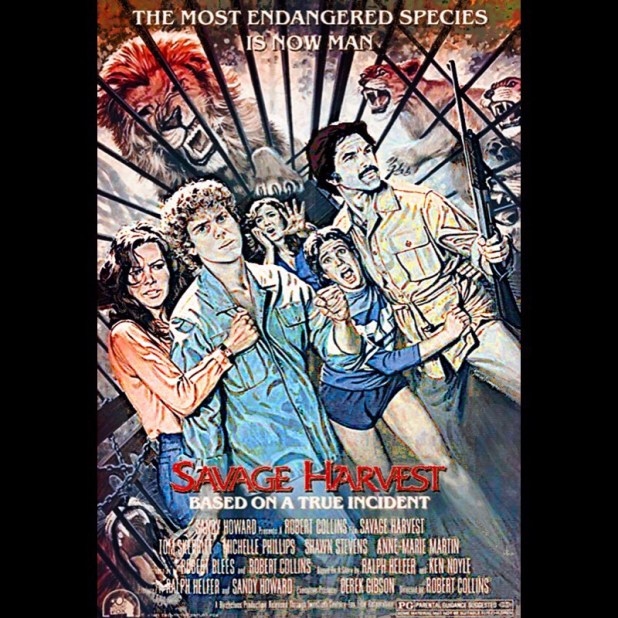
Maggie (Michelle Phillips) and her family live in Kenya and a pride of lions has surrounded their home. Luckily, they have a man named Casey (Tom Skerrit) staying with them and perhaps that will be enough.

There are some scenes that make this worth watching. One has the entire family having a sing-a-long — keep in mind one of the kids just watched a lion maul a housekeeper to the point that you can see meat coming out of the mannequin and this is a PG rated movie — while a lion sneaks in and eats another staff member. There’s also a lion that somehow gets in the chimney and just comes on into the living room to start attacking children.

This is a total vanity project for Helfer, as his daughter Tana plays one of the kids, Kristie. Anothe character, Wendy, is played by Anne-Marie Martin, who was Clea in the TV Dr. Strange, Kim in The Shape of Things to Come, Wendy Richards in Prom Night, Jessica in The Boogens and Darcy Essmont in Halloween II (nurse Karen’s friend who reminds her she promised to give her a ride home). She was also Dori Doreau on Sledge Hammer! and would later marry Michael Crichton, who she met on the set of Runaway. Later, they would write Twister.

You can watch this on YouTube.

APRIL MOVIE THON 3: Twister (1996)

April 18: In Like a Lion — A weather gone wild movie.

They’re making Twisters this year and you know, I don’t care.

I never saw this movie when it came out but my wife did.

I only knew it from the pinball machine.

Last year, she made me watch this movie and you know, I came away wondering how anyone could leave all that food behind at Aunt Meg’s house and then she put it all in bags for everyone because she’s used to all these storm chasers in her life.

Yes, storm chasers. My aunt used to follow tornados with my grandmother but they just had a little Cutlass Ciera. They didn’t have Dorothy and a cool truck, much less a woman who would make gravy for them.

Twister is a strange film because it has great talent — Bill Paxton, Philip Seymour Hoffman — in the service of a Jan de Bont summer blockbuster. That means that there are moments that are total popcorn as trucks raise twisters and then moments of longing and romance that feel honest, thanks to Paxton and Helen Hunt.

Maybe it makes sense, I figure, that there was no script pitch for this movie, but instead a proof of concept clip of the visual effects by Industrial Light & Magic. When you need a movie to go with all those computer animation, you used to get Michael Crichton (who co-wrote this with his wife Anne-Marie Martin).

So here’s how it happens: Bill Harding (Paxton) is now a weatherman but once, he was a storm chased along with his soon-to-be ex-wife Jo (Hunt) and he has to track her down to get the divorce papers signed so that he can marry Dr. Melissa Reeves (Jami Gertz) who gets a raw deal in this movie to be honest but you know, when you chase tornadoes your whole life with a girl who lost her family to one, you have to imagine the sex is like getting tossed around the bed by an F5.

But yeah, while everyone is getting Dorothy IV to send out probes and watching Cary Elwes get pulped by a twister, poor Dr. Melissa is stuck in a truck with Dusty (Hoffman) hearing about how cool weather is. And she’s a therapist!

At least it’s based on some facts, as The National Severe Storms Laboratory in Norman, Oklahoma trained the crew on weather safety and brought the actors along on a tornado chase. There was a moment in the script where one tornado lasted for 36 hours and they shot that down. Speaking of Oklahoma, the production shut down so the cast and crew could pitch in and help after the Oklahoma City bombing.

Also in case you want to talk about stormy weather, the crew wanted to kill Jan de Bont. The camera crew l– ed by Don Burgess — said De Bont “didn’t know what he wanted till he saw it. He would shoot one direction, with all the equipment behind the view of the camera, and then he’d want to shoot in the other direction right away and we’d have to move everything and he’d get angry that we took too long … and it was always everybody else’s fault, never his.” Five weeks into filming, the director knocked over a camera assistant who missed a cue and Burgess and his crew walked off the set, much to the shock of the cast. They agreed to stay Jack N. Green and his crew took over. Sadly, Green was injured when a house rigged to collapse did so with him inside it before filming started. He injured his head and back, which led to de Bont being director of photography for the last two days of the movie.

This movie was filled with injuries, as Hunt had a door hit her in the head and she and Paxton both had their retinas burned because of how intense the lights were during the inside the truck scenes.

Both the soundtrack and the orchestral score featured Respect the Wind,” an instrumental composed and performed for the film by Alex and Eddie Van Halen. Again, speaking of storms, another song — “Humans Being” — was a big mess for the band Van Halen. Lead singer Sammy Hagar didn’t want to be working as his wife Kari was pregnant and they wanted to naturally deliver the child in Hawaii. He also believed that the band should rest up after touring as Eddie had avascular necrosis, which had him on a cane and painkillers, and Alex was in a neck brace.  Their manager Ray Danniels told them they’d get rich off the song, as if they needed more money.

As they wrote the song, Alex called de Bont and asked him how closely he wanted the lyrics to be to the movie. de Bont said, “Oh, please don’t write about tornadoes. I don’t want this to be a narrative for the movie.” Hagar asked for some footage and the lyrics he wrote were “Sky turning black/knuckles turning white/headed for the suck zone.” Yes, he started the song not supposed to be about tornadoes by writing about tornadoes.

As Eddie told Guitar World, “And so what does Sammy come back with? “Sky is turning black, knuckles turning white, headed for the hot zone.” It was total tornado stuff! Not only did Alex tell him not to do that, but the director of the fucking movie told him, “Do not write about tornadoes.’””

Hagar claimed de Bont loved a demo he recorded in Hawaii and provided “300 pages of technical weather terms that tornado chasers use” that had the word “suck zone” in it. He also explained to Livewire, “The new manager that came in wanted us to do a greatest-hits record with both Dave’s era and my era with two new songs from me and, not to my knowledge at the time, two more songs from Dave. We ended up using one of them for Twister, and that was the end of the band. I wanted to do a whole record. I didn’t want to do a greatest hit record. I didn’t think Van Halen was there yet.”

Six weeks after the premiere of the movie, Hagar was out of Van Halen, replaced by David Lee Roth, who was soon replaced by Gary Cherone.

I love that this movie was so loud and had a bass-heavy sound that destroyed the speakers in theaters everywhere. A tornado hit a drive-in theater in Thorold, Ontario, on May 20, 1996, damaging a screen that was due to play this movie.

We don’t get many tornadoes in Pittsburgh but one of the few took out my childhood drive-in, the Spotlight 88, and I have hated tornadoes forever because of that.

APRIL MOVIE THON 3: The Drifting Classroom (1987)

April 17: Did You Get It? — A bug movie.

The Drifting Classroom is based on a horror manga series written and illustrated by Kazuo Umezu, who also had his work turned into the movies The Snake Girl and the Silver-Haired Witch and Tamami: The Baby’s Curse and the TV series Umezu Kazuo: Kyôfu gekijô. The series was originally serialized in Weekly Shōnen Sunday from 1972 to 1974 and is about a school building that has been mysteriously transported through time to a post-apocalyptic future.

Directed by Nobuhiko Ôbayashi (who not only directed House, he was also the man who made the Charles Bronson Mandom commericial) with a cast of untrained actors who were actual students at the Kobe International School, this film takes the sprawling story of the manga and tries to turn it into a condensed film. It avoids one of the major points of the original story as the adults almost all go mad and literally go to war with the young children who have to fight back.

I also have no idea why they shot this in English with Japanese subtitles instead of just making it in the native language. It isn’t like there was a huge crowd in the U.S. dying to see an adaption of a manga made two decades before outside of some hardcores. Maybe they thought that Troy Donahue was still a big deal?

As if it were bad enough that Sho and the other students have traveled through a time slip, this end of the world situation also has monstrous cockroaches that go wild and attack the school, killing many of the children. Yes, a movie that holds back nothing while also having song and dance numbers every few moments. As you can imagine, I’m fascinated by this film.

There’s also a friendly little alien that feels badly that the children have no water to wash their faces, so he urinates in their faces. Where else are you going to see that? Or a child ride a tricycle into the next reality? I’m not saying this is great, but it’s weird and sometimes that’s better than great.

You can download this from the Internet Archive.

APRIL MOVIE THON 3: Mother of Tears (2007)

April 16: Get Me Another — A sequel.

I love Dario Argento. Love his movies. Have his book. A coffee mug from his shop Profundo Russo is in my office. I’ve watched all of his films so many times I can act them out without a script.

But man, Mother of Tears.

Also known as La Terza (The Third Mother); Mater Lachrymarum, The Third Mother and Mother of Tears: The Third Mother, this is the third movie in the cycle of The Three Mothers. The Three Mothers come from “Levana and Our Ladies of Sorrow”, a section of Thomas de Quincey’s Suspiria de Profundis. Just as there are three Fates and Graces, there are also three Sorrows: Mater Lachrymarum (Our Lady of Tears), Mater Suspiriorum (Our Lady of Sighs) and Mater Tenebrarum (Our Lady of Darkness).

Starting with Suspiria and continuing with Inferno, these are the stories of the three ancient witches who are close to ruling our world. At the beginning of the 11th century, they started of witchcraft as they rose from the Black Sea, making their way across countries, making money and gaining power as they kill everyone around them.

In the late 19th century, the Three Mothers had E. Varelli, an Italian architect based in London, design and construct three buildings for them to conduct their magic. The architect learned too late that they were evil and the places he made have become so corrupted by their evil that the very land around them is cursed.

The first of the mothers is Mater Suspiriorum, the Mother of Sighs, the Black Queen Helena Markos of Suspiria. After writing a series of books on the dark occult arts, Markos started the Tanz Akademie outside the Black Forest. As her power and wealth increased, the locals began to suspect her, so she faked her own death in a fire and passed control to the dance school to her greatest student, who was also Helena Markos.

The second mother is Mater Tenebrarum, the Mother of Darkness, is the youngest and cruelest of the Three Mothers and the main antagonist in Inferno. Her home is in New York City where she keeps E. Varelli as her slave.

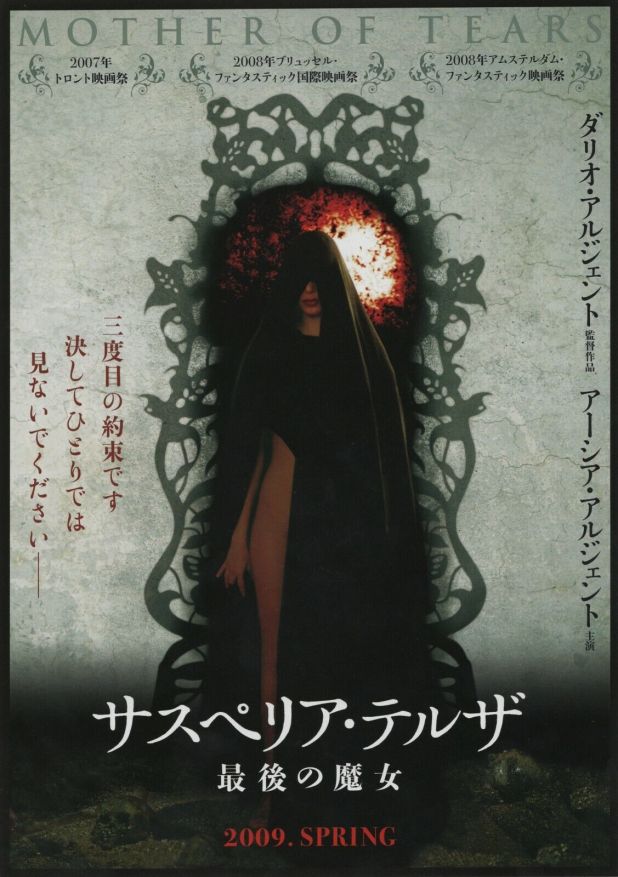
This brings us to The Mother of Tears, as the other two Mothers have died as their homes burned. Before Suspiria, Elisa Mandy (Daria Nicolodi) battles Markos, who killed her and her husband. This left Mater Suspiriorum “a shell of her former self.” This movie is about Elisa’s daughter Sarah Mandy (Asia Argento) and her battles with Mater Lachrymarum in Rome.

Mater Lachrymarum, the Mother of Tears, Palazzo Varelli.is the most beautiful and powerful of the Three Mothers. We first saw her in Inferno as she attempted to use her magic on Mark Elliot as he studied music in Rome.

Directed and written by Dario Argento (along with Jace Anderson and Adam Gierasch), this begins with the Catholic Church finding a magical runic that increases the powers of Mater Lachrymarum. It is sent to the Museum of Ancient Art in Rome, where Sarah (Asia Argento) and her boyfriend Michael Pierce (Adam James) work. Sarah discovers the tunic, along with Giselle (Coralina Cataldi-Tassoni) when they are attacked by the followers of the Third Mother. Sarah only survives thanks to a voice in her head.

Mass suicides, murder and insanity take over Rome, as Michael is killed, his son is eaten by witches and the coven plans on doing the same to Sarah. After being followed by Detective Enzo Marchi (Cristian Solimeno), Sarah learns that she has power and the guidance of her mother, which helps her to bring the entire plan and building down on the final of the Three Mothers.

Why did this movie take so long to be made? In 1984, Nicolodi claimed that she are Argento had written a script. That script was not used and neither was a 2004 script that Dario wrote. When the movie was finally made, its distributor, Medusa Film, asked for the film’s sex and violence to be edited.

Critics were not kind — they never are to Argento — and he said, “…the critics don’t understand very well. But critics are not important – absolutely not important. Because now audiences don’t believe anymore in critics. Many years ago critics wrote long articles about films. Now in seven lines they are finished: ‘The story is this. The actor is this. The color is good.””

I’m honestly not sure how I feel about this movie. Sure, it goes for it and goes even further. But nearly everything Argento has made since, well, forever feels like it doesn’t have his heart in it. It doesn’t mean that I always hate what I watch but it makes me sad. The inventive camera work, the shock of what will happen next, the look and feel are gone, replaced by something else. As to whether or not that’s good, well…it’s different. It’s something I think about all the time.

To be honest, I kind of prefer Luigi Cozzi’s The Black Cat, which is an unofficial sequel to Suspiria and Inferno about a director making his own sequel to those movies and being cursed by the actual witches. It’s also a total mess but it feels like Cozzi is in love with making it which is what I look for when I need to see something go off the rails.

You can watch this on Tubi.

APRIL MOVIE THON 3: Have a Nice Weekend (1975)

April 15: Slasher — A slasher without any sequels.

Directed, co-written (with Inserts director and writer and Mahogany writer John Byrum and Marsha Sheiness) and produced by Michael Walters — his only movie — Have a Nice Weekend is an early slasher that attempts to be ripped from the headlines as it starts with Chris coming home from Vietnam, burning his uniform and inviting his entire family to meet at their summer home.

Father Paul (Michael Miller), mother Laura (Nikki Counselman), sister Muffy (Patricia Joyce), her friend Ellen (Colette Bablon) and football coach and handyman Frank head off to the island, which seemingly has only two other people living there, Donald and Joan Crab (Peter Dompe and Valerie Shepherd). They have a strange meal where Paul looks at a butcher knife to carve the roast like it’s a sexual object and Chris flips out and smashes a radio that dares to speak of the war.

Is it a surprise that Paul is dead the next day, found in the rose bushes his wife was enraged about and stabbed by the same butcher knife he almost came over? Found by Donald and Ellen, now everyone becomes a suspect.  And the killing isn’t done yet, as there’s a garden hoe and a hook to be used.

That said, this feels like a TV movie that no one wants to watch and nobody wants to act in. I do love a sleepy movie, however, and I also adore one that has an ending where it seems like no one knows who did the murders and then someone is like, “We need an epilogue” and it still makes less than any reasonable sense.

Also: Chris gets killed, mom is banging it out with the gardener football coach and Muffy once sunk her fingernails into another girl’s face. It could be anybody. Or it could be someone no one knows who just so happened to head to this island to kill. Also also: Everyone hates everybody. Even the boat captain who takes them to their vacation home yells at everyone, the phones have all been cut off for the season (how is that a thing?) and nobody wants to be around anyone. In no way is this like what Barry Manilow sang, “Time in New England took me away to long rocky beaches you by the bay.”

This weekend in New England will be the death of these people.

If you’ve watched every slasher there is, well, you can watch this one too. I may be talking to myself.

That said, it has one great line: “Making a sandwich is a one man job!”

You can watch this on YouTube.