June 18: Junesploitation’s topic of the day — as suggested by F This Movie— is Gangsters! We’re excited to tackle a different genre every day, so check back and see what’s next.
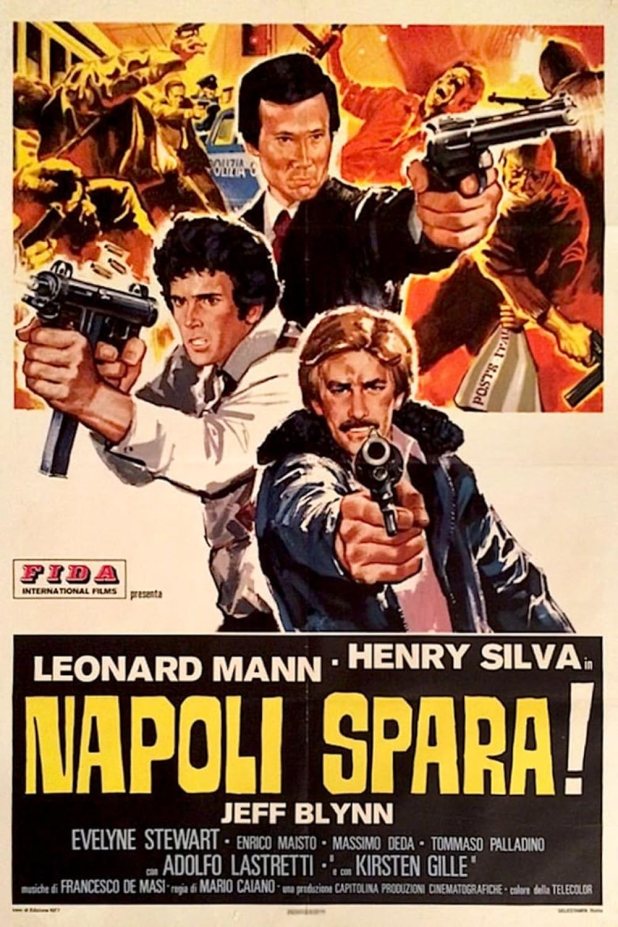
Weapons of Death comes from the Commissioner Betti (Violent Rome, Violent Naples and Special Cop in Action) cinematic universe as a spin off of the character Gennarino (Massimo Deda). Betti is also in this, except now he’s played by Leonard Mann instead of Maurizio Merli. And now, in the place of Umberto Lenzi, there’s Mario Caiano (Nightmare Castle) in charge of the show.
The villain is the main reason to watch this. Henry Silva is always absolutely perfect and here he’s as awesome as you’d hoped as a hit man named Santoro. He has the protection of crime boss Don Alfredo (Tino Bianchi). He’s able to train so many people to do robberies and murders that he puts not just Belli job in jeopardy, but his reputation. That’s because the one time that Santoro gets a gun on him, he lets the policeman live, telling him, “You go your way and I’ll go mine.” That’s how smart he is, as he gets more out of not killing Betti as he would have shooting him.
At the same time, the other crime families all begin to hate Santoro for how out of control he is — one of his major crimes has masked men running wild in the streets, shooting people and kicking women in the stomach — and they try to rub him out.
This movie lives up to the poliziotteschi madness that its fans want, as it has kids turned into young gangsters, a motorcycle rider getting beheaded and a man being castrated in prison. Also, Ida Galli. Or Evelyn Stewart. You know, whatever name you prefer. And it looks out of control because a lot of this was filmed without permits, closing streets or even informing the crowds of people in some of the scenes that they were filming. Instead, they had the camera inside a box on a truck. Italy, I will always love you.
June 18: Junesploitation’s topic of the day — as suggested by F This Movie— is Gangsters! We’re excited to tackle a different genre every day, so check back and see what’s next.
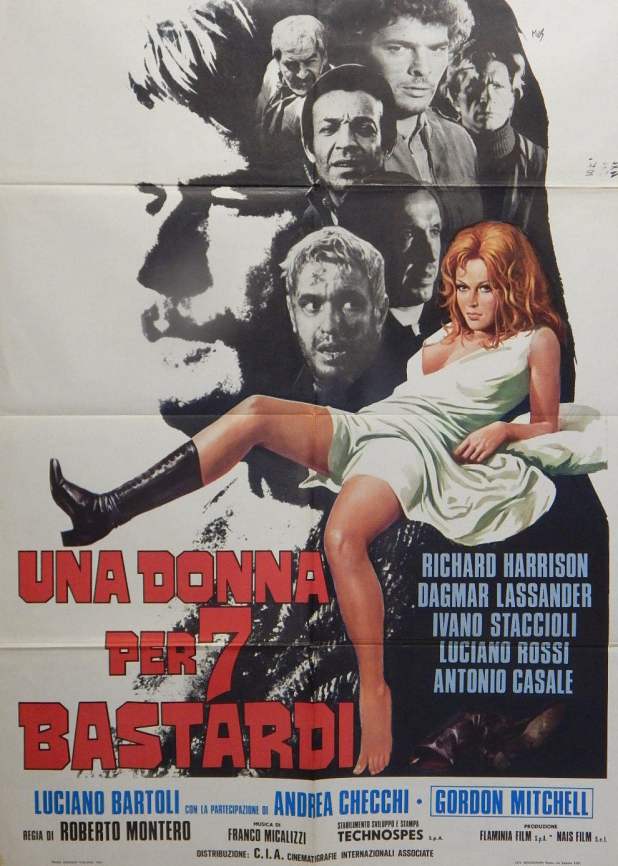
Gordon (Gordon Mitchell) and Carl (Antonio Casale) have taken a stack of gold, moved to the middle of nowhere and hide their fortune in a wooden shack. No one bothers them, because they have a stranglehold on the small town’s alcohol sales, marking it up and getting everyone blissfully wasted. However, a crippled man (Richard Harrison, who came up with the idea) has come to town and everyone that has something to hide is about to get exposed.
Everyone in this small silver mining town is horrible. I mean it, there are murderers, child molesters, thieves and more. And in the middle of them all, playing their arousal off one another is the gorgeous and unsatisfied Rita (Dagmar Lassander). She loves every moment of the worked up chaos that she unleashes.
The town could be a Western one for all we know, save the modern truck, the clothing and the bottles and bottles of J&B. There’s so much J&B here that you wonder how many black gloved killers are here for a convention of psychosexual degenerate switchblade aficionados. Also, Ms. Lassander protects herself with a broken bottle of J&B which is as sexy as you think.
Everything is filthy. Everyone feels like they’re just waiting to die. Or kill you. It’s like Bad Day at Black Rock mixed with the Italian West’s ability to keep remaking Yojimbo and then ripping off the rip off, but you accept it and love it because it’s Italy.
Joe Sarno week (June 16 – 22) Joe Sarno was called the Bergman of 42nd St, but don’t let that stop you from watching his movies! He was able to shape dramatic stories that were entertaining and of-the-moment while working with tight budgets and inexperienced performers but he never lost sight of why people were buying the tickets – HOT SEX!
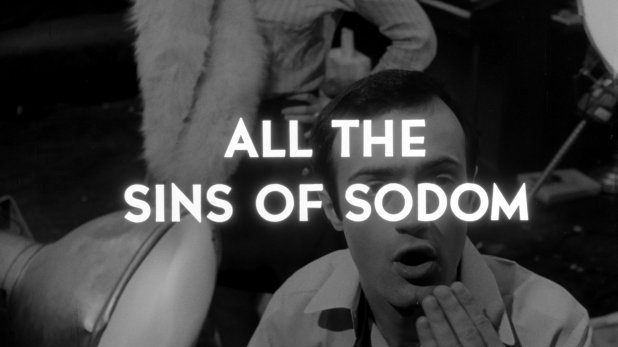
The title of this movie is awesome and then I found out that it’s also called All The Evils Of Satan and I don’t know if I could be more enthusiastic about a film.
New York City shutterbug Henning (Dan Machuen) is supposed to shoot some nudes for his agent Paula (Peggy Sarno) but is obsessed with shooting the evil that lives inside all women. To capture this, he takes images of Leslie (Maria Lease, who would go on to be a director of adult films as well as Dolly Dearestand being the script supervisor on Better Off Dead) as she hangs from the ceiling of his studio. After, they make love, and while Henning usually never sees another of his conquests again, she feels different. She’s also mindblowingly gorgeous, which helps.
He also meets another model named Joyce (Marianne Prevost) who he feels sorry for. She’s homeless and needs a hand up. He invites her to stay in his studio and assist him, but when he grows angry that he can’t capture with his camera what he sees with his eyes, he learns that she’s the perfect muse for his images of base morality. Paula even tells him that she sent Joyce his way, claiming “”I sent her to you because she is what you’re looking for. If I ever I saw it, she’s the daughter of Satan.”
That means that things aren’t going to end well for anyone. Again, this is in stark black and white and while the lovemaking scenes are quite erotic, they’re mostly clothed. Then again, when they were made by Sarno, this burned the celluloid.
June 17: Junesploitation’s topic of the day — as suggested by F This Movie— is Lucio Fulci! We’re excited to tackle a different genre every day, so check back and see what’s next.
When writers cover Italian exploitation film genres, often the concentration is on horror, cannibal movies, mondos, Westerns, giallo. Anything but musicarello, which are jukebox musicals inspired by Elvis’ Jailhouse Rock and Love Me Tender. The movie that really broke this filone — a small stream, so to speak, that flows from the larger river of Italian cinema — was Go, Johnny, Go!, which was directed by Paul Landres and starred Jimmy Clanton, Chuck Berry, Ritchie Valens and Eddie Cochran. Released in Italy as Vai, Johnny vai!, it had sequences filmed just for the Italian market with singer Adriano Celentano opening and closing the movie.
In a pre-MTV world, musicarello featured young singers in the main roles — like Gianni Morandi, Al Bano, Mal Ryder, Tony Renis, Adriano Celentano, Bobby Solo, Orietta Berti, Little Tony, and more — as they performed songs from their latest albums.
As you may expect, several of the same directors who excelled in other Italian genres made their own music movies, including Bruno Corbucci (Questo pazzo, pazzo mondo della canzone), Ferdinando Baldi (Rita of the West), Ruggero Deodato (Donne… botte e bersaglieri), Duccio Tessari (one of the founders of the Italian Western, he made Per amore… per magia…) and the unholy team of Antonio Margheriti and Renato Polselli (Io Ti Amo).
Yet the originator of native Italian-made musicarello is the very same man who most in America only know as the Godfather of Gore. Yes, Lucio Fulci made Ragazzi del Juke-Box and the second example of the genre, Urlatori alla Sbarra (Howlers In the Dock).
Wikipedia says that the musicarello is a mix between “fotoromanzi (photo comics or fumetti), traditional comedy, hit songs and tentative references to tensions between generations.” This is before the Days of Lead and radicalized political moments that would make up much of the late 1960s and 1970s in Italy. And as the genre gets older, generational revolt wouldn’t be something studios wanted to sell to, particularly as the music in this genre was no longer being directed toward young people. Think how the American-International Pictures beach movies seem so dated in just a few years versus movies that Hollywood was releasing by the end of the 60s and early 70s.
A company that makes blue jeans has to rethink their image because of a group called the Teddy Boys, young men and women who love American rock ‘n roll. The leaders of this music-loving group of kids are Joe Il Rosso (Joe Sentieri, whose biggest song was “Uno dei tanti,” which was translated by Leiber and Stoller and recorded by several English-speaking artists as I (Who Have Nothing); he appears in several films, including The Most Beautiful Wife with Ornella Muti), Mina (Mina, Italy’s best-selling music artist of all time; known as the “Queen of Screamers” and the “Tigress of Cremona;” she was banned from TV and radio due to her relationship with married actor Corrado Pani and out of wedlock pregnancy. She was so famous and beloved that this ban ended in a year despite her songs being about religion, sex and one of her favorite things, smoking. Her look was so alien to Italian audiences — shaved eyebrows, dyed blonde hair and fragrant sex appeal — which makes Mina look as cool in 2024 as she did in 1960) and Adriano (Adriano Celentano, who introduced rock ‘n roll to Italy with songs like “24.000 baci”, “Il tuo bacio è come un rock”, and “Si è spento il Sole;” he’s in Fulci’s first music movie as well as a singer in La Dolce Vita. His daughter Rosalinda is best-known for playing Satan in The Passion of teh Christ).
The jeans company wants the kids to improve their image and do good deeds, yet their remain suspicious of them. While this is happening, Joe falls in love with Giulia (Elke Sommer, Baron Blood) — and can you blame him? — whose father Giomarelli (Mario Carotenuto) runs the TV network and wants these rockers off television and to stop influencing other young folks.
Thanks to Italo Cinema, I can report there are nearly twenty songs in this:
Joe Sentieri: “Let’s Go,” “Moto Rock, ” “Millions of Scintille” and “Don’t Talk:
Mina: “I Know Why,” “Nessuno,” “Whisky” and “Tintarella di Luna”
Adriano Celentano: “Rock Matto,” “Blue Jeans Rock,” “Nikita Rock,” “Impressive for You” and Your Cheek is Like a Rock
Chet Baker: “Arrdividerci”
Brunetta: “Precipito” and “Beby Rock”
Umberto Bindi: “Odio”
Gianni Meccia: “Delicate soldiers”
Corrado Lojacono: “Carin”
I Brutos:” I, Blue Devil”
You may look through that list and be somewhat amazed that Chet Baker is in it. The “Prince of Cool” was seen by Hollywood as a potential movie star but the promise of his early career was marred by a life filled with drug addiction. That comes up in this movie, as he is often sleeping — and often, yes, he really was nodding off — and it’s turned into a comedic plot point.
This is also the first film appearance of model — and the only woman fashion designed Valentino ever loved — Marilù Tolo. She’s also in one of my all-time favorite Italian Westerns, Django Kill… If You Live, Shoot!
Fulci co-wrote this with Giovanni Addessi (who would later write and produce Web of the Spider) and Vittorio Vighi (I Maniaci!). Yet his closest collaborator was Piero Vivarelli, who is listed as screenwriter and assistant director. Vivarelli — according to previously cited Italo Cinema — “had been working for radio stations since the 1950s and from the 1960s onwards was editor of the music magazine Big, for which he always wrote the editorials himself and which was regularly devoured by young people looking for good music. Vivarelli’s opinion carried weight; whoever he thought was good could become famous, but whoever he ignored was ignored by the audience.”
Vivarelli lived a wild life. In addition to his music influence, he directed comic book adaptions Avenger Xand Satanik, wrote Django and later in his career wrote the story for D’Amato’s Emauelle In Bangkok and the lunatic Emanuelle In America. Besides that, he was the only foreigner other than Che Guevara to have his membership card for the Cuban Communist Party signed by Fidel Castro.
Working together with cinematographer Gianni Di Venanzo (who would go on to shoot 8 1/2, The 10th Victim and Juliet of the Spirits before dying way too young) , Fulci and Vivarelli created a new visual template for how young audiences saw music that would be adapted by Scopitones and music videos.
Not to be a broken record, but Fulci remains, as ever, so much more than his horror movies.
June 17: Junesploitation’s topic of the day — as suggested by F This Movie— is Lucio Fulci! We’re excited to tackle a different genre every day, so check back and see what’s next.
I was reading through Letterboxd reviews the other day and I saw someone mention in a Fulci horror film that there was a humorous moment that they didn’t enjoy but that made sense because Fulci wasn’t known for making comedies.
Of the 57 movies Lucio Fulci directed that are listed on Letterboxd, 16 are comedies.
Anyways…
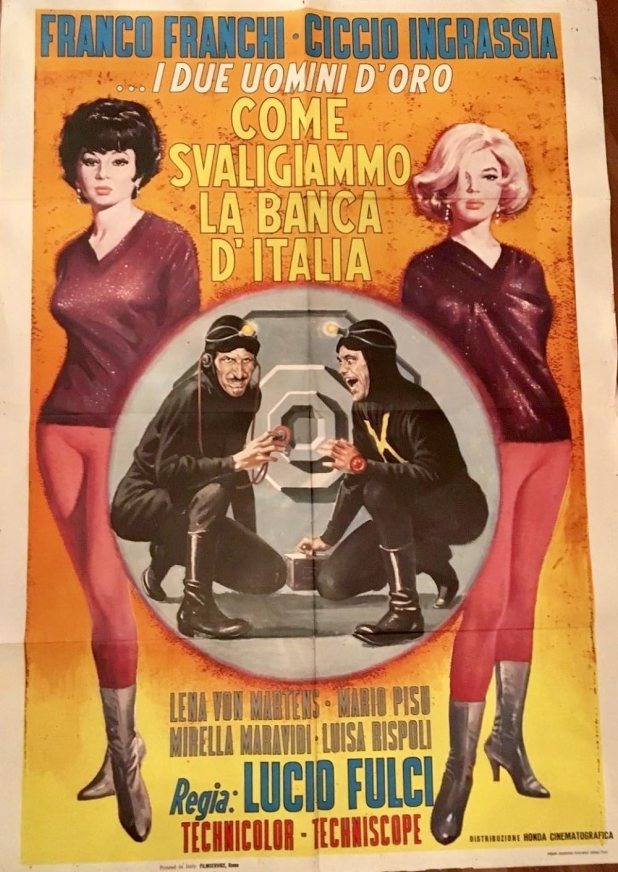
Like many of his comedy films (thirteen, in case you were guessing), this stars the team of Franco Franchi and Ciccio Ingrassia. As always, they play two Sicilian morons. Franco is completely deranged and uses his body and wild face to try and communicate in the loudest ways possible while Ciccio is the mustache-having bully who thinks he’s the more intelligent of the duo but is quite dumb.
In this movie, they have an older brother who is such an incredible thief that he is known as the Master. Paolo (Maro Pisu) wants his brothers to stop being criminals so that they don’t lead the police to him, so he sets them up with money, homes and girlfriends. Yet the two are so annoying that they can never keep these women and way too dumb to not want to be criminals like their brother.
Then Paolo meets two singers, Marilina (Lena von Martens, Operation Counterspy) and Rosalina (Mirella Maravidi, Requiescant, Terror-Creatures from the Grave) who are totally gorgeous and just as insipid as his siblings. He sets them up and leaves the country to hire experts to pull off his most daring and final heist, robbing the Bank of Italy.
The problem is that the ladies are gangsters and want the brothers to show just how good they are at being crooks and pull off their brother’s plan before he gets back.
A heist film that is a comedic version of Seven Golden Men, this even finds Franco and Ciccio dressing up as Diabolik to rob a safe. Plus, you get appearances by Solvi Stubing (Strip Nude for Your Killer), Kitty Swan (House of 1,000 Dolls), Maria Luisa Rispoli (Kriminal) and Adriana Ambesi (Fangs of the Living Dead).
I have to confess that I hated the movies of Franchi and Ingrassia when I first watched them but now find them charming. Maybe it was Argento discussing. how great they are in an interview I saw with him or it could be that I had to learn how to appreciate their basic humor. However I got here, I laughed several times while watching this and loved the space age sets and opening super thief action.
Joe Sarno week (June 16 – 22) Joe Sarno was called the Bergman of 42nd St, but don’t let that stop you from watching his movies! He was able to shape dramatic stories that were entertaining and of-the-moment while working with tight budgets and inexperienced performers but he never lost sight of why people were buying the tickets – HOT SEX!
Bobbi (June Colbourne) is the kind of person who could only appear in a roughie directed by Joe Sarno. She’s a combination exotic dancer and fortune teller who uses a Haitian voodoo amulet to remain young and oh yeah, she can control almost any man, like her lover and bongo player Dave (Derek Murcott).
Her daughter Julia (Dian Lloyd) doesn’t want to live in the world her mother dominates. She’s also a dancer and doubles as a possessed woman during her mother’s psychic flim flam shows, raking in money from the marks and rubes.
After a night getting sodas, she gives her body to Ben Furman (Charles Clements). But soon, Dave decides to steal the amulet, putting everyone’s lives in a tailspin. Didn’t Dave already know that every one of Bobbi’s lovers has died horribly?
There’s no nudity or sex in this, but it feels just plain scuzzy and that’s the kind of filth that I wallow in. The promise of a carnal inferno and the delivery of entropy, so to speak. Then again, you get a lot of dance scenes that were volcanic in 1963 and could play on prime time TV today.
Like how Andy Milligan really only wants family members to lose their minds and scream at one another while the horror elements are just window dressing, so many Joe Sarno movies are about sadness and how people fail to connect. At the end, Bobbi remarks just how old and tired she is, despite all the magic. We don’t see her as younger — there’s no money for special effects — and have to become part of her illusion, hypnotized ourselves with the black and white starkness.
Sarno took over when original director Anthony Farrar left. Sure, it drags despite being 66 minutes, but then you remember that this is a sexless sex movie that has become a voodoo noir and you figure, well, it’s good enough.
One review on Letterboxd said, “The people are not very attractive nor appealing.” Maybe you’ve never seen pre-1970s adult films before. For shame.
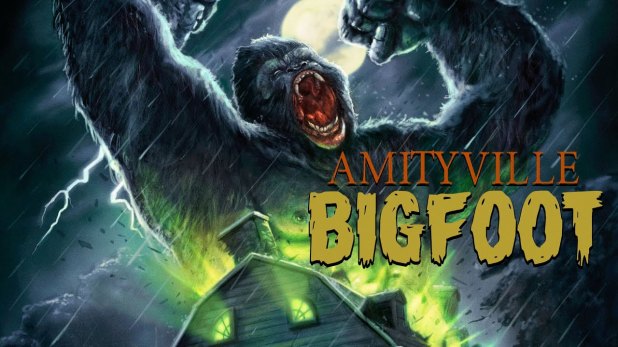
In the woods of Amityville, scientists whose lab once occupied the very space that the house on 112 Ocean Avenue sat have somehow captured Bigfoot, conducting a series of experiments on him. He escapes and runs wild in the woods, all while a film crew is shooting their own Bigfoot movie, local birdwatchers seek an elusive species and protestors who want an end to Amityville movies all gather in one place to become victims.
This movie has almost everything that an Amityville movie should, which is a great name and a better poster, even if that looks like Kong exploding from the familiar windows of the De Feo home. It does not, however, have any taglines.
Directed by Shawn C. Phillips, who co-wrote it with Julie Anne Prescott and is on his ninth trip to Amityville, (he directed Amityville Shark House and Amityville Karen and acted in Amityville Webcam, Amityville Job Interview, Amityville Frankenstein, Amityville Thanksgiving, Amityville In the Hood and Amityville Hex) has put together yet another movie that has no ties to the original other than you’ve seen both movies.
He also plays Ian, the leader of the scientists who lose Bigfoot, leading one of them named Annie (Lauren Francesca, who was the Amityville Karen) to be assaulted by the creature, who she claims “Has the biggest dick I’ve ever had.” The Amityville Bigfoot which acts a lot more like the sasquatch in Night of the Demonthan a friendly skunk ape. Is there such a thing as an amiable abominable snowman?
As for that movie in the woods, its director Claude (Brandon Krum) is having issues with his producer father Harv (Phillip Krum) and his main actress, Francesca (Ashleeann Cittell). And somehow, in the middle of all of this — Bigfoot sexual, fecal and urine assaults abound — Eric Roberts and Tuesday Knight appear. There’s also a scene where Bigfoot pushes a baby carriage with a dog inside it down a hill and this is played for comedy.
This wouldn’t be an Amityville movie without ten minutes at the end of videos sent in by people who paid to be in the movie, as well as news footage that pads out the running time. There’s also lots of ad libbed dialogue, people talking on and on when they never would in real life and so much screaming. Yet it looks a lot better than most Amityville or Bigfoot movies, so I guess that’s some faint praise.
NOTE: Ryan Stockstad informed me: “Just a small correction: the producer’s father was played by Brandon Krum’s actual father Phillip Krum, not G. Larry Butler! Larry plays one of the hobos in the woods;)”
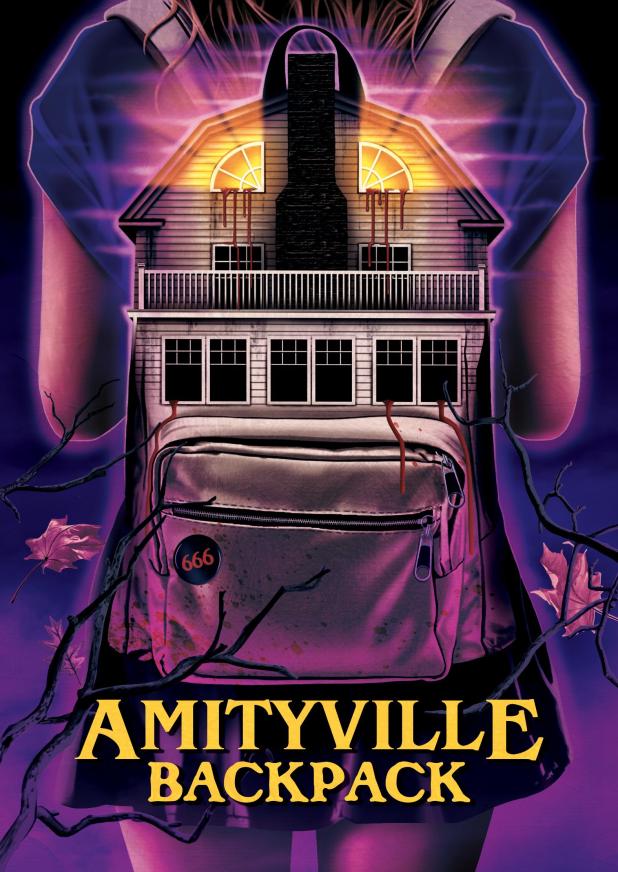
Luther Boots (Mike Hartsfield) goes to a yard sale, finds a backpack — that has killed a child with a stock video explosion and that means I had to send a message to Erica from Unsung Horrors and pass the curse of this on to her — and it starts to kill everyone that is close to him.
Every SRS-released Amityville movie has characters that just talk about everything. They narrate every moment of their lives. No one I have ever met talks like this, but yet this happens in all of their movies. I realize that we need to explain what is happening, but when the talking takes up most of the movie and people are given to saying things like, “Backpack, I think you’re going to help me a lot.” I lose my mind by the time a film like this one is over.
What didn’t help is that I usually watch Amityville movies all alone, but for some reason my wife came in and started watching this one and realized that she had made a mistake marrying me. She had so many questions about why I would spend so much time watching this and I was afraid to show her my Letterboxd list because I’m too old to start over again.
Anyways, what it does have going for it is shots inside the backpack, as well as the fact that the backpack looks just like the house on 112 Ocean Avenue. It also has the threat of a cat death — spoiler warning, it survives — and a lot of people killed by, yes, a backpack. Who knew that my old JanSport could have been so evil?
There were moments of this that were so uncolor balanced and the sun was bleeding into the image that I was shocked that it wasn’t filmed by someone who had never seen a camera or a movie before. Then there would be a great shot or a cool slow motion push in to someone. I wonder, can you tell when one of these movies is a parody any more?
Now, to the tune of Stroke 9’s “Little Black Backpack:”
June 16: Junesploitation’s topic of the day — as suggested by F This Movie— is Bruceploitation! We’re excited to tackle a different genre every day, so check back and see what’s next.
Originally a South Korean movie called Amelika bangmungaeg (also called Visitor of America), this was released in the U.S. by Aquarius Releasing with new dubbing, an incredibly insane poster of Bruce Lee emerging from a grave to defend a half nude woman and battle a flying bat baby as well as a new beginning filmed in the U.S. where lighting strikes the grave of Bruce Lee, who soon emerges, ready to fight. In an amazing display of absolute lunacy, that’s it. No more Bruce Lee.
No, instead, we follow Wong Han (Jun Chong, a judo master who used the name Bruce K. L. Lea; he’s the founder of the World United Martial Arts Organization (WUMAO); has trained Lorenzo Lamas, Sam J. Jones, Phillip and Simon Rhee, and Heather Graham; he also shows up in L.A. Street Fighters, Silent Assassins and Street Soldiers) as he makes his way to America to try and learn who killed his brother Han Ji-Hyeok.
Also: It appears that Wong’s brother died by jumping off his apartment building and is being incinerated in the furnace of the same building, which ends with Wong scooping up all the burned bones and placed them around his neck, along with a photo of the deceased and wandering the streets looking for answers. He’s then attacked by a man in black, who he defeats and kills, which leads to his arrest.
Wong is bailed out by a rich man named Scott Lee and asked to find a woman named Susan (Deborah Dutch, Deep Jaws, 976-EVIL II), who ends up being a waitress. Why Lee hired him is a mystery because he’s shown that he has no idea how to find the killers of his brother, so it’s not like they had a precedent for his detective skills. Anyways, he decides to help Susan and teaches her martial arts so quickly that she can fight nearly as well as him in mere days. She soon informs our hero that she learned from her job in Lee’s Turkish bathhouse that five men were involved in the death of his brother: the black man Wong has already battled, as well as a white man, a Japanese fighter, a Mexican and a cowboy. Seeing as how there are about 4 million people in Los Angeles, this won’t be easy to find them. Then again, he didn’t find the killers yet and did find Susan, so he’s batting .500 which would get you in the hall of fame.
Then, our hero goes to a Christmas parade. Why? So the people there can look directly at the camera and the filmmakers could shoot this without permits. Our hero is a strange guy, one who won’t sleep in Susan’s house for moral reasons, so she buys him an RV to sleep in outside her house.
Anyways, the cowboy is the last alive, killing the other killers before Wong and that means that our hero and he will have to battle one on one. He fights like a pro wrestler, which I can appreciate, and then we learn that maybe Wong’s brother is still alive as nearly everyone else dies. Yes, our hero can’t even protect the woman who helps him, choosing to do a fancy flying kick instead of just disarming the bad guy.
Directed by Lee Doo-yong and written by Hong Ji-Un, this movie is really something else. It’s not good and yet I loved every moment. I kept thinking about the trailer and the poster and how they had to have led people to say, “Bruce Lee versus the black angel of death? How can I not watch this?”
My wife asking me during this movie, “Did cowboys really swear so much?” I figured this movie was just following the lead of Deadwood, but I decided to do some research. According to Notes from the Frontier, they both did and didn’t. Jesse Sheidlower, the American editor of the Oxford English Dictionary and the book The F-Word says, “There were cursing contests when cowboys would get together and insult each other. Evidence that we have is that they were using more religious blasphemy than the sexual insults which are popular today.” That’s because using the f-word didn’t come into use in the U.S. until after World War I. That said, the same article says that Stagecoach Mary, Belle Starr — and this film’s star! — Calamity Jane all were historically known to use tons of profanity.
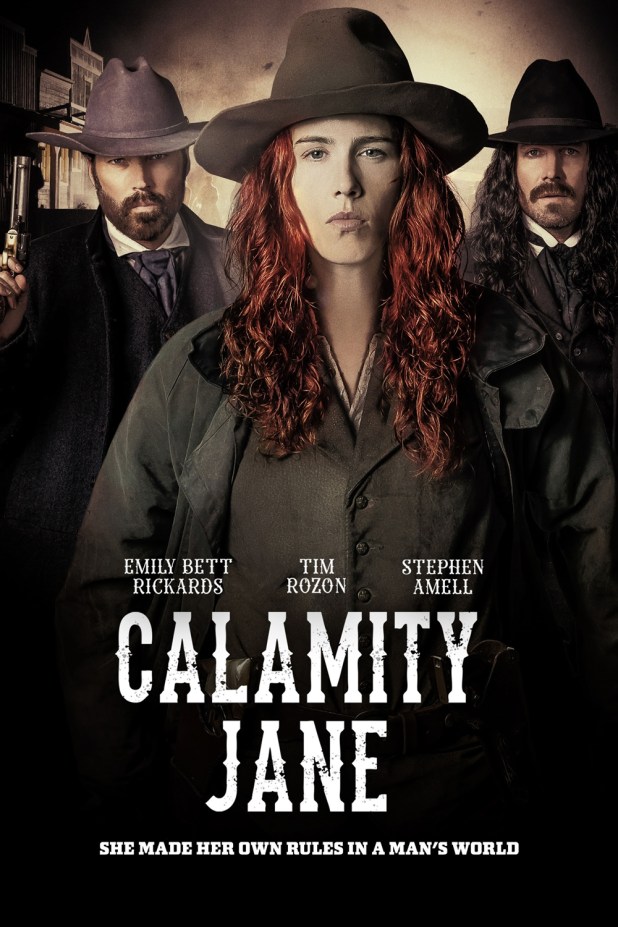
Directed by Terry Miles (Even Lambs Have Teeth) and written by Leon Langford and Collin Watts, this is the story of — you guessed it from the title — Calamity Jane (Emily Bett Rickards, Felicity from Arrow) getting revenge on the man who killed her soon-to-be husband, Wild Bill (Stephen Amell, who was Green Arrow on Arrow and the lead in Heels).
Most of what we know about Calamity Jane — born Martha Jane Canary — comes from an autobiographical pamphlet that she dictated and sold as part of Buffalo Bill’s Wild West Show. As you can imagine, a lot of the story in that pamphlet is exaggerated. She claims that her name came from a battle with Native Americans: “When fired upon, Capt. Egan was shot. I was riding in advance and on hearing the firing turned in my saddle and saw the Captain reeling in his saddle as though about to fall. I turned my horse and galloped back with all haste to his side and got there in time to catch him as he was falling. I lifted him onto my horse in front of me and succeeded in getting him safely to the Fort. Capt. Egan, on recovering, laughingly said: “I name you Calamity Jane, the heroine of the plains.” I have borne that name up to the present time.”
Then again, another story of her life — not written by her — said, “She never saw a lynching and never was in an Indian fight. She was simply a notorious character, dissolute and devilish, but possessed a generous streak which made her popular.”
How realistic is this film’s claim that Wild Bill was married to her?
On September 6, 1941, the U.S. Department of Public Welfare granted old age assistance to a Jean Hickok Burkhardt McCormick. Jean claimed to be the daughter of Martha Jane Canary and James Butler Hickok and had evidence that they were married at Benson’s Landing, Montana on September 25, 1873. She also had a letter from Jane that said that she had been married to Hickok and that he was het birth father. She was then placed for adoption with a Captain Jim O’Neil and his wife.
When she died — of alcoholism — according to Michael Griske’s The Diaries of John Hunton: Made to Last, Written to Last: Sagas of the Western Frontier, “Four of the men who planned her funeral later stated that Hickok had “absolutely no use” for Jane while he was alive, so they decided to play a posthumous joke on him by burying her by his side.”
The truth is always difficult to divine.
Let’s talk about the movie.
When Jane and Bill make it to Deadwood, they finally decide to walk the aisle. Except that he can’t leave behind the chance to play cards and that ends with Jack McCall (Primo Allon) killing him. As you can imagine, McCall gets out of town before Jane can catch him after she easily escapes from the jail of Sheriff Mason (Tim Rozen).
Mason starts a posse to hunt down both Jane and McCall, as well as a criminal that Jane was in jail with — and who started the riot that got her out — by the name of Abigail (Priscilla Faia) starts to stalk her.
If you’re an Arrow fan, this mini-reunion doesn’t last long. So you may be let down. This also feels like way more talking than action, but the fight between Jane and Abigail is pretty great. I also liked the undertaker character who gets Jane through the Badlands, even if he’s barely in this. But hey — I’m all for new Westerns getting made.


 B&S About Movies