JESS FRANCO MONTH: Kiss Me Killer (1977)

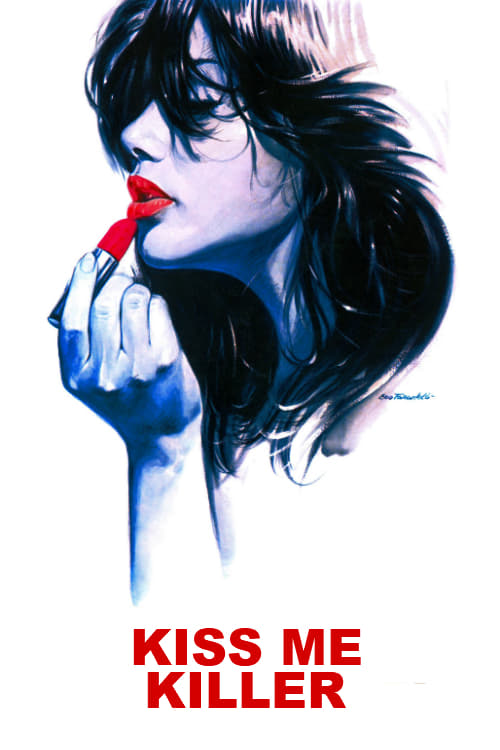
Death Whistles the Blues was 15 years ago, but Jess Franco loves jazz and understands the refrain and sometimes his universe opens to revise films that he has already made to try — sometimes with success — to recreate them now that he has more experience in this world.

Alberto Dalbés is Freddy Carter, which would be Federico de Castro from the original, a role much better acted by Conrado San Martin.

So yeah, Freddy’s dead after a crime gone bad and his two co-criminals — Paul Radeck (Francisco Acosta) and Carlos Moroni (Olivier Mathot) — have run away and assumed those new names. Even more of a punch in the heart is that Radeck also stole away Freddy’s wife Linda (Alice Arno). Now, Moiry Ray (Lina Romay, astounding and rubbing against a stone statue and somehow making it…ah, you get it) is at the Radeck’s club and so is the maybe still alive Freddy.

Really, you don’t have to make a choice between the two films. You can enjoy them both for what they are and the fact that Spanish censorship was gone at this point and we can enjoy Lina lapping at a statue’s granite genitals. Yes, we may have seen it before, but Franco welcomes us and asks us to see it all again through a set of eyes that has seen so much since he first brought this to the screen.

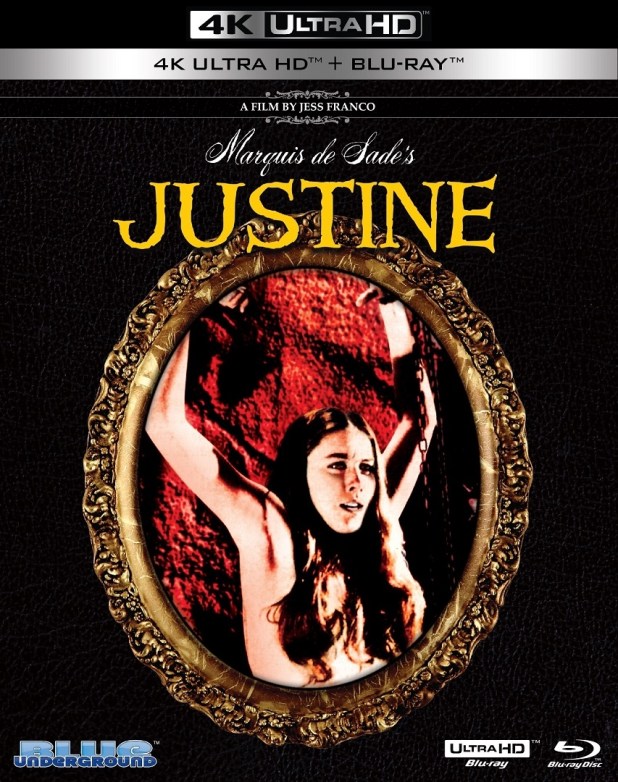
BLUE UNDERGROUND 4K RELEASE: Marquis de Sade: Justine (1969)

EDITOR’S NOTE: This was originally on the site during the first Jess Franco month on February 1, 2022. I’m excited, though, because it’s been released on 4K UHD by Blue Underground.

The Blue Underground 4K UHD released oh Marquis de Sade: Justine has a brand-new 4K restoration from the uncensored original camera negative with Dolby Vision HDRand loaded with extras, including the alternate Deadly Sanctuary cut in HD for the first time ever.

It also has new audio commentary by film historians Nathaniel Thompson and Troy Howarth, an interview with Jess Franco and writer/producer Harry Alan Towers, Stephen Thrower discussing the film, an interview with Rosalba Neri, the French trailer, a poster and still gallery and in addition to the Deadly Sanctuary version, the shorter U.S. edit of the film in HD.

You can get it — and should — from MVD. 

After The Blood of Fu Manchu, producer Harry Alan Towers and Jess Franco wanted to make a more adult film and this movie was the result, made with a million dollar budget, which isn’t much for some people but would be one of Franco’s largest budgets.

There were still some issues, like how Rosemary Dexter (Eye in the Labyrinth) was supposed to play the lead, yet she was moved to the smaller role of Claudine when Romina Power was chosen by a Hollywood moneyman to play the lead. Franco was unhappy with her in the movie, saying “most of the time she didn’t even know we were shooting” and that he had to rewrite the story and move away from DeSade as she was so hard to reach.

Justine and Juliette (Maria Roma) are sisters who live in a convent, a place they’re taken from when he dies and leaves his gold behind. While Juliette goes to stay at Madame de Buisson’s (Carmen de Lirio) house of ill repute, learning the skills of the oldest business, her sister Justine goes to the church, where a priest introduces her to du Harpin (Akim Tamiroff), who hires her on as a maid, but it’s all a scheme to steal from his master and use her as a stooge, yet Justine escapes prison thanks to Madame Dubois (Mercedes McCambridge, can this movie have more great actors in it? Yes, it can.).

While all this is going on, Juliette and another prostitute named Claudine (yes, Rosemary Dexter who was supposed to be the lead) kill their boss and a client, stealing gold and going on the run all the way to Madame Dubois. The men there end up trying to assault her more innocent sister, as she runs to the home of an artist named Raymond (Harald Leipnitz) before being caught in the murderous games of the de Bressacs (Horst Frank and Sylva Koscina), which ends up getting her branded with an M — for murderess — on her breast.

I kind of love that every decision that Juliette makes is stuff like killing people and drowning her crime partners while Justine ends up trapped in all manner of Little Annie Fanny situations like being kidnapped by Father Antonin (Jack Palance) and his order of ascetics. Instead of studying and meditating, they’re making filthy love to anything that moves. When Father Antonin offers to free Justine from this world by making her a sacrifice, but she escapes yet again, finally finding her way back to her sister.

Meanwhile, the Marquis de Sade (Klaus Kinski) has hallucinated this all while stuck in prison, obsessed as always with female flesh. I mean, when Rosalba Neri is in the story you’re imagining, wouldn’t you? Also — just as a warning — Rosemary Dexter was 16 when she made this. Fair warning.

People often ask me, “What’s the one Jess Franco movie I should watch?” Depending on how well you can handle this material, this would be the best produced of his movies, filled with gorgeous settings, period perfect costumes, a wonderful Bruno Nicolai score and perhaps the most focused Franco I’ve seen, despite the fact that he wasn’t getting to make the movie that he wanted to make. And if you’re a maniac, I have a bunch more to tell you about.
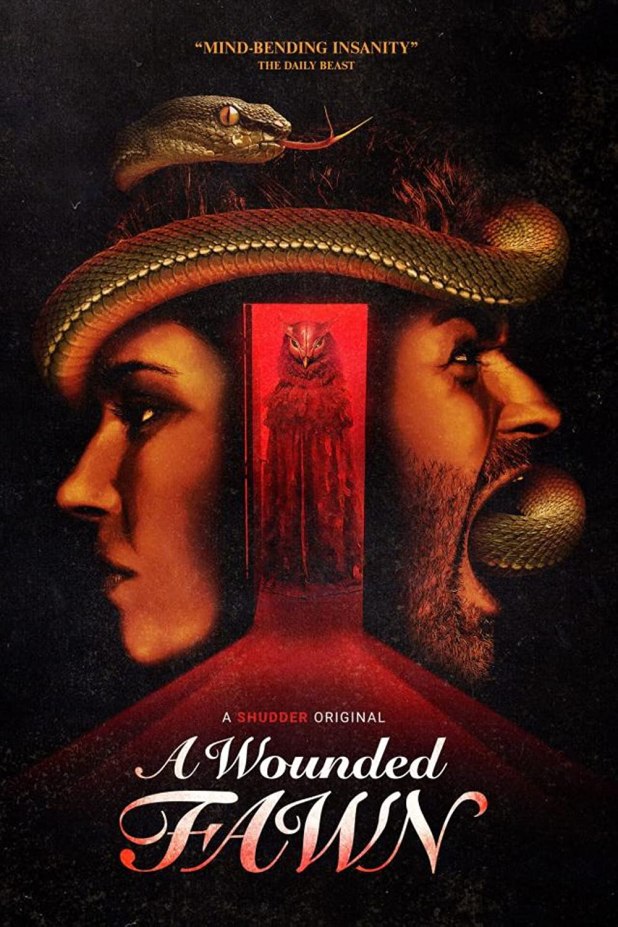
SHUDDER EXCLUSIVE: A Wounded Fawn (2022)

Director and co-writer — with Nathan Faudree — Travis Stevens (Jakob’s Wife, Girl on the Third Floor) combines the slasher, giallo, Greek mythology, art, romance and even comedy all into one strange little movie, one where the antagonist is forced to become the protagonist; one that makes us sympathize with a female character early only to DePalma — and Hitchcock — rug pull and make us realize this is a different film.

Bruce (Josh Ruben) and Meredith (Sarah Lind) seem like they’re on the verge of a connection when he asks her to visit his cabin in the woods. Sure, it’d seem good if we hadn’t already watched him kill someone to get his bloody hands on The Wrath of the Erinyes, a sculpture of the Three Furies.

By the end of the movie, Meredith has caught on and Tisiphone, Alecto and Megaera in the form of his past victims (Sarah Linda, Malin Barr and Katie Kuang) have become alive, seeking to inflict on him the pain he has on so many others, all while he comes to terms with The Owl, a creature that is the darkest side of his mind. It’s kind of amazing that the statue that starts all of this ends up being alive at the close.

This movie also gets its soundtrack right, from Cigarettes After Sex’s haunting “Nothing’s Gonna Hurt You Baby” to The Tammys’ “His Actions Speak Louder Than Words,” Manfred Mann’s “L.S.D.” and Massage’s “At Your Door.”

I always fret about when a movie starts strong and has such a dramatic turn, especially one that suddenly becomes surreal — spoiler warning — and the world changes quickly, but this totally gets the tone right, even when it’s changing and most importantly, has a strong ending that gets it right.

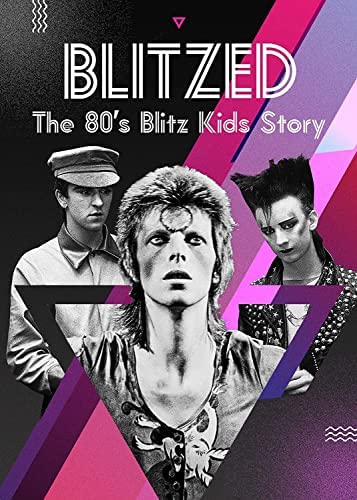
MONSTER/POP TWIST ENTERTAINMENT DVD RELEASE: Blitzed: The 80s Blitz Kids Story (2021)

Can one night change the world? When it was Tuesday night at London’s Blitz club, hosted by Steve Strange and Rusty Egan, the answer was yes. After the no future gloom of punk, the New Romantics made dressing up — while still being poor — into an art form and the music, clothes and attitude would change pop culture.

This film allows you to get the real story — or several versions of it — from those who were there, like Egan, Boy George, Marilyn and Midge Ure to Gary Kemp (who documented the scene in his book I Know This Much), Andy Polaris, Robert Elms, Darla-Jane Gilroy, Michele Clapton and more.

Even if you don’t know about the Bowie-worshipping club or have never heard the music of those who were in the scene like Ultravox, Spandau Ballet, Boy George, Sade and Visage, you’ll enjoy this film, as it paints a gorgeous picture of a long lost time, an incredibly magical time in so many lives.

It’s astounding that so much of this change can be traced back to Bowie, who would use Blitz club kids in his “Ashes to Ashes” video.

Unlike Studio 54, the rough entry policy to the club was more than being exclusive. It was to protect people experiencing their true selves for maybe the very first time. Boy George says in the film, “Sometimes being yourself is the most political act you can ever commit. Saying this is what I am unapologetically. I’m queer and I’m not depressed about it!”

This movie was quite inspiring to me, letting me know more about a scene whose music I love but I had no idea how it all was born. Any documentary that makes you go deeper and seek more — like this — is a success.

You can get this DVD from MVD.

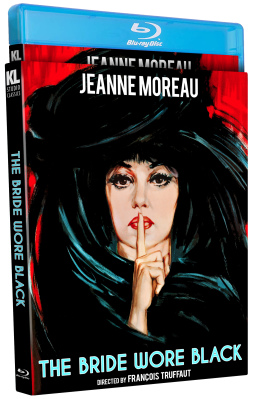
KINO LORBER BLU RAY RELEASE: The Bride Wore Black (1968)

Cornell Woodrich wrote a ton of stories that got turned into movies, like Black Alibi, which was made as The Leopard ManThe Mark of the WhistlerNight has a Thousand Eyes; The Death Stone, which was made as The Earring by Leon Klimovsky; Rear Window; Rendezvous in Black, which was made as Seven Bloodstained Orchids; The Boy Who Cried Murder, which was made as Cloak and Dagger and I’m Dangerous Tonight.

The fact that he made one of Alfred Hitchcock’s best-known movies is no accident, as director and co-writer — with Jean-Louis Richard — François Truffaut was trying to combine Hollywood with the French New Wave. He wasn’t happy with how it came out, as critics savaged it. In truth, he had daily arguments with cinematographer Raoul Coutard over how the movie would be filmed. They fought so much that many scenes ended up being directed by the star of this film, Jeanne Moreau. At the premiere, Truffaut was said to be “tormented by the contrast between the emotional notes he had intended to give the actors and the finished film.” He never called out or named Coutard as the reason why.

Julie Kohler (Moreau) tries to jump out of a window before her mother stops her. She instead goes on a long trip, but in truth, she boards a train and steps right off. She has stripped herself of her funeral black and is clad in all white when she appears again, arousing the ardor of soon-to-be married Bliss (Claude Rich) at a party on the evening before his wedding. He maneuvers her onto the balcony. She maneuvers her way into shoving him off the building.

She follows that by poisoning a lonely bachelor named Coral (Michel Bouquet) and as he dies, she reveals her identity, explaining how the love of her life was shot on the steps of the church on their wedding day. Then, she becomes a teacher, sending away the wife of the politician Morane (Michel Lonsdale), putting his son to bed and locking the man inside a hidden closet. She seals the door and he runs out of oxygen.

All of these men were members of a hunting party drunkenly playing with a rifle in a hotel room when Fergus (Charles Denner) fires it, killing her husband, an event we learn of in flashback. After posing as an artist’s model, she allows him to paint her before killing him. The last of the party is arrested and out of her reach, so she allows herself to be jailed for her crimes, only to use her wiles to find her way into his side of the prison and, yes, getting her revenge.

How Hitchcock is this? Well, in addition to the Woolrich novel, Truffaut had recently finished Hitchcock/Truffaut,  a book of interviews with the master of thrillers and even used Bernard Herrmann to write the score.

The French New Wave argued that American film lovers missed the real heroes of cinema. For example, Truffaut dedicated his first film, Breathless, not to anyone famous or well-considered. He named Monogram Pictures, the b-movie studio.

Therefore, what emerges may not be art, but it is gorgeous and it is suspenseful. And to me, it’s a successful movie.

A lot of people remark how much Kill Bill is like this, as a bride has a list that she crosses off one by one as she hunts those who killed her husband on her wedding day. Tarantino claims he never saw it before he made his movie, which could be hyperbole, but he definitely saw She Killed In Ecstasy, the Jess Franco movie that takes a lot from this.

The Bride Wore Black has been released on blu ray by Kino Lorber. It has commentary by film historians Julie Kirgo, Steven C. Smith and Nick Redman and a trailer. You can buy it from Kino Lorber.

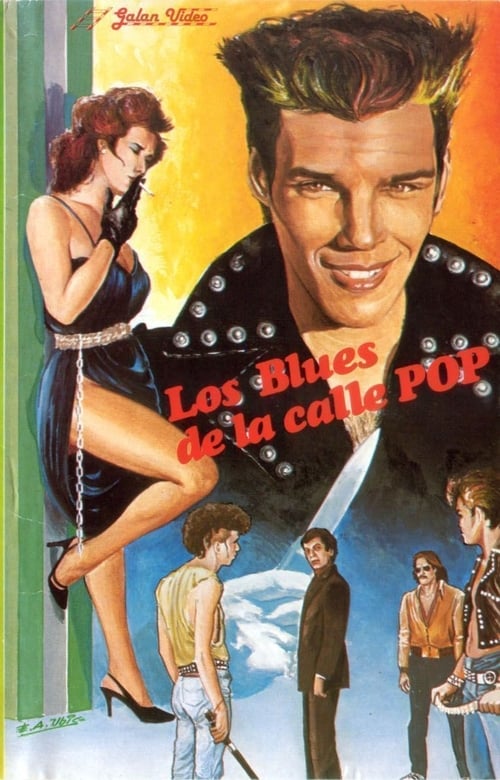
JESS FRANCO MONTH: The Blues of Pop Street (1983)

Los blues de la calle Pop (Aventuras de Felipe Malboro, volumen 8) is a movie where Jess Franco posits that a young girl named Mary Lucky (María del Mar Sánchez) from Mondonedo, Ohio — did he mean Macedonia? — hires a detective named Philip Marlboro (Antonio Mayans) to find her boyfriend Macho Jim who has disappeared into Shit City — yes, Shit City — a place that is ruled by punk rock gangs.

Yes, Phillip Marlboro, not Al Pereira, because this is Jess making this movie and naming everyone after tobacco brands is kind of like what Albert Pyun did with guitars in Cyborg.

There’s also a bar filled with images of Monroe, Bogart and, for some reason, Adam Ant.

That bar is where Marlboro has been told that Macho Jim can be found, a place where Sam Chesterfield (Franco) plays the piano and Genera Johnny “Butterfly” Walker (Lina Romay) dances. There’s also a gang of punks who trounce our protagonist led by Impassive Carter (Agustín García), who is equally qualified to dance the flamenco and toss knives.

This is filled with twists and turns, as Butterfly is really the wife of rich drug dealer Saul Winston (Trino Trives), who is also sleeping with Macho Jim, who also wants to take over the drug trade and steal Butterfly, but Mary knew her from the old days and has always hated her and once she steals her man, well, she shoots her and makes sure that Winston dies in a plane crash before paying off Marlboro with some close-up Jess Franco love scene lovemaking.

As much as I discuss the Jess Franco Cinematic Universe, this is a comic book movie and even shot to look like panels and be part of a much larger narrative, a world where tough detectives, sexy women, punk lowlifes, smoky bars and, always, jazz rule all.

It’s both like and unlike everything else Franco made and that’s why I loved it.

JESS FRANCO MONTH: Downtown Heat (1994)

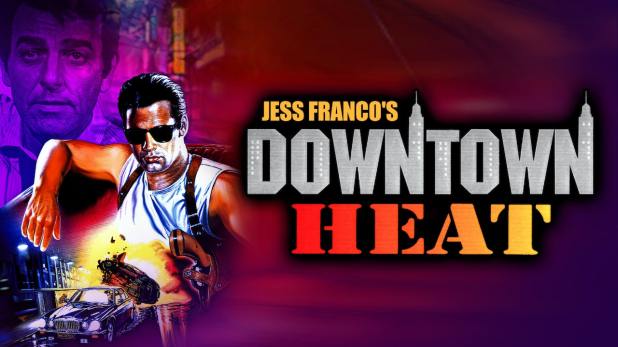
I never think of the world of Jess Franco existing in the same universe as the Hard Rock Cafe and their shirts, which were once everywhere, but here we are as the hero of this movie plays mournful jazz as he laments the death of his wife. Also: when they find the body of his wife, it’s in a junkyard and covered with mice and it turns out that she was having an affair with Melissa, who is Lina Romay and man, just when I was bored by this movie being a police sort of action movie, Lina shows up with a mohawk and eye makeup and a gang that looks straight out of the Bronx by way of Italy.

Oddly enough, this has some American names in the cast including former 20th Century Fox contract player, star of Desilu’s Whirlybirds and alleged early boyfriend of Rock Hudson Craig Hill and Mike Connors (I have no idea how Joe Mannix ended up in a Jess Franco film).

It’s also the last movie of Charlie’s daughter Josephine Chaplin, who was also in Pasolini’s The Canterbury Tales, Franco’s Jack the Ripper and Chabrol’s Cop Au Vin.

Unlike nearly every Franco movie, this was made in sync sound.

So yeah. Cop action. Dead wife. Evil drugs. Somehow the only movie that Jess made in 1994, which kind of blows my mind as much as this not being dubbed.

You can watch this on Tubi.

SHUDDER EXCLUSIVE: The Lair (2022)

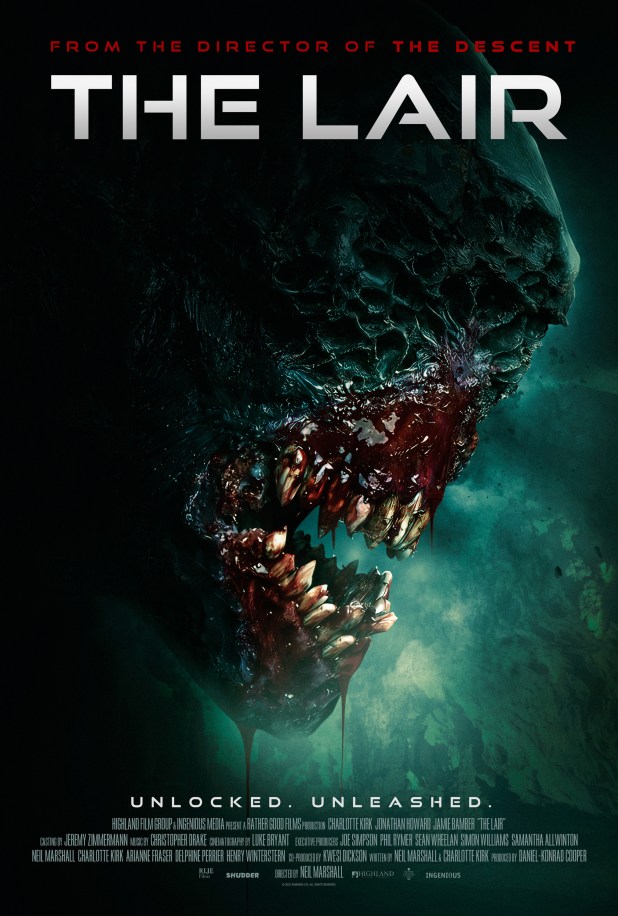
When Royal Air Force pilot Captain Kate Sinclair (Charlotte Kirk) is shot down during her final mission, she somehow discovers an abandoned bunker where Russian scientists once spliced human and alien DNA to make a weapon. A weapon that is now awake.

A strong woman finding monsters in a cave. You know who directed a good movie about that? Neil Marshall. The Descent. Guess what? He’s the director and co-writer — with Kirk — of this movie. He also made Dog Soldiers, so I’m going to give him a free pass and watch anything he does.

The good news is that this is a step up from the last movie I watched from him, Hellboy. It’s not going to be the best thing you’ve watched but you won’t feel like you wasted any time.

It ends up with Kate teaming up with the soldiers that save her — one-eyed top kick Major Roy Finch (Jamie Bamber), SAS soldier Sgt. Oswald Jones (Leon Ockenden), secret pickpocket Corp. Jade Lafayette (Tanji Kibong), battle hardened Corp. Jade Lafayette (Jonathan Howard), combat medic Corp. Kip Wilks (Mark Strepan), big tough Dave Bromhead (Troy Alexander) and Kabir Abdul Rahimia, a local who is sick of all the invaders, including the aliens — to battle monsters who love to eat human flesh.

This feels like a direct to video movie from the video rental past and you know, that’s always good thing. It has goopy monsters, plenty of grisly demises and some incredibly hilarious choices for accents. If this had a video box, it’d say “The maker of The Descent and Dog Soldiers is back!” and, you know, it wouldn’t lie.

ARROW BLU RAY RELEASE: Nightmare at Noon (1988)

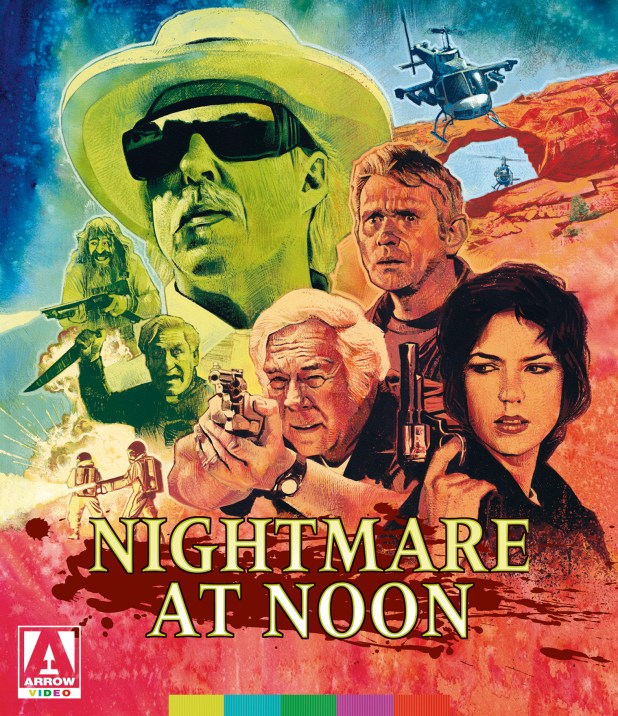
Ken Griffiths (Wings Hauser) and his wife Cheri (Kimberly Beck, Massacre at Central High) are traveling across the highways of America via recreational vehicle — which as I’m obsessed with RV horror I already know is a bad idea — when they pick up ex-cop hitchhiker Reilly (Bo Hopkins), which also seems like a bad idea but it isn’t. What is the most horrible of all ideas is when they pull into Canyonland, Utah, a place where a mysterious albino — but come on, it’s John Carpenter, right? — played by Brion James is working with shadowy government troops and black helicopters to test a bioweapon on the small town, turning everyone there into zombies. Everyone but Ken and Reilly, who have only had beer to drink, and Sheriff Hanks (George Kennedy) — who claims to have not had water in years — and his daughter Deputy Julia (Kimberly Ross, Pumpkinhead) must stay alive as long as they can as the zombies attack the town.

Except that at some point, Hauser disappears and this becomes all about Bo Hopkins on a vision quest in the desert like a Western, hunting down the albino scientist and his men, as well as a lengthy helicopter chase.

Hauser may have not been in the film for an extended period because of his off-set problems. I’ve heard a story that his brother came to visit his motel room and Wings slammed his brother’s head through a wall, which got him arrested and Mastorakis had to pay his bail.

Yet Nico Mastorakis really can’t make a boring movie. This starts with late 80s computer graphics, a synth Hans Zimmer score and great scenery, plus it has a mini-reunion of the stars of Mutant. Actually, it’s very close to that movie to the point that it could be a parallel reality version of the last movie of Film Ventures International.

This is also the wet dream of Q-Anon lovers, as the albino and his black vans, helicopters and APE (Agency for the Protection of the Environment) henchmen all exist to destroy small town America. They’re probably making homosexual frogs, too.

The other title for this, Death Street USA, is better than what they used.

The Arrow Video blu ray of Nightmare at Noon has a new restoration from the original negative; a making of featurettewith commentary by Mastorakis; gehind-the-scenes footage; on-set interviews with actors Hauser, Hopkins, Beck, Kennedy and James; the trailer, an image gallery with the score from Stanley Myers and Hans Zimmer; a reversible sleeve featuring original and newly commissioned artwork by Graham Humphreys and an illustrated collector’s booklet featuring new writing on the film by Johnny Mains. You order it from MVD.

JESS FRANCO MONTH: Death Whistles the Blues (1962)

EDITOR’S NOTE: You can read Sean Mitus’ article about this movie here.

Jess Franco remade this in 1977 as Kiss Me Killer, but before that, this black and white slice of noir feels like an altogether different director. Sure, there’s jazz — Franco himself is playing saxophone in one scene — but this looks and feels different to me. Sure, the easy difference is the black and white, but it feels like a different kind of sexy, if that makes sense. Both this and Rififi in the City have a certain look that I’d like to have seen more often.

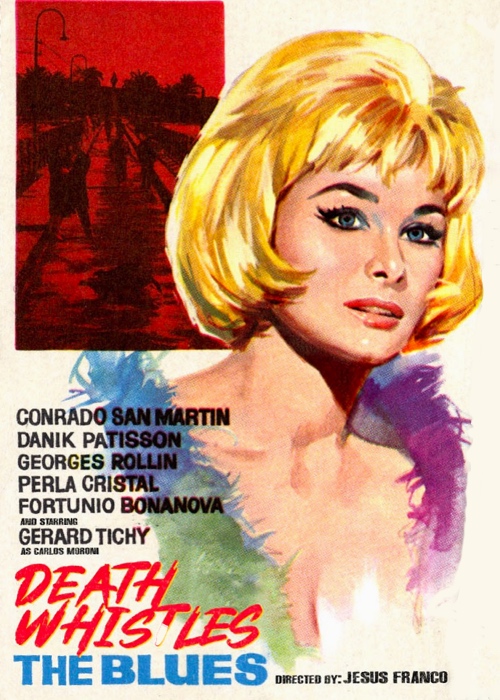
Years ago, a guns for money deal went wrong. Trumpet player Julius Smith (Manuel Alexandre) thought he got away with it and then one night he’s spotted by Lina (Perla Cristal), whose husband Castro was killed when it all went wrong. Now, she’s married to another man of loose morals, Paul Vogel (Georges Rollin), who knows way more about hos Julius died than he lets on. The cops decide to find out just how much and have a new singer named Maria Santos (Danik Patisson) join the club and get close to him. Then, Castro (Conrado San Martin) comes back, the final member of the old smuggling operation, stinging from a decade in prison.

This movie looks great, way better than its budget and I get it, it’s not New Orleans, but who cares? I also love that this is an early shared universe for Jess, as The Stardust nightclub also appears in Rififi in the City. All that’s missing is a jewel thief, Dr. Orloff, Lina Romay in a blonde wig (that said, she was eight when this was made), vampire women and a mist that makes women enraptured.

You can buy this from Severin as part of their Franco Noir set or watch it on Tubi.