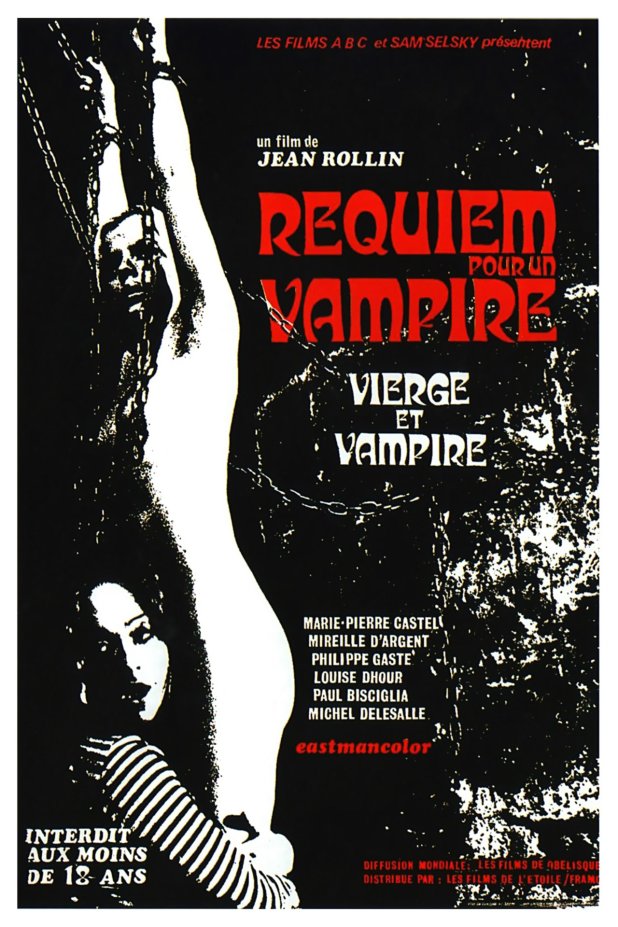
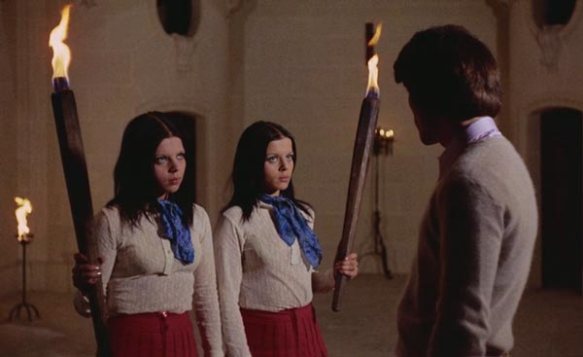
Shot in a historical castle in the small village of Crêvecoeur, Requiem for a Vampire finds director Jean Rollin’s fourth female vampire movie. The castle was nice — it was filled with expensive antiques — but Rollin was more interested in the dungeons that overlooked the entire region.
Marie-Pierre Castel, who starred in Rollin’s The Nude Vampire and Shiver of the Vampires along with her twin sister Catherine, stars and is joined by Mireille Dargent, whose agent was stealing her wages for the movie and Rollin figured that out and got her paid.
They play Marie (Castel) and Michelle (Dargent), who first appear as clowns on the run from unseen pursuers. Their driver is killed and they race into the woods where they are nearly buried alive in a cemetery and then an ancient castle filled with bats and a cozy bed to make love in. The castle is filled with skeletons and a male and female vampire. Of course, the male has designs on them, wanting them for his virginal eternal vampire brides, but Michelle ends up sleeping with another man which ruins those plans and almost destroys her relationship with her true love Marie.
Rollin wrote this in one sitting, piling story beats on top of one another with little care for plausibility or any connection. Then again, when was he any different? Amazingly, this played American grindhouses as Caged Virgins, a title that I guess makes as much sense as anything. One wonders what people thought when confronted by a near-wordless journey of two clown girls trying to shoot everything in their way and setting a man on fire before both finding their way to a vampiric master who finally decides that his bloodline must end.
He was learning however and got past censors by shooting a version where the girls stayed clothed, even when being whipped and while they engaged in a sapphic embrace. Most countries can handle horrific violence; the form of a nude woman is where the problems begin.
This is the only movie I’ve ever seen where a vampire bat goes down on a woman, so for that alone, Jean Rollin has my respect if not obsession.
Get ready for a brand new issue, the first of 2023.
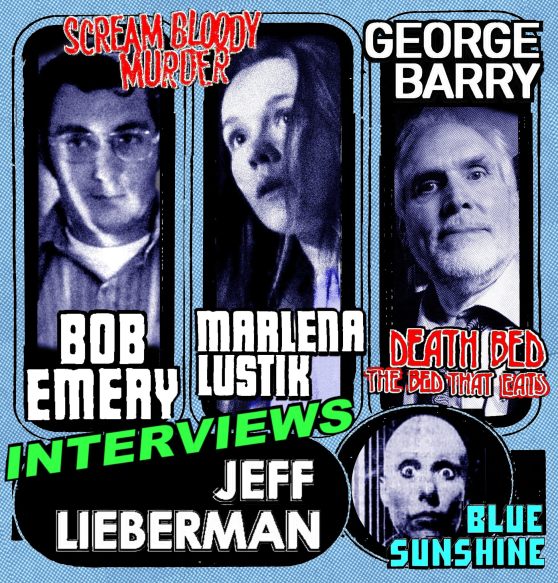
Issue #24 is one of our best ever, we’ve got many great features for you in these pages. First, we have the final interview that George Barry ever gave before his recent passing. Sam Panico talked to George about his phantasmagorical 1977 film Death Bed: The Bed That Eats, as well as the basics of being a monster kid and the appreciation of fantastic films.
1972’s Scream Bloody Murderwas an early effort from Floridian filmmaker Robert J. Emery – currently only available via a 1988 VHS release, this disturbing melodrama sticks in the memories of those who saw it due to its bizarre subject matter. Bill Van Ryn speaks to both Emery and his leading lady in the film, Marlena Lustik, for insight about the creation of this unjustly obscure psychological thriller, which was also known as My Brother Has Bad Dreams.
Steve Wilson talked to director Jeff Lieberman at a convention and asked him about his 1977 freaked-out thriller Blue Sunshine – Steve recounts their conversation here, along with his own thoughts regarding this drug-themed shocker.
We’ve also got commentary about monster rally films, the giallo films of Carroll Baker, remembrances about being a projectionist at a small drive-in theater in the 70s, and reviews of Night of the Demonand Revenge of the Cheerleaders. And yes – as usual, this issue is jam packed with the vintage newsprint ads you love!
72 pages with a full color cover and black & white pages inside, some pages printed on colored paper, 5.5 x 8.5 inches in size.
EDITOR’S NOTE: You can read another take on this film here.
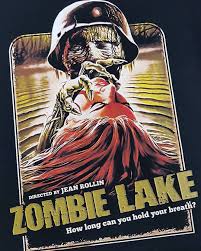
Zombie Lake feels like someone watched Shock Waves and said, “Well, let’s make a zombie Nazi movie right where this stuff actually happened.”
It was supposed to be directed by Jesus Franco, who left the movie over its budget — just imagine how bad that budget had to be — and Eurociné got Jean Rollin on board with just a few days’ notice. It’s not in his official filmography, despite making money, so again — just imagine.
Julian de Laserna also directed parts of the film under the supervision of Rollin, which is why this movie is credited to J.A. Lazer. It was written by Julián Esteban and Eurociné producer Marius Lesoeur using the name A.L. Mariaux.
Twenty years after the second war to end all wars has ended, a small French village has a lake of the damned within it, yet women still skinny dip within it. I mean, if you knew Nazis had been drowned in a lake, would you even go near it? Like some kind of French Larry Vaughn, Howard Vernon keeps denying that there’s any problem.
That’s when reporter Katya Moore (Marcia Sharif) gets to the bottom of things: a woman (Nadine Pascal, you know you’re seen too many Eurotrash when you pick up the actresses without IMDB) in the village had nursed a young soldier back to life and returned this kindness by doing a little bisecting the triangle with her and leaving her with child just in time for him and his entire platoon to be shot to pieces and drowned in the river, as well killing that women moments after he gave birth to their daughter Helena (Anouchka, the daughter of Eurociné’s Daniel Lesoeur; she’s also in Franco’s White Cannibal Queen).
After an entire women’s volleyball team and two cops — including Rollin — are torn to pieces by the Aryan walking dead, the mayor decides to use Helena to lure her undead father and his troops into a mill where they can burn them up.
This movie makes so many mistakes — like being filmed at all, to start with — that it becomes charming. If the war was twenty years ago, how does 1980-1945 = 35 years? Why did they pretend that the water in the beginning is a lake when we can clearly see that it’s a swimming pool and even view an exit sign? Did no one notice that the zombie makeup was rubbing off? Did no one notice that Daniel White just was remixing songs from other movies like Jess Franco’s Female Vampire and The Awful Dr. Orloff? Can you believe that they shot clothes and unclothed versions of this movie? With Antonio Mayans showing up as a one-eyed zombie, can we play six degrees of separation here with Rollin and Franco as well as consider this a Eurociné all-star film? How amazing would this have been if Franco did stay on and made this as another Orloff movie? Isn’t Oasis of the Zombies this movie all over again? Was Charles Band that hungry for content that he bought both those movies for his Wizard Video imprint? If this is not set in the 80s, why are all the roads, signs and buses modern?
If you’re looking for a movie where the crew shows up as often as the cast, this is it. Crew members wander into some shots, show up in mirrors and often leave their cables lying around in nearly every shot.
Yet you know, it’s kind of adorable, if a movie about the French killing soldiers who rise back up at some indeterminate time can be cute. There are bright green men wandering about, mauling nude women and getting their green skin all over everything, all while you can obviously see Howard Vernon in one scene waiting for his cue.
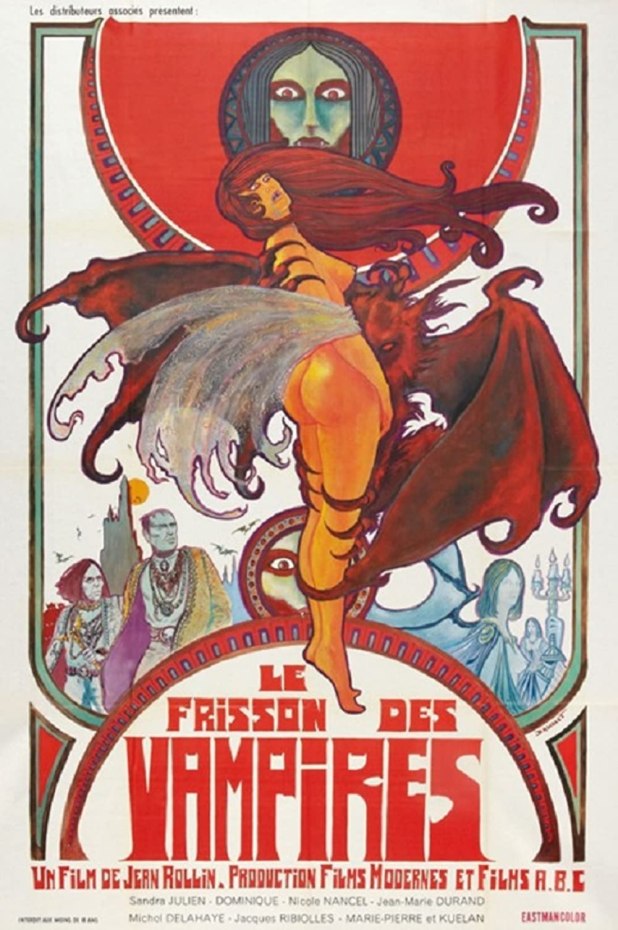
Also known as Sex and Vampires, Strange Things Happen at Night, Terror of the Vampires, Thrill of the Vampire and Vampire Thrills, this is the third time that Jean Rollin would bring a vampire movie to the screen. Look, if you’re obsessed, you’re obsessed.
Isle (Sandra Julien, Je Suis Frigide… Pourquoi?) and Antoine (Jean-Marie Durand) have just arrived in town for their honeymoon, only to learn that the cousins they plan on staying with have died. But hey — they’re house is open, right? And it’s totally not weird that the two servants (Marie-Pierre Castel and Kuelan Herce) just tell them to stay. Nor is it otherworldly that Isolde (Dominique) emerges from a clock and soon, she’s unable to go out into the sun.
Every woman is naked, bras have spikes in them, castles are filled with fog, Rollin shows a love of the lighting and colors of Bava and the band Acanthu is just rocking so hard that no one can yell loud enough over them to tell them, “Hey this is a dreamy sapphic vampire movie, maybe stop rocking so hard” and they’re just headbanging and smoke is everywhere and just go with it, man.
Also: Not the last lesbian vampire movie Rollin had in him.
Either you get into the druggy vibe of Jean Rollin or you think it’s the most boring filmmaking ever. But me, well, I’m nodding off and living inside the languid pace of his films and looking for those moments when masked maniacs wander the streets and indiscriminately murder people and the film doesn’t really feel like cluing you into what’s going on because why should it? You have to earn it.
I mean, what if you went to a party where a woman’s photo is projected on a screen and she kills herself in front of the guests so that a strange woman in an orange nightgown can drink her blood and then your photo comes up next?
None of these things will ever happen to any of us. We’ll never have days where we don’t see the sunlight and realize we’re the first humans to be immortal. At least I don’t think we will. I mean, wouldn’t it be great? But then I wonder, would my acid reflux get bothered by certain types of blood?
I mean, the basic description of this movie says: “Wealthy and decadent industrialist Georges Radamante rules over a strange secret suicide cult and wants to achieve immortality by figuring out a way to share the biochemistry of a young mute orphaned vampire woman.”
If you don’t want to watch that, well, I don’t know what hope there is for you to experience magic.
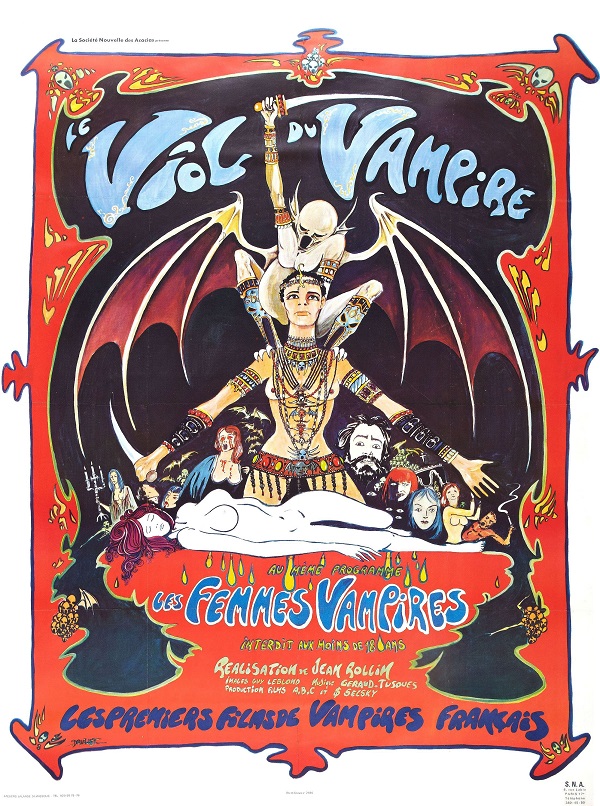
Le Viol du Vampire was the first film directed by Jean Rollin and is a short film with added footage to make it a complete feature. It’s two parts are The Rape of the Vampire and The Queen of the Vampires. It was commissioned by French retailer Jean Lavie, owner of a network of small theatres who needed a short vampire film to play before the 1940 American film Dead Men Walk, which he had bought the rights to and was planning to rebroadcast.
Rollin had only worked on short films and documentaries, but he was excited to work on this film/. With a budget of 200,000 francs, he started making his fantasy film which would be influenced by American adventure serials. The filming, other than the beach scene, was all at an abandoned Paris house called Château de Gressy.
Debuting on May 27, 1968, the film was lucky — maybe — to play to big audiences who were in the midst of strikes and riots and needed entertainment. Lavie’s theaters had it and as they sat through his dream-like film, they weren’t happy.
Rollin told KinoEye, “Le Viol was a terrible scandal here in Paris. People were really mad when they saw it. In Pigalle, they threw things at the screen. The principal reason was that nobody could understand the story.” It would go unreleased on video until 2000.
Four sisters — including model Ursule Pauly and exotic dancer Nicole Romain — believe that they are vampires, making them all fear the daylight and the crucifix, as well as be very suggestable to the old man who orders them to kill and also likes to casually grope them and also be slaves to the idol in the forest who speaks directly to them.
Three people from the big city — Thomas, Brigitte and Marc — have come to cure them of this insanity, believing the villagers have driven them mad. The old man, sure that he will lose his power over them, orders them to kill the outsiders and then unleashes the village on everyone. Thomas begs one of the sisters to prove that she is a vampire and is stunned to learn that she really is, just in time for Marc to kill everyone as he has been driven mad by the death of Brigitte.
The second part of the story involves the queen of th vampires as she attempts to escape her curse and Thomas and Brigitte coming back to life after drinking the blood of the old man. Of course, this being a Rollin movie, a woman is whipped on the beach and everyone ends up dying rather than giving in to their thirst for blood.
Rollin improvised most of the story because he lost the script on the third day of production. Just imagine how wild this man gets when he has no plan if his planned films seem so odd. He’d continue his obsession with vampires, lesbians, old cemeteries and eroticism. This is the DNA that runs through so many of his films with several moments recaptured and reshot later.
EDITOR’S NOTE: Cinematic Void will be playing this movie as Creepers — in 35mm! — on Tuesday, Jan. 31 at 8:00 PM at The Majestic Tempe 7 in Tempe, AZ. CV’s Jim Branscome in person will be in person (tickets here).For more information, visit Cinematic Void.
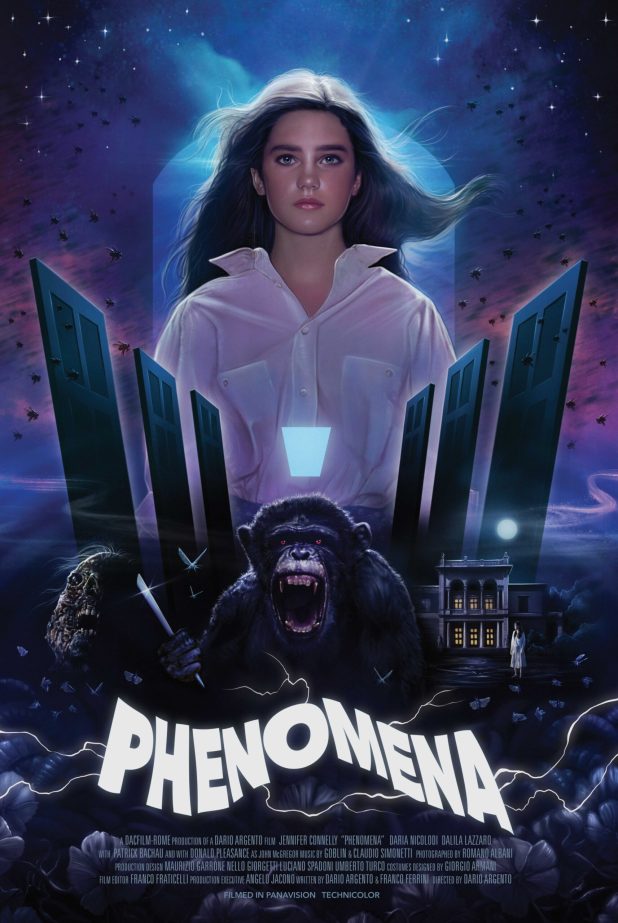
A monkey. A girl who can talk to bugs. Donald Pleasence. All directed by Dario Argento. If you don’t immediately say to yourself, “I’m in,” you’re reading the wrong website.
Within the movie’s first two minutes, you realize you’re watching an Argento film. A tourist misses her bus somewhere in the Swiss countryside before she is attacked by an unseen person and then beheaded.
Fast forward a bit, and we catch Jennifer (Jennifer Connelly, Labyrinth, The Rocketeer) arriving at the Richard Wagner Academy for Girls — did I tell you this is an Argento movie? The head of the school, Frau Brückner (Dario Nicolodi, Argento’s wife (at the time) and mother to his daughter Aria, who also co-wrote Suspiria and appeared in Deep Red, Inferno, Tenebreand Opera, amongst other films), already sets up an air of menace. Even her roommate offers no relief, telling Jennifer how much she wishes she could have sex with the heroine’s famous actor father. At this point, Jennifer relates a horrifying story about how her mother left her — it’s a moment of pure pain in a film that hasn’t led you to expect it. That’s because it’s a true story. The true story of how Dario Argento’s mother left his family.
Jennifer tends to sleepwalk, which leads her through the school and up to the roof, where she watches a student get murdered. She wakes up, falls and runs from the murderer, ending up in the woods where she’s rescued by Inga the chimp — again, did I mention this is an Argento film? Inga works for forensic entomologist John McGregor (Pleasence). Argento was inspired by the fact that insects are often used in crime investigations to learn how old a body is and worked that into this film. McGregor knows that Jennifer can talk to the bugs.
After returning to the school, things go from bad to worse. Jennifer’s roommate is murdered, and a firefly leads our sleepwalking protagonist to a glove covered by Great Sarcophagus flies, which eat decaying human flesh, which can only mean that the killer is keeping his body — again, Argento.
At this point, Phenomena pays tribute to Carrie, with the other students making fun of her regarding her love of bugs. She calls a swarm of flies into the building, and it collapses, which leads to Frau Brückner recommending her to a home for the criminally insane. Luckily, Jennifer runs to McGregor, who gives her a bug in a glass case that she can use to track the murderer. Again, you know who. The bug leads Jennifer to the same house we saw at the film’s beginning.
Meanwhile, McGregor is killed after Inga is locked outside. True fact: the chimpanzee who played Inga, Tanga, sounds like she was uncontrollable. She ran away for an entire evening of the shoot and nearly bit off one of Jennifer Connelly’s fingers.
Let me see if I can sum up the craziness that ensues: Jennifer calls her father’s lawyer for help, who ends up bringing Frau Brückner back into this mess, who tries to poison Jennifer and then knocks her out with a piece of wood. She then KOs a cop before Jennifer escapes, going through a dungeon and a basement until she falls into a pool that is packed with maggot-ridden corpses. This is the point in the film where you may want to stop eating because it gets rather intense from here on out. As Jennifer escapes that watery tomb, she hears someone crying. That someone is Frau’s son, who was born from a rape. Jennifer asks him why she thinks he’s a monster, to which he turns to face her and scares the fucking shit out of her. Seriously, it’s jolting — the kid has Patau Syndrome, a real chromosomal abnormality (it’s makeup in the film, but looks quite true to life). He then chases Jennifer into a motorboat, but at the last second, she calls a swarm of flies to attack him. He falls into the water, and the boat explodes, and he dies, and…whew.
I know this film is 32 years old, but I will leave some spoiler space here because what happens next is crazy.
Jennifer reaches the shore just as her father’s lawyer arrives. All well, all good and then, out of nowhere, Frau cuts the dude’s head clean off. Plus, she’s already killed the cop, and she goes absolutely shithouse.
“He was diseased, but he was my son! And you have… Why didn’t I kill you before? I killed that no-good inspector and your professor friend to protect him! And now… I’m gonna KILL YOU TO AVENGE HIM! Why don’t you call your INSECTS! GO ON! CALL! CALL!”
At this point, Inga, the chimpanzee, comes out of nowhere and kills Frau with a razor. Keep in mind that this is not just one cut. This is a simian who knows how to get the murder business done.
Jennifer and Inga hug. Roll the credits.
Phenomena was the last Argento movie to get significant distribution in the U.S., thanks (or no thanks) to New Line Cinema, which played it here as Creepers. This version is 33 minutes shorter than the original and has so many scenes shuffled that it makes little or no sense. Also, unlike other Argento films, Goblin only has two songs in this, as modern bands like Iron Maiden and Motörhead are featured.
I love this movie. It makes little sense, but you don’t walk into an Italian horror film expecting narrative structure. You hope to see some crazy gore, some interesting death scenes and maggots — all things that this film more than delivers. I’m not the only fan of this flick — the Japanese video game Clock Tower is an homage to this film, even featuring a heroine named Jennifer.
BONUS: We did a podcast all about this movie, and you can hear it here:
EDITOR’S NOTE: Cinematic Void will be playing a 35mm print of this movie on Friday, Jan. 27 at 7:30 PM at The Little Theatre in Rochester, NY. For more information, visit Cinematic Void or purchase tickets here.
Knife + Heart is a true anomaly when it comes to giallo. It’s from France, a country more given to the fantastique film than the giallo — though there are movies like The Night Caller, Without Apparent Motive and The Night Under the Throat. And its victims aren’t gorgeous women, but the actors of the gay porn industry, changing the psychosexual dynamics of the form.
Instead of featuring the sounds of a band like Goblin or a score by the likes of Morricone or Orlandi, Knife + Heart has music by Anthony Gonzalez of M83 who is director Yann Gonzalez’s brother.
A young man is killed by a masked man whose very sex conceals his murder weapon to open the film. Then, we meet Anne (Vanessa Paradis), an adult film director who has recently been abandoned by her girlfriend and editor Lois. The man killed in the opening was the star of several of her films; now she must find an actor to take his place. That leads her to Nans, who despite identifying as a straight man agrees to be in her movie.
The new film — Homocidal — will be her version of the murders, which continue targeting members of her cast. The police either can’t — or won’t — help. But the movie gets finished and as the group celebrates its completion with a picnic, the killer strikes again, just as Anne pretty much assaults Lois in an attempt to get her back.
The true killer is a man whose father caught him making love to another man. He killed his lover and castrated his son, who was also burned in a fire before being brought back from the dead by a blind crow — the fact that this movie isn’t called Call of the Blind Crow speaks to its non-Italian origins — and seeing one of Anne’s movies brought his memories back.
This being a giallo, there’s also a bird expert with a disfigured hand that looks like he has, quite literally, chicken fingers. Plus, the entire end of the movie is explained via voiceover. The fact that so much of this movie is given to style over substance means that it lives up to the movies that inspired it.
While the murders are in your face, the sex is nearly hidden from view. And Anne is an intriguing protagonist — drunken and bitter instead of the normal virginal giallo and slasher ingenues that save the day. She instead brings the killer closer with each scene that she directs.
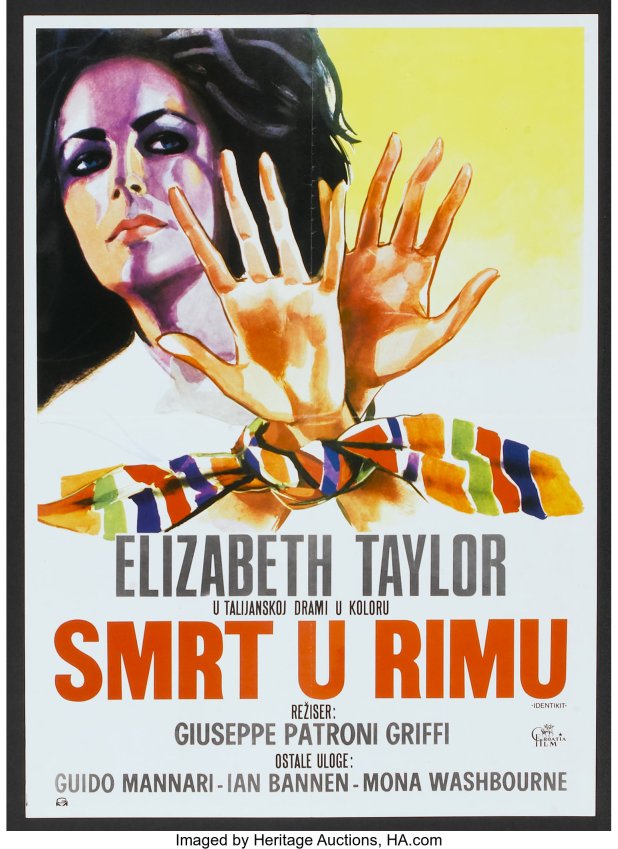
Muriel Spark sold her novel The Driver’s Seat as a whydunnit instead of a detective story. The movie that was made from it, Identikit, by Giuseppe Patroni Griffi somehow goes from a rambling narrative of a woman who has lost or is losing her mind — you knew it, f.giallo — that eventually transforms at the end into an image straight out of the form.
Griffi also made Metti, una sera a cena (Love Circle), which stars Tony Musante and giallo queen Florinda Balkan, as well as Addio, fratello crudele (‘Tis A Pity She’s a Whore), The Divine Nymph which has Tina Aumont from Torso and La Gabbia which had contributions by Fulci and is called an erotic thriller but come on we know what that means.
This was written by Griffi along with Raffaele La Capria.
What’s incredible about this movie is that it finds Liz Taylor — 45-year-old Liz, mind you — playing Lise, a lonely woman from Germany that has come to Rome to find a dangerous liaison, a fatal attraction, dare I say a strange vice to call her own.
Everyone she meets either wants to fuck her or is afraid of her, like the British businessman (Ian Bannen) who tries to pick her up on the plane and offers that he must orgasm every day on his macrobiotic diet; an Italian man (Guido Mannari) who seems perfect if distant and a would-be French lover (Maxence Mailfort).
There’s also the presence of the days of lead looming over everything, as a moment after she lands in Rome, Lise is nearly killed in the crossfire as the police open fire on a protestor and a bomb has cleared all the shoppers away from a mall except for Lise and a doddering elderly woman (Mona Washbourne) in a role that Taylor wanted Bette Davis to play, but Bette said no thanks to a film without a completed script.
Yet the true explosion is within Lise, a woman who won’t have it any way but hers, screaming at a salesgirl — while her one-time biggest star in the world breasts are exposed to the unflinching camera — that she refuses to purchase an outfit that has been treated with stain-resistant chemicals. How dare they believe she’s the type of woman to make such a mess?
This is all told in a way that is both episodic and all over the place, as detectives attempt to understand why Lise was killed along with all of the people that she’s traumatized along the way. It all looks gorgeous, though, as cinematographer Vittorio Storaro is best known for shooting The Bird With the Crystal Plumage, ApocalypseNow, The Last Emperor and Dick Tracy.
At the end, is it a giallo? Well, that fog coming from the trees as — spoiler warning — Lise directs her would-be lover and killer in how to properly bind her hands and stab her isn’t far off from the way most women have to direct their lovers so that they don’t end up penetrating the crease in their leg and never make their way inside them. Liz was just fresh off her first divorce from Richard Burton and it feels like she’s exploding all of her hatred and frustration in this role and man, I only wish that I knew more of this Liz and not the sad last days of tabloid headlines and Larry Fortensky.
One last giallo connection: Franco Mannino also did the music for Murder Obsession.
My favorite thing about this movie? Andy Warhol walks in and takes over a one-minute scene as a British lord.
I love the f.giallo because it’s not always about murder. Sometimes, as in Footprints On the Moon, a movie that this shares the new Severin House of Psychotic Women box sex with, it’s all the female heroine can do to stay sane.
EDITOR’S NOTE: Cinematic Void will be playing this American giallo on Wednesday, Jan. 25, at the Central Cinema in Knoxville, TN. For more information, visit Cinematic Void.
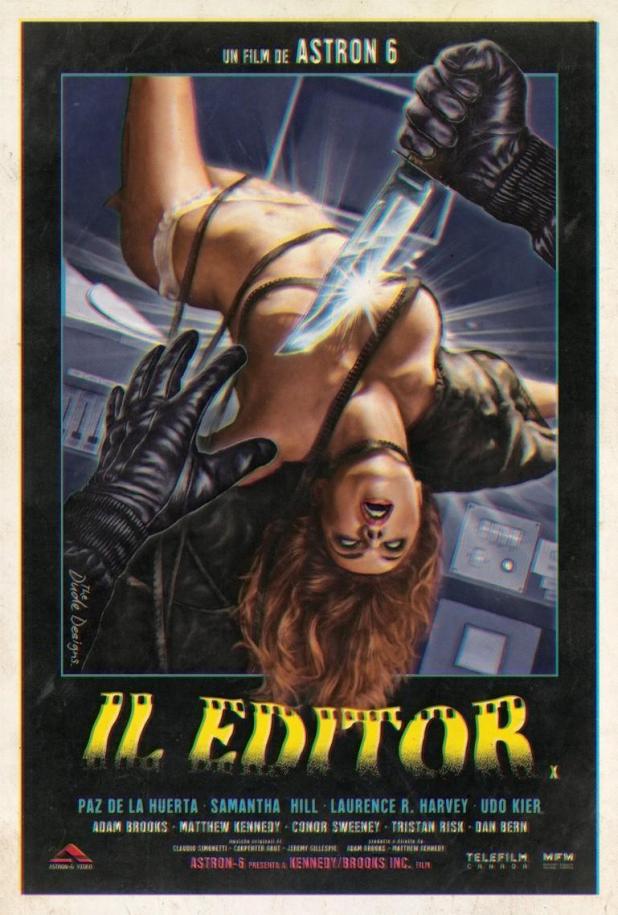
Astron-6 is — well, was as the recent release of the collected Divorced Dad is supposedly their last project together — a Canadian film production and directing company founded in 2007 by Adam Brooks and Jeremy Gillespie which later expanded to add Matt Kennedy, Conor Sweeney and Steven Kostanski. They’re known for producing low-budget horror/comedy films that evoke the 1980s. The fact that their name sounds a lot like Vestron is no accident.
After their initial films — Manborg and Father’s Day — the team moved on to create this tribute/parody of the giallo genre. Gillespie and Kostanski also directed the incredible 2016 horror film The Void, which moves away from the humor of Astron-6.
Film editor Rey Ciso (Adam Brooks) was once a brilliant editor — the best in the world — but that time is far away. Now, he struggles to complete Francesco Mancini’s latest film Tarantola with his assistant Bella. He needs her, as an accident while lost in the madness of editing cost him all of the fingers on his right hand, which are now made of wood.
The loss of those fingers all goes back to Ray getting his start working for Bella’s father, art house director Umberto Fantori, whose debut film The Mirror and the Guillotine won him the success he craved and introduced him to his wife Josephine Jardin (Paz de la Huerta, Nurse 3D, Enter the Void). Eventually, Josephine went mad on Mancini’s next film, which was made to be the longest movie ever. Now, Ray is getting footage of murders sent to him. And to complicate matters, while his wife treats him with disdain, Bella tells him that she loves him.
An unknown killer stalks the studio, killing lead actor Claudio Valvetti and his girlfriend Veronica in a scene that echoes the curtain ripping and blood spraying of Argento’s Tenebre. Margarit Porfiry — another actress on the film — stumbles upon Veronica’s body — hung exactly like the first murder in Argento’s Suspiria — and is struck blind on the spot, making her look exactly like Emily from The Beyond, which the film extends by giving her a dog named Rolfie instead of Dickie.
While her husband Inspector Peter Porfiry (Matthew Kennedy) interviews suspects, co-star Cal Konitz (Conor Sweeney) has his hopes of taking over the movie ruined when a stand-in is found for the lead. Porify’s boss Chief O’Connor wants the case dropped because Margarit is his daughter, but the cop is convinced that the editor is behind the killings, as each murder takes away the fingers of the victim.
Rey has a vision of a dark man with bright blue eyes — Ivan Rassimov, we miss you so — coming after him. Meanwhile, the inspector goes to the insane asylum where Rey lived for some time, meeting Dr. Casini (Udo Kier!), who tells him all about Plato’s Allegory of the Cave. The detective returns home just in time to make love to his wife in a near shot-for-shot remake of the glass smashing love in Sergio Martino’s The Strange Vice of Mrs. Wardh. The killer then makes his or her way into their home and when the cop tries to break into the room with an axe to save her — kind of, sort of like the cemetery scene in City of the Living Dead by way of The Shining — the killer throws her in the way. In order to not be seen as a murderer, Porfiry cuts off his wife’s fingers and feeds them to her dog.
His boss — and remember, the father of his dead wife — screams at Porfiry back at the station while the killer calls to taunt the cop in a scene much like The New York Ripper. That won’t be the last callback to that Fulci film, either.
Rey has gone over the edge, believing himself to be the killer as his wife treats him horribly. He dreams that he is trapped in a world of smoke and gigantic film cans that seems much like the world inside the painting in The Beyond. He gets a psychic flash that Bella is to be murdered but arrives too late to save her.
Giancarlo tries to finish the movie himself, but an army of spiders — again, The Beyond— attacks and he is killed as well. Rey is brought back onto the film and Father Clarke (Laurence Harvey, Frankenstein Created Bikers) explains to him that editors are the vital connection to the other world that Rey glimpsed in his vision. We’ve now gotten to the part of the giallo where reality stops and the Lovecraftian vision takes over.
Everything goes even crazier, if that’s possible, with Cal menacing Rey with a chainsaw before attacking his wife in front of him, ending with his wife laughing it off as she’d been having an affair with the actor. There’s also an ancient bell tower, more tarantulas, a film canister filled with fingers, occult rituals, Josephine declaring herself to be death itself ala the end of Inferno, a fake-out ending that pulls off The Wizard of Oz while again recalling Fulci — both The Psychic, The Beyond— and a post-credits happy ending where Rey and Bella end up together.
This is one strange film. If you’re not hyper aware of giallo, you may be lost by all the references. And if you are, you may be unable to totally take in the narrative as so much of the film feels like spot the reference. That said, I found myself liking The Editor and excited to see where it would go next. The final sequence as the detective and the editor battle the real killer is actually pretty thrilling. And wow, the music is awesome, with Claudio Simonetti composing the main theme.
Even better, the credits keep the story going with Rey Cistro listed as the film’s editor. I also adore the posters for the films within the film, which were created by Graham Humphreys.
This is another review that was inspired by Good Bad Flicks.




 B&S About Movies
You must be logged in to post a comment.