EDITOR’S NOTE: This was first on the site on April 22, 2020.
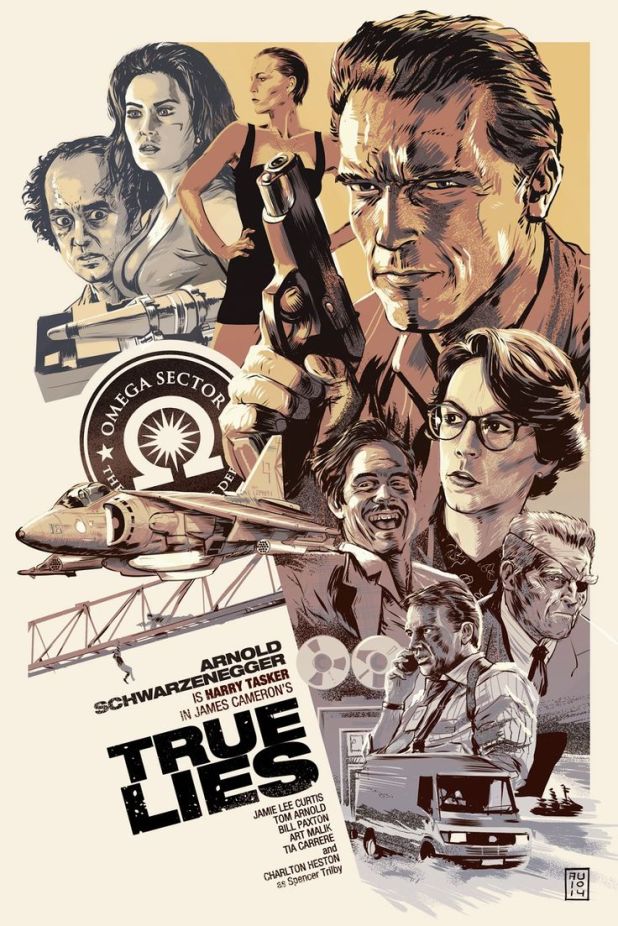
Harry Tasker (Arnold Schwarzenegger) is living two lives. To his wife (Jamie Lee Curtis) and his daughter (Eliza Dushku), he’s a boring computer salesman. But that’s all a cover for his real job, as an agent of the elite Omega Sector. He’s Bond but perhaps even better, as the opening of the film shows him easily seducing Juno Skinner (Tia Carrerestealingeal important files and escaping a society party by killing everyone in his way.
But what happens when his wife meets someone who could be a spy (Bill Paxton) and starts having an affair?
This is a movie that I’d not watched for some reason and I loved it. Particularly, I enjoyed Charlton Heston as Director Spencer Trilby and Tom Arnold as Tasker’s handler Albert Gibson. The spy action moves quickly, the action is big and bold, yet the love between Curtis and Arnold feels real.
Of course, this movie could never be made today, the way that it goes after Arabic people as terrorists. 1994 feels centuries ago in so many ways.
After September 11, 2001, Cameron decided to not do a sequel. He would say, “Terrorism is no longer something to take as lightly as we did in the first one. I just can’t see it happening given the current world climate.” Curtis would also say, “Terrorists aren’t funny anymore. They never were, but, it was distant enough from our psyche that we could make it funny. It’ll never be funny again. I just think that that is over, that kind of humor is over.”
That said, there remains a rumor that McG will be creating a series adaption for Disney+. For what it’s worth, this movie was based on the French film La Totale!, which didn’t get a sequel either.
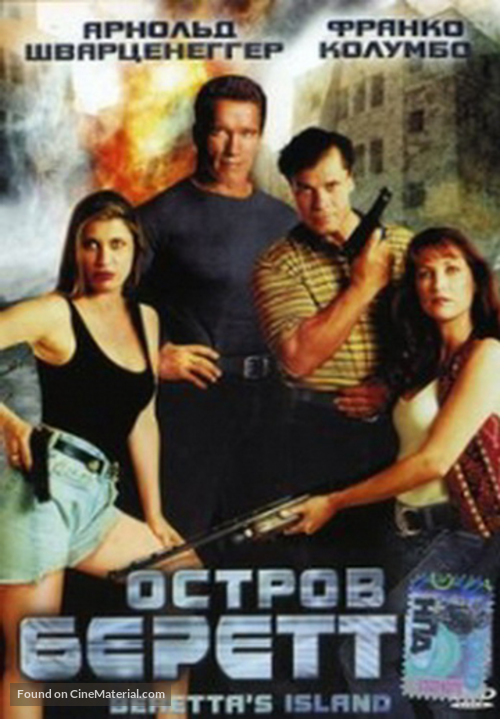
Franco Armando Beretta (Franco Columbu) is a retired Interpol officer who just so happens to train with Arnold Schwarzenegger, just like the real life Franco. The Sardinian Strongman had been in a few movies before — Stay Hungry, Conan the Barbarian, The Terminator, Big Top Pee-Wee — but now he was producing, writing and even directing a series of movies that includes Desperate Crimes, Taken Alive, Doublecross On Costas’s Island and Ancient Warriors.
Franco takes his shirt off every time he gets the chance to and he lives in Sardinia, showing off the beach, the festivals, the folk music and so much more. What more could you ask from a former prizefighter turned Interpol agent and now a winemaker? How about a message movie? Franco starts the movie off with this quote: “Sardinia is my homeland. This beautiful island has always been a refuge for me; untouched by the destructive effects of greed and drugs. Several years ago I was disheartened to find that drugs had infiltrated my precious Island, bringing with them winds of evil that have poisoned even the children of the land. This film is dedicated to the fight against drugs, and to those who have worked to stop the plague of drugs in every country. These are the true heroes of our time and I salute each one of them with gratitude and respect.”
This is also a movie — again — with a three and a half minute long workout scene, as well as having Ken Kercheval, Jo Champa and Elizabeth Kaitan in the cast.
Seriously, this movie seems to be a home movie by Franco mixed in with scenes where he fights drug dealers, several of them needing to duck down when he throws punches because Franco was just 5’5″. That said, he was a ripped 185 pounds who could deadlift 750 pounds and I would never ever consider making fun of him. I’m in love with the films that he made and the career that he left behind.
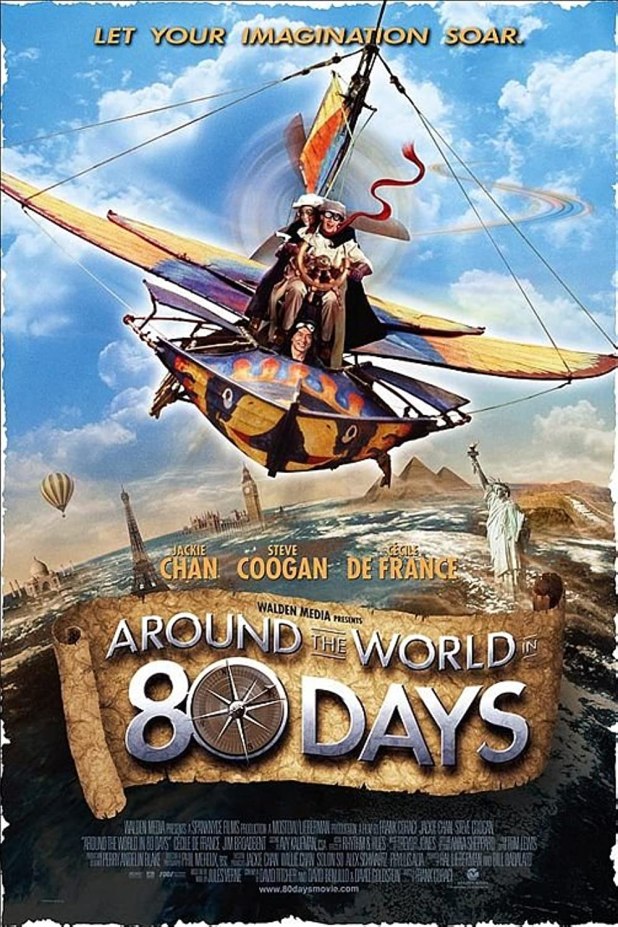
Warner Bros. owned the rights to the 1956 movie of this story, so they had planned a remake with Stephen Sommers directing and Brendan Fraser starring. That’s when this film got in motion, with Jackie Chan being paid $18 million for his role and was somehow made with one of the highest budgets a movie has ever had before it even had a distributor, which ended up being Disney. It only made $72.2 million on a $110 million budget, so factoring in promotion and all of the unseen costs of making movies and you can see that this was a huge bomb.
Directed by Frank Coraci (The Wedding Singer, The Waterboy, Click) from a script by David Titcher (the creator of The Librarian series), David Benullo and David Goldstein, the movie is about Phileas Fogg (Steve Coogan, perhaps not the head of a tentpole movie you were looking for) and his assistant Passepartout (Chan) trying to make it around the world in — you knew it — 80 days.
They’re joined by Cécile de France (HighTension) as Monique Laroche, a painter who wants to see the world and a ton of cameos, including Kathy Bates as Queen Victoria, Arnold Schwarzenegger as a prince in his last movie before becoming a governor, Richard Branson as a balloon man, John Cleese as a cop, Will Forte as another cop, Macy Gray as a sleeping French woman, Luke and Owen Wilson as the Wright brothers, Rob Schneider as a hobo and Chan’s adopted brother Sammo Hung as a karate fighter.
It’s not horrible or great — it fits somewhere in the middle, the kind of movie that you throw on when you have unexpected children over and realize that the majority of your home movie collection is filled with cannibals and nudity.
This Saturday night at 8 PM EST, Bill will be joined by Ben Sher, James Benge and Michael Ferrari to discuss two fantastic films! Watch the show live on the Groovy Doom Facebook and YouTube pages.
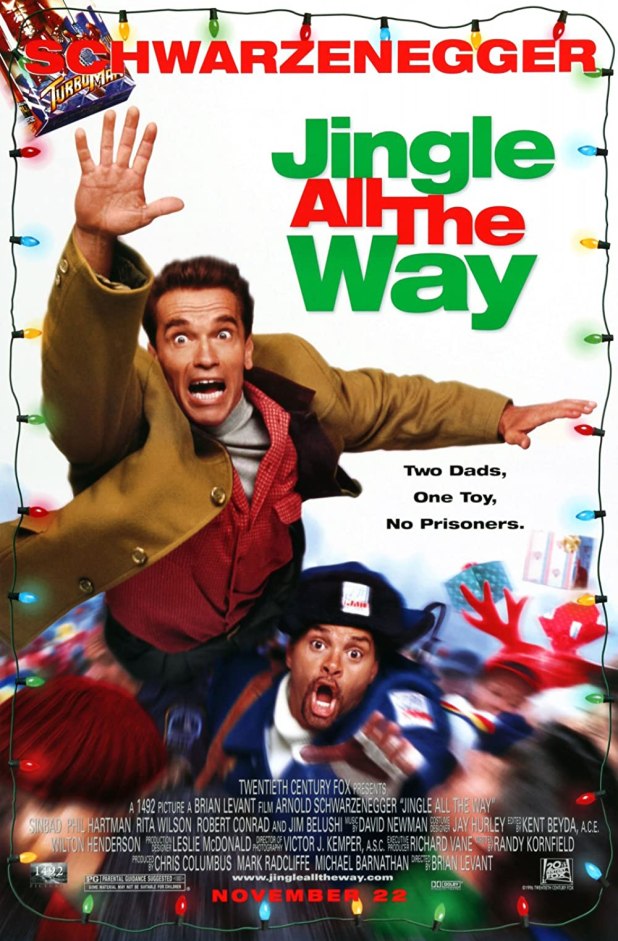
As Arnold Schwarzenegger waited to be in Planet of the Apes — he’s still waiting — director Brian Levant* (who is a secret box office goldmine between this, Beethoven, The Flintstones and Are We There Yet?), producer Chris Columbus and writer Randy Kornfield got him for this tale of a father wo just wants to get his kid the hottest toy for Christmas. Kind of like Cabbage Patch Kids or Power Rangers, except its Turbo-Man in this film.
Mattress salesman Howard Langston (Schwarzenegger) has a lot of love in his heart for his wife Liz (Rita Wilson) and son Jamie (the chewed up and spit up by Hollywood future Star Wars prequels star Jake Lloyd), but he doesn’t have the time to show it, what with how much work he has. His neighbor Ted Maltin (Phil Hartman in his last role; I still get angry about his death, a total waste) always shows him up in an attempt to woo away Liz. Howard misses every big family event, but on Christmas Eve, he has a mission: get a Turbo-Man no matter what.
That same mission is shared by mailman and near comic book supervillain Myron Larabee (Sinbad). The two go near insane with the need for the toy by the end of the movie and the transition from real life to cartoon is complete as Howard dresses as Turbo-Man while Myron has on the costume of his enemy Dementor (Richard Moll plays the character on the TV show that opens the movie).
With a cast that includes Martin Mull as a DJ, Robert Conrad as the same cop that keeps running into Howard, Jim Belushi as a mall Santa, Laraine Newman, Harvey Korman, Curtis Armstrong, The BIg Show** as a giant Santa, Chris Parnell and Verne Troyer, Jingle All the Way never stops moving, placing Arnold and SInbad in pitched combat throughout while giving some life lessons along the way.
I thought I was too cool for Arnold’s family films when this came out and now I can out myself and say that I was wrong. Sure, this gets wildly stupid at the end, but isn’t that what these movies should be? I’m glad that I’ve learned to have fun with movies.
*Levant is honestly critic proof. He said so himself: “To read those reviews is an act of self-flagellation, but reviews be damned when you’re at Blockbuster, and you’re seeing family after family grab one of your movies off the shelf on a Friday night. I can’t tell you how many times I’ve seen that.”
**WWE Films would make a sequel to this in 2014 with Larry the Cable Guy and Santino Marella in the lead roles. There are no other wrestlers involved, not Turbo-Man, as the toy in that film is Harrison The Talking Bear.
After Terminator 2: Judgement Day, the monolith known as Arnold Schwarzenegger could do no wrong. But where do you go after you move from Austria to here with no money, take over the world of bodybuilder and then become the biggest movie star in the world?
You make fun of yourself.
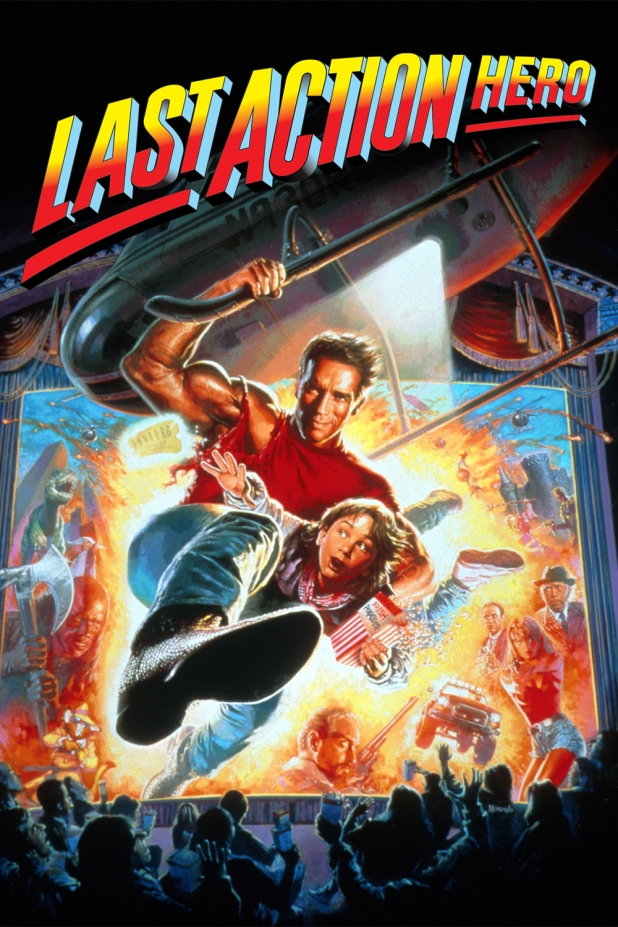
That’s where the original script for Last Action Hero — written by Zak Penn and Adam Leff — came in. Penn has since gone on to write PCU, X2, X-Men: Last Stand, The Avengers, Ready: Player One and Elektra while directing his own movie, Atari: Game Over. Leff hasn’t been as lucky, as his only other writing credits are PCU and Bio-Dome. That said, their screenplay was set in the movie world and concerned a hero named Arno Slater who tries to deal with the never-ending world of violence that takes the lives of everyone around him. Pretty much, it’s a meta-aware Shane Black parody.
How weird is it that Black was brought it to do the rewrite, leading to Penn and Leff only getting a story — and not a screenplay — credit?
In Nancy Griffith’s How They Built the Bomb, the reasons for this film’s failure go beyond its biggest issue: was it a comedy or an action movie? Sure, it could be both, but the film seems wildly schizophrenic in what it wants to achieve. What are the rules in Jack Slater’s world? What are the rules in the real — real as in the movie — world? Why can some people keep their powers and Jack can’t? What the hell is going on here?
The issues that Griffith pointed out include Universal moving Jurassic Park to a week before this film would open, negative publicity caused by initial screenings going so poorly, an out-of-control ad campaign that included a NASA rocket that never launched with the movie’s logo and being the first film released in Sony Dynamic Digital Sound, which didn’t even work in the tiny subset of theaters that even had this set up.
A $26 million loss and the first real bomb on Arnold’s record. It stung.
Let me set that up even better: it made $137 million at the box office (over $220 million in today’s money) and still was a loser, thanks to the budget, the overruns and the advertising.
Arnold even placed the blame on a shifting geopolitical theme in the United States, telling Business Insider, “It was one of those things where President Clinton was elected and the press somehow made the whole thing kind of political where they thought, “Okay, the ‘80s action guys are gone here’s a perfect example,” and they wrote this narrative before anyone saw the movie […] The action hero era is over, Bill Clinton is in, the highbrow movies are the “in” thing now, I couldn’t recuperate.”
Danny Madigan (Austin O’Brien, Prehysteria!) is a kid living with his widowed mom (Mercedes Ruehl) in the dingiest, most crime-challenged part of New York City. He escapes by watching Jack Slater movies and gets to see the new one when Nick the projectionist (Robery Proskey, Gremlins 2) gives him a ticket that once belonged to Harry Houdini.
This ticket allows Danny to enter the world of Slater, where he meets his talking cat Whiskers (Danny Devito!) and wonders about his friend John Practice (F. Murray Abraham), who Danny instantly doesn’t trust because he was also Salieri, the man who killed Mozart in Amadeus.
Of course, because this is a movie, Slater’s supervisor Dekker (Frank McRae, playing a role named for Fred Dekker and basically playing the exact same part that he did in 48 Hrs.) assigns Danny as the supercop’s new partner and sends them after mobster Tony Vivaldi (Anthony Quinn!?!).
After plenty of 80’s cop hijinks, Charles Dance — as henchman Benedict — gets the golden ticket and leaves for our world, stranding Danny, Slater and his daughter Whitney (Bridgette Wilson). And Benedict hatches a plan — kill Arnold so that no more Slater movies can be made. And that means that Tom Noonan can show up as Slater’s big bad, the Ripper. Man, Tom Noonan can be in every movie ever as far as I’m concerned.
The moviemakers wanted Alan Rickman, who was too expensive, so they got Dance instead, who showed up with a shirt proclaiming “I’m cheaper than Alan Rickman!’
Also: Death from The Seventh Seal shows up and instead of Bengt Ekerot, it’s Ian McKellen. This movie plays fast and loose with cameos, with everyone from Tina Turner (the mayor of Los Angeles), Sharon Stone (playing Catherine Tramell from Basic Instinct), Robert Patrick (as the T-1000), Sylvester Stallone as a Terminator, Maria Shriver, Little Richard, MC Hammer, Leeza Gibbons, James Belushi, Damon Wayans, Chevy Chase, Timothy Dalton, Jean-Claude Van Damme and Wilson Phillips showing up.
What can you say about a movie that was still filming a week before it was due in theaters? This was a film against incredible odds, odds that got even worse when negative press got in the way. Director John McTiernan would tell Movieline, “Initially, it was a wonderful Cinderella story with a nine-year-old boy. We had a pretty good script by Bill Goldman, charming. And this ludicrous hype machine got hold of it, and it got buried under bs. It was so overwhelmed with baggage. And then it was whipped out unedited, practically assembled right out of the camera. It was in the theater five or six weeks after I finished shooting. It was kamikaze, stupid, no good reason for it. And then to open the week after Jurassic Park— God! To get to the depth of bad judgment involved in that you’d need a snorkel.”
McTiernan would follow this up with Die Hard with a Vengeance, so that worked out a bit better for him. Then again, he’d also film the bombs Rollerball and The 13th Warrior.
Sadly, Arnold would later say that this was the beginning of the end of his movie career. But you can’t make a movie this big in nine months. Seriously — it just doesn’t happen.
But hey — you can see both Art Carney and Professor Toru Tanaka in their last roles. And it’s not a completely horrible movie. It just doesn’t know what movie it wants to be. And when that much money is on the line, this is what happens.
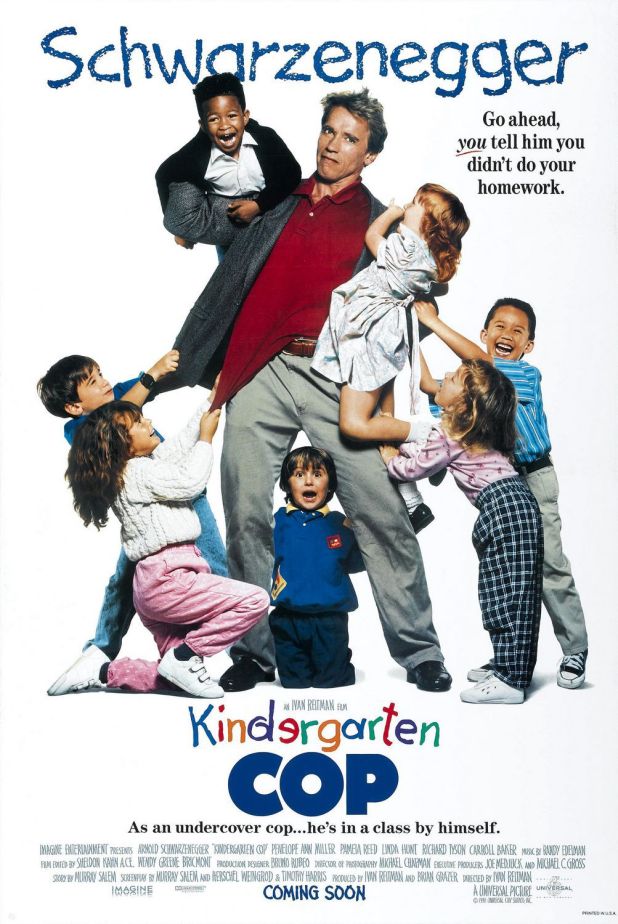
LAPD detective John Kimble (Arnold Schwarzenegger) has been chasing after drug kingpin Cullen Crisp (Richard Tyson) for years. He’s close, as a witness sees Crisp kill an informant after finding out where his wife Rachel (Penelope Ann Miller) and son (Christian and Joseph Cousins) are. Working with former teacher-turned-detective Phoebe O’Hara (Pamela Reed), Kimble becomes a teacher in the child’s school in an attempt to finally get his bust.
With a cast that includes Linda Hunt, Park Overall, Cathy Moriarty and Carroll Baker as Crisp’s mother, this is a fun way to get the action that you come to an Arnold movie for and mix it with comedy. That’s all due to the filmmaking skills of Ivan Reitman, who also made Twins and Junior with Schwarzenegger. He even created the Reitman Rules of Filmmaking from the child actors in this movie, which are five very simple rules: Listen, act natural, know your character, don’t look in the camera and be disciplined.
It also has a funny script by Murray Salem and the team of Herschel Weingrod and Timothy Harris, who wrote Trading Places, Brewster’s Millions, Twins and Space Jam together.
This is yet another Arnold movie where he knows his audience and still takes them to an unexpected place.
Producer Ronald Shusett purchased the rights to science fiction writer Philip K. Dick’s 1966 story “We Can Remember It for You Wholesale” for $1,000 after reading it in the April 1966 issue of The Magazine of Fantasy & Science Fiction. Renaming it to Total Recall, he wrote the script with Dan O’Bannon to write the script. After studios considered their script filled with too many special effects to be filmable, they went on to make Alien. The script was sold to Dino De Laurentiis’s De Laurentiis in 1982 and went through nearly a decade of developmental hell.
All manner of directors were suggested — Richard Rush, David Cronenberg, Lewis Teague, Russell Mulcahy and Fred Schepisi — and the script was written and rewritten as the budget went up and down. Cronenberg wanted to make a movie like Dick’s story; Shusett and De Laurentiis wanted “Raiders of the Lost Ark goes to Mars.”
At some point — probably while working on Raw Deal — Arnold Schwarzenegger became aware of Total Recall and wanted to be in it. Following De Laurentiis’ bankruptcy, he convinced Carolco Pictures to buy the rights. Arnold had substantial power: he retained Shusett as a screenwriter and co-producer alongside producer Buzz Feitshans, and oversaw script revisions, casting decisions and set construction himself, taking home $10 million and 15% of the profits (it made $261.4 million on an $80 million budget, so Arnold did more than fine).
Schwarzenegger hired Paul Verhoeven as the director and there were thirty rewrites before filming started. All in all, there were sixteen years in development, seven directors, four co-writers and forty script drafts before shooting began. The filming was filled with injuries and illnesses, as nearly everyone dealt with dust inhalation on set, as well as food poisoning and gastroenteritis.
To keep things from getting too rough, Arnold was a prankster on set, arranging water gun fights and throwing parties for the crew who were all working long six day weeks. Co-star Michael Ironside had a sick sister; Schwarzenegger helped him stay in regular contact with her using his personal phone in the days before everyone had mobile phones. He later discovered that Arnold was also regularly calling his sister to check on her health.
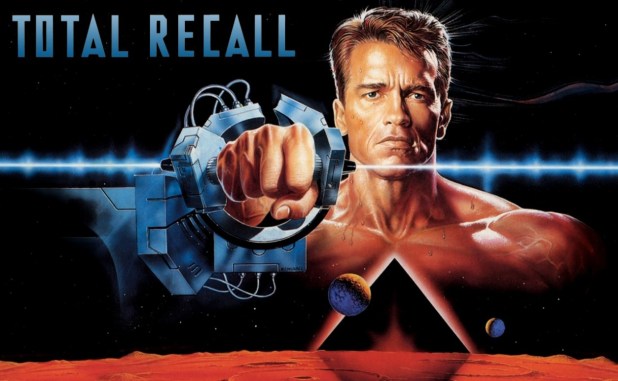
Douglas Quaid (Schwarzenegger) is a man stuck on Earth who dreams of Mars, a place that he can finally see thanks to Rekall, a company that sends people on VR vacations thanks to implanted memories. But then what is reality? Is it what Quaid sees in his dreams? Or is everything after Rekall — his wife (Sharon Stone) being an evil agent and his true love actually being a Martian freedom fighter named Melina (Rachel Ticotin ) — just part of the vacation? I’ve wondered that so many times since I first saw this and like to experience the movie in different mindsets.
Between Ronny Cox playing another rich old man — Vilos Cohaagen — and Michael Ironside as Richter, his main soldier, this movie has a great collection of bad guys who are fighting to keep all the air from the people. And when it gets to Mars, there’s a really interesting world waiting.
It also feels like a Cannon movie because its politics — you can see it as an anti-corporation and revolutionary story — are muddled with the idea of Mars getting Arnold as its white savior. It has so many agendas along with a huge body count. I think too much about movies and the theory of Neal King — Quaid learns that he was living a lie, that he can change his life and yet because any good deeds that he performs are the result of who he was programmed to be, his free will is an illusion — obsesses me.
Like all Verhoeven movies, what appears to be escapist and empty ends up being filled with questions and revelations.
Arnold’s commentary on this movie is the best thing he’s ever created:
EDITOR’S NOTE: You know when you’ve seen too many movies? When you review something twice.
Arnold Schwarzenegger decided to invest in himself by trying comedy. As Universal Pictures saw this as a major risk, he gave up his salary in exchange for a share of the film’s profits. Seeing as how this movie made $216.6 million dollars on an $18 million dollar budget — director Ivan Reitman and Dabby DeVito made the same deal — I think it all worked out. Some sources say that Arnold made 20% of the profits, which added up to $35,000,000 through international sales, video/DVD sales, and cable and TV airings.
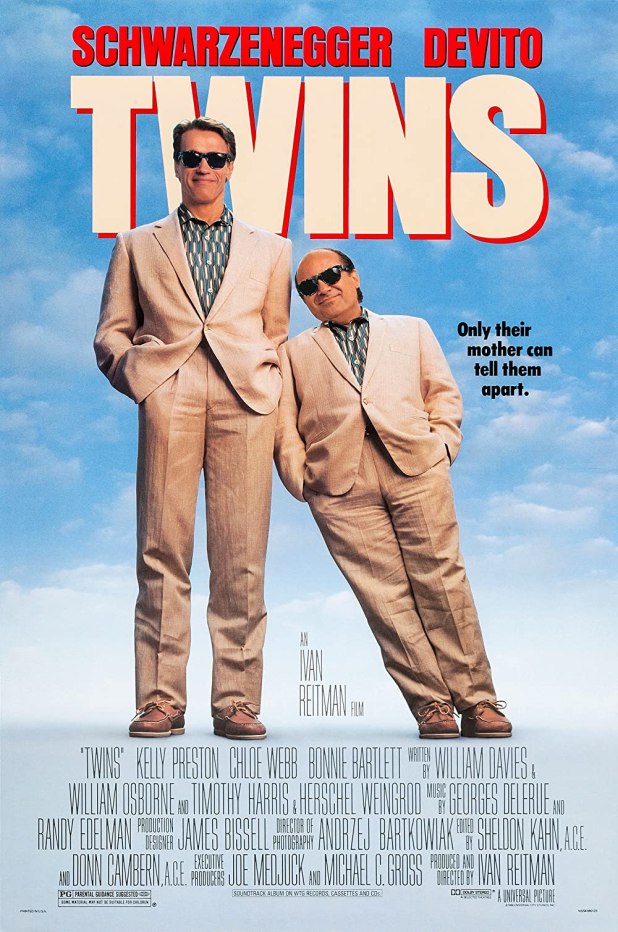
Schwarzenegger and DeVito play Julius and Vincent Benedict, fraternal twins who were created in a secret experiment that combined the DNA of six fathers to produce the perfect baby. Well, they also got Vincent, who received none of the Doc Savage-like upbringing that Julius had.
On his 35th birthday, Werner tells Julius about Vincent. He tracks down his brother in a jail in Los Angeles due to unpaid parking tickets. They also discover that their mother may still be alive, all while dealing with paying off Vincent’s mob debts.
Written by Will Davis (Stop! Or My Mom Will Shoot), William Osborne (The Scorpion King) and Timothy Harris (Kindergarten Cop, My Stepmother Is an Alien), this movie helped prove that Arnold was more than an action star.
There were plans to do Triplets, which had both Eddie Murphy and Tracy Morgan attached, but with Reitman dying, those plans may have been canceled.
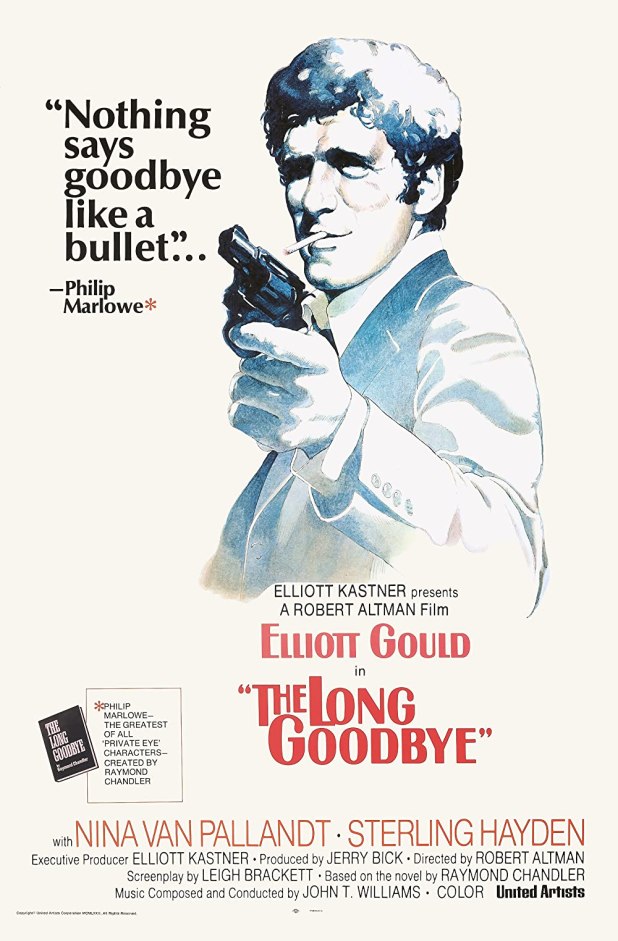
Directed by Robert Altman and based on Raymond Chandler’s 1953 novel, with a script by Leigh Brackett (who co-wrote the screenplay for Chandler’s The Big Sleep), who said that United Artists demanded that “either you take Elliott Gould or you don’t make the film. Elliott Gould was not exactly my idea of Philip Marlowe, but anyway there we were.” — The Long Goodbye was revised to move the story to the 70s.
As for Gould, he hadn’t worked in two years, ever since battling with Kim Darby and director Anthony Harvey on A Glimpse of Tiger. He had to take a psychological examination before United Artists would sign him to be the lead.
Marlowe (Gould) is asked by his friend Terry Lennox (baseball player and author of Ball Four Jim Bouton) to take him to the border at Tijuana. When he gets home, the cops bring him in and question him about Lennox killing his wife Sylvia. After three days in jail — and refusing to help the police — Marlowe learns that Lennox is said to have committed suicide. He refuses to believe that story.
Marlowe is hired by Eileen Wade (Nina van Pallandt, who dated Hughes diary forger Clifford Irving and sings “Do You Know How Christmas Trees Are Grown?” in On Her Majesty’s Secret Service) to find her missing husband Roger (Sterling Hayden, who was drunk and stoned for most of the movie; he’s still great), which takes the detective — who never stops smoking — into the health and fitness world of well-off Californians. And of course, the Wade and the Lennox couples knew one another, as Eileen confesses that Roger was sleeping with Sylvia, and might have killed her, right after Roger walks into the sea and drowns. Oh yeah — there’s also the matter of mob boss Marty Augustine (Mark Rydell) who has some money owed to him by Terry.
All paths lead back to Mexico, where Marlowe soon realizes that he’s been played for a fool. However, he plans on having the last laugh. Altman referred to his character as Rip Van Marlowe, as he saw him as a man trapped in the 50s and “trying to invoke the morals of a previous era.”
The cast also includes David Arkin, Pancho Córdova, Amityville 2 and Mommie Dearest star Rutanya Alda, Jack Riley, David Carradine, Morris the Cat and a non-speaking role for an impossibly young Arnold Schwarzenegger.
Critics savaged this on initial release with Jay Cocks from Time saying, “It is a curious spectacle to see Altman mocking a level of achievement to which, at his best, he could only aspire.” Chris Champlin of the Los Angeles Times summed up what so many thought of Gould as Chandler’s hard boiled detective hero by writing, “He is not Chandler’s Marlowe, or mine, and I can’t find him interesting, sympathetic or amusing, and I can’t be sure who will.”
As for the actor, he has said that as ong as he is physically able, he holds out hopes that he will reprise the role. He has a screenplay entitled It’s Always Now based on the Chandler story “The Curtain.” The Chandler estate sold him the rights for $1.
With an always moving camera and the pastel cinematography of Vilmos Zsigmond, this movie still looks wonderful and has stood the test of its time, a time when it was not as well considered.

 B&S About Movies