The Mechanic (1972)

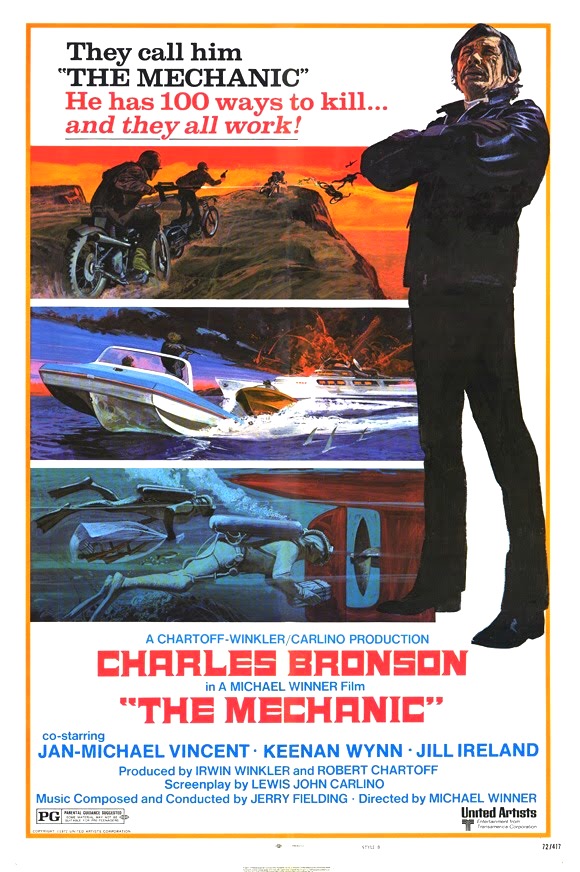
Arthur Bishop (Charles Bronson) is an artist. He listens to classical music, he loves the finest in artwork and knows the best wines. Yet he can’t trust anyone. He can’t have any emotions. Because his art is murder and that puts him under so much stress that he passes out at times. The only love in his life is paid for, as a call girl (Jill Ireland) writes letters and meets him for a girlfriend experience that ultimately is meaningless.

For the first sixteen minutes of The Mechanic, he moves in absolute quiet to make his kill.

After completing the job of killing a high ranking official in his own group, “Big Harry” McKenna (Keenan Wynn), he meets the man’s son Steve (Jan-Michael Vincent). He has the same aptitude for murder, so Bishop begins training him against the wishes of his superiors, which makes them doubt the older killer. And when Bishop finds notes on himself in Steve’s papers, has he let the wrong person into his life?

The second movie that Bronson would make with Michael Winner, but it was originally intended to be Monte Hellman (Two-Lane Blacktop) making the movie. The script was also altered, as it was about the sexual relationship between the two men and there’s no way that Bronson was going to make that film.

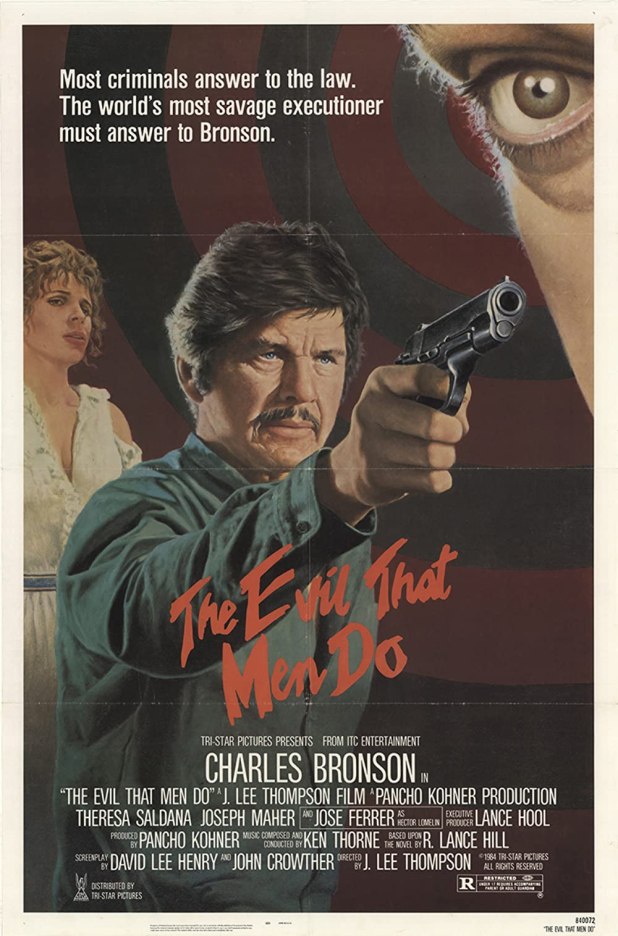
The Evil That Men Do (1984)

Charles Bronson, his wife Jill Ireland, J. Lee Thompson and producer Pancho Kohner had purchased the rights to this novel in 1980 and tried to bring it to Cannon after Death Wish 2, but they didn’t want to pay for all of the costs, so Bronson used it as the last movie on his contract with ITC.

The writer of the book. R. Lance Hill, wrote the first draft under the name David Lee Henry, with the script being finished by John M. Crowther (who was a MAD cartoonist and also wrote Kill and Kill Again). Don’t feel bad for Hill, who went on to write Road House.

Fielder Cook (How to Save a Marriage and Ruin Your Life) was the original director, but he was dealing with late career Bronson who had his whole family on set and would work eight hours a day and then be done. Obviously, J. Lee Thompson would need to come back and direct.

Clement “The Doctor” Molloch (Jospeh Mahler) isn’t a healer. He’s an expert in torture used by governments all over the world. He kills anyone in his way, like journalist Jorge Hidalgo (Jorge Humberto Robles) and can even outwit the Mossad.

When Holland (Bronson), a retired killer for the CIA, learns of his friend Hidalgo’s death, he decides to make it his business to do what assassins worldwide have never been able to do: bring Molloch to justice. His plan involves taking Jorge’s widow Rhiana (Theresa Saldana; Ireland was originally going to play this role, but as associate producer she advocated for Saldana, who had survived being stabbed ten times with a hunting knife by an obsessive stalker only two years earlier) and her daughter Sarah (Amanda Nicole Thomas) into Guatemala, where the Doctor is based, under the guise that they are a family.

Holland is a deadly and driven man, someone willing to physically manhandle a man who gets too close to Rhiana and then work with her to lure a henchman to their hotel for a threeway and then immediately stab the man right in the neck as she looks on absolutely shocked.

It turns out that Moloch has more power — and connections — than Holland believed, but then again, Holland is also Charles Bronson. No matter the setbacks, he’s going to do all he can to stop a man who he may have more in common with than he’d like to admit.

Hey — Jose Ferrer and John Glover are in it too, so Bronson and team weren’t skimping when it came to the supporting cast. And the ending is stark and totally perfect.

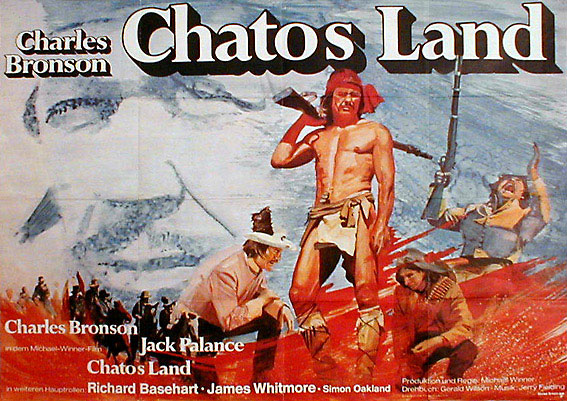
Chato’s Land (1972)

EDITOR’S NOTE: Chato’s Land first was on the site on November 10, 2021. You can get the blu ray from Kino Lorber. It has a brand new 2K master of the film, as well as new audio commentary by film historians Howard S. Berger and Steve Mitchell, an interview with screenwriter Gerald Wilson and reversible cover art. You can order it from Kino Lorber.

After shooting the racist sheriff in self-defense, Apache Chato (Charles Bronson) heads back home, far away from the affairs of the white men. However, former Confederate Captain Quincey Whitmore (Jack Palance) has put back on his uniform and brought together former soldiers demoralized by the end of the war — look at what year this movie came out and you can see what this movie really is saying — and begins hunting down Chato, who much like the Vietcong knows the land better and is fighting for his family, not for pride or because he’s been peer pressured.

That means he kills every single one of them.

Also, this is when you realize that Michael Winner directed this movie, because not only do four of the posse — Elias (Ralph Waite), Earl (Richard Jordan), Hall (Victor French) and Lansing (William Watson) — gang rape and leave Chato’s wife for dead, they also string up his best friend and set him on fire.

Yes, Michael Winner, the man who brings you the patriarch of The Waltons assaulting a woman.

The first victim afterward is Earl, who is obsessed with Chato’s wife. Like a slasher villain, Bronson’s character dispatches the men one after the other and leaves their bodies to be found. He’s gone full Apache, no longer wearing the clothes of the Europeans and the men begin to turn on one another, even killing Whitmore, who has long become disgusted by their actions.

Still, the odds are against Bronson. Then again, that’s usually how it is.

The first of six movies that Winner would make with Bronson, this was shot on some of the same Spanish sets as Once Upon a Time in the West. Winter would say, in the book Bronson’s Loose, that this was the only of their films that Bronson enjoyed watching.

Love and Bullets (1979)

John Huston was originally going to direct Charles Bronson and Jill Ireland in this movie, working from a script by Wendell Mayes, the writer of Death Wish as well as From Hell to Texas and The Poseidon Adventure. Huston worked for some time on the film, but a mixture of illness and creative issues led to him leaving and being replaced by Stuart Rosenberg (The Amityville HorrorVoyage of the Damned).

Charlie Congers (Bronson) has been assigned to bring gangster Joe Bomposa’s (Rod Steiger) girlfriend Jackie Pruitt (Jill Ireland) back to the U.S. so that she can testify what she knows. The truth is, she knows nothing, but that doesn’t mean that Bomposa won’t take her out and the FBI won’t hang both her and Congers out to dry.

This movie was produced by Lew Grade’s ITC Entertainment, which spent millions on movies like The Legend of the Lone Ranger, Movie MovieRaise the TitanicThe Golden GateEscape to AthenaThe Golden Gate and Road to the Fountain of Youth with Bing Crosby and Bob Hope (the last two of these went unmade). The only two of their movies that made money were The Boys from Brazil and The Muppet Movie. Bronson would make two more movies for ITC, Borderline and The Evil That Men Do.

It’s not the best of Bronson’s movies, but it does have lots of great character actors in it, like Strother Martin, Bradford Dillman, Henry Silva and Paul Koslo. Not that it mattered to Bronson, who was a success on this no matter what, as he made $1.5 million, a percentage of the film’s profits, a role for his wife and the traveling expenses for an entourage of more than fourteen people and the blended Bronson-Ireland family.

You can watch this on Tubi.

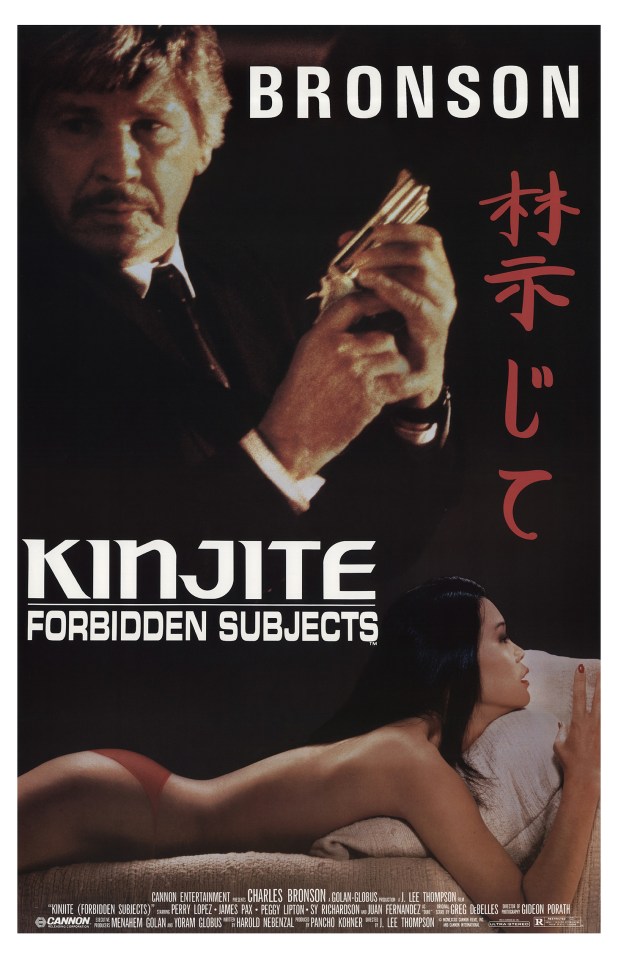
Kinjite: Forbidden Subjects (1989)

The final film between director J. Lee Thompson and Charles Bronson, Kinjite was the ninth movie they made together and was going to be shot back to back with The Golem, a movie I wish had been made.

When reviewing the movie, the Los Angeles Times said, “If you think you might be offended by it, don’t go. You will be.”

While in Japan, a businessman had watched a woman be assaulted on the subway without complaint. And when he comes to Los Angeles, that moment continues to obsess him to the point that he attempts to recreate it and he learns that American women refuse to suffer in silence. Running from the scene of his attempted crime, he’s mugged and as others in the community learn of the crime and begins attacking men who resemble the businessman.

The woman who was involved is Rita Crowe (Amy Hathaway), the daughter of LAPD vice-squad detective Lt. Crowe (Bronson). And when he learns that the man that tried to hurt his daughter has just lost his own daughter to a child prostitution ring. Now he must get past his hate for the man and prejudice against the Japanese to do his job.

There’s not really a happy ending here — the girl is saved but the experiences she’s endured have ruined her to the point that she overdoses — and Bronson and his partner (Perry Lopez) go against their badges and attempt to murder the gang to stop them from ever doing what they did again.

Beyond the last film they did together, this was Bronson’s last Cannon movie — he would make Death Wish V with Golan — and Thompson’s final movie. It’s a dark movie in two careers where plenty of equally dark corners were explored ending with a man satisfied with finally finishing the job he set out to do.

You can watch this on Tubi.

Cold Sweat (1970)

Based on the Richard Matheson novel Ride the NightmareCold Sweat has Joe Moran — an American in France played by Charles Bronson — dealing with his wife and kids being taken by former associates that he once double-crossed.

Directed by James Bond director Terence Young from a script by Dorothea Bennett, Shimon Wincelberg and noir master Jo Eisinger, it shows just how quiet of a life Martin is living along with his wife Fabienne (Liv Ullmann) and daughter Michèle. But ten years ago, he’d been part of a gang with Katanga (Jean Topart), Ross (James Mason), his girl Moria (Jill Ireland), Whitey (Michel Constantin dubbed by David Hess) and Fausto (Luigi Pistilli) show back up and ruin his life.

Yeah, like Bronson is going to take that.

Liv Ullmann later complained that Bronson was rude to her and her daughter during the filming. When her daughter wandered over to his lunch table, Bronson brought her back and said, “Please keep your child to yourself.”

I grew up not far from Bronson and my dad always told me when we went to dinner, when and if we did, that the men in the bars had just come out of the mills and mines and just wanted some quiet. “They aren’t here to listen to you be stupid,” he said, and I get it. Bronson got it. And now Liv Ullmann’s kid got it.

You can watch this on Tubi.

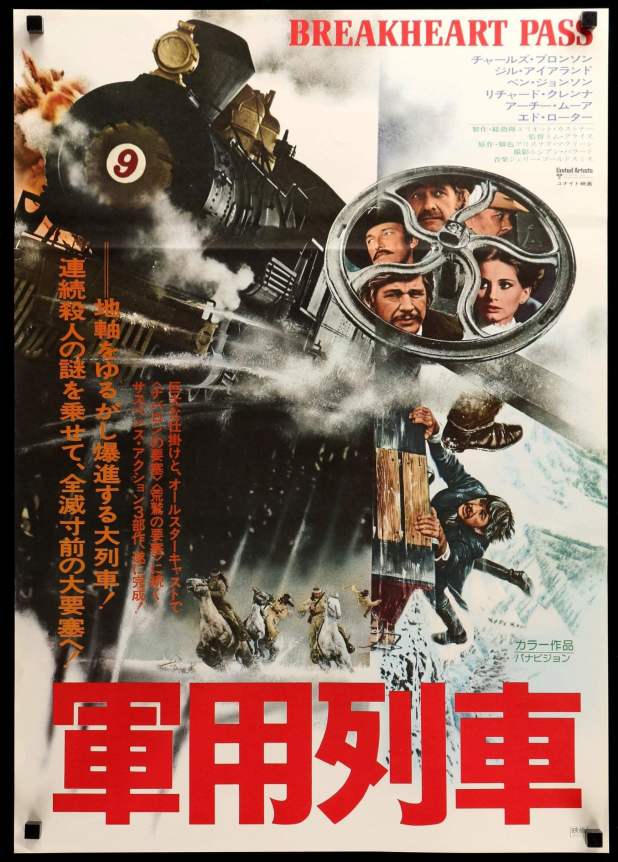
Breakheart Pass (1976)

EDITOR’S NOTE: Breakheart Pass first was on the site on November 11, 2021. You can get the blu ray from Kino Lorber. It has a brand new 2K master, new audio commentary by film historians Howard S. Berger, Steve Mitchell and Nathaniel Thompson, and reversible cover art.

Based on the book Breakheart Pass by Alistair MacLean, this movie begins with a remote settlement in Eureka, California suffering from a diphtheria epidemic. An express train is dispatched toward the fort, filled with reinforcements and much-needed medical supplies. There are also some important civilians on board, like Nevada Governor Richard Fairchild (Richard Crenna) and his fiancée Marica (Jill Ireland), the daughter of Fort Humboldt’s commander.

Then, the train stops to let on United States Marshal Pearce (Ben Johnson) and his prisoner, John Deakin (Charles Bronson), a notorious outlaw with a price on his head.

The truth is that Deakin is really a Secret Service agent and that anyone who seemed on the side of the law is really using the epidemic as an excuse to send weapons to Native Americans to use against their fellow Americans. Anyone who isn’t part of the conspiracy is being killed one by one.

Beyond boasting other cast members like Sally Kirkland, Charles Durning and Ed Lauter. there’s ultra-heavy bad guy Robert Tessier and an insane fight on a train car in the snow that looks like one of the most dangerous scenes I’ve ever seen filmed. It was performed by stuntmen Howard Curtis (who was doubling Bronson) and Tony Brubaker (who was Archie Moore’s stand-in). It’s the last stunt directed by Yakima Canutt, who directed the chariot race in Ben-Hur and performed the stagecoach drop in Stagecoach that inspired the scene in Raiders of the Lost Ark where Indiana Jones goes under the German truck. He also taught John Wayne how to fall off a horse, as well as inspired how the Duke acted on screen. The drawling, hesitant speech and the hip-rolling walk that made Wayne famous were all how Canutt actually behaved in real life. Along the way, Cannutt got hurt so many times that his injuries seem hyperbole: multiple broken ribs, breaking both legs at the ankles and even having his intestines split in half while doubling for Clark Gable in Boom Town.

In spite of all of those injuries, he lived to be ninety.

Directed by Tom Gries (The Rat Patrol TV series, Earth II), this film has another astounding practical effect. Those aren’t model train cars getting destroyed. They’re full-sized cars bought just to be run into each other.

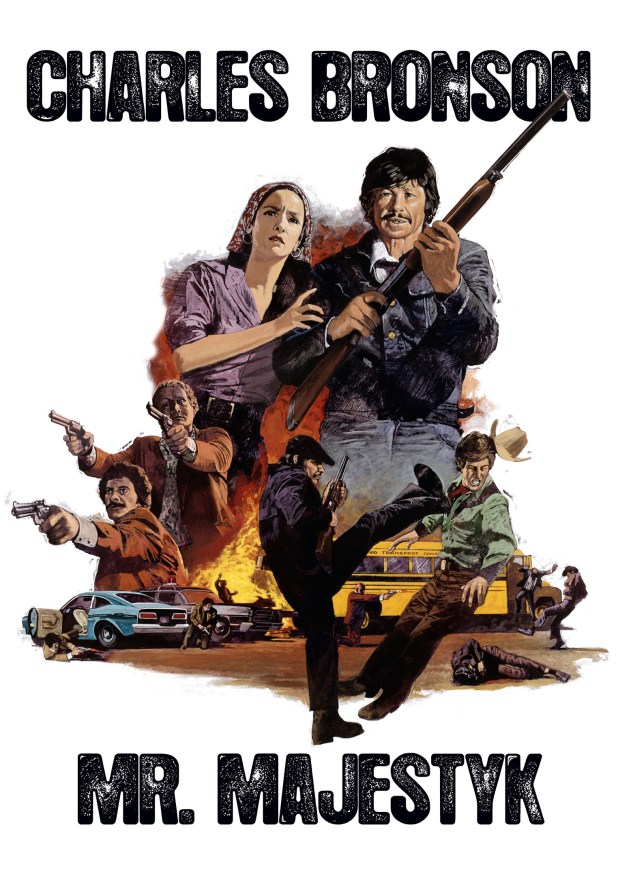
Mr. Majestyk (1974)

EDITOR’S NOTE: This review originally appeared on the site on December 11, 2021. The Kino Lorber blu ray of this film has a gorgeous brand new 2K master, commentary by film historian Paul Talbot, the author of Bronson’s Loose*,  interviews with Director of Photography Richard H. Kline and Lee Purcell, TV commercials and a trailer. You can get it from Kino Lorber.

Directed by Richard Fleischer (CompulsionFantastic VoyageSoylent GreenMandingoThe Jazz Singer) and written by Elmore Leonard (Get ShortyOut of Sight), this film finds our pally Charles Bronson playing Vincent Majestyk, an ex-con, former U.S. Army Ranger instructor and current watermelon farmer who just wants to get his crop in on time.

Bobby Kopas (Paul Koslo, Vanishing Point) tries to get Majestyk to pay protection money and ends up on the end of his own shotgun. He turns the table on our hero by bringing assault charges against him and Majestyk goes to jail before he can harvest his crops, potentially ruining his finances. So he does what you or I would: when gangster Frank Renda’s (Al Lettieri, The Godfather) men try to busy him loose, he kidnaps the crook himself and holds him for hostage. All he wants is to pick his melons.

The rest of the film finds the two men continually going at one another. Well, to be fair, Majestyk is only concerned with melons, whether in the field or owned by his love interest Nancy Chavez (Linda Cristal, who was on the TV show The High Chaparral and in the TV movie The Dead Don’t Die). Every time Renda, Kopas or any of their underlings try to take him down, he just laughs and gets over on them. Hey — it’s Bronson, you know?

I also love Lee Purcell in this movie, playing the gangster’s moll who carries a Bible everywhere she goes.

You have to love the tagline for this film: “

They also tried: “Why are they saying it’s the one movie you should see this year? Ask anyone who’s seen it. Anyone.”

This came out the same month as Death Wish and to show what a star Bronson was, when The Man with the Golden Gun underperformed, Mr. Majestyk played as a supporting feature underneath that Bond picture. I mean, there’s even a Turkish remake of this movie, Karpuzcu, which shows you just how big Bronson’s appeal was worldwide.

*Check out our interview with Paul here.

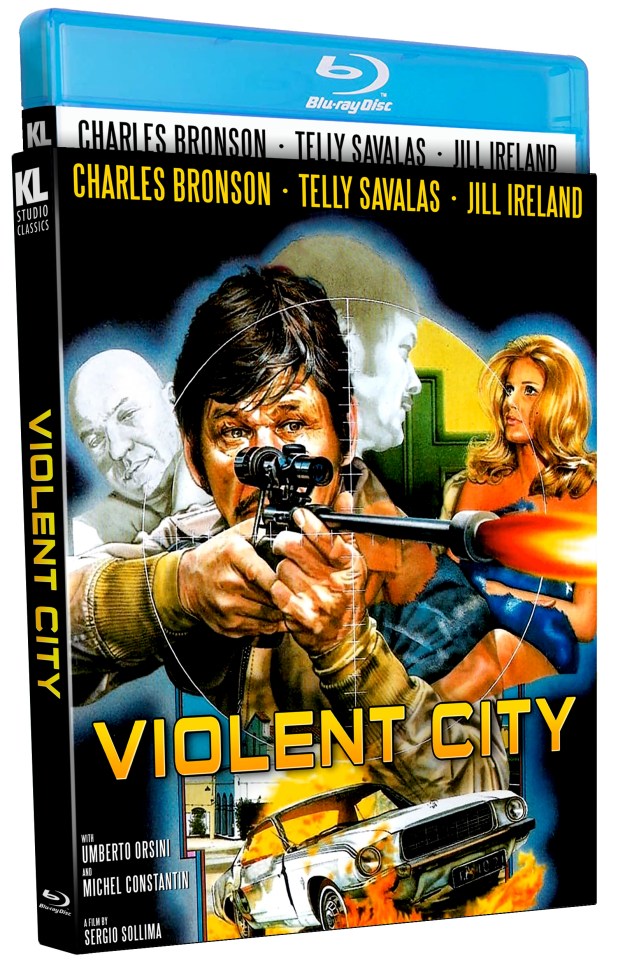
KINO LORBER BLU RAY RELEASE: Violent City (1970)

Director Sergio Sollima is mainly known for westerns such as Run Man RunFace to Face and The Big Gundown, the Eurospy movies Agent 3S3: Passport to HellAgent 3S3: Massacre In the Sun and Requiem for a Secret Agent and the pirate movies SandokanLa tigre è ancora viva: Sandokan alla riscossa! and The Black Corsair

With Violent City, co-written with Swept Away director Lina Wertmüller, he was originally upset that it was going to be a traditional gangster story. He did, however, say that “we had the chance to shoot in the U.S., and I would do whatever it took to do that.” So he worked with Wertmüller to create the non-linear way that the story would be told. He also worked with Telly Savalas, who plays the main villain in a movie of bad people, to bring out the humor in his role. As for Bronson, he found him uncommunicative while his wife Jill Ireland was the exact opposite, which is probably why they worked so well together.

He said that in the end, the movie was a lot like his westerns and all about “the encounter and struggle between the individual and the society which is all around him, and the way he reacts to it.”

During a vacation, Jeff Heston (Bronson) and his lover Vanessa (Ireland) are attacked by killers sent by an old business associate who Vanessa has seemingly left Jeff for. He’s jailed and refuses to name her, even if he receives a lower sentence. As soon as he’s released, crime lord Al Weber (Savalas) wants him to work for him, but he claims he’s retired, which is a lie, as he kills the man who set him up in the very next scene.

Of course, Vanessa has been married to Weber all along and even though Jeff wants revenge on her, he can’t kill her. Weber even tells him that his love for her will be his undoing, that she’s the one pulling the strings, but Jeff’s critical flaw is in thinking that she can’t be such a person.

The movie had two major American releases, with the first distributed as Violent City by International Co-Productions and the second wide release distributed by United Artists as The Family, complete with a logo using the same font as The Godfather and a tagline that shouted
The Godfather Gave You an Offer You Couldn’t Refuse. The Family Gives You No Alternative.”

If this was to be strictly an Italian film, Tony Musante and Florinda Bolkan would have been the leads. There was also an attempt to make the movie with Jon Voight and Sharon Tate.

This is a moody and dark film that predates the poliziotteschi films while boasting a strong soundtrack by the master, Ennio Morricone. It also has a stark ending that I’ve been thinking over again and again in the days since I’ve watched the film.

The Kino Lorber blu ray release of Violent City has a 2K restoration of the movie in English and Italian with optional English subtitles, new commentary by Paul Talbot, author of the BRONSON’S LOOSE! books, as well as an interview with director and co-writer Sergio Sollima, trailers, TV spots and a second disc with a 4K restoration of Citta Violenta, an HD master of the American version The Family and a series of Bronson trailers. You can order it directly from Kino Lorber.
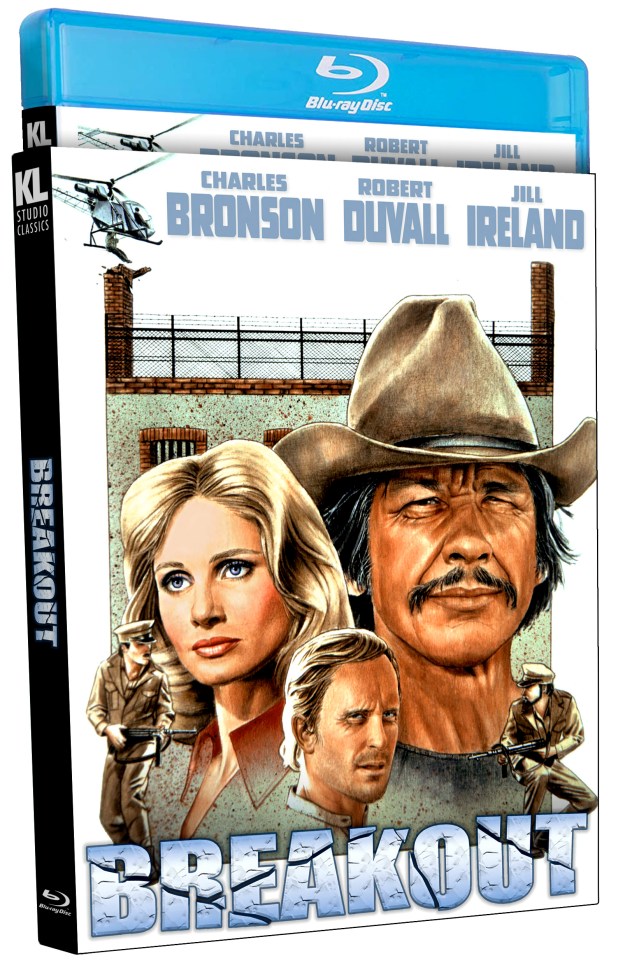
KINO LORBER BLU RAY RELEASE: Breakout (1975)

Jay Wagner (Robert Duvall) has been framed for murder by his grandfather (John Huston). and is looking at three decades of hard labor in a Mexican jail, unless his wife Ann (Jill Ireland) is able to convince Nick Colton (Charles Bronson), his partner Hawk (Randy Quaid) and Myrna (Sheree North) to take the impossible job of getting his broken out of jail in a daring helicopter mission.

Original director Michael Ritchie didn’t like the idea of the female lead being played by Bronson’s wife Jill Ireland, so you can imagine that’s why Tom Gries (who had already made Breakheart Pass with Bronson) took over. Mexico also had an issue at how their country would be shown in the film, so it was shot at Fort de Bellegarde, France with local gypsies standing in for Mexican people.

Strangely enough, Breakout was based on a true story. Joel David Kaplan was a New York businessman and nephew of molasses tycoon Jacob Merrill Kaplan as well as a potential CIA asset used to funnel money and build relations with governemnts in Latin America. He was connected with the murder of Dominican Republic leader Rafael Trujillo and that man’s godson, Luis Melchior Vidal Jr., who had at one point worked with Kaplan to work as arms dealers for the CIA. And man — you thought politics was complicated now! Anyways, Kaplan went to Mexican jail for 28 years — just like Jay in Breakout — and his wife Judy worked with San Francisco attorney Vasilios Basil “Bill” Choulos to fly a Bell helicopter flying Mexican colors directly into the jail. Joel and his cellmate Carlos Antonio Contreras Castro escaped and were never recaptured.

As for Breakout, it was one of the first movies that used saturation booking instead of a traveling print, opening on 1,300 screens on its first day. It also had 17,000 radio ads. This strategy would be used to even greater effect later that year when Jaws came out.

It’s a fun movie and odd to see Bronson so lighthearted throughout, particularly as this movie follows Death Wish.

The Kino Lorber blu ray release of Breakout has commentary by the king of all Bronson knowledge Paul Talbot, as well as trailers, TV and radio ads. You can buy it directly from Kino Lorber.