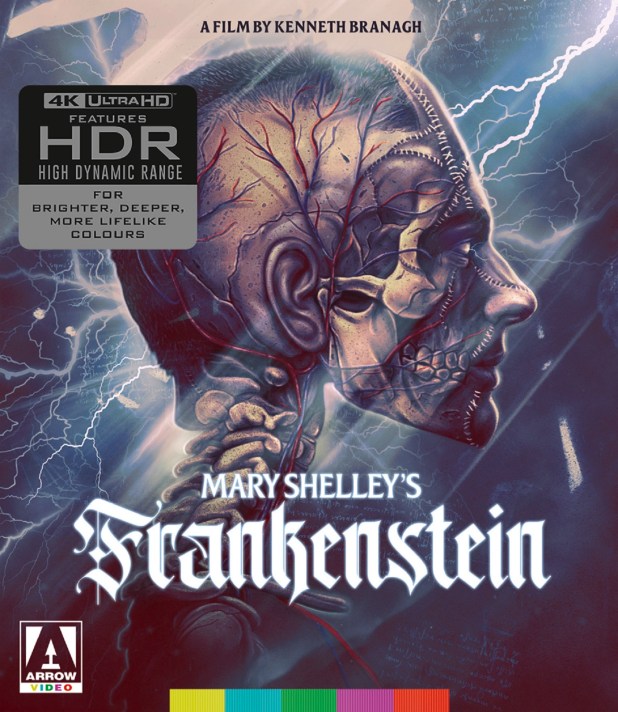
ARROW UHD RELEASE: Mary Shelley’s Frankenstein (1994)

Considered the most faithful film adaptation of Mary Shelley’s 1818 novel Frankenstein; or, The Modern Prometheus, this 1994 movie was directed by Kenneth Branagh and written by Steph Lady and Frank Darabont, who said that it was, “the best script I ever wrote and the worst movie I’ve ever seen.”

He told Creativescreenwriting.com, “t’s kind of like the movie I wrote, but not at all like the movie I wrote. It has no patience for subtlety. It has no patience for quiet moments. It has no patience period. It’s big and loud and blunt and rephrased by the director at every possible turn. Cumulatively, the effect was a totally different movie. I don’t know why Branagh needed to make this big, loud film…the material was subtle. Shelley’s book was way out there in a lot of ways, but it’s also very subtle. I don’t know why it had to be this operatic attempt at filmmaking. Shelley’s book is not operatic, it whispers at you a lot. The movie was a bad one. That was my Waterloo. That’s where I really got my ass kicked most as a screenwriter…”

Branagh plays Victor Frankenstein, who starts the film as a man suffering from pneumonia who has been seeking to kill his creation, tracking it into the arctic. We go back to see how things became this dire, as Victor promises his mother, at her grave, that he will conquer death. For a time, he’s joined by his teacher Professor Waldman (John Cleese), who warns him of the consequences of going against God and nature. After he’s murdered (by an unnamed man played by Robert DeNiro, who goes on to play the creature that Frankenstein brings to life), his brain is used within the creature given the spark of life.

Victor is horrified by his creation’s appearance and tries to kill him. In his nascent state, the creature is driven from town by the villagers. Even when he connects with an old blind man, it goes badly. Finally, he burns the farm of the man’s family to the ground and declares war on his creator. He kills Frankenstein’s brother William, sets up Justine, the family maid who has always loved the doctor and demands that his nemesis make him a mate. When he refuses, he murders Frankenstein’s fiancee (Helena Bonham Carter) and forces him to bring her back to life. She’s horrified at the way she looks and sets herself on fire, which brings us back to the cold ice floes and the close of the tale.

Mary Shelley’s Frankenstein may be imperfect, but DeNiro is absolutely incredible in the lead. He studied the way that stroke victims who have learned to speak again sound to get the right voice. I love the way he creates his own take on a creature that has been filmed so many times and his role is the absolute best thing in this movie.

The Arrow UHD release of this movie has a new 4K restoration from the original camera negatives by Sony Pictures Entertainment, as well as new audio commentary by film historians Michael Brooke and Johnny Mains; new interviews with composer Patrick Doyle, costume designer James Acheson and make-up designer Daniel Parker; Mary Shelley and The Creation of a Monster, a new documentary featurette on the origins and evolution of the Frankenstein story, featuring Gothic specialists David Pirie, Jonathan Rigby and Stephen Volk; Dissecting Mary Shelley’s Frankenstein, a new featurette with David Pirie, Jonathan Rigby and Stephen Volk on the differences between the novel and Kenneth Branagh’s screen adaptation; the Edison version of Frankenstein, made in 1910 and shown in 2K restoration form from the Library of Congress with music by Donald Sosin; original trailers; a reversible sleeve featuring original and newly commissioned artwork by Laz Marquez and an illustrated collector’s booklet featuring new writing by Jon Towlson and Amy C. Chambers.

You can purchase this from MVD.
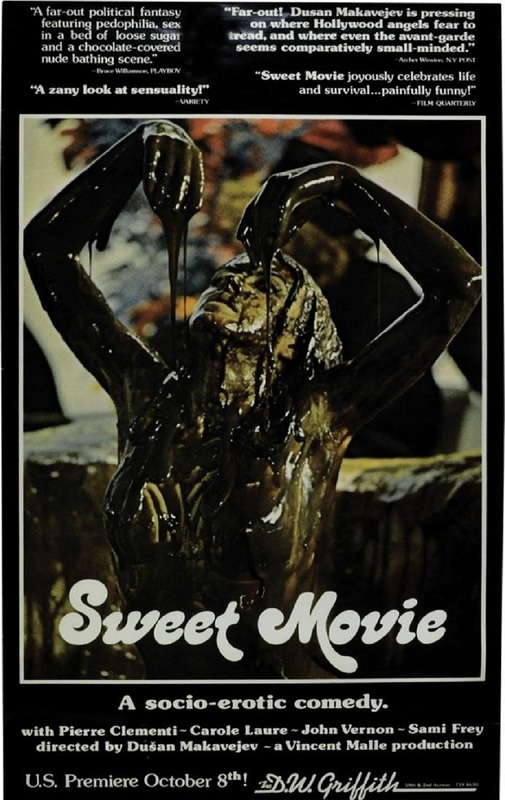
APRIL MOVIE THON DAY 20: Sweet Movie (1974)

In The 50 Worst Films of All Time–and How They Got That Way by Harry Medved and Randy Dreyfuss, this movie is destroyed. And yet it also ruined lives, with actress Anna Prucnal — just for being in this movie — finding herself exiled from her native Poland for seven years even being denied a visa to see her dying mother. Her role was added to the movie after the original protagonist Miss Canada (Carole Laure, Strange Shadows in an Empty Room) quit the film, saying “I admire Dusan very much but after he signed me to the movie, he asked me to do things no human being could do. I had to refuse. I could not do these things as a person, let alone an actress. I don’t mean sex scenes, to them I have no objection if the script is right. I mean much worse things than that.”

Director Dušan Makavejev was a member of the Black Wave of filmmaking creating some of the most interesting films of Yugoslav cinema in the late 1960s and early 1970s, including W.R.: Mysteries of the Organism, which is all about Wilhelm Reich, who was interested in the energy of the orgasm.

Miss Canada has won the award of being “most virgin” and given to a milk industry tycoon (John Vernon, how did he end up in this!?!) who treats her brutally, so she tried to leave and is taken away by the family bodyguard, who uses her for his own needs, then packs her in a suitcase for Paris, where she falls in love with singer El Macho, until nuns frighten them into sexual paralysis. She finally ends up in a commune where members are literally reborn, puking, urinating and defecating around one another before she ends up in a chocolate commercial that feels way too close to the roman, yellow and brown showers that we’ve just watched. I mean, if you watched it. I wouldn’t blame you if you looked away.

At the same time, Anna Planeta (Prucnal) and her candy-filled, Karl Marx decorated boat floats through Amsterdam, as the sailor Potemkin gets on board and falls for her. She keeps telling him that she will kill him, but love makes you blind, so in the midst of making love, she follows through. She may have also murdered and definitely abused numerous children — whose bodies line the canal which plays alongside footage of the remains of the Polish Katyn Massacre victims — and is arrested just as the children come back to life.

Francis Ford Coppola liked Makavejev’s directing so much that he wanted him to be the one to create Apocalypse Now. He picked this movie instead, a brutal punch to the stomach of anyone expecting the title of this movie to be lived up to.

In case you’re wondering what you’re getting into, Pier Paolo Pasolini dubbed the Italian dialogue.

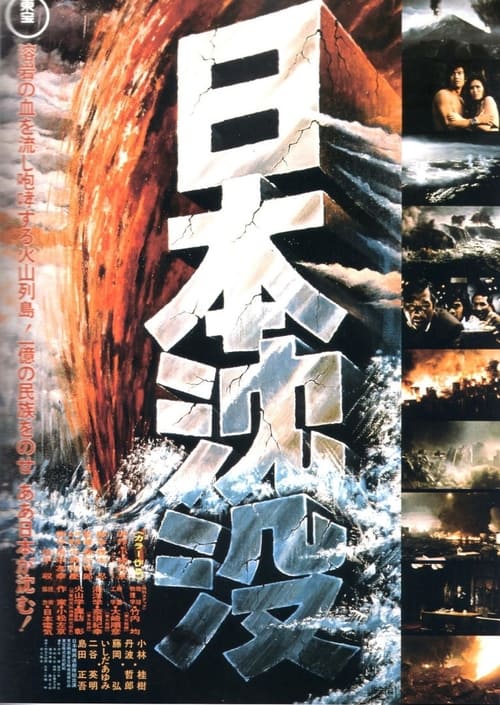
APRIL MOVIE THON DAY 21: Nihon Chinbotsu (1973)

The highest grossing film in Japan in 1973 and 1974, Submersion of Japan or Japan Sinks! was also a big deal in the U.S. Roger Corman bought the rights as part of New World Pictures and made a remix where he cut out lots of footage, added new sequences directed by Andrew Meyer (Night of the Cobra Woman) and added Lorne Greene as an ambassador at the United Nations as well as appearances by Rhonda Leigh Hopkins (Summer School Teachers), John Fujioka (Shinyuki from American Ninja), Marvin Miller (anarratorr in several movies), Susan Sennett (Candy from The Candy Snatchers), Ralph James (Sixpack Annie), Phil Roth, Cliff Pellow and Joe Dante.

Now called Tidal Wave, it came out in May of 1975, while New World also released an uncut subtitled version called Submersion of Japan in America.

If you remember when we discussed Nosutoradamusu no daiyogen, Japan was in disaster mania, predicting the end of the world at every turn. This movie was inspired by Nippon chinbotsu by Sakyô Komatsu, the same author of Virus: The EndBye Bye JupiterDisappearance of the Capital and Time of the Apes. Of all his work, Komatsu’s sinking story was so popular that it became a TV series in 1974 and was remade in 2006 as Doomsday: The Sinking of Japan, then remade again as the 2020 TV mini-series Japan Sinks 2020, which was so big that it played theaters and spun off another series, Japan Sinks: People of Hope.

There was even a 2006 parody, Nihon igai zenbu chinbotsu, which means The World Sinks Except Japan.

This was no cheap picture. Director Shirô Moritani has been second unit on Yojimbo while writer Shinobu Hashimoto was behind RashomonSeven SamuraiThe Hidden Fortress and Throne of Blood amongst many other movies, as well as the director of Lake of Illusions, Minami no kaze to nami and I Want to Be a Shellfish.

Two hundred million years ago, what we know as the Earth was a single continent which split up over the years. At one point, Japan was part of the continent of Asia. But now? If you read the title, spoiler, Japan is going to sink. The first people to find out are geophysicist Dr. Tadokoro (Keiju Kobayashi, whose roles in comedies defined what post-war Japan saw as the ideal salaryman) and Onodera Toshio (Hiroshi Fujioka, the original Kamen Rider) take their submarine Wadatsumi-1 to the Ogasawara Islands. How bad is it? Well, the land mass that makes up the islands of Japan itself are about to collapse into a trench.

While Onodera is falling for Abe Reiko (Ayumi Ishida), volcanos start to erupt and earthquakes break out with more frequency. A rich businessman named Mr. Watari (Shōgo Shimada) pays for a series of expeditions to discover if Japan can be saved. But just like our climate, it’s already too late. Unlike our crisis, Japan has three choices: form a new country, seek a home in other countries or accept the end of the country and die.

They only have ten months to decide and as many countries offer to help, I’m reminded that as much as I love Japan, it’s an incredibly racist country. Even in a fictional story, South Korea, China and Taiwan refuse to help them. By the end, as the country sinks into the sea, more than half the population remains to go down with the ship. And our hero and heroine? They’re seperated a world away from one another.

You know who is in this? Turkish born actor Andrew Hughes, a businessman based in Tokyo as an import-export businessman who shows up in so many Japanese films from the late 1950s to the mid-1980s, usually in minor roles but even playing Hitler in The Crazy Adventure. The Japanese prime minister is played by Nobuo Nakamura, who was in Kurosawa’s films, but the really interesting actor is the man playing the driver of the Japanese leader. He’s played by Haruo Nakajima, who played Godzilla from 1954’s original film to 1972’s Godzilla vs. Gigan. After this role, he went to work in Toho’s bowling alley. I wish I was making that up.

This movie has some amazing alternate titles, such as Panic Over Tokyo (West Germany and I’m shocked that Frankenstein was not involved, as his name was on every Toho Godzilla movie releasd there), The Fall of Japan (Belgium), Death in the Rising Sun (Portugal knows how to name a movie), The Sun Does Not Rise Over the Island (Czechoslovakia), Planet Earth Year Zero (Italy), S.O.S. The Earth Is Sinking (Sweden) and The End of the World (Turkey).

Roger Ebert nominated this movie for The 50 Worst Films of All Time–and How They Got That Way by Harry Medved and Randy Dreyfuss. He said, “The movie never ends, but if you wait long enough it gets to a point where it’s over.”

As for the Japanese version of the film — which lends its special effects to the aforementioned Toho Nostradamus movie — I really liked that unlike so many disaster films, the actual socioeconomic problems that the world would face get explained and shown. There’s no shortage of waves crushing everything in their way, but at least we learn something.

You can watch the original Japanese version of this movie at the Internet Archive.

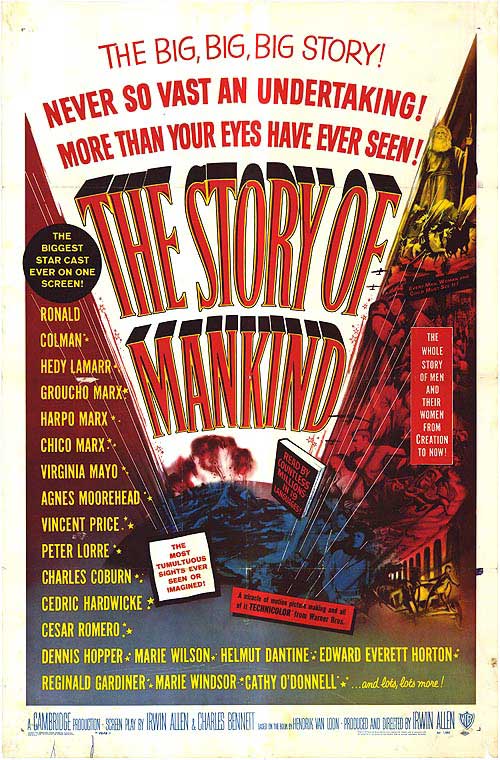
APRIL MOVIE THON DAY 20: The Story of Mankind (1957)

Hendrik Willem van Loon, a Dutch-American historian, wrote and illustrated The Story of Mankind in 1921. The book is a unique exploration of the history of Western civilization, told through a series of brief chapters. Van Loon’s narrative style is characterized by his constant questioning of the pivotal role of certain individuals or events in shaping the course of history. He often asks, ‘Did the person or event in question perform an act without which the entire history of civilization would have been different?

Thirty years later, former publicist Irwin Allen, in a bold move, chose the book as his first non-documentary film. He directed, wrote, and produced the movie, initially planning for only an actor and actress to appear in the film. However, he then decided to take a page out of the recent box office hit Around the World In 80 Days and assembled a cast of nearly fifty stars to tell the story. This unique approach, along with the use of lots of repurposed B-roll from other movies and stock footage, makes The Story of Mankind a truly one-of-a-kind cinematic experience.

Ronald Colman is The Spirit of Man, and Vincent Price is Mr. Scratch. They’re testifying in front of a tribunal that will decide the fate of mankind, who has created a Super H-Bomb, and the powers that run the universe will determine whether they stop the bomb or allow it to destroy the human race. That leads to a cavalcade of stardom, with Hedy Lamarr as Joan of Arc,  Virginia Mayo as Cleopatra, Agnes Moorehead as Queen Elizabeth I, Peter Lorre as Nero, Charles Coburn as Hippocrates, along with all three Marx Brothers in their last film together.

But wait — there’s more. Cesar Romero! John Carradine! Dennis Hopper as Napoleon!  Francis X. Bushman as Moses! Jim Ameche, taking over the role his brother made famous, Alexander Graham Bell!

They are all on sets that seem made for TV, with dialogue made for the grade school stage. Yes, The Story of Mankind certainly is something else. Everyone in this showed up for one day to film their part and was all paid pretty well. The movie’s odd presentation, resembling a religious epic with no religion, adds an intriguing element to the viewing experience.

When asked if the film was based on a book, Colman replied, “Yes. But they are using only the notes on the dust jacket.”

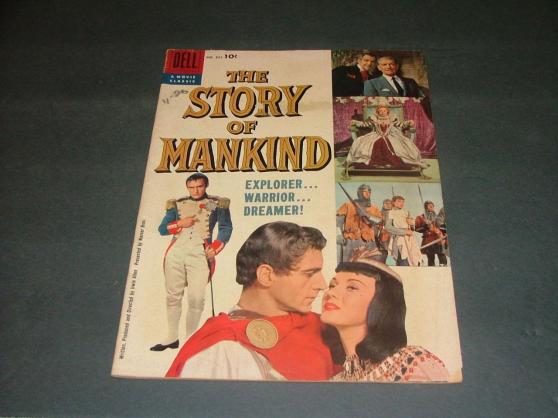
There was a comic book, though. Dell released an adaption written by Gaylord Du Bois and illustrated by Bob Jenney.

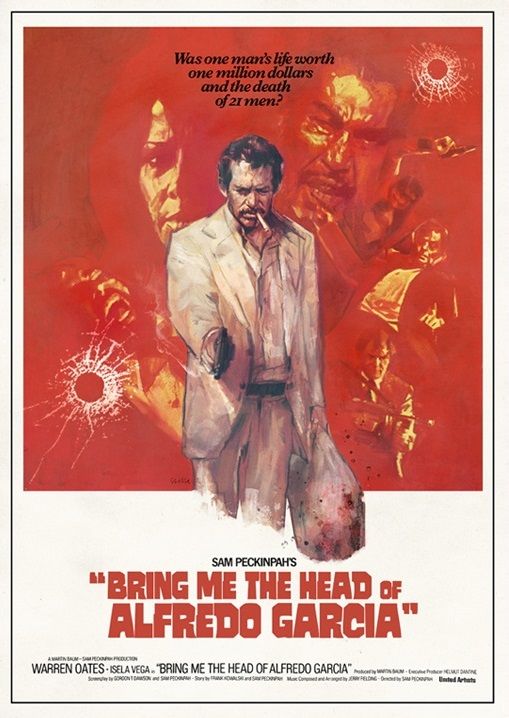
APRIL MOVIE THON DAY 20: Bring Me the Head of Alfredo Garcia (1974)

Sam Peckinpah said, “For me, Hollywood no longer exists. It’s past history. I’ve decided to stay in Mexico because I believe I can make my pictures with greater freedom from here.”

With the exception of a few key people, Peckinpah made this movie with a Mexican crew, including camerman Alex Phillips, Jr., who hared wide-angle lenses, loved zooms and who created a multiple camera setup that allowed Peckinpah to basically edit the film in his head as he shot.

It also allowed him lots of creative freedom and to capture the bleak world that he wanted. Shooting at a bar called the Tlaquepaque, he said out loud that this place was real. It was — the owner had once killed a woman on the premises and bribed the right people to make it go away.

And the results, sure, they ended up in the Medved co-authored The Fifty Worst Movies of All Time, but Roger Ebert said, “Bring Me the Head of Alfredo Garcia is Sam Peckinpah making movies flat out, giving us a desperate character he clearly loves, and asking us to somehow see past the horror and the blood to the sad poem he’s trying to write about the human condition.”

Who is Garcia? He was once the man selected to be the successor for El Jefe (Emilio Fernández), but he messed up when he knocked up the boss’ daughter Teresa, putting a million dollar bounty on his head. Two months pass before two hit men, Sappensly (Robert Webber) and Quill (Gig Young), walk into the saloon where Bennie (Warren Oates) plays piano.

He claimns he doesn’t know who Garcia is yet he surely does. He’s the man who his lover Elita (Isela Vega) cheated on him with. He confronts her as to the man’s whereabouts and learns that he died in an accident. Easy money — he gets $10,000 for Garcia’s head, plus a $200 advance for expenses, and takes Elita along with him to dig the grave. On the way, he proposes to her, telling her that she can retire and they can live in peace, but we know that can never happen as the moment they get there, they’re attacked by bikers (Kris Kristofferson and Donnie Fritts) who nearly assault her before Bernie comes to and dispatches them both. As he starts digging the grave, against the protests of Elita, he’s knocked out. He wakes up buried alive with his girl dead by his side, the body of Garcia already missing its head. Oates took mushrooms before this scene, so he’s really living this experience.

Arguing with the head, which has been packed in a sack with dry ice, Bennie leads a death march across Mexico, with everyone in his way dying, death always at his side, waiting for him, as he begins to realize that the head means nothing at all to him or anyone else. The money was meaningless. The revenge doesn’t matter. Yet he must follow through.

Warren Oates copied Peckinpah to play his part, right down to borrowing a pair of sunglasses from the director. And this was the only time that the maverick creator ever got final cut on one of his movies. The twosome also bonded over cocaine, which only added to the air of paranoia and doom that fills every single second of this movie.

I can see why some would dislike and even hate this movie, but for me, it just plain sings. The song may be abrasive, it may be filled with anger, but it’s a song nonetheless.

APRIL MOVIE THON DAY 20

For the twentieth day of the B&S About Movies April Movie Thon, let’s forget about the Golden Turkey Awards and how they predisposed people toward disliking some really great films.

April 20: Screw the Medveds — Here’s a list of the movies that the Medveds had in their Golden Turkey Awards books. What do they know? Defend one of the movies they needlessly bashed.

All April long, we’ll have thirty themes as writing prompts. If you’d like to be part of it, you can just send us an article for that day to bandsaboutmovies@gmail.com or post it on your site and share it out with the hashtag #BSAprilMovieThon.

Here are a few films to check out:

Airport ’79 (1979): You know, I have watched this movie tons of times and I can tell you how bad it is, but it entertains me every single watch. Maybe movies can be fun, huh?

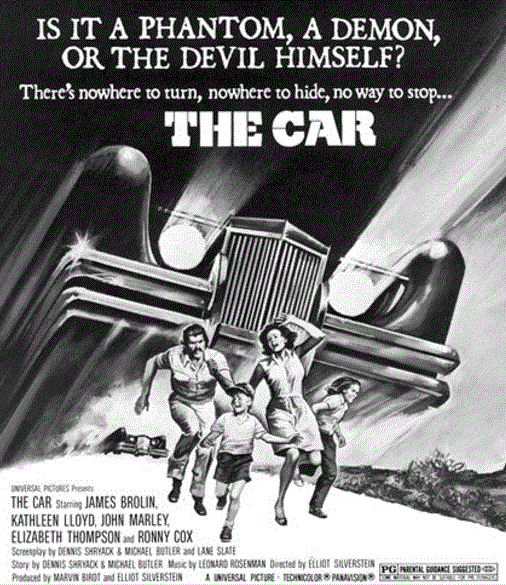
The Car (1977): Seriously, the Medveds have little to no taste. How can you dislike this movie?

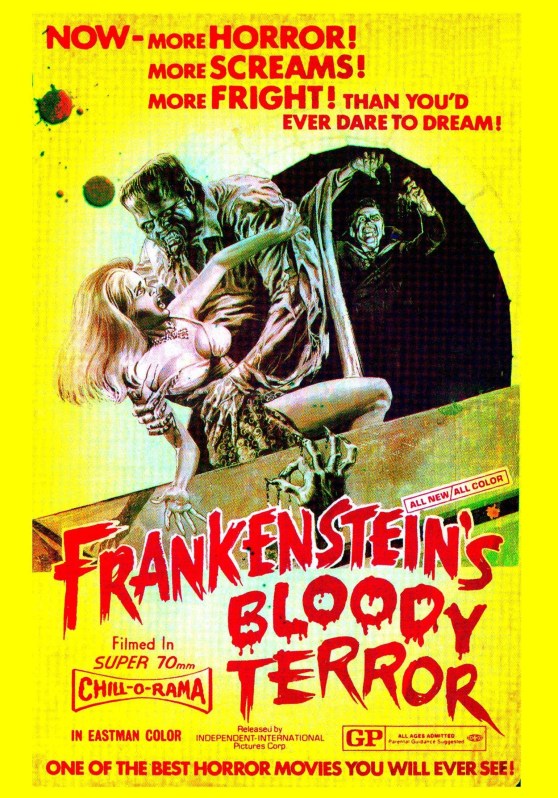
Frankenstein’s Bloody Terror (1968): A Frankenstein movie about vampires and Count Waldemar Daninsky, the werewolf that Paul Naschy played many times with many origins.

What are you watching?

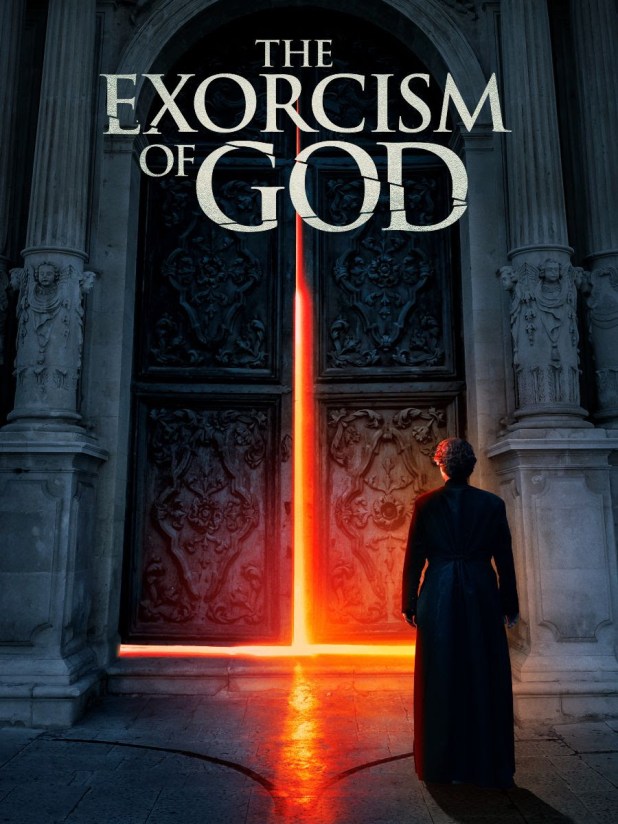
LIONSGATE BLU RAY RELEASE: The Exorcism of God (2021)

EDITOR’S NOTE: We originally watched this movie on October 1, 2021. Now it’s available on blu ray+ digital and DVD from Lionsgate. 

Exorcism is in this year, if Fantastic Fest is any gauge of the pop culture zeitgeist. It totally is, right? Right.

Between ZalavaAgnes and this movie, I’ve seen plenty of demonic women uttering blasphemy, floating and spitting pea green soup. But hey — I’m also the guy who put together a list of ten movies that I might like more The Exorcist that rip off The Exorcist. Amityville II: The Possession? Enter the Devil? Alucarda? These are the films that I love.

But I have never seen a movie where a demon tries to exorcise God from the soul of a priest, so well done The Exorcism of God and director/co-writer Alejandro Hidalgo (The House at the End of Time).

The open of this film is the end of an exorcism, with Father Peter Williams (Will Beinbrink), going against the church to exorcise a woman. The demon inside her seduces and possesses him, leading to him committing a major sin, a moment of sexual congress ends up having been not consensual, despite the whole possession, and then the priest hides it for two decades as the rest of his small town nearly makes him a saint.

So yeah — it’s kind of hard to see a man who would take advantage of a woman during an exorcism as the hero. That said, this film has some intense imagery, like a possessed Jesus, that will keep the more pious of us up late into the evening.

I’d have also liked this a bit more if it could decide what film it wanted to be: a satire against the hypocrisy of organized religion or an effects-heavy bring out the green vomit horror movie. And hey — a lot of that green goo gets al lover Joseph Marcell, Geoffrey from The Fresh Prince of Bel-Air, who is really good in the short time he appears.

Look, a possession movie is like a bowl of ramen. I’ve had high-end bowls with butter bombs and organic infusions, fish head ramen at 5 AM in a Tokyo standing shop and all manner of 3-minute bowls and they’re all good. It’s ramen. I love ramen. And that’s kind of how I feel about this movie. It’s not the best bowl of ramen I’ve ever had, but I really enjoyed some of the new flavor that I found when I dug to the bottom — yeah, that demon making a priest renounce God scene is pretty great — and wish that that spice went through the whole dish.

But it still tastes fine.

APRIL MOVIE THON DAY 19: The Unholy Three (1925)

The first of eight movies that Lon Chaney would make with director Tod Browing (The BlackbirdThe Road to MandalayLondon After MidnightThe UnknownThe Big CityWest of Zanzibar and Where East Is East are the others),

Tweedledee (Harry Earles) is a small man who leaves the circus when he assaults a young heckler and starts a riot. He’s joined by the incredibly strong Hercules (Victor McLaglen), Professor Echo (Chaney), a ventriloquist who becomes pet shop owner Mrs. O’Grady and his pickpocket girlfriend Rosie O’Grady (Mae Busch), who pretends to be his granddaughter.

Their new scam? Sell pets, deliver them and come back and steal everything. Their scheme brings in the innocent Hector McDonald (Matt Moore), who falls for Rosie. Browning was always using the duality of identity in his films and this one has every character nearly becoming someone else, but their crimes bind them.

The Unholy Three was remade in 1930, directed by Jack Conway. Chaney returned as Echo and Earles as Tweedledee, while Hercules would be played by Ivan Linow and Rosie by Lila Lee. This movie proved that Chaney was not only the Man of a Thousand Faces, but also the Man of A Thousand Voices. It’s the only film in his career where Chaney would speak.

APRIL MOVIE THON DAY 19: Dr. Jekyll and Mr. Hyde (1920)

John Barrymore, who plays both Dr. Henry Jekyll and Mr. Edward Hyde in this movie, was such a gifted physical actor that the initial part of his transformation has no makeup. It’s him contorting his body and appearance all on his own.

This adaption of Strange Case of Dr. Jekyll and Mr. Hyde by Robert Louis Stevenson was written by Clara Beranger (who was one of the original faculty members at USC School of Cinematic Arts) and was directed by John S. Robertson, who The Byrds wrote the song “Old John Robertson” about.

Henry Jekyll (Barrymore) is led to believe that all men have two sides at constant war for their souls: a good and evil brain, basically. A potion that he creates allows him to access that evil side of his being, unleashing Edward Hyde. Yet by the end of the film, the potion is no longer needed and the transformation comes whenever Jekyll becomes upset.

A few years after making this movie, Barrymore bought a house in Hollywood for $6,000. He got the seller to lower the price by a thousand dollars by showing up the closing dressed as Mr. Hyde.

APRIL MOVIE THON DAY 19: The Hands of Orlac (1924)

Robert Wiene is best known for directing The Cabinet of Dr. Caligari, but this is yet another masterwork. It’s been remade four times, as Mad Love in 1935, The Hands of Orlac, Hands of a Stranger in 1962 and Body Parts in 1991. They all are versions of the 1920 novel Les Mains d’Orlac by French writer Maurice Renard.

It also was kind of sort of remade as The HandThe Beast With Five FingersThe Crawling Hand, Les Mains de Roxana and segments in Dr. Terror’s House of Horrors and Body Bags.

Concert pianist Paul Orlac (Conrad Veidt) loses his hands in an accident only to receive a transplant of the hands from an executed murderer, a fact that begins to drive him insane. The surgeon tries to tell him that a person is not governed by hands, but by the head and heart. But Paul knows — he’s now obsessed by the idea of killing someone.

Now that he can no longer play piano, Orlac is destitute. He goes to ask his father for money, only to find him stabbed by the same knife the killer once used. It gets worse. He’s unsure if he killed his father or not, so he goes to drink, and meets a man who claims to be the killer. Could the surgeon have transplanted a new body on the hands of the killer? Perhaps. But whomever the man is, he begins to blackmail Orlac.

There’s a twist which I won’t give away — why spoil a movie that’s 98 years old — but this movie is still a great watch so many years later.