APRIL MOVIE THON DAY 21: Island of Lost Souls (1932)

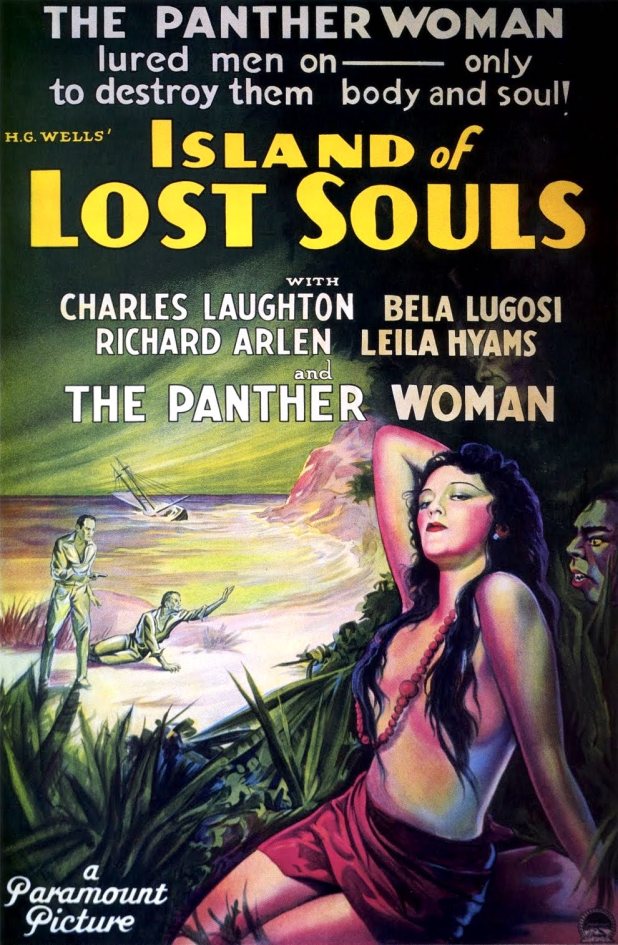
For all the infamous takes on The Island of Dr. Moreau, the third try — after the silent films Ile d’Epouvante and Die Insel der Verschollenen — got it right. Written by Waldemar Young (The Unholy ThreeThe Mystic) and Philip Wylie (whose Gladiator inspired Superman, The Savage Gentleman led to Doc Savage and When Worlds Collide was homaged by Flash Gordon), this film ended up banned in 14 states for embracing evolution and a line where Moreau says, “Do you know what it means to feel like God?” When it was re-released nine years later, any inference that Moreau created the animal/human hybrids was cut. It didn’t make it to the UK until 1957, a fact that pleased original writer H.G. Welles, who hated the movie as it was more horror than a studied philosophical narrative.

Director Eric Kenton took the long way to Hollywood, starting as a school teacher and then doing dog, pony and animal shows at the circus before working in vaudeville. He was a fan of horror, making The Ghost of Frankenstein, House of FrankensteinHouse of Dracula and The Cat Creeps as well as two Abbott and Costello movies, Pardon My Sarong and Who Done It?

Edward Parker (Richard Arlen) survives a shipwreck and is rescued by a freighter delivering animals to the literal island of Dr. Moreau. After saving M’ling (Tetsu Komai), an animalistic looking man, from the captain, both are thrown off the boat and sent to Moreau via Mr. Montgomery’s (Arthur Hohl, a Pittsburgh native who was also in Show Boat) boat.

Moreau (Charles Laughton, who in addition to a fine acting career also had perhaps the finest one and done directing career with The Night of the Hunter) shows off his animal men to Parker, including Lota (former model Kathleen Burke, who was tied to this role for the rest of her life), a woman who appears human but is truly a panther. But something is amiss. After all, why would she refer to the lab as the House of Pain? And why would Moreau need to hold his men back with a whip and make them recite the Law of Man?

“Not to eat meat, that is the law. Are we not men? Not to go on all fours, that is the law. Are we not men? Not to spill blood, that is the law. Are we not men?”

The Sayer of the Law is, obviously, Bela Lugosi. And he’s perfect in this.

Lota falls for Parker, which was all a ruse by Moreau, as he wanted to see if she could feel human emotions. Parker is enraged by this, as he still loves his fiancee Ruth (Leila Hyams) and is shocked to see Lota’s fingernails turn into claws. She’s lost in despair, yet Moreau laughs, screaming that he will burn out the animal left within her in his House of Pain.

Speaking of Ruth, she gets a rescue crew to visit the island and save Parker and that’s when Moreau decides to kill everyone, using one of his creations Ouran (Hans Steinke) as the killer. This backfires, as the rest of his creations realize that if the man who made them doesn’t need to follow the law, they don’t need to either.

“What is the law? Law no more!” they shout as they hold Moreau down and repeatedly stab him with his own surgical tools, just as Montgomery, Parker, Ruth and Lota make their escape. At the last moment, Ouran attacks and Lota gives her life to allow Parker and Ruth to live their lives far from the now burning island.

This is a movie that shocked and upset audiences, with even the sound design causing chaos. Soundman Loren L. Ryder recorded a mix of animal sounds and foreign languages, then played them backward at multiple speeds. The sound that resulted made people physically sick.

As much as Welles disliked this movie, his book was missing the dynamic between Parker, Ruth and Lota. The Panther Woman character was so popular and enduring that she influenced every adaption made after this one, such as Frances in Terror Is a Man, Ayessa in The Twilight People, Barbara Carrera in the 1977 remake and Aissa in the 1996 movie that is so infamous.

This film also influenced numerous musicians. The Cramps’ song “The Natives Are Restless” is about the film, Blondie had the song “Island of Lost Souls,” House of Pain took their name from the movie (and even named a tour He Who Breaks the Law), The Meteors had a song with the title of the film, Oingo Boingo recorded “No Spill Blood” and Buckethead has a song named “Island of Lost Minds.”

Cleveland-based horror rock band Manimals based much of their look on the film and when they played the song “Island of Lost Souls” live, fans would shout “What is the law?”

Van Halen played a song called “House of Pain” that was a progressive rock song that was definitely not the radio friendly rock they’d soon become known for. When played live, David Lee Roth would give a long introduction about how the movie inspired the song and then Eddie would go into an intro that eventually became “Eruption.” The demo of the song — there’s a different version with different lyrics on 1984 — is incredible.

Yet no band was more inspired than Devo. The “What is the law?” dialogue formed the lyrics to their “Jocko Homo,” while they took the question “Are we not men?” for their 1978 debut album Q: Are We Not Men? A: We Are Devo!

Pretty good for a movie with no music on its soundtrack.
Children of Sin (2022)

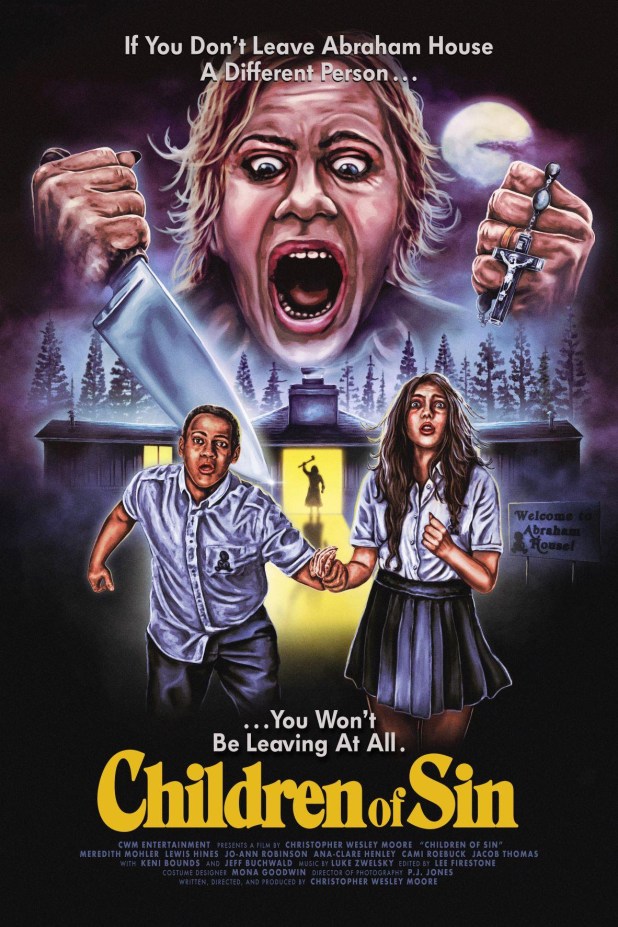
After being sent to Abraham House, a sinister religious retreat, Emma (Meredith Mohler) — who is pregnant — and Jackson (Lewis Hines) — who is gay — must escape and save their mother Tammy (Keni Bounds) from their stepfather Robbie (Jeff Buchwald).

Jackson wants desperately to make his mother happy, even trying in the past to get along with his abusive stepfather while Emma is always a rebel. Now under the watchful eye of Mary Esther (Jo-Ann Robinson), a religious fanatic who rules the house as she sees the Good News, Jackson agrees to pray away his homosexuality while Emma looks for a way out.

Director and writer Christopher Wesley Moore also made Triggered, which I really enjoyed. This slasher has its heart in the better stalk and slice movies of the past while using the politics and religion of today to create a story that has resonance. It does a lot with not much budget, including no small amount of blood as the film moves toward its conclusion.

It’s so frightening because I honestly believe that it could happen. Conversion therapy is insidious and I honestly feel that every day we inch closer toward an American Taliban.

Children of Sin is available on Amazon Prime. You can learn more on the official Facebook page.

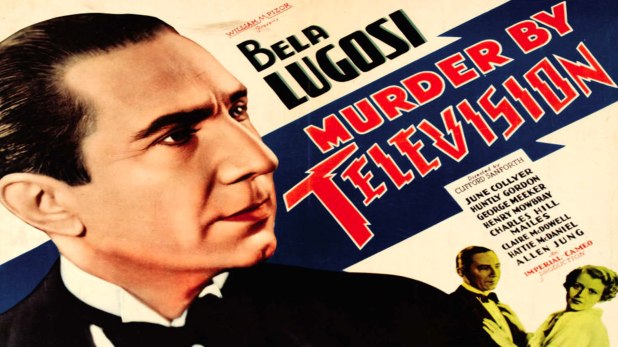
APRIL MOVIE THON DAY 21: Murder by Television (1935)

You know how bad people wanted television in 1935? When an inventor comes up with a way of sending signals from anywhere, he’s murdered — for television more than by it — and we’re into this detective caper directed by Clifford Sanforth and written by Joseph O’Donnell who mainly worked on cowboy films.

This movie is 54 minutes long — it feels way longer and nothing happens until the last ten minutes of the movie — which is the length that all movies should be. It was originally called The Houghland Murder Case. It’s a bit too talky and not the best mystery ever, but it’s worth watching just to see Bela Lugosi play a good and evil twin.

Keep an eye out for Hattie McDaniel playing a cook a year before she won an Oscar for Gone With the Wind.

There’s a line that claims that television “will make of this Earth a paradise.” What shows would that be?

You can watch this on Tubi.

APRIL MOVIE THON DAY 21: Final Curtain (1957)

Narrated by Dudley Manlove (Eros from Plan 9 from Outer Space) and intended for TV, Final Curtain would have been an episode of Portraits of Terror. If it seems familiar, well, that’s because some of the footage would be in Night of the Ghouls.

That said, a complete version of the episode was long thought lost until a copy was found by Jason Insalaco, great-nephew of one of Ed Wood’s returning players Paul Marco.

Duke Moore (Lt. Harper from Plan 9) is the actor — in a role intended for Bela Lugosi  wandering a theater, stalked by a vampire (Jeannie Stevens, whose only other role was in Night of the Ghouls, but that doesn’t really count because it’s just repurposed footage from this short).

Wood would recycle dialogue from this in his book Orgy of the Dead. Sadly, the world would never see a weekly series from Ed and we’re all the worse for it.

You can watch this on Tubi.

APRIL MOVIE THON DAY 21: The Return of the Vampire (1943)

This isn’t an official sequel to the 1931 Universal Studios film Dracula but it really feels like it, except that Lugosi’s name is Armand Tesla and this is made by Columbia. This would be the actor’s last major studio movie.

Lady Jane Ainsley (Frieda Inescort) is stalked by Tesla twice, once during the first World War and again during the second. The first time they crossed paths, she ended up staking him and freeing Andréas, a werewolf, from his curse. He becomes her assistant and his makeup would go on to be used again in 1956’s The Werewolf.

Twenty four years later, during the blitz, some cemetery workers find the body of Tesla and remove the stake from his heart, thinking that it’s shrapnel. Now Tesla walks the Earth again, with Andréas back in thrall, taking the name of Hugo Bruckner, a scientist who has escaped from a concentration camp and is coming to work with Ainsley. Meanwhile, Sir Fredrick Fleet of Scotland Yard believes that Ainsley is a murderer and that there’s no way there can be a vampire.

Director Lew Landers also made 175 other movies, with probably The Raven being his best-known film.

It’s pretty wild that Columbia did everything they could to make their own Dracula movie. Universal did threaten to sue, as they had the Lon Chaney Jr.-starring Son of Dracula coming out. If you think you may have seen this before, it is the movie playing in Iron Maiden’s video for “Number of the Beast.”

CALGARY UNDERGROUND FILM FESTIVAL: Sundown (2021)

ABOUT THE AUTHOR: Joseph Perry writes for the film websites Gruesome Magazine, The Scariest Things, Horror Fuel and Diabolique Magazine; for the film magazines Phantom of the Movies’ VideoScope and Drive-In Asylum; and for the pop culture websites When It Was Cool and Uphill Both Ways. He is also one of the hosts of When It Was Cool’s exclusive Uphill Both Ways podcast and can occasionally be heard as a cohost on Gruesome Magazine’s Decades of Horror: The Classic Era podcast.

Some films are difficult to write spoiler-free reviews about, and then there is writer/director Michel Franco’s French/Mexican/Swedish coproduction Sundown, a genre-defying work that goes beyond being a textbook example of that and takes the concept to a whole ‘nother plane. If films that leave you with many questions to ponder long after the ending credits roll are your style — and they almost always are for yours truly — then Sundown is absolutely worth your time. 

As the film opens, we meet the Bennetts: Neil (Tim Roth), Alice (Charlotte Gainsbourg), and older teens or young adults (their ages are never mentioned, one of the many puzzle pieces that Franco leaves for viewers to ponder) Colin (Samuel Bottomley) and Alexa (Albertine Kotting McMillan) as they lounge around poolside at a luxury resort in a beach locale disclosed later in the film. Alice falls apart emotionally when she receives a phone call that her mother has died, and as the four family members rush to the airport, Neil can’t find his passport, and the youngsters lead a distraught Alice to the plane as Neil promises to catch the next flight.

I’ll let you know that Neil doesn’t make good on his promise, and leave the plot description at that. Sundown is a slow burn, focused mainly on Neil and his behavior after he parts with the other family members. Although the premise might not sound exciting from my description, it works magnificently as Roth puts on an absolute acting clinic as a low-key man who is an utter mystery. Franco sprinkles bread crumbs here and there and then sends the proceedings in wholly unexpected directions. One of the first major reveals of the film happens in an understated “Did I hear that correctly?!?” manner, and from there, sudden shocking jolts and subtle divulgences occur, adding to the enigmatic ongoings as clarifications usually only lead to more mystifying situations.

Franco has constructed a remarkable head-scratcher that demands constant attention. He is aided by a splendid cast, which also includes Iazua Larios as local shopkeeper Berenice and Henry Goodman as family attorney Richard. Sundown also boasts gorgeous cinematography by Yves Cape that captures both the beauty and dark side of its setting (again, revealing it here would be a spoiler). Franco and his film ask a lot of its viewers, but if you give yourself over to its decidedly unhurried telling, you may find that it makes a case for being one of the year’s best cinematic offerings.

Sundown screens as part of the 19th Calgary Underground Film Festival, which takes place April 21–May 1, 2022 both at Calgary’s Globe Cinema and streaming on demand online. For more information, visit https://www.calgaryundergroundfilm.org/.

APRIL MOVIE THON DAY 21: The Black Sleep (1956)

Reginald Le Borg was a banker in Austria and a director in America, making low budget horror at Universal like The Mummy’s Ghost and Weird Woman. Released along with The Creeping Unknown, it was ahead of the Shock Theater package that would ignite a new interest in Universal’s horror movies. It’s also Bela Lugosi’s last movie, although footage of him appears in  Plan 9 from Outer Space.

Dr. Gordon Ramsay (Herbert Rudley) claims that he is innocent yet remains in jail, guilty of murder, when surgeon Sir Joel Cadman (Basil Rathbone) offers him a chance at redemption. All he has to do is assist him with some experiments, starting with taking a potion called The Black Sleep, which will put him into a deathlike slumber.

After the “dead” body of Ramsay is discovered in his cell, Cadman takes the body for burial and revives Ramsay back in his lab. There, he’s attempting to learn the mysteries of the brain so that he can bring his wife Angelina (Louanna Gardner) back to life. One of his servants, Mungo (Lon Chaney Jr.) was once Doctor Monroe, one of Ramsay’s former teachers. Now he’s a monstrous beast barely under control. And then there’s the mute — and frightening — Casimir (Bela Lugosi).

So why do Laurie (Patricia Blake), Odo (Akim Tamiroff, who replaced Peter Lorre, who wanted more than this production could pay for) and Daphnae (Phyllis Stanley) work for him? It turns out that Laurie is Mungo’s daughter and wants her father to be normal again. That said, there’s an entire basement filled with experiments that haven’t worked, broken human beings — like Tor Johnson — led by a maniacal preacher named Borg (John Carradine). They’re so close to breaking through the doors to the lab…

The Black Sleep has a great cast but doesn’t do much with them. But it’s a fast movie and if you don’t think too much — or want to hear Bela speak — you may enjoy it.

You can watch this on Tubi.

APRIL MOVIE THON DAY 21: Glen or Glenda (1953)

I despise the notion that Ed Wood was a horrible filmmaker. Sure, his movies aren’t technically proficient and are often pretty maudlin in moments, but he’s an actual auteur. For this movie, he didn’t just direct and write, he also starred as Daniel Davies. Who else could? After all, Wood convinced producer George Weiss that he was the perfect director for this movie as he was a real-life transvestite.

In this movie, Wood takes pains to emphasize that a male transvestite is not automatically a homosexual. He swore that he had never had a single homosexual relationship in his life and was considered a womanizer. He also was given to directing his adult work in full drag and claimed that his greatest fantasy was to come back as a gorgeous blonde. Yet he still would say that he was comforted by the feel of angora.

So while the Golden Turkey Awards may give Wood the title of Worst Director of All Time and Leonard Maltin may say that this is “possibly the worst movie ever made,” it has heart. An inept heart, but heart.

A transvestite who has been to prison four times for cross-dressing has killed themselves, saying “Let my body rest in death forever, in the things I cannot wear in life.”

This leads Dr. Alton (Wood player Timothy Farrell) to seek out Glen, another man who loves to dress as the other sex, often stealing the clothing of his fiancee Barbara (Dolores Fuller, Wood’s girlfriend at the time). Glen is struggling between being honest with Barbara before their wedding or telling her afterward. Through extended dream sequences, he finally comes to terms with who he is and his other side, revealing it to her. As she hands him an angora sweater, she accepts every side of him.

The doctor then learns of another person, Alan/Anne. Anne was born a boy, but her mother wanted a girl and raised her that way, which left her abused throughout school. Despite hiding her true self during the war, she has since had an operation to become “a lovely young lady.”

Let me tell you, this kind of movie is incendiary in 2022. This was made in 1953.

A movie with these words, which we should live by: “Give this man satin undies, a dress, a sweater and a skirt, or even the lounging outfit he has on, and he’s the happiest individual in the world. He can work better, think better, he can play better, and he can be more of a credit to his community and his government because he is happy.”

So yes, Ed Wood isn’t someone with a cinematic eye. But he put himself — all of himself — on the screen. That’s worthy of celebration.

The inclusion of Bela Lugosi is as well. That’s what takes this movie from message movie to true oddity, as Bela plays The Scientist, a character unconnected to any narrative that begins the film and is not even the narrator, much like how Encounter with the Unknown decides to have a second uncredited voice take the role because just having Rod Serling is not enough.

“Beware. Beware. Beware of the big, green dragon that sits on your doorstep. He eats little boys, puppy dog tails and big, fat snails. Beware. Take care. Beware.

Wood would bring back Glen/Glenda again in two of his novels. Killer in Drag has Glen/Glenda becoming a serial killer while Death of a Transvestite has Glen/Glenda being executed.

You can watch this on Tubi.

APRIL MOVIE THON DAY 21

For the twenty-first day of the B&S About Movies April Movie Thon, let’s celebrate Bela Lugosi.

April 21: Lugosi Love — What’s your favorite Bela Lugosi movie?

All April long, we’ll have thirty themes as writing prompts. If you’d like to be part of it, you can just send us an article for that day to bandsaboutmovies@gmail.com or post it on your site and share it out with the hashtag #BSAprilMovieThon.

Here are some Bela films to savor:

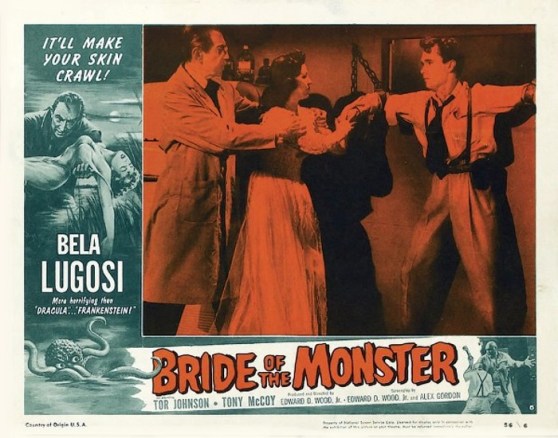
Bride of the Monster (1955): The final speaking role for Bela Lugosi, this kinda sequel to The Corpse Vanishes has him using the same hypnotic stare from Dracula and White Zombie.

Plan 9 from Outer Space (1959): I refuse to be part of the mean world that says this is a bad movie. It’s just a film that needed the budget to realize its scope.

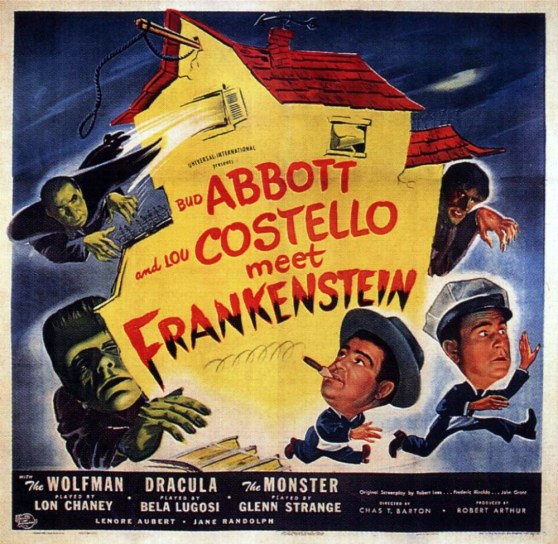
Abbott and Costello Meet Frankenstein (1948): For the role that he’s been typecast as, Lugosi only technically played Dracula twice.

What are you watching?

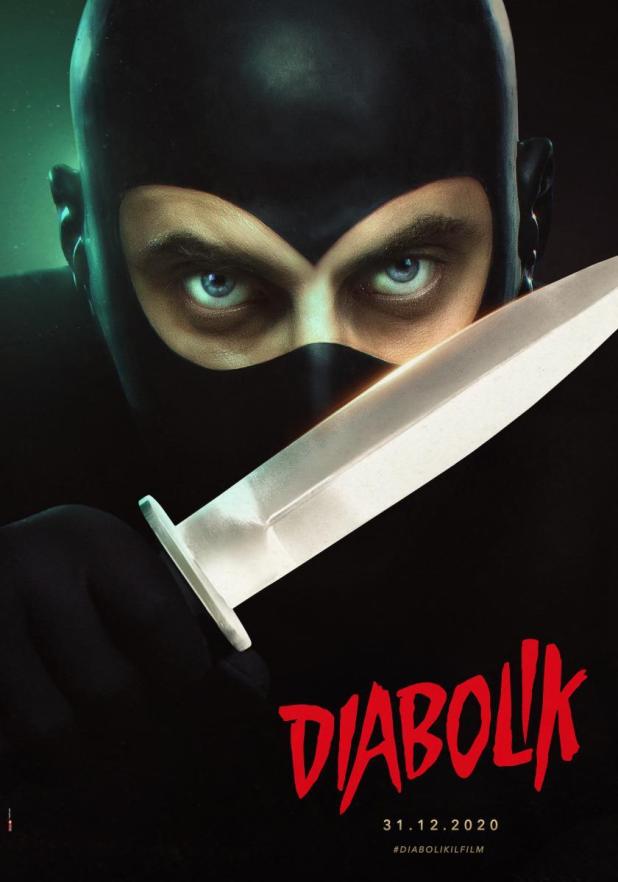
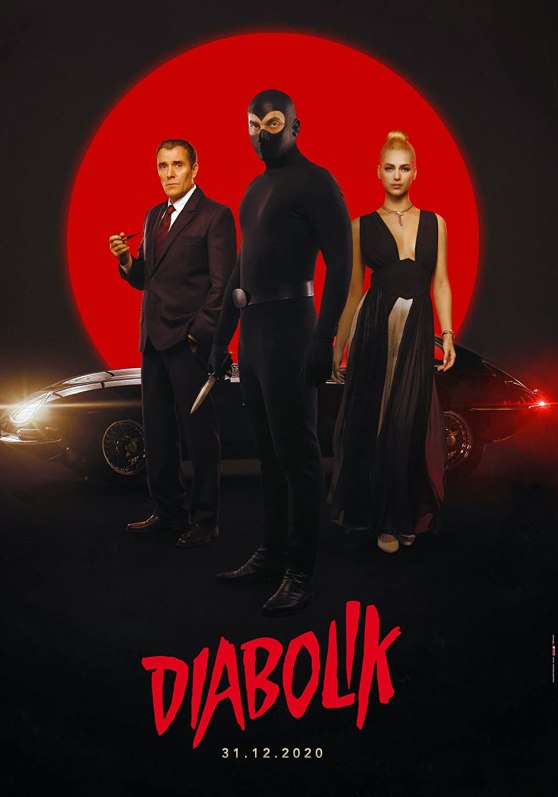
Diabolik (2021)

This was a movie that I wasn’t certain I was ready to watch.

I’ve been outspoken about my adoration for Mario Bava’s Danger: Diabolik and I knew there was no way that any movie could live up to the artistry of that film.

But what if a film did something so few comic book movies do? What if it actually stayed true to the source material?

The Manetti Bros. started their careers making music videos before directing Zora the Vampire, a movie that wasn’t a great experience for them or anyone that’s seen the film. They rebounded with a movie set on an elevator, Floor 17, and L’ispettore Coliandro, a TV series based on the stories by Carlo Lucarelli (Almost Blue) that references crime and action movies of the 70s and 80s. That show lasted seven seasons and led to further success such as The Arrival of WangPaura 3D, the poliziotteschi comedy tribute Song’e Napule, the musical comedy Ammore e malavita and now, Diabolik.

Diabolik was created in 1962 by sisters Angela and Luciana Giussani. Over 800 volumes, he and his partner Eva Kant have evolved from amoral supervillains out to swindle the town of Clerville to growing a code of honor and stealing from other criminals. He was raised on a secret island hideout of King, a crime boss, learning everything he needed to become the world’s greatest villain before killing his would-be father figure before he would be betrayed, taking his name from the black panther that that man had once killed. He doesn’t know his name or where he really comes from. He is only Diabolik. Only one man has a chance to stop him, the valiant, intelligent and incorruptible Inspector Ginko.

This film takes us back to a time when Diabolik (Luca Marinelli, They Call Me Jeeg) and Eva (Miss Italia 2008 Miriam Leone) knew each other, as he plans on stealing a ring from her, thinking she’s just another vapid heiress. After all, isn’t she dating deputy minister of justice Giorgio Caron (Alessandro Roja)? Using his ability to make life-like masks, Diabolik visits her hotel as his archenemy Ginko (Valerio Mastandrea). However, instead of taking from Eva, he becomes fascinated by her.

It turns out that Giorgio is an even worse criminal than Diabolik and he’s been blackmailing Eva, forcing her to date him. She soon falls for the master thief just as his girlfriend Elisabeth (Serena Rossi) discovers his secret hideout and sets him up for arrest by Ginko. A trial follows and Diabolik is sentenced to the guillotine (the judge is Mario Gomboli, author and chief editor of the Diabolik comic. He was one of the writers of the film, along with the Manettis and Michelangelo La Neve, who wrote the Dylan Dog comic, which Cemetery Man comes from).

That’s when Eva reveals that she’s just as resourceful as the black masked master criminal and the two put together a plan that takes out nearly all of their enemies while, at least, showing that even Diabolik has a code that he lives by.

Staying true to the third volume of the comic book, L’arresto di Diabolik (The Arrest of Diabolik), there’s a lot to like about this movie. The exterior scenes create a Clerville that is set in an unknown time, at once having modern technology and others showing a Eurospy sensibility with hidden rooms within brick walls and trees opening to create secret passages.

What doesn’t is the length of the film, taking over two hours to tell its story. Perhaps the explanations of the escapes could have been condensed or tweaked. There are times when you want this to become an action movie and it struggles in those moments.

That said, I came away liking the film, particularly Leone, who plays an Eva Kant who is just as capable as her lover. I do love the way the Manettis approached this film, however.

In an interview with Opentapes, Mario Gomboli said, “I understood that the Manettis could be the right choice when they told me: we don’t want to make a film about Diabolik, but the film about Diabolik. Diabolik is a character outside the box.” He also discussed how Eva had to be her own person, saying “I was inspired by the Giussani sisters: I dedicated all my work to them. They are the ones who created this woman who is a planet, she is not a satellite of a man, she is not at the service of any man.”

Supposedly there are two sequels already in post-production, so I’m excited to see what happens next. In fact, that was my exact thought as I watched this: I want to watch the same actors and creators make another one. That’s my scale for whether or not a movie works.

Hey — it was also nice to briefly see Demons actor Urbano Barberini in this! And I would have loved this even more if we’d had just a hint of “Deep Deep Down” play on the soundtrack.

One more piece of Diabolik trivia: Claudia Gerini, who plays Mrs. Morel in the film, has already appeared in the Diabolik universe. She was Eva Kant in the video for “Amore Impossibile” by Tiromancino, which was directed by Lamberto Bava. John Phillip Law in the video too!