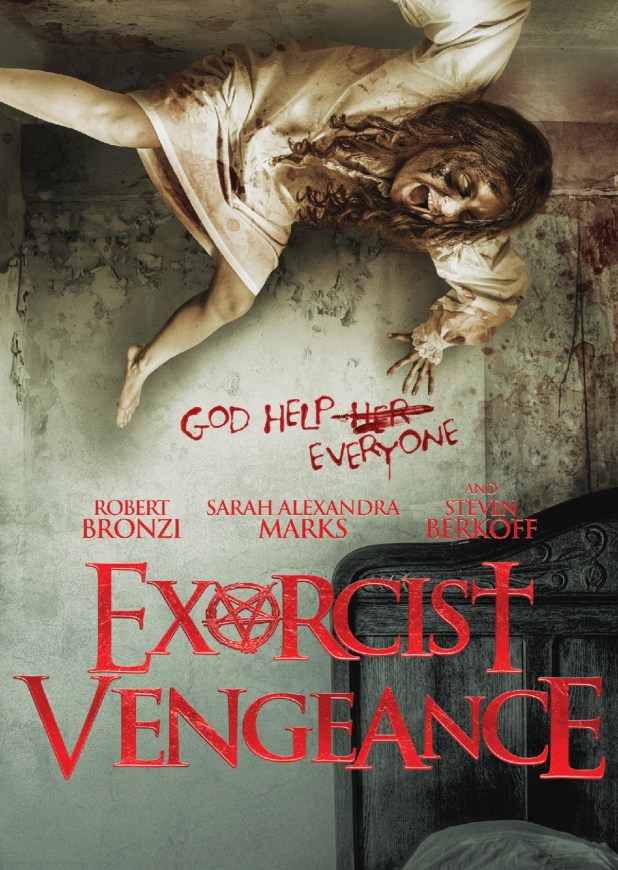
Exorcist Vengeance (2022)

I often wonder, what if some of my favorite movies had Charles Bronson in them. Like The Exorcist. What if Bronson went up against Pazuzu? And now, thanks to directors Scott Jeffrey and Rebecca J. Matthews — as well as executive producer Mark Lester (yes, the man who made Commando and Class of 1984) — as well as actor Robert Bronzi — who I really need to do an entire post devoted to all of his many recent movies — I know the answer.

I think this movie was made just for me.

Bronzi is Father Jozsef, a hardboiled priest with a troubled past that carries a gun. Really, is there anything else I need to say after that to prove why I loved this? It’s absolutely ridiculous in the best ways possible, a movie that if I saw on a mom and pop new release shelf I’d react like I was replacing an idol with a bag of sand like a low budget horror movie loving Indiana Jones.

He’s called in by Bishop Canelo (Steven Berkoff, OctopussyRambo: First Blood Part II) to stop the demon that has moved from old woman to housekeeper and now threatens an entire family. Yes, in the world of this movie, the Vatican calls in hits on demons.

Edna’s granddaughter Rebecca (Sarah Alexandra Marks) is the lone family member that understands why Jozsef has to be there and this is a mission that will require him to face the death of his wife and a demon — and family — intent on spitting in God’s face.

Written by Matthew B.C. (Medusa, Checkmate) and Jeff Miller (The ToyboxHellblock 13Once Upon a Time in Deadwood), this is the kind of escapist fun that I’m always looking for.

Now, here’s hoping some of my other questions, like how would Bronson fare against zombies, aliens and a romantic comedy can be answered by future Robert Bronzi movies.

You can watch Exorcist Vengeance on digital and on DVD from Uncork’d Entertainment.You can learn more on the official Facebook page.

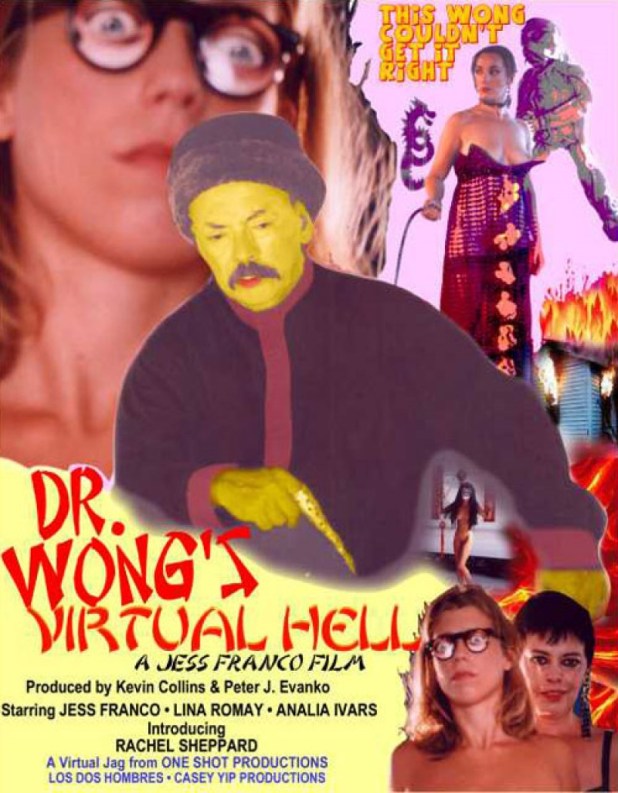
JESS FRANCO MONTH: Dr. Wong’s Virtual Hell (1999)

Jess Franco is Dr. James Wong, as well as this movie’s director and writer, and he’s bedeviling Rachel Sheppard, who plays Rita, while his long-time muse Line Romay plays his daughter Tsai Ming as well as his nemesis Nelly Smith (but only when she’s wearing the wig that allows us to know that she’s Candy Coster).

The whole thing looks like a comic book and Nelly is aided by stock footage* of Howard Vernon as the magician Cagliostro.

Still with me?

Then Analía Ivars does a fifty-minute long striptease while Jess goes wild with late 90s video effects which look as dated as that sounds. There’s also this cyberspace virtual reality thing about twenty years before anyone could actually explore that world, so as you can imagine, Jess Franco’s idea of VR is basically women dancing and dancing and then kissing tongues and then dancing some more.

Also: Jess Franco dressing up as an Asian stereotype about twenty or thirty years after people were like, “That’s a bad look.”

*It’s from The Erotic Rites of Frankenstein.

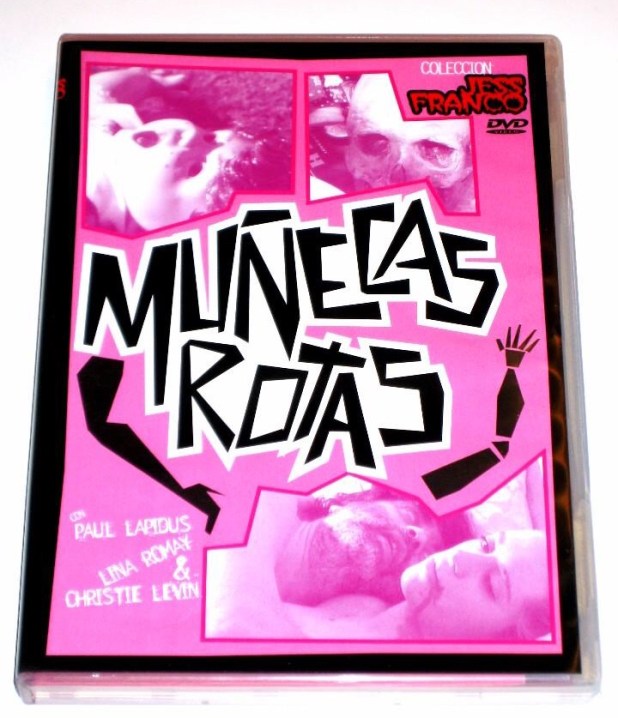
JESS FRANCO MONTH: Muñecas Rojas (1999)

On an island near the coast of Maracaibo, ex-Shakesperean actor Don Martin (Paul Lapidus) has brought an entire family of followers with him to start a new society. The inhabitants of his kingdom include his wife Tona (Lina Romay), his lover Gina (Christie Levin, Snakewoman), his daughter Beatriz (Mavi Tienda, Helter Skelter) and Herbie (Exequiel Cohen).

Their days are all the same, mostly with Tona beating Beatriz while screaming at an ocean liner, Gina trying to pick up Herbie and Beatriz spying on her father having sex with Gina. Yet no one tries to leave and even follows the old actor when he buries a treasure on the island. And then, Mario (Guillermo Agranati) shows up and wants to marry Gina. The old man marries off his daughter instead, as he thinks that Mario can get him in with a composer.

And then Herbie finds the treasure, which reveals that maybe Don Martin wasn’t all that great of an actor. He proves that with a long soliloquy that he closes by stabbing Mario and Beatriz as they have sex on his bed before drowning himself, dooming everyone to never leave the island.

Pretty much a shot on video version of House of Lost Women, it’s a soap opera or maybe Franco working through his fascist father hating that he played jazz. But man, some days I do feel like LIna, standing on that island and screaming how badly I want to get out of here, so I get it.

If you make enough movies, eventually you remake your own movies. If you’re Jess Franco, you remake your remakes and than make new versions of them.

JESS FRANCO MONTH: Les gardiennes du pénitencier (1981)

So this is kind of cheating, because this is less a Jess Franco movie and more a Eurocine mix tape that has been edited from Franco’s Barbed Wire Dolls, Alain Peyat’s Hitler’s Last Train and Patrice Rhomm’s Captive Women 4 with some new footage directed by Alain Deruelle in which numerous SS officers run away to Latin American where they’ve created special laboratories to breed beautiful women that will satisfy their darkest desires. How this helps them get revenge for the fall of the Third Reich is way beyond me.

Seriously, all of those movies, all mixed up, all with new dialogue dubbed over the top of them.

Jailhouse Wardress is literally only for Franco completists. And by that, I mean me. But seriously, if you’ve never watched one of his movies, this would not be the one to start with. Or really ever have to see.

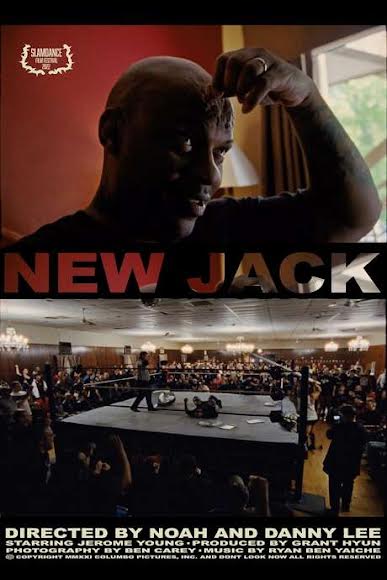
SLAMDANCE: New Jack (2022)

ABOUT THE AUTHOR: G.G. Graham is a cult film cryptid, horror hag, and exploitation film explorer of the dusty and disreputable corners of cinema history. The street preacher of Z-grade cinema can be found at Midnight Movie Monster, as well as writing for various genre sites and print publications, or on Twitter and Instagram @msmidnightmovie. Visit her blog at www.midnightmoviemonster.com and Twitter @msmidnightmovie.

The 1990s brought the concept of extremity to ridiculous extremes. Everything from toy cars to soft drinks to discount drugstore deodorant was being rebranded to reflect the tastes of a new generation perceived to be indifferent at best, and slackers at worst. A never ending pile of consumer goods, sporting events, and media properties rushed to cloak themselves in high contrast color palettes, creative spellings and other assorted folderol meant to convey the nebulous concept of “attitude”.

Independent wrestling promotion ECW (Extreme Championship Wrestling) was one of the very few creations of the era that understood the concept of “extreme” on both a literal and marketing level. The brand incorporated more international performers, and had a heavy emphasis on hardcore matches. Unlike the comparatively slower paced and family friendly fare of the (then) WWF, ECW pushed the boundaries, booker Paul Heyman innately understanding that what most interpreted as the audience’s love of “attitude” was actually more of a search for perceived authenticity.

Matches bursting with blood, weapons, and barbed wire merged with storylines that gleefully destroyed the previous boundaries for depictions of sex and violence in wrestling. The promotion blithely blurred the lines between performers and their in-ring characters, transgressing the conventions of classical kayfabe and offering something that felt more genuinely unfiltered than its more polished competition. If anything, ECW was an early harbinger of the sort of carefully curated “realistic” unreality that would come to dominate all of mainstream television (wrestling or otherwise) later in the 90s.

For a sport so often sniffily dismissed as fake, Jerome “New Jack” Young dragged real life violence and rage behind him like they were just another weapon in his omnipresent trashcan, an outlier even on the roster of a promotion named for the rough and ready fringes. To tell the story of his life and career is to discuss the deeply ingrained racism that was an unavoidable occupational hazard in working the rural South, the countless jumps from impossible heights, and a history of hidden blades that lead to both a winding network of facial scars and New Jack facing multiple sets of charges for felony assault.
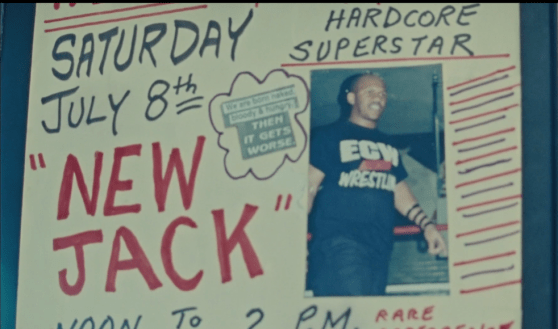
Watching the opening minutes of Danny Lee and Noah Lee’s documentary New Jack, it’s quite obvious that years of living on the edge makes a fall inevitable. Like many veteran wrestlers, the 2019 version of New Jack is wracked with old injuries, in the legacy act stage of his career. He makes his living working local shows for smaller promotions, often wrestling up and comers who both fear his reputation and revere his ring persona. 

One of the film’s few visual flourishes makes the point beautifully, cutting together New Jack’s various ring entrances over the years. Theme song “Natural Born Killaz” pounding on the soundtrack, the familiar trash can in tow, but the movements slower and the scars more prominent over time. The crowds get more sparse, cell phone cameras replace the television versions, but it’s better to be on fans’ minds than off. 

Rather than any strict chronology, the rest of the documentary tends to wander back and forth between past and present, without much structure to which events it chooses to highlight at any given time. Within the first 15 minutes the film careens between the previously mentioned house show, to the 2004 in-ring stabbing of opponent Hunter Red, to New Jack’s violently abusive childhood. This informal, snapshot style dominates the rest of the film, combining archive footage, new interviews, and New Jack’s candid reactions to videos from his wrestling heyday.

For established fans, a lot of the topics at hand will be familiar. From the surface of the sun level heat that a Black tag team with a gangbanger gimmick drew in the below the Mason Dixon territory of Smoky Mountain Wrestling, to the addiction struggles that marked New Jack’s ECW glory years, to the cumulative injuries collected over decades of high flying dives off balconies and steel chair shots, the documentary primarily busies itself with territory that has been well trodden in previous interviews.

The abundant charisma that made New Jack’s ring promos so electric to watch is still present, even when he’s detailing his most volatile actions. It is surprisingly easy to get wrapped up in how he recounts events, even if it’s a story of deeply questionable ethics and near miss criminal liability. He’s a born storyteller, and as these controversies have been a topic of debate amongst fans and press for years, he’s had plenty of practice in telling them to maximum effect.

For those keeping score at home, New Jack is remarkably consistent in his views on his most infamous moments—the artery severing blading of the “Mass Transit Incident” that nearly sank the nascent rise of ECW, tossing Vic Grimes off a scaffolding in retaliation for a previous botched stunt, the hospitalization required weaponized beatdowns of both Gypsy Joe and Hunter Red— often couching them as the natural outgrowth of opponents who lacked suitable experience in the ring or respect for their fellow wrestlers. He also doesn’t bother to hide how his heavy cocaine usage at the time may have shortened the fuse on his already explosive temper.

It’s rare that a documentary subject is both incredibly willing to answer questions, engaging while doing so, and utterly indifferent toward garnering viewer sympathy or revising history. That makes New Jack‘s general reluctance to venture beyond well worn paths all the more disappointing. The co-directors don’t seem to have a great handle on what form they wanted the finished film to take. While their occasional interjections often skirt the edge of some revealing territory, they cut abruptly to another subject rather than probing any deeper. This leaves the most interesting nuances of New Jack’s larger than life story unaddressed at the edges of the frame.

How did New Jack feel about being asked by bookers to monetize rural racism, when he was the one who took on the largest physical and psychological risk, for what was likely the smallest cut of the profits? What would he have considered to be going too far, and what ideological line separated those instances from a career full of real life violence in the context of fictional narrative? How did he manage to continue working for decades, despite openly admitting his liability nightmare tendencies to go dangerously off script when provoked? How did any of this reconcile with the man who was fiercely protective of keeping his surprisingly ordinary roles as a husband and parent out of the public eye almost entirely?

New Jack offers an identity crisis with no real answers. By editing the film into series of vignettes, the directors have created something that likely will be too disjointed to paint a clear picture for casual wrestling fans, while offering little new insight for dedicated devotees of hardcore wrestling history. Given that the film’s Slamdance Festival premiere is an accidental epitaph —Jerome Young passed away in May of 2021, at age 58— it is unfortunate that New Jack doesn’t have anything more definitive to say about the man or the character he created. It feels like a missed opportunity that film satisfies itself with a surface level journey into the familiar celluloid arc of an aging wrestler having to fend for themselves once the inevitable injuries force the final bell on their days as a headliner.
DOUBLE THE ITALIAN DUPLICATION ON THE DRIVE-IN ASYLUM DOUBL FEATURE!

This Saturday at 8 PM EST, visit the Groovy Doom Facebook and YouTube pages to get blasted into space with two movies that may seem a little familiar. We’ll be showing ads, discussing the movies and have drink recipes.

Up first is the space madness of Shocking Dark which you can watch on Tubi.

Here’s the drink.

Shocking Limoncello

  • 1 oz. vodka
  • 1 oz. blue curaçao
  • 2 oz. lemonade
  • 6 oz. club soda
  • Lemon and lime juice, to taste
  1. Mix vodka, blue curaçao and lemonade in a shaker with ice.
  2. Pour into a large glass, top with club soda and add lemon and lime juice to taste.

Our second movie is Alien 2: On Earth which is on YouTube.

Cocktail 2 Sulla Terra

  • 1 oz. Irish cream
  • 1 oz. Midori
  • 1 oz. vodka
  • 1 oz. high powered rum (Bacardi 151 or Cruzan Hurricane Proof)
  1. Layer Midori, then Irish cream, then vodka.
  2. Top with rum, shoot the shot and enjoy the movie.

See you on Saturday!

Get issue 23 of Drive-In Asylum now!

Drive-In Asylum #23 is here, and we’ve got another stellar issue for you to dig into! You can get it at the Etsy shop right now.

First off, we’ve got two fantastic interviews; the first is with Pat Cardi, who starred in the 1973 independent regional production Horror High, which many of us saw on TV in the 70s & 80s as Twisted Brain. Pat talks to us about his career in acting, working with genre luminary William Castle, his experiences as a child actor, and of course making the low budget thriller Horror High with director Larry Stouffer, co-stars Austin Stoker and Rosie Holotik, and a few Dallas Cowboys, too.

We’ve also got an interview with Kristine DeBell in this issue, too – yes, A.L. from Meatballs herself! In addition to that 1979 film, Kristine has worked with such names as Nick Castle (TAG: The Assassination Game), Jackie Chain (The Big Brawl), Paul Mazursky (Willie & Phil) and many others. She talks to us about her experiences in genre cinema, as well as her return to acting after a 22 year hiatus.

Plenty of other great features in this issue too, including personal recollections of attending exploitation screenings in grindhouses and lots of reviews, too!

In this issue, I contributed a painting of Dr. Phibes to go with a great article about those films and something about the Nightmare Theater syndication package.

This issue has 60 black and white pages, some pages printed on colored paper, 5.5 x 8.5 inches in size.

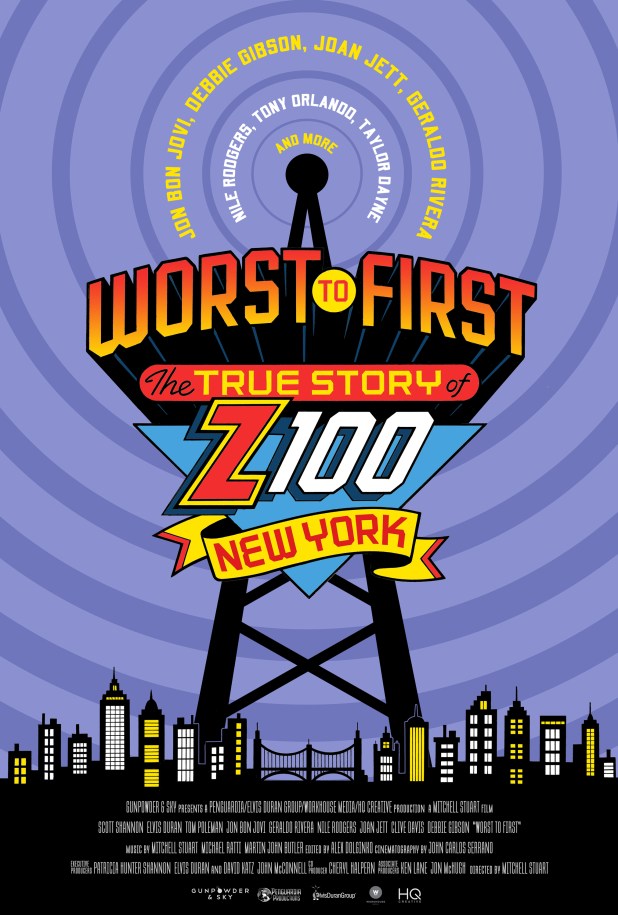
Worst to First: The True Story of Z100 New York (2022)

In 1983, Z100 launched from the swamps of Secaucus, New Jersey, a place where they believed that no artist would venture. A station where the DJs had to buy their own records just to have music to play. And a place where Scott Shannon would rally listeners into going, as the title says, from worst to first.

Directed and written by Mitchell Stuart, who produced with Trish Hunter Shannon, Elvis Duran, David Katz, and John McConnell, this movie tells the story of how a small radio company from Cleveland teamed up with a rock ‘n’ roll- loving DJ from Tampa named Scott Shannon to create WHTZ. Within the 74 days that the station took to go from worst to first, they not only brought back the top 40 format, but they were the station that launched the careers of so many stars. A major part of the movie is how Madonna used to stand outside the station and beg to be on the air and paid back the station by letting them premiere her songs from Who’s That Girl.

With appearances by Shannon, Elvis Duran, Jon Bon Jovi, Nile Rodgers, Clive Davis, Debbie Gibson, Joan Jett, Taylor Dayne, Tony Orlando, Joe Piscopo, “Magic” Matthew Alan, “Professor” Jonathan B. Bell, Anita Bonita, Ross Brittain, Pete Cosenza, Michael Ellis, Gavin DeGraw, Cathy Donovan, Gary Fisher, Frank Foti, Sean “Hollywood” Hamilton, David Hinckley, Donnie lenner, Jim Kerr, Steve Kingston, Ken Lane, Kenny Laguna, Jimi LaLumia, Tom Poleman, Geraldo Rivera, Trish Hunter Shannon, Patty Steele, Claire Stevens, Mitchell Stuart, John Sykes and Jim Wood, this film feels like something that would be running in the lobby of the station or sent to media companies looking to buy time. Or, for radio geeks like me, it’s a great time capsule of a moment that will never exist again, when FM radio ruled entertainment.

Worst to First is available on all on demand platforms from Gunpowder and Sky.

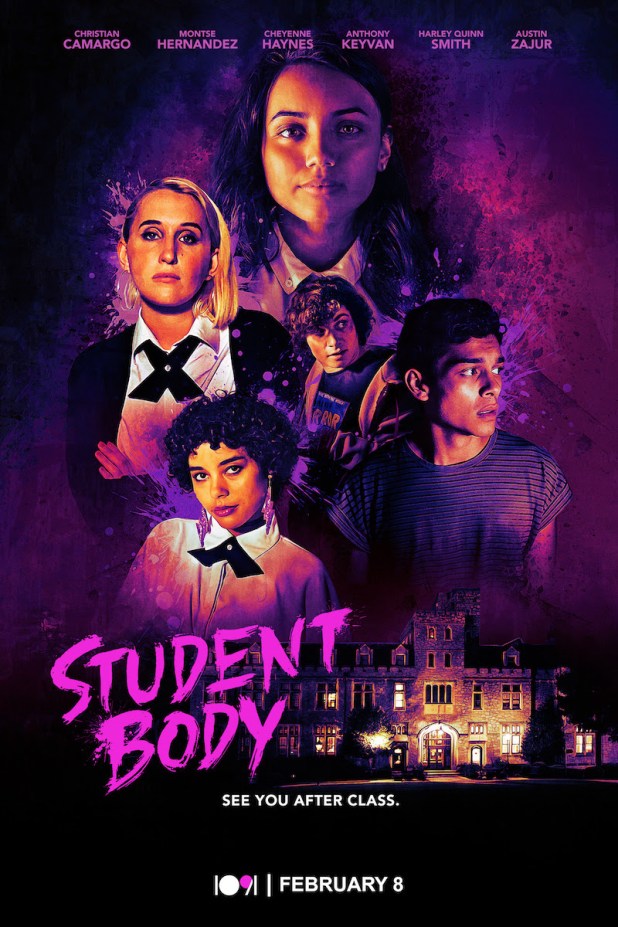
Student Body (2022)

Jane Shipley (Montse Hernandez) and Merritt Sinclair (Cheyenne Haynes) were childhood best friends, but now Jane’s struggling to fit in with Merritt’s friend circle. To make matters worse in her life, teacher Mr. Aunspach (Christian Camargo) oversteps her personal boundaries and no one in power cares, which means that Merritt makes Jane get her own justice. But is that enough? And if she keeps pushing her further, how bad can things get? And what if Merritt’s friends convince the two to set up an elaborate prank over the weekend, forcing them to break into Allendale High School? And (last time, I promise) what if they’re not alone?

This is director and writer Lee Ann Kurr’s first full-length film and she really shines in the way that she frames the same scenes we may have seen in several slashers before, but gives them a different glance. There’s a bathroom-set murder that does so much with hiding the actual impact of the violence, but showing it in hints within a pool of blood and on the actors’ faces as they discover what has happened. The same can be said for the close of the film, as the framing and sound design allows our minds to fill in the gaps of what’s happening and how brutal it is without needing to push it right in our faces.

While there aren’t many faces in the cast that are all that well-known as of yet — save perhaps Harley Quinn Smith — don’t let that keep you from watching this. I’m all for more slashers, obviously, but I’m also even more for ones that work. This one does.

Student Body is available digitally from 1091 Pictures.

JESS FRANCO MONTH: Botas negras, látigo de cuero (1983)

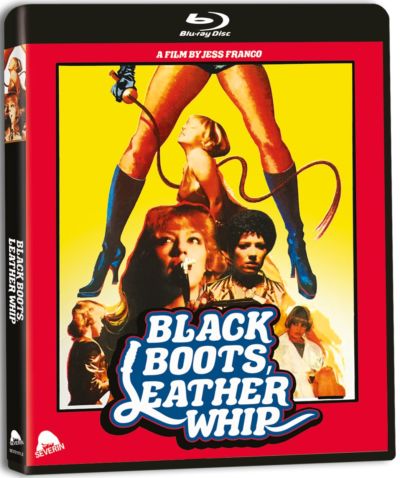
Black BootsLeather Whip is another adventure of Al Pereira (Antonio Mayans), the detective hero of what I’m just going to start calling the Jess Franco Cinematic Universe.

This time, he’s hired by Lina (yep, Lina Romay, using the name Candy Coster), who wants to keep some damaging photos from her wealthy husband. So she sleeps with our protagonist and one by one, all of the blackmail suspects are eliminated, making him a suspect. But then he has to kill a few people, but hey, it’s Lina in a blonde wig so I guess maybe we can understand, right?

There’s also a scene of a blind doctor getting off by demanding that her slaves are whipped harder, but hey, if that has nothing to do with the plot, perhaps this should not be your first go-round into the late period films — and it gets later and weirder — of Jess Franco.

This would be his film noir movie, I guess, and while I’m used to his other repeated story arcs of madmen who have to keep their daughters alive or female armies or, well, just Lina Romay lying on a table in a hotel meeting room while the camera zooms all around, this has a pretty decent scuzzy story to hang its prurient content on.

You can get this from Severin.