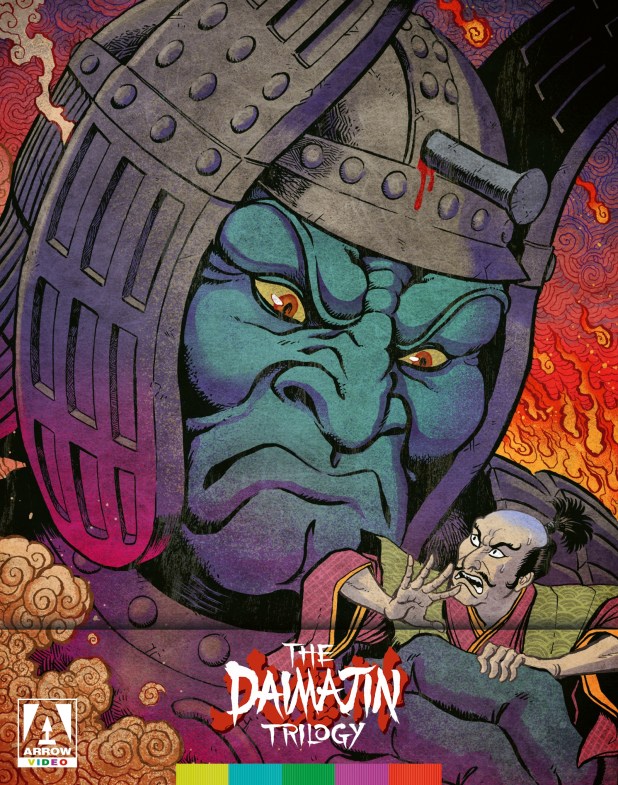
The Daimajin Trilogy from Arrow Video

The Daimajin Trilogy contains the three film series that transplants the legend of the golem to Japan in the 16th century, as an ancient stone god defends the peasant people from the greedy and unjust.

These movies barely made it to America — the first played theaters, the second only TV, the third didn’t make it to our shores in official release until 2012 — yet they’re incredible documents of Japanese movie-making ingenuity and special effects skill.

The three movies in this set are:

Daimajin (1966): The two children of a benevolent ruler are chased from their home and their father killed by a brutal usurper. Years later, the sorceress who saved them is killed by the same man, now the ruler of their land, who can only be stopped by the god who sleeps behind a crumbled stone idol.

Return of Daimajin (1966): When an evil warlord enslaves two small islands and destroys the statue of the stone god, vengeance is not far away, as Daimajin rises and literally parts the ocean to save his people.

Wrath of Daimajin (1966): Four boys take on a magical quest to call upon the spirit of the stone god to save their families, who have been taken by a tyricannical leader.

This limited edition set includes 1080p versions of the three Daimajin films with optional English subtitles, a lushly illustrated book featuring new essays by Jonathan Clements, Keith Aiken, Ed Godziszewski, Raffael Coronelli, Erik Homenick, Robin Gatto and Kevin Derendorf, postcards of the original Japanese artwork for all three films and reversible sleeves featuring original and newly commissioned artwork by Matt Frank. Each of the films also have tons of extras, like the U.S. openings of Daimajin (Majin – The Monster of Terror) and Return of Daimajin (Return of the Giant Majin), video features on the special effects and a variety of interviews and commentaries on the films. If you love kaiju films, you need this in your collection. You can order it from MVD.

Wrath of Daimajin (1966)

Daimajin is found at the top of a mountain, above a village where an evil lord has forced men into work camps. This sends their sons to rescue them, which takes them past the statue of Daimajin, which they take the time to pay proper respect to. However, the big bad has decided that he can openly disrespect the statue, which leads to the same thing that happens in all three of these films: Daimajin goes wild and ruins the evil empire.

Written by Tetsurô Yoshida, this movie was directed by Kazuo Mori (Forty-Eight Hours to Kill), this film focuses on four young boys who are trying to save their fathers and discover that they have a psychic link to Daimajin.

This is the only film in the trilogy that wasn’t released in the U.S. during the 1960s and it didn’t have an English dub until Mill Creek Entertainment released it on blu ray in 2012.

While these films were all shot together to save time and money, they’re all interesting in their own ways. This one feels more of a children’s story, except that our heroes face incredible danger throughout.

You can get this movie as part of Arrow Video’s new The Daimajin Trilogy. Wrath of Daimajin has commentary by Asian historian Jonathan Clements and a feature on the cinematography of the trilogy. Get it now from MVD.

The Psychopath (1966)

You know, between Die! Die! My Darling! and the poster for this, which shows the killer asking, Glenn Danzig sure found plenty of ways to be inspired by British horror films.

Directed by Freddie Francis for Amicus, this is the story of a series of murders that all have a doll — that looks exactly like the victim — attached to the dead bodies!

It’s a nascent giallo and has a really great scene of a room filled with dolls that is quite stunning. All that’s missing is some fashion, a jazzy soundtrack, a few bottles of J&B, some nudity and this movie would completely fit in. You could also consider this a slasher and I would be find with your decision.

Patrick Wymark (Blood on Satan’s Claw) plays Inspector Holloway, the mysterious wheelchair-bound doll maker Mrs. Von Sturm is Margaret Johnson (SebastianNight of the Eagle) and her obsessive son Mark is John Standing (The Elephant Man).

If you’re reading this and think “A movie where a man with mommy issues becomes a murderer sounds kind of like Psycho,” this was written by the same person, Robert Bloch.

The Creeping Flesh (1973)

Directed by Freddie Francis* for Tigon, this film is a thrilling collaboration that pairs the iconic Christopher Lee and Peter Cushing. It’s a gem from the end of the era of British gothic horror, and despite its occasional silliness, such as Cushing holding a gigantic prehistoric finger that appears as sexualized as it gets, I find every moment of this film utterly captivating.

Cushing is Prof. Emmanuel Hildern, a scientist who discovers a colossal skeleton — Anunnaki alert — that is older than other skeletons in the area yet much more advanced. He hopes that this finding will win him the Richter Prize, but that award looks like it’s going to be won by his brother John (Lee), who has been looking after Emmanuel’s institutionalized wife for years. He plans to use his study of his brother’s wife to win that award and refuses to pay for the professor’s skeleton-finding trips.

Whatever this skeleton is, legend says that it was a monster that feared rain—maybe because the Great Flood wiped out the other Nephilim—and that it could grow skin when it came into contact with water.

Hildern has a theory that if evil itself—the skeleton—can be a living being, then it can be biologically contained and treated like a disease. He created a serum that can stop evil using cells from the skeleton’s fleshy finger. After testing the drug on a monkey with good results, Emmanuel also immunizes his daughter Penelope, who may have inherited her mother’s mental illness.

Of course, the next day, the monkey has gone wild, and now we have Penelope dancing on tables and slashing sailors. Soon, James finds out about the serum, kidnaps his niece and steals the skeleton. The skeleton gets exposed to the rain and becomes, well, a pretty goofy-looking monster that I can’t help but completely fall head over heels for.

The ending of this movie is a masterstroke, leaving the door wide open for interpretation. You can see it as Lee’s character denying that his brother is related to him to save his reputation or that Emmanuel was never a doctor at all but just another patient. If that’s true, then who really took his finger in revenge? Does the monster exist? It’s a thought-provoking conclusion that will keep you pondering long after the credits roll.

You can watch this on Tubi.

*Don Sharp, who also made Psychomania, was the original director before Francis was hired to replace him.

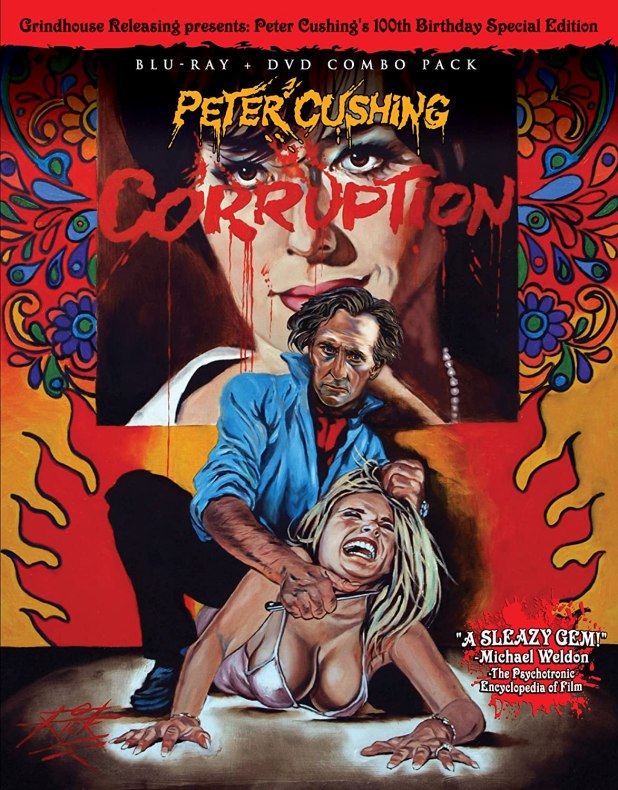
Corruption (1968)

As the trailer will tell you, Corruption is not a women’s picture.

That’s debatable.

What is not is that Corruption is a ripoff of Eyes without a Face.

But hey — some of my favorite movies are total ripoffs.

Renowned plastic surgeon Sir John Rowan (Peter Cushing) starts the movie at a swinging 60s party with his beautiful fiancée Lynn (Sue Lloyd, Hysteria). Sir John isn’t dealing well with all this counterculture excess, so when a pervy photographer makes a pass at his girl, he attacks the man, sending a hot light into Lynn’s face. This party may seem like a parody when seen today, but this is a serious scene, with Cushing facing the Summer of Love and not dealing so well with all of it.

Rowan pledges to flix Lynn’s scarred face through a combination of laser technology and a pituitary gland transplant. Sound good? Well, it’s fueled by murder, giving the fluids of young women to his wife, to keep her face from scarring and it needs to be repeated again and again to stop the scars from coming back. Everything goes well — as well as repeatedly killing people and basically feeding their skin to your wife can go –until Sir John and Lynn try to seduce a new victim who ends up being part of a gang of robbers.

Those criminals break into the home of Sir John and they soon learn his secret. However, no one profits from this knowledge, as everyone end up getting killed by a surgical laser. And then, get this — it’s all a dream!

Cushing would say, “It was gratuitously violent, fearfully sick. But it was a good script, which just goes to show how important the presentation is.” You have to love a movie where Van Helsing flips out at a party that Austin Powers would say is way too mod. And wow, it’s pretty gory for a late sixties British movie!

Director Robert Hartford-Davis would also make Incense for the DamnedGonks Go Beat and The Fiend.

Also, just to remind you one more time, Corruption is not a women’s picture.

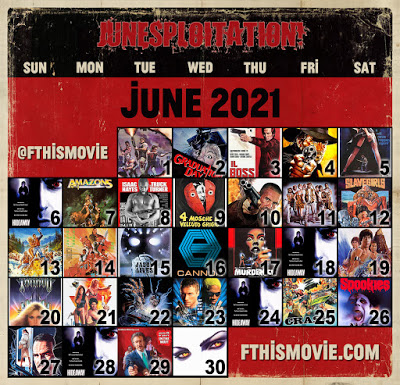
Junesploitation recap!

We were excited to take part in the 9th annual Junesploitation, a month-long celebration of exploitation and genre film that’s sponsored by F This Movie!

Here are the movies that we watched!

DAY 1: 80s action
Pray for Death

DAY 2: Slasher
Nightmare Sisters

DAY 3: Henry Silva
Cry of a Prostitute

DAY 4: Western
A Town Called Hell

DAY 5: Revenge
From Hell It Came

DAY 6: Free
The Astrologer

DAY 7: Sword and Sorcery
Deathstalker IV

DAY 8: Blacksploitation
Black Force and Truck Turner

DAY 9: Italian horror
Specters

DAY 10: Scott Adkins
Accident Man

DAY 11: Vigilantes
The Annihilators

DAY 12: Science fiction
Legion of Iron

DAY 13: 80s comedy
Private Lessons

DAY 14: Kung fu
Ninja Zombie

DAY 15: Sequels
Curse 2: The Bite

DAY 16: Cannon
Enter the Ninja and Keaton’s Cop

DAY 17: Lucio Fulci
My Sister-In-Law

DAY 18: Free
The Passover Plot

DAY 19: Jackie Chan
Fantasy Mission Force

DAY 20: Musical
Pennies from Heaven

DAY 21: Julie Stain
Babes In Kong Land and Die, Delta, Die

DAY 22: Zombies
Zeder

DAY 23: 90s action
Dobermann

DAY 24: Free
The Opponent

DAY 25: Cars
Motorama

DAY 26: 80s horror
Midnight

DAY 27: Cops
A Special Cop In Action

DAY 28: Free
Street Law

DAY 29: Gangsters
The Cynic, The Rat and the Fist

DAY 130: Vampires
Blood for Dracula

You can also check out our Letterboxd list.

If you’ve come here from reading one of our Juneploitation posts, we hope you’ll keep coming back to read what we have to say about movies! Thanks to F This Movie! for making June such a fun month.

Junesploitation 2021: Andy Warhol’s Dracula (1974)

June 30: Junesploitation’s topic of the day — as suggested by F This Movie— is vampires.

I’ve had the Criterion version of this movie on my shelf for a while, so when Severin re-released this film for their summer sale, I decided that it was the vampire movie that would close out my first ever Junesploitation.

Also known as Blood for Dracula, this was written and directed by Paul Morrissey, despite the fact that some prints had director Antonio Margheriti listed.

A day after the principal shooting for Flesh for Frankenstein ended, Morrissey had Udo Kier, Joe Dallesandro and Arno Juerging get shorter hair cut and start filming. You can spot several directors in this film, like Vittorio De Sica (Bicycle Thieves) and Roman Polanski.

The Dracula in this film (Udo Keir) is not the romantic master of women. Instead, he’s sick for most of the film, whining about his lot in life and the fact that there just aren’t many virgin women left. His familiar, Anton (Arno Juerging), has brought him to Italy in the hopes that a more religious country will have more virgins, as they are the only food that vampires can eat outside of a vegetarian diet.

Il Marchese di Fiore (de Sica) believes that one of his four daughters would be perfect to marry Dracula, but he doesn’t realize that two of them, Saphiria (Dominique Darel) and Rubinia (Stefania Casini, Suspiria), have been deflowered by the Marxist handyman Mario (Dallesandro). Dracula soon learns that they are not pure by drinking their blood. While he is weakened, he is able to make them into his slaves.

Dracula does succeed in drinking. the virginal plasma of the plain eldest daughter Esmerelda (Milena Vukotic) but not the youngest, Perla (Silvia Dionisio, Live Like a Cop, Die Like a Man).

hat’s because Mario assaults her to destroy her virginity, which is somehow trying to be protective.

Throughout this film, the noble traditions of the past are undone by the common man, much less the modern man. You can ascribe artifice to that or just realize that Dallesandro was not doing an accent, no matter what, and you got what you got. Which is kind of like how this movie has Andy Warhol’s name on it, leading people to wonder what he had to do with the making of it.

He answered, “I go to the parties.”

Die! Die! My Darling! (1965)

Tallulah Bankhead — in her last movie — absolutely owns every scene she’s in here, playing Mrs. Trefoile,the mother of Patricia Carroll’s (Stefanie Powers) deceased fiance. As she comes to London, Patricia decides to get closure by visiting the old woman. Yet within a few scenes, she’s now a captive of the hysterically religious woman and is due to be exorcised.

Trefoile also has three servants — Harry (Peter Vaughan), Anna (Yootha Joyce) and Joseph (Donald Sutherland) — who are keeping our heroine away from the rest of the world, hiding her from her fiancee Alan Glentower (Maurice Kaufmann).

Also known as Fanatic**, this is a strong entry in the psychobiddy genre that has Richard Matheson adapting Anne Blaisdell’s novel Nightmare*. It was directed by Silvio Narizzano, who also made the Dennis Hopper and Carroll Baker movie Bloodbath and Georgy Girl.

Nearly fifty years after making this movie, Stefanie Powers acted in Looped, a play based on a true story about Bankhead being inebriated and unable to loop the line, “Die! Die my darling!” for this film. The role was originated by Valerie Harper, who was nominated for a Tony Award for her performancem despite the play closing after 33 performances. Harper played the role on the road until become sick with brain cancer.

*One of the many names of Elizabeth Linington, who also wrote under her real name and the alter egos Lesley Egan, Egan O’Neill and Dell Shannon.

**Bankhead sued Columbia Pictures when they retitled this for U.S. theaters.

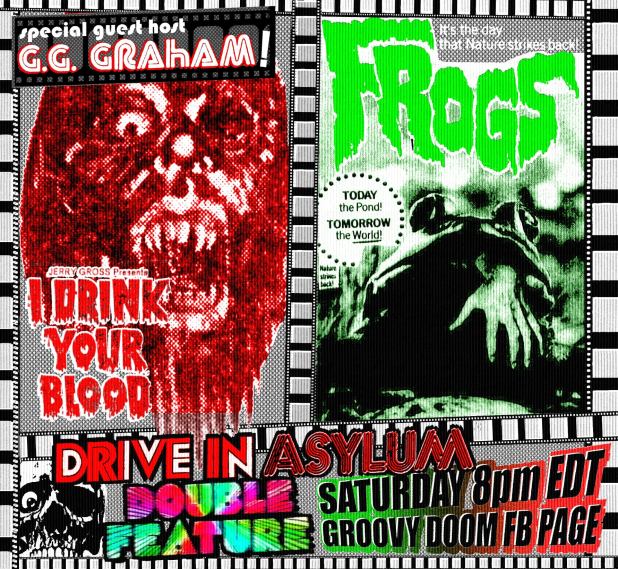
Join G.G. Graham and us for a fourth of July DIA Double Feature!

Get ready for some fireworks this Saturday on the Groovy Doom Facebook page starting at 8 PM East Coast Time.

We’re starting with the movie that proves that Satan was an acidhead, the transcendent blast that is I Drink Your Blood! It’s on YouTube.

Before the movie, we’ll discuss it, share a drink recipe and show the advertising behind the film. Here’s our first cocktail recipe.

Rabies Acid Trip

  • 1.5 oz. Midori
  • .5 oz. gin
  • .5 oz. vodka
  • .5 oz. rum
  • .5 oz. tequila
  1. Shake everything up with ice and pour into a glass.
  2. Don’t forget to fill a syringe with blood. It’s fun!

Up next is the Fourth of July blast known as Frogs! You can watch it on YouTube.

Here’s the drink for that movie!

Crockett Frog

  • 1 oz. vodka
  • 2 oz. coconut rum
  • 1 oz. Midori
  • 1 oz. blue curacao
  • 2 oz. orange juice
  • 1 oz. lemon-lime soda
  • Maraschino cherries
  1. Fill a glass with ice, then add your ingredients in this order: vodka, rum, Midori, curacao, juice and then top with soda.
  2. Finish it all off with the cherries.

We can’t wait to see you on Saturday!

Return of Daimajin (1966)

Never released theatrically in the United States — it was shown on TV by American-International Pictures in 1967 — the second film in the trilogy finds Daimajin concerns an evil lord who takes over the villages of Chigusa and Nagoshi. He also shatters the statue of Daimajin with gunpowder, sending what’s left of the spirit to the bottom of a lake where it comes back to life to save the villagers who pray to him.

All three of these movies were written by Tetsurô Yoshida, with this installment being directed by Kenji Misumi, who made four of the Lone Wolf and Cub films. While this is similar to the first film, it does have a scene where the giant Daimajin parts the seas as well as an amazing scene where he rescues a crucified woman while stomping an army of samurai into puddles of bone and blood.

The effects in this film are gorgeous, with the stone spirit looking as if it was a real kaiju and not just special effects. These movies aren’t as well known in the U.S., but they certainly deserve to be.

You can get this movie as part of Arrow Video’s new The Daimajin Trilogy. Return of Daimajin has commentary by Japanese film experts Tom Mes and Jasper Sharp a discussion of the movie’s storyboard, an interview with Professor Yoneo Ota (director of the Toy Film Museum, Kyoto Film Art Culture Research Institute) and opening credits for the U.S. release of Return of the Giant Majin. Get it now from MVD.