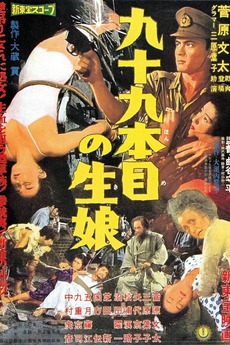
The Blood Sword of the 99th Virgin (1959)

On my second tour of Japan, someone in Tokyo told me, “You sound like you’re from Osaka,” and I took it as a compliment. Then my friend told me, “That’s like someone in New York City saying you sound like your accent is from West Virginia.”

Magatani Morihei’s Kyujukyu-honme no Kimusume is set in the remote mountains of Iwate Prefecture, which in the same way my particular dialect of Japanese sounds so, well, Appalachian, this section of the country is pretty much the Ozarks.

Which brings us to another fact about Japan: they can be the most polite and racist people at the same time. While we were in Osaka, a truck with bullhorns was driving around giving political speeches about keeping Japan Japanese, not directed at gaijin Americans like us per se, but more Asian races like Koreans.

Iwate is the second largest prefecture in Japan, but also one of the least inhabited, being mostly mountains and those that live in the hills are seen as primitive people and discriminated against even by others in Iwate, much less the rest of Japan.

In this film, some of those locals have spent their lives making swords. Sadly, one of these swords is cursed and in order to appease their ancestor, they must continually kill virgins with it and bathe the blade in their blood.

There’s also the matter of the Fire Festival, which is a Shinto tradition. One of the most famous is in the Hokuriku Shinetsu region, which takes place every January 15. Villages carry torches to burn down a shrine, while the unlucky males of ages 25 and 42 defend the shrine or sing and chant respectively. The Fire Festival dispels evil and ensures happy relationships. The pro wrestling group Zero1 has also run a Fire Festival tournament from July to August every year, with the winner being given a ceremonial sword.

Well, the locals just won’t celebrate their festival properly. When hikers start getting attacked, the cops get involved, including Bunta Sugawara, years before he would be in the Battles Without Honor or Humanity series. Yoko Mihara, star of so many “pinky violence” films and movies with astounding titles like Girl Divers at Spook MansionBlackmail Is My LifeNude Actress Murder Case: Five Criminals and the infamous School of the Holy Beast, also appears.

The past of Japan — virgin killing rituals, witches and all — comes up hard against cops in helicopters with sniper rifles. This was a pretty controversial movie due to how it portrayed the mountain folk — it was never banned — so I was happy to see it.
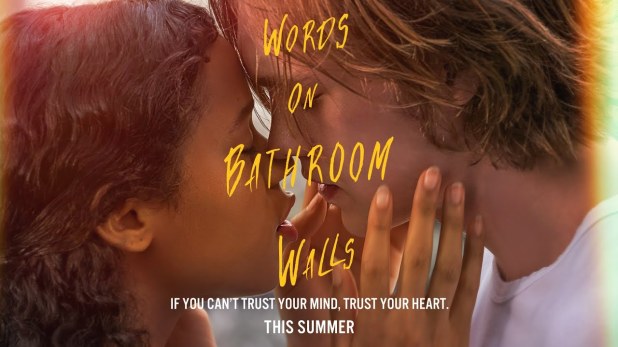
Words On Bathroom Walls (2020)

With Hotel for DogsDiary of a Wimpy Kid and Percy Jackson: Sea of Monsters, Thor Freudenthal established himself as a strong director for effects-driven kid movies. Now, Words On Bathroom Walls takes his verve for imaginative effects and applies them to a story for older teens and young adults.

Based on the novel of the same name by Julia Walton, this is the story of Adam Petrizelli (Charlie Plummer), a schizophrenic student trying to make it through life.

Expelled halfway through his senior year following a psychotic break while in chemistry class, Adam is diagnosed with a mental illness and sent to a Catholic academy to finish out his term. He knows that he won’t fit in and just hopes that he can keep his illness a secret and make it to culinary school while avoiding his mother’s new boyfriend Paul (the always great Walton Goggins).

The film does an admirable job of translating Adam’s mental illness via special effects and personifying the voices within his head. He worries that his life will always be one of hiding until he meets Maya (Taylor Russell), who inspires him to open his heart and not be defined by his condition.

Lobo Sebastian, who plays the Bodyguard inside Adam’s visions, was also in Ghosts of Mars and played Lil Joker in Next Friday. Plus, it’s always great to see Andy Garcia in films, here as a priest who helps our protagonist.

Words on Bathroom Walls is available on blu ray, DVD and on demand from Lionsgate, who were nice enough to send us a copy to review.

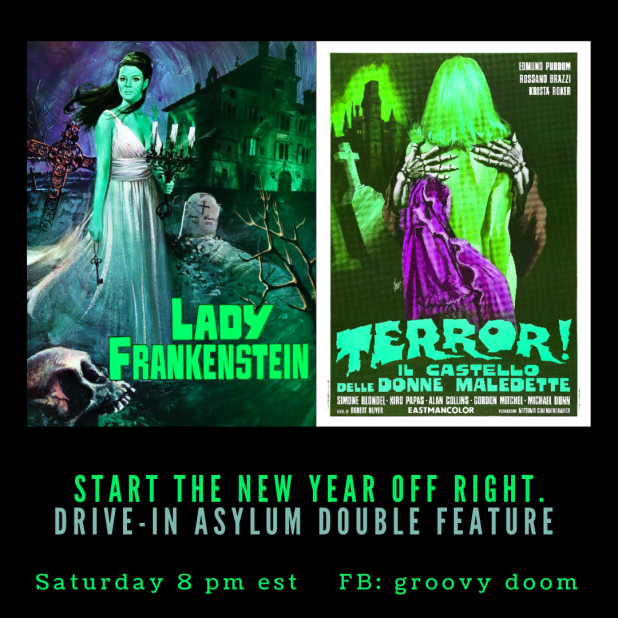
JOIN US THIS SATURDAY FOR THE DRIVE-IN ASYLUM DOUBLE FEATUTE

This Saturday, we’re back for the very first show of the year on the Groovy Doom Facebook page at 8 PM East Coast Time! Make sure to “like” the page so you get an alert when we go live throughout the night.

Who is this irresistible creature who has an insatiable love for the dead? Lady Frankenstein!

Need a drink? Please do it responsibily!

Tania’s Science Project (tweaked from this recipe)

  • 1/2 oz. blue curacao
  • 3/4 oz. Chambord
  • 1 oz. vodka
  • 1 1/2 oz. cranberry juice
  • 1 1/2 oz. lemon-lime soda
  1. Mix alcoholic ingredients with ice in a shaker.
  2. Pour into tall glass filled with ice and top with juice and soda.

You can watch this on Amazon Prime and Tubi.

It’s double Frankenstein night, so get ready to enjoy even more sleaze with Frankenstein’s Castle of Freaks.

Count Frank’s Freaky Fizz (based on this recipe)

  • 2 oz. gin
  • 2 oz. lemon juice
  • 1 oz. Midori
  • 2 egg whites
  1. Combine gin, lemon juice, Midori and egg whites in a shaker.
  2. Shake it as if you were Marshall the monster and you have a townsperson around the throat (for a minute or more).
  3. Strain into glass and spoon on foam.

You can watch this on Tubi or the Internet Archive.

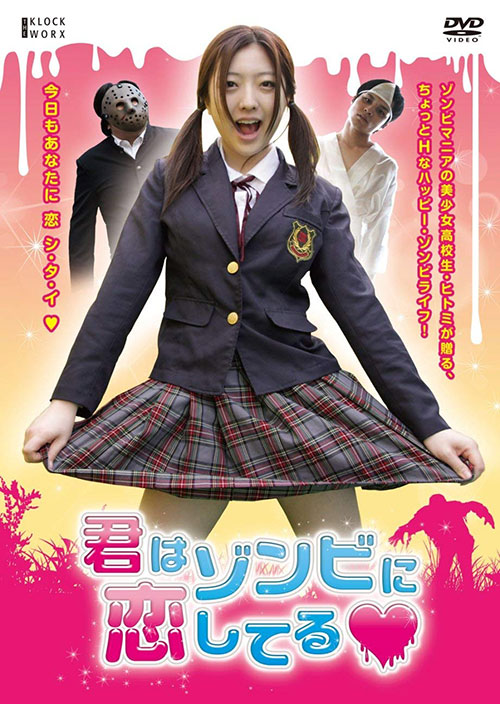
Kimi Wa Zonbi Ni Koishiteru (2011)

With a title that translates as Bite Me If You Love Me, this is a movie for people who love zombies and understands that if you want purely bonkers genre cinema, go to Japan.

Naoyuki Tomomatsu, who also made Vampire Girl vs. Frankenstein Girl, directed this, which tells the story of Hitomi (AV starlet Ai Haneda), a high school girl obsessed with zombies. When she finds an Italian book — where else would one learn how they undead walk — that can make the dead live, she hooks up with a geeky boy named Shota who everyone already calls Zombie. She knocks him off the roof, pours powder all over him and before you can say Romero, she’s aardvarking with one of the living dead.

There’s a great moment when the girls are all comparing boys and Hitomi shows everyone the maggot zombie from Fulci’s Zombi and talks about how hot he is.

Shota ends up becoming a celebrity, but as his body rots, so too does Hitomi’s love for him. She soon falls for a fat Japanese Jason Vorhees, turning this into a love triangle with deadly consequences.

This is cheap, scummy, gory and goofy. These are all adjectives that I love.

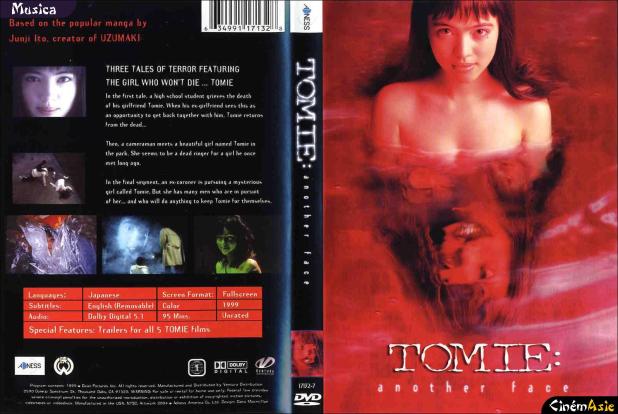
Tomie: Another Face (1999)

The first sequel to Tomie was actually a three-episode TV series that was later released to video. It was originally called Tomie: Fearsome Beauty, but was renamed for the home video release.

This version of the Tomie story introduces her at different times in her life, beginning when her dead body is discovered amongst the garbage in the street. She comes back to life to break up her boyfriend and his former girlfriend, all while a mysterious man follows her, taking photos. Things end as they always do, with Tomie tossed from a roof and being taken to the woods to be buried, proving that these characters didn’t watch the first movie. As they walk to school the next day, hand in hand, our protagonists learn that Tomie cannot die.

Another photographer, who has lost his love for his art, finds Tomie and tells her that she reminds him of another girl, the one who taught him to love taking photos. However, when the photos are developed, he notices that Tomie has two faces, one beautiful and the other distorted. She tells him to in order to prove that she is not a ghost, he should kill her. He does, at which point she revives and the original girl — also Tomie — led him to his death before posing for selfies.

Finally, the eyepatch-wearing man is revealed as a cornoner who lost his job and family when Tomie left his examination table in the morgue. He attacks her, but she uses her new lover to fight him off, telling him if he loves her then he will kill the older trenchcoat-clad man. The coroner shows the boyfriend the truth, that Tomie has been responsible for so many deaths, but even when they try to burn her body, all of the ashes form in the sky in the shape of her face, with every bit of her forming new Tomies.

Nearly every review of this movie made mention of its low budget and general ineptitude. I kind of enjoyed it, but knew going in that this wasn’t going to be a perfect sequel. But for those looking for more Tomie, well, here it is.

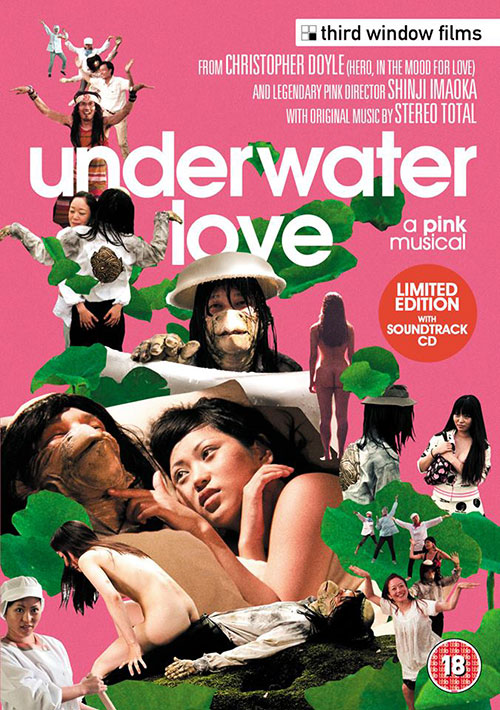
Onna No Kappa (2011)

Shinji Imaoka is one of the Seven Lucky Gods of Pink (the others are Toshiya Ueno, Mitsuru Meike, Yūji Tajiri, Yoshitaka Kamata, Toshirō Enomoto and Rei Sakamoto) who make some of the strangest and most interesting adult-oriented movies from Japan.

It probably has the best cinematography the adult genre ever has had — outside of the movies Gary Graver worked on — thanks to Christopher Doyle working on this movie. The Australian native has been part of some really famous films, such as Fruit Chan’s Dumplings, Gus Van Sant’s Psycho and several films with Wong Kar-Wai.

This entire movie was shot in five and a half days, all with only one take per scene.

Asuka works in a fish factory and is about to marry her boss when she meets a legendary river creature known as a kappa. She soon discovers that it is the reincarnation of her first love Aoki, who drowned when they were only seventeen. The film, while adult in nature, tries to explain the feelings of love and loss. And oh yeah, it’s also a musical.

Yes, this is probably the only movie where you can see not only singing and dancing, but also what a Japanese water demon’s genitals look like. It also has a soundtrack by the French/German duo Stereo Total.

I pride myself in finding strange films, but at no point in my movie-watching life did I say, “I wish that The Shape of Water showed the sex and oh yeah, that everyone occasionally had song and dance numbers.” But here we are.

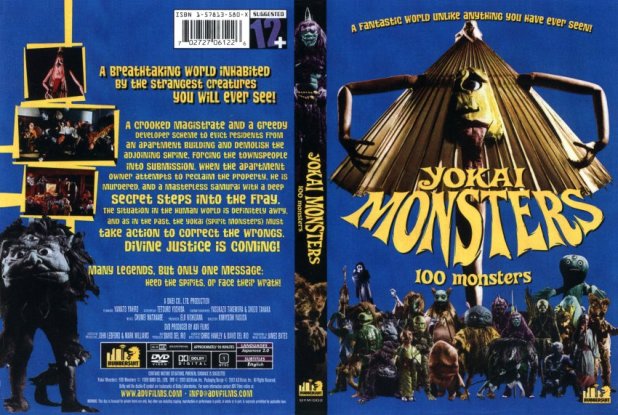
Yokai Monsters: 100 Monsters (1968)

Daiei could produce a masterpiece like Akira Kurosawa’s Rashomon while still putting out movies that featured Gamera, Zatoichi, Daimajin and the Yokai Monsters, who are based on the monsters of Japanese folklore. They may be evil creatures who cause great misfortune and harm or — quite the opposite — could  also be beings that bring good fortune to those who meet them.

Much like the aforementioned films like Gamera and Daimajin, this is a tokusatsu film that uses practical effects, including actors in costumes, puppets and animation to tell the story.

That story is really about a rich landowner, who wants to tear down a local shrine to build a brothel. He cheaps out and after telling the stories of the yokai, neglects to pay for the ceremony to keep them out. They soon go wild in the town, partying down as they arrive with sake.

Known in Japan as Yokai Hyaku Monogatari, this was directed by Kimiyoshi Yasuda, who made six of the Zatoichi movies. It suffers the sin of some Godzilla movies, in that we don’t really care about the humans. We just want the monsters. And we’ve been promised a hundred of them!

The following film, Yokai Monsters: Spook Warfare, came out the same year and realizes this issue and instead fills nearly every moment of the movie with monster after monster. This is good. That movie is great.

You can watch this on YouTube.

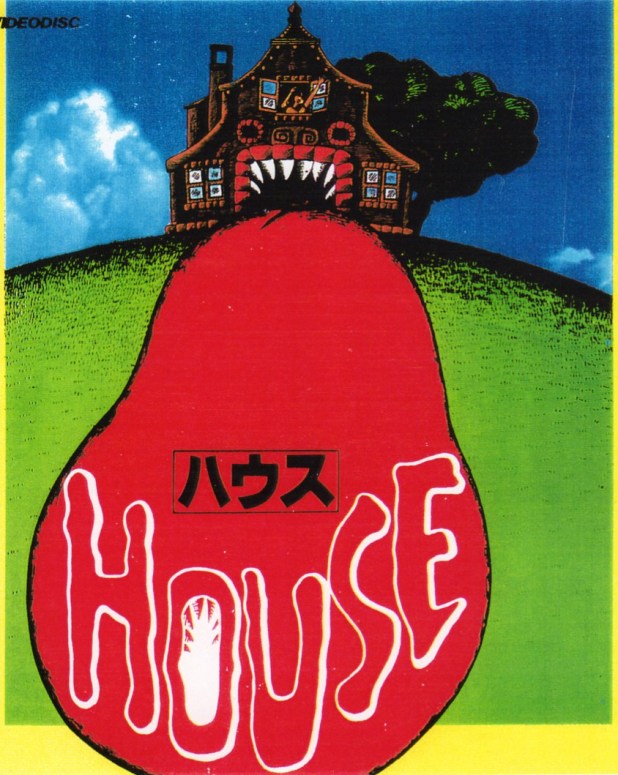
House (1977)

Nobuhiko Obayashi died this year, but left behind a career that began as an experimental filmmaker and somehow moved into mainstream success and around 3,000 commercials. At least in the U.S., he’s best known for this movie, which got its start when Toho asked Obayashi to make a movie like Jaws. His daughter Chigumi gave him several ideas that he worked into a script with Chiho Katsura. For two years, no director wanted to make the movie*, so eventually, Obayashi made it himself with a cast of nearly all amateur actresses**. So much of what ended up on the screen was influenced by Hiroshima, where the director grew up and saw every one of his childhood friends die in an atomic blast.

This is truly a haunted house tale told by and for children. Obayashi even wanted the special effects to look unrealistic, as if made by a child. So let that inform the story of Gorgeous, who has been planning a summer vacation with her father, who has been Italy scoring film music***.

Instead, she learns that she has a new stepmother and makes the decision to visit her aunt, along with her friends Prof, Melody, Kung Fu, Mac, Sweet and Fantasy, all of who have names that completely explain who they are.

From there on out, honestly, you’re on your own. House is a movie that should be experienced instead of read about, because this is the kind of movie where pianos can eat children, where watermelons become human heads and heroines can burst into flames within happy endings.

Man, according to the IMDB trivia section, Obayashi proposed a story for what would have been the 16th Godzilla film, which would have used the same crew as House. In this story, a girl named Momo finds the dead body of Godzilla, who is really a pregnant female alien named Rozan who died from diabetes, and then she becomes a spaceship to take children to her home planet to bring Godzilla back. There was, of course, a female monster who shot flames out of her breasts.

*Obayashi would later say that a producer told him that Toho was tired of losing money on comprehensible films, so they decided to let him make something that was incomprehensible.

**Most of those actresses had worked on his commercials, other than Yoko Minamida who played the Auntie. Also, Obayashi was a smart guy, because he made a series of movie tie-ins before the movie was even made, promoting the script so that Toho saw that it would be a success. He published a commercially-successful manga, radio drama and soundtrack album with the band Godiego before Toho finally said that he could make the movie himself.

***How weird would it be if her dad was scoring Suspiria, a movie that House shares the idea of childhood against horror, some level of nonlinear storytelling and primary colors with?

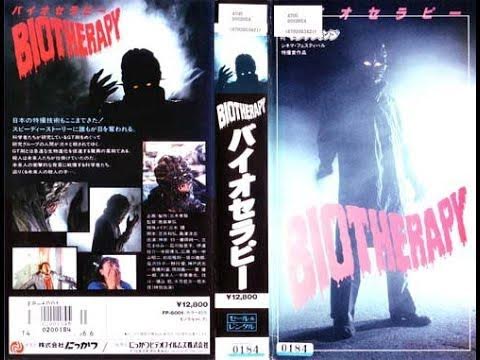
Biotherapy (1986)

ABOUT THE AUTHOR: Herbert P. Caine is the pseudonym of a frustrated academic and genre movie fan in Pennsylvania. You can read his blog at https://imaginaryuniverseshpc.blogspot.com/.

Biotherapy is a Japanese horror short from 1986 that takes full advantage of its short running time. Although it does not have much in the way of plot or characterization, it makes up for it with a fast pace, great special effects, and all the gore you could ask for in thirty-five minutes.

The short traces the horrible fates that befall a group of scientists working on “GT medicine,” a promising but still flawed chemical that induces exponential growth in those that consume it, similar to H. G. Wells’s Food of the Gods. The scientists find themselves being stalked by a mysterious masked man who emits a blue glow and murders them one by one while demanding a sample of the medicine. Does it have anything to do with the recent meteor shower, or is he just an addict ahead of the curve?

The film’s main selling points are its gruesome murders and excellent practical effects. The scientists’ pursuer is disturbingly creative in his means of killing, starting with an opening sequence where he tears out the lead scientist’s eye. Although obviously made on a low budget, the filmmakers squeeze every cent to present convincing effects for the masked killer’s murder spree. Although they are not as high tech as modern CGI, these “cheap” practical effects seem more realistic. The model body parts and fake blood have a sense of weight, having not been drawn on with a computer. Furthermore, even the corniest fake blood looks better than CGI blood, which has yet to capture the flow of an actual liquid splashing or spreading on the ground.

As stated at the beginning, Biochemistry’s script is pretty bare bones. None of the characters are fleshed out, and the villain’s motives and actions are at times confusing. The script also relies on the occasional deus ex machina to help out its characters. However, it makes up for these flaws with a fast pace that keeps the plot moving and prevents you from thinking too much about lapses in logic.

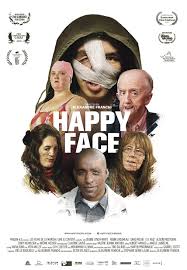
Happy Face (2018)

Stan has a complex life. He’s dealing with a manipulative cancer-stricken mother and in order to find a place to fit in, he’s taped up his face to distort it, which allows him to join a therapy group for those with disfigured faces.

The other encounter group patients soon discover his trickery, but they allow him to stay in the hopes that he learns to cope with the death of his mother while he shows them how they can use their ugliness to feel better about themselves.

Director and co-writer Alexandre Franchi has hired first-time actors with real facial deformities to give this movie a dramatic edge that it may not have otherwise. It never feels like a sideshow. Instead, this feels real and lived in.

As someone that used role playing games to get through my high school years, the fact that the members of the group play also comes off as authentic. It allows them to become someone they aren’t. Someone different. And perhaps have power in a world where the ugly are often the strongest.