We’ve gone down the DUST rabbit hole once before — as part of last year’s Scarecrow Video of Seattle’s Psychotronic October Scarecrow Challenge of watching 31 movies in 31 days. For the 24th day of the challenge, the theme was “Short Attention Span Theatre: Watch Some Shorts or Anthology Things.” And I chose to meet the challenge with a pair of short films from DUST: a You Tube-based, social media portal that features science fiction shorts from emerging filmmakers obsessed with aliens, robots, space exploration, technology, and the human experience in space.
During my last year’s DUST excursion, I felt moved to the point of wanting to review two of the many wonderful films on the DUST platform — and chose to review Colin West’s Plastic Pink Flamingos and Marko Slavanic’s Skyborn. This year, I was wowed by the writing and directing, narrative-fiction debut of Ben Griffin, a filmmaker who earned his bones in the music video field with the likes of Demi Lovato, Imagine Dragons, Machine Gun Kelly, and Metallica* (2019’s Metallica & San Francisco Symphony). (We previously reviewed A Clear Shot, the latest feature film by Nick Leisure, himself a writer-director who rose up through the music video field ranks.)
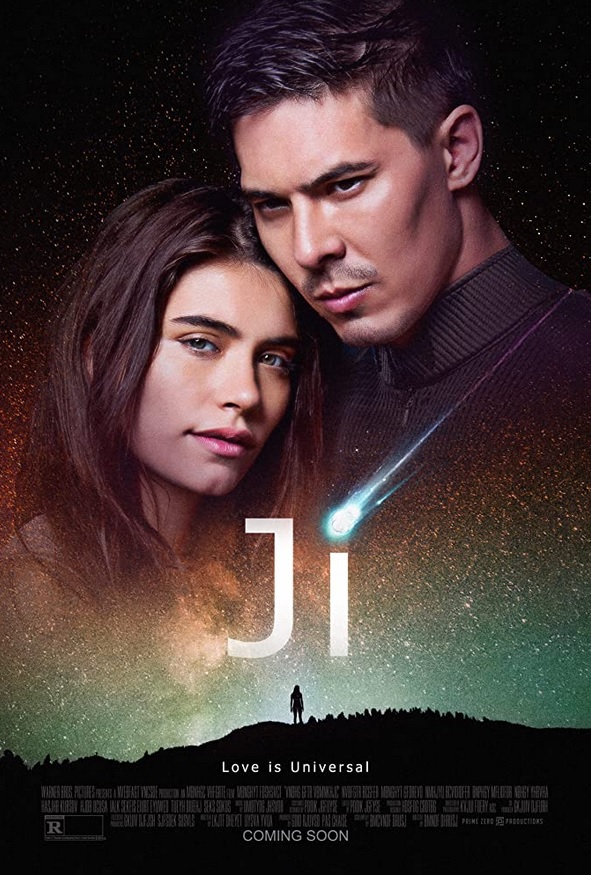
Lewis Tan (Shatterstar in Deadpool 2; Gaius Chau on AMC’s Into The Badlands; Lu Xin Lee in Netflix’s Wu Assassins) is Ji, a modified human and commanding General in a military unit protecting the mechanized exo-planet Nilo. His artificial life on his artificial home world is perfect — yet, he hungers to learn of his human roots.
Against orders and abandoning his post, Ji sets off for Earth and comes to discover it’s not the wasteland he and his people were told. Upon arrival, he meets an Earth woman (Eva De Dominici, of the upcoming Bruce Willis sci-fi actioner Cosmic Sin and TV’s Hawaii Five-O) and falls in love. You’ll also recognized Peter Adrian Sudarso (Marvin Shih and Preston Tien in the respective Power Rangers‘ spinoff series HyperForce and Ninja Steel) as Ji’s commanding officer who ventures to Earth to return him to Nilo.
Ben Griffin’s debut is the epitome of skilled filmmaking at its finest, complete with a top-notch, imaginative script flowing in perfect harmony with a solid cast and stunning special effects: a highly recommended watch that’s worthy of expansion into a feature-length film. The last time I was this enraptured with an action-oriented short film, was Brando Benetton’s top notch college thesis project, Nightfire. Which proves my ongoing point: it doesn’t have to be long to be good: it’s in the content, not the length.
You can learn more about the works of San Francisco’s Ben Griffin and his Prime Zero Productions at their official website, Facebook and You Tube pages. After completing a successful film festival run, Ji is now available at DUST You Tube as of July 30, 2020.
* We previously reviewed Metallica’s support of Spencer Susser in 2010’s Hesher (Will somebody please back Spencer and let him make another feature film, will yah? Hesher is so good.)
Disclaimer: We were not sent a screener or received a review request for this short. We discovered it on our own and truly enjoyed the work.
About the Author: You can learn more about the writings of R.D Francis on Facebook.He also writes for B&S About Moviesand publishes on Medium.
If you haven’t noticed: I write a lot of reviews about films at B&S About Movies. And when I am not writing about movies, I’m talking about films—both in the fingering-digital and lipping-physical realms. There nothing quite like hanging out during a Groovy Doom Saturday Night Double Feature Watch Party (Ugh, more shameful plugs!) and chatting with the digital patrons or at a sports bar with your fellow actors and filmmakers, discuss-debating films and examining the industry (sorely missed during these COVID days)—while the Steelers dominate the gridiron, and the Pirates, the diamond.
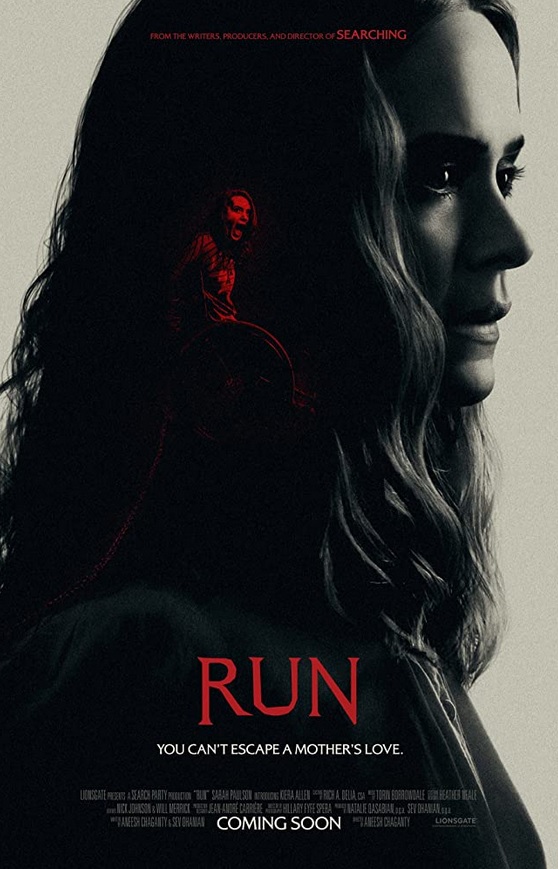
The revamped streaming one-sheet
One of those discussions was in regards to attending movie theatres vs. streaming and, to that end, which streaming service: Hulu or Netflix. The general consensus: Hulu is the cut-out bargain bin of streamers; they’re the $5.00 impulse-buy barrel on the aisle sandwiched between the home goods and electronics section. Netflix is where people actually log-on to see a film. Yep. It’s the old My Space vs. Facebook and Facebook vs. Snapchat argument, again. Ugh!
And my buddy, Eric; he who despises all thing Seinfeldian (Oops, sorry Sam!) and minces no words when expressing his disdain for failures in the artistic realms, added this observation: “Why the frack is friggin’ Sarah Paulson always friggin’ ranting, bawling, and running around like madwoman in every movie?”
Eric’s also never heard of writer-director Aneesh Chaganty. But I have. And I really enjoyed his previous film, Searching. Chaganty’s adept at the Final Draft and framing the Canon Reds; therefore, I have no doubt that, with his skills as a filmmaker, in conjunction with the always-very-good Paulson as his lead actress (12 Years a Slave, TV’s Law & Order), I had a feeling Run was another worthy streamer on his behalf—regardless of the opinion that “Hulu is the dumping ground for projects studios have no faith in.”
Ah, but the studios do.
Lionsgate had Chaganty’s sophomore effort penciled for a national theatrical release three months ago, back on May 8. Then the pandemic hit and shut down the big theatre chains in March. And while the theatre chain operators are none too happy, the major studios are thankful that we’re living in the digital clouds of 2020; if the COVID virus hit in the Soylent Green-year of 1975, when there was no streaming . . . perish the thought. So, for reasons that aren’t of our middling consumer concerns: Lionsgate cut a deal—instead with Netflix—to stream on Hulu. In fact, another of Lionsgate’s films, the Janelle Monae-horror Antebellum, had its theatrical rollout axed for a September 18 digital premiere.
Even without a pandemic, the fact remains: the brick-and-mortar theatreverse is in a competitive battle—first with cable television, then with PPV, and now with streaming services. Today, theatre chains are all about tentpole-films and summer blockbusters. Those ‘90s-halcyon days of driving to an outside-of-the-big-city six-plex with a screen or two dedicated to a Miramax or Fox Searchlight release (starring Steve Buscemi and Crispin Glover!) are over. Low-to-mid budget movies from mini-majors in the big-city plexs—like Lionsgate, with films like Run and Antebellum—are over. The new, congealing distribution model seems to be forgoing traditional theatrical releases and issuing indie-flicks straight into the home digital markets. In a 28-plex behemoth marketplace, how will audiences find these smaller genre films, like The App from Elisa Fursas and Jason Lester’s High Resolution?
Hello, streaming service.
So, what are we babbling about here? As his previous movie Searching proves: Aneesh Chaganty is a solid filmmaker. And as someone who streams more than his fair share of indie streamers—especially in the horror genre—I’m grateful that he’s giving us a film that’s of a quality that’s head and shoulders above steaming norms. For me, it’s not the service that delivers the film: it’s the film itself. So the mindset here is to cut Aneesh Chaganty some slack and not predisposition his sophomore effort as “awful” just because the backing studio made a deal with one streaming service over the other.
Are we now maligning films over the streaming platform that distributes the movie? Is that what all of this COVID news-cycling has done to us?
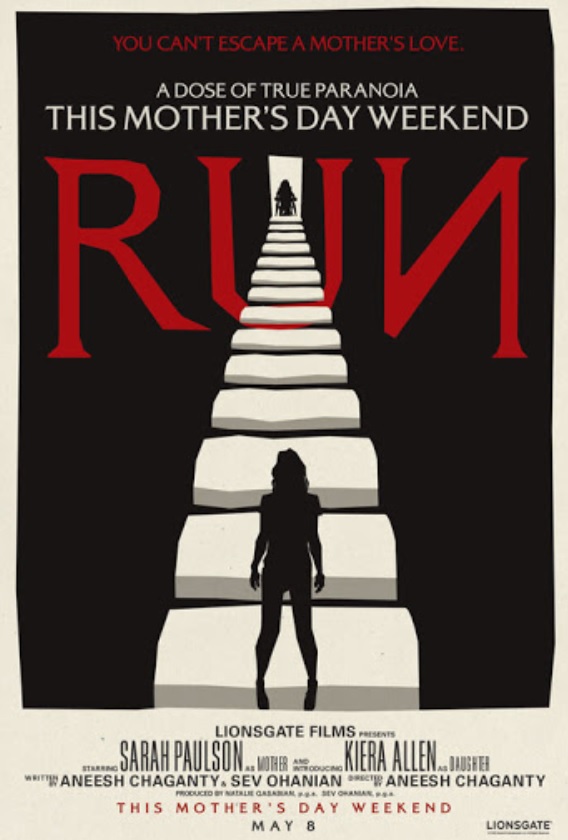
The original threatical one-sheet with a nice ’70s retro-Giallo vibe
Aneesh Chaganty has taken an already terrifying, destructive mental illness, one that also manifests itself as a multi-physical illness in another—Munchausen by Proxy—and turned the admittedly tired stalking genre (deluded by Lifetime’s endless stream of psycho-antagonists vs. damsel-in-distress flicks) upside down.
Diane (Sarah Paulson) is a mother whose love runs deep—deep enough that’s she put her daughter Chloe (Kiera Allen) into a wheelchair. And because of the bullying and discrimination that accompanies a handicap; Diane holds her daughter in a home school isolation that’s slowly built since Chloe’s birth. Diane’s method of control: she medicates her daughter into a mystery- debilitating illness that results in a perpetual round of surgeries and more medications. Now a teenager, Chloe beings to suspect her mother’s love isn’t one of compassion, and not one of a mental illness out of her mother’s control, but one of a sinister, ulterior motive that has nothing to do with love.
You can keep up to date on the release rollout of Run and the ever-expanding library on Hulu at their website or Twitter and Facebook pages. You can also get more info at Lionsgate.com.
UPDATE: Hulu set a premiere date for November 20, 2020.
Disclaimer: We weren’t provided with a screener nor received a review request from the film’s P.R firm. That has no bearing on our review.
About the Author: You can learn more about the writings of R.D Francis on Facebook. He also writes for B&S About Movies and publishes on Medium.
Surfing TubiTV’s digital library is a byte-shoot on the digital felts of the cloud. Most times you stream 2, 3 and 12s; but sometimes you’ll upload 7s and 11s. If one exhibits patience—and cross-references with the IMBb—they’ll 7 and 11 well-made overseas films that, in the horror oeuvres, are on equal with any of the U.S. domestics from the commercial A24 and Blumhouse slots. And many of these under-the-felts streaming cherries come courtesy of the industry’s leading indie-film streaming purveyor Wild Eye Entertainment (along with other distributors, such as Gravitas Ventures, Indie Rights, Uncork’d Entertainment, and ITN Studios), which has been importing some very impressive foreign horrors: the neo-giallos Dark Sister (aka Australia’s Sororal) and Evil River (aka Italy’s Shanda’s River) are two of those recently spun jackpots. Other recent, satisfying byte-shoots were the Asian horrors Daughter (aka Hong Kong’s Shuang shen) and 0.0 MHz (South Korea). Then there’s the inventive found-footage tale Cold Ground (France’s Sol Froid), the creative zombie tale Inmate Zero (aka, Wales-Ireland’s Patients of a Saint), the radio station-based thriller When Murder Calls (aka Canada’s Radio Silence), and the Liam Neeson-styled actioner Revenge (aka, France’s Revanche).
Sadly, many movie lovers see these films as “three lemons” on the ol’ roulette app because the indie distributors, as you can see, forgo the films’ original titles from the respective country’s initial theatrical release and digitally rebaptize the films for American-domestic consumption—and pair the rechristened films with admittedly well-drawn/shot, but low-grade, sensationalistic-to-cheesy streaming one-sheets that make the films look like so many of the other (amateur-to-lower budget) sensationalistic-to-cheesy indie streams out there; you know the type: the films where the incident/character on the poster never occurs/appears in the film. The aforementioned Daughter and Evil River—with their respective, stringy-haired possessed girls crucifixion-floating above their bed under the sign of a wall-scribbled pentagram and rising out of mucky river waters in front of a remote, rural cabin—are the worse-case examples of a great movie hidden under deceptive-discouraging J-Horror-inspired art work.
And that brings us to the English-language Italian import Cruel Peter. You’ll notice that the streaming one-sheets—as do all streaming one-sheets, because of the size-diminishing of a movie’s poster in an online library—forgo tagline and credits: instead you get artwork (rebooted-sensationalistic, natch) and a title. That’s it.
Of course, Cruel Peter churned out of the digital-distribution sausage processing centers relatively intact. But still: That red-hued poster makes me think that some kid with a Jess Franco-level grease paint-cum-oatmeal gook-acne problem, under the direction of Don Dohler, is wreaking havoc in a small town. And I am burnt out on A) Shaky-cam cheap horrors, B) Zombies, especially of the kid variety or any creepy brats of the low-budget variety, C) If I want to see a Don Dohler movie (e.g., Night Beast), I’ll watch an actual Don Dohler movie, and D) Don’t mistake celluloid ineptitude as a “retro-homage” to a ’70s drive-in ditty, because, well the classy-majesty of The Brotherhood of Satan (1971), Messiah of Evil (1973) and The Living Dead at the Manchester Morgue (1974) are never going to be duplicated.
Which is why you need to hit the big red streaming button and byte-shoot the digital felts and let the 1s and 0s roll stream for at least 10 minutes . . . and in the case of this second feature film collaboration from writer/directors Christian Bisceglia and Ascanio Malgarini, I am glad I took the digital gambit.
The duo’s first effort was the under-the-radar The Haunting of Helena (2012); which, natch, got the ‘ol U.S. distribution reboot retitle-cover art boondoggle as Fairytale. Based on that female-centric corpse from the Sam Raimi School of Witch Bitches and Cellar Dwellers screaming through the window, I probably came across it on a streaming platform—and passed on it because I don’t take well to scary toys, dolls, freak clowns (real or puppet), or fluttering Lord of the Rings-inspired fairy-creatures due to my own childhood traumas. But that’s my loss. Based on my enjoyment of Cruel Peter, I’m seeking out The Haunting of Helena—now that I know the film’s true title vs. its deceptive title.
What we have here with Cruel Peter is a psychological, neo-Gothic flick that expertly pays homage to the ’70s productions of Hammer and Amicus Studios. As the characters navigate the remodeled, rural Italian villas, overgrown cemeteries, and crumbly crypts, we drift back to the Italian and Spanish, old-school horrors of yesteryear by Armando De Ossorio (his four-film “Blind Dead” series) and Paul Naschy (Horror Rises from the Tomb); a film awash in superb, picturesque locations—only with the high production values afforded to an A24 or Blumhouse domestic U.S. production—sans the mainstream “jump scares” modus operandi of those studios’ resumes.
We’ve got animated, articulate corpses, demon wall-crawling, shadowy ghosts rising out of floors, hands emerging from a murky sink waters, witchcraft, necromancy, and poltergeists afoot in a creepy, slow burn that dispenses with the been-there-and-done-that blood n’ guts slasher-gore and trades up for an articulate approach of dripping-with-atmosphere cinematography and plotting. Cruel Peter is a horror film just like the ‘70s used to make—before John Carpenter’s Halloween reinvented (for better or worse; opinions vary) the horror genre and drowned ‘80s home video shelves with an endless stream of implement-slashing, woodsy stalkers.
The film begins in 1908 in the village of Messina, Sicily, where a rich, English-bred mother coddles her 10-year old son’s sociopathic tendencies. Peter’s prone to slashing a servant girl’s face, dousing a caged field mouse with lighter fluid to watch the poor creature burn, and buries the dog of a house servant’s son alive. It’s also believed Peter murdered his own father. But the dog’s death was the last straw: the children of the villa’s servants ambush Peter and bury him alive.
And in the case of the “Devil looks after his own”: an earthquake strikes and kills thousands—and decimates the town’s cemetery where Peter was buried. And he’s forgotten. . . .
In the present day, Norman, a widowed British archaeologist—with his own bag of demons and closeted bones—along with his resentful, strong-willed and deaf-mute daughter Liz, relocate (and take up resident in Peter’s old villa home) for Norman’s latest assignment: excavate and restore Messina’s long-neglected cemetery. Courtesy of her father and late mother’s work, Liz also has an interest in the past—a deeper past of the supernatural and occult where she spends her days examining grimoires as she plays with a Ouija Board-inscribed crystal ball that displays letters on the wall—all in the efforts to contact her late mother.
During the excavations, Norman discovers Peter’s lost grave—and a small box of Peter’s belongings. Now freed, Peter, through Liz’s occult interests, makes contact—which she thinks is her mother. As Peter’s possession is fully realized, Liz’s personality changes and Peter extracts his long-simmering revenge.
During this article’s search-and-destroy Intel mission, a constant comment by threaders on the Amazon Prime and Netflix frontiers: the film is too dark; you can’t see anything. And the TubiTV stream I watched—in a darkened room with no light glare—was dark; characters and sets washed-out in shadows. Monitor adjustments didn’t help. So we’re not sure if that’s the result of a cinematography snafu, a post-production oversight, or an artistic choice of using a real location’s (not a stage set) natural light. But what it actually seems to be is a screen-ratio issue. Cruel Peter, based on its stellar, high production values—while it’s been primarily seen outside of its native Italy (and probably Europe) as a cable PPV and, more likely, as an online VOD—isn’t just another direct-to-streaming production: it’s a theatrical feature film, again, of an A24 and Blumhouse-level, meant to be seen on the big screen. It seems the image compression for streaming devices compromised the film’s cinematography and caused the “too dark” issues. The solution: watch on a laptop, sit closer, and angle the screen until you find a comfortable position.
It’s worth the effort. Cruel Peter is a great horror flick to nosh popcorn by—just like the ‘70s used to pop—without the slasher-bloody buttery aftertaste.
Netflix gave Cruel Peter its U.S. debut proper in June. It’s now available as a free-with-ads stream on TubiTv; you can also watch it on You Tube/Amazon Prime. The Haunting of Helena is not available on TubiTV, but is available as a VOD on You Tube/Amazon Prime.
Disclaimer: We weren’t provided a screener nor received a review request from the film’s P.R firm. That has no bearing on our review. We discovered this film on our own and genuinely enjoyed the movie.
About the Author: You can learn more about the writings of R.D Francis on Facebook.He also writes for B&S About Moviesand publishes on Medium.
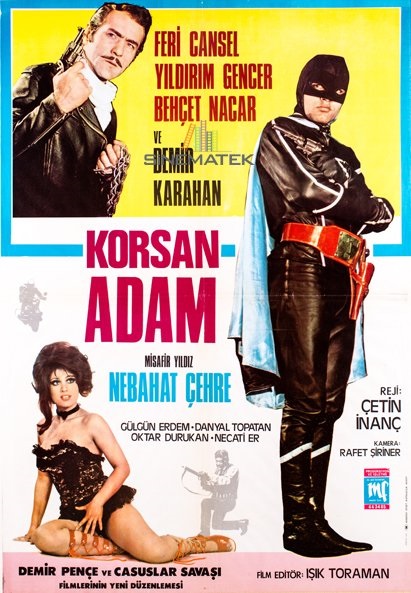
With a title that translates as Iron Claw (Pirate Man), this movie is also called Iron Claw the Pirate and comes from the magical brain of Çetin Inanç. Fantomas — if you’re here worrying about copyrights, you’re in the wrong place — and his goon Bechet goes up against Iron Claw and his Batgirl-esque assistant to keep the villain from invading Turkey.
Somehow between 1967 and 1969, Turkish filmmakers learned that superhero cinema had moved from 1930’s movie serials to 1960’s Batmania. This feels similar to Yilmaz Atadeniz’s own Casus Kiran, a riff on Spy Smasher, which makes sense as Inanç started as an assistant to Atadeniz.
Much like most Turkish superheroes, Iron Claw is allowed to sleep with all of the evil women he wants and keep his lady Mine. Perhaps even sadder is despite the fact that she is shown to be a capable hero, she’s never given a superhero name of her own. She’s just a nameless helper who dresses in a much sexier version of our hero’s costume. Iron Clawette seems like too easy of a name and look, I spent more time worrying about it than the people who made this movie.
Yildrim Gencer — the man who played Kilink — is also in this as a mustache sporting agent on the side of good.
Beyond the steel fisted Behcet, Fantomas also employs Cancel, who is played by Feri Cansel. If you think, that might be the best villain of all time, let me tell you that he also gets away with things no movie serial villain ever does, like murdering a kindly old professor and then making a sacrifice of that man’s daughter on an altar. Well done, Fantomas!
This is another magical trip to the no limits world of Turkish film, a place where innocent kink exists fist in glove with murderous superheroes and masked villains who get away with it.
Lost in pain and loneliness, Scott (Daved Wilkins) calls the suicide prevention hotline one night yet accidentally reaches Beth (Sarah Booth), who works as a janitor at a local community college.
It’s a story that may have been told before, but never like this. That’s because the entire film was made as two continuous shots, with two crews filming simultaneously in different parts of a city to create one movie. Think of it as One Cut of the Dead meets Wicked, Wicked, as Last Call employs split-screens to tell both of its stories at the same time.
To match the action unfolding on the screen in real-time, composed Adrian Ellis also had musicians play the entire soundtrack while watching the film from start to finish. It adds a really great touch to a movie that has a lot going for it.
Gavin Michael Booth, who directed this, is also a writer, producer, cinematographer and editor. His other project that I know of is The Scarehouse, which I am going to track down and see if it’s as well-made as this movie.
You can learn more about the movie at its official site. We were sent a copy by its PR film, which doesn’t impact our review, but we appreciated getting to watch such an interesting new take on what could have been a familiar story.
Leave it to Turkish filmmakers to not only completely rip off E.T., but also make the alien gay and lost in 70’s Turkey.
Written, directed and starring Müjdat Gezen, this is the second Turkish Xerox of that Spielberg blockbuster that I know. The other, Badi, has an alien that is frightening instead of loveable. The movie poster also features the USS Enterprise, which is not in the movie*. Such is the country for which we have been exploring all week.
I love that someone spent the time to write a research paper on this movie. I guess if you’re going to spend the time and energy to make a movie where a big butt alien comes down to our planet and helps us explore the ways that LGBT people dealt with the opression of 1970’s Turkey, as well as exploring tabloid culture, this would be the movie to write about.
This is why when people at work ask, “What movies has everyone been watching?” I hope that someone else answers, because then I have to explain that one, there’s a Turkish version of E.T., two that it has a gay alien and three that it had no subtitles and therefore I was forced to watch it and make up the dialogue inside my own head.
*The makers of Evils of the Night, which features a hot pants wearing teen being menaced by zombie hands while the Millenium Falcon zooms overhead, had to have been paying attention.
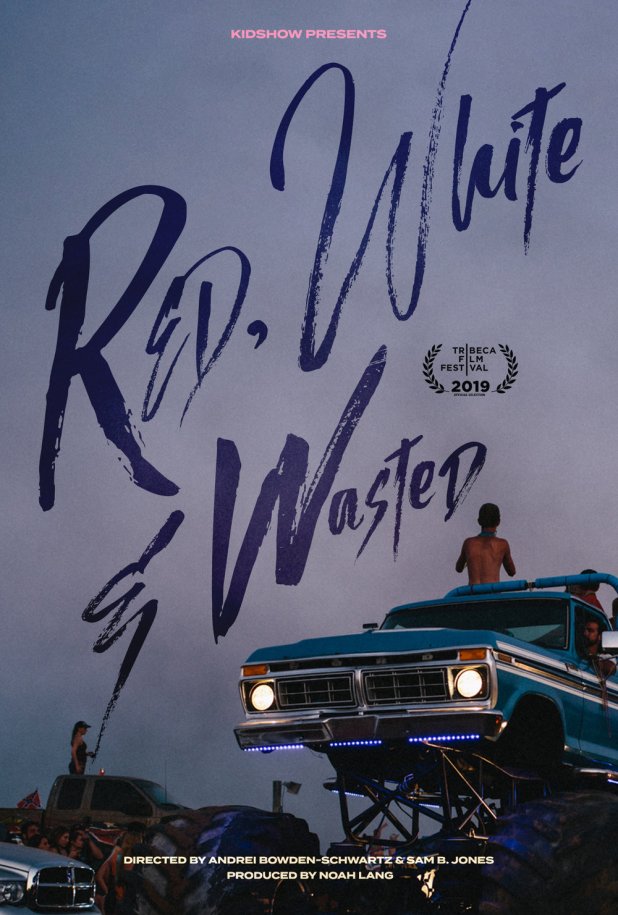
I grew up in a small town — not in Florida, but in Pennsylvania — and mudding was also a big thing for so many people. I remember coming home one Thanksgiving from college and took multiple trucks out into the freezing woods, chasing one another until we flipped and were submerged in the chilly, muddy waters. After walking a mile back to the road with icy filth clinging to every pore, I thought, “I have no interest in ever doing that again.”
Matthew Burns has raised his family amongst the monster trucks. There’s a scene in the beginning of the film that’s astounding, as they show images of his daughters growing up, almost always covered in mud.
There’s a tendency in the intelligent left — and I’m sure both sides of the aisle — to write off rural and redneck Americans. Or, more often, make fun of their ways and even worse, co-opt them for pop culture.
Instead, I invite you to watch this film free of any prejudices. That said, some of the moments, like the Redneck Yacht Club and the way women are treated as objects, are difficult to watch through any lens. There’s also a moment where one interview subject suggests that if we all stopped talking about racism, it would go away. Sadly, this is a statement I have heard echoed so many times.
In the shadow of the happiest place on Earth, this is the life that exists around the clean facades, a world where the “theys” and “people in power” are constantly taking songs off the radio and pushing their agenda on the little man.
As the mudholes close in this film and a way of life changes, I sit here meditating on how the world is going to keep changing and not for the better. I really try and stay away from politics, but I’m kind of upset this morning about a negative email interaction with a director. This movie has made me think of the small people caught up in the gears of the bullet point media coverage from both sides as I think of these mudders, out and trying to find a new place in the woods and stuck watching videos of their old trucks and thinking, “Where did the good old days go?”
Have you ever wondered when things are so bad that for some, this period of time will be their good old days?
The long and short of it is that there’s mud and smoke and fireworks that draw you into this film, but the real story is the human drama of Matthew’s family falling apart and his life getting sadder as all he does is work, scrapping and taking the garbage of people a level above him in caste and trying to get all the money that he can from it. This film is awash in tragedy and pathos and regrets when on the surface it only feels like it’s going to be about good old boys tearing it up.
This movie may make you happy. Or angry. Or just sad. But that said, it does what a movie should. It makes you think.
You can learn more at the official site. It will be playing virtual theaters this month.
DISCLAIMER: We were sent this review by its PR company. We appreciate them sharing it with us.
Tarkan and the Vikings is the fifth in the series of seven films that tell the story of Tarkan, who seems at continual war with Vikings. Created by Sezgin Burak in 1967, Tarkan is rare in Turkish cinema in that he is not a remake, a remix or a rip-off. Instead, the Hunnish warrior and his wolf companion Kurt appear in their own movies which only slightly echo the Italian sword and sandal films, but are reflected through the low budget and high concept world of Turkish cinema.
The Vikings are, of course, beyond evil. They sacrifice virgins and worship an octopus god who — mercifully — emerges from the deep to menace our hero. Kartal Tibet would play Tarkan in five movies and he’s the exact action hero you want in this kaleidoscopic 74-minute blast directly to your brain. The villains do more than just shoot him in the back twice. They kill his dog. He swears to his dog’s son that he will have his horrible and bloody revenge. And oh yes — he will.
This wouldn’t be a Turkish film without the pilfered music, here being Strauss’ “Also Sprach Zarathustra” and at least one John Barry song. Seriously, I think Turkish filmmakers liked Barry more than even their British counterparts!
Eva Bender shows up in three of the Tarkan films and you’ll wish that she was in every movie that you’ve ever seen. While she plays the evil Gosha in Tarkan and the Golden Medallion and Tarkan and the Silver Saddle, here she’s Ursula, the leader of the rebellion against the Vikings.
Much like all Turkish films, the bad guys are quite literally the worst bad people you’ve ever seen with no redeeming qualities. They feed people to their pet hawks, they throw innocent women onto trampolines (yes, really) and literally throw kids in the air and slice at them with axes (double yes, really). Lotus (Seher Seniz) is a dragon lady so sinister that she does a striptease belly dance with throwing knives as our hero hangs perilously over a pit of snakes. Just writing about this scene makes me want to go back and watch this all over again.
You will learn much from this piece of art, but most importantly, you will walk away learning that Vikings chose to wear lots of pinks and purples.
You can download this from the Internet Archive or watch it on YouTube.
“Documentaries are boring. Who wants to watch a bunch of talking heads bragging about themselves?” —Eric, purveyor of film quality and all things Sein(feld)suck.
And to a degree, I agree with my running-bud Eric: unless you have an interest in the subject matter at hand. As someone who’s spent his life in radio broadcasting and enamored with the craft of filmmaking, I’ve watched more than my fair share documentaries on the subjects of broadcasting and radio personalities, and film with its related actors and directors. And, even in person, those creative individuals can push self-aggrandizing into the new limits of boredom.
Don’t believe me?
The Snack Bar is Open! Free Dove Bars if you buy a hotdog. Darn freezer’s broke again!
Go to a party or any social gathering. Find yourself an actor or director. And I am not talking about running into a well-rounded, educated fellow like Werner Herzog with whom you can have a meaningful conversation about anything from soup to nuts. I am talking about the (always) one-the-way-up-and-after-one-film-they-think-they’re-Elvis types. But since this is in reference to film: Steven Spielberg. And actors are worse than directors. Christian Bale and Klaus Kinski earned the right to set-rant. You, Mr. DeMille and Ms. Desmond, do not.
Don’t believe me?
Watch The Disaster Artist, the (excellent) dramedy about the making of Tommy Wiseau’s The Room. There’s a telling scene in the film where actor Greg Sestero confides his career frustrations to a fellow thespian—and all the other actor can do is drone on and on about how great his career is going. And as someone with lots of “under the tent” experience in holding areas, I’ve seen and heard it all, ad nauseam. Sestero tells it true.
And screenwriters? Well, I’ll spare you that paragraph, but here’s the equation: Director ego x Actor oneselfness = the greatest screenwriter in the world, aka “Listen to me, for I am the lord god of all scribes surveyed.”
And heaven forbid if you don’t like that up-and-coming Elvis-Spielberg’s latest entry to their no-one-has-ever-heard-of-or-seen oeuvre, aka a celluloid nobody and never will be: be prepared for the bowels of hell to rip open and for the lathes of heaven to crash into the fiery abyss and scorch to embers. Yeah, sometimes (almost always) the auteur is just another egomaniacal Billy Walsh (know your Entourage trivia) who blesses you with the distinct privilege of viewing their master(shite)piece—just because it received a set of “Official Selection” leaves from some obscure, off-the-circuit, emo-haughty film festival that won’t be in business next year and mainstream Hollywood doesn’t acknowledge because, well, Hollywood is already full up with more talented haughties than yourself. But thanks for asking! We’ll be looking for that star on the walk of fame, DeMille.
But even the established directors can be a handful, as evidenced in The Man You Love to Hate (1979), about the uncompromising director of silent films, Erich von Stroheim (acted inSunset Boulevard). There’s Luchino Visconti (1999), about the iconic neorealist behind (the incredible, must watches) The Leopard, Death in Venice and Ludwig. There’s Felini: I’m a Born Liar (2002), Carl Th. Dreyer: My Métier (1995), about the director behind the seminal vampire flick, 1932’s Vampyr, and Pier Paolo Pasolini: A Film Maker’s Life (1971). And you can go on and on . . . with docs about Robert Altman, a couple regarding Woody Allen and Roman Polanksi, along with Orson Wells, Howard Hawks, Bergman, Kurosawa, Kurbick, and even producer Robert Evans. The documentary Easy Riders, Raging Bulls examines the industry and careers of ‘60s “bulls” Martin Scorsese, Dennis Hopper, Peter Bogdanovich, and Sam Peckinpah. And, speaking of Werner Herzog: Burden of Dreams (1982) follows the German (deserving of the noun spoken in the same sentence as his name) auteur as he deals with difficult actors, bad weather and getting a boat over a mountain during Fitzcarraldo.
But this is B&S About Movies . . . and you know us crazy, frolicking lads in the wilds of Allegheny County. We’ve got to go just a little bit deeper into the films—the realm of documentaries about directors. You may not know them. You may know them and hate them. But you know what: they don’t care. They, with a Kurt Vonnegut tenacity, just keep on creating. And that’s cool with me.
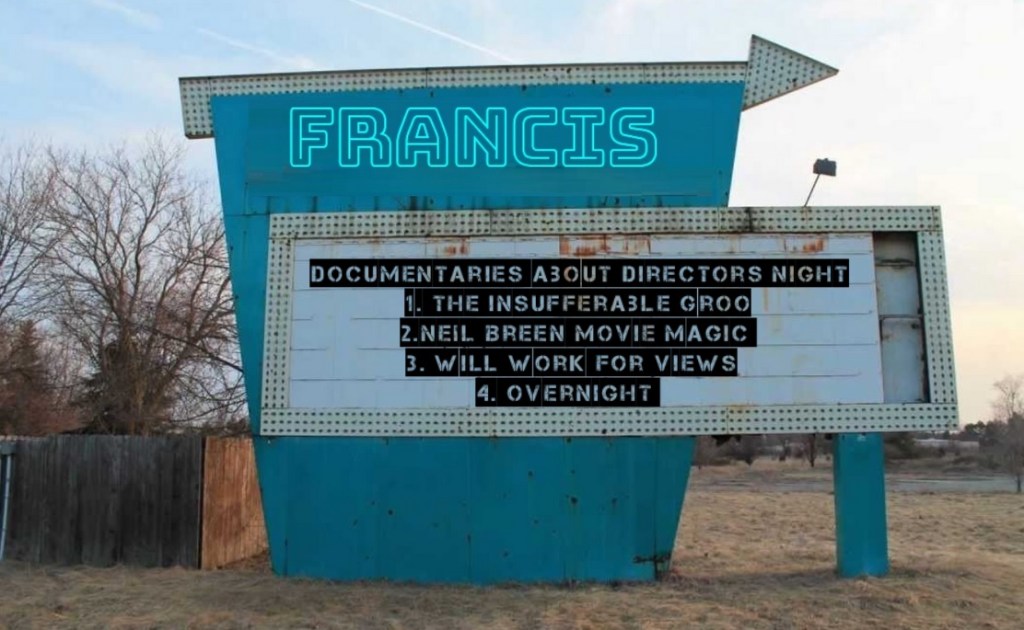
Image available across multiple sites; source unknown
Movie 1: The Insufferable Groo (2018)
At the time of the filming of this documentary by Scott Christopherson, Provo, Utah, resident Steven Groo’s resume encompassed 166 films—after its release, his resume grew to 200 films. A lesser documentarian would most likely—as so many internet warriors—slag Groo’s ultra-low-budget tales. Instead—what makes this film so lovely and tragic at the same time—is that Christopherson focuses on Groo’s determination to tell his stories. While Groo can be admittedly abrasive, his tenacity paid off with the patronages of actor Jack Black and director Jared Hess of Napoleon Dynamite and Nacho Libre fame. And Jack Black starred in Goo’s Unexpected Race (2018). In the end, you root for Groo.
You can watch The Insufferable Groo as a free-with-ads stream on TubiTv. You can also watch Unexpected Race on the platform, as well. Since Groo participated in its making and approves of the film, you can still find this document out in the Internet ethers. The same can’t be said for our next feature. . . .
Movie 2: Neil Breen Movie Magic (2020)
When Tommy Wiseau’s name drops, the name of ultra-independent filmmaker Neil Breen follows. And if you’re a hardcore fan of ultra-low budget films, Cybela Clare—with her equally incompetent-to-obsessive films about humanity, animals, and aliens rife with awful CGI set design—name drops after Breen’s. To say Breen is a film cult icon is an understatement. Plug Breen’s name into You Tube or Google and you’ll discover the rabid fandom of his works. His films couldn’t be more polarizing: they’re either IMDb-rated as 1-star or 10-star . . . although it’s obvious the 10-starrers are pure parody-sarcasm, at best.
Anyways . . . a licensed architect by trade who made his money in real estate, Breen self-financed/produced, directed and starred in his debut feature, Double Down (2005). As of 2018, he completed five films and has since launched pre-production on his sixth film: Cade: The Tortured Crossing (2023).
You may love ‘em. You may hate ‘em. You may say they suck—and they ultimately do—but courtesy of an underground fan base cultivated via social media, Breen’s films—in a Wiseauian twist—have been picked up by arthouse theatres and film festivals around the world.
Sadly, you can no longer watch Neil Breen Movie Magic on You Tube. Yeah, it seems ol’ Neil can’t take criticism: the film wasn’t favorable to his works, so he’s since had the film pulled; however, to Neil’s credit: it did use his intellectual property without his approval.
So, as any narcissist would: Breen released his own documentary in response: Neil Breen’s 5 Film Retrospective, in May 2020. As with Neil Breen’s Movie Magic: it is another must-watch for Breen fans. You can watch Breen’s insights on himself on You Tube.
Needless to say: The trailers for Neil’s movies are as bloated as his films . . . so strap in for a 9-minute trailer to Neil’s self aggrandizing documentary. A nine-minute trailer? I guess it’s justified, considering the movie itself is five-hours long. For reals.
Don’t worry. Neil’s not offended. He’s gone on record to say he doesn’t read his reviews (but had Movie Magic pulled, so . . . okay) a few which this Las Vegas Weekly article features.
Intermission!
Back to the show!
Movie 3: Will Work for Views: The Lo-Fi Life of Weird Paul (2019)
Say what you will about Pittsburgh You Tube star Weird Paul—but the dude has 34,000-plus subscribers. People love him. You can’t help but dig him and his unique brand of retro-‘80s video productions, which he’s been posting since signing onto You Tube on Feb 4, 2007. I’ve been a fan of Paul’s ever since. And so should you. He’d make Kurt Vonnegut proud.
You can watch Will Work for Views as a free-with-ads stream on TubiTV.
Movie 4: Overnight (2003)
It amazes me that for as many people that have watched Boondock Saints—and quote the film, wear the t-shirts, and even have Boondock Saints “double gun” lamps on their end tables in their media room—have no knowledge of this documentary shot by writer-director Troy Duffy’s former friends.
You may have heard the stories about Duffy’s meteoric rise and even quicker fall, but here’s your chance to see it all up close and personal. Even if you aren’t a fan of documentaries or have not the need-to-know about what goes on behind a camera, you’ll be fascinated by this document that tells us the story of a (film and music) career that might have been. For bless the “Holy Fool.”
You can watch Overnight as a free with-ads-stream on TubiTv. Unlike Breen: Since Duffy authorized the cameras filming his every move during the making of his film, he couldn’t stop this film from being seen.
“Documentaries suck and are made by people who can’t make a real movie. I’d rather sit through a TBS Seinsuck marathon.” —Eric
Indeed, Eric. Indeed.
Like I always say: Friends and film, huh? But chicks and film is (always) worse. (A woman who digs Klaus Kinski and knows Paul Naschy’s works is out there, somewhere! I can hope.)
Again, in the eyes of the many: documentaries just aren’t their canister of celluloid. Yes, documentaries—if you’re not into the subject at hand—can be as pedestrian as a CBS-TV 48 Hours segment or as bone-dust dry as a PBS-TV chronicle. But that’s not the case with these four heartfelt, well-made documents of their equally talented, intriguing subjects—each who make Vonnegut proud.
Hey, Eric, be sure to check out all of the films reviewed during our “Documentary Week” feature.
“Fuck off, R.D!” —Eric
About the Author: You can learn more about the writings of R.D Francis on Facebook.He also writes for B&S About Movies.







 B&S About Movies

You must be logged in to post a comment.