Mill Creek Sci-Fi Invasion:The Girl from Rio (1969)

ABOUT THE AUTHOR: Phil Bailey is a long time photographer and film writer, who doesn’t actually hate everything, but has no fear of being a contrarian.  Follow at Twitter at @stroke_midnight or on Facebook at https://www.facebook.com/philbaileyphoto

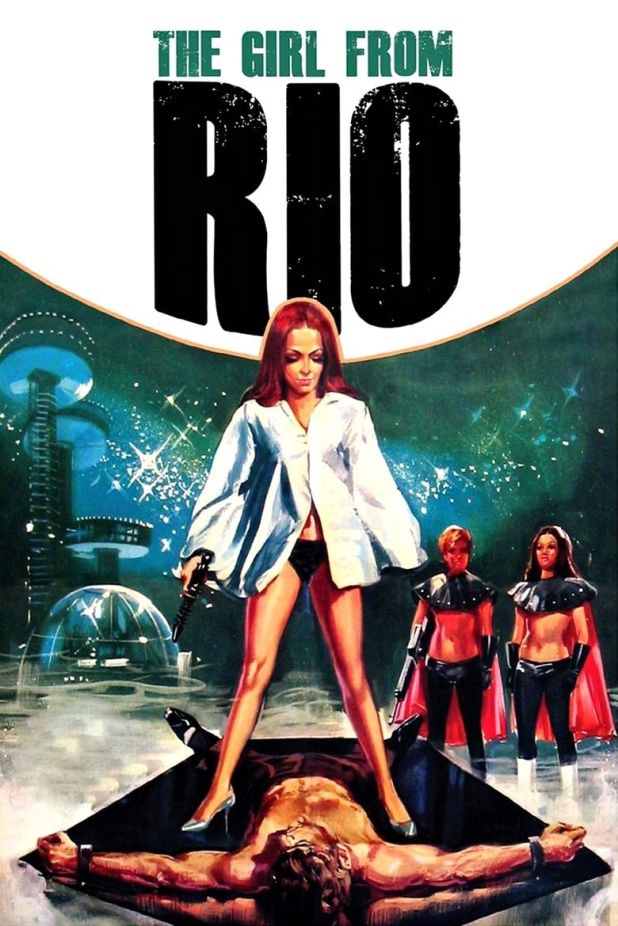
Sumuru, the femme villain bent on world domination, originally created for a BBC radio serial by Fu Manchu creator and author Sax Rohmer. If there is a Sax Rohmer story, then producer Harry Alan Towers must be lurking somewhere nearby. Towers produced a series of Fu Manchu films with Christopher Lee starring as the Chinese scientist bent on world domination and decided to take on Rohmer’s lesser known creation with James Bond girl Shirley Eaton in the lead with The Million Eyes of Sumuru in 1967 and followed it up two years later with The Girl from Rio.

The Girl from Rio was directed by Eurocult legend Jess Franco, sandwiched between his two Fu Manchu films The Blood of Fu Manchu and The Castle of Fu Manchu. This is nowhere as gonzo as his most famous/notorious films, it still boasts some great style and a bevy of beautiful women is all manner of undressed and barely dressed. Shirley Eaton, the blonde who was killed by being painted gold in Goldfinger is Sumuru who doesn’t really do much other than lounge around and look beautiful so Eaton is perfectly cast, but the real stars of the movie are Jess Franco regulars Maria Rohm and Beni Cardoso who just fit better with Franco’s vision (that vision being long legs and bare midriffs) and you can just feel Franco’s energy perk up when they are on screen, especially the impossibly leggy Cardoso as Sumuru’s head torturer/dominatrix Yana Yuma who basically steals the movie.

If you’re waiting fora recap of the plot, forget it, because that’s basically what the director did. Rio suffers from the common ailment of Eurocult films of having simultaneously too much and too little plot, It has so many plot threads that are so underdeveloped you can’t really keep it straight, despite all of the on-screen expository telephone calls. It has something to do with a mobster and a British Lord both vying to plunder Sumuru’s island fortress: Femina. Sumuru’s island fortress comes complete with a torture chamber and an all girl army decked out in pleather halter tops, capes, and go-go boots. There’s a lot of talking, a lot of scantily clad women, just enough nudity to keep the plot moving forward. The whole affair plays out like a super sexy, R rated The Man from U.N.C.L.E episode, which makes sense as the title is an obvious play on The Girl from U.N.C.L.E. tv series.

The Girl from Rio is a trashy if slight Eurocult delight that has loads of stylish eye candy. The trippy Italian comic feel to the scenes on Femina almost make up for how odd and disjointed the rest of the movie is. Structurally the movie is a bit of a mess, obviously stitched together from multiple chunks of footage that never quite convinces you that all of these people are in the same story. All faults aside, the campy, fetishistic delights that Jess Franco indulges in during the Femina sequences are well worth the 90 minutes and make the whole affair worthwhile, if just barely.

The Capture (2018)

Science Fiction is one of the hardest genres to accomplish — convincingly — on a budget, but it can be done: our recent reviews for Ares 11, Double Riddle, Space, and Space Trucker Bruce are proof of that point. And if you appreciated the recent, effective against-the-budget tales regarding the complex subject matter of time travel spun in Same Boat and Making Time (both rom-com oriented), then you’ll appreciate this tale (a thriller) regarding a group of scientists whose experiments with the human soul, in an effort to bend space and time, jeopardize the very fabric of the universe.

Every time I come to appreciate one of these inventive-style-on-a-budget sci-fi’ers, I can’t help but recall the intelligence of Shane Carruth’s low-budget time travel drama Primer from 2004. This time, we have Jim Agnew weaving an analogous thinking-man’s journey in the realms of theoretical physics.

For us giallo fans, ex-Film Threat Magazine scribe and rock video director Jim Agnew (The Mars Volta) is name we known from Giallo, his 2009 screenwriting debut directed by Dario Argento. His other Final Draft works include the Wesley Snipes-starring Game of Death (2011), Nicolas Cage’s Rage (2014), and the always enjoyable Wes Bentley in Broken Vows (2016). As a producer, Agnew also brought us the Cage in Between World (2018). In this, his fifth screenwriting effort, Agnew makes his feature film directing debut — one that won “Best Feature Film” at the 2017 Berlin Sci-Fi Filmfest.

Since we’re in the low-budget realms, don’t expect the flashy “body horror” romps of Ken Russel’s Altered States (1980), the Brat Packery of Joel Schumacher’s Flatliners (1990), or David Cronenberg’s The Fly (1986). And while Jim Agnew has brought some interesting metaphysical concepts to the table — spiritual theories that would have greatly benefited from the budget and set designs afforded those major studio productions — the fact that we’re inside a minimally set-dressed, dreary warehouse for most of the film, one equipped with lots of wires and laptops — with our test subjects lying on cots with attached electrodes — doesn’t detract from the story.

God Bless America: Turning the human essence into a weapon, one soul at time.

Louis (a very good Jordan Tisdale in his feature film and leading man debut; he had a support role in a 2020 episode of FOX-TV’s recently cancelled Deputy) is a theoretical physicist who believes he can break the First Law of Thermodynamics by channeling the human body’s energy and heat into the afterlife via the human soul: he believes dark matter, which comprises over 80% of the matter is the universe, is composed of “human souls.”

While Louis’s — and his assistant Alex ‘s (Irish television actress Nora-Jane Noone from 2005’s The Descent and 2008’s Doomsday) spiritual questions are noble inquiries, their ethics come into question as they secure payments of two-million dollars from each from four terminally-ill test subjects (Amanda Wyss from Fast Times at Ridgemont High and A Nightmare on Elm Street ’84) who volunteer to be euthanized in the hopes their “dark matter” can be returned to, and renew, their physical world — with no guarantee the theory will even work.

But it does work. And Louis and Alex have “captured” — instead of resurrecting one their four test subjects — a “soul guide” from the afterlife. And their inability to send the possessive entity back into the dark matter from which it came will destroy the spiritual and physical realms.

As of November 2020 The Capture is now available for the first time as a free-with-ads stream from Freestyle Digital Media on Tubi TV. Other indie films from the studio on the Tubi platform include Ayla, Cut Shoot Kill, and Sick for Toys. Coming up on November 29th, we’re reviewing another recent, Freestyle release: the equally inventive-on-a-budget sci-fi’er The Control. Freestyle has also recently acquired the previously reviewed film festival winner Shedding, which will be released on December 8th across all digital platforms. You can watch the trailers for these films — and more — on Freestyle’s official You Tube page.

Disclaimer: We did not receive a review request from the studio or its P.R firm. We discovered this film on our own and truly enjoyed the work.

About the Author: You can learn more about the writings of R.D Francis on Facebook. He also writes for B&S About Movies and publishes short stories and music reviews on Medium.

Sweet Parents (2017)

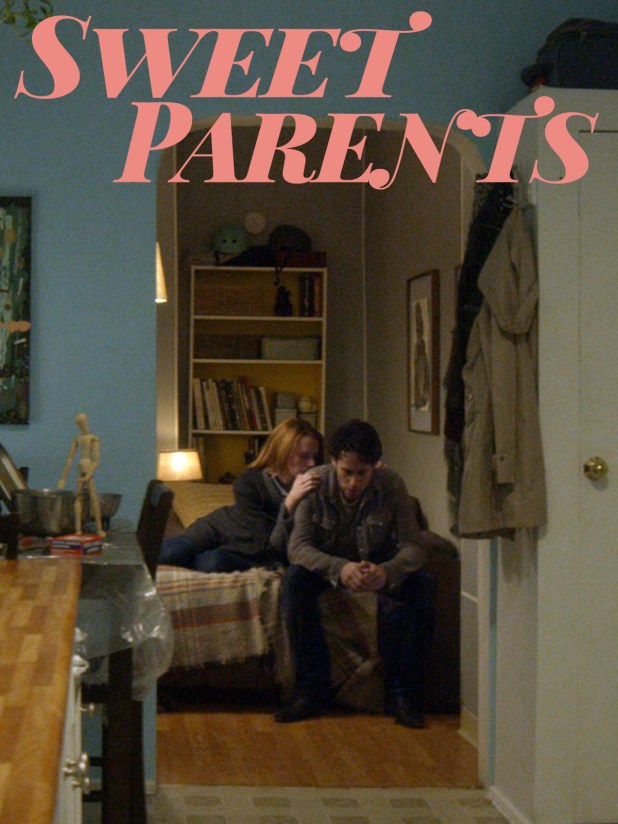
Gabby (Leah Rudick) and Will (David Bly) are a couple that has been living together as they work toward their dreams of being a sculptor and a chef. However, their lives and even their relationship is going nowhere until they get “sweet parents,” or rich older benefactors of the opposite sex.

Oscar (Casey Biggs) and Guylaine (Barbara Weetman) become those benefactors, yet it all happens so naturally, as Gabby leaves the country with the older man to get more opportunities for her art, while Will’s brother pushes him to find a female patron and do the exact same thing.

By the time the movie starts, you get the idea that Gabby and Will have already checked out of the relationship and by the way he acts throughout the film, it’s pretty difficult to gain a moment’s sympathy for him or to even be on his side, particularly the way he acts on the evening where they bring the benefactors in for something like a double date.

That’s a big risk for David Bly, who wrote this along with Rudick. He also directed and plays Will in the film. That doesn’t mean that you’ll enjoy his character any more, but at least this feels like an honest film.

You can learn more at the official site and official Facebook page.

WILLIAM GREFE WEEK: The Hooked Generation (1968)

The films that William Grefé made in Florida feel sweaty and messy and filled with menace, just like the Sunshine State itself, the kind of place that could give you both the Happiest Place on Earth and bands like Deicide and, well, Creed.

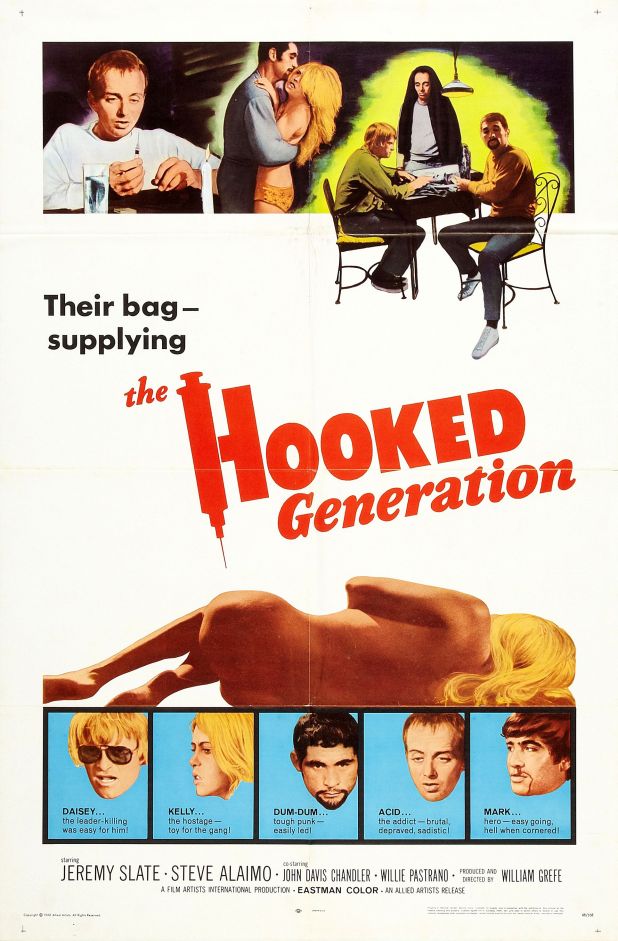
This time around, Grefé is telling us the story of a group of three drug pushers who are no longer content to kidnap people and assault women. No, they’re in for the big score, killing their Cuban drug suppliers, an act that puts them on a one-way ticket to the kind of horrible end that can only be found in a regional drive-in movie.

Daisy (Jeremy Slate, The Born LosersTrue Grit), Acid (John Davis Chandle, who is also in Grefé’s Mako: The Jaws of Death and Whiskey Mountain, as well as playing the lead bad guy in Adventures In Babysitting) and Dum Dum (Willie Pastrano, who Grefé hired for The Wild Rebels and The Naked Zoo) are absolute scumbags that spend the majority of this movie doing horrible things and talking as much as they can to pad things out.

Look for William Kerwin — who you may know from Herschell Gordon Lewis movies — shows up as an FBI agent.

This movie can be found on the new Arrow Video He Came from the Swamp set that you can grab from Diabolik DVD.

Cicada (2018)

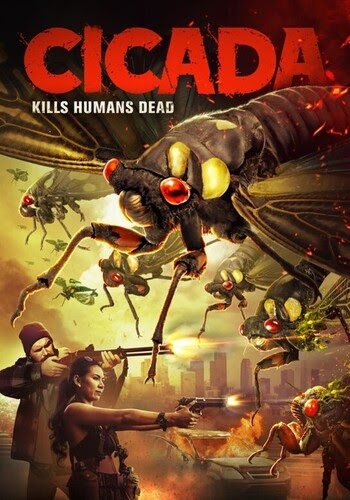
This is what 2020 was missing. Giant cicada sucking the blood of humans so hard their heads explode. Sure, the effects are low budget and the story of four people coming together in the endtimes — who knew that they would involve giant bugs filled with sugar which somehow turns them into flying bombs — has been told before. But sometimes, you just need to turn your brain off and enjoy the silliness of a movie that dares to have the tagline “Kills humans dead.”

Writer/director David Willis understands just how goofy this all is and treats this story with none of the reverence that it deserves. After all, this is a movie where a disgraced baseball player and his exotic dancer girlfriend must come together with a scientist and a bartender to save the world. Or at least Los Angeles, I guess.

There are long stretches of people being destroyed by bugs. Some of you may think to yourself, “This really seems like way too much insect on human violence.” I’ll answer that by saying that if you watch a movie called Cicada, you shouldn’t just expect bug homicide. You should demand it.

You can learn more on the official Facebook pageCicada is available from Wild Eye on demand and on DVD.

Mill Creek Sci-Fi Invasion: Evil Brain from Outer Space (1965)

Editor’s Note: This review previously ran on November 15, 2019, as part of our Mill Creek Pure Terror Month tribute.

About the Author: Paul Andolina is one of my favorite people to talk movies with. If you like his stuff, check out his site Wrestling with Film

Evil Brain from Outer Space is a science fiction film from 1965. It happens to be a couple of the Japanese Super Giant films that have been hacked up and spliced together to make one English dubbed film. It’s an odd movie about a group of aliens who send one of their own to earth to stop the brain of the evil mutant Balazar from destroying humanity. 

Special effects films and television shows are big in Japan and they have been since Godzilla roared onto screens. The Super Giant series from the late 50’s is a bunch of stand-alone films that are about the deeds of a man named Giant of Steel or as he is known in EBfOS Star Man. Star Man is a superhero basically and he wears some pretty nifty lycra outfits, he looks like a luchador that forgot his mask at home.

Evil Brain sees Star Man coming to earth to stop a few evil doctor/scientists who are in league with the evil extraterrestrial brain of Balazar. There is a hawk that hangs out with one of these doctors and a one-legged man who serves the other. There are some pretty awesome mutants who fight Star Man in this film as well. One looks like a chupacabra from the black lagoon and has strange tendril-like fingers and makes some weird noises, if I had seen this a child I would have been scared of him immediately. I actually said out loud, “WTF is that?” while watching the movie. He is by far my favorite part of the film. The other mutant is a long-haired demon lady who doesn’t quite know how to put on her lipstick. She jumps around and scratches the air while making demonic cat noises. There are also some generic henchmen mutants as well.

I would love to see the Super Giant serials in Japanese with English subtitles but I’m not sure they can live up to the insanity that is this film. It seems longer than it is because there is too much jibber-jabber. Honestly would love to see Star Man just mess up some mutants and forgo the plot altogether. If you like psychotronic films this is definitely the one for you. I have no idea what they were thinking when they pieced this bad boy together. I’d like to believe there was some acid involved and a whole lotta pot. It is in black and white but it still is a lot of fun. 

If you have any interest in the Tokasatsu trend in Japan and want to see an earlier effort you can’t get much better than Evil Brain from Outer Space.

WILLIAM GREFE WEEK: The Checkered Flag (1963)

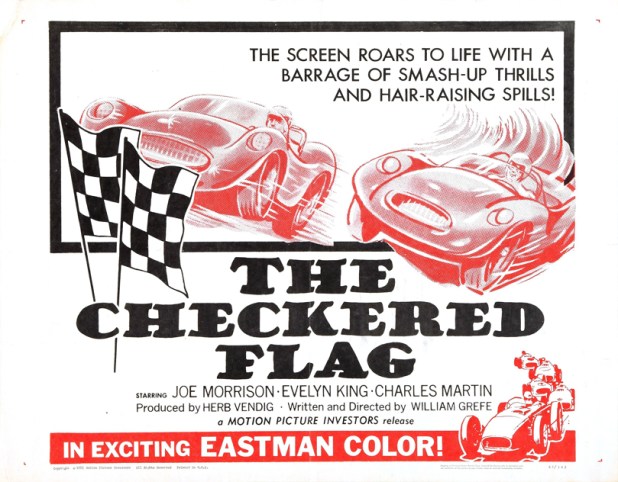
This was William Gréfe’s first script and when the original director got sick, it also became the first movie he’d direct. Shot on weekends, as Gréfe was working a full-time job as a firefighter, this is the tale of a rookie race driver named Bill Garrison being conned into murdering Rutherford, an older and richer rival, thanks to the machinations of an evil wife.

Consider this: there’s plenty of stock footage of races and several musical numbers with the ending kind of, sort of taken from Freaks. It’s not the best car racing movie you’ve ever seen and probably may vie for the worst, but at least it’s the start of Gréfe’s career as one of Florida’s top exploitation directors.

“Miami” Joe Morrison, who plays the young driver, would go on to be in Sting of Death and Racing Fever, while Evelyn King, who played the conniving Bo Rutherford, went on to be in a lost movie called Scream, Evelyn, Scream! As for Rutherford, he was played by Charles G. Martin, who shows up in plenty of Florida productions, such as Flipper and Gentle Ben.

You can watch this on YouTube.

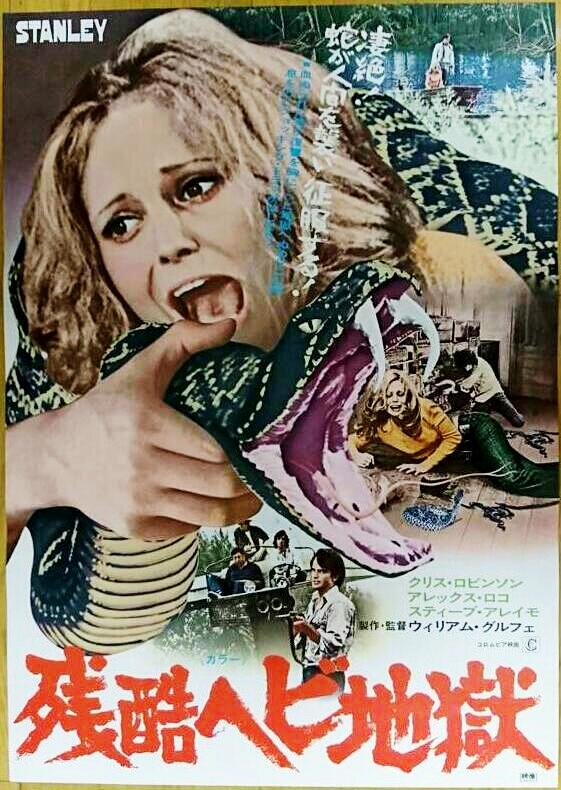
WILLIAM GREFE WEEK: Stanley (1972)

Tim Ochopee (Chris Robinson, who would write, direct and star in 1975’s The Intruder) is a war damaged Seminole just back from Vietnam that wants to live out the rest of his life in the Everglades with his snake Stanley. He didn’t count on Richard Thomkins (Alex Rocco), a maker of leather goods with mob ties, killing his father. Now, all the snakes that Tim has lived with will be the death of everyone who has done him wrong.

Only Grefe could take a ripoff of Willard and somehow make it more disturbing than you’d expect. Yes, this is a movie packed with snakes doing all manner of damage to people and people doing just as horrible things to them, including an exotic dancer playing a geek and biting the head off one on stage as she dances seductively with blood all over her bare chest.

Of course, Tim has to kill everyone in the way and kidnap Thomkin’s daughter Susie (Susan Caroll), but any hope of true love kind of goes the way that you’d expect in a Florida regional horror film that doesn’t stop with just stealing from one film and moves into being a reptile-obsessed Billy Jack.

That said — for a movie so much about protecting snakes, the actual snakes in this movie were defanged and some had their mouths sewn shut. There’s enough human on snake violence in this that you’d expect that it was made in Italy. Grefe still owns the wallet that they made out of the skin of the main snake that played Stanley, which is pretty weird when you dwell on it as much as I have.

Gary Crutcher wanted to do a sequel called Stanley in Miami, but it didn’t happen. He wrote this on two days under the influence of amphetamines, which is the most Florida thing you can say about a movie that is the most Sunshine State movie I’ve seen.

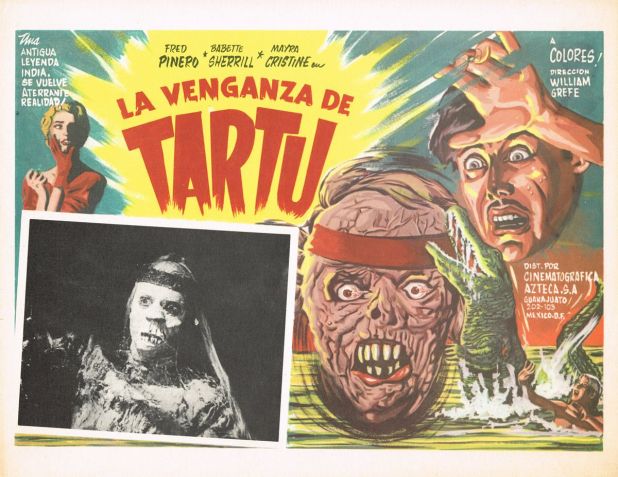
WILLIAM GREFE WEEK: Death Curse of Tartu (1966)

If you didn’t have enough of teenagers in the Everglades screwing with forces they didn’t quite comprehend in Grefe’s Sting of Death — which was the other part of a double bill with this film — then good news! Four students on an archaeology assignment decide that it would be a great idea to have a shindig on the grave of Tartu, an ancient Native American medicine man.

Frank Weed, who played Sam in this, owned all of the animals that Tartu comes back from beyond within. He did not own the stock footage that was also used for some of these animals, nor his own voice, as he was dubbed for this movie.

Somehow, Tartu has the power set of your average mummy villain, except you know, he turns into animals. One of those animals is a “lake shark,” which I had to look up, and learned that true freshwater sharks can be found in fresh water in Asia and Australia, as well as bull sharks, which can swim in both salt and fresh water and are mostly found in tropical rivers. Actually, bull sharks have been found as far north as Illinois. Yet another reason why the Everglades are totally terrifying.

Why Tartu’s weakness is mud — when he makes his home in the Florida swamps — is beyond me. Man, who knows? This is kind of a nature film, you know, except for all the killing of teens after they dance. It’s got a great name. an awesome poster and really, isn’t that all it needs?

If you want to see it for yourself, you can find this movie on the new Arrow Video He Came from the Swamp set that you can grab from Diabolik DVD.

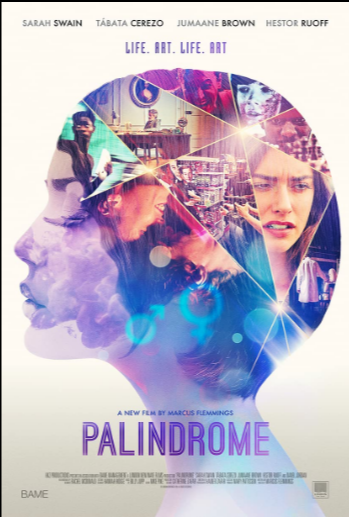
Palindrome (2020)

A palindrome is a word or a story that can be read the same forward or backward, which is the idea of the multiple stories within this film. At the same time, it may be about a painter named Anna who becomes famous at a very personal cost while Fred, a patient in a psychiatric facility, is obsessed with saving Anna frombeing killed.

So what is the story about? Is it Fred trying to find a way toward sanity or Anna realizing that she must destroy herself? Or both? Or are they just two sides of the same story? This movie doesn’t give you any answers.

Also: what do the mysterious turn of the last century nurse and doctor have to do with all of this?

If you’re the kind of person who throws their arms up and gets angry at the artier side of film, then this movie isn’t for you. If you’re willing to put an investment into watching something and coming away with your own impression of what the artist was attempting to share, then you may very well enjoy your time here.

This is a movie that doesn’t just try to tackle one issue, but many, and at times it’s scattershot, but that could also be its charm. But like I said, your experience may vary.