LEAGUE OF FORGOTTEN HEROES: The Shadow (1994)

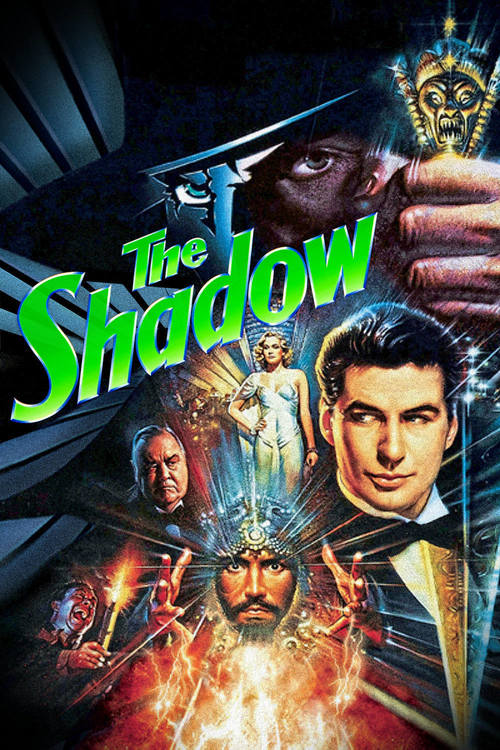
After Tim Burton’s Batman, producers scrambled to get a comic book movie — any comic book movie — up on the screen. So why not the hero who directly inspired the Caped Crusader (Batman’s first appearance in Detective Comics #27 is a tale that’s directly influenced by The Shadow story “Partners of Peril”)?

The trouble is that The Shadow hadn’t really appeared in anything pop culture related since 1958’s The Invisible Avenger, two episodes of an unaired TV series that were edited together as a movie (it was also re-released with additional footage in 1962 as Bourbon Street Shadows). And explaining to audiences why a character was popular 60 years ago isn’t always easy.

In Tibet, Lamont Cranston (Alex Baldwin, Glengarry Glen Ross) has become the opium dealer known as Yin-Ko. But Tulku, a mystic in the body of a young boy, takes him away from his dissolute life and uses the Phurba, a talking dagger, to begin redeeming the man. For seven years, Cranston learns the physical and mental skills that he’ll need to stop evil — including the power to cloud men’s minds.

It’s a rough conceit to start your film with your hero killing his own men and basically being the villain of the story. It’s why in so many stories of The Shadow, they start with the good side first before revealing his origin.

In New York City, Cranston is a wealthy playboy who is really The Shadow, a vigilante who has created a network of agents to help him battle the forces of evil. He meets Margo Lane (Penelope Ann Miller, Adventures in Babysitting), a woman who gets through his defenses, possibly because she’s telepathic.

Shiwan Khan (John Lone, Rush Hour 2) is Tulku’s fallen student who claims to have murdered the holy man. His powers are beyond The Shadow’s and he claims to be the descendant of Genghis Khan. He’s amassed a large army and has kidnapped Margo’s father Reinhardt (Ian McKellen, Lord of the Rings) to create an atomic bomb for him.

Khan hypnotizes Margo into killing The Shadow, but he stops her as Cranston. She realizes they are one and the same, but there’s no time to reflect. The Shadow has to rescue her father from Khan’s men, who now include Reinhardt’s treacherous assistant Farley (Tim Curry, Legend), who The Shadow hypnotizes into jumping off a balcony to his death.

Inside the Hotel Monolith, Khan and The Shadow have a final battle involving the Phurba, which demands a peaceful mind. Overcoming his past, The Shadow masters the weapon, frees Reinhardt from his brainwashing and defeats Khan inside a hall of mirrors by telekinetically using a shard of a mirror to give him a lobotomy.

Oh yeah — Jonathan Winters shows up as Barth and Peter Boyle plays Moe Shrevnitz, one of our heroes many lieutenants.

Sam Raimi originally wanted to adapt and direct this film, but was supposedly denied the rights to it. You can see echoes of the character in his 1990’s film Darkman.

Russell Mulcahy ended up directing the film. He came from the world of music videos, where his directorial efforts for Duran Duran helped create the image for the band. His first work that got noticed in the U.S. was the Australian horror film Razorback, followed by his work in the first Highlander (we shouldn’t discuss Highlander 2: The Quickening). Today, he’s known for the MTV series Teen Wolf.

The film does a good job getting plenty of references in to past tales of The Shadow, but again, it’s a rough character to sell to modern audiences without explaining why he’s so awesome before you show where he came from.

This was planned to be a franchise, with plenty of tie-ins like an entire line of action figures from Kenner.

The toys are typical of the mid 1990’s Kenner design aesthetic, with limited poseability and action features. They fit in well with the Super Powers and Swamp Thing lines that came out several years before.

The original DVD of the film was out of print for some time (indeed, it goes for around $12 in most used stores, a lofty price) but was re-released on blu-ray in 2013. It’s worth looking for, especially if you’re someone like me that stayed awake late at night to listen to the 1970’s re-airings on the syndicated program Golden Age of Radio.
MESSED UP AND MUSICAL: Bugsy Malone (1976)

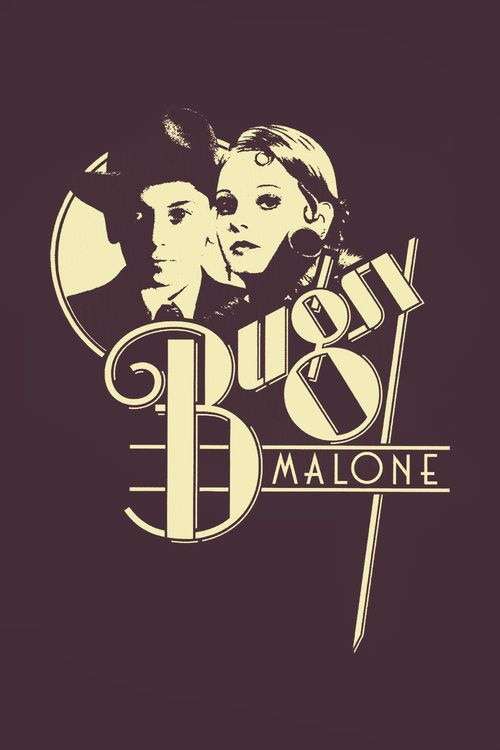
I often write about movies in the middle of the night, when the rest of the world is asleep. Sometimes, a movie will seem like a dream instead of something real. Imagine a musical gangster movie starring all child actors with music by Paul Williams. Yet, wonder of wonders, this movie actually was filmed.

Sir Alan Parker’s feature-length directorial debut (he also directed Pink Floyd’s The WallAngel HeartFame and so many more), this is also Scott Baio’s first movie and features a young Jodie Foster.

Why kids? Parker said, “I had four young children and we used to go to a cottage in Derbyshire at weekends. On the long, boring car journey up there, I started telling them the story of a gangster called Bugsy Malone. They’d ask me questions and I’d make up answers, based on my memories of watching old movie reruns as a kid.” His oldest son loved the stories and suggested that when he made the movie, children should play the roles. 

The strangest moment of the film is seeing kids sing with Paul Williams’ voice. Parker agrees today. “Watching the film after all these years, this is one aspect that I find the most bizarre. Adult voices coming out of these kids’ mouths? I had told Paul that I didn’t want squeaky kids voices and he interpreted this in his own way. Anyway, as the tapes arrived, scarcely weeks away from filming, we had no choice but to go along with it!”

The film starts with Roxy Robinson being splurged by another gang. In the film, guns shoot whipped cream instead of bullets and once you get splurged, you’re done.  We meet speakeasy boss Fat Sam and Bugsy Malone (Baio) with a big musical number. Fat Sam is played by John Cassisi, a kid who was selected by Parker after asking for the worst behaved child in his Brooklyn class. Interestingly enough, after he retired from acting, Cassisi became involved in construction, rising to the Director of Global Construction for Citigroup. However, he pleaded guilty to bribery in 2012 and was sentenced to 2 to 6 years in prison, pretty much making him a real gangster.

Then, we meet Blousey Brown, a singer, and Dandy Don, the rival gangster who wants to take over Fat Sam’s rackets and splurging all his men. Meanwhile, Sam’s girlfriend Tallulah (Foster) tries to get between Bugsy and Blousey.

Bugsy helps Sam survive a trap that Dandy Dan sets, drawing Bugsy deeper into the gangster life, despite his budding affair with Blousey. Finally, everyone but our young lovers gets splurged and realizes that they can all get along.

This is a movie that defies my descriptions. You should just watch the trailer for yourself to confirm to me that this is all real and not a dream.

Unfortunately, this movie has never been released on DVD in the United States, so you’ll either need to import the film or turn to gray market sources to watch it.

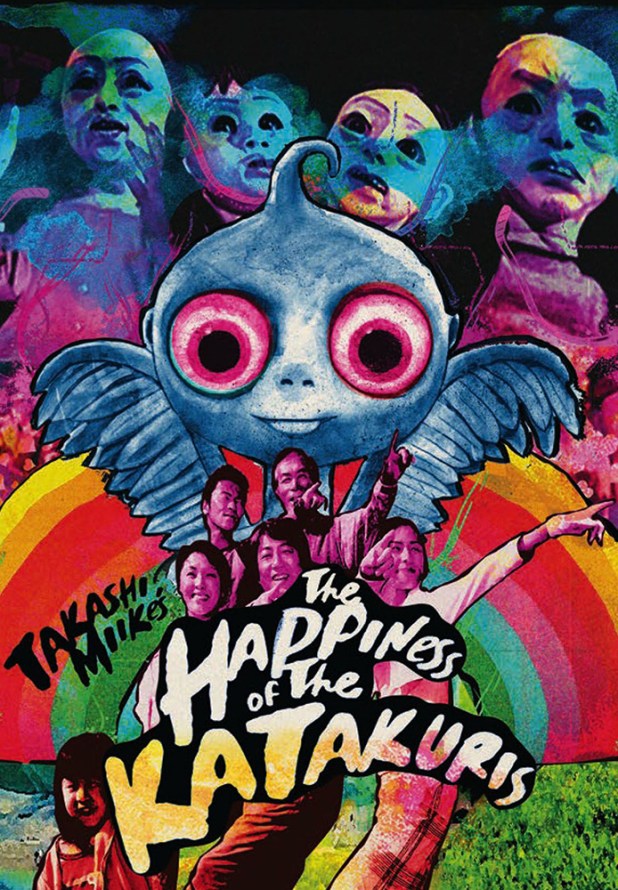
MESSED UP AND MUSICAL: The Happiness of the Katakuris (2001)

Becca hates this movie. When I asked her for her review, the words stupid, boring and dumb were used. I asked why and she replied, “It’s just horrible.” Me? I loved it. As Paula Abdul sang, “Opposites attract.” Also, much like that song, I hate cigarettes and Becca likes to smoke!

All four generations of Katakuris live on a house built over a garbage dump near Mt. Fuji. It’s not much to write home about, but they dream of calling it the White Lover’s Inn, a bed and breakfast that will serve the visitors that the road that runs nearby is sure to bring.

Finally, after much waiting, a TV personality shows up and the family is overjoyed. Yet he soon kills himself and they find his naked body. So they do what any family would do: they bury it and move on. A second guest, a sumo wrestler, dies having sex with his underage girlfriend.

In fact, every guest they get dies, whether by accident or murder or suicide. And the backyard is filling up!

Oh yeah — there’s also a con man in love with the youngest daughter, the police investigating all these murders and an active volcano.

Takashi Miike (Dead or AliveBlade of the ImmortalVisitor Q) has directed everything from light-hearted children’s films to movies so controversial governments have stepped in to block them. Here, he creates a musical that combines Japanese pop, karaoke and traditional musicals to make one of the most legitimately bonkers films I’ve ever watched. The film can quickly turn into flashbacks or claymation at a moment’s notice, sometimes multiple times within the same scene.

The leader of the Katakuris, Masao, is played by Kenji Sawada, who was a crossover pop star at the end of the 1960’s. He was nicknamed Julie for his love of Julie Andrews. He’s one of only two Japanese artists to ever appear on the cover of Rolling Stone and even had Barry Gibb write songs for him!

Shizue’s boyfriend, the sailor who claims to be a British relative of Queen Elizabeth, is played by Kiyoshiro Imawano, who was known as Japan’s king of rock, even recording with Booker T & the M.G.’s. His funeral, dubbed The Aoyama Rock n’ Roll Show, drew 42,000 mourners.

The father, Jinpei, is Tetsurō Tamba, who was Tiger Tanaka in You Only Live Twice. And Naoto Takenaka, who plays a reporter, is the Japanese voice of Batman and Nick Fury.

This is a movie that demands to be experienced. From animated fairies ending up in people’s soup to heroic dogs that surf through lava, this is a demented version of The Sound of Music. Check out the trailer and see if it strikes your fancy, then you can watch this on Shudder. If you hate it, you can share your feelings with Becca.

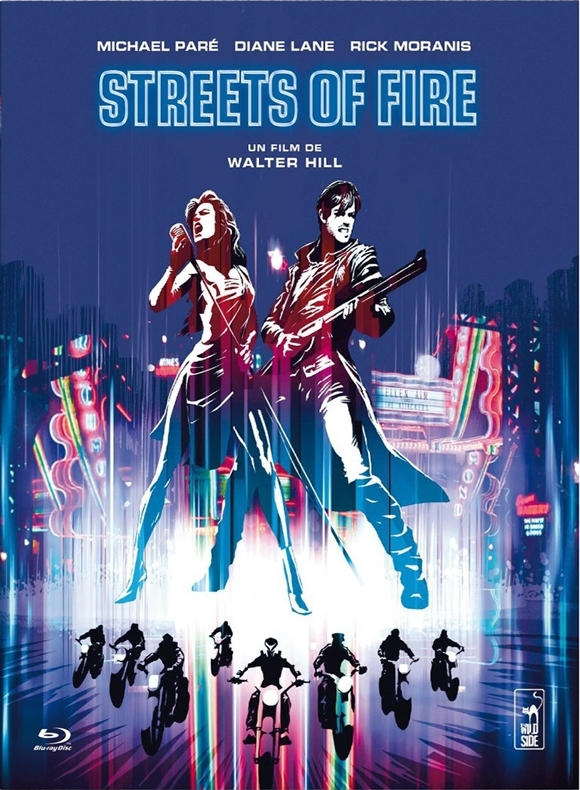
MESSED UP AND MUSICAL: Streets of Fire (1984)

Streets of Fire is no ordinary movie. It is, as the poster promises, “a rock ‘n roll fable.” It also feels like it comes from a reality unlike our own, a place of perpetual night, thanks to a majority of the film being shot on two large sets that were covered in a tarp 1,240 feet long by 220 feet wide. Outside of night shoots in Chicago, it’s basically a soundstage film, which adds to its otherworldly feel.

The Chicago in Streets of Fire is a world where it rains all the time, where neighborhoods have their own color palette and people speak in an exaggerated tough guy language that led Roger Ebert to say that this was the way “really mean guys would have talked in the late 1950s, only with a few words different — as if this world evolved a slightly different language.”

Director and writer Walter Hill (48 HoursThe Warriors) wanted to create a new action hero, something that felt like a comic book that wasn’t based on any existing character, the first in a new franchise of films about a character called The Stranger (who became known as Tom Cody). Oh yeah. It was also going to be a musical.

Hill’s vision was to create a film that had everything he loved as a teenager: “custom cars, kissing in the rain, neon, trains in the night, high-speed pursuit, rumbles, rock stars, motorcycles, jokes in tough situations, leather jackets and questions of honor.”

He had other rules: no one under the age of 30 and because he saw the film as a fairy tale, the violence was to be stylized. No one was to die.

After clashing with Paramount head Michael Eisner over the film feeling similar to an Indiana Jones film (no one would have that argument after seeing the final product), Hill sold the film to Universal. Named for the Bruce Springsteen song, you’d think that Bruce would be included on the soundtrack. Indeed, music is incredibly essential to the final film, so Meatloaf and Alice Cooper co-conspirator Jim Steinman came in to write the song that closes the film, “Tonight is What it Means to Be Young.” The song was so good — it was written in two days, believe it or not — that it led to a $1 million reshoot, as the film had the Springsteen song already shot as the ending.

Again, the final product is just strange. Co-writer Larry Gross (the writer of 48 HoursTrue Crime and Prozac Nation)  had a moment late in the production where he realized that “this movie is somewhat weirder than we thought.” He said the failure of the film was because “our commitment to be stylized was thorough and conscious and maybe too extreme for the mainstream audience.”

In another time, another place, in an unnamed city, rock star Ellen Aim (Diane Lane, known to today’s moviegoers as Martha Kent in the DC Comics movies) returns home to put on a show with her band, the Attackers. However, The Bombers, a motorcycle gang led by Raven Shaddock (Willem Dafoe, The Last Temptation of Christ, 2009’s Antichrist, not the one with the goat licking), kidnaps her.

Reva Cody (Deborah Van Valkenburgh, Mercy from The Warriors) hires her brother Tom (Michael Paré, The Philadelphia ExperimentEddie and the Cruisers) to rescue Ellen (who also happens to be his ex-girlfriend). He brings in McCoy (Amy Madigan, The Dark Half), a fellow ex-soldier who can drive anything. And Reva brings in Billy Fish (Rick Moranis, GhostbustersStrange Brew), Ellen’s manager and boyfriend.

What follows is stylized action with Cody and McCoy breaking into the gang’s base and rescuing Ellen, all while the rock star argues with Cody as to why he saved her. She thinks it was about money and he tells her that at one point in his life, he would have done anything to save her. But now, it’s all changed.

Finally, Cody decides to leave Ellen behind, as he can’t see a future where he can be what she needs him to be. He has a final battle with Raven, which he wins, and Raven is carried away by his gang. After one final goodbye, Cody and McCoy ride off into the neon, rain-soaked night. Basically, the movie ends like Casablanca.

Streets of Fire is packed with great minor characters that populate its strange world. EG Daily (Dottie in Pee Wee’s Big Adventure and the voice of Tommy Pickles on Rugrats) plays Baby Doll. Richard Lawson (Sugar HillPoltergeist and the stepfather of Beyoncé and Solange Knowles) plays a police officer who tries to keep Cody and Raven apart. Bill Paxton plays a bartender. And Lee Ving from Fear is even in the film (he also played Mr. Boddy in Clue, which is a great trivia question if you ever want to use it). There’s even a fake band, The Sorels, made up of actors Stoney Jackson, Grand Bush (Balrog in Street Fighter), Mykelti Williamson and comedian Robert Townsend.

You can see the influence of Streets of Fire in some interesting places, mainly in the video games and animation of Japan. Capcom’s Final Fight owes a big debt to the film. And the anime Bubblegum Crisis has featured musical sequences and songs that were taken almost 100% from the film. Here’s a great distillation of the Western influences that shaped that anime:

I can’t speak objectively about this movie. I love it. I love that it’s so completely off the rails, that it is not tied to our real world at all, that it’s a musical, that it appears to be based on something but it’s actually an original story. I remember watching it on VHS as a teenager and wishing that everyone in the film was a real person that I could spend more time getting to know.

There were plans to do two more Tom Cody films — The Far City and Cody’s Return, but the failure of the film ended those plans. However, Albert Pyun (The Sword and the SorcererDollman) directed 2008’s Road to Hell, an unofficial sequel that has Paré as Cody.

Shout! Factory has finally come to the rescue of everyone who wanted this on blu-ray and released what is the definitive version of the film. I suggest that you purchase it immediately, as I need more people to talk about this movie with!

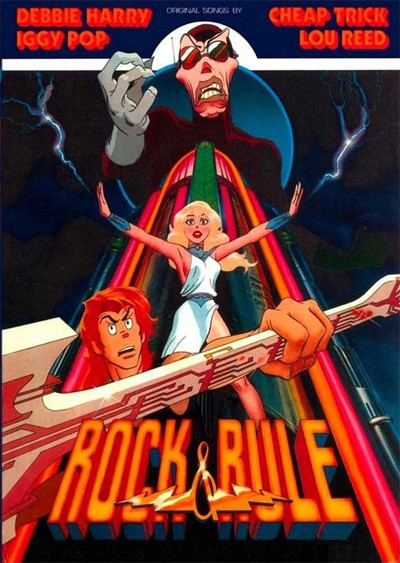
MESSED UP AND MUSICAL: Rock and Rule (1984)

Nelvana was a Canadian animation powerhouse in the 1980’s, producing the Boba Fett cartoon in the Star Wars Holiday Special, Droids, Ewoks and even the live action Whoopi Goldberg movie Burglar. Along the way, Nelvana’s franchises have been shown on over 360 television stations in more 180 countries, in approximately 50 languages. But their first major film was Rock and Rule.

Based heavily on their earlier animated film The Devil and Daniel Mouse, the film took five years to create and used up all of the studio’s resources thanks to its $8 million dollar budget. MGM never promoted the film and it quickly faded from the U.S. box office. If Nelvana hadn’t started working in kid-friendly TV, they would have gone out of business.

In 1983, a nuclear war destroys the human race and mutated street animals populate the Earth.Mok Swagger is a legendary rock musician (voiced by Don Francks, with Lou Reed and Iggy Pop singing his songs) who is hunting for a special voice that will allow him to release a demon. Why? Well, as he’s lost his fame, he just wants to set the world on fire.

Meanwhile, in a nightclub in Mok’s hometown, Ohmtown, Omar (Paul Le Mat voiced him with Robin Zander from Cheap Trick singing), Angel (Susan Roman voice, Debbie Harry singing), Dizzy and Stretch play a show in a small bar. Mok hears Angel sing and knows that he has finally found the voice that he’s been looking for.

Mok invites the band to his mansion outside of town, drugging the band and escaping with Angel. Taking her to Nuke York, he stages a magic ritual as a rock concert, we learn that only one voice, one heart and one song can stop the demon. Yet the evil rock star convinces Omar that Angel is willingly with him before capturing and torturing the band.

Will Omar get it together? Will Mok unleash a demon on the world? Will we get to hear songs by Cheap Trick, Earth Wind & Fire, Lou Reed, Iggy Pop and Debbie Harry? Yes. Maybe. Yes.

This isn’t a cartoon for kids. It’s packed with drugs, devil worship, some sex and swearing (there was more before MCA demanded cuts). They pretty much dumped the film with only a Night Flight mention and a Marvel tie-in comic. I remembered waiting for the film to come out and it never did.

The book is really gorgeous because instead of original art being created for the comic, it’s a fumetti style book that takes cel art and creates comic book layouts from it.

This film is like an 80’s rock and roll version of The AppleThere’s a musical couple that is torn apart by evil big business, but way less camel toe — ironic as many of the creatures in the film look like humanoid dromedaries.

The animation is pretty interesting as well, looking Bakshi-like (indeed, Ralph Bakshi is often credited as the director of this, but Clive A. Smith in the true person behind the film). Even though production started as early as 1978, it really reflects the MTV style of the 80’s. It compares favorably with a more well-known animated film from Canada, Heavy Metal.

Rock and Rule played on HBO and Showtime in the U.S., never showing in theaters. It wasn’t released officially on video until 2005 and a new blu-ray from Unearthed Films was released in 2010.

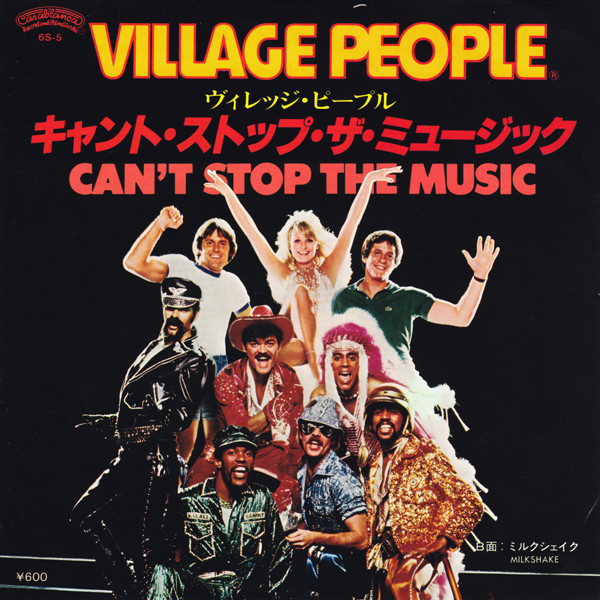
MESSED UP AND MUSICAL: Can’t Stop the Music (1980)

This movie — and Xandau — are why the Razzies exist, awards that celebrate the worst in movies. It’s the only movie that Nancy Walker — Rhoda’s mom and the Bounty paper towel lady — ever directed. It’s Bruce Jenner’s film debut. And I don’t care what anyone says, I love it in spite of everything bad you can say about it.

You can see why the movie happened. Producer Allan Carr was riding high off the success of Grease. Disco had finally hit the mainstream with Saturday Night Fever. And there was probably so much coke going around that everyone had a constant nasal drip. The time was ripe for what people had been clamoring for: the origin story of the Village People.

Wait — what?

The Village People — you probably know the words to YMCA — were created by Jacques Morali and Henri Belolo. While in New York, Morali attended a costume ball at the Greenwich Village gay disco “Les Mouches.” There, he was taken by all of the macho male stereotypes that he saw in the room and thought — this could be a music act, with each member being a different gay fantasy. Soon, they were signed to Casablanca Records, where their songs “San Francisco (You Got Me),” “Macho Man” and “In the Navy” played in clubs all over the world.

The truth is that the Village People were all one person at first: Victor Willis. Once the album became a hit, Morali and Belolo quickly put out an ad that said: “Macho Types Wanted: Must Dance And Have A Moustache.” From that big success to the time this movie was ready to come out, disco was just about dead, a fact that Carr had foreseen, changing the title from the original Discoland–Where The Music Never Ends! 

So what’s it really all about? Jack Morell (Steve Guttenberg, Police Academy) — named for Jacques Morali, of course — wants to be a composer. But for now, he’s DJing at Saddle Tramps, a disco. His roommate, Samanta Simpson (Valerie Perrine, Superman) is a newly retired supermodel. He writes her a song and everyone loves it, so she uses all of her connections to get him a deal. Her ex-boyfriend Steve Waits of Marrakech Records — get it, Casablanca Records? — wants her back, so he agrees to listen to a demo.

However, Jack’s vocals pretty much suck. So she recruits all of her fabulous friends, like waiter Felipe Rose — the Indian! And model David “Scar” Hodo — the Construction Worker! Randy Jones needs dinner, so he joins up as the Cowboy! We almost have formed Voltron…I mean, the Village People!

We’re treated to a solo song by David the Construction Worker called “I Love You to Death” where he fantasizes about all of the women who will be chasing him once he’s popular. When this scene played in San Francisco, supposedly movie screens were decimated with eggs.

Meanwhile, Samantha’s former agent (Tammy Grimes, who is one of the commercial stars in The Stuff) wants her back in the modeling business and orders her secretary Lulu to make it happen. Somehow, Ron White (Jenner), a tax lawyer, gets mugged on his way to delivering a cake to Sam’s sister, but then Lulu gives Jack drugs, then Ray Simpson — the Cop! — shows up and the four sing the song “Magic Night.” It’s all too much for Ron, who runs away.

The next day, Ron and Sam get back together and hook up. Now that he has a reason to help, he offers his office for further auditions, where we meet Glenn Hughes — the Leatherman! — and Alex Briley — the G.I.! — who finally form the full version of the group. Blink and you’ll miss W.A.S.P. frontman Blackie Lawless trying out! Finally, Ron’s boss Richard says (Russell Nype, who is also in The Stuff) that their company shouldn’t have anything to do with the group, so Ron quits the firm.

The band then goes to the YMCA to rehearse, which leads to a musical number for the song of the same name. If you’re looking to see plenty of naked men in a PG movie, well, here you go! I won’t judge! Marrakech offers too little money for their contract, so the gang decides to throw a party to raise some funds.

Seriously: this is the most raw dong I have ever seen in a non-porno movie.

Samantha agrees to model again for a milk commercial, as long as the Village People can be there, too. The TV spot — with six small boys dressed as the band — starts with Samantha pouring them milk and turning into the song “Milkshake.” Of course, the milk company balks at this. I’ve been in advertising for some time. I can only imagine the meeting where they showed this video to them and the blank stares turning into faces filled with pure rage.

Norma White (Barbara Rush, It Came From Outer Space) decides to help and invites the guys to be part of her fundraiser. Sam lures Steve to the show by suggesting they can canoodle, so Ron dumps her. Meanwhile, on Steve’s jet, Jack and his mother Helen (June Havoc, sister of Gypsy Rose Lee!) win the record company owner over and the Village People are signed!

Everything works out just fine. Ron and Sam get back together. He gets his old job offered back. And following a song by Morali’s other band The Richie Family, the Village People finally unite for “Can’t Stop the Music.”

If only reality had been so kind. After all, the infamous Disco Demolition Night in Chicago, the evening most people claim was the death knell for disco in the United States, happened two weeks into filming.

Even with a TV special — Allan Carr’s Magic Night — featuring Hugh Hefner and Cher, along with a new Village People song Ready for the 80’s! that was cut from the film, it was to prime America for a movie that by the time it was filmed no one really wanted to see.

Oh man, the lyrics to that song:

I’m ready for the eighties things look positive
I’m ready and I’ve got a lot of love to give
There’s hope in every heart and love on ev’ey face
The eighties promise everything is just gonna be great

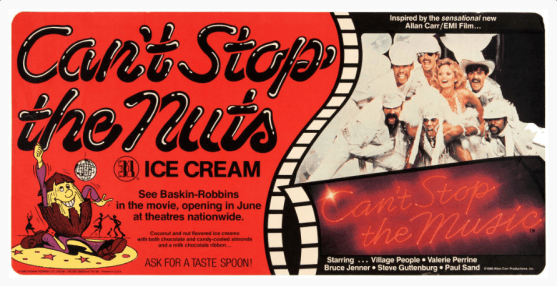
But hey — Baskin Robbins had a flavor made for the film. Can’t Stop the Nuts was offered for the whole summer of 1980. Think I made this up? Nope. I have evidence.

It’s also one of the first appearances of Ray Simpson as the Policeman. The previously mentioned Victor Willis, the original lead singer, quit the group during pre-production. Turns out he wanted to let everyone know he was the straightman of the group and had insisted that his wife, the soon to be divorced and renamed Phylicia Rashad, be written into the film as his girlfriend. Her role in the film ended up being played by Sammy Davis Jr.’s wife Altovise Davis.

Even crazier was that filming in New York was constantly delayed by protestors who were upset about the film Cruising. Many of them thought that this film was that film, so they protested against the wrong movie!

The film failed. Disco died. But why are we talking about this all thirty-some years later? Simple: disco never really went away. And neither did the Village People. Victor Willis is even back in the group, after years of fighting. Sure, there are two different Village People bands touring. But people love them. They’re a part of our culture, even if this movie is pretty much forgotten (outside of Australia, where it’s a New Year’s Eve tradition).

If you want to see it for yourself, Amazon Prime has it for your viewing pleasure. I also want to inform you for some reason this movie is 2 hours and 3 minutes long. I have no idea why it has to be so long. Plan your evening accordingly.

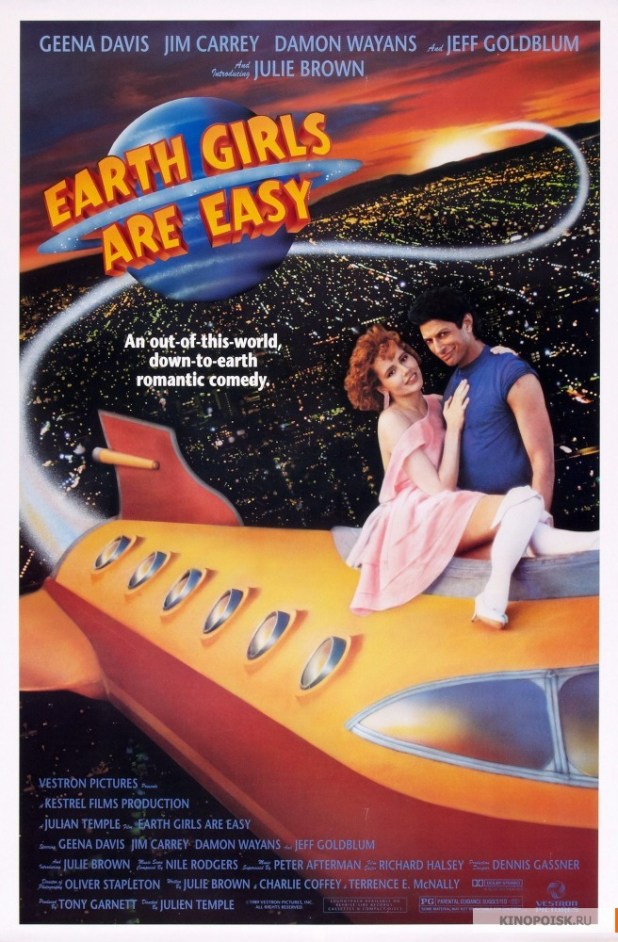
MESSED UP AND MUSICAL: Earth Girls Are Easy (1988)

In the 90’s, there were two Julie Browns on one channel. MTV. One was the wubba wubba wubba fashionista. The other was a wild redhead who sang songs like “Homecoming Queen’s Got a Gun.” One guess which one we preferred?

Written by Brown (along with frequent collaborator Charlie Coffey and Terrence McNally) and directed by Julian Temple (a groundbreaking video director who also was in the chair for The Great Rock ‘n Roll Swindle with the Sex Pistols and Absolute Beginners), this movie was a troubled production, with over five months of post-production that led to several scenes and even an entire production number being removed. Due to the De Laurentiis Entertainment Group going out of business, the film went unscreened for over a year.

Three aliens — Mac (Jeff Goldblum, Jurassic Park), Zeebo (Damon Wayans, The Last Boy Scout) and Wiploc (Jim Carrey, Man in the Moon) notice a broadcast from Earth filled with aerobics and half-naked women. They follow the signal to Earth and the home of Valerie (Geena Davis, The Long Kiss Goodnight), a manicurist who has lost her fiance, Ted (Charles Rocket, who famously said fuck on Saturday Night Live in an era where that would ruin your career). The aliens crash land in Valerie’s pool and when she investigates, she smacks her head against the UFO.

Mac decides to miniaturize her and bring her inside the ship. Why is the ship miniaturized? I’ve wondered the answer to this question for decades. The aliens quickly assimilate Earth culture via TV and get a makeover from Valerie’s best friend Candy (Brown), then go to a nightclub where Mac and Valerie fall in love and Deebo has a long dance battle that defies any description that I can write

Valerie and Mac make love while Zeebo and Wiploc go to the beach with pool boy Woody (Michael McKean, This is Spinal Tap). Through some miscommunication, they end up robbing a convenience store and get arrested, along with Mac and Valerie, who have come to rescue them.

The aliens are taken to Ted’s hospital, where he learns that they are aliens. Valerie and Mac convince him that he’s gone insane and take everyone back to her house, where the aliens prepare to leave for their home planet. Thinking that Mac has picked his home planet over her, Valerie plans on marrying Ted in Las Vegas. Of course, she soon realizes the error of her ways and goes into space to be with her true love.

The soundtrack is rich with the music of the 80’s: Hall & Oates, Information Society, the B-52’s, Depeche Mode, the Jesus and Mary Chain and several songs by Brown, including “Brand New Girl,” “Earth Girls Are Easy” and “Cause I’m a Blonde.”

This is a movie packed with fun. It’s the kind of future that the 50’s thought that the 80’s would be. Throw in an appearance by the “patron saint of Los Angeles” Angelyne and you have a time capsule of the goofier side of MTV era pop culture.

BONUS: Frankenstein and Calamity Jane’s cars from Death Race 2000 and Robby the Robot make cameos in the film, as well as the lectroids from The Adventures of Buckaroo Banzai Across the Eighth Dimension!

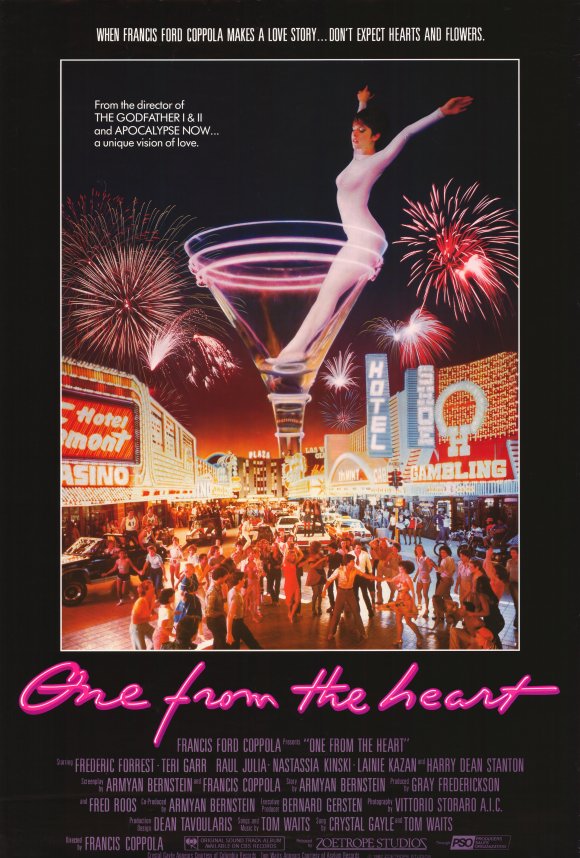
MESSED UP AND MUSICAL: One from the Heart (1981)

In his series, My Year of Flops, Nathan Rubin said, “It’s telling that when a filmmaker succeeds in running his own studio, it’s because he’s learned to let his inner businessman veto his inner artiste. Coppola ran Zoetrope with his heart. It nearly destroyed him.” One from the Heart wasn’t just director Francis Ford Coppola’s dream project. It was his way of saying to producers like Robert Evans, who Coppola famously warred with as he made The Godfather, “Hey. I don’t need you. I can control costs and production and make a movie all on my own.”

Somehow, One from the Heart went from a personal love story to a $28 million dollar epic. It went from a movie to a Quixotic odyssey. Or was that 1979’s Apocalypse Now, a film that went from Joseph Conrad cover version to a sprawling epic that nearly killed several of the people in its orbit? From typhoons to nervous breakdowns, actors getting replaced mid-production, Martin Sheen having a heart attack, Marlon Brando showing up out of shape and not ready to perform, Dennis Hopper high on drugs before disappearing for days in the jungle and so much more, the film was delayed and delayed and delayed. The director himself succinctly put it this way: “We were in the jungle, there were too many of us, we had access to too much money, too much equipment and little by little, we went insane.” Yet the movie that emerged was a classic.

Now that Coppola was making a movie on his own terms, the odds were higher than they’d ever been before. The film had to be a winner with the public’s hearts, minds and wallets.

Coppola wanted to create something that he called Electric Cinema (I’ve also heard it called Live Cinema). There would be long takes, performances that felt like they belonged on the theater stage and cameras that would shoot from every angle to ensure coverage so that Coppola’s editing team could craft magic from the wealth of available film. This technique — which involves modern video editing years before it was used or even feasible — isn’t something that Coppola has given up on. He was part of what is said to be “an ambitious “Distant Vision” project as a “live cinema” experiment at his alma mater, the UCLA School of Theater, Film and Television” in 2016 and published a book, Live Cinema and Its Techniques, in 2017.

Roger Ebert stated in his January 1, 1982 review, “Everybody knows that Coppola used experimental video equipment to view and edit his movie, sealing himself into a trailer jammed with electronic gear* so that he could see on TV what the camera operator was seeing through the lens. Of course, the film itself was photographed on the same old celluloid that the movies have been using forever; Coppola used TV primarily as a device to speed up the process of viewing each shot and trying out various editing combinations.” In short, Coppola did exactly what every modern production does today, particularly commercial shoots, using a more advanced version of the Video Assist that Jerry Lewis claimed to have invented (in truth, Jim Songer was the patent holder, read more in this fascinating article).

What emerged is a film that is just as much theater as it is a movie as it is live TV. It begins and ends with a curtain. And what is in-between is a mix between heartfelt passion and pure cinematic gloss. Everything that can be neon will be — even the names of the cast and crew. Yet the story that is told is between two people and could happen to anyone.

This isn’t the real Las Vegas, though. This is the Vegas of movies, of dreams, of what Vegas feels like but can’t be. It’s a world where the music of Crystal Gayle and Tom Waits provide their voices, as the film becomes a musical. Kind of. Sort of.

Hank (Frederic Forrest, The RoseApocalypse Now) and Frannie (Teri Garr, Close Encounters of the Third KindYoung Frankenstein) are a couple who’ve been together too long. Five years too long. They’re sick of one another, they’ve left another one too many times and now, this is the end of their story.

They spend their fifth anniversary with their dream lovers. Hank falls for Leila, who is youth and beauty and pure sex (it’s no accident that Nastassja Kinski plays her). Frannie picks the dark, handsome and mysterious Ray (Raul Julia, who I really don’t want to say is also in Street Fighter, but he was), a man who will give her what she always wanted: he will sing to her.

It’s not enough for Hank, who tracks down Frannie and tells her that he loves her, but she refuses his advances. He even follows her to the airport, where she is due for Bora Bora with her new lover, ready to leave reality behind for a life of idyllic passion. He tries to sing to her in his cracked voice but leaves in tears.

Back in their broken home, he’s lost, but she comes home to him, realizing that they are meant to be together.

My question is, “Why?” The film never shows us why the real world is better than a dream. Would you choose a ramshackle house and a life of arguments over dancing with Julia or a neon sign graveyard with Kinski gyrating against a Technicolor sky? No. You wouldn’t.

That’s my main issue with One from the Heart. Its heart seems in the wrong place, that these two mismatched souls belong together when the film repeatedly shows us that no, they belong with their fantasies.

Another nod to the stage is that the film features understudies, including Rebecca De Mornay. I’d also be remiss if I didn’t call out one of the best parts of the film — Harry Dean Stanton, who elevates every single piece of film he ever wandered into. Here, he’s the owner of the neon graveyard.

What amazes me is that Coppola would try to direct another musical, particularly after his work on 1968’s Finian’s Rainbow led many in Hollywood to brand him as someone who was hard to work with and hard to keep on budget. Again, I turn to the superior words of Nathan Rabin, who had this to say about the film: “As Coppola tells it on Finian’s Rainbow‘s shockingly candid audio commentary, he was the wrong man for the job in every conceivable way. Coppola fancied himself a New Wave-style auteur. Warner Bros saw him as a cheap gun-for-hire.”

While One to the Heart was intended as a small follow-up to Apocalypse Now, obviously things didn’t turn out that way. For Coppola, it meant going back to the studio system. Every movie he made for almost two decades — The OutsidersThe Godfather: Part IIIJackThe Rainmaker and even a return to working with Robert Evans (this one’s a whole other tale in and out of itself) on The Cotton Club was all to pay back the debts from this film.

Should you see it? You better after I wrote over 1,200 words about it! But seriously, the color palette of this film is something you won’t see outside of Suspiria. It’s a music video in an era where that art form was still growing. And it informs later works like Bram Stoker’s Dracula, which is even more overt in its reference to the works of Mario Bava than simply loving his brighter color choices. And if you watch this on DVD, you even get the choice to simply watch the musical numbers, which may improve on the film for some.

*Indeed, Coppola would direct a lot of the film from “The Silver Fish, a mobile HQ, fully equipped with a kitchenette, espresso machine and onboard Jacuzzi,” which had a loudspeaker that he could issue orders from. Insane. And by insane, I mean brilliance.