I’m not so sure I’d be friends with Al Bailey. Or if I was, I wouldn’t let him direct a documentary about my life. Or I’d at least not be a maniac like his airline pilor Christian.
Then again, I’m not an airline pilot constantly criss crossing the globe using Tinder to find new people to sleep with. I’m just a guy who likes to watch Spanish werewolf movies.
Over a year and a half, Al and Christian — a widowed airline pilot — meet up in various cities and countries in the pursuit of love for one night or at least a good buzz. This also puts their friendship to the test, which you’d think will probably not survive the pilot seeing this film.
That’s because while the materials for this film describe at as a quest for love, Christian succumbs — more than once — to the lure of easy sex and gradually becomes someone that the director no longer seems to like all that much. In fact, Al seems like he doesn’t even want to be part of his own film at times.
Things get worse after a trip to San Francisco and beyond the point of no return in Vegas, where Christian buys sex toys and even rubs a used one into the director’s face after drugging him at a club. Honestly, I started to wonder if the film was staged way before this point and I’m honestly not sure that it wasn’t. The punch up at the Denver Airport makes me think that either this is the best real footage ever captured or a really good version of a mockumentary.
I think you should honestly check it out for yourself. It’s not an easy watch, but I feel like no good documentary ever is.
DTFwill premiere at LA’s Dances With Films before being able to rent or own on September 15 on Amazon, iTunes, Comcast, Spectrum, Vudu and more. Thanks to its PR company for sending it our way.
Boy Howdy! Another rock-doc about Detroit? We’re still coming down from the high of Detroit’s Suzi Quatro’s career chronicle with the Australian-made Suzi Q. And how can we forget Louder Than Love, the chronicle on Detroit’s famed The Grande Ballroom?
Before the D.I.Y punk ethos of Britain in the late ’70s, that D.I.Y spirit began in the late ’60s with a staff of overworked and underpaid writers, editors, and photographers back by a mascot—Boy Howdy—a faux beer label designed by Robert Crumb, the underground comic book artist behind Fritz the Cat. (Crumb’s life and career is preserved in 1995’s Crumb; you can see Crumb characterized on film by James Urbaniak in 2003’s American Splendor.)
Originally known as Boy Howdy: The Story of CREEM Magazine, this Scott Crawford-directed rock doc chronicles the seminal music magazine from its 1969 launch in Detroit to the untimely death of its publisher Barry Kramer in 1981—and to the magazine’s 1989 demise. And the tale began in a ramshackle office in a burnt-out building in 1967 post-riot Detroit (when it ended: 43 people were dead, 342 injured, nearly 1,400 buildings had been burned and 7,000-plus National Guard and U.S. Army troops had been called into service) as the underground, counterculture newspaper rose to national prominence to go head-to-head with the “sellout” rock publication, Rolling Stone magazine. CREEM covered the bands the mainstream press dared to touch and gave said bands their first national coverage.
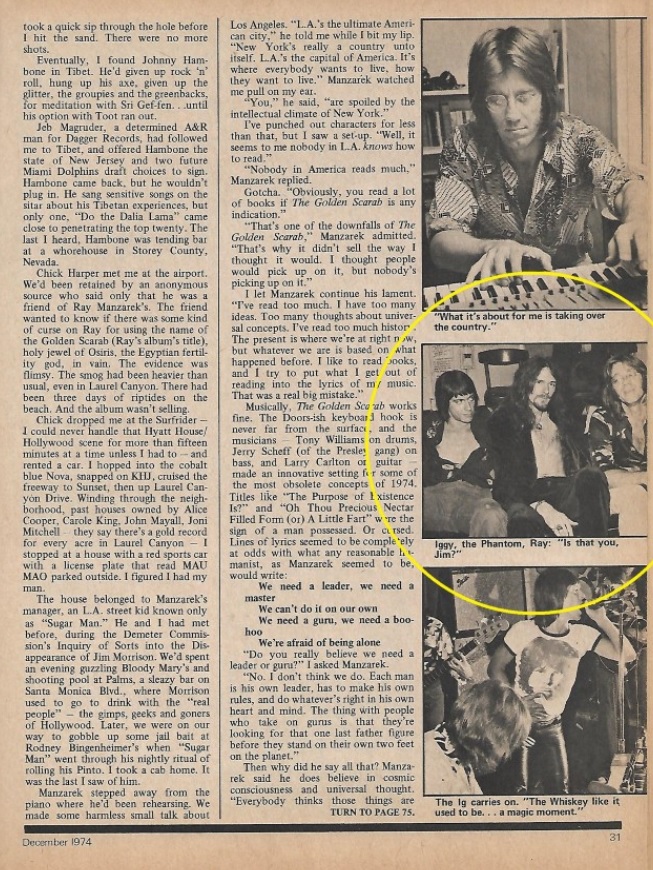
December 1974 issue of CREEM featuring Iggy Pop and Ray Manzarek with Jim Morrison’s fabled “ghost,” the Phantom.
While we get to see archive footage of the iconic Lester Bangs (portrayed on film by Philip Seymour Hoffman in 2000’s Almost Famous; Patrick Fugit was Cameron Crowe), along with those in the CREEM bunker and Detroit trenches with writers Crowe and Dave Marsh, along with Alice Cooper, Wayne Kramer of the MC 5, and Suzi Quatro—as any film on Detroit should—we get a little bit too much of the impressions and “what CREEM meant to me” insights from its musician-readers, such as Thurston Moore of Sonic Youth, Pearl Jam’s Jeff Ament, Chad Smith from the Red Hot Chilli Peppers, Metallica’s Kirk Hammett, Chris Stein of Blondie, and the J.Geils Band’s Peter Wolf.
Sure, those musicians played shows in Detroit and the magazine supported their early careers, but the film needed a little less of them and more from the Detroiters—regardless of their obscurity or lack of national fame—in the proceedings. Gene Simmons and Paul Stanley of KISS also offer their insights; however, not only was Detroit a major tour stop for—and early supporter of—the band, Simmons was a part of the “scene” as result of his clandestine recording sessions at Detroit’s Fiddlers Music with that studio’s engineer, Scott Strawbridge. (Scott Strawbridge discusses his Detroit reflections in the Medium article “Happy Dragons, Phantoms, Fiddlers, Rockets, and Spliffs: The Career of Scott Strawbridge.”) And do we really have to mention that KISS song?
While some of the Detroit scenesters I’ve spoken with from back in the day have their passionate qualms about the film, as to whom was in the film and who wasn’t, it’s my feeling those omissions are the result of the unavailability (and sadly, deaths) of those individuals and not cinematic ineptitude—not when one considers the filmmaking pedigree behind the film. Plus, I’d have to add: Clevelanders I know—who were close friends with the late Stiv Bators—were none too happy with Stiv (2019), the document on the late Dead Boys’ singer; in fact, MTV’s Martha Quinn, who dated Stiv Bators in the ’80s, was absent from the film.
And so it goes . . . you can’t please everyone when it comes to rock docs. There’s always going to be detractors who feel the film is “incomplete,” one way or another.
Screenwriter Jaan Uhelszki, an American music journalist who was the co-founder of CREEM, was one of the first women to work in rock journalism. Uhelszki’s August 1975 feature article, “I Dreamed I Was Onstage with KISS in My Maidenform Bra,” documents the night she performed in full costume and makeup with KISS—the only rock journalist ever to do so. She also traveled with Lynyrd Skynyrd for a feature article about their second-to-last tour (be sure to check out our review of the 2020 Lynyrd Skynyrd bio flick Street Survivors). And I’d have to point out: Jaan Uhelszki was born and raised in Detroit and worked as a “Coke Girl” selling sodas at The Grande Ballroom—yet, she does not appear in the documentary Louder Than Love about the Grande. (FYI: Suzi Quatro also started out as a “Coke Girl” at Detroit’s Hideout Ballrooms operated by Bob Seger’s manager, Punch Andrews.)
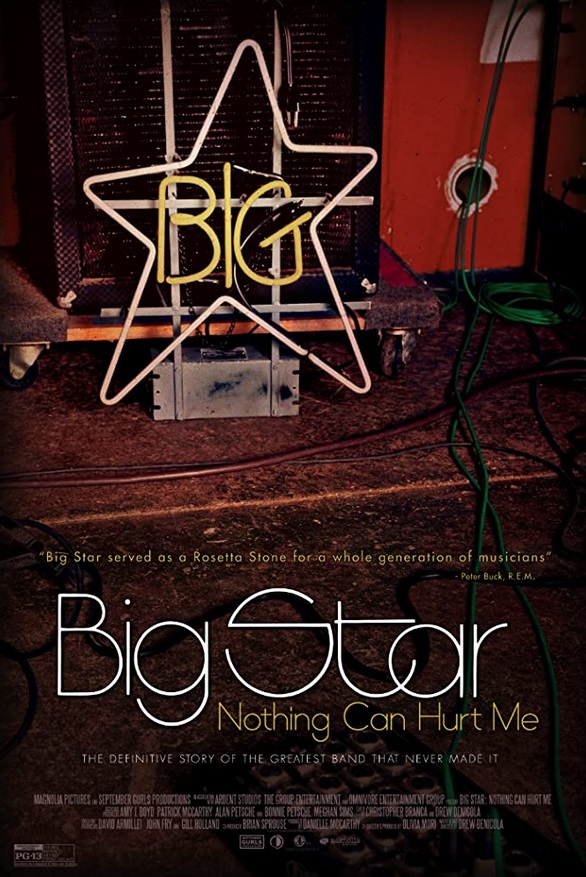
You’ve seen Jaan Uhelszki’s film work before with the absolutely stellar documentary about the tragic, unsung career of Chris Bell, along with Alex Chilton, with Big Star: Nothing Can Hurt Me (2012). (You can catch the film as a free-with-ads stream on TubiTV.) You can spend more time with Jaan and look through her photo archives at her personal website.
Director Scott Crawford made his feature film debut with the worldwide, critically-acclaimed document, Salad Days: A Decade of Punk in Washington, DC 1980-90. If you’re a fan of Bad Brains, Minor Threat (Ian McKay of Another State of Mind), and Scream (Dave Grohl’s band before Nirvana), then that film is a must watch. Crawford grew up in the Washington, D.C. area and published his own CREEM-inspired ‘zine in his teen years; he understands the mid-western D.I.Y ethos that also drove the punk scene of his hometown.
This is a truly great, American Rock ‘n’ Roll Movie about America’s Only Rock ‘n’ Roll Magazine. Watch it.
You can learn more at the film’s official website and you can stream it at Amazon Prime, You Tube Movies, and other VOD platforms. For the hardcopy version, you can check out CREEM writer Robert Matheu’s 2007 book of the same name, available on Amazon.
Update: As of November 24, throughout the U.S. and Canada, you can purchase the DVD of CREEM: America’s Only Rock ‘n’ Roll Magazine through Kino Lorber. You can learn more about Kino Lorber’s complete roster of films at their official website and Facebook, and watch the related film trailers on You Tube.
From the Shamless Plugs Department: Since we’re on the subject of Detroit rock ‘n’ roll and honoring those fading memories of the musicians and the times: I wrote two books about the 1974, Detroit-born mystery and myth of Jim Morrison’s etheral doppelganger, The Phantom—with the books The Ghost of Jim Morrison, The Phantom of Detroit, and the Fates of Rock and Tales from a Wizard: The Oral History of Walpurgis. Both books are available worldwide through all online retailers for all eReader platforms, and as Amazon-exclusive softcovers.
About the Author: You can learn more about the writings of R.D Francis on Facebook.He also writes for B&S About Moviesand publishes on Medium.
If you’re a frequent visitor to B&S About Movies, you know of my admiration for Law and Order: TOS and SVU. However, while expertly produced and acted, my precious exploits of Captain Olivia Benson and her squad (and Blue Bloods, I think) sometimes falls back on the ol’ the-car-won’t start-at-the-most-inopportune-moment trope of the ol’ our-security-cameras-haven’t-worked-in-months-and-our-bosses-are-too-cheap-to-fix-‘em trope.
But guess what?
It’s not a screenwriting trope. I’ve witnessed four incidents during my 9 to 5 lifetime where crimes-incidents (yes, people do spike coffee pots and icepick tires and key paint and steal food and spread icky-sticky things around and go into cubicle “smack down” mode) occurred in my workplace—and the cameras were broke. And yes, back in the pre-digital epoch when VCRs interfaced with those cameras—the VHS tapes really were “taped over” every 24 to 48 hours. And security cameras really are the new “digital mailboxes,” as wayward teens like to either—due to a lack of a “canvas” to craft an epithet on—spray paint the lenses or give ‘em a whack with a baseball bat, you know, for fun. Those rascally scamps.
Courtesy of digital technologies and through constant hardware miniaturization upgrades, security cameras—that you don’t know are there and everywhere—are recording everything. And if there’s not a camera to capture our societal faux pas, someone is at the smartphone-ready—recording everything. Then there are those high-tech-toys-not-meant-for-boys drones that, as with any piece of technology, are a benefit to man in the right hands—and a nefarious tool in bad hands. And if those technologies aren’t capturing us in an innocent Ridiculousness moment, the digital ethers chronicle our not-so-innocent-moments; ubiquitous technologies that leads to nary the pass of a day that our local and national news or browser portal feeds go without a newsworthy event or crime—thought private—that becomes our “forever” moment. . . .
A young office worker is thrust into that world of false security set forth by those omnipresent cameras capturing our forever moments—cameras that really are sometimes malfunctioning or vandalized and never repaired by our bottom-line employers. And if you’ve worked odd-ball hours in the big city, then you’ve experienced the reasonable fears of those remote, concrete wildernesses known as a parking garage. . . .
And, for this young office drone, that broken security camera in that desolate parking garage becomes a catalyst: her life is about to change . . . but is it for the better . . . or the worst?
Spoiler Alert: Watch the short, now, in its entirety, before scrolling onward.
Prior to watching and reviewing this debut work by Austin, Texas-based writer and director Travis White, I wrote an upcoming review for our October “All Slasher-All Horror Month” for Thom Eberhardt’s (Night of the Comet) horror-thriller Naked Fear (2007)—a film that concerns a woman’s emotional breakdown and catharsis at the nefarious hands of others.
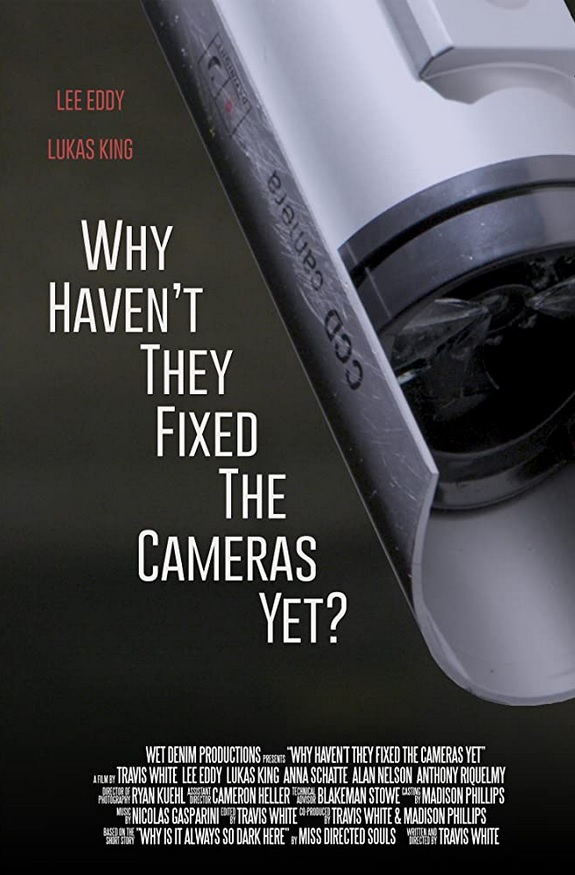
The reason for my critical analogy of these two decade-apart films is that I see the possibilities of White’s short film—which is exactly what a short film is supposed to do: leave you wanting more; to serve as a visual business card to pitch a feature film development deal.
I’m not privy to reading “Why Is It Always So Dark Here?,” the short story on which this film is based, but I look forward to learning about this office worker’s exploits that—considering Thom Eberhardt’s work with the great Sir Michael Caine (1988’s Without a Clue)—remind of one of my favorite films starring Sir Michael: A Shock to the System (1990). In that film, the accidental death of a hated co-worker at Caine’s hands starts off an anti-hero murder-to-right-the-wrongs-and-for-workplace-advancement chain of events.
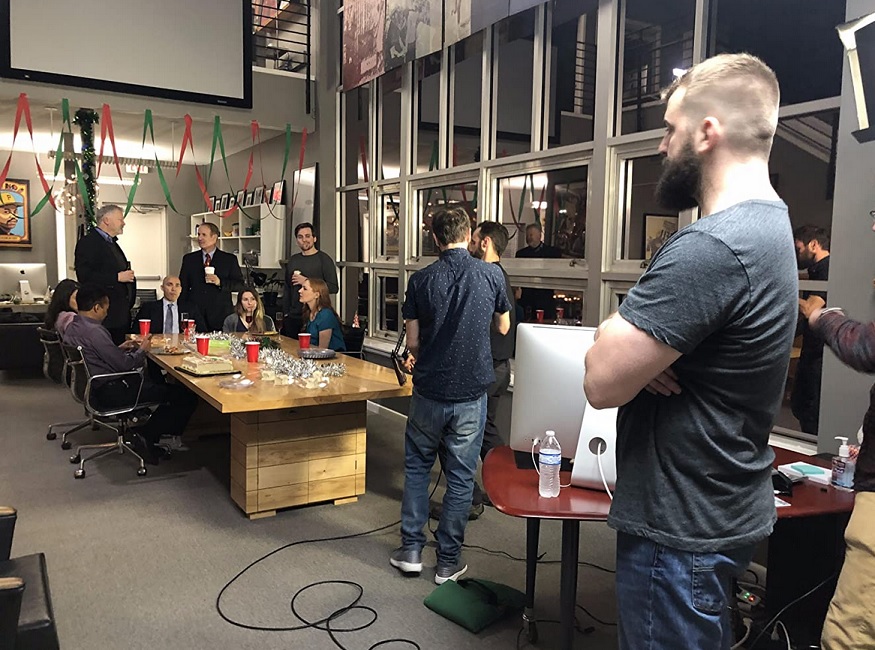
Office Parties: I hate people, but love gatherings. Isn’t it ironic?/courtesy of Wet Demin Productions
You can watch the complete film—and other productions—courtesy of Wet Demin Production’s You Tube page. And, in a special treat, we have an opportunity to share the film’s storyboards completed by writer-director Travis White. As you can see, no matter how long or short the film, an incredible amount of thought, time, effort, and planning goes into a film. It’s not about the length. It’s always about the content. Always.
If this is what Travis White (and producer Madison Phillips) can do in less than five minutes with his debut work, then we’re looking forward to see what he can do with his future works. In fact, he’s currently in the pre-production stages of his next short-narrative, Man Seeking Man (beware of those who ask for “favors”), which will see release in 2021. And you’ll hear about it first, at B&S About Movies.
And bigger things are on the horizon for actress Lee Eddy, here as the nameless office worker. She’s currently in pre-production on Richard Linklater’s (Dazed and Confused, School of Rock) Apollo 10 1/2: A Space Age Adventure, a coming-of-age story set in the suburbs of Houston, Texas, in the summer of 1969, centered on the historic Apollo 11 moon landing. That film stars Zachary Levi (Thor: Ragnarok and Shazam!) and Jack Black (Jumanji: The Next Level). Eddy’s husband, Macon Blair, won the U.S. Dramatic Competition Grand Jury Prize at the 2017 Sundance Film Festival for the Netflix-released I Don’t Feel at Home in This World Anymore. Fans of Scratch Acid and Jesus Lizard may want to check out the film (it’s great, by the way) as it co-stars lead vocalist David Yow (Under the Silver Lake).
Disclaimer: We were provided a screener by the film’s public relations firm. That has no bearing on our review.
About the Author: You can learn more about the writings of R.D Francis on Facebook.He also writes for B&S About Moviesand publishes on Medium.
“Uh, Mr. and Mrs. Yates? How do you like your hedges trimmed?” “I don’t know. Darling, do you like your bush, square or round?” —Mr. Yates multitasking ‘breakfast sex’ and getting rid of Daryl the groundkeeper
For most people residing in the wilds of Arizona (Pinnacle Peak outside of Phoenix/Mesa), when a mountain lion wakes them from a poolside nap . . . well, I know what “function” my body would do. Then there’s Phillip Penza. The beastly encounter inspired him to make a movie: he started to think about the “safety” of the pool; that jumping in the water—if the lion had charged, instead of running off—would have saved his life.
Now, as we’ve said many times before at B&S About Movies: when it comes to the low-budget films that cross our transom, it’s all about the cast that makes us hit that big red streaming button. And in this case, it wasn’t the ubiquitous Eric Roberts—it was Lorenzo Lamas, aka Reno Raines from our beloved 1992 to 1997 syndicated series Renegade (I never missed it!). Lamas currently resides in Arizona and previous worked on Penza’s debut film, My Name is Nobody (2014), along with the just-released (to Amazon Prime) vampire romp, Real Blood: The True Beginning. (Penza’s other films are 2016’s Movie Madness, and 2019’s Fire and Rain.)
We won’t sugar coat: the IMDb and Amazon streamingverse hasn’t been kind to Penza’s third (out of five) film. But again, like we always say here at B&S About Movies: you have to cut generous slack for the filmmakers and actors in the indieverse and view their films through a less judgmental set of eyes. Acting faux pas are par for the course. There’s going to be directorial, cinematography, and editorial stumbles. But there’s bad acting and filmmaking: then there’s filmmakers that are trying. And in the case of Phillip Penza and his crew and cast of unknown, Phoenix-based filmmakers, they’re pleasantly gallant in their efforts.
And Penza certainly knows his way around a script (the well-written line, noted above, spoken by Mr. Yates, himself a successful screenwriter, brought on a laugh-out loud moment). At first, it looks as if we have ourselves a low-budget desert noir of the old ‘90s USA Network variety (back when that channel produced original content before becoming an aftermarket shill for NBC-TV series), with the Yates—the home’s new residents—suffering a violent, home-invasions fate brought on by the home’s previous residents.
Then it veers off course.
When we meet Frank (Lorenzo Lamas), a well-off psychiatrist (They’re always more “defective” than their patients, aren’t they?) with a private, home-based practice inside his desert-mansion spread, he’s in the midst of a poolside tryst with his wife’s best friend—who’s returned early from a business trip. The ensuing knife fight results in Frank drowning his wife—and his lover urging him to “chop up the body and burn her in the outdoor fire pit.”
Yeah, Frankie knows how to pick ‘em. Good Headshinker. Good judge of character.
And Frank—who’s always in it for the nookie—does the deed. And guess who gets the next whack of the ax? Eh, you know how it is when your “disappeared” wife’s $11 million life insurance policy pays off—thanks to your buddy in the police department closing the case: there’s no sharesies for the side action in your life. Ah, but ol’ Frankie made one fatal mistake: he dumped his wife’s ashes in the pool. And she’s pissed off, rightfully so. Yep. This film noir just went supernatural on your ass with “killer water” spilling out of faucets and showers, less-than-forthcoming real estate agents, flickering lights, creaking chairs, missing Santeria priests, J-Horror Yūrei’s disappearing down sink drains, kids walking on water and talkin’ to disembodied playground swings—and one bitch-ass of a backyard pool (that dispatched Frank’s latest secretary-squeeze).
There’s been a lot of aquatic horror movies (we burned through some of that water-resume with our review of 2020’s Underwater); however, for the life of me, I can’t recall any films with “killer water” flowing through a home’s plumbing system. So, to that end: Phillip Penza certainly impressed me with a unique twist to the haunted house genre (which, again, I thought I was getting a neo-noir)—a house lost somewhere between Wes Craven’s “electrified spirit” serial killer romp, Shocker (1989) and the Bruce Dern-starring The Incredible Two-Headed Transplant(1971).
That latter film is recalled courtesy of Big Brody’s effective turn as Daryl Brown (also reminding of the late Michael Clarke Duncan of The Green Mile), the desert abode’s low intelligence-gentle giant that reminds of John Bloom’s heartfelt turn as Danny Norton in that early-70s AIP drive-in classic. But those are more than likely coincidental—and not direct, inspirational similarities—pulled from my personal, analog-film snob cortexes. But what we do get with Water is decent I-didn’t-think-this-was-going-this-way plot twists and a couple of eye-widening, noirish character-defective moments paired with atmospheric cinematography and genuinely creepy special effects.
In the end, the indie spirit of Phoenix, Arizona, is in Phillip Penza’s capable hands. So take a dip in his supernatural neo-noir, will ya? The water’s fine (sorry).
While you can watch Water ad-free on Amazon Prime for a very affordable price, it recently made its debut as a free-with-ads stream on TubiTv. You can learn more about Phillip Penza’s works at the official website and Facebook page of Little Book Films. Penza also discusses the making and release of Water in a radio interview posted on You Tube.
Oh, and speaking of Eric Roberts (The Arrangement and Lone Star Deception): there he is, again! The master thespian co-stars in Phillip Penza’s webseries Scrutiny, now streaming on Amazon Prime Video and Vimeo on Demand.
About the Author: You can learn more about the writings of R.D Francis on Facebook.He also writes for B&S About Moviesand publishes on Medium.
Disclaimer: We were not provided a screener nor received a review request from the filmmakers or their P.R firm. We discovered this film on our own and genuinely enjoyed movie.
If you haven’t noticed: I write a lot of reviews about films at B&S About Movies. And when I am not writing about movies, I’m talking about films—both in the fingering-digital and lipping-physical realms. There nothing quite like hanging out during a Groovy Doom Saturday Night Double Feature Watch Party (Ugh, more shameful plugs!) and chatting with the digital patrons or at a sports bar with your fellow actors and filmmakers, discuss-debating films and examining the industry (sorely missed during these COVID days)—while the Steelers dominate the gridiron, and the Pirates, the diamond.
The revamped streaming one-sheet
One of those discussions was in regards to attending movie theatres vs. streaming and, to that end, which streaming service: Hulu or Netflix. The general consensus: Hulu is the cut-out bargain bin of streamers; they’re the $5.00 impulse-buy barrel on the aisle sandwiched between the home goods and electronics section. Netflix is where people actually log-on to see a film. Yep. It’s the old My Space vs. Facebook and Facebook vs. Snapchat argument, again. Ugh!
And my buddy, Eric; he who despises all thing Seinfeldian (Oops, sorry Sam!) and minces no words when expressing his disdain for failures in the artistic realms, added this observation: “Why the frack is friggin’ Sarah Paulson always friggin’ ranting, bawling, and running around like madwoman in every movie?”
Eric’s also never heard of writer-director Aneesh Chaganty. But I have. And I really enjoyed his previous film, Searching. Chaganty’s adept at the Final Draft and framing the Canon Reds; therefore, I have no doubt that, with his skills as a filmmaker, in conjunction with the always-very-good Paulson as his lead actress (12 Years a Slave, TV’s Law & Order), I had a feeling Run was another worthy streamer on his behalf—regardless of the opinion that “Hulu is the dumping ground for projects studios have no faith in.”
Ah, but the studios do.
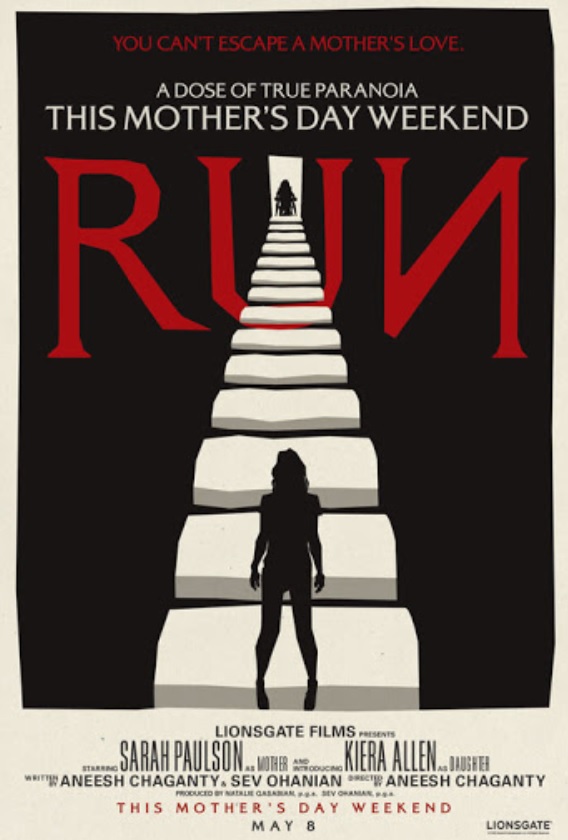
Lionsgate had Chaganty’s sophomore effort penciled for a national theatrical release three months ago, back on May 8. Then the pandemic hit and shut down the big theatre chains in March. And while the theatre chain operators are none too happy, the major studios are thankful that we’re living in the digital clouds of 2020; if the COVID virus hit in the Soylent Green-year of 1975, when there was no streaming . . . perish the thought. So, for reasons that aren’t of our middling consumer concerns: Lionsgate cut a deal—instead with Netflix—to stream on Hulu. In fact, another of Lionsgate’s films, the Janelle Monae-horror Antebellum, had its theatrical rollout axed for a September 18 digital premiere.
Even without a pandemic, the fact remains: the brick-and-mortar theatreverse is in a competitive battle—first with cable television, then with PPV, and now with streaming services. Today, theatre chains are all about tentpole-films and summer blockbusters. Those ‘90s-halcyon days of driving to an outside-of-the-big-city six-plex with a screen or two dedicated to a Miramax or Fox Searchlight release (starring Steve Buscemi and Crispin Glover!) are over. Low-to-mid budget movies from mini-majors in the big-city plexs—like Lionsgate, with films like Run and Antebellum—are over. The new, congealing distribution model seems to be forgoing traditional theatrical releases and issuing indie-flicks straight into the home digital markets. In a 28-plex behemoth marketplace, how will audiences find these smaller genre films, like The App from Elisa Fursas and Jason Lester’s High Resolution?
Hello, streaming service.
So, what are we babbling about here? As his previous movie Searching proves: Aneesh Chaganty is a solid filmmaker. And as someone who streams more than his fair share of indie streamers—especially in the horror genre—I’m grateful that he’s giving us a film that’s of a quality that’s head and shoulders above steaming norms. For me, it’s not the service that delivers the film: it’s the film itself. So the mindset here is to cut Aneesh Chaganty some slack and not predisposition his sophomore effort as “awful” just because the backing studio made a deal with one streaming service over the other.
Are we now maligning films over the streaming platform that distributes the movie? Is that what all of this COVID news-cycling has done to us?
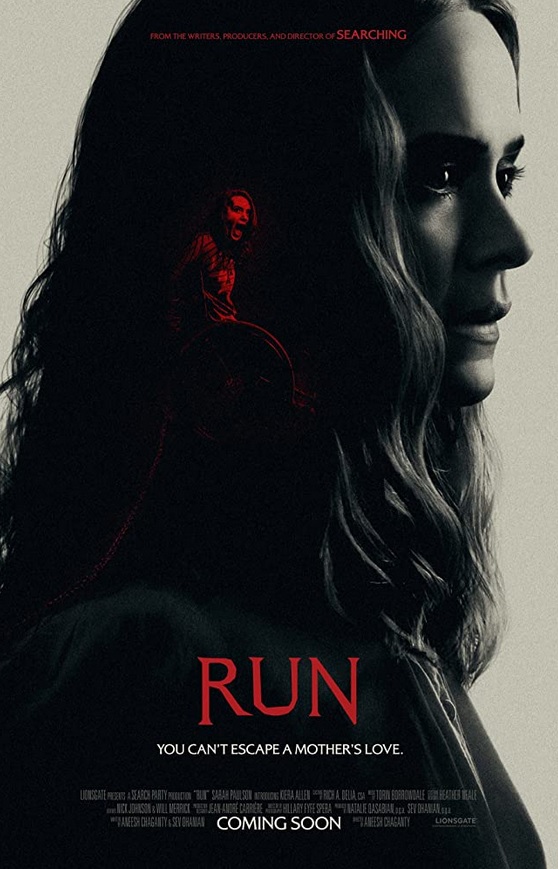
The original threatical one-sheet with a nice ’70s retro-Giallo vibe
Aneesh Chaganty has taken an already terrifying, destructive mental illness, one that also manifests itself as a multi-physical illness in another—Munchausen by Proxy—and turned the admittedly tired stalking genre (deluded by Lifetime’s endless stream of psycho-antagonists vs. damsel-in-distress flicks) upside down.
Diane (Sarah Paulson) is a mother whose love runs deep—deep enough that’s she put her daughter Chloe (Kiera Allen) into a wheelchair. And because of the bullying and discrimination that accompanies a handicap; Diane holds her daughter in a home school isolation that’s slowly built since Chloe’s birth. Diane’s method of control: she medicates her daughter into a mystery- debilitating illness that results in a perpetual round of surgeries and more medications. Now a teenager, Chloe beings to suspect her mother’s love isn’t one of compassion, and not one of a mental illness out of her mother’s control, but one of a sinister, ulterior motive that has nothing to do with love.
You can keep up to date on the release rollout of Run and the ever-expanding library on Hulu at their website or Twitter and Facebook pages. You can also get more info at Lionsgate.com.
UPDATE: Hulu set a premiere date for November 20, 2020.
Disclaimer: We weren’t provided with a screener nor received a review request from the film’s P.R firm. That has no bearing on our review.
About the Author: You can learn more about the writings of R.D Francis on Facebook. He also writes for B&S About Movies and publishes on Medium.
“Documentaries are boring. Who wants to watch a bunch of talking heads bragging about themselves?” —Eric, purveyor of film quality and all things Sein(feld)suck.
And to a degree, I agree with my running-bud Eric: unless you have an interest in the subject matter at hand. As someone who’s spent his life in radio broadcasting and enamored with the craft of filmmaking, I’ve watched more than my fair share documentaries on the subjects of broadcasting and radio personalities, and film with its related actors and directors. And, even in person, those creative individuals can push self-aggrandizing into the new limits of boredom.
Don’t believe me?
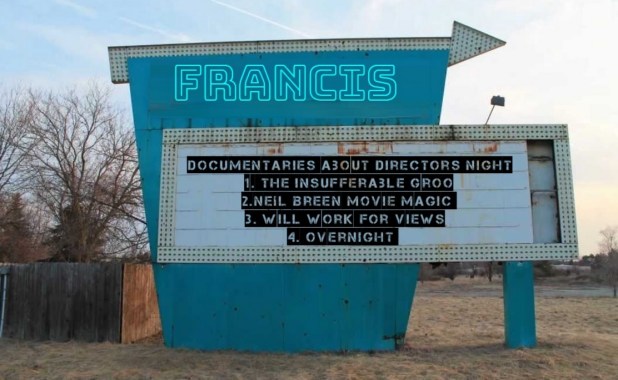
The Snack Bar is Open! Free Dove Bars if you buy a hotdog. Darn freezer’s broke again!
Go to a party or any social gathering. Find yourself an actor or director. And I am not talking about running into a well-rounded, educated fellow like Werner Herzog with whom you can have a meaningful conversation about anything from soup to nuts. I am talking about the (always) one-the-way-up-and-after-one-film-they-think-they’re-Elvis types. But since this is in reference to film: Steven Spielberg. And actors are worse than directors. Christian Bale and Klaus Kinski earned the right to set-rant. You, Mr. DeMille and Ms. Desmond, do not.
Don’t believe me?
Watch The Disaster Artist, the (excellent) dramedy about the making of Tommy Wiseau’s The Room. There’s a telling scene in the film where actor Greg Sestero confides his career frustrations to a fellow thespian—and all the other actor can do is drone on and on about how great his career is going. And as someone with lots of “under the tent” experience in holding areas, I’ve seen and heard it all, ad nauseam. Sestero tells it true.
And screenwriters? Well, I’ll spare you that paragraph, but here’s the equation: Director ego x Actor oneselfness = the greatest screenwriter in the world, aka “Listen to me, for I am the lord god of all scribes surveyed.”
And heaven forbid if you don’t like that up-and-coming Elvis-Spielberg’s latest entry to their no-one-has-ever-heard-of-or-seen oeuvre, aka a celluloid nobody and never will be: be prepared for the bowels of hell to rip open and for the lathes of heaven to crash into the fiery abyss and scorch to embers. Yeah, sometimes (almost always) the auteur is just another egomaniacal Billy Walsh (know your Entourage trivia) who blesses you with the distinct privilege of viewing their master(shite)piece—just because it received a set of “Official Selection” leaves from some obscure, off-the-circuit, emo-haughty film festival that won’t be in business next year and mainstream Hollywood doesn’t acknowledge because, well, Hollywood is already full up with more talented haughties than yourself. But thanks for asking! We’ll be looking for that star on the walk of fame, DeMille.
But even the established directors can be a handful, as evidenced in The Man You Love to Hate (1979), about the uncompromising director of silent films, Erich von Stroheim (acted inSunset Boulevard). There’s Luchino Visconti (1999), about the iconic neorealist behind (the incredible, must watches) The Leopard, Death in Venice and Ludwig. There’s Felini: I’m a Born Liar (2002), Carl Th. Dreyer: My Métier (1995), about the director behind the seminal vampire flick, 1932’s Vampyr, and Pier Paolo Pasolini: A Film Maker’s Life (1971). And you can go on and on . . . with docs about Robert Altman, a couple regarding Woody Allen and Roman Polanksi, along with Orson Wells, Howard Hawks, Bergman, Kurosawa, Kurbick, and even producer Robert Evans. The documentary Easy Riders, Raging Bulls examines the industry and careers of ‘60s “bulls” Martin Scorsese, Dennis Hopper, Peter Bogdanovich, and Sam Peckinpah. And, speaking of Werner Herzog: Burden of Dreams (1982) follows the German (deserving of the noun spoken in the same sentence as his name) auteur as he deals with difficult actors, bad weather and getting a boat over a mountain during Fitzcarraldo.
But this is B&S About Movies . . . and you know us crazy, frolicking lads in the wilds of Allegheny County. We’ve got to go just a little bit deeper into the films—the realm of documentaries about directors. You may not know them. You may know them and hate them. But you know what: they don’t care. They, with a Kurt Vonnegut tenacity, just keep on creating. And that’s cool with me.
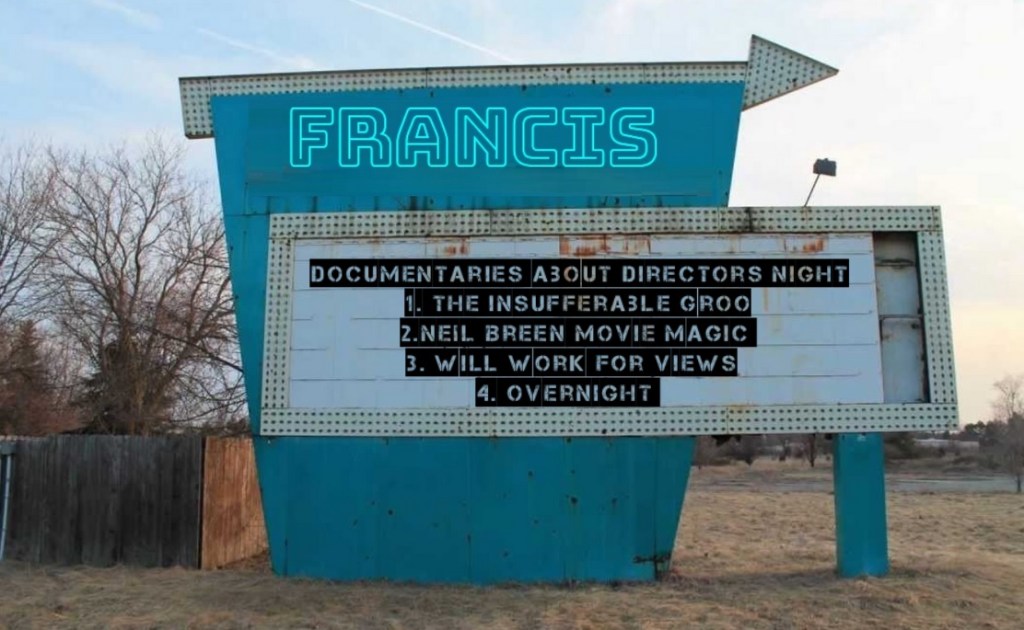
Image available across multiple sites; source unknown
Movie 1: The Insufferable Groo (2018)
At the time of the filming of this documentary by Scott Christopherson, Provo, Utah, resident Steven Groo’s resume encompassed 166 films—after its release, his resume grew to 200 films. A lesser documentarian would most likely—as so many internet warriors—slag Groo’s ultra-low-budget tales. Instead—what makes this film so lovely and tragic at the same time—is that Christopherson focuses on Groo’s determination to tell his stories. While Groo can be admittedly abrasive, his tenacity paid off with the patronages of actor Jack Black and director Jared Hess of Napoleon Dynamite and Nacho Libre fame. And Jack Black starred in Goo’s Unexpected Race (2018). In the end, you root for Groo.
You can watch The Insufferable Groo as a free-with-ads stream on TubiTv. You can also watch Unexpected Race on the platform, as well. Since Groo participated in its making and approves of the film, you can still find this document out in the Internet ethers. The same can’t be said for our next feature. . . .
Movie 2: Neil Breen Movie Magic (2020)
When Tommy Wiseau’s name drops, the name of ultra-independent filmmaker Neil Breen follows. And if you’re a hardcore fan of ultra-low budget films, Cybela Clare—with her equally incompetent-to-obsessive films about humanity, animals, and aliens rife with awful CGI set design—name drops after Breen’s. To say Breen is a film cult icon is an understatement. Plug Breen’s name into You Tube or Google and you’ll discover the rabid fandom of his works. His films couldn’t be more polarizing: they’re either IMDb-rated as 1-star or 10-star . . . although it’s obvious the 10-starrers are pure parody-sarcasm, at best.
Anyways . . . a licensed architect by trade who made his money in real estate, Breen self-financed/produced, directed and starred in his debut feature, Double Down (2005). As of 2018, he completed five films and has since launched pre-production on his sixth film: Cade: The Tortured Crossing (2023).
You may love ‘em. You may hate ‘em. You may say they suck—and they ultimately do—but courtesy of an underground fan base cultivated via social media, Breen’s films—in a Wiseauian twist—have been picked up by arthouse theatres and film festivals around the world.
Sadly, you can no longer watch Neil Breen Movie Magic on You Tube. Yeah, it seems ol’ Neil can’t take criticism: the film wasn’t favorable to his works, so he’s since had the film pulled; however, to Neil’s credit: it did use his intellectual property without his approval.
So, as any narcissist would: Breen released his own documentary in response: Neil Breen’s 5 Film Retrospective, in May 2020. As with Neil Breen’s Movie Magic: it is another must-watch for Breen fans. You can watch Breen’s insights on himself on You Tube.
Needless to say: The trailers for Neil’s movies are as bloated as his films . . . so strap in for a 9-minute trailer to Neil’s self aggrandizing documentary. A nine-minute trailer? I guess it’s justified, considering the movie itself is five-hours long. For reals.
Don’t worry. Neil’s not offended. He’s gone on record to say he doesn’t read his reviews (but had Movie Magic pulled, so . . . okay) a few which this Las Vegas Weekly article features.
Intermission!
Back to the show!
Movie 3: Will Work for Views: The Lo-Fi Life of Weird Paul (2019)
Say what you will about Pittsburgh You Tube star Weird Paul—but the dude has 34,000-plus subscribers. People love him. You can’t help but dig him and his unique brand of retro-‘80s video productions, which he’s been posting since signing onto You Tube on Feb 4, 2007. I’ve been a fan of Paul’s ever since. And so should you. He’d make Kurt Vonnegut proud.
You can watch Will Work for Views as a free-with-ads stream on TubiTV.
Movie 4: Overnight (2003)
It amazes me that for as many people that have watched Boondock Saints—and quote the film, wear the t-shirts, and even have Boondock Saints “double gun” lamps on their end tables in their media room—have no knowledge of this documentary shot by writer-director Troy Duffy’s former friends.
You may have heard the stories about Duffy’s meteoric rise and even quicker fall, but here’s your chance to see it all up close and personal. Even if you aren’t a fan of documentaries or have not the need-to-know about what goes on behind a camera, you’ll be fascinated by this document that tells us the story of a (film and music) career that might have been. For bless the “Holy Fool.”
You can watch Overnight as a free with-ads-stream on TubiTv. Unlike Breen: Since Duffy authorized the cameras filming his every move during the making of his film, he couldn’t stop this film from being seen.
“Documentaries suck and are made by people who can’t make a real movie. I’d rather sit through a TBS Seinsuck marathon.” —Eric
Indeed, Eric. Indeed.
Like I always say: Friends and film, huh? But chicks and film is (always) worse. (A woman who digs Klaus Kinski and knows Paul Naschy’s works is out there, somewhere! I can hope.)
Again, in the eyes of the many: documentaries just aren’t their canister of celluloid. Yes, documentaries—if you’re not into the subject at hand—can be as pedestrian as a CBS-TV 48 Hours segment or as bone-dust dry as a PBS-TV chronicle. But that’s not the case with these four heartfelt, well-made documents of their equally talented, intriguing subjects—each who make Vonnegut proud.
Hey, Eric, be sure to check out all of the films reviewed during our “Documentary Week” feature.
“Fuck off, R.D!” —Eric
About the Author: You can learn more about the writings of R.D Francis on Facebook.He also writes for B&S About Movies.
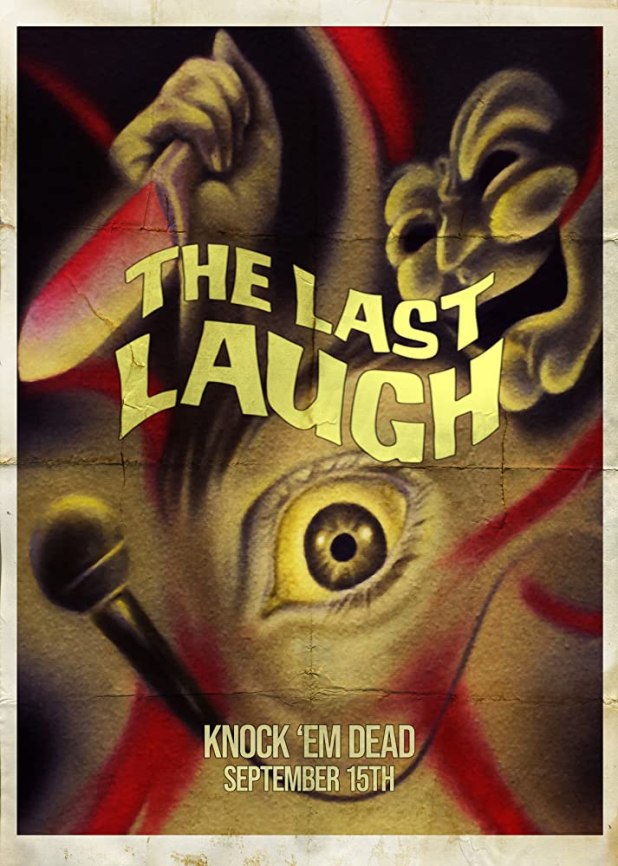
Originally known as Killing Joke, this is the story of Myles, a comedian who has never properly dealt with the loss of his wife. Yet his manager believes in him enough to get him booked for one last shot at the big time. The show will take place in a gorgeous theater instead of a seedy comedy club and booking agents will be on their way. The staff is helpful, too. Everything seems to be going Myles’ way until the blood starts dripping down the walls.
You may think that Myles has lost his mind, but there’s also a slasher killer murdering everyone in the venue, turning this into the stand-up version of Soavi’s Stage Fright. I say that as they’re both set in a small theater that has a killer on the loose and not because this movie has the visual flair of that 1987 slasher. Don’t take that as an insult — it’s one of my favorite films and a hard bar to leap over.
Writer/director Jeremy Berg does a fine job here of keeping things tense and moving at the same time, which is quite a feat. He has a good lead in Steve Vanderzee, who lends Myles the right mix of humor, pathos and outright terror in the face of the realitization that his comeback may be his last night ever.
You can get this movie on demand from High Octane Pictures. We were sent a review copy by the film’s PR company, but that has no bearing on our review.
“You’ve got to get out of here by morning.” — says the ski-masked clad man with a shotgun pointed at you
Nine years ago, actor, writer, and director Chris Levine wasn’t an actor, writer, or director. He was a marketing director for an online company, living large on the beach in Boca Raton, Florida — and one day, woke up unhappy. A set of headshots and a few film school shorts and indie shorts six months later, his wanderlust-infection was complete. Hollywood was calling. (And he didn’t need a ski-masked clad man with a shotgun pointed at him to tell him to get out by morning.) So Levine did the most sensible thing a person could do: move to the town that chews up and squeezes out the tinsel-tainted dreamers on the Hollywood Walk of Fame in steaming piles at two and three at a squeeze.
Only the monster of Hollyweird didn’t count on Chris Levine blowing into town. Look out, Oscarzilla. Monstervine is here to kick your arse.
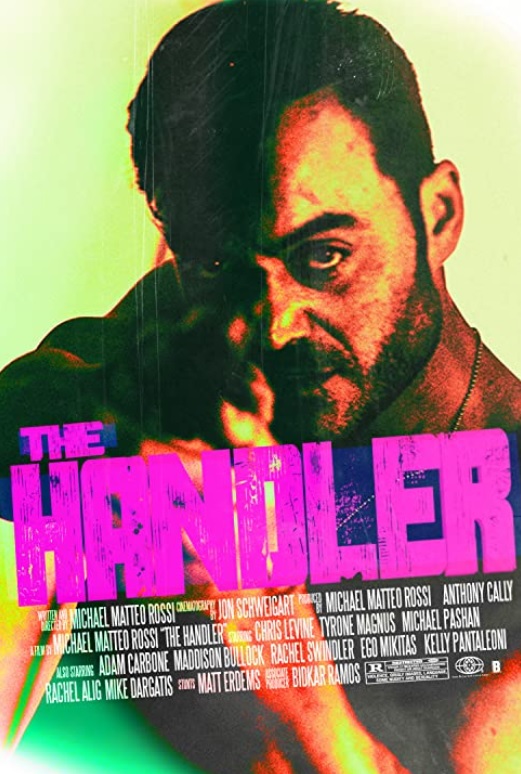
Teaming with experienced film editor and visual effects artist Landon Williams (in the producer’s and director’s chairs), Levine wrote, produced, and starred in the obsessive tale about a young man’s quest for the perfect body in Anabolic Life (2017), which starred the familiar Daniel Baldwin (TV’s Cold Case Files and Hawaii Five-O) and Sharon Lawrence (Showtime’s Shameless, TNT’s Rizzoli & Isles). The film received five nominations at the 2017 Orlando Film Festival, with Levine walking away with a “Best Actor Award.” (He’s also worked on the award-winning short film, concerned with a traffic stop gone bad, The Ice Cream Stop and is currently starring on the currently-in-production indie-actioner, The Handler.)
Encouraged by the film’s reception, the duo created the Van Nuys-based London Levine Pictures as Chris Levine set out to write and produce his next feature film, the horror-thriller No Way Out (formerly known as Cryptid), which shot in the wilds of Alaska.
Trying to salvage their romantic-personal relationships, two couples go on a weekend camping trip in the Alaska wilds — only to discover that they aren’t alone in the woods they’ve found themselves lost in. And the others don’t know the cabin they’ve squatted sits on land that once belonged to Blake’s (Chris Levine) family. And these woods are the source of his childhood trauma-hang ups about “the woods,” which triggers nightmares in quick succession. Of course, when spoiled city kids vacation in the woods (instead of Hawaii, as one character laments) and squat cabins and a hunter’s unattended campfire, Chris’s tweaks are the least of their worries: they’re just asking for the ol’ Happy Valentine’s Day-chop n’ stab from a masked deep-breather.
No Way Out has a sharp opening credit sequence on par with any A-List film in the horror oeuvres and the soundtrack is effectively creepy when it needs to be, and fairy tale-like when the mood calls. The same holds true for the cinematography (the prologue before-the-credits introduction of our gas-masked friend encourages viewing) that’s crisp and moody. And there’s a welcomed restraint in the editing suite. Oh, the B&S crew can’t tell you how many indies we’ve watch (we’re nice about it) meandering towards a patience-trying two-hour mark (my pet peeve) or lacking in narrative structure and woefully short, with extensive end credits to pad the short running time to a distribution-acceptable 80-minutes (Sam’s pet peeve). Team Levine-Hamilton know that they’re not a proven commodity and that they’re asking a lot for us to purchase a stream — so they keep the narrative down to a tight 78 minutes. Perfect. So kudos to production designer Joe Hamilton, in his directing-producing debut, for giving us a product that’s above the horror-streaming norms.
However, when the Blair Witch POVs started as we first meet the sides of our romantic rectangle, there was a fear that we were venturing into the twisted Myrick-Sánchez-Raimi wood with another found-footage after-the-fact cabin slaughter narrative. (Or a Bigfoot would show up, ugh. More Bigfoot analogies, later). But that’s not a deal breaker, as we enjoyed the not-a-trope POV handheld rollout with the intelligent alien-horror romp Case 347 by Chris Wax and Fabien Delage’s somewhat No Way Out-similar, quality wooden-romp, Cold Ground.
What’s appreciated is that Blake’s (non-found footage) madness-descent isn’t driven by drug abuse or demons or detox-intervention — but by his psychology. And the possibility that his “weird family” is still out there. And that Blake may have serious Sybil-issues compounded by a gas mask fetish. And that there’s really no one out there: only him.
The romantic (Devil’s) rectangle: Johanna Rae, Jennifer Karraz, Christopher McGahan, and Chris Levine
Now, you might yawn and say “we’ve seen this all before,” but you have to cut respectful slack with indie films. Unknown actors trying to develop resumes, frustrated at their lack of castings, need to take matters into their own hands (which we discussed extensively in our review of the radio-dramedy Loqueesha). So, to that end, you can’t go into No Way Out (or any horror streamer) expecting an A24 or Blumhouse shock-scares romp with Tobin Bell or Tony Todd or Lin Shayne buoying the show. Off-the-radar actors, as well as directors, want to create and want to share their skill sets with the world. And you have to shoot ’em cheap. And the woods are a great, non-permit method of storytelling. The Halloween-cum-Friday the 13th slasher ’80s thrived on it. But while No Way Out has an ’80s slasher vibe, it’s shot better and scripted smarter than an ’80s slasher flick. (Case in point: Go back and watch the ’80s Halloween rips Slaughter High and Don’t Go Into the Woods, spotlighted during a recent Drive-In Asylum Saturday Night Double Feature Online Watch Party for evidence of that fact. BTW: Saturday’s at 8 PM on Groovy Doom — shameful plug.)
From the watch parties, and Bigfoots, and shameful plugsdepartments: During the course of preparing this review for No Way Out, Bill Van Ryn of Groovy Doom and Sam Panico of B&S About Movies hosted another Drive-In Asylum Saturday Night Double Feature Online Watch Party (Sorry, Chris!) and screened Shriek of the Mutilated, Michael and Roberta Findlay’s 1974 shaggy-dog bigfoot version of Agatha Christie’s Ten Little Indians (aka 1939’s And Then There Were None). And (probably to Chris Levine’s chagrin) my analog memory cores critically connected the two.
Does that mean Chris Levine saw Shriek of the Mutilated? No. Personally, I never saw that semi-inept drive-in ditty until the Van Ryn-Panico Borg assimilated me into the Groovy Doom collective. (And I’ve watched an insane amount of movies across the UHF and VHS spectrums. See? You can’t see ‘em all.) So while I’ve critically scribbled a Findlay-Levine throughline in my review notes, there’s no mistaking No Way Out is the winner in the wooded-betrayal sweepstakes.
Sure, Shriek is an over-the-top, emulsion-scratched ‘70s oddity that offers us good ol’ cheesy fun. But No Way Out offers us a digital clarity of intelligence and craft that informs you — and Hollywood — that LevineFoot has arrived. And he’s not a goofy shaggy-dog Bigfoot. Chris Levine is a skilled actor and filmmaker on the way to a sidewalk star in the city of dreams: a dream that will become reality.
The bottom line is that Chris Levine and Joe Hamilton have the skills. And we look forward to their next films. And they’ll be reviewed here, first. And we won’t need a ski-masked clad man with a shotgun to encourage us.
Currently rolling out on the film festival circuit and film markets, you’ll be able to stream No Way Out in the coming months. You can currently stream Anabolic Life via Gravitas Ventures on Amazon Prime, iTunes, Vudu, and You Tube Movies. So look for No Way Out on those platforms as well.
Update: You can now enjoy No Way Out on Amazon Prime through Gravitas Ventures.
You can learn more about Chris Levine’s acting and filmmaking endeavors on Facebook and London Levine Pictures and watch the company’s short film projects on You Tube. And our thanks to Voyage LA for their assistance by introducing us to Chris Levine in the preparation of this review.
Chris Levine’s new feature, the action-packed The Handler, coming December 14, 2021, from Uncork’d Entertainment on Amazon.
Disclaimer: We were provided a screener for the film. That has no bearing on our review.
About the Author: You can learn more about the writings of R.D Francis on Facebook. He also writes for B&S About Movies and publishes on Medium.
Editor’s Note: We first reviewed this indie horror-comedy during its run as a festival entry. We’re pleased to announce Allen C. Gardner has finalized a worldwide streaming distribution deal with Indie Rights Movies. You can visit their platform on Facebook.You can start streaming Cold Feet as a PPV on September 26, 2021, via IRM’s Amazon Prime page, along with a later, free-with-ads stream to come on IRM’s You Tube portal.
As of 2022, Cold Feet is now appearing on various Smart TV digital platforms — with limited commercials; as of January, The Roku Channel users can watch the film.
You can watch several of Allen’s earlier efforts with easy via in his LinkTree that will direct you the Amazon, Tubi, Vudu, and You Tubestreaming platforms.
At a Memphis, Tennessee, rented house (where the film was shot), Eddie (writer, director, actor, producer, editor Allen C. Gardner), a sensible high school English teacher, is having that ubiquitous attack of the ol’ “cold feet” with his impending marriage to Jenny. And you know what that means: first comes love, then comes marriage . . . then mortgages, kids, and, most likely divorce. So it’s time for one last blow out with the guys before Eddie becomes a soccer dad and mini-van pilot, and overall pompatus-prisoner of love. And, with that, his motley crew of best friends rent a home from an affable gent named Oscar (the familiar and welcomed John Speredakos, who got his start with Kevin Smith in Jersey Girl and multiple appearances in the Law & Order franchise; you know me and my L & O fetish!).
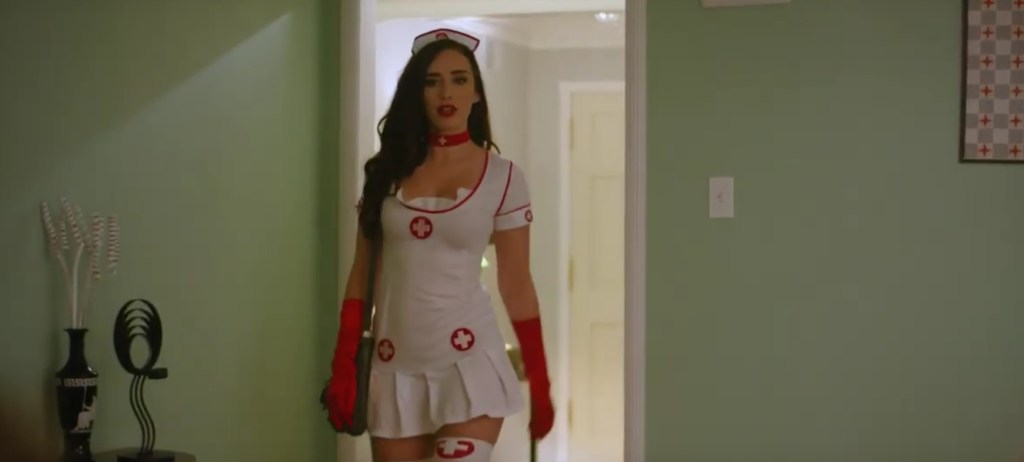
Now, Eddie’s a good boy. He loves his to-be wife (well . . .). And that means, to the chagrin of his buddies: no strippers. But a slutty nurse-uniformed Courtney shows up — that none of Eddie’s buddies invited. And guess who’s hooking up (emotionally, natch) with the stripper: Eddie. And Eddie confides to Courtney that, while he loves Jenny, he’s hot for his friend Kim, a fellow teacher.
Uh, Eddie, a piece of advice: never confide in hookers. This isn’t Milk Money or Pretty Woman. You’re a character in Cold Feet, bro. Didn’t you read the screenplay you’re in? There’s no kind-hearted hookers here. . . .
Yep! The mystery-hired Courtney the Nurse texts Kim, steals all of the smart devices and laptops in the house — and stabs herself in the heart. (Da-frack? Okay, Oscar, what’s your game?) And Eddie and the guys can’t call the cops. And when they try to leave the house to go to the police — a sniper fires a warning shot. Then, when they hunker down in the house to avoid the sniper, a pissed off ghost shows up. (Oops, sorry Oscar . . . well, maybe not.)
Yeah, there’s nothing quite like a dead hooker, a sniper, and a ghost to chill one’s debauched heels and test those delusional, “tight” bounds of friendship. For when that ship starts to sink, be prepared to be the only rodent (Or is that red herring?) left on deck.
Oh, yeah. This night is going to work out just fine. . . .
Cold Feet ended up being a well-written not-sure-where-this-is-going surprise. If Judd Apatow and Sam Raimi got into a room and clashed their propensities for raunch and cabins — and peeled the fishy-oily newspapers off a few of Dario Argento’s red herrings — you’d be inside the cabin environs of this, the seventh writing-directing effort of Allan C. Gardner. (Gardner co-directed with his friend Brad Ellis; their mutual friend Laura Jean Hocking served as editor.) Only not as tasteless-funny as an Apatow flick. And not as bloody-campy as a Raimi flick. We’ve been there and are not “noseblind” to those frames of sun-rotting, scaly aquatic celluloid.
Now, that’s a good thing, because that’s what you expect to happen in Cold Feet, but Gardner’s adept at the Final Draft change-up to give us the unexpected. And in the competitive, stream-clogged world of the VOD environs in the digital ethers, we need the unexpected to assure us those credit card charges for our VOD movie fixes isn’t money flushed down the digital drain. Gardner may or may not have used Apatow, Raimi, and Argento (just my smarmy, critical cortex a-sparkin’) as a jump-off point, but he checked the expiration dates on his influences to give us a Febreze-fresh flick.
Cold Feet was recently nominated for “Best Feature Film” and “Best Writing for a Feature Film” at the 2019 NOLA Horror Film Fest — so if that doesn’t tell you this is a quality film, then nothing will. Old School Pictures and Open Dialogue Productions is currently in the film markets seeking distribution and you can stay abreast of when it will debut on various PPV and VOD platforms via the Cold Feet Facebook page. Until then, you can watch Allen C. Gardner’s other films over on Amazon Prime.
And Allen isn’t a guy who sits around and lets his heels cool. He’s currently in post-production on the comedy/drama Baby, Come Home, and in the pre-production stages on the country music-fueled drama Breaker Breaker (no, there’s no Chuck Norris arse-kicking . . . at least we don’t think there is!), the serial killer thriller (say that three-times fast) Burn It Down, the horror-thriller Sold (vacation-white slavery or a haunted trinket/home?), and the dating app-themed dramedy Data Date Soul Mate. Of course, when those films are completed, you’ll read those reviews first, right here on B&S About Movies, where we not only coddle the obscure and the forgotten films of the VHS, UHF, and Drive-In yesteryears, but we dole out the emoji hugs for unsung, indie films, as well.
And we emoji-love Cold Feet. But not like Quentin Tarantino. That would be, like weird.
Again, as of September 26, 2021, you can stream Cold Feet on Amazon Prime via Indie Rights Movies’ Amazon portal.
Disclaimer: We were provided a screener for the film by October Coast, the film’s P.R firm. That has no bearing on our review.
About the Author: You can learn more about the writings of R.D Francis on Facebook.He also writes for B&S About Moviesand publishes on Medium.
The inspirational goddesses of literature, science, and the arts, a Muse, a female deity who infuses man with the gift of poetry and song, began as a source of myth and legend in Greek culture, then spread to Roman culture. That Greco-Roman concept of supernatural inspiration inspired Irish poet W.B Yeats to expose the modern world to the leannán sídhe, aka “Fairy-Love,” a beautiful, vampiric female who seeks out creative souls, i.e., painters or poets, musicians or writers, to be her lover; in exchange for the artist’s devotion, the muse will bless them with artistic inspiration — as the artist spirals into a love of madness and, eventually, death.
Thrust into this supernatural vortex is the socially-awkward Adam (which returns us to the biblical story of Eve, The Garden, Adam’s first wife, and the first “muse,” if you will: Lilith), an artist with technical talents to spare, but he lacks the heart to transform into an artist of distinction. Desperate for cash (another rent increase on his cavernous studio hovel), he drives his seedy neighbor into the woods to do a drug deal (and scores $300 bucks). It’s there he hears the whispers of and meets an entrancing, silent blonde muse — who’s already killed two men fixing a flat tire near her wooded domain. And now that Adam’s laid his eyes on her, she’s latched onto his soul.
Back at the studio, where the muse now lives, Adam begins to feverishly sketch and paint images of her; his drug-dealing neighbor sees her as a “loose end.” She quickly begins dispatching those who threaten her and come between her and Adam. Even when she’s caked in blood, Adam embraces her — and cleans up after the mayhem. And he soon begins to ensnare others to “feed” her.
In the world of indie film, horror is the most popular of genres among aspiring filmmakers, since the format lends itself to be shot cost-effectively without splashy practical effects (e.g., the works of Eli Roth, such as Hostel), instead relying on light and shadows, and a slow burn of darkness and suspense. Such is this ninth film and second feature film overall (the first was 1999’s The Beast; Legends of the Muse is the first to receive widespread distribution) by director John Burr.
The level of quality of this psychological, atmospheric tale — pushed beyond the limits of beauty by cinematographer Damian Horan — mesmerizes in the same way that Nicolas Roeg brought a level of class and style to the Italian Giallo genre with his 1973 masterpiece, Don’t Look Now. (If you’re familiar with Roeg’s classic editing style employed in that that film during its “sexually graphic” love-making scene between Julie Christie and Donald Sutherland, you’ll understand my comparison of this film to Roeg’s work.)
And it’s not just Burr’s eye and Horan’s lens: all of the film disciplines are at their finest the in frames of Legends of the Muse — but we must single out the performance of Elle Evans (the wife of Matthew Bellamy of, ironically, the band Muse; you may have previously seen her in Scouts Guide to the Zombie Apocalypse). A true standout in the acting department as The Muse, she captivates without a syllable of dialog, employing only facial expressions and body language.
This is a beautiful film and certainly not the last we’ll hear from writer and director John Burr.
Legend of the Muse is currently streaming on Amazon Prime — with other platforms to follow — courtesy of TriCoast Pictures/Rock Salt Releasing. The joint-studios also recently brought us the equally engaging horrors of The Soul Collector and Case 347, along with the Michael Polish-directed drama Nona, the Eric Roberts-starring political potboiler Lone Star Deception, and the return of Alex Cox to U.S. cinemas with Tombstone Rashomon.
Update2022: In addition to making its debut as a free-with-ads stream on Tubi, you can watch Legend of the Muse on several Smart TV On Demand streaming-with-ads platforms.










 B&S About Movies

You must be logged in to post a comment.